AUDIOLINGUAL METHOD
BY :
OSCAR YUSTINO CARASCALAO
INTRODUCTION
• Like the Direct Method, it is also an oral-based approach. The
Audio-Lingual Method drills students in the use of grammatical
sentence patterns.
• Unlike the Direct Method, it has a strong theoretical base in
linguistics and psychology.
• Charles Fries (1945) of the University of Michigan led the way in
applying principles from structural linguistics in developing the
method, and for this reason, it has sometimes been referred to
as the ‘Michigan Method
• It was thought that the way to acquire the sentence patterns of
the target language was through conditioning –helping learners
to respond correctly to stimuli through shaping and
reinforcement. Learners could overcome the habits of their
native language and form the new habits required to be target
language speakers
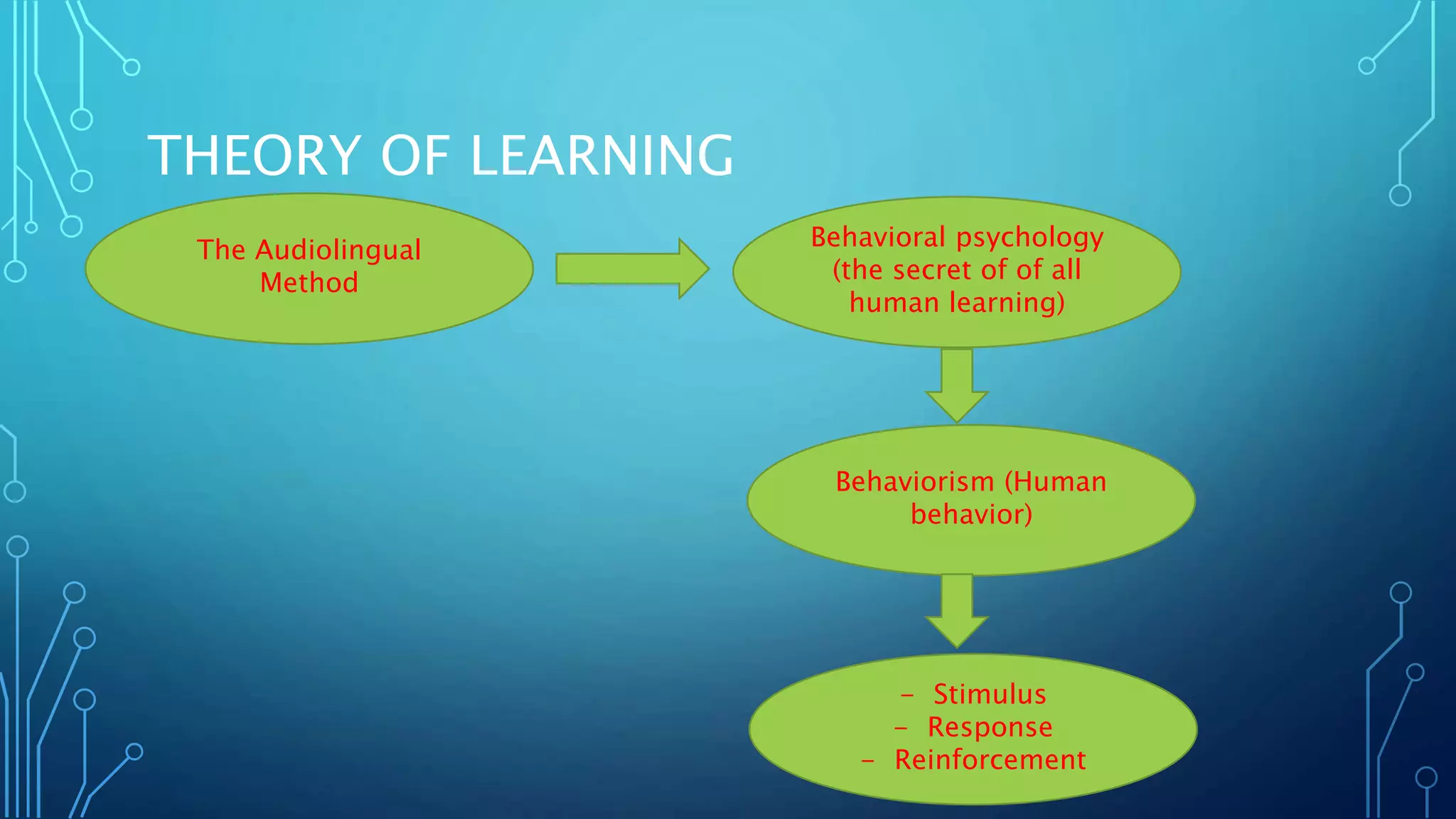
THEORY OF LEARNING
•
The Audiolingual
Method
Behaviorism (Human
behavior)
Behavioral psychology
(the secret of of all
human learning)
- Stimulus
- Response
- Reinforcement
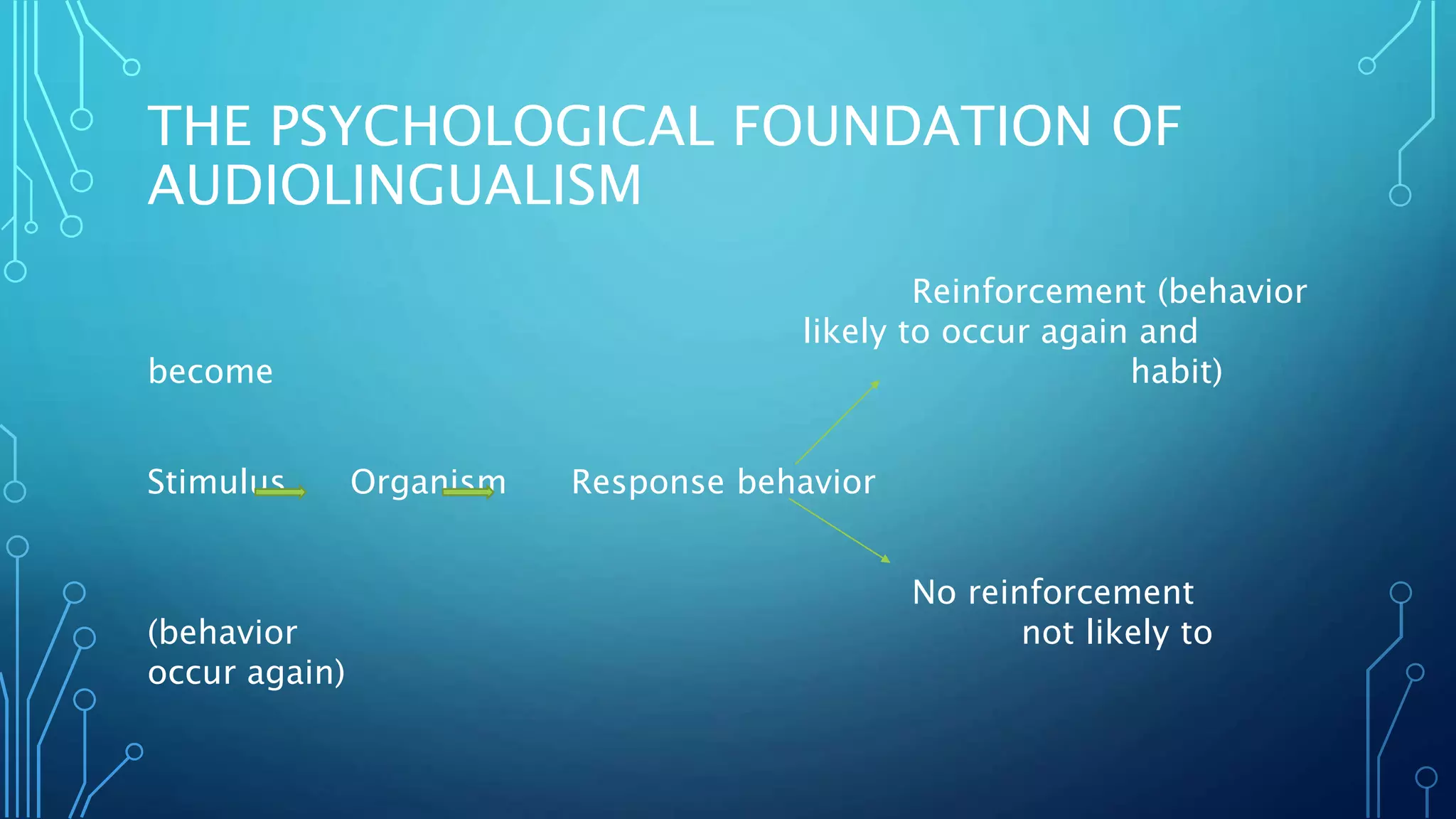
THE PSYCHOLOGICAL FOUNDATION OF
AUDIOLINGUALISM
Reinforcement (behavior
likely to occur again and
become habit)
Stimulus Organism Response behavior
No reinforcement
(behavior not likely to
occur again)
OBJECTIVES
Brooks defined that there are two objectives of Audiolingual
method as follows:
1. Short-range objectives
2. Long-range objectives
1. WHAT ARE THE GOALS OF TEACHERS WHO USE
THE AUDIO-LINGUAL METHOD?
• Teachers Want their students to be able to use the target
language communicatively. Their students achieve this by
forming new habits in the target language and overcoming the
old habits of their native language.
2. WHAT ARE SOME CHARACTERISTICS OF THE
TEACHING/LEARNING PROCESS?
• New vocabulary and structural patterns are presented through dialogues.
• The dialogs are learned through imitation and repetition.
• Drills are conducted based upon the patterns present in the dialog.
• Students' successful responses are positively reinforced.
• Grammar is induced from the examples given; explicit grammar rules are
not provided.
• Cultural information is contextualized in the dialogs or presented by the
teacher.
• Students’ reading and written work is based upon the oral work they did
earlier.
3. WHAT IS THE NATURE OF STUDENT-TEACHER
INTERACTION?
• There is student-to-student interaction in chain drills or when
students take different roles in dialogs, but this interaction is
teacher-directed. Most of the interaction is between teacher
and students and is initiated by the teacher
4. HOW IS THE LANGUAGE VIEWED? HOW IS THE
CULTURE VIEWED?
• Every language is seen as having its own unique system. The
system is comprised of several different levels: phonological,
morphological, and syntactic. Each level has its own distinctive
patterns.
• Everyday speech is emphasized in the Audio-Lingual Method.
Culture consists of the everyday behavior and lifestyle of the
target language speakers.
5. WHAT AREAS OF LANGUAGE ARE EMPHASIZED?
WHAT LANGUAGE SKILLS ARE EMPHASIZED?
• Vocabulary is kept to a minimum while the students are
mastering the sound system and grammatical patters.
• The natural order of skills presentation is adhered to: listening,
speaking, reading, and writing. The oral/aural skills receive
most of the attention. Pronunciation is taught from the
beginning, often by students working in language laboratories
on discriminating between members of minimal pairs.
6.WHAT IS THE ROLE OF THE STUDENTS’NATIVE
LANGUAGE?
• The habits of the students’ native language are thought to
interfere with the students’ attempts to master the target
language.
7. HOW DOES THE TEACHER RESPOND TO
STUDENT ERRORS?
• Student errors are to be avoided if at all possible through the
teacher’s awareness of where the students will have difficulty
restriction of what they are taught to say.
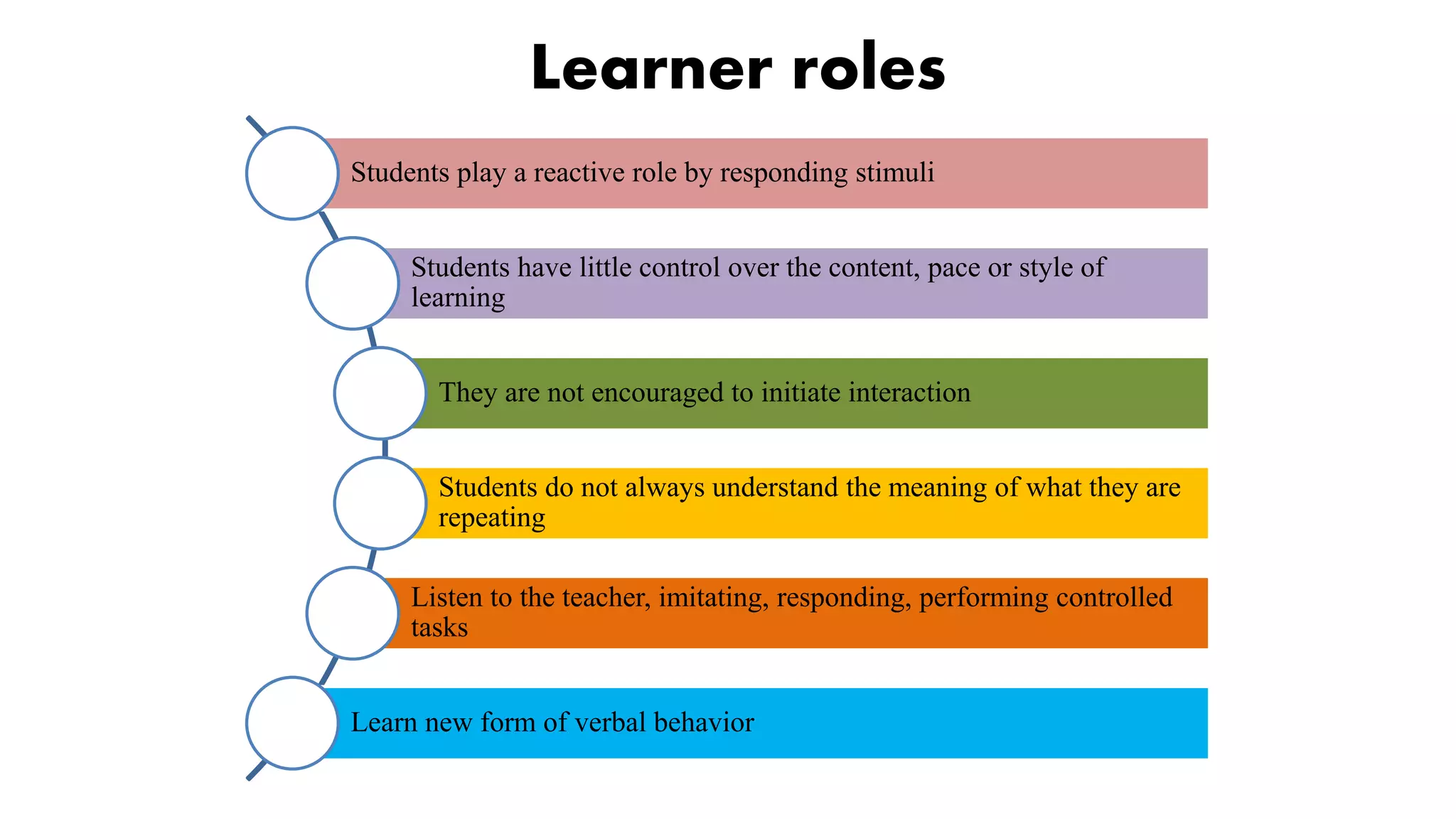
Learner roles
Students play a reactive role by responding stimuli
Students have little control over the content, pace or style of
learning
They are not encouraged to initiate interaction
Students do not always understand the meaning of what they are
repeating
Listen to the teacher, imitating, responding, performing controlled
tasks
Learn new form of verbal behavior
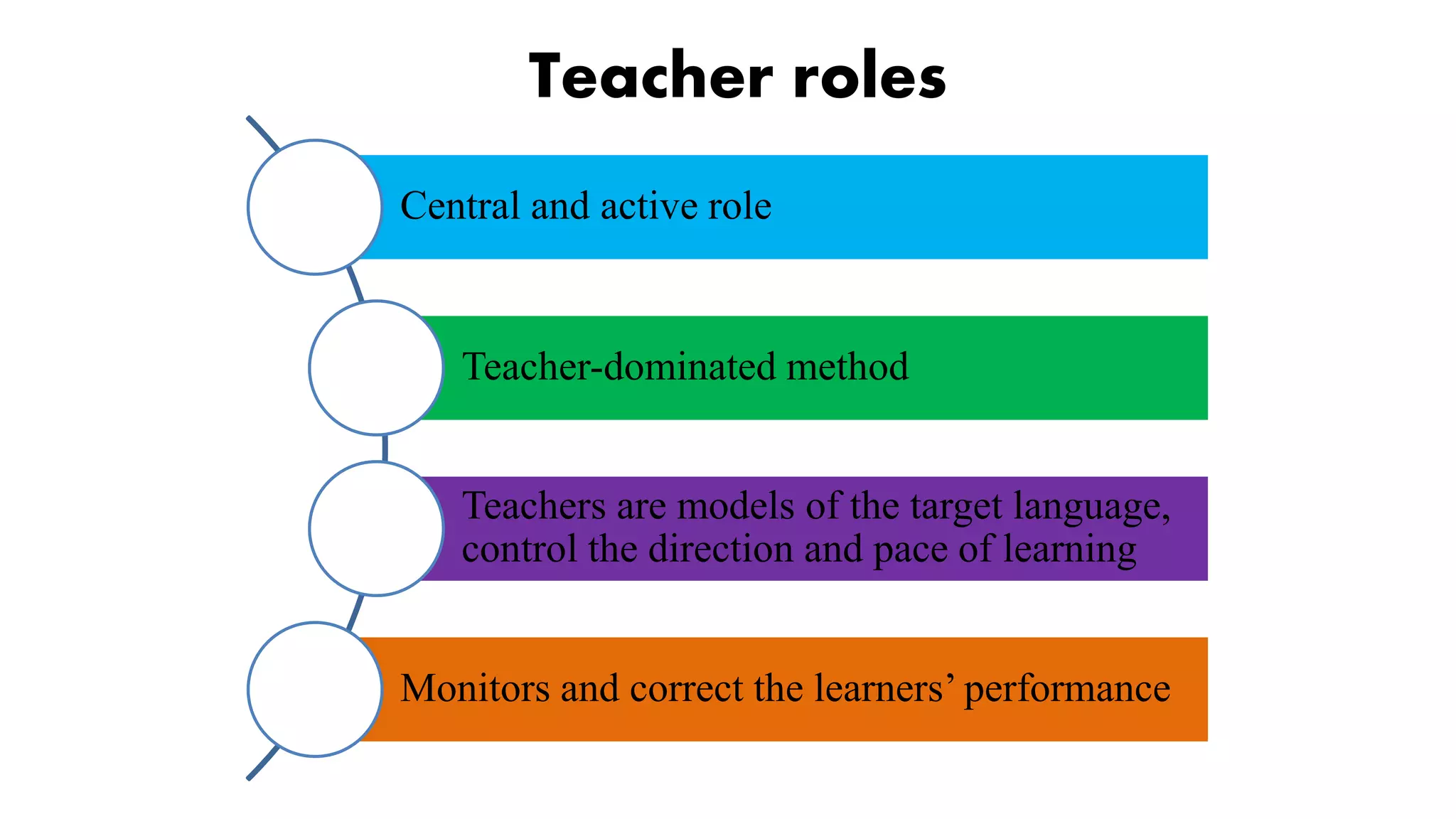
Teacher roles
Central and active role
Teacher-dominated method
Teachers are models of the target language,
control the direction and pace of learning
Monitors and correct the learners’ performance
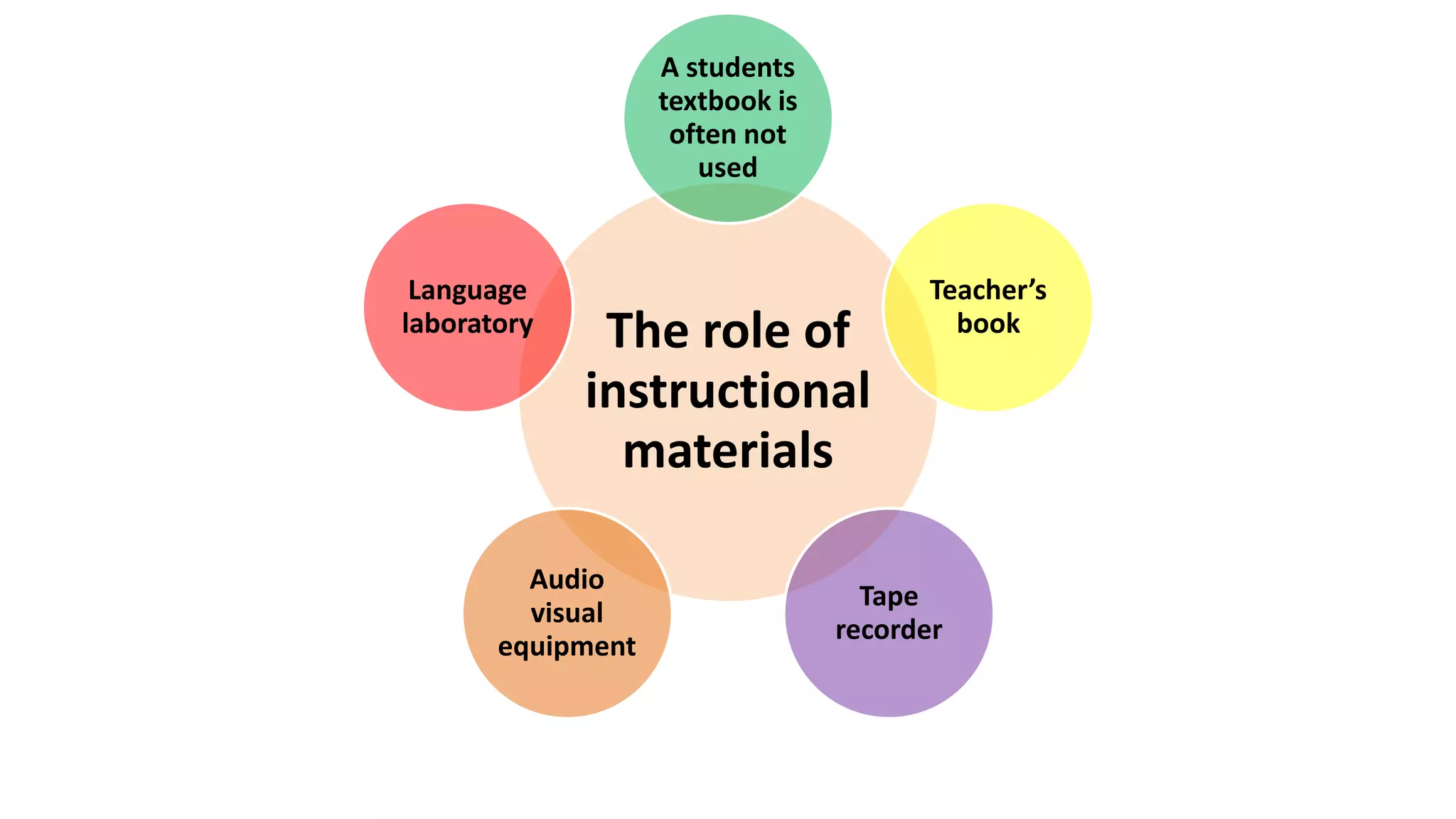
The role of
instructional
materials
A students
textbook is
often not
used
Teacher’s
book
Tape
recorder
Audio
visual
equipment
Language
laboratory
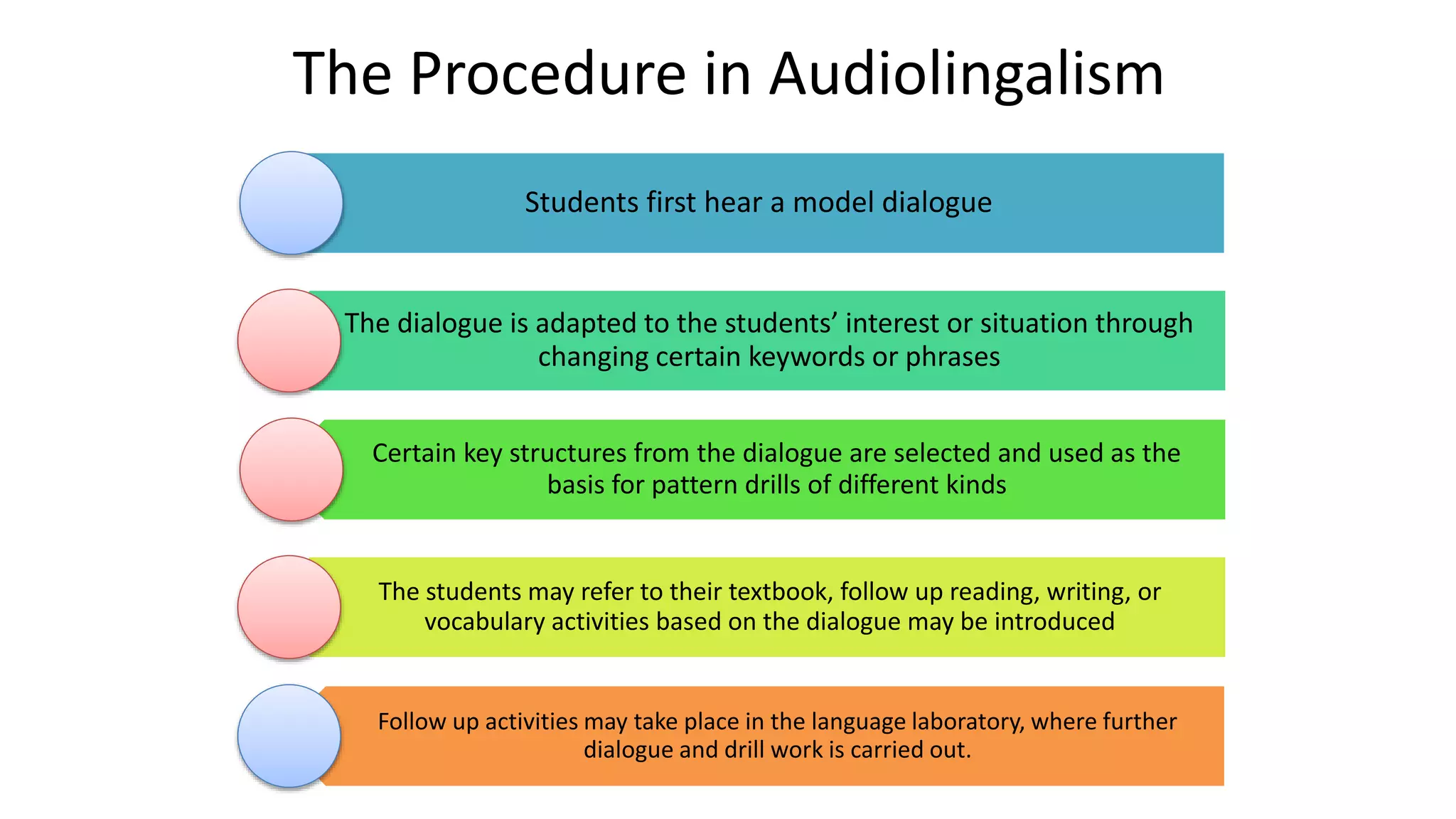
The Procedure in Audiolingalism
Students first hear a model dialogue
The dialogue is adapted to the students’ interest or situation through
changing certain keywords or phrases
Certain key structures from the dialogue are selected and used as the
basis for pattern drills of different kinds
The students may refer to their textbook, follow up reading, writing, or
vocabulary activities based on the dialogue may be introduced
Follow up activities may take place in the language laboratory, where further
dialogue and drill work is carried out.
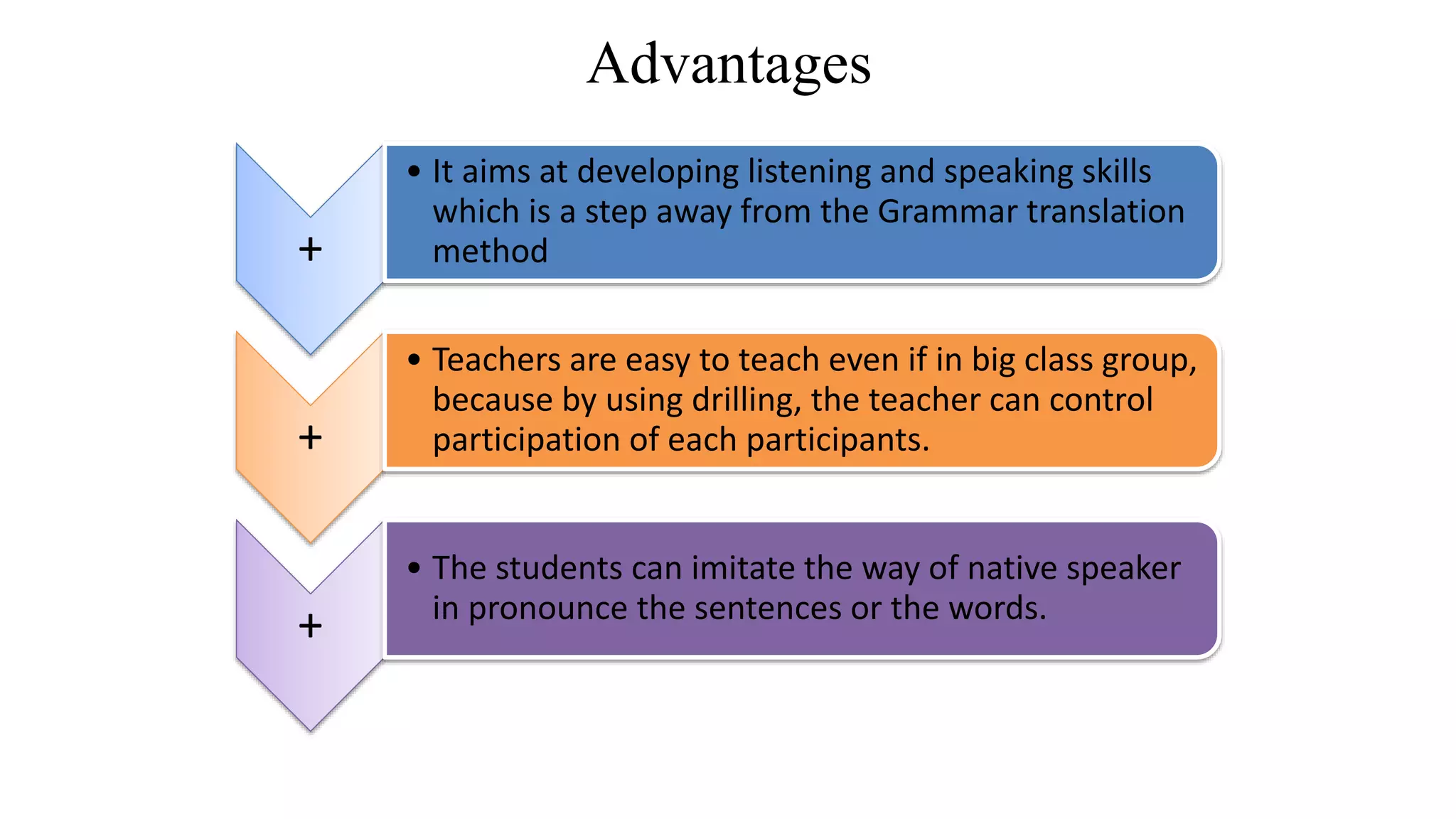
Advantages
+
• It aims at developing listening and speaking skills
which is a step away from the Grammar translation
method
+
• Teachers are easy to teach even if in big class group,
because by using drilling, the teacher can control
participation of each participants.
+
• The students can imitate the way of native speaker
in pronounce the sentences or the words.
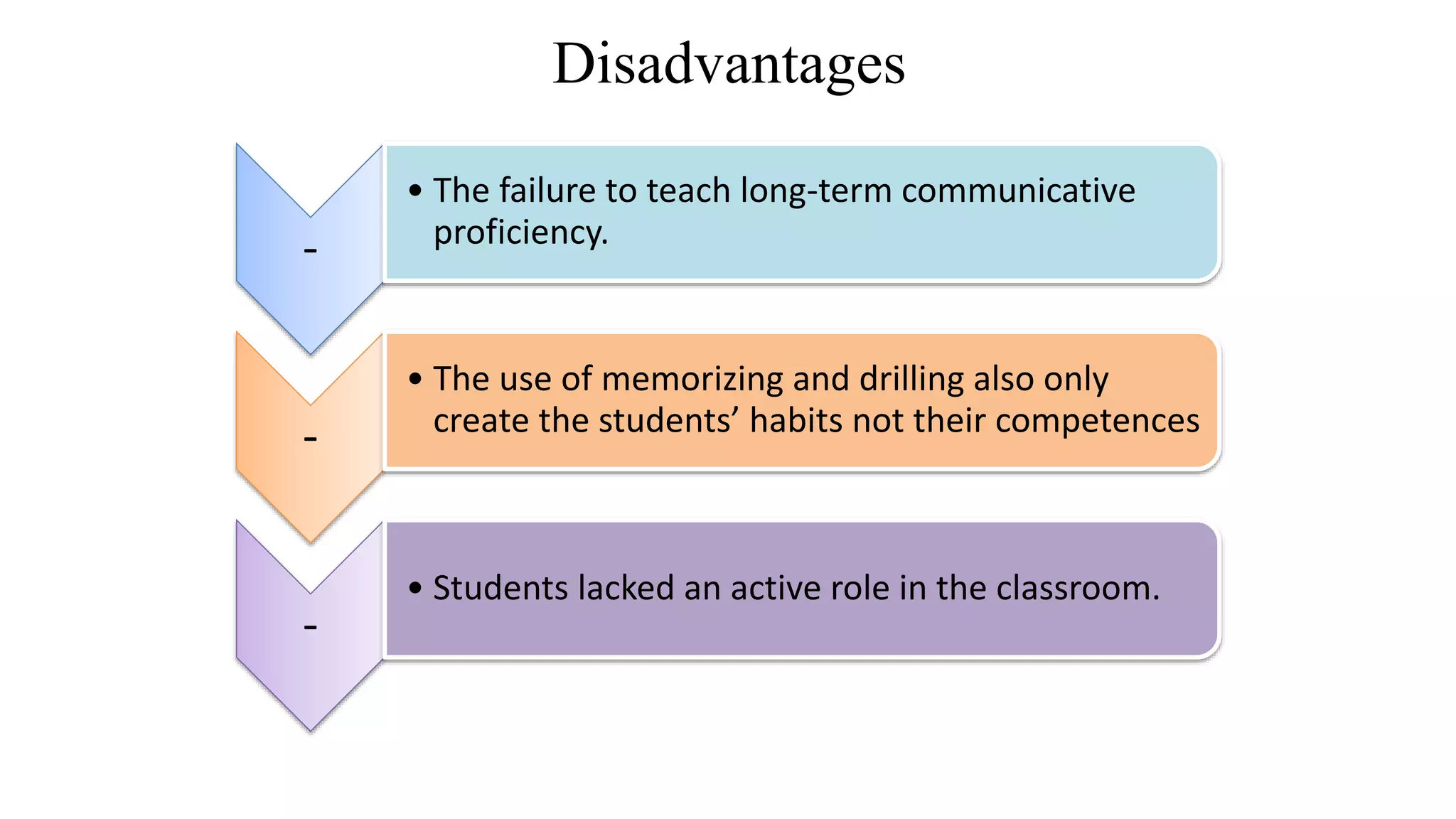
Disadvantages
-
• The failure to teach long-term communicative
proficiency.
-
• The use of memorizing and drilling also only
create the students’ habits not their competences
-
• Students lacked an active role in the classroom.
Conclusion
There are many similarities between Situational
Language Teaching and Audiolingualism. The order
in which the language skills are introduced, and the
focus on accuracy through drill and practice in the
basic structures and sentence patterns of the target
language, might suggest that these methods drew
from each other. In fact, however, Situational
Language Teaching was a development of the
earlier Direct method and does not have the strong
ties to linguistics and behavioral psychology that
characterize Audiolingualism.
It’s time to
full fill a
questionare
Thank You
For Your
Attention

Audiolingual method

  • 1.
  • 2.
    INTRODUCTION • Like theDirect Method, it is also an oral-based approach. The Audio-Lingual Method drills students in the use of grammatical sentence patterns. • Unlike the Direct Method, it has a strong theoretical base in linguistics and psychology.
  • 3.
    • Charles Fries(1945) of the University of Michigan led the way in applying principles from structural linguistics in developing the method, and for this reason, it has sometimes been referred to as the ‘Michigan Method • It was thought that the way to acquire the sentence patterns of the target language was through conditioning –helping learners to respond correctly to stimuli through shaping and reinforcement. Learners could overcome the habits of their native language and form the new habits required to be target language speakers
  • 4.
    THEORY OF LEARNING • TheAudiolingual Method Behaviorism (Human behavior) Behavioral psychology (the secret of of all human learning) - Stimulus - Response - Reinforcement
  • 5.
    THE PSYCHOLOGICAL FOUNDATIONOF AUDIOLINGUALISM Reinforcement (behavior likely to occur again and become habit) Stimulus Organism Response behavior No reinforcement (behavior not likely to occur again)
  • 6.
    OBJECTIVES Brooks defined thatthere are two objectives of Audiolingual method as follows: 1. Short-range objectives 2. Long-range objectives
  • 7.
    1. WHAT ARETHE GOALS OF TEACHERS WHO USE THE AUDIO-LINGUAL METHOD? • Teachers Want their students to be able to use the target language communicatively. Their students achieve this by forming new habits in the target language and overcoming the old habits of their native language.
  • 8.
    2. WHAT ARESOME CHARACTERISTICS OF THE TEACHING/LEARNING PROCESS? • New vocabulary and structural patterns are presented through dialogues. • The dialogs are learned through imitation and repetition. • Drills are conducted based upon the patterns present in the dialog. • Students' successful responses are positively reinforced. • Grammar is induced from the examples given; explicit grammar rules are not provided. • Cultural information is contextualized in the dialogs or presented by the teacher. • Students’ reading and written work is based upon the oral work they did earlier.
  • 9.
    3. WHAT ISTHE NATURE OF STUDENT-TEACHER INTERACTION? • There is student-to-student interaction in chain drills or when students take different roles in dialogs, but this interaction is teacher-directed. Most of the interaction is between teacher and students and is initiated by the teacher
  • 10.
    4. HOW ISTHE LANGUAGE VIEWED? HOW IS THE CULTURE VIEWED? • Every language is seen as having its own unique system. The system is comprised of several different levels: phonological, morphological, and syntactic. Each level has its own distinctive patterns. • Everyday speech is emphasized in the Audio-Lingual Method. Culture consists of the everyday behavior and lifestyle of the target language speakers.
  • 11.
    5. WHAT AREASOF LANGUAGE ARE EMPHASIZED? WHAT LANGUAGE SKILLS ARE EMPHASIZED? • Vocabulary is kept to a minimum while the students are mastering the sound system and grammatical patters. • The natural order of skills presentation is adhered to: listening, speaking, reading, and writing. The oral/aural skills receive most of the attention. Pronunciation is taught from the beginning, often by students working in language laboratories on discriminating between members of minimal pairs.
  • 12.
    6.WHAT IS THEROLE OF THE STUDENTS’NATIVE LANGUAGE? • The habits of the students’ native language are thought to interfere with the students’ attempts to master the target language.
  • 13.
    7. HOW DOESTHE TEACHER RESPOND TO STUDENT ERRORS? • Student errors are to be avoided if at all possible through the teacher’s awareness of where the students will have difficulty restriction of what they are taught to say.
  • 14.
    Learner roles Students playa reactive role by responding stimuli Students have little control over the content, pace or style of learning They are not encouraged to initiate interaction Students do not always understand the meaning of what they are repeating Listen to the teacher, imitating, responding, performing controlled tasks Learn new form of verbal behavior
  • 15.
    Teacher roles Central andactive role Teacher-dominated method Teachers are models of the target language, control the direction and pace of learning Monitors and correct the learners’ performance
  • 16.
    The role of instructional materials Astudents textbook is often not used Teacher’s book Tape recorder Audio visual equipment Language laboratory
  • 17.
    The Procedure inAudiolingalism Students first hear a model dialogue The dialogue is adapted to the students’ interest or situation through changing certain keywords or phrases Certain key structures from the dialogue are selected and used as the basis for pattern drills of different kinds The students may refer to their textbook, follow up reading, writing, or vocabulary activities based on the dialogue may be introduced Follow up activities may take place in the language laboratory, where further dialogue and drill work is carried out.
  • 18.
    Advantages + • It aimsat developing listening and speaking skills which is a step away from the Grammar translation method + • Teachers are easy to teach even if in big class group, because by using drilling, the teacher can control participation of each participants. + • The students can imitate the way of native speaker in pronounce the sentences or the words.
  • 19.
    Disadvantages - • The failureto teach long-term communicative proficiency. - • The use of memorizing and drilling also only create the students’ habits not their competences - • Students lacked an active role in the classroom.
  • 20.
    Conclusion There are manysimilarities between Situational Language Teaching and Audiolingualism. The order in which the language skills are introduced, and the focus on accuracy through drill and practice in the basic structures and sentence patterns of the target language, might suggest that these methods drew from each other. In fact, however, Situational Language Teaching was a development of the earlier Direct method and does not have the strong ties to linguistics and behavioral psychology that characterize Audiolingualism.
  • 21.
    It’s time to fullfill a questionare Thank You For Your Attention