
THALASSEMIA



           Presented by:
        Livson Thomas
        CON, CMC Ludhiana.
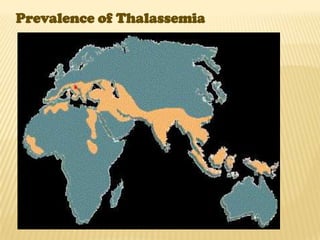
Prevalence of Thalassemia
DEFINITION


   Thalassemia is a group of inherited/ hereditary
    disorders characterized by reduced or absent
    amounts of hemoglobin or synthesis of hemoglobin.
TWO BASIC GROUPS OF THALASSEMIA
DISORDER


   Alpha Thalassemia


   Beta Thalassemia: A person with this
    disorder has two mutated genes
TYPES OF BETA THALASSEMIA
   Beta thalassemia minor– the mildest form of beta
    thalassemia.

   Thalassemia trait - heterozygous disorder resulting in
    mild hypochromic, microcytic hemolytic anemia.

   Beta thalassemia intermedia - Severity lies between
    the minor and major.

   Beta thalassemia major - homozygous disorder
    resulting in severe transfusion-dependent hemolytic
    anemia.
                                                             6
CLINICAL FEATURES

   ANAEMIA
      - Pallor
      -Unexplained Fever
      -Poor feeding
      -Enlarged spleen and liver
WITH PROGRESSIVE ANAEMIA


 Anorexia
 Headache

 Restlessness

 Decreased activity tolerance
OTHER FEATURES

 Small stature
 Delayed sexual maturation

 Bronze complexion

 Failure to thrive, gross motor delay
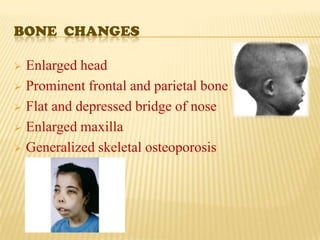
BONE CHANGES

 Enlarged head
 Prominent frontal and parietal bone

 Flat and depressed bridge of nose

 Enlarged maxilla

 Generalized skeletal osteoporosis
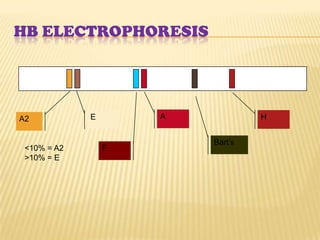
HB ELECTROPHORESIS


A2           E       A            H


                         Bart’s
 <10% = A2       F
 >10% = E
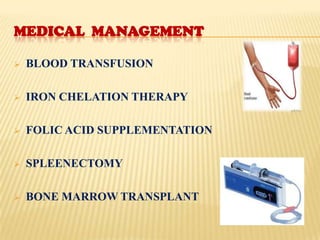
MEDICAL MANAGEMENT

   BLOOD TRANSFUSION

   IRON CHELATION THERAPY

   FOLIC ACID SUPPLEMENTATION

   SPLEENECTOMY

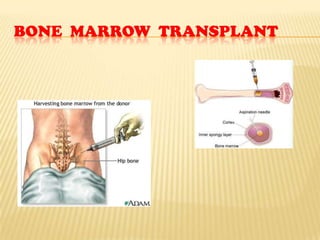
   BONE MARROW TRANSPLANT
BONE MARROW TRANSPLANT
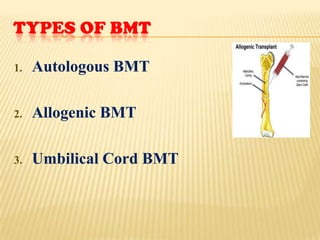
TYPES OF BMT

1.   Autologous BMT

2.   Allogenic BMT

3.   Umbilical Cord BMT
Thalassemia

Thalassemia

  • 1.
    THALASSEMIA   Presented by:  Livson Thomas  CON, CMC Ludhiana.
  • 2.
  • 3.
    DEFINITION  Thalassemia is a group of inherited/ hereditary disorders characterized by reduced or absent amounts of hemoglobin or synthesis of hemoglobin.
  • 5.
    TWO BASIC GROUPSOF THALASSEMIA DISORDER  Alpha Thalassemia  Beta Thalassemia: A person with this disorder has two mutated genes
  • 6.
    TYPES OF BETATHALASSEMIA  Beta thalassemia minor– the mildest form of beta thalassemia.  Thalassemia trait - heterozygous disorder resulting in mild hypochromic, microcytic hemolytic anemia.  Beta thalassemia intermedia - Severity lies between the minor and major.  Beta thalassemia major - homozygous disorder resulting in severe transfusion-dependent hemolytic anemia. 6
  • 7.
    CLINICAL FEATURES  ANAEMIA - Pallor -Unexplained Fever -Poor feeding -Enlarged spleen and liver
  • 8.
    WITH PROGRESSIVE ANAEMIA Anorexia  Headache  Restlessness  Decreased activity tolerance
  • 9.
    OTHER FEATURES  Smallstature  Delayed sexual maturation  Bronze complexion  Failure to thrive, gross motor delay
  • 10.
    BONE CHANGES  Enlargedhead  Prominent frontal and parietal bone  Flat and depressed bridge of nose  Enlarged maxilla  Generalized skeletal osteoporosis
  • 11.
    HB ELECTROPHORESIS A2 E A H Bart’s <10% = A2 F >10% = E
  • 12.
    MEDICAL MANAGEMENT  BLOOD TRANSFUSION  IRON CHELATION THERAPY  FOLIC ACID SUPPLEMENTATION  SPLEENECTOMY  BONE MARROW TRANSPLANT
  • 13.
  • 14.
    TYPES OF BMT 1. Autologous BMT 2. Allogenic BMT 3. Umbilical Cord BMT