TEST
ING
OF
by
Christine May
M. Serrano
WHAT IS
SPEAKING?
 the action of conveying
information or expressing one's
thoughts and feelings in spoken
language
 to utter words or articulate
sounds
 an interactive process of
constructing meaning that involves
producing and receiving and
WHAT ARE WE TRYING
TO MEASURE?
In testing speaking, we are trying
to measure the students’ ability to
INTERACT in the target language
in spoken form.
Therefore, this involves not just
PRODUCTION but as well as
COMPREHENSION.
TESTING
SPEAKING
Why is it so difficult to test the speaking
skills?
 It is neither possible nor desirable to
separate the speaking skills from
listening skills because these two are
interdependent.
 It is frequently impossible to
administer a reliable test to a large
number of students because of limited
time.
TEST FORMATS
FOR SPEAKING
Reading Aloud
Conversational Exchanges
Pictures and Diagrams
Oral Interview
More others…
1. READING
ALOUD
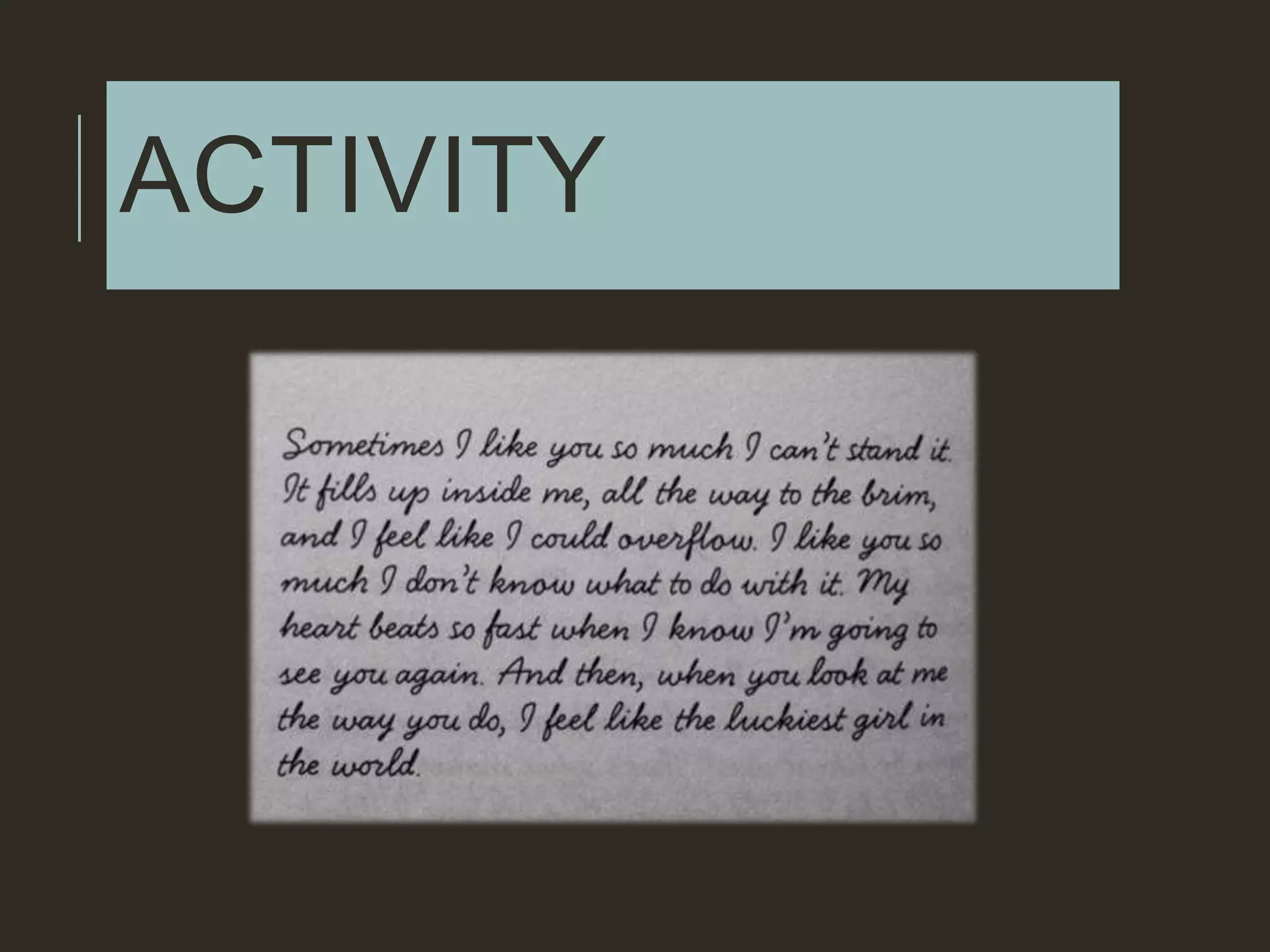
Many present-day oral tests include
a test of reading aloud in which the
students are given a short time to
glance through an extract before
being required to read it aloud.
Tests involving reading aloud are
generally used to assess the
students’ pronunciation skills.
READING ALOUD
In reading aloud, it is helpful
to imagine actual situations:
Reading aloud directions to a
friend(e.g., how to cook a certain dish)
Reading aloud a
letter
Re-telling a short story or an
incident
ACTIVITY
Pork Sinigang Cooking Instructions
1. Boil water in a pot.
2. Add the pork liempo, tomato, onion, and
tamarind sinigang soup mix.
3. Cover the pot and boil until the meat is
tender.
4. Add the long chili pepper, radish, taro,
string beans, and eggplant.
5. Cover the pot and continue boiling until the
vegetables are cooked.
ACTIVITY
2.
CONVERSATIONAL
EXCHANGES
Constructive interplay with
unpredictable stimuli and responses
attempts to control the interaction
taking place.
The item types range from items
presenting the testees with
situations in which they initiate
conversations to incomplete
conversations with the part of one
speaker omitted (one-sided
2.
CONVERSATIONAL
EXCHANGES
Type 1. The testees are given a
series of situations and are
required to construct
sentences/lines accordingly.
ACTIVITY
Directions: Construct and deliver lines orally
whether it is a monologue or a dialogue
according to the given situations below.
1. It’s raining heavily. Tom and Anna are
waiting impatiently at home to set off on
their picnic.
2. Delilah is waiting for her friends outside the
cinema. The show is just about to start but
they haven’t arrived yet.
3. Mrs. Green is living alone in a flat. She
wishes she lives in a small house with a
garden.
2.
CONVERSATIONAL
EXCHANGES
Type 2. This type of test item is
similar to the previous one but
not as strictly controlled. No
made responses are given by
the examiner and the students
are free to use whatever
response they wish.
ACTIVITY
Directions: Respond orally according to the
given situations below.
1. A friend of yours has been dumped by her
boyfriend. She would not stop crying. What
will you tell her?
2. You are on your way home when you see
your little brother being bullied by his
classmates. You approach them angrily. What
will you say to his classmates?
3. You and your boyfriend are about to go on a
date. Your best friend suddenly popped
inside your room inviting you to a party.
2.
CONVERSATIONAL
EXCHANGES
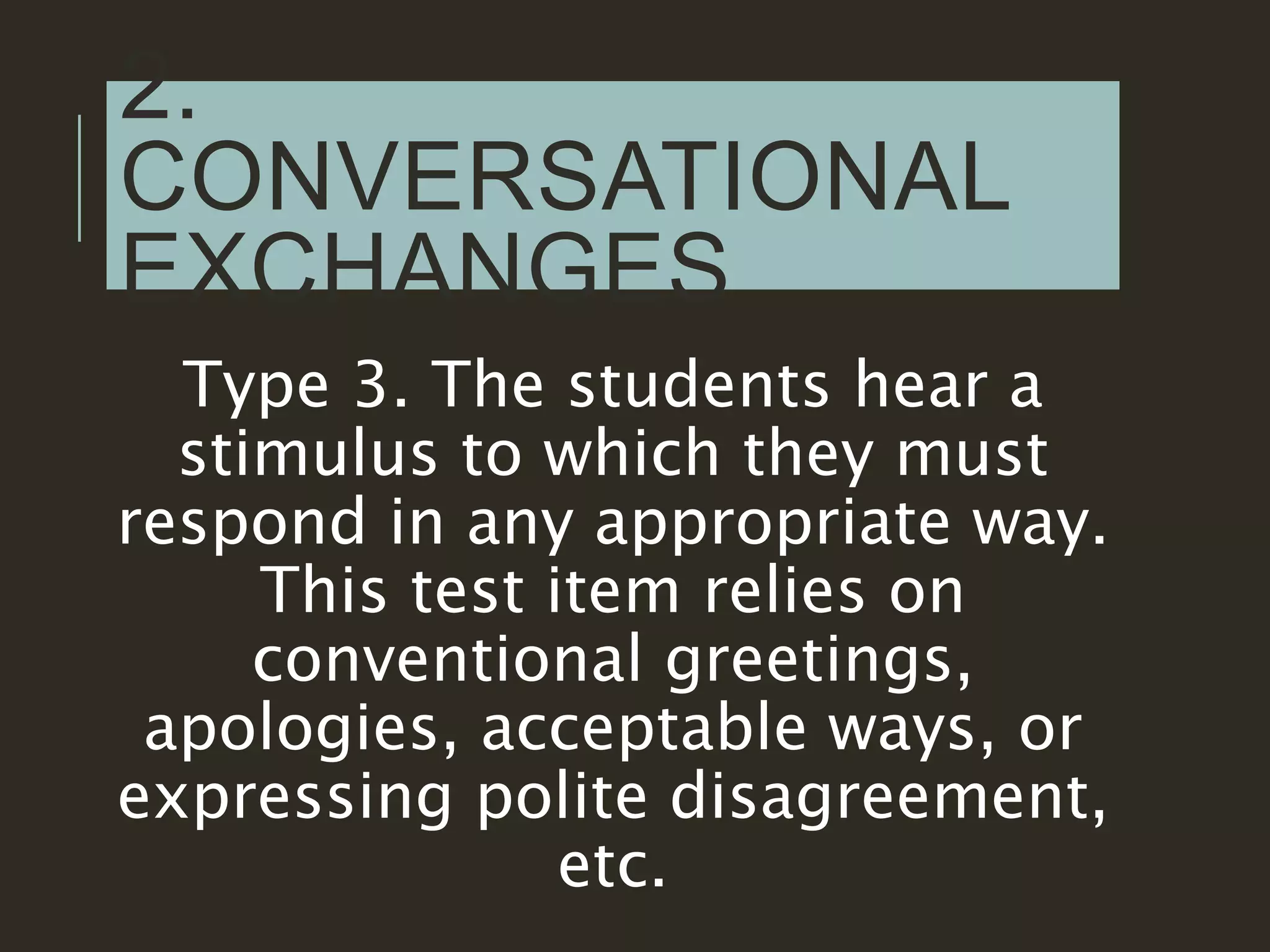
Type 3. The students hear a
stimulus to which they must
respond in any appropriate way.
This test item relies on
conventional greetings,
apologies, acceptable ways, or
expressing polite disagreement,
etc.
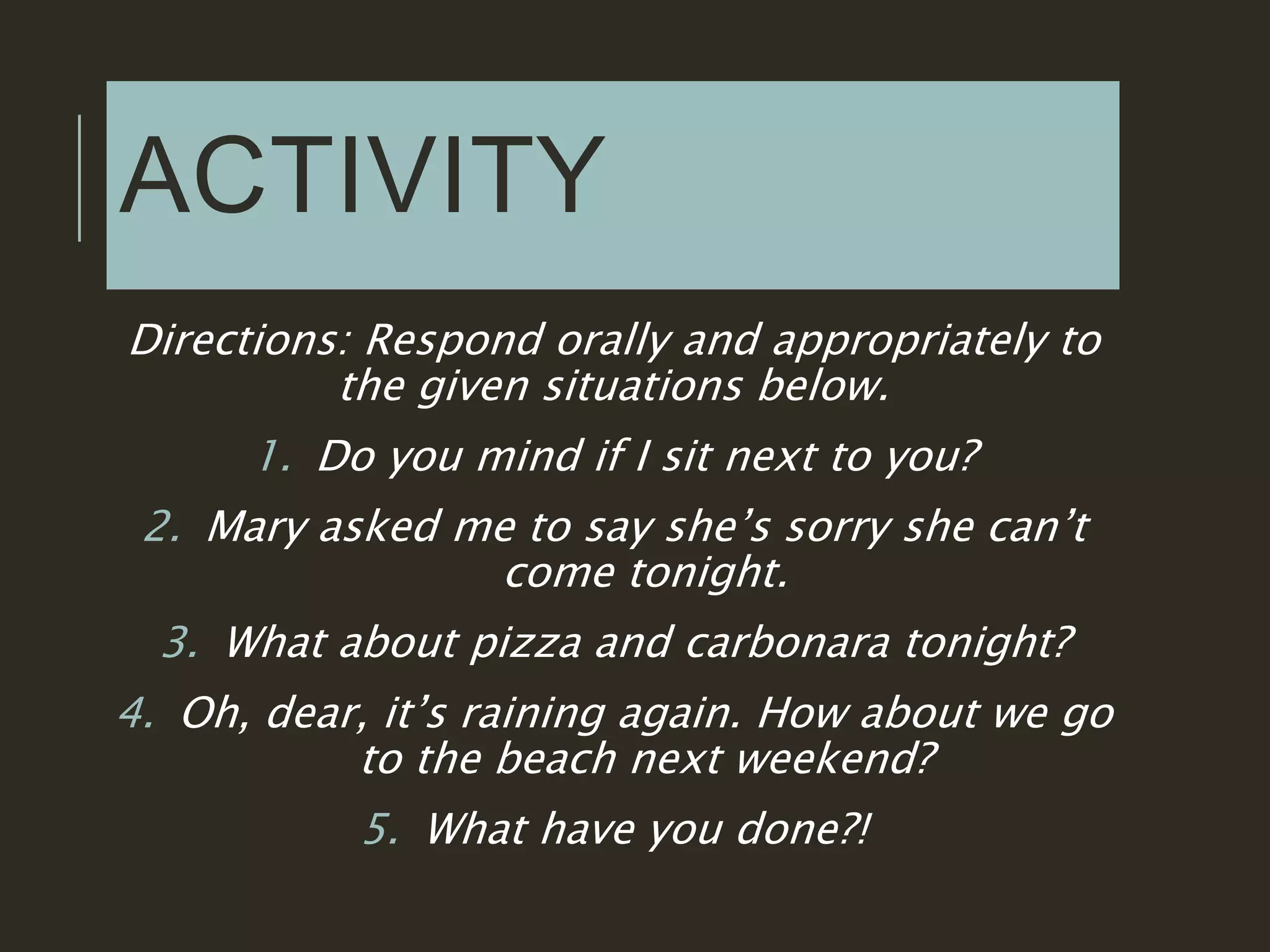
ACTIVITY
Directions: Respond orally and appropriately to
the given situations below.
1. Do you mind if I sit next to you?
2. Mary asked me to say she’s sorry she can’t
come tonight.
3. What about pizza and carbonara tonight?
4. Oh, dear, it’s raining again. How about we go
to the beach next weekend?
5. What have you done?!
2.
CONVERSATIONAL
EXCHANGES
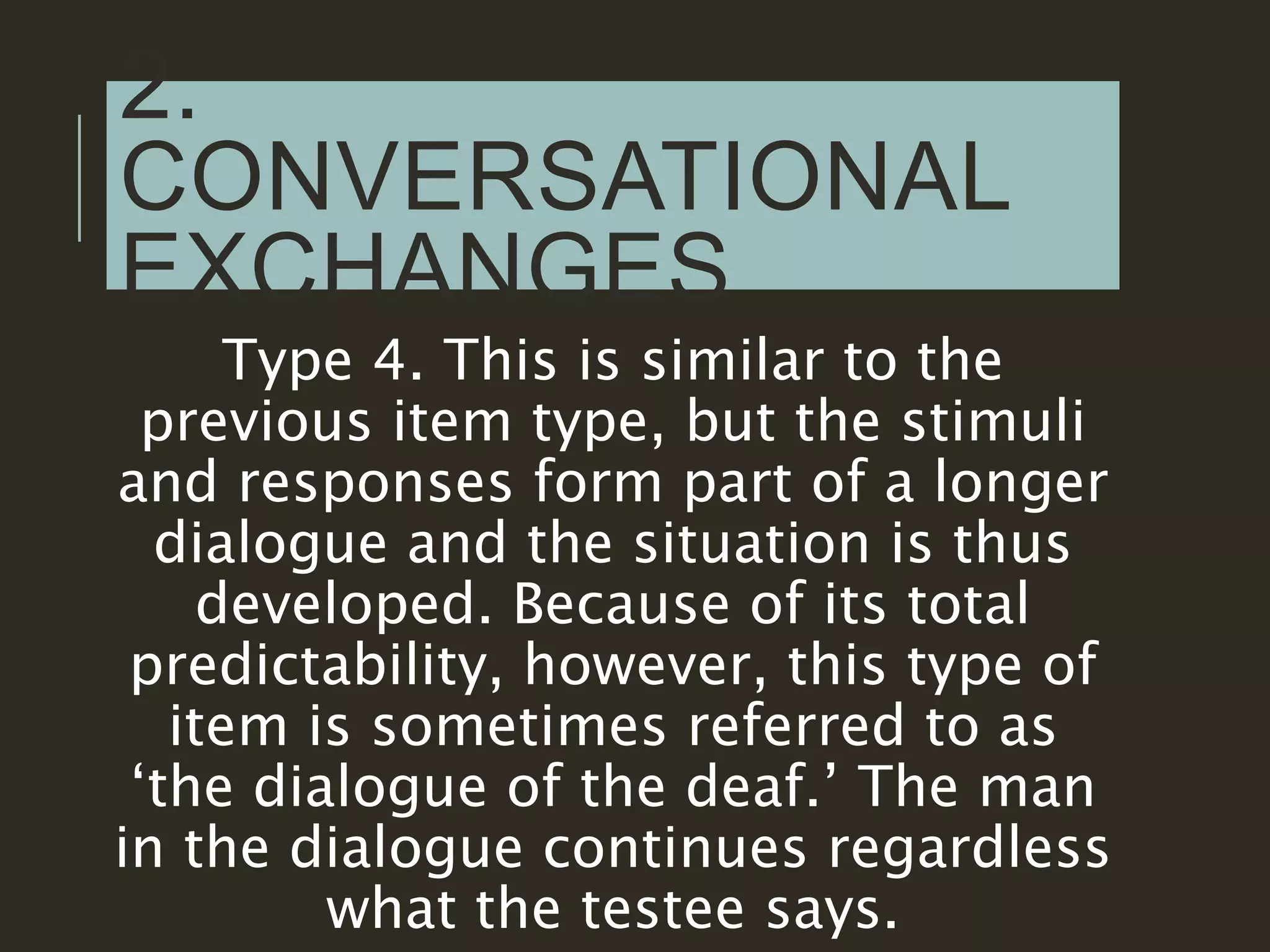
Type 4. This is similar to the
previous item type, but the stimuli
and responses form part of a longer
dialogue and the situation is thus
developed. Because of its total
predictability, however, this type of
item is sometimes referred to as
‘the dialogue of the deaf.’ The man
in the dialogue continues regardless
what the testee says.
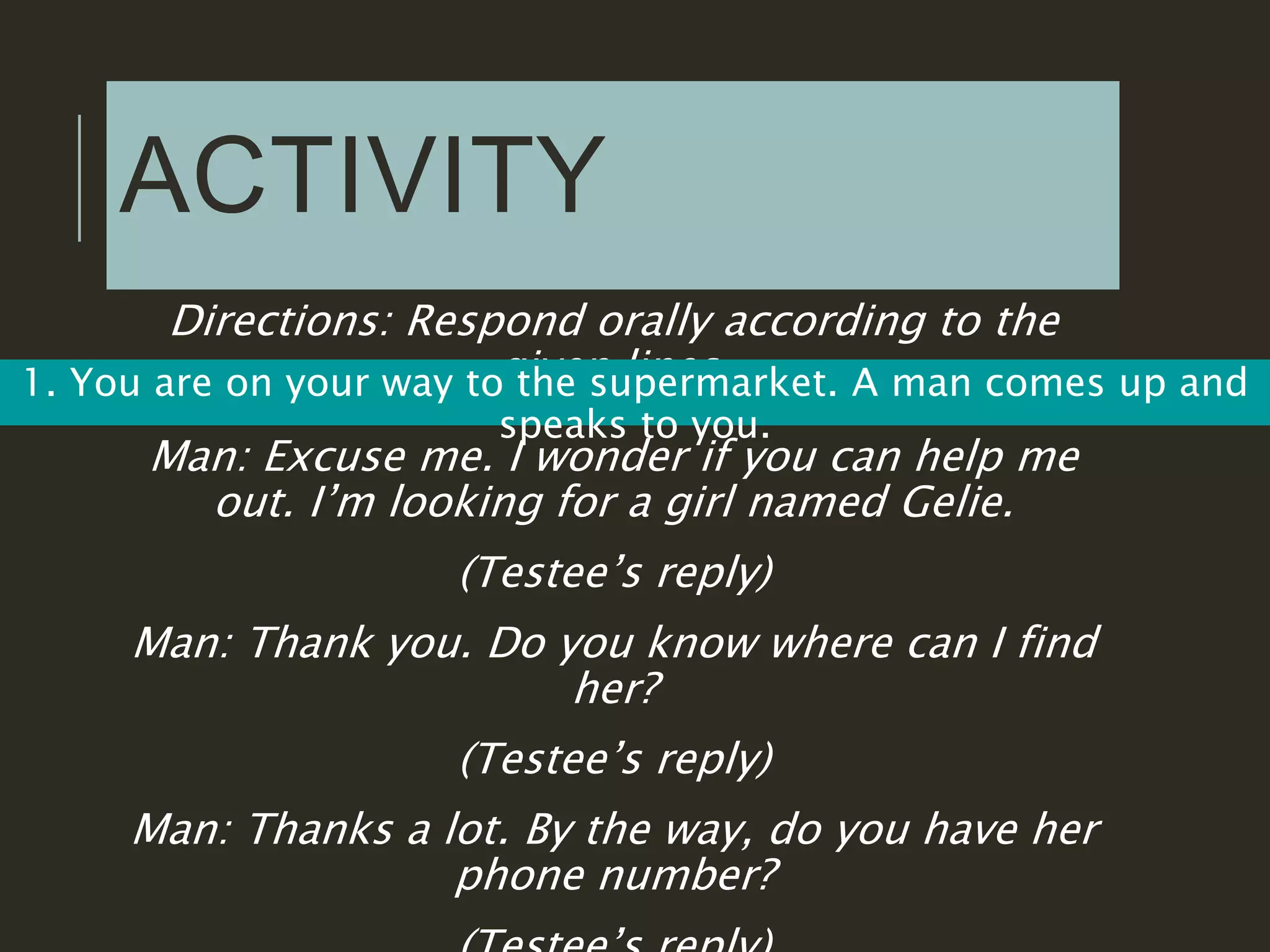
ACTIVITY
Directions: Respond orally according to the
given lines.1. You are on your way to the supermarket. A man comes up and
speaks to you.
Man: Excuse me. I wonder if you can help me
out. I’m looking for a girl named Gelie.
(Testee’s reply)
Man: Thank you. Do you know where can I find
her?
(Testee’s reply)
Man: Thanks a lot. By the way, do you have her
phone number?
ACTIVITY
Directions: Respond orally according to the
given lines.
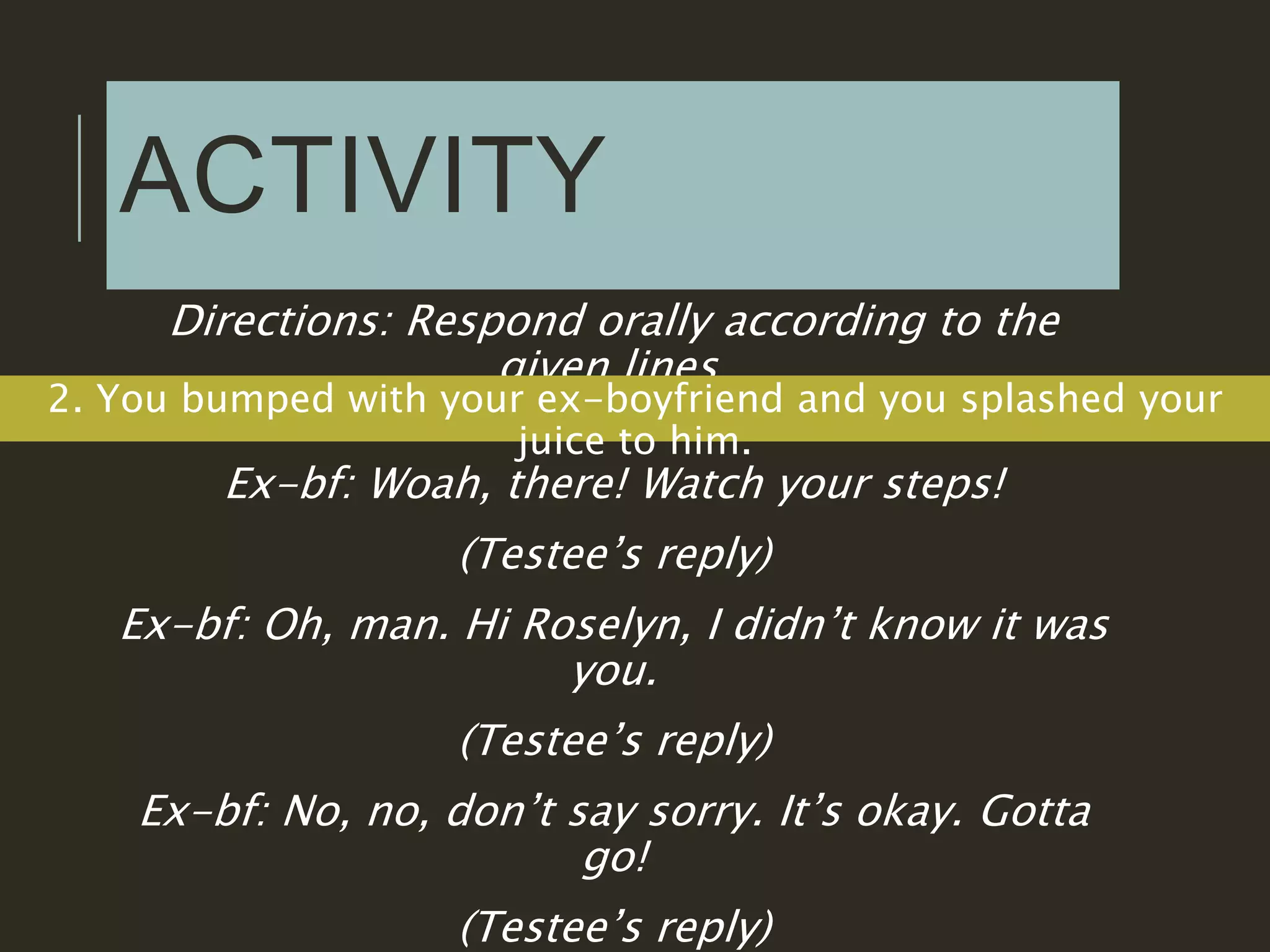
2. You bumped with your ex-boyfriend and you splashed your
juice to him.
Ex-bf: Woah, there! Watch your steps!
(Testee’s reply)
Ex-bf: Oh, man. Hi Roselyn, I didn’t know it was
you.
(Testee’s reply)
Ex-bf: No, no, don’t say sorry. It’s okay. Gotta
go!
(Testee’s reply)
ACTIVITY
Directions: Respond orally according to the
given lines.
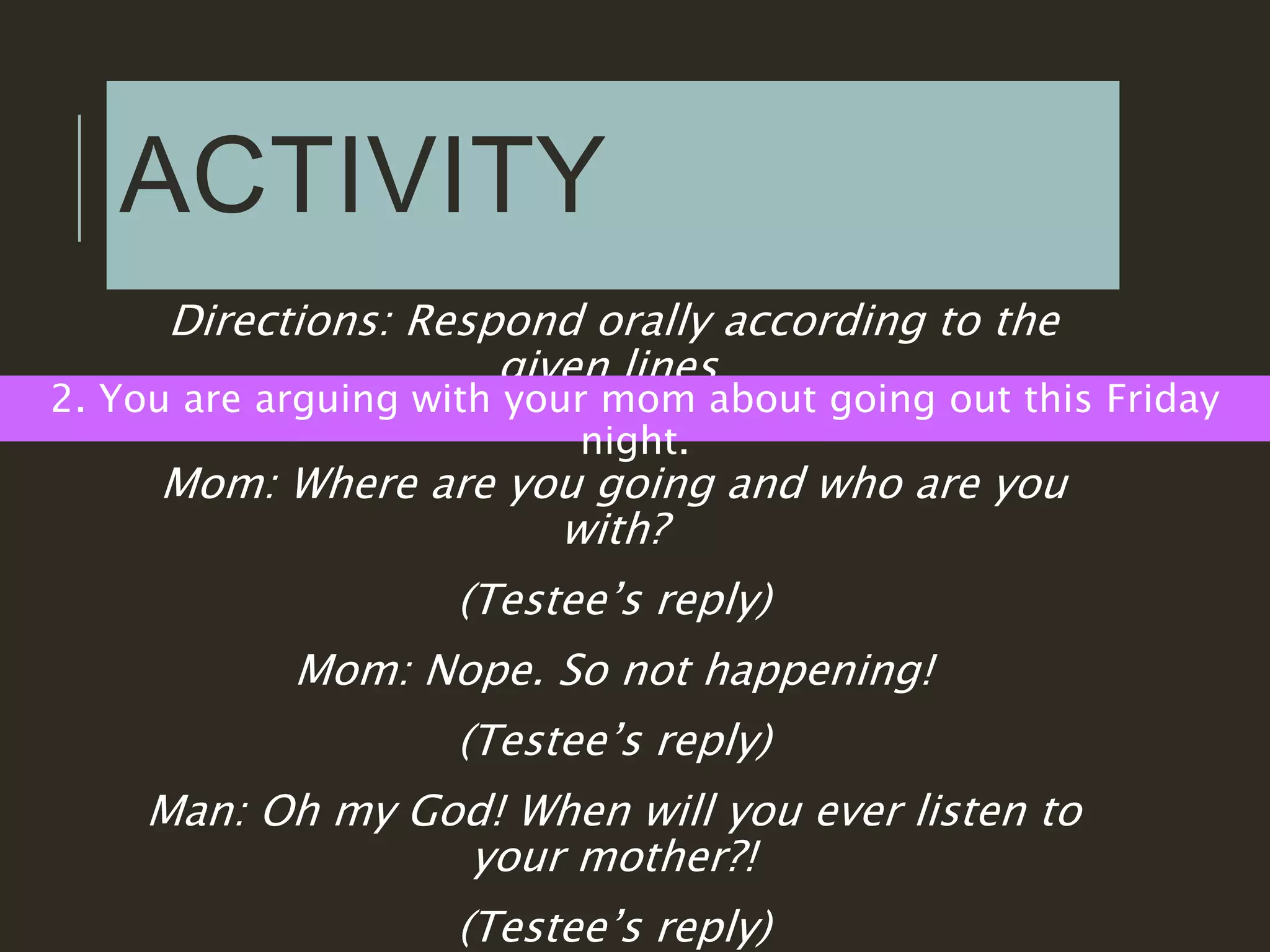
2. You are arguing with your mom about going out this Friday
night.
Mom: Where are you going and who are you
with?
(Testee’s reply)
Mom: Nope. So not happening!
(Testee’s reply)
Man: Oh my God! When will you ever listen to
your mother?!
(Testee’s reply)
2.
CONVERSATIONAL
EXCHANGES
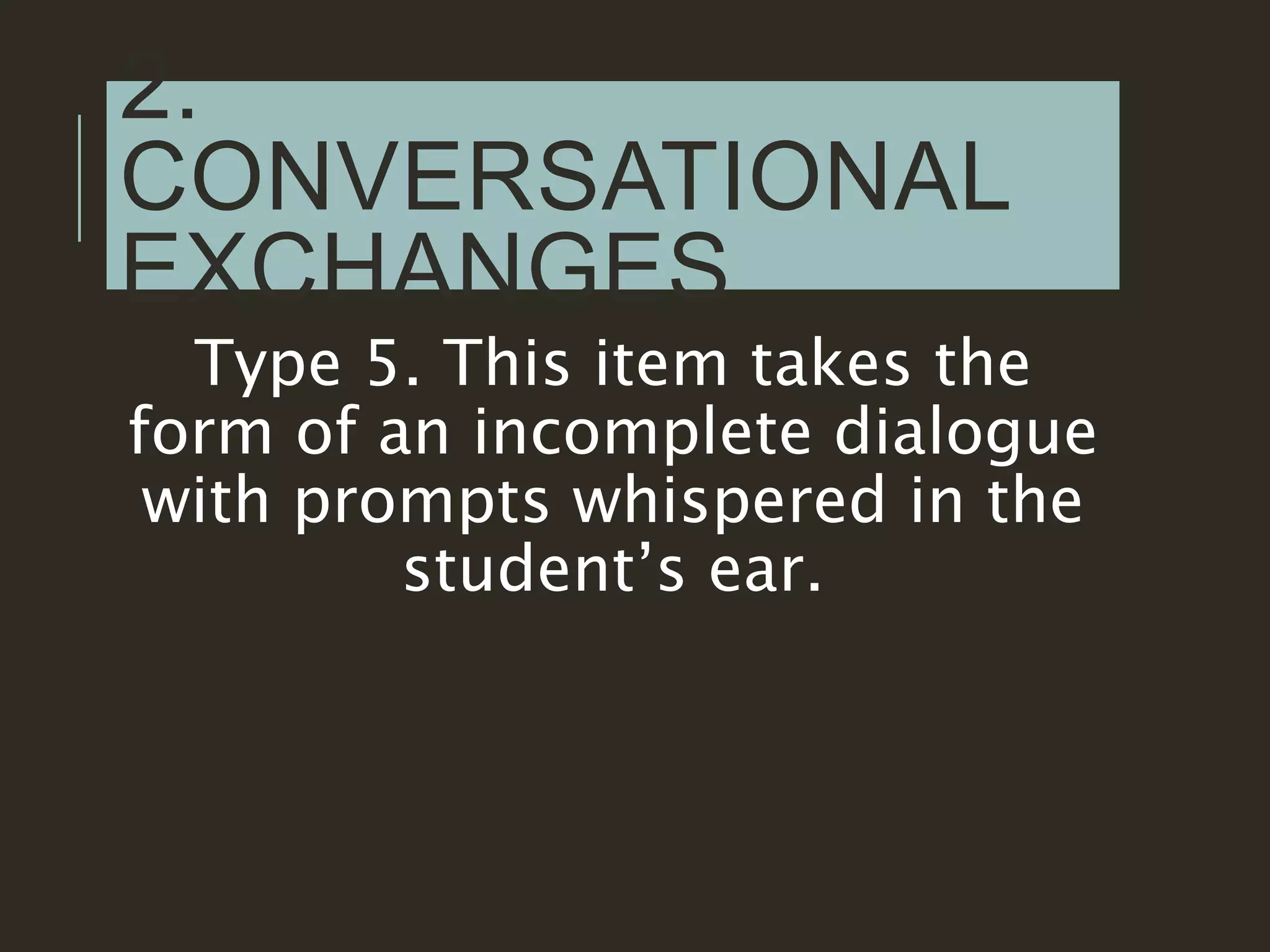
Type 5. This item takes the
form of an incomplete dialogue
with prompts whispered in the
student’s ear.
ACTIVITY
Directions: Respond orally to the situation using
the prompts to be given by your teacher.
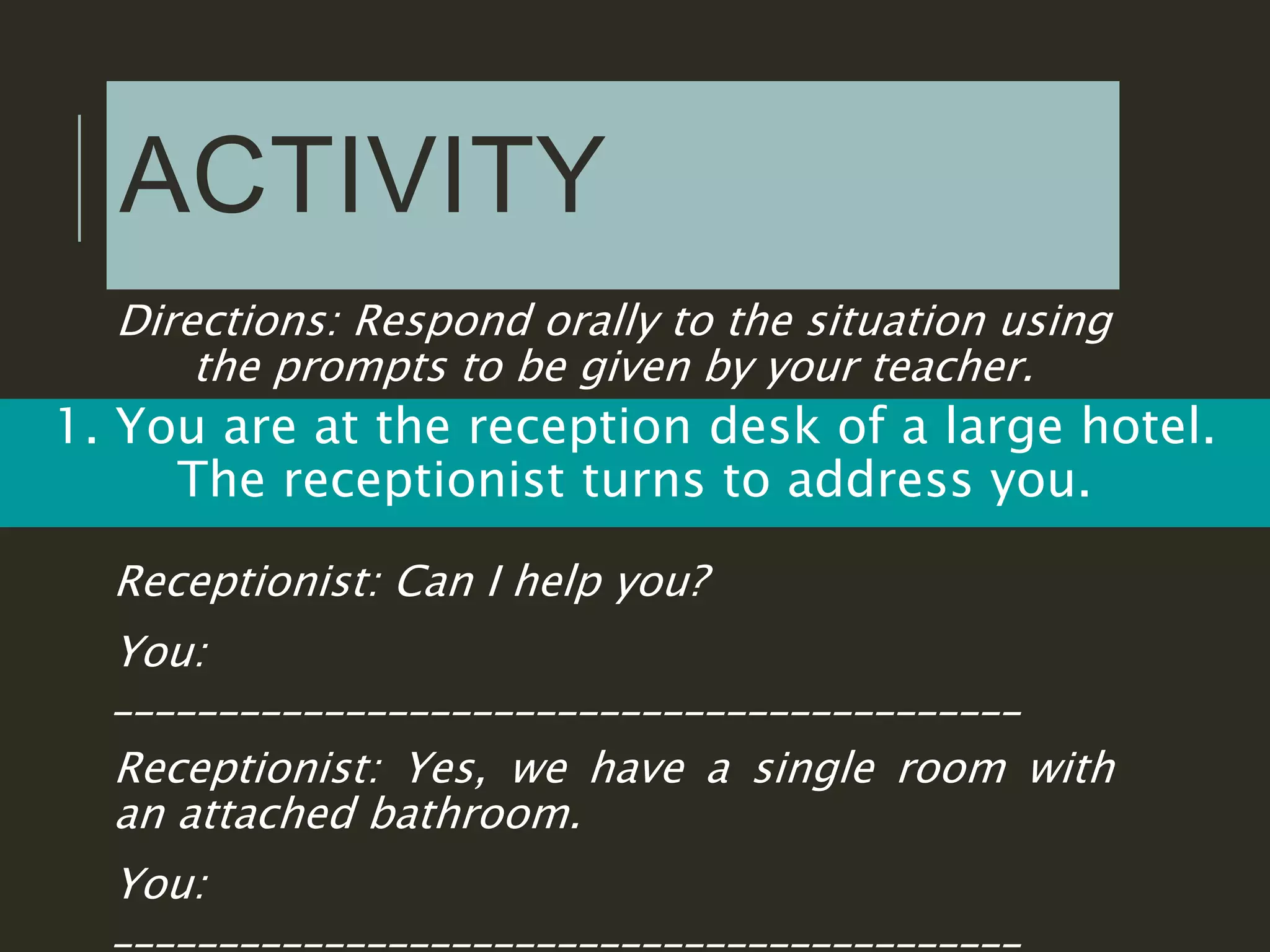
1. You are at the reception desk of a large hotel.
The receptionist turns to address you.
Receptionist: Can I help you?
You:
___________________________________________
Receptionist: Yes, we have a single room with
an attached bathroom.
You:
___________________________________________
ACTIVITY
Receptionist: Thirty-four pounds fifty a right.
You:
___________________________________________
Receptionist: Yes, that’s with continental
breakfast.
You:
___________________________________________
Receptionist: It’s fruit juice, coffee or tea, and
bread rolls.
You:
___________________________________________
ACTIVITY
Directions: Respond orally to the situation using
the prompts to be given by your teacher.
2. You are at the mall and you saw your much
awaited copy of Taylor Swift’s latest song album. A
saleslady approached you.
Saleslady: It’s 10% off, would you like to avail it?
You:
___________________________________________
Saleslady: But I think there aren’t much copies
left.
You:
___________________________________________
ACTIVITY
Saleslady: Are you sure?
You:
___________________________________________
Saleslady: Alright.
You:
___________________________________________
3. PICTURE AND
DIAGRAMS
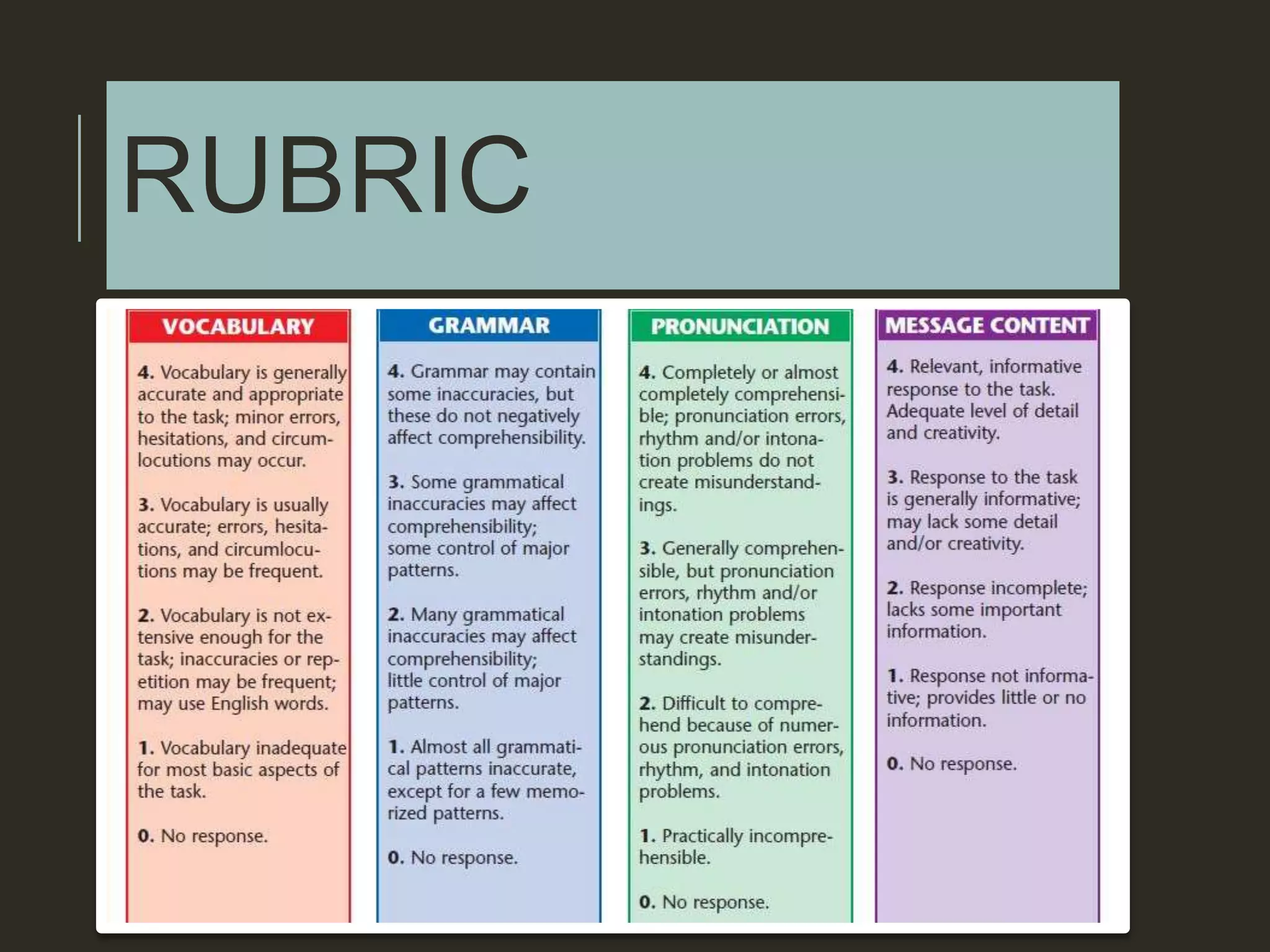
Type 1. The students are given a
picture to study for a few minutes
then they are required to
describe the picture in a given
time. Scores for general fluency,
grammar, vocabulary, phonology,
and accuracy of description are
based on a rubric.
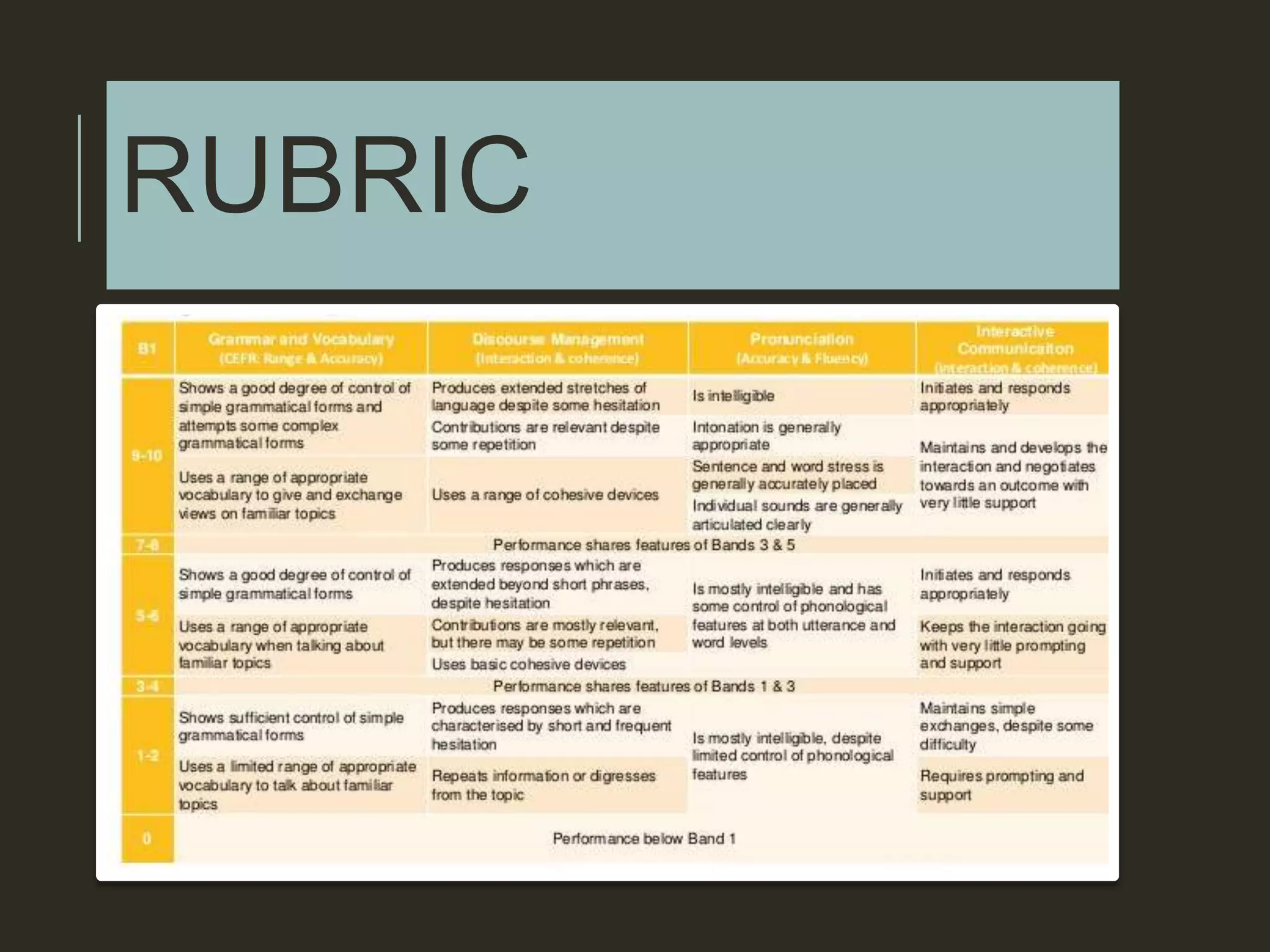
RUBRIC
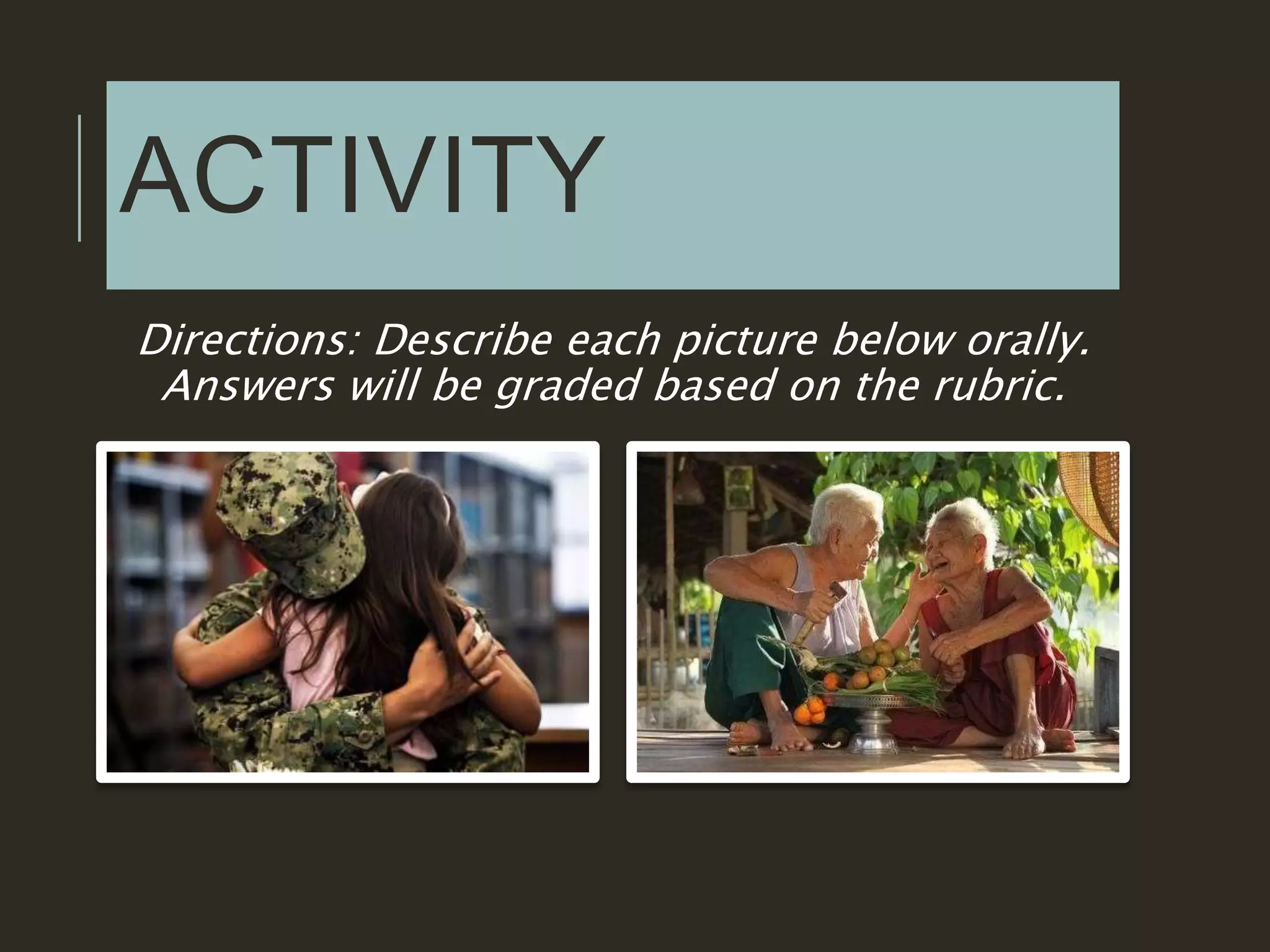
ACTIVITY
Directions: Describe each picture below orally.
Answers will be graded based on the rubric.
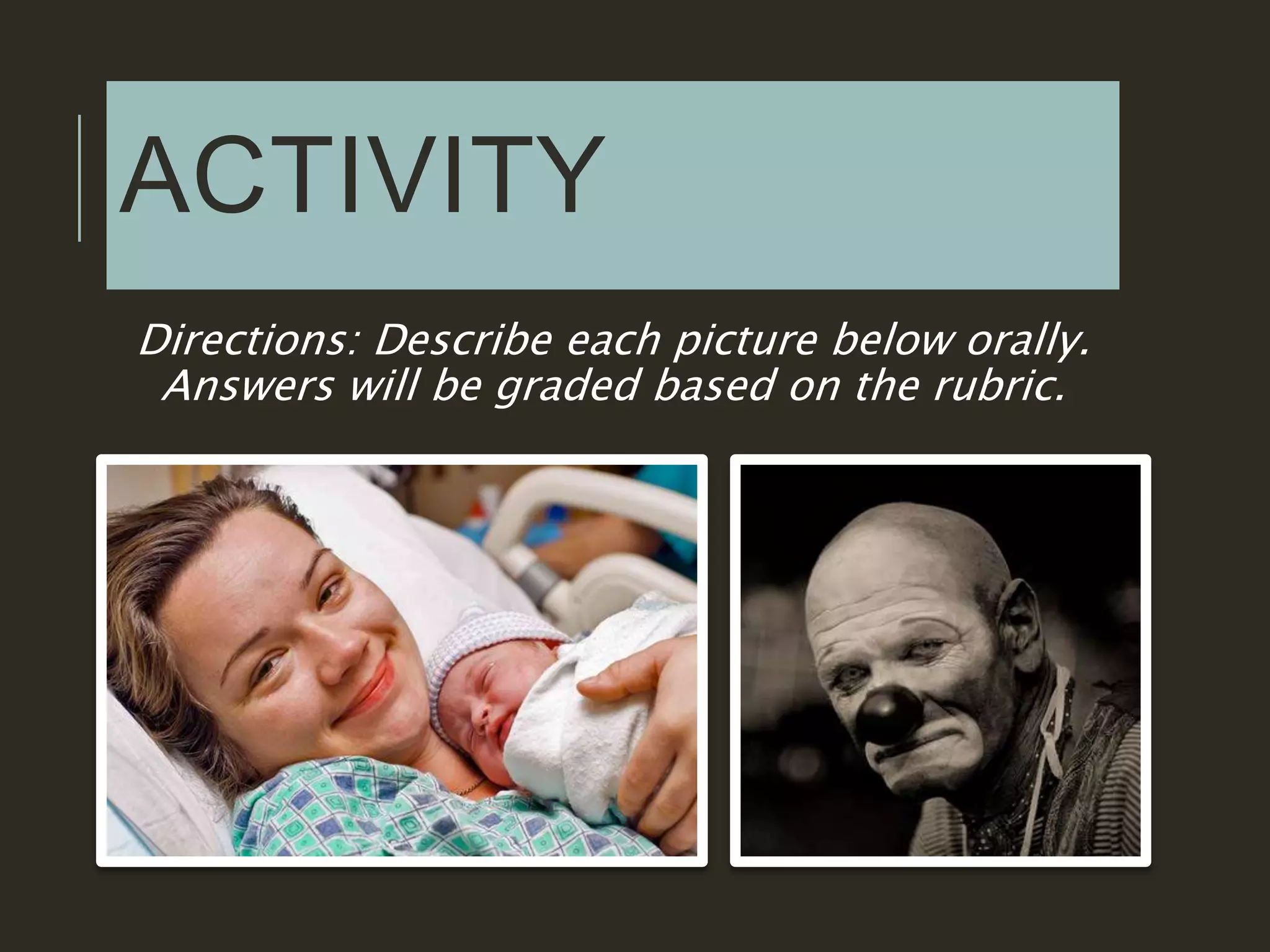
ACTIVITY
Directions: Describe each picture below orally.
Answers will be graded based on the rubric.
3. PICTURE AND
DIAGRAMS
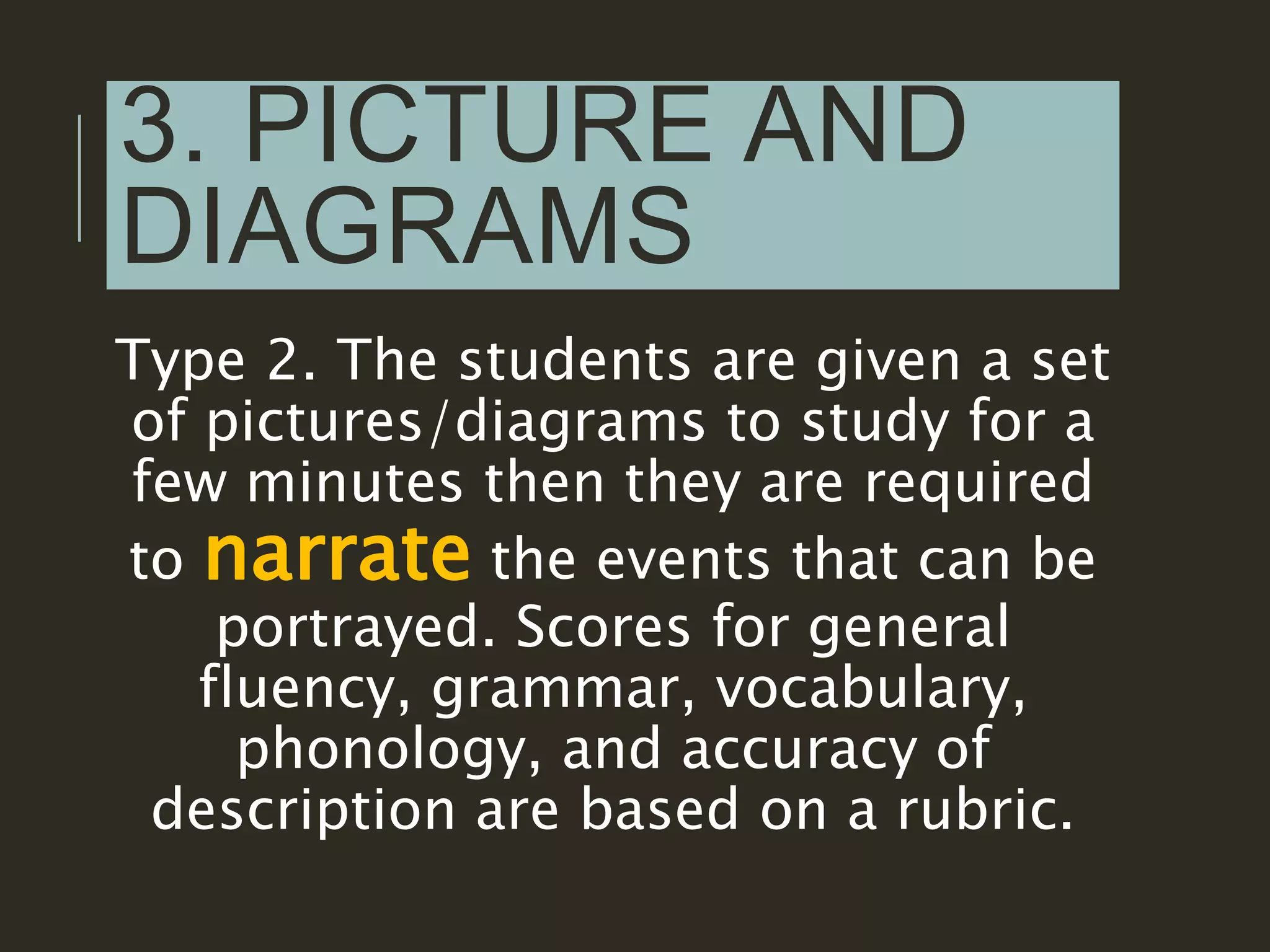
Type 2. The students are given a set
of pictures/diagrams to study for a
few minutes then they are required
to narrate the events that can be
portrayed. Scores for general
fluency, grammar, vocabulary,
phonology, and accuracy of
description are based on a rubric.
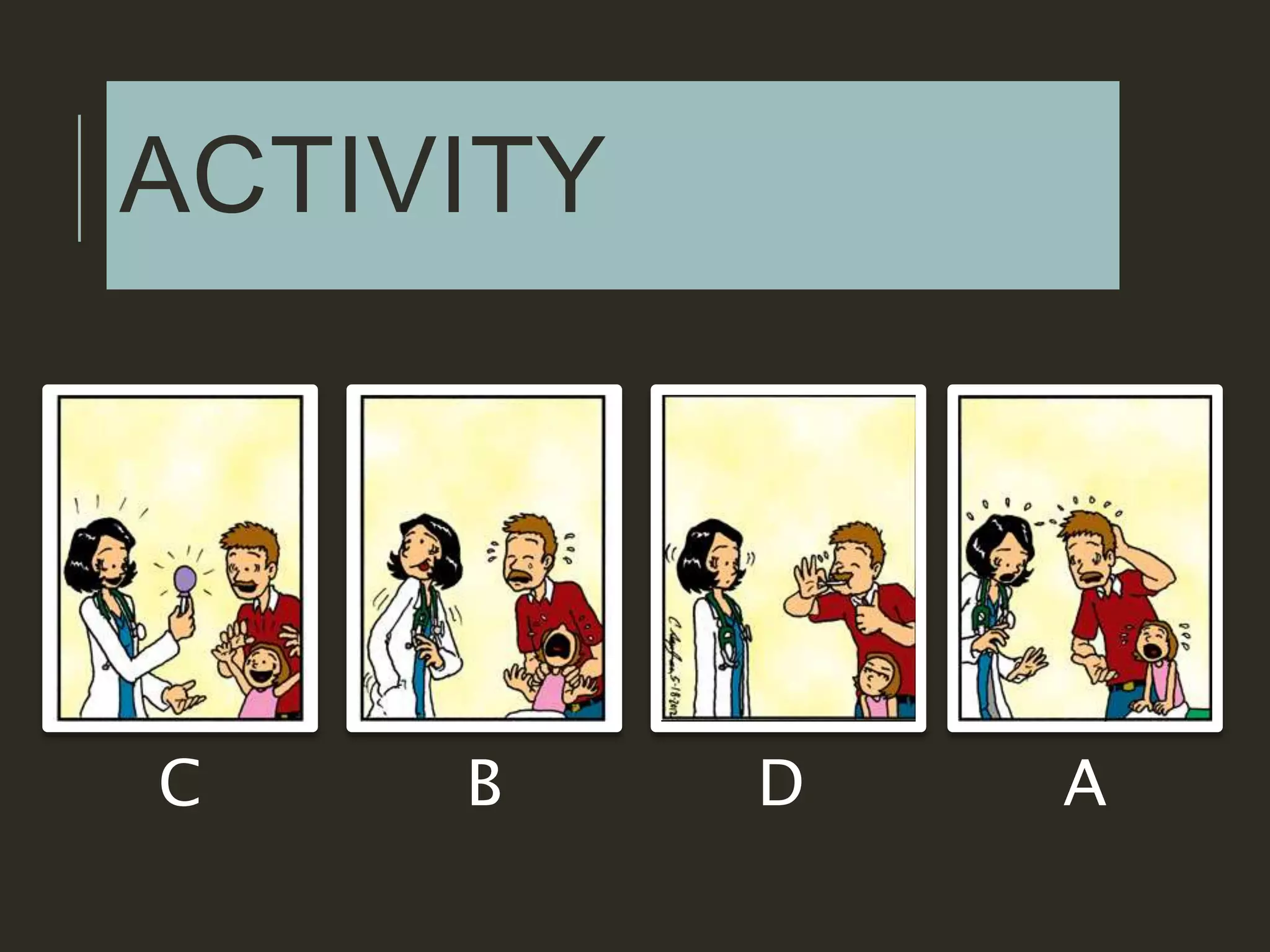
ACTIVITY
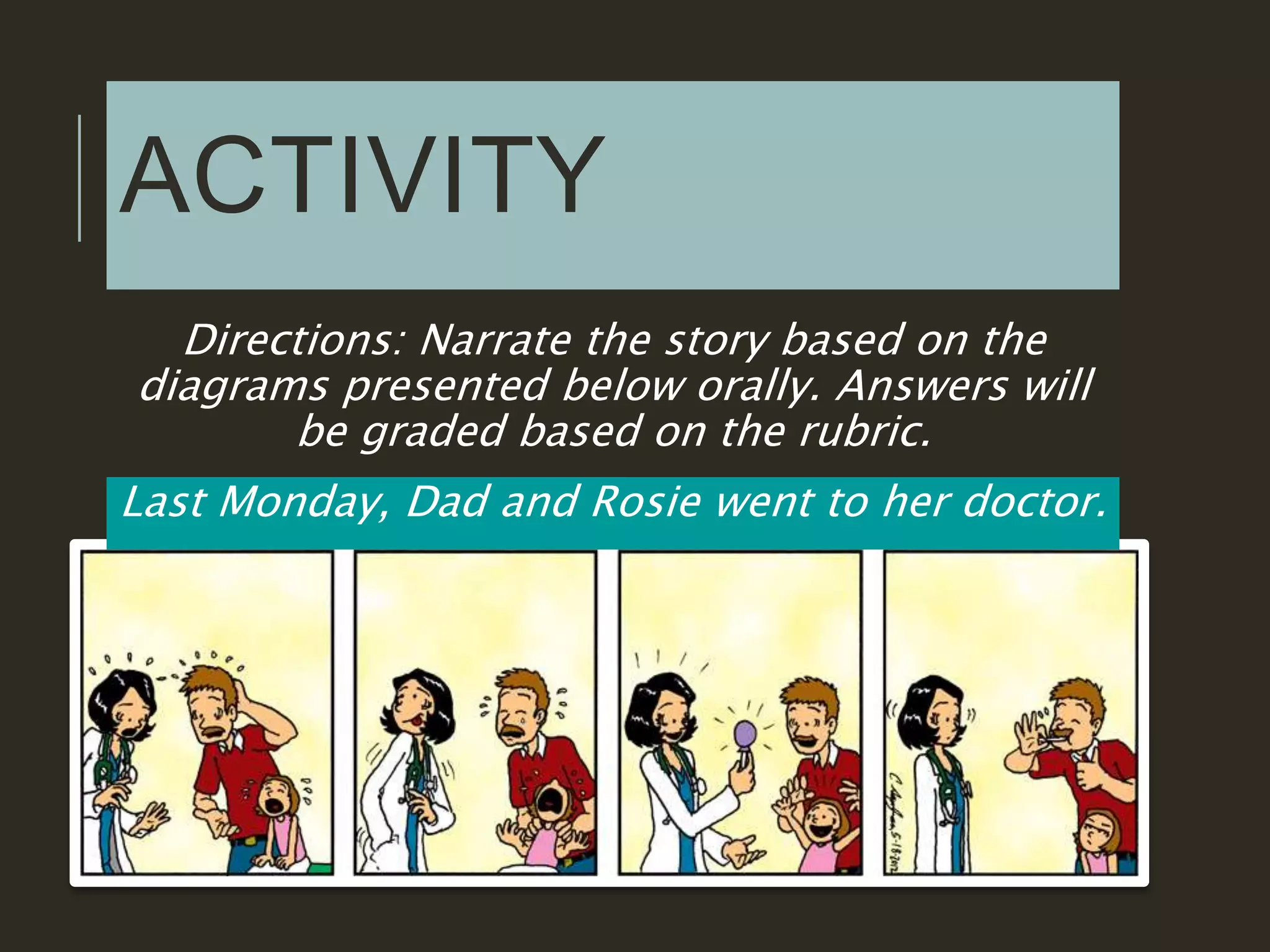
Directions: Narrate the story based on the
diagrams presented below orally. Answers will
be graded based on the rubric.
Last Monday, Dad and Rosie went to her doctor.
ACTIVITY
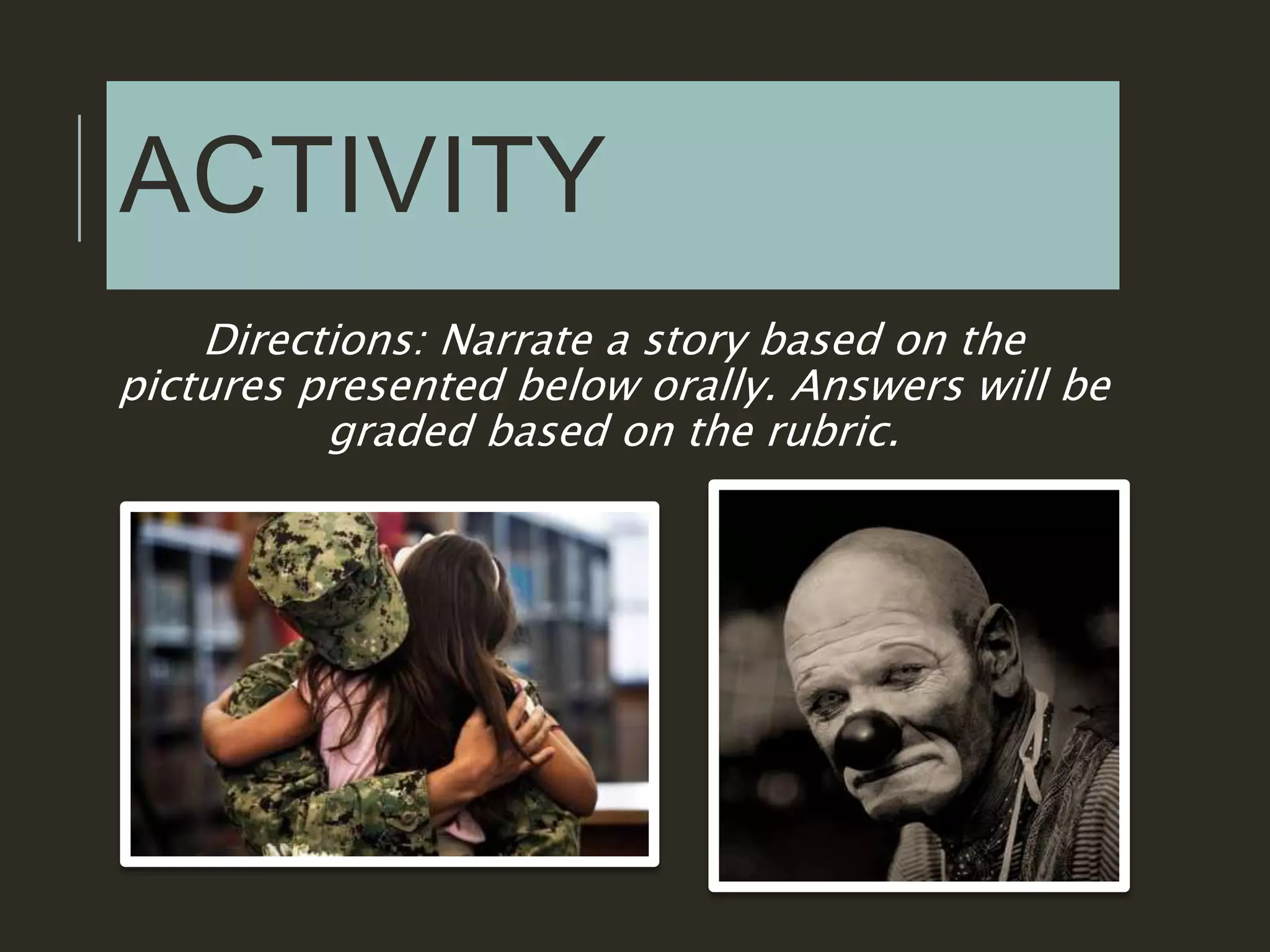
Directions: Narrate a story based on the
pictures presented below orally. Answers will be
graded based on the rubric.
ACTIVITY
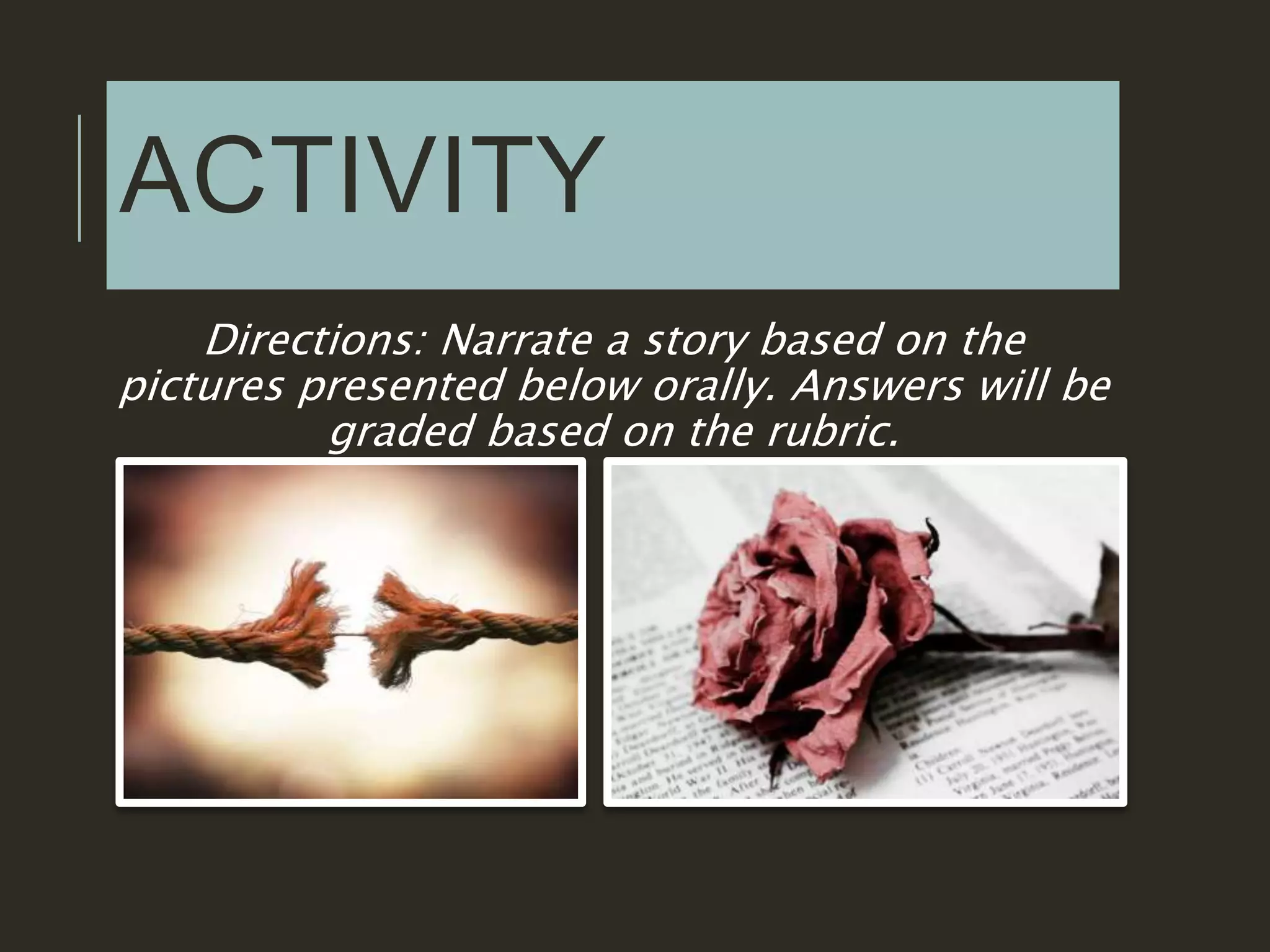
Directions: Narrate a story based on the
pictures presented below orally. Answers will be
graded based on the rubric.
3. PICTURE AND
DIAGRAMS
Type 3. The students are given a
pair of identical pictures to study
for a few minutes then they are
required to compare the two.
Scores for general fluency,
grammar, vocabulary, phonology,
and accuracy of description are
based on a rubric.
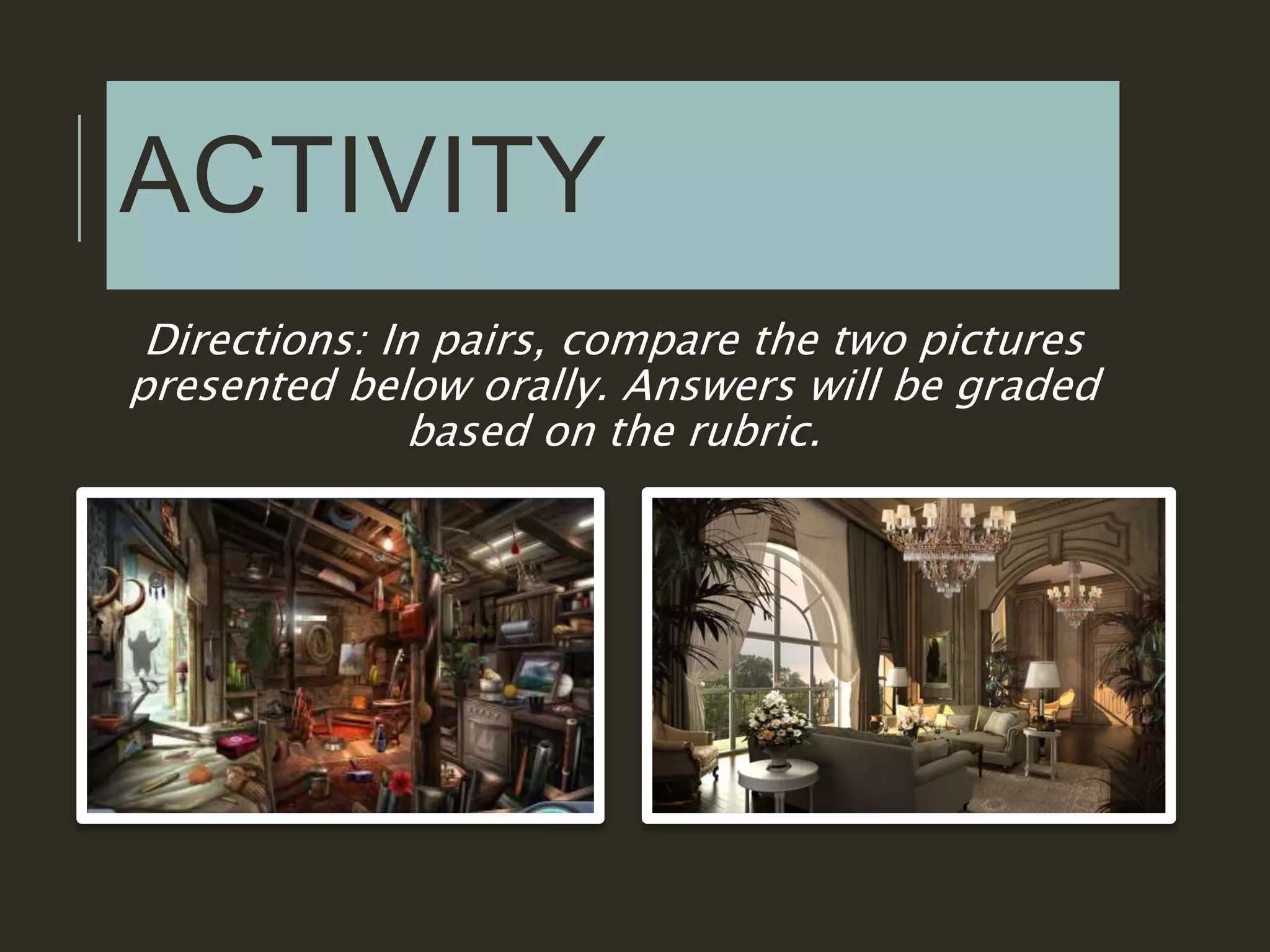
ACTIVITY
Directions: In pairs, compare the two pictures
presented below orally. Answers will be graded
based on the rubric.
3. PICTURE AND
DIAGRAMS
Type 4. The most effective type of
oral examination on using pictures
requires not only
narration/description/comparison
but also discussion about the
picture/s concerned.
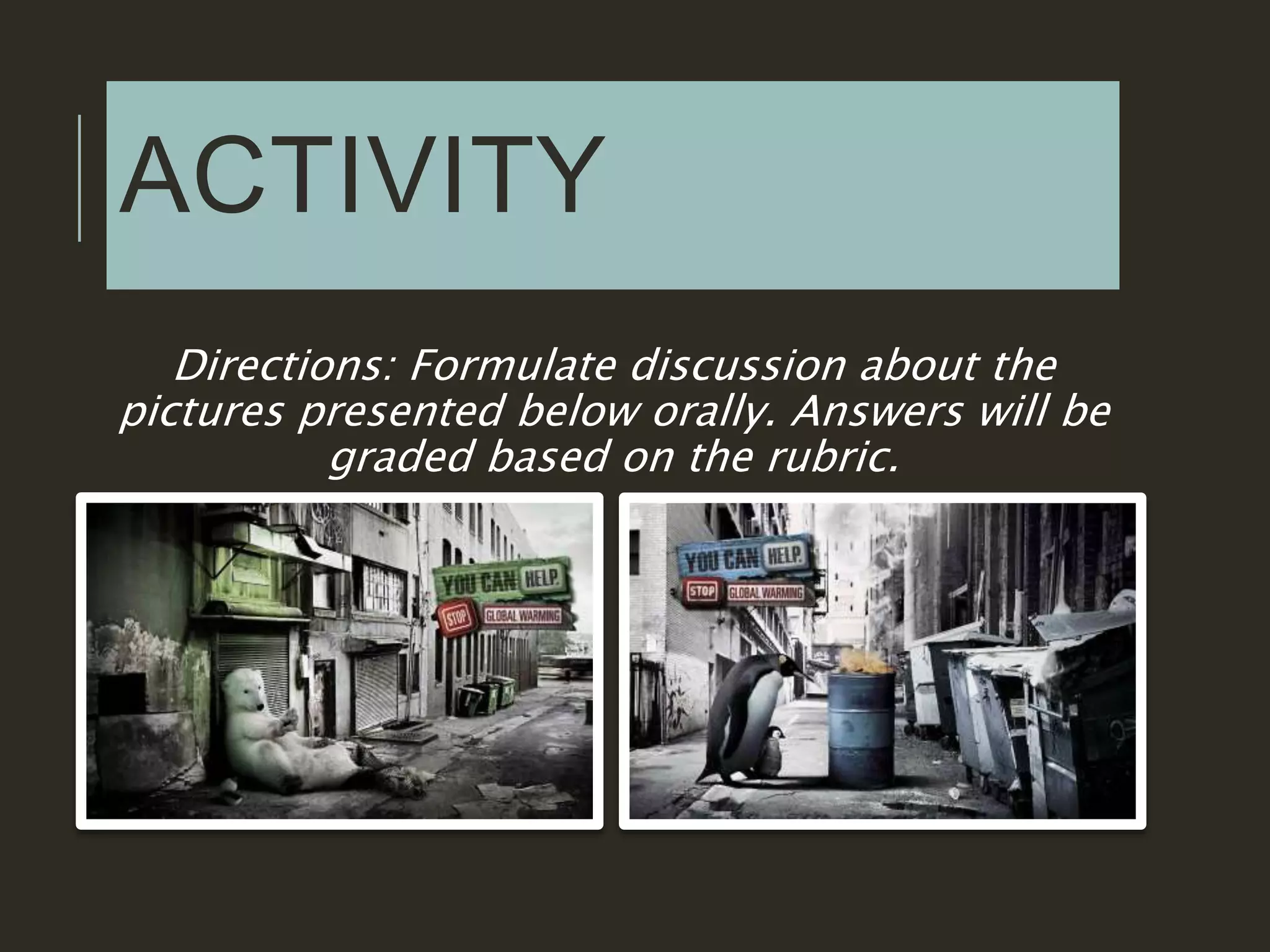
ACTIVITY
Directions: Formulate discussion about the
pictures presented below orally. Answers will be
graded based on the rubric.
3. PICTURE AND
DIAGRAMS
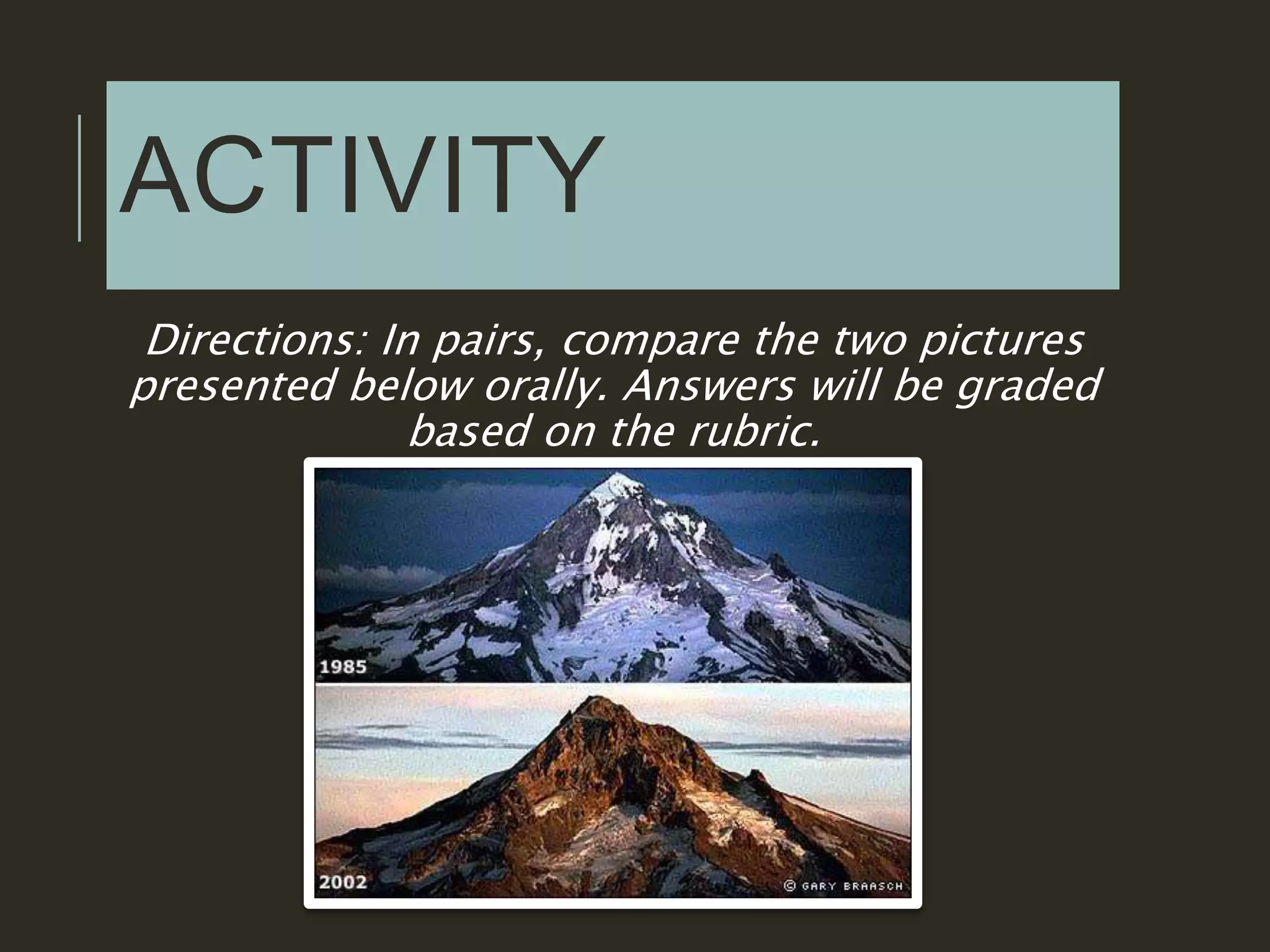
Type 5. Another effective way of
assessing students’ ability to speak is by
giving them a simple task to perform.
Working in pairs, students can describe
their own picture before listening to their
partner’s description of a similar but not
identical picture. However, the two
cannot see each other’s picture. They can
then discuss in which ways the two
pictures are the same and in which they
differ.
ACTIVITY
Directions: In pairs, compare the two pictures
presented below orally. Answers will be graded
based on the rubric.
3. PICTURE AND
DIAGRAMS
Type 6. Another useful way to assess
speaking skills is by involving pictures to
be arranged in sequence. Students
should begin by describing their own
picture without showing it to other
members of the group. After each picture
has been described and discussed in
relation to other pictures, the group
decides on an appropriate sequence.
Each member of the group then puts
down his/her picture in the order
ACTIVITY
ABC D
4. ORAL
INTERVIEW
This type of examination appears to
offer a realistic means of assessing
the total oral skills in a natural
speech situation. However, the
assessment tend to be highly
subjective and has only low
reliability.
RUBRIC
ACTIVITY
Directions: Respond to the following questions
accordingly. You will be graded based on the
rubric.
Today is the day. You are now heading to the main
office for your job interview. You sit and patiently
wait for your turn until a woman tells you: “Mr. Grey
will see you now.”
ARE YOU
READY?
ACTIVITY
Mr. Grey: Hi. Good morning. And you are?
Mr. Grey: Yes, Ms. _______. What can I do for
you?
Mr. Grey: Can you tell me something that is not
here in your job applicant form?
Mr. Grey: What are your edges among other
applicants?
How about your strengths?
Your weaknesses?
What do you have that others don’t?
ACTIVITY
Mr. Grey: I see. Among all other companies, why
did you choose my company?
Mr. Grey: What made you think you will gain
satisfaction here?
Mr. Grey: Please describe yourself in three
words.
Mr. Grey: Thank you. You will be contacted by
my personnel to see how it goes.
OTHER ORAL
TEST FORMATS
Short Talk
Group Discussion
Roleplaying
1. SHORT TALK
In certain examinations, students
are required to prepare a short talk
on a given topic. They may be
allowed several days or only a few
minutes in which to prepare the talk
and in some cases, they may be
provided with notes or reference
materials.
ACTIVITY
Directions: Respond to each question
accordingly.
1. If you are to choose between
beauty and intelligence, what would
you choose and why?
2. What is your stand with our current
president’s war on drugs?
3. What is your dream wedding?
2. GROUP
DISCUSSION
In here, students are given an
opportunity to use exploratory
talk for more meaningful and
active involvement.
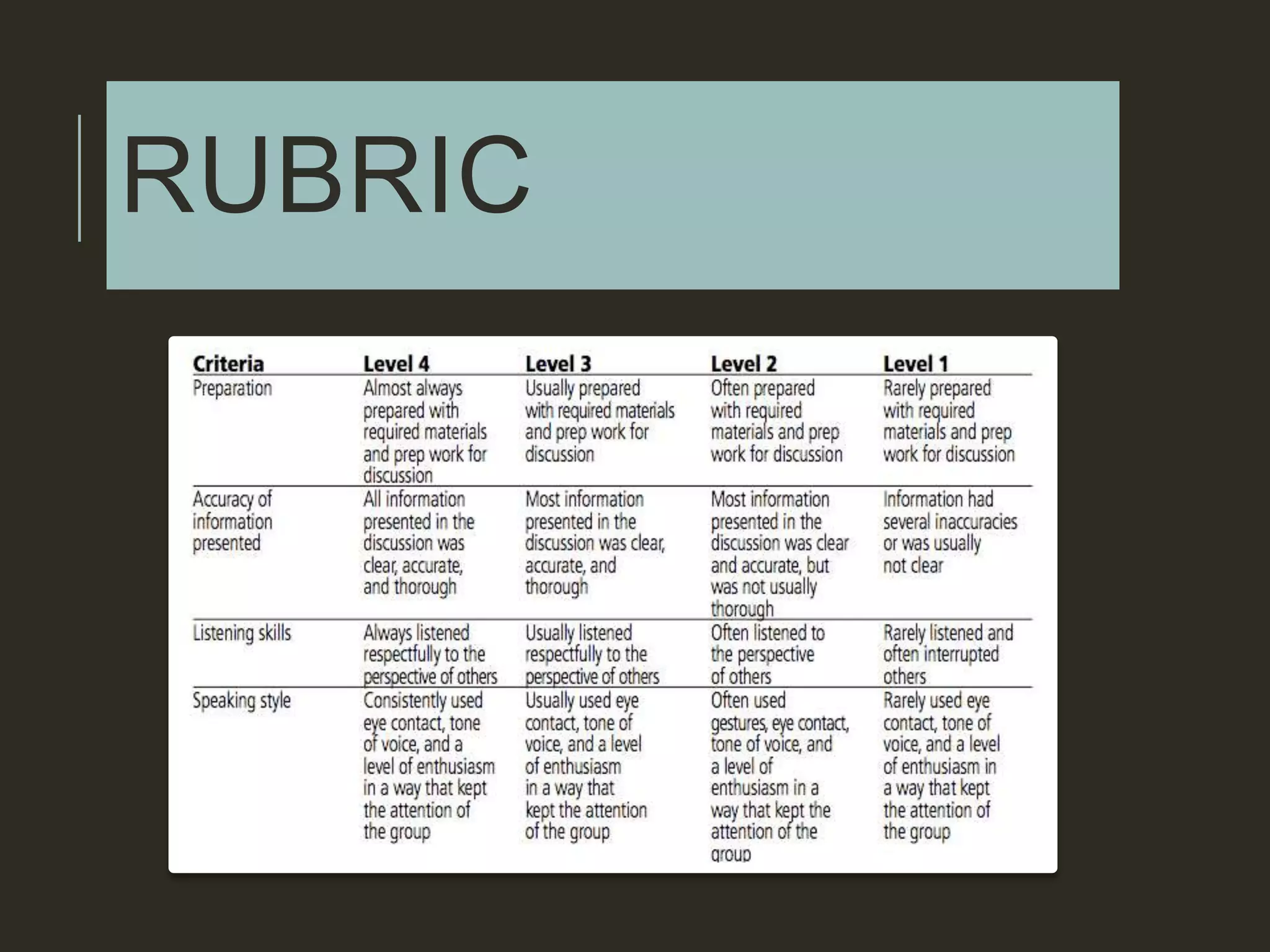
RUBRIC
ACTIVITY
Instructions:
 Ask the students to form a circle.
 Everyone is encouraged to
respond to the situation to be given
by the teacher.
You are to meet your in-laws,
what would you choose to wear
and why?
3. ROLEPLAY
The students are assigned
fictitious roles and are required
to improvise language and
behavior.
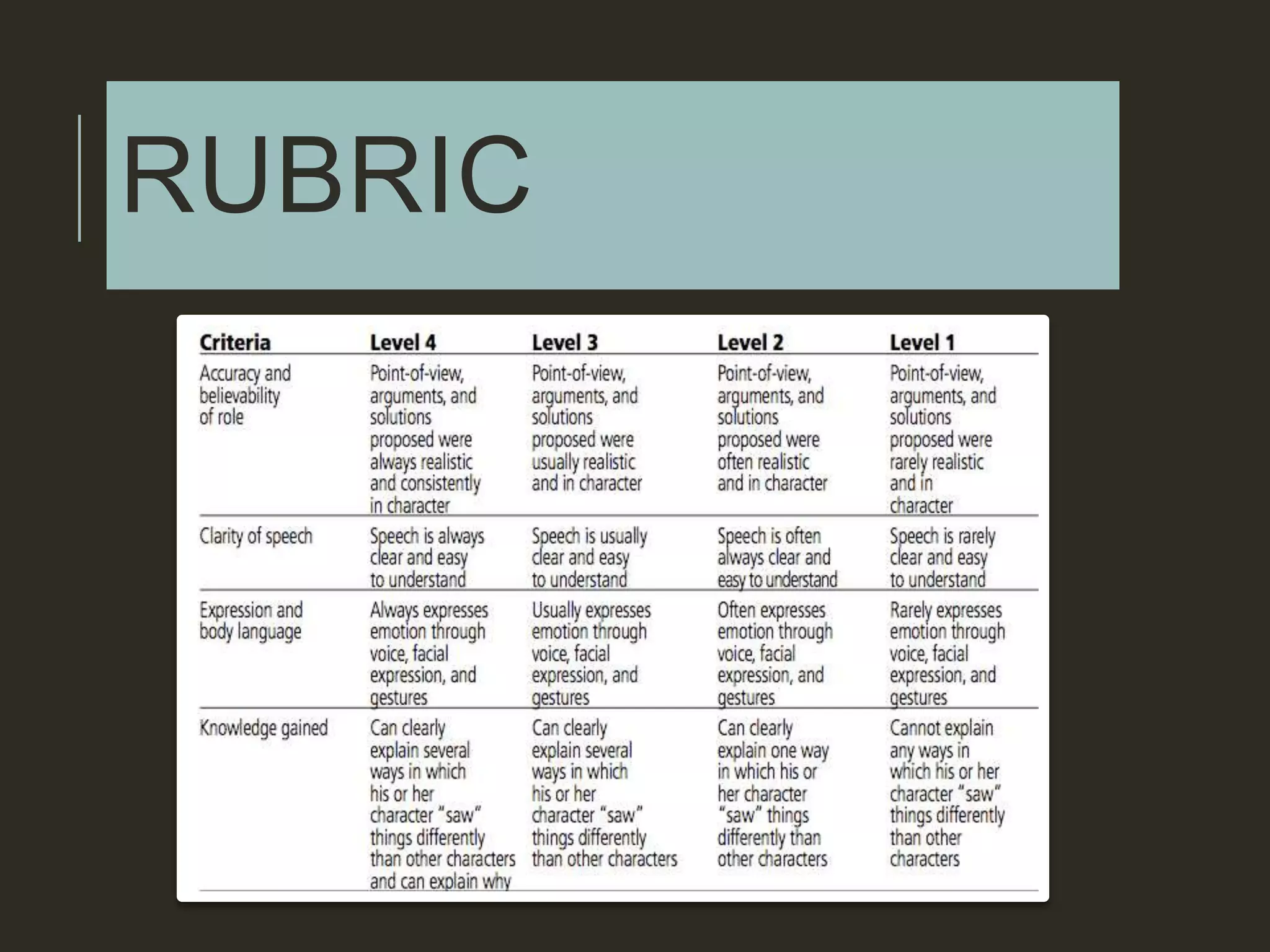
RUBRIC
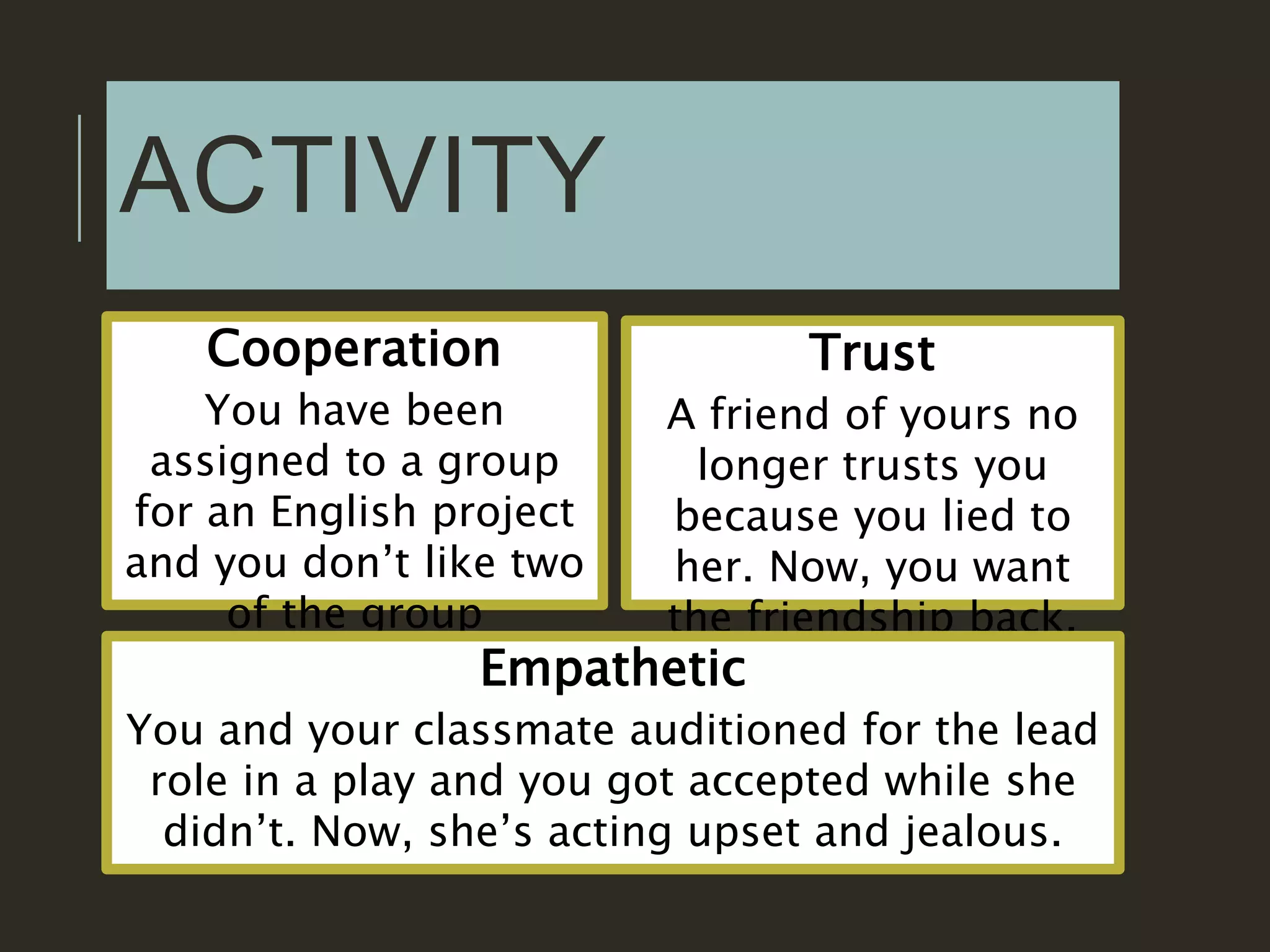
ACTIVITY
Cooperation
You have been
assigned to a group
for an English project
and you don’t like two
of the group
members.
Trust
A friend of yours no
longer trusts you
because you lied to
her. Now, you want
the friendship back.
Empathetic
You and your classmate auditioned for the lead
role in a play and you got accepted while she
didn’t. Now, she’s acting upset and jealous.
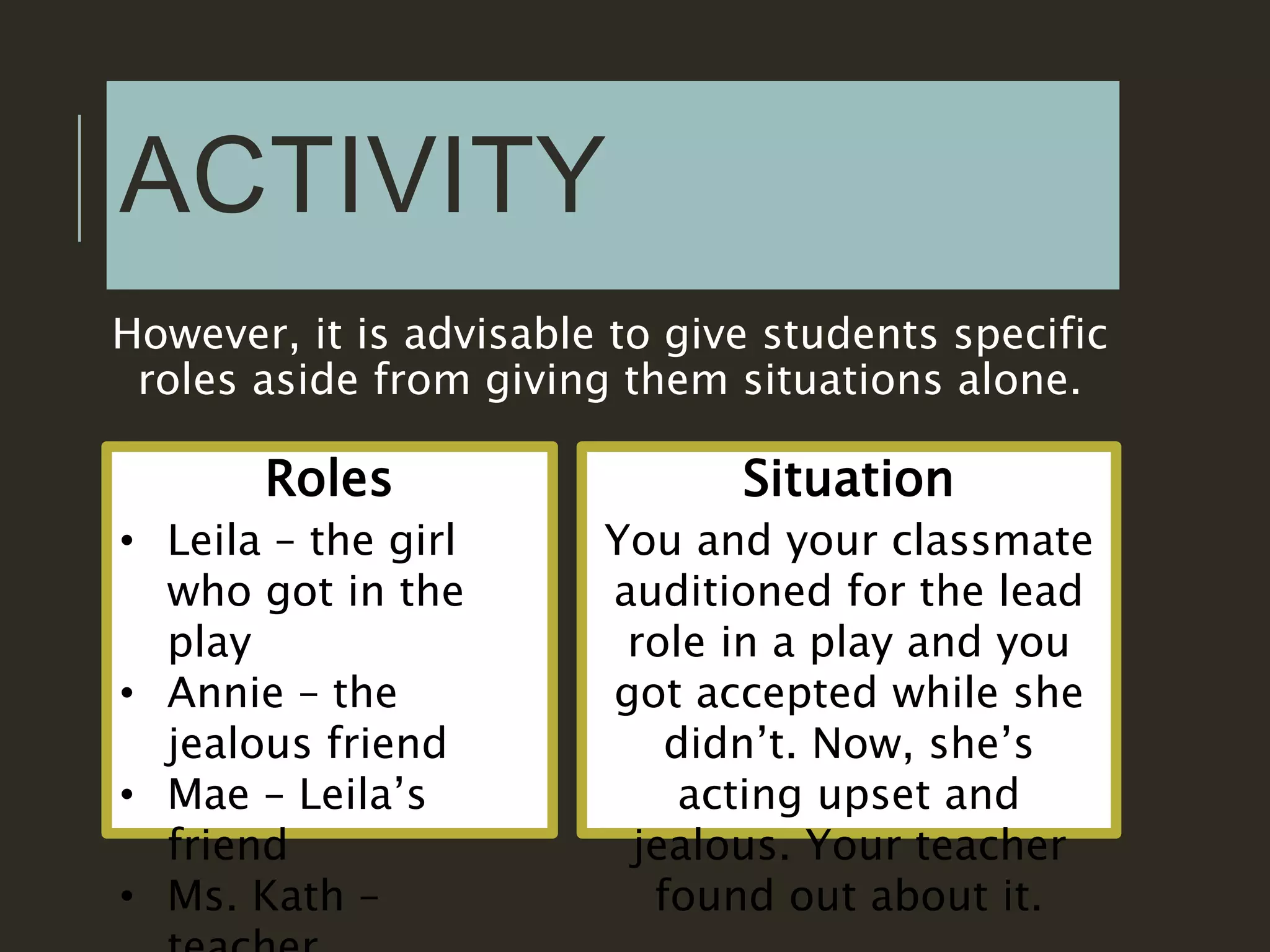
ACTIVITY
Roles
• Leila – the girl
who got in the
play
• Annie – the
jealous friend
• Mae – Leila’s
friend
• Ms. Kath –
However, it is advisable to give students specific
roles aside from giving them situations alone.
Situation
You and your classmate
auditioned for the lead
role in a play and you
got accepted while she
didn’t. Now, she’s
acting upset and
jealous. Your teacher
found out about it.

Testing Speaking (Language and Literature Assesment)

  • 1.
  • 2.
    WHAT IS SPEAKING?  theaction of conveying information or expressing one's thoughts and feelings in spoken language  to utter words or articulate sounds  an interactive process of constructing meaning that involves producing and receiving and
  • 3.
    WHAT ARE WETRYING TO MEASURE? In testing speaking, we are trying to measure the students’ ability to INTERACT in the target language in spoken form. Therefore, this involves not just PRODUCTION but as well as COMPREHENSION.
  • 4.
    TESTING SPEAKING Why is itso difficult to test the speaking skills?  It is neither possible nor desirable to separate the speaking skills from listening skills because these two are interdependent.  It is frequently impossible to administer a reliable test to a large number of students because of limited time.
  • 5.
    TEST FORMATS FOR SPEAKING ReadingAloud Conversational Exchanges Pictures and Diagrams Oral Interview More others…
  • 6.
    1. READING ALOUD Many present-dayoral tests include a test of reading aloud in which the students are given a short time to glance through an extract before being required to read it aloud. Tests involving reading aloud are generally used to assess the students’ pronunciation skills.
  • 7.
    READING ALOUD In readingaloud, it is helpful to imagine actual situations: Reading aloud directions to a friend(e.g., how to cook a certain dish) Reading aloud a letter Re-telling a short story or an incident
  • 8.
    ACTIVITY Pork Sinigang CookingInstructions 1. Boil water in a pot. 2. Add the pork liempo, tomato, onion, and tamarind sinigang soup mix. 3. Cover the pot and boil until the meat is tender. 4. Add the long chili pepper, radish, taro, string beans, and eggplant. 5. Cover the pot and continue boiling until the vegetables are cooked.
  • 9.
  • 10.
    2. CONVERSATIONAL EXCHANGES Constructive interplay with unpredictablestimuli and responses attempts to control the interaction taking place. The item types range from items presenting the testees with situations in which they initiate conversations to incomplete conversations with the part of one speaker omitted (one-sided
  • 11.
    2. CONVERSATIONAL EXCHANGES Type 1. Thetestees are given a series of situations and are required to construct sentences/lines accordingly.
  • 12.
    ACTIVITY Directions: Construct anddeliver lines orally whether it is a monologue or a dialogue according to the given situations below. 1. It’s raining heavily. Tom and Anna are waiting impatiently at home to set off on their picnic. 2. Delilah is waiting for her friends outside the cinema. The show is just about to start but they haven’t arrived yet. 3. Mrs. Green is living alone in a flat. She wishes she lives in a small house with a garden.
  • 13.
    2. CONVERSATIONAL EXCHANGES Type 2. Thistype of test item is similar to the previous one but not as strictly controlled. No made responses are given by the examiner and the students are free to use whatever response they wish.
  • 14.
    ACTIVITY Directions: Respond orallyaccording to the given situations below. 1. A friend of yours has been dumped by her boyfriend. She would not stop crying. What will you tell her? 2. You are on your way home when you see your little brother being bullied by his classmates. You approach them angrily. What will you say to his classmates? 3. You and your boyfriend are about to go on a date. Your best friend suddenly popped inside your room inviting you to a party.
  • 15.
    2. CONVERSATIONAL EXCHANGES Type 3. Thestudents hear a stimulus to which they must respond in any appropriate way. This test item relies on conventional greetings, apologies, acceptable ways, or expressing polite disagreement, etc.
  • 16.
    ACTIVITY Directions: Respond orallyand appropriately to the given situations below. 1. Do you mind if I sit next to you? 2. Mary asked me to say she’s sorry she can’t come tonight. 3. What about pizza and carbonara tonight? 4. Oh, dear, it’s raining again. How about we go to the beach next weekend? 5. What have you done?!
  • 17.
    2. CONVERSATIONAL EXCHANGES Type 4. Thisis similar to the previous item type, but the stimuli and responses form part of a longer dialogue and the situation is thus developed. Because of its total predictability, however, this type of item is sometimes referred to as ‘the dialogue of the deaf.’ The man in the dialogue continues regardless what the testee says.
  • 18.
    ACTIVITY Directions: Respond orallyaccording to the given lines.1. You are on your way to the supermarket. A man comes up and speaks to you. Man: Excuse me. I wonder if you can help me out. I’m looking for a girl named Gelie. (Testee’s reply) Man: Thank you. Do you know where can I find her? (Testee’s reply) Man: Thanks a lot. By the way, do you have her phone number?
  • 19.
    ACTIVITY Directions: Respond orallyaccording to the given lines. 2. You bumped with your ex-boyfriend and you splashed your juice to him. Ex-bf: Woah, there! Watch your steps! (Testee’s reply) Ex-bf: Oh, man. Hi Roselyn, I didn’t know it was you. (Testee’s reply) Ex-bf: No, no, don’t say sorry. It’s okay. Gotta go! (Testee’s reply)
  • 20.
    ACTIVITY Directions: Respond orallyaccording to the given lines. 2. You are arguing with your mom about going out this Friday night. Mom: Where are you going and who are you with? (Testee’s reply) Mom: Nope. So not happening! (Testee’s reply) Man: Oh my God! When will you ever listen to your mother?! (Testee’s reply)
  • 21.
    2. CONVERSATIONAL EXCHANGES Type 5. Thisitem takes the form of an incomplete dialogue with prompts whispered in the student’s ear.
  • 22.
    ACTIVITY Directions: Respond orallyto the situation using the prompts to be given by your teacher. 1. You are at the reception desk of a large hotel. The receptionist turns to address you. Receptionist: Can I help you? You: ___________________________________________ Receptionist: Yes, we have a single room with an attached bathroom. You: ___________________________________________
  • 23.
    ACTIVITY Receptionist: Thirty-four poundsfifty a right. You: ___________________________________________ Receptionist: Yes, that’s with continental breakfast. You: ___________________________________________ Receptionist: It’s fruit juice, coffee or tea, and bread rolls. You: ___________________________________________
  • 24.
    ACTIVITY Directions: Respond orallyto the situation using the prompts to be given by your teacher. 2. You are at the mall and you saw your much awaited copy of Taylor Swift’s latest song album. A saleslady approached you. Saleslady: It’s 10% off, would you like to avail it? You: ___________________________________________ Saleslady: But I think there aren’t much copies left. You: ___________________________________________
  • 25.
    ACTIVITY Saleslady: Are yousure? You: ___________________________________________ Saleslady: Alright. You: ___________________________________________
  • 26.
    3. PICTURE AND DIAGRAMS Type1. The students are given a picture to study for a few minutes then they are required to describe the picture in a given time. Scores for general fluency, grammar, vocabulary, phonology, and accuracy of description are based on a rubric.
  • 27.
  • 28.
    ACTIVITY Directions: Describe eachpicture below orally. Answers will be graded based on the rubric.
  • 29.
    ACTIVITY Directions: Describe eachpicture below orally. Answers will be graded based on the rubric.
  • 30.
    3. PICTURE AND DIAGRAMS Type2. The students are given a set of pictures/diagrams to study for a few minutes then they are required to narrate the events that can be portrayed. Scores for general fluency, grammar, vocabulary, phonology, and accuracy of description are based on a rubric.
  • 31.
    ACTIVITY Directions: Narrate thestory based on the diagrams presented below orally. Answers will be graded based on the rubric. Last Monday, Dad and Rosie went to her doctor.
  • 32.
    ACTIVITY Directions: Narrate astory based on the pictures presented below orally. Answers will be graded based on the rubric.
  • 33.
    ACTIVITY Directions: Narrate astory based on the pictures presented below orally. Answers will be graded based on the rubric.
  • 34.
    3. PICTURE AND DIAGRAMS Type3. The students are given a pair of identical pictures to study for a few minutes then they are required to compare the two. Scores for general fluency, grammar, vocabulary, phonology, and accuracy of description are based on a rubric.
  • 35.
    ACTIVITY Directions: In pairs,compare the two pictures presented below orally. Answers will be graded based on the rubric.
  • 36.
    3. PICTURE AND DIAGRAMS Type4. The most effective type of oral examination on using pictures requires not only narration/description/comparison but also discussion about the picture/s concerned.
  • 37.
    ACTIVITY Directions: Formulate discussionabout the pictures presented below orally. Answers will be graded based on the rubric.
  • 38.
    3. PICTURE AND DIAGRAMS Type5. Another effective way of assessing students’ ability to speak is by giving them a simple task to perform. Working in pairs, students can describe their own picture before listening to their partner’s description of a similar but not identical picture. However, the two cannot see each other’s picture. They can then discuss in which ways the two pictures are the same and in which they differ.
  • 39.
    ACTIVITY Directions: In pairs,compare the two pictures presented below orally. Answers will be graded based on the rubric.
  • 40.
    3. PICTURE AND DIAGRAMS Type6. Another useful way to assess speaking skills is by involving pictures to be arranged in sequence. Students should begin by describing their own picture without showing it to other members of the group. After each picture has been described and discussed in relation to other pictures, the group decides on an appropriate sequence. Each member of the group then puts down his/her picture in the order
  • 41.
  • 42.
    4. ORAL INTERVIEW This typeof examination appears to offer a realistic means of assessing the total oral skills in a natural speech situation. However, the assessment tend to be highly subjective and has only low reliability.
  • 43.
  • 44.
    ACTIVITY Directions: Respond tothe following questions accordingly. You will be graded based on the rubric. Today is the day. You are now heading to the main office for your job interview. You sit and patiently wait for your turn until a woman tells you: “Mr. Grey will see you now.” ARE YOU READY?
  • 45.
    ACTIVITY Mr. Grey: Hi.Good morning. And you are? Mr. Grey: Yes, Ms. _______. What can I do for you? Mr. Grey: Can you tell me something that is not here in your job applicant form? Mr. Grey: What are your edges among other applicants? How about your strengths? Your weaknesses? What do you have that others don’t?
  • 46.
    ACTIVITY Mr. Grey: Isee. Among all other companies, why did you choose my company? Mr. Grey: What made you think you will gain satisfaction here? Mr. Grey: Please describe yourself in three words. Mr. Grey: Thank you. You will be contacted by my personnel to see how it goes.
  • 47.
    OTHER ORAL TEST FORMATS ShortTalk Group Discussion Roleplaying
  • 48.
    1. SHORT TALK Incertain examinations, students are required to prepare a short talk on a given topic. They may be allowed several days or only a few minutes in which to prepare the talk and in some cases, they may be provided with notes or reference materials.
  • 49.
    ACTIVITY Directions: Respond toeach question accordingly. 1. If you are to choose between beauty and intelligence, what would you choose and why? 2. What is your stand with our current president’s war on drugs? 3. What is your dream wedding?
  • 50.
    2. GROUP DISCUSSION In here,students are given an opportunity to use exploratory talk for more meaningful and active involvement.
  • 51.
  • 52.
    ACTIVITY Instructions:  Ask thestudents to form a circle.  Everyone is encouraged to respond to the situation to be given by the teacher. You are to meet your in-laws, what would you choose to wear and why?
  • 53.
    3. ROLEPLAY The studentsare assigned fictitious roles and are required to improvise language and behavior.
  • 54.
  • 55.
    ACTIVITY Cooperation You have been assignedto a group for an English project and you don’t like two of the group members. Trust A friend of yours no longer trusts you because you lied to her. Now, you want the friendship back. Empathetic You and your classmate auditioned for the lead role in a play and you got accepted while she didn’t. Now, she’s acting upset and jealous.
  • 56.
    ACTIVITY Roles • Leila –the girl who got in the play • Annie – the jealous friend • Mae – Leila’s friend • Ms. Kath – However, it is advisable to give students specific roles aside from giving them situations alone. Situation You and your classmate auditioned for the lead role in a play and you got accepted while she didn’t. Now, she’s acting upset and jealous. Your teacher found out about it.