Assesing Writing
The assesment of writing is no simple task.
As you consider assesing students writing
ability, as usual you need to be clear about
your objective or criterion.
Simply says what is it you want to
test?
Types of Writting Perfomance
1. Imitative
2. Intensive
3. Responsive
4. Extensive
Imitative Writing
 It is also call as fundamental skill assesment. The ability to
spell correctly and to perceive phoneme-grapheme
correspondences in the English Spelling System.
 There are two types of basic training in Imitative writing
assessments
Task in (hand) writing Letters, Words, and Punctuation.
 Spelling Task and Detecting Phoneme-Grapheme
Correspondences
Task in (hand) writing Letters, Words, and
Punctuation.
 A limited variety of types of tasks are commonly used to asses a
person ability to produce written letters and symbols. Let’s see the
examples below.
1. Copying
There is nothing innovative or modern about directing a test-takers to
copy letters or words.
 2. Listening cloze selection task.
This task combine dictation with a writers script that has relatively
deletion ratio. The purpose of this stage is not to test spelling but to
give practice in writing.
Example:
3. Converting Numbers and
Abbreviations
 This task can serve as a reasonably reliable method to
stimulate handwritten English.
Spelling Task and Detecting Phoneme-
Grapheme Correspondences
 A number of task types are in popular use to assess the ability to
spell words correctly and to process phoneme-grapheme
correspondences.
Example:
1. Spelling Test
the teacher dictates a simple words, one word at a time,
followed by the two word in a sentence, repeated again, with a pause
for test-takers to write the words.
2. Multiple-choice Technique
 Presenting words phrases in the similar forms. It might be more
challenging.
 Example:
3. Matching phonetic symbols.
 This task can be used since the students have become familiar wit
the phonetic symbols and asked to write correctly spelled word
alphabetically.
 Example:
Intensive (controlled) writing
 This task focuses on display the test-takes competence in
grammar, vocabulary or sentence formation.
1. Dictation and Dicto-comp
 Dictation is simply the rendition of what one hears aurally,
(imitative writing).
 Dicto-Comp, a paragraph is read a normal speed, usually
two or three times. Then the teacher asks students to rewrite
the paragraph from the best of their recollection.
2. Grammatical Transformation
task.
 Sometimes test designers attempt to add authenticity by
providing a context “Today Doug is doing all things, tomorrow
he will do the same things again. Write about what Doug will
do tomorrow by using the future tense.”
Numerous versions of the task are possible to give
3. Picture-Cued Task
 The main advantage of this technique is in detaching reading and
writing connection.
 Example, Picture sequence description
4. Vocabulary Assessment Task
The major technique s used to assess vocabulary are
defining and using a word in sentence.
Read (2000) suggested several types of items for
assessment of basic knowledge of the meaning of a
word, collocation possibilities, and derived morphological
forms.
5. Ordering task
 One task at he sentence level may appeal to those who are
fond of words games and puzzles: ordering the scrambles
words into a correct sentence.
Issues in assessing responsive and
extensive writing
 Responsive writing focus on rhetorical conventions of paragraph
structure and of connecting two or three paragraphs in texts of limited
length. The learners are responsible for accomplishing a purpose in
writing.
 Extensive, or “free,” writing takes all the principle and guidelines or
responsive writing and puts them into practice in longer text such as
full-lenght essays, terms papers, project reports, and theses and
dissertations. While in extensive writing, however, the writer has been
given even more freedom to choose: topics, length, style and
perhaps.
Cont….
Both responsive and extensive writing tasks are
the subject of some classic. The different flavor
from those at the lower-end production of writing
are in.
1. Authenticity
2. Scoring
3. Time
Responsive & Extensive Writing
1. Paraphrasing
2. Guided Question and Answer.
 A guided question and answer format in which the test
administrator poses a series questions that essentially serve
as an outline of the emergent written text.
3. Paragraph Construction Tasks
Writing is the art of emulating what one reads. When you
read an effective paragraph: you analyze the ingredients
of its success. Assessment of paragraph development
takes on a number of different forms.
a) Topic Sentence Writing
b) Topic development within a paragraph
c) Development of main and supporting ideas across
paragraphs.
4. Strategic Options
Developing main ideas and supporting ideas is the goal
for the writer attempting to create an effective text,
whether a short one to two paragraphs.
1. Attending to the task in responsive writing, the
context is seldom completely open-ended.
2. Attending to Genre the extent to which both the
constrains and the opportunities of the genre are
exploited.
5. Test of Written English (TWE)
 The TWE is in the category of a timed impromptu test in test takers
under a 30 minute time limit are not able to prepare ahead of time for
the topic that will appear.
Scoring methods for responsive and
extensive writing
1. Holistic Scoring
2. Primary Trait Scoring
 This type of scoring emphasizes the task at hand and
assigns a score based on the effectiveness of the text’s
achieving that one goal.
 For rating primary Trait of the task, Lloyd-Jones (1977)
suggested a four point scale ranging from zero to 4. in
summary, a primary tail score would assess:
3. Analytical Scoring
 Brown and Bailey (1984) designed this an analytical scoring
scale that specified five major categories (organization,
logical development of ideas, grammar,
punctuation/spelling/mechanics, style and quality of
expression) and description of five different levels in each
category, ranging from ‘unacceptable’ to ‘excellent’
Example
Beyond Scoring: Responding to
Extensive Writing
Assessment takes on a crucial role in such an
approach. Learning how to become a good writer
places the student in an almost constant stage of
assessment. To guide students to the maximum
benefit of assessment, it is important to consider
A. Earlier stages (from free writing to the first draft
or two)
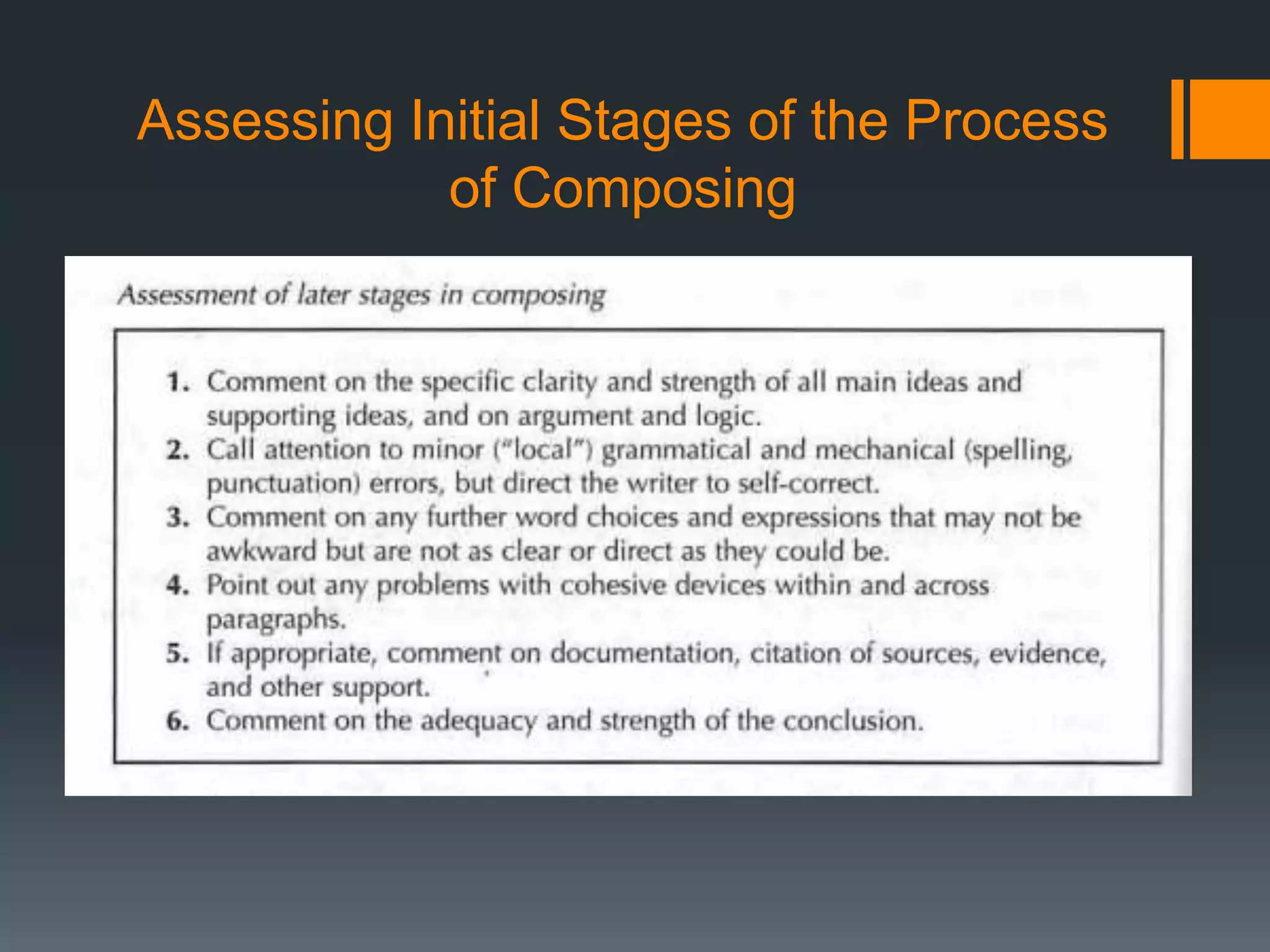
B. Later stages (revising and finalizing)
Assessing Initial Stages of the Process
of Composing
Assessing Initial Stages of the Process
of Composing

langauge Testing - Assesing writing

  • 1.
  • 2.
    The assesment ofwriting is no simple task. As you consider assesing students writing ability, as usual you need to be clear about your objective or criterion. Simply says what is it you want to test?
  • 3.
    Types of WrittingPerfomance 1. Imitative 2. Intensive 3. Responsive 4. Extensive
  • 4.
    Imitative Writing  Itis also call as fundamental skill assesment. The ability to spell correctly and to perceive phoneme-grapheme correspondences in the English Spelling System.  There are two types of basic training in Imitative writing assessments Task in (hand) writing Letters, Words, and Punctuation.  Spelling Task and Detecting Phoneme-Grapheme Correspondences
  • 5.
    Task in (hand)writing Letters, Words, and Punctuation.  A limited variety of types of tasks are commonly used to asses a person ability to produce written letters and symbols. Let’s see the examples below. 1. Copying There is nothing innovative or modern about directing a test-takers to copy letters or words.
  • 6.
     2. Listeningcloze selection task. This task combine dictation with a writers script that has relatively deletion ratio. The purpose of this stage is not to test spelling but to give practice in writing. Example:
  • 7.
    3. Converting Numbersand Abbreviations  This task can serve as a reasonably reliable method to stimulate handwritten English.
  • 8.
    Spelling Task andDetecting Phoneme- Grapheme Correspondences  A number of task types are in popular use to assess the ability to spell words correctly and to process phoneme-grapheme correspondences. Example: 1. Spelling Test the teacher dictates a simple words, one word at a time, followed by the two word in a sentence, repeated again, with a pause for test-takers to write the words.
  • 9.
    2. Multiple-choice Technique Presenting words phrases in the similar forms. It might be more challenging.  Example:
  • 10.
    3. Matching phoneticsymbols.  This task can be used since the students have become familiar wit the phonetic symbols and asked to write correctly spelled word alphabetically.  Example:
  • 11.
    Intensive (controlled) writing This task focuses on display the test-takes competence in grammar, vocabulary or sentence formation. 1. Dictation and Dicto-comp  Dictation is simply the rendition of what one hears aurally, (imitative writing).  Dicto-Comp, a paragraph is read a normal speed, usually two or three times. Then the teacher asks students to rewrite the paragraph from the best of their recollection.
  • 12.
    2. Grammatical Transformation task. Sometimes test designers attempt to add authenticity by providing a context “Today Doug is doing all things, tomorrow he will do the same things again. Write about what Doug will do tomorrow by using the future tense.” Numerous versions of the task are possible to give
  • 13.
    3. Picture-Cued Task The main advantage of this technique is in detaching reading and writing connection.  Example, Picture sequence description
  • 14.
    4. Vocabulary AssessmentTask The major technique s used to assess vocabulary are defining and using a word in sentence. Read (2000) suggested several types of items for assessment of basic knowledge of the meaning of a word, collocation possibilities, and derived morphological forms.
  • 15.
    5. Ordering task One task at he sentence level may appeal to those who are fond of words games and puzzles: ordering the scrambles words into a correct sentence.
  • 16.
    Issues in assessingresponsive and extensive writing  Responsive writing focus on rhetorical conventions of paragraph structure and of connecting two or three paragraphs in texts of limited length. The learners are responsible for accomplishing a purpose in writing.  Extensive, or “free,” writing takes all the principle and guidelines or responsive writing and puts them into practice in longer text such as full-lenght essays, terms papers, project reports, and theses and dissertations. While in extensive writing, however, the writer has been given even more freedom to choose: topics, length, style and perhaps.
  • 17.
    Cont…. Both responsive andextensive writing tasks are the subject of some classic. The different flavor from those at the lower-end production of writing are in. 1. Authenticity 2. Scoring 3. Time
  • 18.
    Responsive & ExtensiveWriting 1. Paraphrasing
  • 19.
    2. Guided Questionand Answer.  A guided question and answer format in which the test administrator poses a series questions that essentially serve as an outline of the emergent written text.
  • 20.
    3. Paragraph ConstructionTasks Writing is the art of emulating what one reads. When you read an effective paragraph: you analyze the ingredients of its success. Assessment of paragraph development takes on a number of different forms. a) Topic Sentence Writing b) Topic development within a paragraph c) Development of main and supporting ideas across paragraphs.
  • 21.
    4. Strategic Options Developingmain ideas and supporting ideas is the goal for the writer attempting to create an effective text, whether a short one to two paragraphs. 1. Attending to the task in responsive writing, the context is seldom completely open-ended. 2. Attending to Genre the extent to which both the constrains and the opportunities of the genre are exploited.
  • 22.
    5. Test ofWritten English (TWE)  The TWE is in the category of a timed impromptu test in test takers under a 30 minute time limit are not able to prepare ahead of time for the topic that will appear.
  • 23.
    Scoring methods forresponsive and extensive writing
  • 24.
  • 25.
    2. Primary TraitScoring  This type of scoring emphasizes the task at hand and assigns a score based on the effectiveness of the text’s achieving that one goal.  For rating primary Trait of the task, Lloyd-Jones (1977) suggested a four point scale ranging from zero to 4. in summary, a primary tail score would assess:
  • 26.
    3. Analytical Scoring Brown and Bailey (1984) designed this an analytical scoring scale that specified five major categories (organization, logical development of ideas, grammar, punctuation/spelling/mechanics, style and quality of expression) and description of five different levels in each category, ranging from ‘unacceptable’ to ‘excellent’
  • 27.
  • 28.
    Beyond Scoring: Respondingto Extensive Writing Assessment takes on a crucial role in such an approach. Learning how to become a good writer places the student in an almost constant stage of assessment. To guide students to the maximum benefit of assessment, it is important to consider A. Earlier stages (from free writing to the first draft or two) B. Later stages (revising and finalizing)
  • 29.
    Assessing Initial Stagesof the Process of Composing
  • 30.
    Assessing Initial Stagesof the Process of Composing