COMMUNICATIVE
TESTING

By :
Ningsih Sri Mulyani
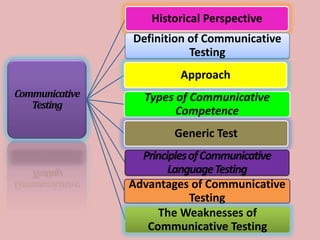
Historical Perspective
Definition of Communicative
Testing
Approach
Communicative
Testing

Types of Communicative
Competence
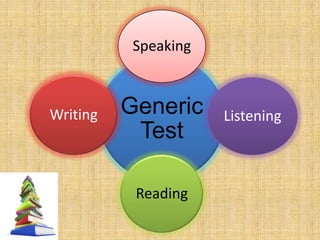
Generic Test
Principles of Communicative
Language Testing
Advantages of Communicative
Testing
The Weaknesses of
Communicative Testing
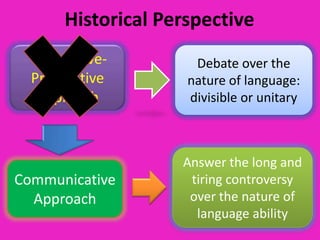
Historical Perspective
IntegrativePragmative
Approach

Debate over the
nature of language:
divisible or unitary

Communicative
Approach

Answer the long and
tiring controversy
over the nature of
language ability
What is communicative testing?
• Communicative Language Testing is intended to
provide test-takers with information about the testtaker’s ability to perform the target language in
certain context-specific tasks.
• It has to be recognized that given the constrains of
time and practicality, only a small sample of the
tester-test-takers’ language can be collected
• However realistic the tasks may be intended to be,
the students’ performance will inevitably reflect the
fact the s/he was performing under tests conditions.
CA

Function of
Language

Listening
Speaking
Reading
Writing

Means of
communication
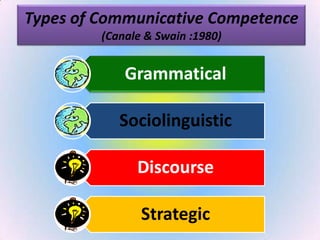
Types of Communicative Competence
(Canale & Swain :1980)

Grammatical
Sociolinguistic
Discourse
Strategic
Language
competence

Knowledge
structures

Language
Ability
Components
(Bachman:1990)

Context of
situation

4

Psychological
mechanisms

Strategic
competence
Speaking

Writing

Generic
Test
Reading

Listening
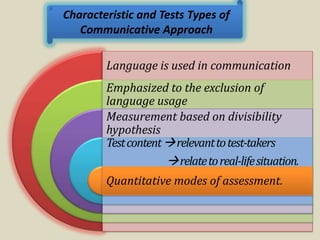
Characteristic and Tests Types of
Communicative Approach
Language is used in communication
Emphasized to the exclusion of
language usage
Measurement based on divisibility
hypothesis
Test content  relevant to test-takers
 relate to real-life situation.

Quantitative modes of assessment.
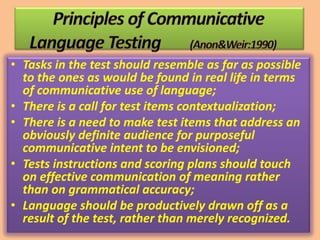
• Tasks in the test should resemble as far as possible
to the ones as would be found in real life in terms
of communicative use of language;
• There is a call for test items contextualization;
• There is a need to make test items that address an
obviously definite audience for purposeful
communicative intent to be envisioned;
• Tests instructions and scoring plans should touch
on effective communication of meaning rather
than on grammatical accuracy;
• Language should be productively drawn off as a
result of the test, rather than merely recognized.
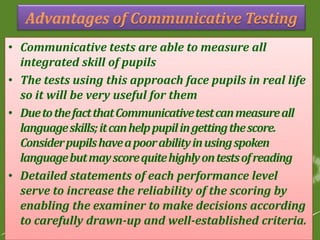
• Communicative tests are able to measure all
integrated skill of pupils
• The tests using this approach face pupils in real life
so it will be very useful for them
• Due to the fact that Communicative test can measure all
language skills; it can help pupil in getting the score.
Consider pupils have a poor ability in using spoken
language but may score quite highly on tests of reading
• Detailed statements of each performance level
serve to increase the reliability of the scoring by
enabling the examiner to make decisions according
to carefully drawn-up and well-established criteria.
The Weaknesses of Communicative
Testing
• Different from structuralism
approach this approach will not
be able to grasp structurally
because communicative
competence can ever be achieved
without a considerable mastery
of the grammar of a language
• It is unavoidable that cultural
bias affects the reliability of the
Write an application to the position as
advertised of about 200 words. You very much
want to be in the position. So, be convincing
and make yourself sound fitting to the
position. Your application should be clear,
well-organized and easy to read.
EXAMPLE:
• ‘That woman over there looks confused’
‘Why don’t you ask her______?’
a. does she need help?
d. do you need help
b. if she need help
e. she needs helps or not
c. whether she needs helps
(SPMB 2006-711:13)
• ‘Your haircut looks cool, Jane. I like it’
‘_______’
a. Come on. Don’t be joking
b. Oh really? Thanks a lot
c. Well, I have it hair-done
d. It is my style, you know?
e. I don’t think so. But thanks
Communicative  Testing

Communicative Testing

  • 1.
  • 2.
    Historical Perspective Definition ofCommunicative Testing Approach Communicative Testing Types of Communicative Competence Generic Test Principles of Communicative Language Testing Advantages of Communicative Testing The Weaknesses of Communicative Testing
  • 3.
    Historical Perspective IntegrativePragmative Approach Debate overthe nature of language: divisible or unitary Communicative Approach Answer the long and tiring controversy over the nature of language ability
  • 4.
    What is communicativetesting? • Communicative Language Testing is intended to provide test-takers with information about the testtaker’s ability to perform the target language in certain context-specific tasks. • It has to be recognized that given the constrains of time and practicality, only a small sample of the tester-test-takers’ language can be collected • However realistic the tasks may be intended to be, the students’ performance will inevitably reflect the fact the s/he was performing under tests conditions.
  • 5.
  • 6.
    Types of CommunicativeCompetence (Canale & Swain :1980) Grammatical Sociolinguistic Discourse Strategic
  • 7.
  • 8.
  • 9.
    Characteristic and TestsTypes of Communicative Approach Language is used in communication Emphasized to the exclusion of language usage Measurement based on divisibility hypothesis Test content  relevant to test-takers  relate to real-life situation. Quantitative modes of assessment.
  • 10.
    • Tasks inthe test should resemble as far as possible to the ones as would be found in real life in terms of communicative use of language; • There is a call for test items contextualization; • There is a need to make test items that address an obviously definite audience for purposeful communicative intent to be envisioned; • Tests instructions and scoring plans should touch on effective communication of meaning rather than on grammatical accuracy; • Language should be productively drawn off as a result of the test, rather than merely recognized.
  • 11.
    • Communicative testsare able to measure all integrated skill of pupils • The tests using this approach face pupils in real life so it will be very useful for them • Due to the fact that Communicative test can measure all language skills; it can help pupil in getting the score. Consider pupils have a poor ability in using spoken language but may score quite highly on tests of reading • Detailed statements of each performance level serve to increase the reliability of the scoring by enabling the examiner to make decisions according to carefully drawn-up and well-established criteria.
  • 12.
    The Weaknesses ofCommunicative Testing • Different from structuralism approach this approach will not be able to grasp structurally because communicative competence can ever be achieved without a considerable mastery of the grammar of a language • It is unavoidable that cultural bias affects the reliability of the
  • 13.
    Write an applicationto the position as advertised of about 200 words. You very much want to be in the position. So, be convincing and make yourself sound fitting to the position. Your application should be clear, well-organized and easy to read.
  • 14.
    EXAMPLE: • ‘That womanover there looks confused’ ‘Why don’t you ask her______?’ a. does she need help? d. do you need help b. if she need help e. she needs helps or not c. whether she needs helps (SPMB 2006-711:13) • ‘Your haircut looks cool, Jane. I like it’ ‘_______’ a. Come on. Don’t be joking b. Oh really? Thanks a lot c. Well, I have it hair-done d. It is my style, you know? e. I don’t think so. But thanks