QUIZ: Discuss the extent to which you
agree or disagree with the following
statements.
1. Dictation provides a reasonably valid method
for testing listening and writing.
2. Listening tasks may focus on a grammatical
category such as verbs, tenses, etc.
3. Sound discrimination tests are normally not
authentic.
4. The Backwash effect of listening is harmful to
non-native speakers of English.
Assessing Speaking
Language Testing and
Evaluation
Teaching speaking
• What is Speaking?
¨Speaking is an interactive process of constructing
meaning that involves producing and receiving and
processing information¨ (Brown, 1994; Burns & Joyce,
1997).
According to Kramsch (1986) cited in O´Malley and
Valdez (1996) ¨Speaking means anticipating the
listener´s response and possible misunderstandings, and
arriving at the closest possible match between intended,
perceived, and anticipated meanings¨.
Jun-23 3
Assessing Speaking
Characteristics of Spoken language
Spoken language is different from written language for many reasons.
One important reason is that it usually has to be understood
immediately whereas written language can be read many times. For
that reason, spoken language has many different features.
 Spoken language has the following characteristics (Halliday, 1989, p.
31):
 Variation in speed (generally faster than writing)
 Loudness or quietness
 Gestures - body language
 Intonation
 Stress
 Rhythm
 Pitch range
 Pausing and phrasing
Jun-23 4
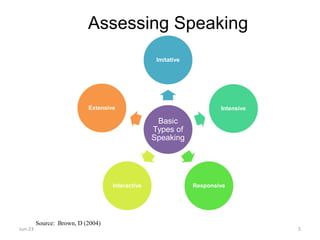
Assessing Speaking
Basic
Types of
Speaking
Imitative
Intensive
Responsive
Interactive
Extensive
Jun-23 5
Source: Brown, D (2004)
Assessing Speaking
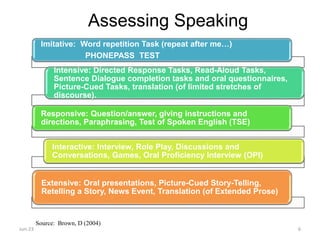
Imitative: Word repetition Task (repeat after me…)
PHONEPASS TEST
Intensive: Directed Response Tasks, Read-Aloud Tasks,
Sentence Dialogue completion tasks and oral questionnaires,
Picture-Cued Tasks, translation (of limited stretches of
discourse).
Responsive: Question/answer, giving instructions and
directions, Paraphrasing, Test of Spoken English (TSE)
Interactive: Interview, Role Play, Discussions and
Conversations, Games, Oral Proficiency Interview (OPI)
Extensive: Oral presentations, Picture-Cued Story-Telling,
Retelling a Story, News Event, Translation (of Extended Prose)
Jun-23 6
Source: Brown, D (2004)
ASSESSMENT FORMATS FOR
SPEAKING
1. READING ALOUD
• Student is given a short time to glance
through an extract before being required to
read it aloud.
• Backwash effect is harmful.
• Used to test pronunciation.
2. CONVERSATIONAL EXCHANGES
• Suitable for the language laboratory and can
serve to focus attention on certain aspects of
the spoken language.
• Do not allow for authentic interaction.
• TEST TYPE 1:
– The testees are given a series of situations and are
required to construct sentences on the lines of a
certain pattern of group of patterns.
• Example:
– It’s raining heavily. Tom and Anna are waiting
impatiently at home to set off on their picnic.
– (They wish it would stop raining)
• Mr. Black has a small carbut hi neighbors all
have large cars. He would like a large car too.
• Anna hasn’t learnt to swim yet but most of
her friends can swim.
• Tom is waiting for Bill outside the cinema. The
show is about to start.
• TEST TYPE 2:
– Similar to number one but not as strictly controlled.
– No model responses are given by the examiner and
the students are free to use whatever pattern s they
wish.
• Example:
– A friend of yours has forgotten where he has put his
glasses. He cannot see well without them. What will
you say to him? (Let me help you to look for them..)
• You are trying to get to the public library but
you are lost. Ask a police officer the way.
• Your friend returned from a holiday abroad.
What do you say to him?
• A waitress has just brought you the bill but
has totalled it up incorrectly. What do you say
to her?
• TEST TYPE 3:
– The students hear a stimulus to which they
respond in any appropriate way. (conventional
greetings, apologies, acceptable ways of
expressing disagreement)
• Example:
– Do you mind if I use your pencil for a moment?
– (Not at all, Certainly, Please do, Go ahead)
• TEST TYPE 4:
– Similar to number 3 but the stimuli and responses
form part of a longer dialogue and the situation is
thus developed.
• Example;
– MAN: Excuse me. I wonder if you can help me at
all. I’m looking for a chemist.
PAUSE FOR TESTEE’S REPLY
MAN: Thank you. Do you know what time it opens?
PAUSE for TESTEES REPLY.
• TEST TYPE 5:
– Incomplete dialogue with prompts whispered in
student’s ear.
• EXAMPLE:
RECEPTIONIST: CAN I help you?
(You want to know if there is a single room available)
YOU: __________________________
RECEPTIONIST: Yes, we have a single room.
(Ask the price)
YOU: __________________________
3. Using pictures
• Picture of single objects can be used to assess
phoneme contrasts.
• Picture of a scene can be used for examining
the total oral skills.
• Description and narration.
• Students are given a picture to study for a few
minutes; then they are required to describe
the picture in a given time.
PICTURE-CUED STORY TELLING (intermediate level sample)
Source:http://www.google.co.ve/search?hl=es&biw=1259&bih=573&gbv=2&tbm=isch&sa=1&q=sequenced+pictures+for+story+telling&btnG=Buscar&oq=sequenced+pictu
res+for+story+telling&aq=f&aqi=&aql=&gs_sm=s&gs_upl=54413l75052l0l31l30l2l0l0l3l905l6206l0.2.11.4.1.1.1
Source: Brown, H., 2004. Language Assessment Principles and Classroom Practices.
PICTURE – CUED STORY TELLING
(OBJECTIVE: SIMPLE PAST)
4. Oral interview
• Highly subjective but realistic
• Students are highly susceptible to
psychological tensions and also to language
constraints.
• Teacher as the interviewer
• Interview students in pairs or even threes.
Assessing Speaking:
Interactive Speaking
Choosing the best test format
Jun-23 21
ROLE PLAY
Structured role
play (information
gap)
Structured
interview
Unstructured
Interviews
ROLE PLAY
Unstructured
role play
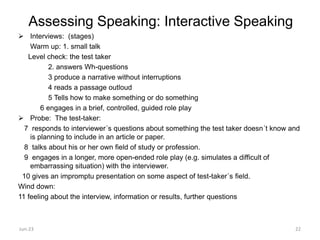
Assessing Speaking: Interactive Speaking
 Interviews: (stages)
Warm up: 1. small talk
Level check: the test taker
2. answers Wh-questions
3 produce a narrative without interruptions
4 reads a passage outloud
5 Tells how to make something or do something
6 engages in a brief, controlled, guided role play
 Probe: The test-taker:
7 responds to interviewer´s questions about something the test taker doesn´t know and
is planning to include in an article or paper.
8 talks about his or her own field of study or profession.
9 engages in a longer, more open-ended role play (e.g. simulates a difficult of
embarrassing situation) with the interviewer.
10 gives an impromptu presentation on some aspect of test-taker´s field.
Wind down:
11 feeling about the interview, information or results, further questions
Jun-23 22
OTHER TECHNIQUES FOR ORAL
EXAMINING
Role Plays
Discussions and conversations
Assessing Speaking:
Extensive Speaking
Jun-23 26
Translation of
an extended
prose
Oral
Presentations
Picture-cued
Story Telling
Retelling a
story
Source: Brown, 2004
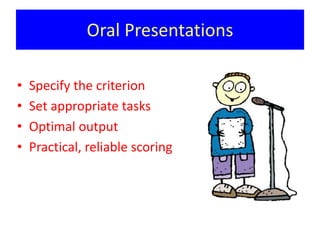
Oral Presentations
• Specify the criterion
• Set appropriate tasks
• Optimal output
• Practical, reliable scoring
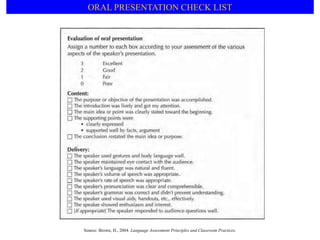
Source: Brown, H., 2004. Language Assessment Principles and Classroom Practices.
ORAL PRESENTATION CHECK LIST
Conclusions
• Speaking assessment is very difficult.
• It is important to determine what criteria to use to assess
whether accuracy or fluency. Such criteria can be based upon
created models or adapted ones.
Jun-23 29
References
• Brown, D. (2004). Language Assessment, Principles and Classroom Practices.
Longman
• O Malley, M. and Valdez L. (1995). Authentic Assessment for English
Language Learners. Practical Approaches for Teachers. Addison-Wesley Publishing Company.
• Weir, C. (1990). Communicative Language Testing. Prentice Hall.
• Bailey, K.M., & Savage, L. (1994). "New ways in teaching speaking." Alexandria, VA: Teachers of
English to Speakers of Other Languages.
• Brown, H.D. (1994). "Teaching by principles: an interactive approach to language pedagogy.“
Englewood Cliffs, NJ: Prentice Hall Regents.
• Burns, A., & Joyce, H. (1997). "Focus on speaking." Sydney: National Center for English Language
Teaching and Research.
• Carter, R. & McCarthy, M. (1995). Grammar and spoken language. "Applied Linguistics, 16" (2),
141-158
Jun-23 30

Assessing Speaking.pptx

  • 1.
    QUIZ: Discuss theextent to which you agree or disagree with the following statements. 1. Dictation provides a reasonably valid method for testing listening and writing. 2. Listening tasks may focus on a grammatical category such as verbs, tenses, etc. 3. Sound discrimination tests are normally not authentic. 4. The Backwash effect of listening is harmful to non-native speakers of English.
  • 2.
  • 3.
    Teaching speaking • Whatis Speaking? ¨Speaking is an interactive process of constructing meaning that involves producing and receiving and processing information¨ (Brown, 1994; Burns & Joyce, 1997). According to Kramsch (1986) cited in O´Malley and Valdez (1996) ¨Speaking means anticipating the listener´s response and possible misunderstandings, and arriving at the closest possible match between intended, perceived, and anticipated meanings¨. Jun-23 3
  • 4.
    Assessing Speaking Characteristics ofSpoken language Spoken language is different from written language for many reasons. One important reason is that it usually has to be understood immediately whereas written language can be read many times. For that reason, spoken language has many different features.  Spoken language has the following characteristics (Halliday, 1989, p. 31):  Variation in speed (generally faster than writing)  Loudness or quietness  Gestures - body language  Intonation  Stress  Rhythm  Pitch range  Pausing and phrasing Jun-23 4
  • 5.
  • 6.
    Assessing Speaking Imitative: Wordrepetition Task (repeat after me…) PHONEPASS TEST Intensive: Directed Response Tasks, Read-Aloud Tasks, Sentence Dialogue completion tasks and oral questionnaires, Picture-Cued Tasks, translation (of limited stretches of discourse). Responsive: Question/answer, giving instructions and directions, Paraphrasing, Test of Spoken English (TSE) Interactive: Interview, Role Play, Discussions and Conversations, Games, Oral Proficiency Interview (OPI) Extensive: Oral presentations, Picture-Cued Story-Telling, Retelling a Story, News Event, Translation (of Extended Prose) Jun-23 6 Source: Brown, D (2004)
  • 7.
  • 8.
    1. READING ALOUD •Student is given a short time to glance through an extract before being required to read it aloud. • Backwash effect is harmful. • Used to test pronunciation.
  • 9.
    2. CONVERSATIONAL EXCHANGES •Suitable for the language laboratory and can serve to focus attention on certain aspects of the spoken language. • Do not allow for authentic interaction.
  • 10.
    • TEST TYPE1: – The testees are given a series of situations and are required to construct sentences on the lines of a certain pattern of group of patterns. • Example: – It’s raining heavily. Tom and Anna are waiting impatiently at home to set off on their picnic. – (They wish it would stop raining)
  • 11.
    • Mr. Blackhas a small carbut hi neighbors all have large cars. He would like a large car too. • Anna hasn’t learnt to swim yet but most of her friends can swim. • Tom is waiting for Bill outside the cinema. The show is about to start.
  • 12.
    • TEST TYPE2: – Similar to number one but not as strictly controlled. – No model responses are given by the examiner and the students are free to use whatever pattern s they wish. • Example: – A friend of yours has forgotten where he has put his glasses. He cannot see well without them. What will you say to him? (Let me help you to look for them..)
  • 13.
    • You aretrying to get to the public library but you are lost. Ask a police officer the way. • Your friend returned from a holiday abroad. What do you say to him? • A waitress has just brought you the bill but has totalled it up incorrectly. What do you say to her?
  • 14.
    • TEST TYPE3: – The students hear a stimulus to which they respond in any appropriate way. (conventional greetings, apologies, acceptable ways of expressing disagreement) • Example: – Do you mind if I use your pencil for a moment? – (Not at all, Certainly, Please do, Go ahead)
  • 15.
    • TEST TYPE4: – Similar to number 3 but the stimuli and responses form part of a longer dialogue and the situation is thus developed. • Example; – MAN: Excuse me. I wonder if you can help me at all. I’m looking for a chemist. PAUSE FOR TESTEE’S REPLY MAN: Thank you. Do you know what time it opens? PAUSE for TESTEES REPLY.
  • 16.
    • TEST TYPE5: – Incomplete dialogue with prompts whispered in student’s ear. • EXAMPLE: RECEPTIONIST: CAN I help you? (You want to know if there is a single room available) YOU: __________________________ RECEPTIONIST: Yes, we have a single room. (Ask the price) YOU: __________________________
  • 17.
    3. Using pictures •Picture of single objects can be used to assess phoneme contrasts. • Picture of a scene can be used for examining the total oral skills. • Description and narration. • Students are given a picture to study for a few minutes; then they are required to describe the picture in a given time.
  • 18.
    PICTURE-CUED STORY TELLING(intermediate level sample) Source:http://www.google.co.ve/search?hl=es&biw=1259&bih=573&gbv=2&tbm=isch&sa=1&q=sequenced+pictures+for+story+telling&btnG=Buscar&oq=sequenced+pictu res+for+story+telling&aq=f&aqi=&aql=&gs_sm=s&gs_upl=54413l75052l0l31l30l2l0l0l3l905l6206l0.2.11.4.1.1.1
  • 19.
    Source: Brown, H.,2004. Language Assessment Principles and Classroom Practices. PICTURE – CUED STORY TELLING (OBJECTIVE: SIMPLE PAST)
  • 20.
    4. Oral interview •Highly subjective but realistic • Students are highly susceptible to psychological tensions and also to language constraints. • Teacher as the interviewer • Interview students in pairs or even threes.
  • 21.
    Assessing Speaking: Interactive Speaking Choosingthe best test format Jun-23 21 ROLE PLAY Structured role play (information gap) Structured interview Unstructured Interviews ROLE PLAY Unstructured role play
  • 22.
    Assessing Speaking: InteractiveSpeaking  Interviews: (stages) Warm up: 1. small talk Level check: the test taker 2. answers Wh-questions 3 produce a narrative without interruptions 4 reads a passage outloud 5 Tells how to make something or do something 6 engages in a brief, controlled, guided role play  Probe: The test-taker: 7 responds to interviewer´s questions about something the test taker doesn´t know and is planning to include in an article or paper. 8 talks about his or her own field of study or profession. 9 engages in a longer, more open-ended role play (e.g. simulates a difficult of embarrassing situation) with the interviewer. 10 gives an impromptu presentation on some aspect of test-taker´s field. Wind down: 11 feeling about the interview, information or results, further questions Jun-23 22
  • 23.
    OTHER TECHNIQUES FORORAL EXAMINING
  • 24.
  • 25.
  • 26.
    Assessing Speaking: Extensive Speaking Jun-2326 Translation of an extended prose Oral Presentations Picture-cued Story Telling Retelling a story Source: Brown, 2004
  • 27.
    Oral Presentations • Specifythe criterion • Set appropriate tasks • Optimal output • Practical, reliable scoring
  • 28.
    Source: Brown, H.,2004. Language Assessment Principles and Classroom Practices. ORAL PRESENTATION CHECK LIST
  • 29.
    Conclusions • Speaking assessmentis very difficult. • It is important to determine what criteria to use to assess whether accuracy or fluency. Such criteria can be based upon created models or adapted ones. Jun-23 29
  • 30.
    References • Brown, D.(2004). Language Assessment, Principles and Classroom Practices. Longman • O Malley, M. and Valdez L. (1995). Authentic Assessment for English Language Learners. Practical Approaches for Teachers. Addison-Wesley Publishing Company. • Weir, C. (1990). Communicative Language Testing. Prentice Hall. • Bailey, K.M., & Savage, L. (1994). "New ways in teaching speaking." Alexandria, VA: Teachers of English to Speakers of Other Languages. • Brown, H.D. (1994). "Teaching by principles: an interactive approach to language pedagogy.“ Englewood Cliffs, NJ: Prentice Hall Regents. • Burns, A., & Joyce, H. (1997). "Focus on speaking." Sydney: National Center for English Language Teaching and Research. • Carter, R. & McCarthy, M. (1995). Grammar and spoken language. "Applied Linguistics, 16" (2), 141-158 Jun-23 30