TESTING
WRITING
What is writing?
       “If a writer knows enough about what he is writing about,
he may omit things that he knows. The dignity of movement of
an iceberg is due to only one ninth of it being above water.”
                                                 Ernest Hemingway
Writing Skills
 1) Grammatical Skills – the ability to write correct
    sentence
 2) Stylistic Skills – the ability to manipulate
    sentences and use language effectively
 3) Mechanical Skills – the ability to use correctly
    those conventions peculiar to the written
    language
 4) Judgment Skills – the ability to write in an
    appropriate manner for a particular audience in
    mind, together with an ability to select, organize
    and order relevant information
Stages of Instruction in Writing


 1)Pre-writing

 2)Guided writing

 3)Free writing
Different Types of Writing
1. Academic writing
       - Persuasive/ Argumentative such as position
       paper, critique
       - Expository/ Explanatory such as review article,
       research report, scientific report
2. Expressive writing
       - Creative such as poem, play, story
       - Personal such as personal letter, diary
3. Practical writing
       - Prescribed such as questionnaire, formal letter,
       receipt
       - Non-prescribed such as official report(police),
       ads, letter to the editor, pamphlets, directions
Why are there various kinds of writing tests?


      A wide variety of writing tests is needed to test the
many kinds of writing tasks that we engage in.
Ideas for Writing Tasks

• Taking notes
• Making lists
• Writing messages
• Writing letters
• Writing notes
• Writing articles
• Answering want ads from the newspapers
• Writing want ads
• Filling-in forms
• Writing diary entries
• Writing telegrams, greeting cards
• Writing poems, literary-type texts
• Writing descriptions of home, room, family, friends, scene, etc.
Factors to consider in Developing
Writing Tasks
• The type of writing
• The function
• The addressee
• Process
• Product
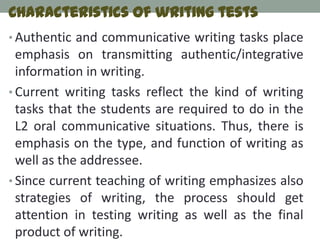
Characteristics of writing tests
• Authentic and communicative writing tasks place
  emphasis on transmitting authentic/integrative
  information in writing.
• Current writing tasks reflect the kind of writing
  tasks that the students are required to do in the
  L2 oral communicative situations. Thus, there is
  emphasis on the type, and function of writing as
  well as the addressee.
• Since current teaching of writing emphasizes also
  strategies of writing, the process should get
  attention in testing writing as well as the final
  product of writing.
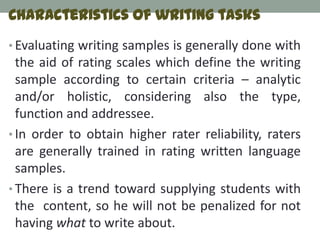
Characteristics of writing tasks
• Evaluating writing samples is generally done with
  the aid of rating scales which define the writing
  sample according to certain criteria – analytic
  and/or holistic, considering also the type,
  function and addressee.
• In order to obtain higher rater reliability, raters
  are generally trained in rating written language
  samples.
• There is a trend toward supplying students with
  the content, so he will not be penalized for not
  having what to write about.

Testing writing

  • 1.
  • 2.
    What is writing? “If a writer knows enough about what he is writing about, he may omit things that he knows. The dignity of movement of an iceberg is due to only one ninth of it being above water.” Ernest Hemingway
  • 3.
    Writing Skills 1)Grammatical Skills – the ability to write correct sentence 2) Stylistic Skills – the ability to manipulate sentences and use language effectively 3) Mechanical Skills – the ability to use correctly those conventions peculiar to the written language 4) Judgment Skills – the ability to write in an appropriate manner for a particular audience in mind, together with an ability to select, organize and order relevant information
  • 4.
    Stages of Instructionin Writing 1)Pre-writing 2)Guided writing 3)Free writing
  • 5.
    Different Types ofWriting 1. Academic writing - Persuasive/ Argumentative such as position paper, critique - Expository/ Explanatory such as review article, research report, scientific report 2. Expressive writing - Creative such as poem, play, story - Personal such as personal letter, diary 3. Practical writing - Prescribed such as questionnaire, formal letter, receipt - Non-prescribed such as official report(police), ads, letter to the editor, pamphlets, directions
  • 6.
    Why are therevarious kinds of writing tests? A wide variety of writing tests is needed to test the many kinds of writing tasks that we engage in.
  • 7.
    Ideas for WritingTasks • Taking notes • Making lists • Writing messages • Writing letters • Writing notes • Writing articles • Answering want ads from the newspapers • Writing want ads • Filling-in forms • Writing diary entries • Writing telegrams, greeting cards • Writing poems, literary-type texts • Writing descriptions of home, room, family, friends, scene, etc.
  • 8.
    Factors to considerin Developing Writing Tasks • The type of writing • The function • The addressee • Process • Product
  • 9.
    Characteristics of writingtests • Authentic and communicative writing tasks place emphasis on transmitting authentic/integrative information in writing. • Current writing tasks reflect the kind of writing tasks that the students are required to do in the L2 oral communicative situations. Thus, there is emphasis on the type, and function of writing as well as the addressee. • Since current teaching of writing emphasizes also strategies of writing, the process should get attention in testing writing as well as the final product of writing.
  • 10.
    Characteristics of writingtasks • Evaluating writing samples is generally done with the aid of rating scales which define the writing sample according to certain criteria – analytic and/or holistic, considering also the type, function and addressee. • In order to obtain higher rater reliability, raters are generally trained in rating written language samples. • There is a trend toward supplying students with the content, so he will not be penalized for not having what to write about.