




OPEN CLASS VS. CLOSED CLASS
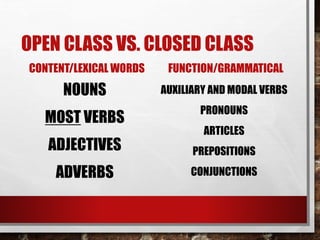
CONTENT/LEXICAL WORDS
NOUNS
MOST VERBS
ADJECTIVES
ADVERBS
FUNCTION/GRAMMATICAL
AUXILIARY AND MODAL VERBS
PRONOUNS
ARTICLES
PREPOSITIONS
CONJUNCTIONS
WHAT IS THE DIFFERENCE
BETWEEN OPEN CLASS AND
CLOSED CLASS?
OPEN CLASS (CONTENT/LEXICAL)
•Lexical words deal with content and vocabulary.
•They have concrete meaning that goes beyond their
function in a sentence.
•These words refer to things, people, actions, descriptions,
or other ideas that have more than just a grammatical
usage.
OPEN CLASS (CONTENT/LEXICAL)
The categories of English words that are lexical include
nouns, most verbs, adjectives, and adverbs.
Nouns, for example, refer to specified ideas, people, places,
or things. The concepts behind words like “dog,” “love,” or
“Philippines,” for example, are very clear.
OPEN CLASS (CONTENT/LEXICAL)
Adjectives describe nouns in well-defined ways, providing
information about colors, textures, number, size, and so on.
Likewise, adverbs can be lexical words if they specifically
describe verbs. Because they evoke specific ideas,
descriptors like “red,” “quickly,” “heavy,” or “effectively” are
considered lexical.
OPEN CLASS (CONTENT/LEXICAL)
Most verbs also fall into the lexical category because they
refer to specific actions.
For example, the meanings of words like “think,” “sing,”
“understand,” and “jump” are easy to grasp.
CLOSED CLASS
(GRAMMATICAL/FUNCTION)
• Grammatical words deal with the formation of sentences.
• They have ambiguous meaning and serve to express
grammatical relationships with other words within a sentence.
• They signal the structural relationships that words have to one
another and are the glue that holds sentences together.
• Thus, they serve as important elements to the structure of
sentences.
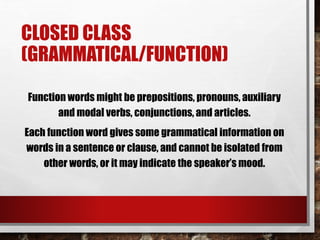
CLOSED CLASS
(GRAMMATICAL/FUNCTION)
Function words might be prepositions, pronouns, auxiliary
and modal verbs, conjunctions, and articles.
Each function word gives some grammatical information on
words in a sentence or clause, and cannot be isolated from
other words, or it may indicate the speaker’s mood.
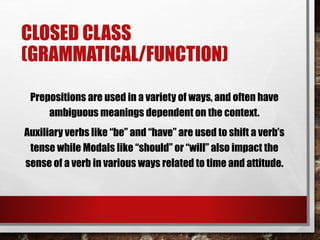
CLOSED CLASS
(GRAMMATICAL/FUNCTION)
Prepositions are used in a variety of ways, and often have
ambiguous meanings dependent on the context.
Auxiliary verbs like “be” and “have” are used to shift a verb’s
tense while Modals like “should” or “will” also impact the
sense of a verb in various ways related to time and attitude.
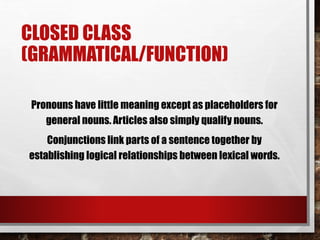
CLOSED CLASS
(GRAMMATICAL/FUNCTION)
Pronouns have little meaning except as placeholders for
general nouns. Articles also simply qualify nouns.
Conjunctions link parts of a sentence together by
establishing logical relationships between lexical words.
OPEN CLASS
VS. CLOSED CLASS
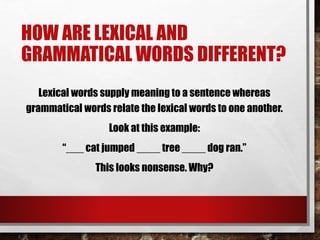
HOW ARE LEXICAL AND
GRAMMATICAL WORDS DIFFERENT?
Lexical words supply meaning to a sentence whereas
grammatical words relate the lexical words to one another.
Look at this example:
“___ cat jumped ____ tree ____ dog ran.”
This looks nonsense. Why?
HOW ARE LEXICAL AND
GRAMMATICAL WORDS DIFFERENT?
All you know is that it is about jumping cats, running dogs,
and trees. It may be possible to guess the complete meaning
of the sentence but you can’t know for certain because cats,
dogs, and trees can be related in different ways.
HOW ARE LEXICAL AND
GRAMMATICAL WORDS DIFFERENT?
Now, look at this sentence:
“The cat jumped into the tree as the dog ran
forward.”
The sentence makes sense 
HOW ARE LEXICAL AND
GRAMMATICAL WORDS DIFFERENT?
Notice, however, that if you put a different set of
grammatical words in, you get a completely different
meaning:
“The cat jumped from the tree after the dog ran away.”
You can see that the grammatical words clarify the
logical relations between the lexical words and define
their function in the sentence.

Open-class and Closed-class Words

  • 2.
    OPEN CLASS VS.CLOSED CLASS CONTENT/LEXICAL WORDS NOUNS MOST VERBS ADJECTIVES ADVERBS FUNCTION/GRAMMATICAL AUXILIARY AND MODAL VERBS PRONOUNS ARTICLES PREPOSITIONS CONJUNCTIONS
  • 3.
    WHAT IS THEDIFFERENCE BETWEEN OPEN CLASS AND CLOSED CLASS?
  • 4.
    OPEN CLASS (CONTENT/LEXICAL) •Lexicalwords deal with content and vocabulary. •They have concrete meaning that goes beyond their function in a sentence. •These words refer to things, people, actions, descriptions, or other ideas that have more than just a grammatical usage.
  • 5.
    OPEN CLASS (CONTENT/LEXICAL) Thecategories of English words that are lexical include nouns, most verbs, adjectives, and adverbs. Nouns, for example, refer to specified ideas, people, places, or things. The concepts behind words like “dog,” “love,” or “Philippines,” for example, are very clear.
  • 6.
    OPEN CLASS (CONTENT/LEXICAL) Adjectivesdescribe nouns in well-defined ways, providing information about colors, textures, number, size, and so on. Likewise, adverbs can be lexical words if they specifically describe verbs. Because they evoke specific ideas, descriptors like “red,” “quickly,” “heavy,” or “effectively” are considered lexical.
  • 7.
    OPEN CLASS (CONTENT/LEXICAL) Mostverbs also fall into the lexical category because they refer to specific actions. For example, the meanings of words like “think,” “sing,” “understand,” and “jump” are easy to grasp.
  • 8.
    CLOSED CLASS (GRAMMATICAL/FUNCTION) • Grammaticalwords deal with the formation of sentences. • They have ambiguous meaning and serve to express grammatical relationships with other words within a sentence. • They signal the structural relationships that words have to one another and are the glue that holds sentences together. • Thus, they serve as important elements to the structure of sentences.
  • 9.
    CLOSED CLASS (GRAMMATICAL/FUNCTION) Function wordsmight be prepositions, pronouns, auxiliary and modal verbs, conjunctions, and articles. Each function word gives some grammatical information on words in a sentence or clause, and cannot be isolated from other words, or it may indicate the speaker’s mood.
  • 10.
    CLOSED CLASS (GRAMMATICAL/FUNCTION) Prepositions areused in a variety of ways, and often have ambiguous meanings dependent on the context. Auxiliary verbs like “be” and “have” are used to shift a verb’s tense while Modals like “should” or “will” also impact the sense of a verb in various ways related to time and attitude.
  • 11.
    CLOSED CLASS (GRAMMATICAL/FUNCTION) Pronouns havelittle meaning except as placeholders for general nouns. Articles also simply qualify nouns. Conjunctions link parts of a sentence together by establishing logical relationships between lexical words.
  • 12.
  • 13.
    HOW ARE LEXICALAND GRAMMATICAL WORDS DIFFERENT? Lexical words supply meaning to a sentence whereas grammatical words relate the lexical words to one another. Look at this example: “___ cat jumped ____ tree ____ dog ran.” This looks nonsense. Why?
  • 14.
    HOW ARE LEXICALAND GRAMMATICAL WORDS DIFFERENT? All you know is that it is about jumping cats, running dogs, and trees. It may be possible to guess the complete meaning of the sentence but you can’t know for certain because cats, dogs, and trees can be related in different ways.
  • 15.
    HOW ARE LEXICALAND GRAMMATICAL WORDS DIFFERENT? Now, look at this sentence: “The cat jumped into the tree as the dog ran forward.” The sentence makes sense 
  • 16.
    HOW ARE LEXICALAND GRAMMATICAL WORDS DIFFERENT? Notice, however, that if you put a different set of grammatical words in, you get a completely different meaning: “The cat jumped from the tree after the dog ran away.” You can see that the grammatical words clarify the logical relations between the lexical words and define their function in the sentence.