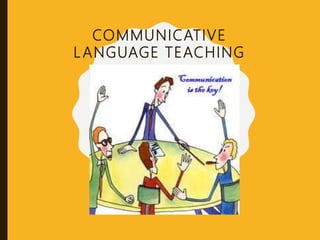
COMMUNICATIVE
LANGUAGE TEACHING
•1970’s CAN
STUDENTS COMMUNICATE????
Sts knew the rules of linguistic
usage, but they
COULDN`T USE THE LANGUAGE
WHAT IS COMMUNICATION?
It involves COMMUNICATIVE COMPETENCE:
That sts perform certain functions:
• Promising
• Inviting
• Declining invitations, etc
• Within a social context
WHAT IS COMMUNICATIVE
COMPETENCE?
Knowing WHEN and
HOW to say WHAT to
WHOM. (Hymes 1971)
Communicative Language
Teaching by makes
communicative competence
the goal of language teaching
by acknowledging the
interdependence of
language and communication
A person who is communicative competent knows:
• When something is formally
possible.
• If something is feasible to
implement
• If it is appropriate in relation to a
context.
• Whether something is in fact
done.
Many questions about CLT cannot be
answered:
• How to implement it at the level of
classroom procedure.
• How can the range of communicative
activites and procedures be defined.
• How can a teacher determine a mix and
timing of activites that best suit the needs
of the learners.
BACKGROUND
•It belongs to the post - method
era of language.
•It started in the changes of British
language teaching tradition in the
late 60’s.
•As a reaction against Situational
Language Teaching and
Audiolingualism
WHAT IS THE COMMUNICATIVE
APPROACH?
•It is the THEORY that language is
communication.
• It is the most recognized approach
of language teaching.
•It is an integration of grammatical and
functional teaching.
IT IS AN APPROACH NOT A
METHOD THAT AIMS TO:
a) Make COMMUNICATIVE
COMPETENCE the goal of teaching
b) Develop procedures for the teaching of
the FOUR LANGUAGE SKILLS
THEORY OF LANGUAGE
• The goal of language teaching is to develop
COMMUNICATIVE COMPETENCE.
• What the speaker needs to know in order to
be communicatively competent in a speech
community.
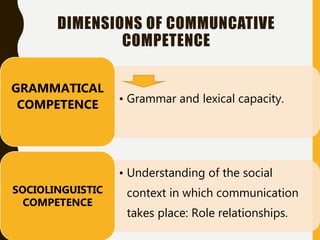
DIMENSIONS OF COMMUNCATIVE
COMPETENCE
• Grammar and lexical capacity.
GRAMMATICAL
COMPETENCE
• Understanding of the social
context in which communication
takes place: Role relationships.
SOCIOLINGUISTIC
COMPETENCE
DIMENSIONS OF COMMUNCATIVE
COMPETENCE
• Interpretation of individual message
elements.
DISCOURSE
COMPETENCE
• Coping strategies that
communicators employ to initiate,
terminate, maintain a communication
STRATEGIC
COMPETENCE
THEORETICAL BASE
1. Language is a system for the
expression of meaning.
2. The primary function of language is to
allow interaction and communication.
THEORETICAL BASE
3. The structure of language reflects its
functional and communicative uses.
4. The primary uses of language are the
categories of functional and
communicative meaning in discourse.
FUNCTIONALISM: (Halliday, 1970)
“Linguistic is concerned with the description
of speech acts or texts, since only through
the study of language in use are all the
functions of the language, and therefore
components of meaning, brought into
focus…”
FUNCTIONS
INSTRUMENTAL
To use the
language
to get
things
REGULATORY
To control
the
behaviour
of others.
INTERACTIONAL
To create
interactio
with
others
PERSONAL
To
express
persona
l
feelings
FUNCTIONS
HEURISTICS
To learn and
discover
IMAGINATIVE
To create a
world of
imagination.
REPRESENTATIONAL
To
communicate
information
THEORY OF LEARNING
• It’s not well developed.
• It addresses the CONDITIONS
necessary to promote learning.
THEORY OF LEARNING
COMMUNICA
-TION
PRINCIPLE
.
•Activities that involve real communication promote
TASK
PRINCIPLE
• Activities in which language is used for carrying out
meaningful tasks promote learning
MEANING-
FULLNESS
PRINCIPLE
• Language that is meaningful to the learner supports
learning process
DESIGN: OBJECTIVES
INTEGRATIVE AND
CONTENT LEVEL.
AFFECTIVE LEVEL
LINGUISTIC AND
INSTRUMENTAL LEVEL
INDIVIDUAL LEARNING
NEEDS LEVEL
GENERAL EDUCATIONAL
LEVEL OF EXTRA-
LINGUISTIC GOALS.
THE SYLLABUS
•Classroom activities that could be
used as the basis of a
communicative methodology, such
as group work, task-work, and
information-gap activities.
THE SYLLABUS
• There have been many attempts to design a syllabus
like:
1. Structures plus functions.
2. Functional spiral around a structural core.
3. Structural, functional, instrumental
4. Functional
5. Interactional.
6. Task-based
7. Learner-generated
TYPES OF LEARNING AND
TEACHING ACTIVITIES
• They are unlimited.
• They have to:
– Enable learners to attain the communicative
objectives of the curriculum.
– Engage learners in communication.
– Require the use of communicative processes in
information sharing.
– Negotiate meaning.
– Interact.
TYPES OF LEARNING AND
TEACHING ACTIVITIES
Comparison of
sets of pictures
noting differences
and similarities.
Sequence of
events in a set of
pictures.
FUNCTIONAL
COMMUNICA
TION
ACTIVITIES
Conversation and
discussion sessions,
improvisations and
debates
Dialogues and role plays,
simulations.
SOCIAL
INTERACTION
ACTIVITIES
TEACHER ROLES
The teacher’s main roles are:
1) To facilitate the communication
between all participants in the
classroom.
2) To act as an independent participant
within the learning-teaching group.
3) Researcher and learner.
4) Needs analyst, counselor, group
process manager
LEARNERS’ ROLES
• Students are, above all,
communicators. They are actively
engaged in negotiating meaning-
in trying to make themselves
understood and in understanding
others-even when their knowledge
of the target language is
incomplete.
MATERIALS
Materials fall into three broad
categories:
text-based,
task-based
realia.
TEXT-BASED MATERIALS
Practice exercises, reading
passages, gap fills, recordings, etc.
can be found in almost any course
book as well as in books
containing supplementary
materials. They form an essential
part of most lessons.
TASK-BASED MATERIALS
These include game boards,
roleplay cards, materials for drilling,
pairwork tasks, etc.
They might be used to support 'real
life' tasks such as role playing
booking into a hotel, or a job
interview.
REALIA
Magazines, newspapers, fruit and
vegetables, axes, maps - things from
the real world outside the classroom.
They can be used in many activities.
For example, fruit and vegetables could
be used in a shopping activity,
PROCEDURE
• There is no description of procedures
because Communicative language
Teaching can be applied to the teaching
of any skill, at any level, and because of
the wide variety of classroom activities
and exercises types
PROCEDURE
The lesson extract follows a method
called Presentation-Practice-
Production or PPP for short.
Traditional procedures are not
rejected but reinterpreted and
extended
PROCEDURE
Pre- communicative
activities
Structural activities
Quasi-communicative
activities
Communicative activities
Functional
communication activities
Social interaction
activities
BENEFITS OF USING CLT
•It increases all the components of
communicative competence
•It increases students’ motivation and
attitude to learn the target language
• Students have to produce and receive
language in different real-life contexts.
•It provides them with skills they
really need in their real life
•It is a student-centered class where
the focus is on the interests of the
students.
BIBLIOGRAPHY
•Richards, J; Rogers, T. (2001).
Approaches and Methods in
Language Teaching. Cambridge
University Press.

Communicative language teaching

  • 1.
  • 2.
    •1970’s CAN STUDENTS COMMUNICATE???? Stsknew the rules of linguistic usage, but they COULDN`T USE THE LANGUAGE
  • 3.
    WHAT IS COMMUNICATION? Itinvolves COMMUNICATIVE COMPETENCE: That sts perform certain functions: • Promising • Inviting • Declining invitations, etc • Within a social context
  • 4.
    WHAT IS COMMUNICATIVE COMPETENCE? KnowingWHEN and HOW to say WHAT to WHOM. (Hymes 1971)
  • 5.
    Communicative Language Teaching bymakes communicative competence the goal of language teaching by acknowledging the interdependence of language and communication
  • 6.
    A person whois communicative competent knows: • When something is formally possible. • If something is feasible to implement • If it is appropriate in relation to a context. • Whether something is in fact done.
  • 7.
    Many questions aboutCLT cannot be answered: • How to implement it at the level of classroom procedure. • How can the range of communicative activites and procedures be defined. • How can a teacher determine a mix and timing of activites that best suit the needs of the learners.
  • 8.
  • 9.
    •It belongs tothe post - method era of language. •It started in the changes of British language teaching tradition in the late 60’s. •As a reaction against Situational Language Teaching and Audiolingualism
  • 10.
    WHAT IS THECOMMUNICATIVE APPROACH? •It is the THEORY that language is communication. • It is the most recognized approach of language teaching. •It is an integration of grammatical and functional teaching.
  • 11.
    IT IS ANAPPROACH NOT A METHOD THAT AIMS TO: a) Make COMMUNICATIVE COMPETENCE the goal of teaching b) Develop procedures for the teaching of the FOUR LANGUAGE SKILLS
  • 12.
    THEORY OF LANGUAGE •The goal of language teaching is to develop COMMUNICATIVE COMPETENCE. • What the speaker needs to know in order to be communicatively competent in a speech community.
  • 13.
    DIMENSIONS OF COMMUNCATIVE COMPETENCE •Grammar and lexical capacity. GRAMMATICAL COMPETENCE • Understanding of the social context in which communication takes place: Role relationships. SOCIOLINGUISTIC COMPETENCE
  • 14.
    DIMENSIONS OF COMMUNCATIVE COMPETENCE •Interpretation of individual message elements. DISCOURSE COMPETENCE • Coping strategies that communicators employ to initiate, terminate, maintain a communication STRATEGIC COMPETENCE
  • 15.
    THEORETICAL BASE 1. Languageis a system for the expression of meaning. 2. The primary function of language is to allow interaction and communication.
  • 16.
    THEORETICAL BASE 3. Thestructure of language reflects its functional and communicative uses. 4. The primary uses of language are the categories of functional and communicative meaning in discourse.
  • 17.
    FUNCTIONALISM: (Halliday, 1970) “Linguisticis concerned with the description of speech acts or texts, since only through the study of language in use are all the functions of the language, and therefore components of meaning, brought into focus…”
  • 18.
    FUNCTIONS INSTRUMENTAL To use the language toget things REGULATORY To control the behaviour of others. INTERACTIONAL To create interactio with others PERSONAL To express persona l feelings
  • 19.
    FUNCTIONS HEURISTICS To learn and discover IMAGINATIVE Tocreate a world of imagination. REPRESENTATIONAL To communicate information
  • 20.
    THEORY OF LEARNING •It’s not well developed. • It addresses the CONDITIONS necessary to promote learning.
  • 21.
    THEORY OF LEARNING COMMUNICA -TION PRINCIPLE . •Activitiesthat involve real communication promote TASK PRINCIPLE • Activities in which language is used for carrying out meaningful tasks promote learning MEANING- FULLNESS PRINCIPLE • Language that is meaningful to the learner supports learning process
  • 22.
    DESIGN: OBJECTIVES INTEGRATIVE AND CONTENTLEVEL. AFFECTIVE LEVEL LINGUISTIC AND INSTRUMENTAL LEVEL INDIVIDUAL LEARNING NEEDS LEVEL GENERAL EDUCATIONAL LEVEL OF EXTRA- LINGUISTIC GOALS.
  • 23.
    THE SYLLABUS •Classroom activitiesthat could be used as the basis of a communicative methodology, such as group work, task-work, and information-gap activities.
  • 24.
    THE SYLLABUS • Therehave been many attempts to design a syllabus like: 1. Structures plus functions. 2. Functional spiral around a structural core. 3. Structural, functional, instrumental 4. Functional 5. Interactional. 6. Task-based 7. Learner-generated
  • 25.
    TYPES OF LEARNINGAND TEACHING ACTIVITIES • They are unlimited. • They have to: – Enable learners to attain the communicative objectives of the curriculum. – Engage learners in communication. – Require the use of communicative processes in information sharing. – Negotiate meaning. – Interact.
  • 26.
    TYPES OF LEARNINGAND TEACHING ACTIVITIES Comparison of sets of pictures noting differences and similarities. Sequence of events in a set of pictures. FUNCTIONAL COMMUNICA TION ACTIVITIES Conversation and discussion sessions, improvisations and debates Dialogues and role plays, simulations. SOCIAL INTERACTION ACTIVITIES
  • 27.
    TEACHER ROLES The teacher’smain roles are: 1) To facilitate the communication between all participants in the classroom. 2) To act as an independent participant within the learning-teaching group. 3) Researcher and learner. 4) Needs analyst, counselor, group process manager
  • 28.
    LEARNERS’ ROLES • Studentsare, above all, communicators. They are actively engaged in negotiating meaning- in trying to make themselves understood and in understanding others-even when their knowledge of the target language is incomplete.
  • 29.
    MATERIALS Materials fall intothree broad categories: text-based, task-based realia.
  • 30.
    TEXT-BASED MATERIALS Practice exercises,reading passages, gap fills, recordings, etc. can be found in almost any course book as well as in books containing supplementary materials. They form an essential part of most lessons.
  • 31.
    TASK-BASED MATERIALS These includegame boards, roleplay cards, materials for drilling, pairwork tasks, etc. They might be used to support 'real life' tasks such as role playing booking into a hotel, or a job interview.
  • 32.
    REALIA Magazines, newspapers, fruitand vegetables, axes, maps - things from the real world outside the classroom. They can be used in many activities. For example, fruit and vegetables could be used in a shopping activity,
  • 33.
    PROCEDURE • There isno description of procedures because Communicative language Teaching can be applied to the teaching of any skill, at any level, and because of the wide variety of classroom activities and exercises types
  • 34.
    PROCEDURE The lesson extractfollows a method called Presentation-Practice- Production or PPP for short. Traditional procedures are not rejected but reinterpreted and extended
  • 35.
    PROCEDURE Pre- communicative activities Structural activities Quasi-communicative activities Communicativeactivities Functional communication activities Social interaction activities
  • 36.
    BENEFITS OF USINGCLT •It increases all the components of communicative competence
  • 37.
    •It increases students’motivation and attitude to learn the target language
  • 38.
    • Students haveto produce and receive language in different real-life contexts.
  • 39.
    •It provides themwith skills they really need in their real life •It is a student-centered class where the focus is on the interests of the students.
  • 40.
    BIBLIOGRAPHY •Richards, J; Rogers,T. (2001). Approaches and Methods in Language Teaching. Cambridge University Press.