ENGLISH FOR SPECIFIC
PURPOSES
26/05/2017
BY:
AISHA ILYAS
THE ISLAMIA UNIVERSITY
OF BAHAWALPUR
26/05/2017
OUTLINE
 Why English?
 English for Specific Purposes
 Dudley-Evans on ESP
 Absolute Characteristics
 Variable Characteristics
 Types of ESP
 Characteristics of ESP Courses
 ESP Course Design
 Role of ESP Teacher
 Designing an ESP Course Design
 Conclusion
26/05/2017
WHY ENGLISH??
 English has become the internationally accepted
language of nearly all fields of knowledge.
 It is recognized and understood by people almost
everywhere in world.
 With more than 350 million people around the world
speaking English as a first language and more than
430 million speaking it as a second language, there
are English speakers in most countries around the
world.
26/05/2017
 In some cases people with inadequate proficiency
in English need to be taught to handle specific jobs.
 To fulfil the needs of these learners specific courses
were designed and introduced, ESP is one of them.
26/05/2017
ENGLISH FOR SPECIFIC PURPOSES
 English for Specific Purposes (ESP) is a
learner-centred approach to teaching English as an
additional language, which focuses on developing
communicative competence in a specific discipline
such as academics, accounting, business, IT,
teaching, and engineering.
26/05/2017
 English for specific purposes (ESP) is a sphere
of teaching English language including Business
English, Technical English, Scientific English,
English for medical professionals, English for
waiters, English for tourism, English for Art
Purposes, etc
 "ESP is an approach to language teaching in
which all decisions as to content and method are
based on the learner's reason for learning".
(Hutchinson)
26/05/2017
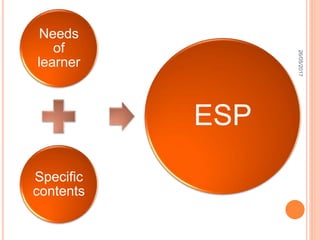
Needs
of
learner
Specific
contents
ESP
26/05/2017
DUDLEY-EVANS ON ESP
Dudley-Evans define ESP in terms of
absolute and variable characteristics
This division in absolute and variable
characteristics is helpful in resolving
arguments about ESP
26/05/2017
ABSOLUTE CHARACTERISTICS
1. ESP is defined to meet specific needs of the
learners
2. ESP makes use of underlying methodology
and activities of the discipline it serves
3. ESP is centred on the language appropriate
to these activities in terms of grammar, lexis,
register, study skills, discourse and genre.
26/05/2017
VARIABLE CHARACTERISTICS
1. ESP may be related to or designed for specific disciplines
2. ESP may use, in specific teaching situations, a different
methodology from that of General English
3. ESP is likely to be designed for adult learners, either at a
tertiary level institution or in a professional work situation.
4. Most ESP courses assume some basic knowledge of the
language systems
26/05/2017
TYPES OF ESP
David Carter (1983) identifies
three types of ESP:
 English as a restricted language
 English for Academic and Occupational
Purposes
 English with specific topics.
26/05/2017
ENGLISH AS A RESTRICTED LANGUAGE
Only used for specific contexts.
It may not help in communication outside
that particular context.
For example: of a pilot or of a waiter.
26/05/2017
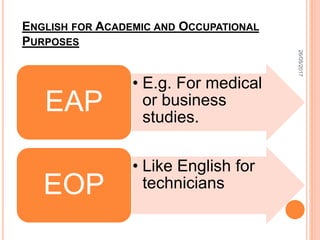
ENGLISH FOR ACADEMIC AND OCCUPATIONAL
PURPOSES
• E.g. For medical
or business
studies.
EAP
• Like English for
techniciansEOP
26/05/2017
ENGLISH WITH SPECIFIC TOPICS
 It is uniquely concerned with anticipated future
English needs.
 For example; scientist requiring English for post
graduate studies or attending conferences.
26/05/2017
CHARACTERISTICS OF ESP COURSES
Carter (1983) states that there are
three features common to ESP
courses:
a) Authentic material
-material should be authentic.
b) Purpose-related orientation
- orientation lessons must be according to needs and
wants of students.
c) Self-direction
- freedom should be given to learners, to decide what to
learn and how to learn
26/05/2017
ESP COURSE DESIGN
 Course design refers to the planning and structuring of a
course to achieve the needed goals.
 The aim of the ESP courses is to prepare the learners in
accordance with specific skills and vocabulary needed in
their own field in order to be able to communicate
effectively in the target situation.
26/05/2017
To achieve these aims, number of
parameters have to be taken into
consideration namely:
- The Identification of Needs.
- Syllabus Design.
- Materials Production.
- Evaluation and Assessment.
26/05/2017
ROLE OF ESP TEACHER
An ESP teacher should:
 Set goals and objectives
 Organize courses
 Prepare materials
 Evaluate students.
26/05/2017
An ESP teacher should not follow a book
rigidly
He/She should organize the material based
on grammar, functional and situational point
of view.
The material must fit the students’ needs
and the goals set by the teacher.
26/05/2017
DESIGNING AN ESP COURSE
1) Course title: ESP for bankers
2) Size of class: 10
3) Time frame: 60 minutes
Introduction and explanation= 35min
Class discussion= 10 min
Activity= 15 min
26/05/2017
4) Learning outcomes and goal:
By the end of course, participants will be able to
use English accurately in target situation i.e.
Banks.
5) Syllabus:
Emphasis on four basic skills, tips/exercises to
answer the phone call, how to give presentation
effectively, types of business letters, how to write
formal letters, E-mail guideline and etc
26/05/2017
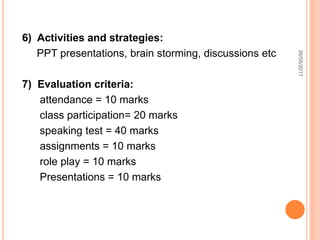
6) Activities and strategies:
PPT presentations, brain storming, discussions etc
7) Evaluation criteria:
attendance = 10 marks
class participation= 20 marks
speaking test = 40 marks
assignments = 10 marks
role play = 10 marks
Presentations = 10 marks
26/05/2017
CONCLUSION
The English for Specific Purposes has
emerged as a significant field in
Applied Linguistics. It is mostly
concerned with the learners’ needs for
a specific field of academics or
occupation.
26/05/2017
ANY
QUESTIONS??
26/05/2017
THANK YOU
26/05/2017