Lecturer: Yee Bee Choo 
IPGKTHO
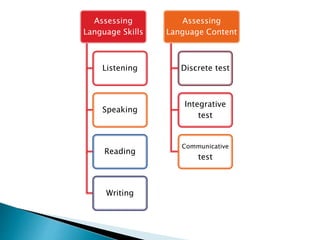
Assessing 
Language Skills 
Listening 
Speaking 
Reading 
Writing 
Assessing 
Language Content 
Discrete test 
Integrative 
test 
Communicative 
test
Listening 
Two kinds of listening tests: 
1. Tests that test specific aspects of listening, 
like sound discrimination 
2. Task-based tests which test skills in 
accomplishing different types of listening 
tasks considered important for the students 
being tested.
Listening 
1. Intensive 
 Listening for perception of the components 
(phonemes, words, intonation, discourse 
markers, etc) of a larger stretch of language. 
 Task: recognising phonological and 
morphological elements 
 E.g. phonemic pair, vowels 
Test-takers hear: is he living? 
Test-takers read: (a) Is he leaving? (b) Is he living?
Listening 
2. Responsive 
 Listening to a relatively short stretch of language 
( a greeting, question, command, comprehension 
check, etc.) in order to make an equally short 
response. 
 Task: question and answer 
 E.g. 
Test-takers hear: How much time did you take to do your 
homework? 
Test-takers read: (a) In about an hour 
(b) About an hour 
(c) About RM10 
(d) Yes, I did.
Listening 
3. Selective 
 Processing stretches of discourse such as short 
monologues for several minutes in order to “scan” for 
certain information. 
 The purpose of such performance is not necessarily to 
look for global or general meaning but to be able to 
comprehend designated information in a context of longer 
stretches of spoken language( such as classroom 
directions from a teacher, TV or radio news items, or 
stories). 
 Tasks: listening cloze, information transfer 
 E.g. test-takers listen for names, numbers, grammatical 
category, directions (in a map exercise), or certain facts 
and events.
Listening 
4. Extensive 
 Listening to develop a top-down , global 
understanding of spoken language. 
 Task: Extensive performance ranges from 
listening to lengthy lectures to listening to a 
conversation and deriving a comprehensive 
message or purpose. 
 E.g. listening for the gist/ main idea, making 
inferences, dictation, etc.
Speaking 
 In the assessment of oral production, both discrete 
feature objective tests and integrative task-based 
tests are used. 
 The first type tests such skills as pronunciation, 
knowledge of what language is appropriate in 
different situations, language required in doing 
different things like describing, giving directions, 
giving instructions, etc. 
 The second type involves finding out if pupils can 
perform different tasks using spoken language that is 
appropriate for the purpose and the context. 
 Task-based activities involve describing scenes 
shown in a picture, participating in a discussion 
about a given topic, narrating a story, etc.
Speaking 
1. Imitative 
 It is the ability to imitate a word or phrase or possibly a 
sentence. 
 Although this is a purely phonetic level of oral production, 
a number of prosodic (intonation, rhythm, etc.), lexical , 
and grammatical properties of language may be included 
in the performance criteria. 
 We are interested only in what is traditionally labelled 
“pronunciation”; no inference are made about the test-takers 
ability to understand or convey meaning or to 
participate in an interactive conversation. 
 E.g. 
Examiner : Repeat after me: 
beat bit bag beg 
Test-takers repeat the stimulus.
Speaking 
2. Intensive 
 The production of short stretches of oral 
language designed to demonstrate competence 
in a narrow band of grammatical, phrasal, lexical, 
or phonological relationships. 
 Tasks: directed response tasks (requests for 
specific production of speech), reading aloud, 
sentence and dialogue completion, limited 
picture-cued tasks including simple sentences, 
and translation up to the simple sentence level.
Speaking 
3. Responsive 
 Tasks: questions and answers, short conversation, standard 
greetings, small talk, simple requests and comments, etc. 
 The stimulus is almost always a spoken prompt (to preserve 
authenticity) with one or two follow-up questions or retorts: 
A. Liza : Excuse me, do you have the time? 
Don : Yeah. Six-fifteen. 
B. Jo : What is the most urgent social problem today? 
Sue : I would say bullying. 
C. Lan : Hey, Shan, how’s it going? 
Shan: Not bad, and yourself? 
Lan : I’m good. 
Shan: Cool. Okay gotta go.
Speaking 
4. Interactive 
 The difference between responsive and 
interactive speaking is in the length and 
complexity of the interaction, which 
sometimes includes multiple exchanges 
and/or multiple participants. 
 Tasks: Interview, role play, discussions and 
conversations, etc.
Speaking 
4. Interactive 
 Interaction can be broken down into two 
types : 
(a) transactional language, which has the purpose of 
exchanging specific information 
(b) interpersonal exchanges, which have the purpose 
of maintaining social relationships. 
 (In the three dialogues cited above, A and B 
are transactional, and C is interpersonal).
Speaking 
5. Extensive (monologue) 
 Tasks: speeches, oral presentations, and storytelling, 
during which the opportunity for oral interaction from 
listeners is either highly limited (perhaps to 
nonverbal responses) or ruled out together. 
 Language style is more deliberative (planning is 
involved) and formal for extensive tasks. 
 It can include informal monologue such as casually 
delivered speech (e.g., recalling a vacation in the 
mountains, conveying recipes, recounting the plot of 
a novel or movie). 
(Brown 2010)
Reading 
 Cohen (1994) describes skimming and scanning as 
two different types of reading. 
Skimming: read rapidly 
Scanning: read to locate specific information 
 He also discusses receptive reading or intensive 
reading which refers to “a form of reading aimed at 
discovering exactly what the author seeks to convey” 
(p. 218). This is the most common form of reading 
especially in test or assessment conditions. 
 Another type of reading is to read responsively where 
respondents are expected to respond to some point 
in a reading text through writing or by answering 
questions.
Reading 
 A reading text can convey various kinds of meaning: 
1. Grammatical meaning are meanings that are expressed 
through linguistic structures such as complex and simple 
sentences and the correct interpretation of those 
structures. 
2. Informational meaning which refers largely to the concept 
or messages contained in the text. Respondents may be 
required to comprehend merely the information or content 
of the passage and this may be assessed through various 
means such as summary and précis writing. Compared to 
grammatical or syntactic meaning, informational meaning 
requires a more general understanding of a text rather 
than having to pay close attention to the linguistic 
structure of sentences.
Reading 
3. Discourse meaning refers to the perception of rhetorical 
functions conveyed by the text. One typical function is 
discourse marking which adds cohesiveness to a text. 
These words, such as unless, however, thus, therefore etc., 
are crucial to the correct interpretation of a text and 
students may be assessed on their ability to understand 
the discourse meaning that they bring in the passage. 
4. Meaning conveyed by the writer’s tone which maybe 
cynical, sarcastic, sad or etc. It is important in reading 
comprehension but may be quite difficult to identify, 
especially by less proficient learners. Nevertheless, there 
can be many situations where the reader is completely 
wrong in comprehending a text simply because he has 
failed to perceive the correct tone of the author.
Reading 
 Strategies for reading process: 
1. Bottom-up 
Comprehension is achieved with fundamental 
basics of letter and sound recognition, words, 
phrases and sentences. 
2. Top-down 
Comprehension is achieved by using 
background knowledge and making 
predictions.
Reading 
1. Perceptive 
 Bottom-up processing is implied. 
 Tasks: reading letters, words, punctuation, 
and other graphemic symbols. 
 E.g. reading aloud, multiple-choice, picture-cued 
items,
Reading 
2. Selective 
 A combination of bottom-up and top-down 
processing maybe used. 
 Tasks: picture-cued tasks, matching, 
true/false, multiple-choice, etc. 
 Include stimuli such as sentences, brief 
paragraphs, simple charts and graphs. 
 E.g. cloze (word choice is given), matching, 
gap-filling.
Reading 
3. Interactive 
 The reader must interact with the text, which 
means to negotiate meaning; the reader brings to 
the text a set of schemata for understanding it, 
and intake is the product of that interaction. 
 A top-down processing is needed. 
 Reading texts: anecdotes, short narratives and 
descriptions, questionnaires, memos, 
announcements, recipes, etc. 
 E.g. cloze (without word choice), comprehension 
reading, scanning.
Reading 
4. Extensive 
 The purpose of assessment is to tap into a 
learner’s global understanding of a text. 
 Top-down processing is needed. 
 Reading texts: professional articles, essays, 
technical reports, short stories, and books. 
 E.g. skimming, summarising, note-taking, 
outlining.
Writing 
1. Imitative 
 To produce written language, the learner must 
attain the skills in the fundamental, basic tasks 
of writing letters, words, punctuation, and brief 
sentences. 
 At this stage the learners are trying to master the 
mechanics of writing. Form is the primary focus 
while context and meaning are of secondary 
concern. 
 Tasks: hand-writing letters, words, and 
punctuation; spelling and detecting phoneme-grapheme 
correspondences.
Writing 
2. Intensive (controlled) 
 Meaning and context are important in 
determining correctness and appropriateness but 
most assessment tasks are more concerned with 
a focus on form and are rather strictly controlled 
by the test design. 
 Tasks: dictation and dicto-comp, grammatical 
transformation, picture-cued description, 
vocabulary within a context, collocation and 
idioms, and correct grammatical features up to 
the length of a sentence. .
Writing 
3. Responsive 
 Tasks relate to pedagogical directives, lists of criteria, 
outlines, and other guidelines. 
 Genres of writing include brief narratives and 
descriptions, short reports, lab reports, summaries, 
brief responses to reading, and interpretations of 
charts and graphs. 
 Form-focused attention is mostly at the discourse 
level, with a strong emphasis on context and 
meaning. 
 Tasks: paraphrasing, connecting sentences into a 
paragraph and creating a logically connected 
sequence of two or three paragraphs.
Writing 
4. Extensive 
 Focus is on achieving a purpose, organizing and 
developing ideas logically, using details to 
support or illustrate ideas, demonstrating 
syntactic and lexical variety, and in many cases, 
engaging in the process of multiple drafts to 
achieve a final product. 
 Focus on grammatical form is limited to 
occasional editing and proofreading of a draft. 
 Tasks: writing a long essay, a term paper, a 
major research project report, or a thesis.
Discrete Test 
 Discrete point tests examine one element at a 
time. 
 In the discrete point test, language is seen to be 
made up of smaller units and it may be possible 
to test language by testing each unit at a time. 
 Testing knowledge of the relative pronoun, for 
example, is certainly assessing the students on a 
particular unit of language and not on the 
language as a whole. 
 A multiple choice type test is an example of a 
discrete point test.
Integrative Test 
 Integrative tests, “requires the candidate to 
combine many language elements in the 
completion of a task” (Hughes, 1989: 16). 
 It is a simultaneous measure of knowledge and 
ability of a variety of language features, modes, 
or skills. 
 In an integrative test, the perspective of language 
is that of an integrated whole which cannot be 
broken up into smaller units or elements. Hence, 
the testing of language should maintain the 
integrity or wholeness of the language. 
 An essay is an example of an integrative test.
Communicative Test 
 A communicative test involves many aspects, 
two of which revolve around communicative 
elements in tests and meaningful content. 
 Fulcher (2000) highlights the three principles 
of communicative tests: 
· involve performance; 
· are authentic; and 
· are scored on real-life outcomes.

Topic 6 Assessing Language Skills and Content

  • 1.
    Lecturer: Yee BeeChoo IPGKTHO
  • 2.
    Assessing Language Skills Listening Speaking Reading Writing Assessing Language Content Discrete test Integrative test Communicative test
  • 3.
    Listening Two kindsof listening tests: 1. Tests that test specific aspects of listening, like sound discrimination 2. Task-based tests which test skills in accomplishing different types of listening tasks considered important for the students being tested.
  • 4.
    Listening 1. Intensive  Listening for perception of the components (phonemes, words, intonation, discourse markers, etc) of a larger stretch of language.  Task: recognising phonological and morphological elements  E.g. phonemic pair, vowels Test-takers hear: is he living? Test-takers read: (a) Is he leaving? (b) Is he living?
  • 5.
    Listening 2. Responsive  Listening to a relatively short stretch of language ( a greeting, question, command, comprehension check, etc.) in order to make an equally short response.  Task: question and answer  E.g. Test-takers hear: How much time did you take to do your homework? Test-takers read: (a) In about an hour (b) About an hour (c) About RM10 (d) Yes, I did.
  • 6.
    Listening 3. Selective  Processing stretches of discourse such as short monologues for several minutes in order to “scan” for certain information.  The purpose of such performance is not necessarily to look for global or general meaning but to be able to comprehend designated information in a context of longer stretches of spoken language( such as classroom directions from a teacher, TV or radio news items, or stories).  Tasks: listening cloze, information transfer  E.g. test-takers listen for names, numbers, grammatical category, directions (in a map exercise), or certain facts and events.
  • 7.
    Listening 4. Extensive  Listening to develop a top-down , global understanding of spoken language.  Task: Extensive performance ranges from listening to lengthy lectures to listening to a conversation and deriving a comprehensive message or purpose.  E.g. listening for the gist/ main idea, making inferences, dictation, etc.
  • 8.
    Speaking  Inthe assessment of oral production, both discrete feature objective tests and integrative task-based tests are used.  The first type tests such skills as pronunciation, knowledge of what language is appropriate in different situations, language required in doing different things like describing, giving directions, giving instructions, etc.  The second type involves finding out if pupils can perform different tasks using spoken language that is appropriate for the purpose and the context.  Task-based activities involve describing scenes shown in a picture, participating in a discussion about a given topic, narrating a story, etc.
  • 9.
    Speaking 1. Imitative  It is the ability to imitate a word or phrase or possibly a sentence.  Although this is a purely phonetic level of oral production, a number of prosodic (intonation, rhythm, etc.), lexical , and grammatical properties of language may be included in the performance criteria.  We are interested only in what is traditionally labelled “pronunciation”; no inference are made about the test-takers ability to understand or convey meaning or to participate in an interactive conversation.  E.g. Examiner : Repeat after me: beat bit bag beg Test-takers repeat the stimulus.
  • 10.
    Speaking 2. Intensive  The production of short stretches of oral language designed to demonstrate competence in a narrow band of grammatical, phrasal, lexical, or phonological relationships.  Tasks: directed response tasks (requests for specific production of speech), reading aloud, sentence and dialogue completion, limited picture-cued tasks including simple sentences, and translation up to the simple sentence level.
  • 11.
    Speaking 3. Responsive  Tasks: questions and answers, short conversation, standard greetings, small talk, simple requests and comments, etc.  The stimulus is almost always a spoken prompt (to preserve authenticity) with one or two follow-up questions or retorts: A. Liza : Excuse me, do you have the time? Don : Yeah. Six-fifteen. B. Jo : What is the most urgent social problem today? Sue : I would say bullying. C. Lan : Hey, Shan, how’s it going? Shan: Not bad, and yourself? Lan : I’m good. Shan: Cool. Okay gotta go.
  • 12.
    Speaking 4. Interactive  The difference between responsive and interactive speaking is in the length and complexity of the interaction, which sometimes includes multiple exchanges and/or multiple participants.  Tasks: Interview, role play, discussions and conversations, etc.
  • 13.
    Speaking 4. Interactive  Interaction can be broken down into two types : (a) transactional language, which has the purpose of exchanging specific information (b) interpersonal exchanges, which have the purpose of maintaining social relationships.  (In the three dialogues cited above, A and B are transactional, and C is interpersonal).
  • 14.
    Speaking 5. Extensive(monologue)  Tasks: speeches, oral presentations, and storytelling, during which the opportunity for oral interaction from listeners is either highly limited (perhaps to nonverbal responses) or ruled out together.  Language style is more deliberative (planning is involved) and formal for extensive tasks.  It can include informal monologue such as casually delivered speech (e.g., recalling a vacation in the mountains, conveying recipes, recounting the plot of a novel or movie). (Brown 2010)
  • 15.
    Reading  Cohen(1994) describes skimming and scanning as two different types of reading. Skimming: read rapidly Scanning: read to locate specific information  He also discusses receptive reading or intensive reading which refers to “a form of reading aimed at discovering exactly what the author seeks to convey” (p. 218). This is the most common form of reading especially in test or assessment conditions.  Another type of reading is to read responsively where respondents are expected to respond to some point in a reading text through writing or by answering questions.
  • 16.
    Reading  Areading text can convey various kinds of meaning: 1. Grammatical meaning are meanings that are expressed through linguistic structures such as complex and simple sentences and the correct interpretation of those structures. 2. Informational meaning which refers largely to the concept or messages contained in the text. Respondents may be required to comprehend merely the information or content of the passage and this may be assessed through various means such as summary and précis writing. Compared to grammatical or syntactic meaning, informational meaning requires a more general understanding of a text rather than having to pay close attention to the linguistic structure of sentences.
  • 17.
    Reading 3. Discoursemeaning refers to the perception of rhetorical functions conveyed by the text. One typical function is discourse marking which adds cohesiveness to a text. These words, such as unless, however, thus, therefore etc., are crucial to the correct interpretation of a text and students may be assessed on their ability to understand the discourse meaning that they bring in the passage. 4. Meaning conveyed by the writer’s tone which maybe cynical, sarcastic, sad or etc. It is important in reading comprehension but may be quite difficult to identify, especially by less proficient learners. Nevertheless, there can be many situations where the reader is completely wrong in comprehending a text simply because he has failed to perceive the correct tone of the author.
  • 18.
    Reading  Strategiesfor reading process: 1. Bottom-up Comprehension is achieved with fundamental basics of letter and sound recognition, words, phrases and sentences. 2. Top-down Comprehension is achieved by using background knowledge and making predictions.
  • 19.
    Reading 1. Perceptive  Bottom-up processing is implied.  Tasks: reading letters, words, punctuation, and other graphemic symbols.  E.g. reading aloud, multiple-choice, picture-cued items,
  • 20.
    Reading 2. Selective  A combination of bottom-up and top-down processing maybe used.  Tasks: picture-cued tasks, matching, true/false, multiple-choice, etc.  Include stimuli such as sentences, brief paragraphs, simple charts and graphs.  E.g. cloze (word choice is given), matching, gap-filling.
  • 21.
    Reading 3. Interactive  The reader must interact with the text, which means to negotiate meaning; the reader brings to the text a set of schemata for understanding it, and intake is the product of that interaction.  A top-down processing is needed.  Reading texts: anecdotes, short narratives and descriptions, questionnaires, memos, announcements, recipes, etc.  E.g. cloze (without word choice), comprehension reading, scanning.
  • 22.
    Reading 4. Extensive  The purpose of assessment is to tap into a learner’s global understanding of a text.  Top-down processing is needed.  Reading texts: professional articles, essays, technical reports, short stories, and books.  E.g. skimming, summarising, note-taking, outlining.
  • 23.
    Writing 1. Imitative  To produce written language, the learner must attain the skills in the fundamental, basic tasks of writing letters, words, punctuation, and brief sentences.  At this stage the learners are trying to master the mechanics of writing. Form is the primary focus while context and meaning are of secondary concern.  Tasks: hand-writing letters, words, and punctuation; spelling and detecting phoneme-grapheme correspondences.
  • 24.
    Writing 2. Intensive(controlled)  Meaning and context are important in determining correctness and appropriateness but most assessment tasks are more concerned with a focus on form and are rather strictly controlled by the test design.  Tasks: dictation and dicto-comp, grammatical transformation, picture-cued description, vocabulary within a context, collocation and idioms, and correct grammatical features up to the length of a sentence. .
  • 25.
    Writing 3. Responsive  Tasks relate to pedagogical directives, lists of criteria, outlines, and other guidelines.  Genres of writing include brief narratives and descriptions, short reports, lab reports, summaries, brief responses to reading, and interpretations of charts and graphs.  Form-focused attention is mostly at the discourse level, with a strong emphasis on context and meaning.  Tasks: paraphrasing, connecting sentences into a paragraph and creating a logically connected sequence of two or three paragraphs.
  • 26.
    Writing 4. Extensive  Focus is on achieving a purpose, organizing and developing ideas logically, using details to support or illustrate ideas, demonstrating syntactic and lexical variety, and in many cases, engaging in the process of multiple drafts to achieve a final product.  Focus on grammatical form is limited to occasional editing and proofreading of a draft.  Tasks: writing a long essay, a term paper, a major research project report, or a thesis.
  • 27.
    Discrete Test Discrete point tests examine one element at a time.  In the discrete point test, language is seen to be made up of smaller units and it may be possible to test language by testing each unit at a time.  Testing knowledge of the relative pronoun, for example, is certainly assessing the students on a particular unit of language and not on the language as a whole.  A multiple choice type test is an example of a discrete point test.
  • 28.
    Integrative Test Integrative tests, “requires the candidate to combine many language elements in the completion of a task” (Hughes, 1989: 16).  It is a simultaneous measure of knowledge and ability of a variety of language features, modes, or skills.  In an integrative test, the perspective of language is that of an integrated whole which cannot be broken up into smaller units or elements. Hence, the testing of language should maintain the integrity or wholeness of the language.  An essay is an example of an integrative test.
  • 29.
    Communicative Test A communicative test involves many aspects, two of which revolve around communicative elements in tests and meaningful content.  Fulcher (2000) highlights the three principles of communicative tests: · involve performance; · are authentic; and · are scored on real-life outcomes.