LOSS TANGENT DELTA TEST
General:
The tan δ-measurement is intended to detect deviations in an insulation of a machine during its
service-lifetime. To obtain this, periodic tanδ-measurements are advisable.
Introduction
During the service-lifetime of a rotating machine deviations in its insulation system can not be
excluded. Reasons of such deviations are manifold and thus are spread widely, between e.g. a
deterioration of the potential grading and e.g. a delimitation of the insulation. Starting the tan δ-
measurement (= loss tangent test, dissipation factor test) prior to the first operation of a machine,
the tan δ-readings are characteristic for a particular machine and each change in the tan δ will be an
obvious indicator of deviations in the insulation.
The tan δ-measurement
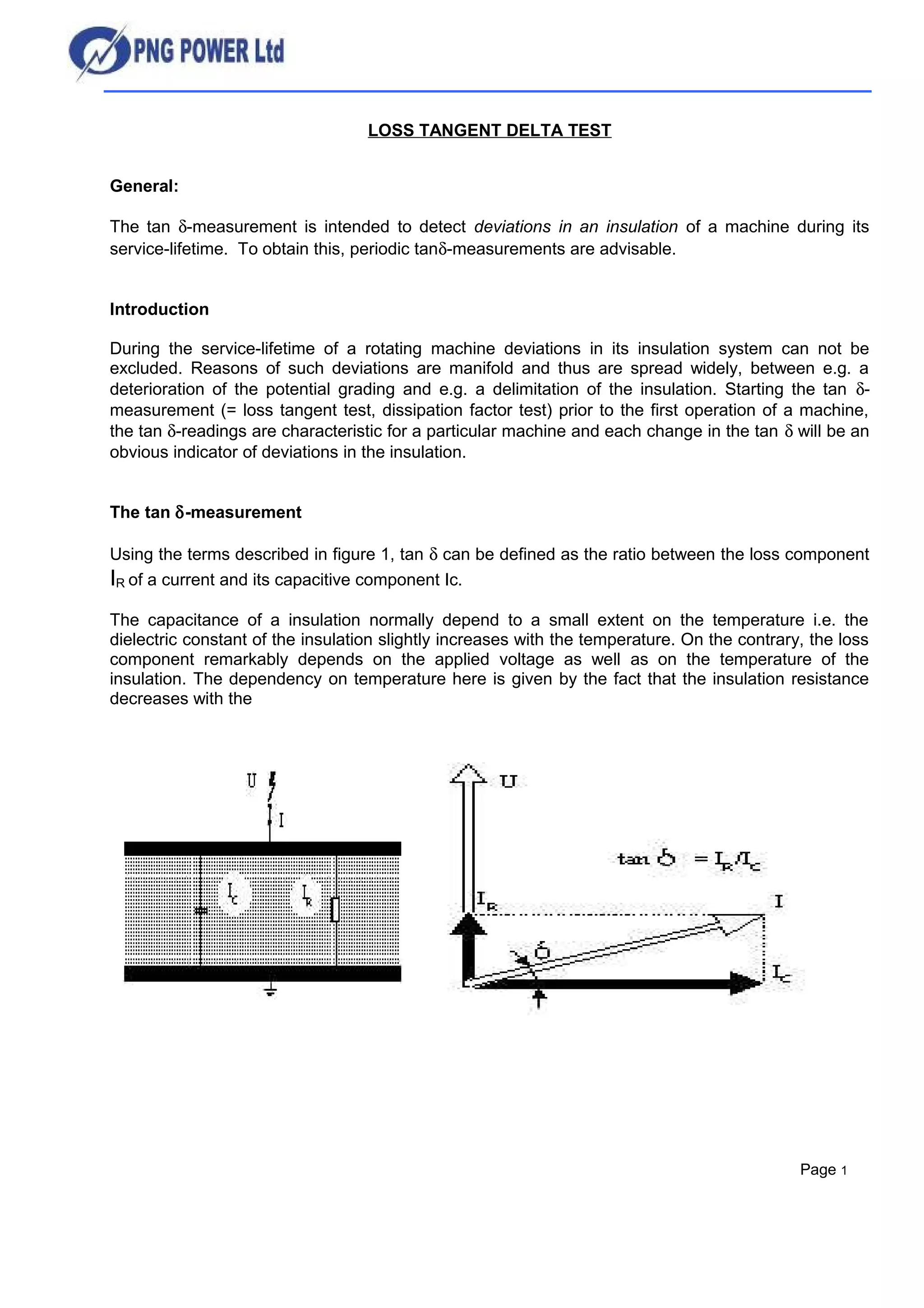
Using the terms described in figure 1, tan δ can be defined as the ratio between the loss component
IR of a current and its capacitive component Ic.
The capacitance of a insulation normally depend to a small extent on the temperature i.e. the
dielectric constant of the insulation slightly increases with the temperature. On the contrary, the loss
component remarkably depends on the applied voltage as well as on the temperature of the
insulation. The dependency on temperature here is given by the fact that the insulation resistance
decreases with the
Page 1
Temperature and thus both IR and tan δ increase with the temperature as both IC and IR change their
value depending on the temperature (but in contrary way), the tan δ rises remarkably with the
temperature. Thus an exact recording of the temperature of the insulation under test is
indispensable for comparing tan δ-measurements.
It is common practice to increase the applied voltage in steps of 20% (or 10%) of the normal line-to-
line voltage and read the respective tanδ-values. In particular the tanδ-values at 20%, 60% and
100% of the nominal line-to-line voltage are important as well as the tip-up, i.e. the maximum
increment per 20% - (or 10%) voltage-step.
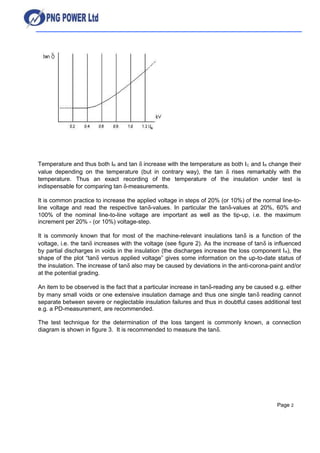
It is commonly known that for most of the machine-relevant insulations tanδ is a function of the
voltage, i.e. the tanδ increases with the voltage (see figure 2). As the increase of tanδ is influenced
by partial discharges in voids in the insulation (the discharges increase the loss component IR), the
shape of the plot “tanδ versus applied voltage” gives some information on the up-to-date status of
the insulation. The increase of tanδ also may be caused by deviations in the anti-corona-paint and/or
at the potential grading.
An item to be observed is the fact that a particular increase in tanδ-reading any be caused e.g. either
by many small voids or one extensive insulation damage and thus one single tanδ reading cannot
separate between severe or neglectable insulation failures and thus in doubtful cases additional test
e.g. a PD-measurement, are recommended.
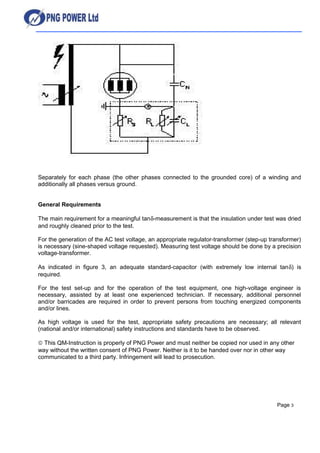
The test technique for the determination of the loss tangent is commonly known, a connection
diagram is shown in figure 3. It is recommended to measure the tanδ.
Page 2
Separately for each phase (the other phases connected to the grounded core) of a winding and
additionally all phases versus ground.
General Requirements
The main requirement for a meaningful tanδ-measurement is that the insulation under test was dried
and roughly cleaned prior to the test.
For the generation of the AC test voltage, an appropriate regulator-transformer (step-up transformer)
is necessary (sine-shaped voltage requested). Measuring test voltage should be done by a precision
voltage-transformer.
As indicated in figure 3, an adequate standard-capacitor (with extremely low internal tanδ) is
required.
For the test set-up and for the operation of the test equipment, one high-voltage engineer is
necessary, assisted by at least one experienced technician. If necessary, additional personnel
and/or barricades are required in order to prevent persons from touching energized components
and/or lines.
As high voltage is used for the test, appropriate safety precautions are necessary; all relevant
(national and/or international) safety instructions and standards have to be observed.
© This QM-Instruction is properly of PNG Power and must neither be copied nor used in any other
way without the written consent of PNG Power. Neither is it to be handed over nor in other way
communicated to a third party. Infringement will lead to prosecution.
Page 3

Loss tangent delta test

  • 1.
    LOSS TANGENT DELTATEST General: The tan δ-measurement is intended to detect deviations in an insulation of a machine during its service-lifetime. To obtain this, periodic tanδ-measurements are advisable. Introduction During the service-lifetime of a rotating machine deviations in its insulation system can not be excluded. Reasons of such deviations are manifold and thus are spread widely, between e.g. a deterioration of the potential grading and e.g. a delimitation of the insulation. Starting the tan δ- measurement (= loss tangent test, dissipation factor test) prior to the first operation of a machine, the tan δ-readings are characteristic for a particular machine and each change in the tan δ will be an obvious indicator of deviations in the insulation. The tan δ-measurement Using the terms described in figure 1, tan δ can be defined as the ratio between the loss component IR of a current and its capacitive component Ic. The capacitance of a insulation normally depend to a small extent on the temperature i.e. the dielectric constant of the insulation slightly increases with the temperature. On the contrary, the loss component remarkably depends on the applied voltage as well as on the temperature of the insulation. The dependency on temperature here is given by the fact that the insulation resistance decreases with the Page 1
  • 2.
    Temperature and thusboth IR and tan δ increase with the temperature as both IC and IR change their value depending on the temperature (but in contrary way), the tan δ rises remarkably with the temperature. Thus an exact recording of the temperature of the insulation under test is indispensable for comparing tan δ-measurements. It is common practice to increase the applied voltage in steps of 20% (or 10%) of the normal line-to- line voltage and read the respective tanδ-values. In particular the tanδ-values at 20%, 60% and 100% of the nominal line-to-line voltage are important as well as the tip-up, i.e. the maximum increment per 20% - (or 10%) voltage-step. It is commonly known that for most of the machine-relevant insulations tanδ is a function of the voltage, i.e. the tanδ increases with the voltage (see figure 2). As the increase of tanδ is influenced by partial discharges in voids in the insulation (the discharges increase the loss component IR), the shape of the plot “tanδ versus applied voltage” gives some information on the up-to-date status of the insulation. The increase of tanδ also may be caused by deviations in the anti-corona-paint and/or at the potential grading. An item to be observed is the fact that a particular increase in tanδ-reading any be caused e.g. either by many small voids or one extensive insulation damage and thus one single tanδ reading cannot separate between severe or neglectable insulation failures and thus in doubtful cases additional test e.g. a PD-measurement, are recommended. The test technique for the determination of the loss tangent is commonly known, a connection diagram is shown in figure 3. It is recommended to measure the tanδ. Page 2
  • 3.
    Separately for eachphase (the other phases connected to the grounded core) of a winding and additionally all phases versus ground. General Requirements The main requirement for a meaningful tanδ-measurement is that the insulation under test was dried and roughly cleaned prior to the test. For the generation of the AC test voltage, an appropriate regulator-transformer (step-up transformer) is necessary (sine-shaped voltage requested). Measuring test voltage should be done by a precision voltage-transformer. As indicated in figure 3, an adequate standard-capacitor (with extremely low internal tanδ) is required. For the test set-up and for the operation of the test equipment, one high-voltage engineer is necessary, assisted by at least one experienced technician. If necessary, additional personnel and/or barricades are required in order to prevent persons from touching energized components and/or lines. As high voltage is used for the test, appropriate safety precautions are necessary; all relevant (national and/or international) safety instructions and standards have to be observed. © This QM-Instruction is properly of PNG Power and must neither be copied nor used in any other way without the written consent of PNG Power. Neither is it to be handed over nor in other way communicated to a third party. Infringement will lead to prosecution. Page 3