
Designing and ConductingDesigning and Conducting
Summative EvaluationsSummative Evaluations
Larry F. Cobb
ObjectivesObjectives
Define the purpose of summative
evaluation
Describe the two phases of
summative evaluation and the
decisions resulting from each phase
Design a summative evaluation to
examine organizational benefits of
instruction they have implemented
Contrast Formative and summative
evaluation by purpose and design
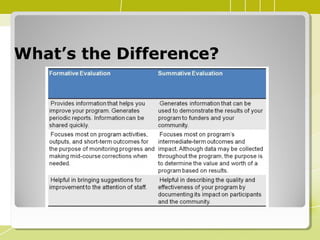
What’s the Difference?What’s the Difference?
What is Summative EvaluationWhat is Summative Evaluation
Summative evaluation is defined as
the design of evaluation studies and
the collection of data to verify the
effectiveness of instructional materials
with target learners.
The Purpose of SummativeThe Purpose of Summative
EvaluationEvaluation
Make “go-no-go” decisions
• Keep current materials?
• Look for something better suited to meet
organization’s specific instruction needs?
• Summative evaluations are used to
judge the impact of a plan of
instruction on the organization’s
initial problem.
Evaluators – Why they should beEvaluators – Why they should be
ExternalExternal
The primary evaluator in a summative
evaluation is rarely the designer or
developer of the instruction.
Evaluator is often unfamiliar with the
materials, the organization requesting
the evaluation, or the setting in which
the materials are evaluated.
Preferred because they have no
personal investment and will likely be
more objective
Two Main Phases of SummativeTwo Main Phases of Summative
EvaluationEvaluation
1.Expert Judgment Phase
2. Field Trial Phase
Expert Judgment PhaseExpert Judgment Phase
Purpose:
Do the materials have the potential for
meeting this organization’s needs?
There are several activities that decide whether
the candidate instruction is promising.
1. Congruence Analysis
2. Content Analysis
3. Design Analysis
4. Utility and Feasibility Analysis
5. Current User Analysis
Expert Judgment PhaseExpert Judgment Phase
Congruence Analysis
Analyzing the congruence among
1.An organization’s state needs and goals and
those addressed in candidate instruction
2.An organization’s target learners’ entry skills
and characteristics and those for which candidate
materials are intended
3.An organization’s resources and those required
for obtaining and implementing candidate
instruction
Expert Judgment PhaseExpert Judgment Phase
Content Analysis
During this activity, an identified expert is used to
judge material for accuracy and completeness to
determine if they are inline with the organization’s
stated goals. An instructional analysis of the
stated goal is a very cost effective method.
Expert Judgment PhaseExpert Judgment Phase
Design Analysis
The design analysis is an evaluation of the
adequacy of the components of the instructional
strategy included in the candidate material.
Checklist are great during this activity.
Expert Judgment PhaseExpert Judgment Phase
Utility and Feasibility Analysis
Factors such as the availability of a learner guide
or syllabus and an instructor’s manual are taking
into consideration during this activity. This is also
the time when you get information for the people
that determine that the evaluation was necessary.
Expert Judgment PhaseExpert Judgment Phase
Current User Analysis
This final analysis seeks to get information about
the candidate material from the organizations
that are experienced in using them. The names
of current users can often be obtained from the
publishers of the materials.
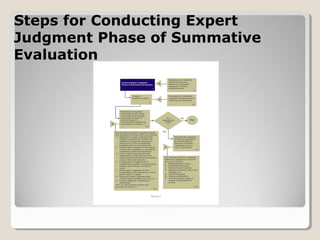
Steps for Conducting ExpertSteps for Conducting Expert
Judgment Phase of SummativeJudgment Phase of Summative
EvaluationEvaluation
Field Trial PhaseField Trial Phase
Purpose:
Are the materials effective
with target learners in the
prescribed setting?
Outcomes Analysis:
1.Impact on Learners
2.Impact on Job
3.Impact on Organization
Field Trial Phase (continued)Field Trial Phase (continued)
Management Analysis:
1.Are instructor and manager attitudes
satisfactory?
2.Are recommended implementation
procedures feasible?
3.Are costs related to time, personnel,
equipment, and resources reasonable?
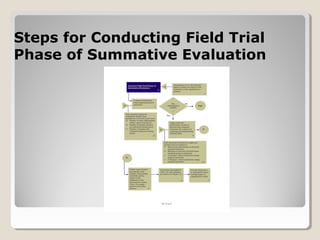
Steps for Conducting Field TrialSteps for Conducting Field Trial
Phase of Summative EvaluationPhase of Summative Evaluation
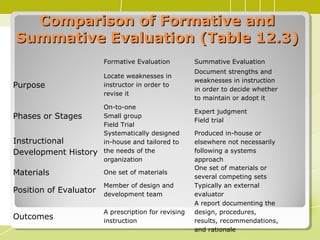
Comparison of Formative andComparison of Formative and
Summative Evaluation (Table 12.3)Summative Evaluation (Table 12.3)
Formative Evaluation Summative Evaluation
Purpose
Locate weaknesses in
instructor in order to
revise it
Document strengths and
weaknesses in instruction
in order to decide whether
to maintain or adopt it
Phases or Stages
On-to-one
Small group
Field Trial
Expert judgment
Field trial
Instructional
Development History
Systematically designed
in-house and tailored to
the needs of the
organization
Produced in-house or
elsewhere not necessarily
following a systems
approach
Materials One set of materials
One set of materials or
several competing sets
Position of Evaluator
Member of design and
development team
Typically an external
evaluator
Outcomes
A prescription for revising
instruction
A report documenting the
design, procedures,
results, recommendations,
and rationale
Change AgentChange Agent
As a change agent, is very important for
us to constantly evaluate the
instructional strategy ensure that is
staying the course with what the
organization has in mind while being
usable and feasible for the
organization. The summative
evaluation does just that.
Larry F. CobbLarry F. Cobb
lfcobb@alasu.edu

Designing and conducting summative evaluations

  • 1.
    Designing and ConductingDesigningand Conducting Summative EvaluationsSummative Evaluations Larry F. Cobb
  • 2.
    ObjectivesObjectives Define the purposeof summative evaluation Describe the two phases of summative evaluation and the decisions resulting from each phase Design a summative evaluation to examine organizational benefits of instruction they have implemented Contrast Formative and summative evaluation by purpose and design
  • 3.
  • 4.
    What is SummativeEvaluationWhat is Summative Evaluation Summative evaluation is defined as the design of evaluation studies and the collection of data to verify the effectiveness of instructional materials with target learners.
  • 5.
    The Purpose ofSummativeThe Purpose of Summative EvaluationEvaluation Make “go-no-go” decisions • Keep current materials? • Look for something better suited to meet organization’s specific instruction needs? • Summative evaluations are used to judge the impact of a plan of instruction on the organization’s initial problem.
  • 6.
    Evaluators – Whythey should beEvaluators – Why they should be ExternalExternal The primary evaluator in a summative evaluation is rarely the designer or developer of the instruction. Evaluator is often unfamiliar with the materials, the organization requesting the evaluation, or the setting in which the materials are evaluated. Preferred because they have no personal investment and will likely be more objective
  • 7.
    Two Main Phasesof SummativeTwo Main Phases of Summative EvaluationEvaluation 1.Expert Judgment Phase 2. Field Trial Phase
  • 8.
    Expert Judgment PhaseExpertJudgment Phase Purpose: Do the materials have the potential for meeting this organization’s needs? There are several activities that decide whether the candidate instruction is promising. 1. Congruence Analysis 2. Content Analysis 3. Design Analysis 4. Utility and Feasibility Analysis 5. Current User Analysis
  • 9.
    Expert Judgment PhaseExpertJudgment Phase Congruence Analysis Analyzing the congruence among 1.An organization’s state needs and goals and those addressed in candidate instruction 2.An organization’s target learners’ entry skills and characteristics and those for which candidate materials are intended 3.An organization’s resources and those required for obtaining and implementing candidate instruction
  • 10.
    Expert Judgment PhaseExpertJudgment Phase Content Analysis During this activity, an identified expert is used to judge material for accuracy and completeness to determine if they are inline with the organization’s stated goals. An instructional analysis of the stated goal is a very cost effective method.
  • 11.
    Expert Judgment PhaseExpertJudgment Phase Design Analysis The design analysis is an evaluation of the adequacy of the components of the instructional strategy included in the candidate material. Checklist are great during this activity.
  • 12.
    Expert Judgment PhaseExpertJudgment Phase Utility and Feasibility Analysis Factors such as the availability of a learner guide or syllabus and an instructor’s manual are taking into consideration during this activity. This is also the time when you get information for the people that determine that the evaluation was necessary.
  • 13.
    Expert Judgment PhaseExpertJudgment Phase Current User Analysis This final analysis seeks to get information about the candidate material from the organizations that are experienced in using them. The names of current users can often be obtained from the publishers of the materials.
  • 14.
    Steps for ConductingExpertSteps for Conducting Expert Judgment Phase of SummativeJudgment Phase of Summative EvaluationEvaluation
  • 15.
    Field Trial PhaseFieldTrial Phase Purpose: Are the materials effective with target learners in the prescribed setting? Outcomes Analysis: 1.Impact on Learners 2.Impact on Job 3.Impact on Organization
  • 16.
    Field Trial Phase(continued)Field Trial Phase (continued) Management Analysis: 1.Are instructor and manager attitudes satisfactory? 2.Are recommended implementation procedures feasible? 3.Are costs related to time, personnel, equipment, and resources reasonable?
  • 17.
    Steps for ConductingField TrialSteps for Conducting Field Trial Phase of Summative EvaluationPhase of Summative Evaluation
  • 18.
    Comparison of FormativeandComparison of Formative and Summative Evaluation (Table 12.3)Summative Evaluation (Table 12.3) Formative Evaluation Summative Evaluation Purpose Locate weaknesses in instructor in order to revise it Document strengths and weaknesses in instruction in order to decide whether to maintain or adopt it Phases or Stages On-to-one Small group Field Trial Expert judgment Field trial Instructional Development History Systematically designed in-house and tailored to the needs of the organization Produced in-house or elsewhere not necessarily following a systems approach Materials One set of materials One set of materials or several competing sets Position of Evaluator Member of design and development team Typically an external evaluator Outcomes A prescription for revising instruction A report documenting the design, procedures, results, recommendations, and rationale
  • 19.
    Change AgentChange Agent Asa change agent, is very important for us to constantly evaluate the instructional strategy ensure that is staying the course with what the organization has in mind while being usable and feasible for the organization. The summative evaluation does just that.
  • 20.
    Larry F. CobbLarryF. Cobb lfcobb@alasu.edu