Rangeland
Muhammad Ali
13-arid-1035
What is it?
 Rangelands are vast natural landscape of grassland,
shurbland, wetland and desert.
Rangelands are distinguished from pasture because they
grow primarily native vegetation, rather than plants
established by humans.
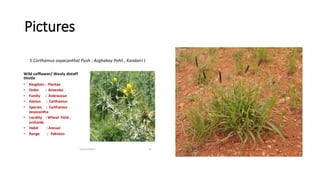
Pictures
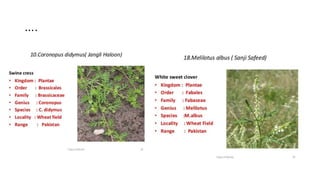
….
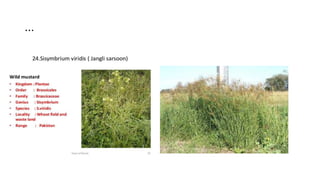
…
Significance of Rangeland
About 60% of the total area of the country comprises
rangelands.
The area partly supports 93.5 million head of
livestock. Rangelands are mostly used for livestock
grazing in northern Pakistan.
Baluchistan , which covers about 40 percent area of
the country, primarily depends on livestock
production from its rangeland.
Important Definitions
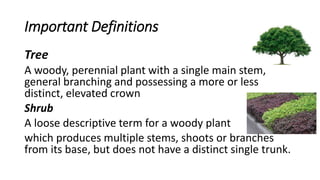
Tree
A woody, perennial plant with a single main stem,
general branching and possessing a more or less
distinct, elevated crown
Shrub
A loose descriptive term for a woody plant
which produces multiple stems, shoots or branches
from its base, but does not have a distinct single trunk.
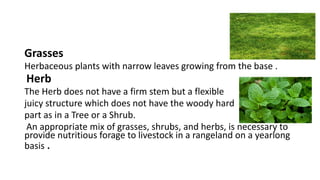
Grasses
Herbaceous plants with narrow leaves growing from the base .
Herb
The Herb does not have a firm stem but a flexible
juicy structure which does not have the woody hard
part as in a Tree or a Shrub.
An appropriate mix of grasses, shrubs, and herbs, is necessary to
provide nutritious forage to livestock in a rangeland on a yearlong
basis .
Carrying Capacity
CARRYING CAPACITY is defined as the maximum stocking rate possible
which is consistent with maintaining or improving vegetation or related
resources. It may vary from year to year on the same area due to
fluctuating forage production
Grazing Capacity
Sometimes used synonymously with carrying capacity, is defined as the
total number of animals which may be sustained on a given area based
on total forage resources available
Stocking Rate
It is defined as the number of specific kinds and classes
of animals grazing or utilizing a unit of land for a
specified time period. It may be expressed as animal
unit months or animal unit days per acre, hectare, or
section, or the reciprocal (area of land/animal unit
month or day)
Uses of Rangeland
Rangelands produce a wide variety of goods and services desired by
society, including livestock forage (Grazing), wildlife
habitat, water, mineral resources, wood products, wildland recreation,
open space and natural beauty. The geographic extent and many
important resources of rangelands make their proper use and
management vitally important to people everywhere.
Rangeland in Asia
In the past, rangelands in western China supported a pastoral
economy and large wildlife populations. Now the rangelands
have shrunk due to population growth, economic,
government, and social factors. Rangeland types in China
include; Semi-desert, Dry Alpine Grasslands, Alpine Dwarf
Shrub, Wetland types.
Rangeland in Pakistan
• Pakistan have a total livestock population of about 120
million heads, composed primarily of goats, sheep, cattle,
buffaloes, camels, horses, donkeys and mules. About 3
million people living from Himalayas to the coast of Arabian
Sea depend on livestock for their bread and butter and are
engaged in its herding and rearing.
Thank You.!

Rangeland

  • 1.
  • 2.
    What is it? Rangelands are vast natural landscape of grassland, shurbland, wetland and desert. Rangelands are distinguished from pasture because they grow primarily native vegetation, rather than plants established by humans.
  • 3.
  • 4.
  • 5.
  • 6.
    Significance of Rangeland About60% of the total area of the country comprises rangelands. The area partly supports 93.5 million head of livestock. Rangelands are mostly used for livestock grazing in northern Pakistan. Baluchistan , which covers about 40 percent area of the country, primarily depends on livestock production from its rangeland.
  • 7.
    Important Definitions Tree A woody,perennial plant with a single main stem, general branching and possessing a more or less distinct, elevated crown Shrub A loose descriptive term for a woody plant which produces multiple stems, shoots or branches from its base, but does not have a distinct single trunk.
  • 8.
    Grasses Herbaceous plants withnarrow leaves growing from the base . Herb The Herb does not have a firm stem but a flexible juicy structure which does not have the woody hard part as in a Tree or a Shrub. An appropriate mix of grasses, shrubs, and herbs, is necessary to provide nutritious forage to livestock in a rangeland on a yearlong basis .
  • 9.
    Carrying Capacity CARRYING CAPACITYis defined as the maximum stocking rate possible which is consistent with maintaining or improving vegetation or related resources. It may vary from year to year on the same area due to fluctuating forage production Grazing Capacity Sometimes used synonymously with carrying capacity, is defined as the total number of animals which may be sustained on a given area based on total forage resources available
  • 10.
    Stocking Rate It isdefined as the number of specific kinds and classes of animals grazing or utilizing a unit of land for a specified time period. It may be expressed as animal unit months or animal unit days per acre, hectare, or section, or the reciprocal (area of land/animal unit month or day)
  • 11.
    Uses of Rangeland Rangelandsproduce a wide variety of goods and services desired by society, including livestock forage (Grazing), wildlife habitat, water, mineral resources, wood products, wildland recreation, open space and natural beauty. The geographic extent and many important resources of rangelands make their proper use and management vitally important to people everywhere.
  • 12.
    Rangeland in Asia Inthe past, rangelands in western China supported a pastoral economy and large wildlife populations. Now the rangelands have shrunk due to population growth, economic, government, and social factors. Rangeland types in China include; Semi-desert, Dry Alpine Grasslands, Alpine Dwarf Shrub, Wetland types.
  • 13.
    Rangeland in Pakistan •Pakistan have a total livestock population of about 120 million heads, composed primarily of goats, sheep, cattle, buffaloes, camels, horses, donkeys and mules. About 3 million people living from Himalayas to the coast of Arabian Sea depend on livestock for their bread and butter and are engaged in its herding and rearing.
  • 14.