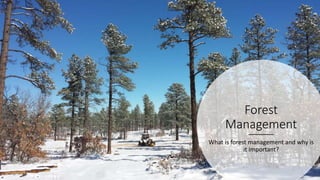
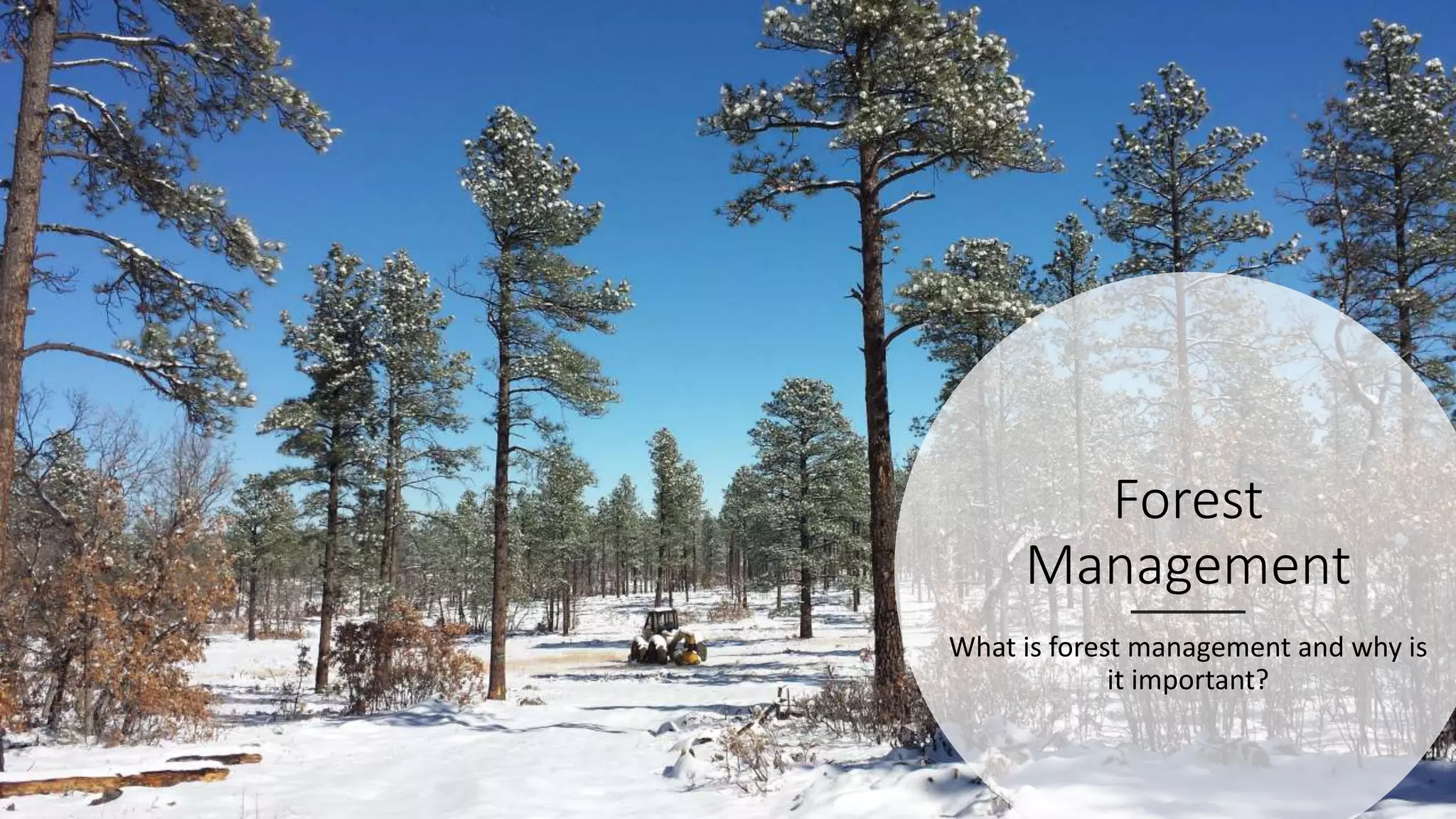
Forest
Management
What is forest management and why is
it important?
Forest
Management
Impacts
Communities
Healthy forests provide water -- critical for
sustaining agricultural production and community
populations across NM and the southwest
Other vital resources -- wood, recreation, wildlife,
grazing, etc
Unmanaged forests can become unhealthy, and
also dangerous to people and property
Increased fire risk threatens nearby communities
Past management
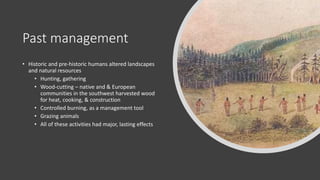
• Historic and pre-historic humans altered landscapes
and natural resources
• Hunting, gathering
• Wood-cutting – native and & European
communities in the southwest harvested wood
for heat, cooking, & construction
• Controlled burning, as a management tool
• Grazing animals
• All of these activities had major, lasting effects
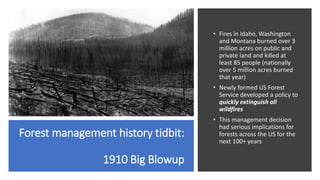
Forest management history tidbit:
1910 Big Blowup
• Fires in Idaho, Washington
and Montana burned over 3
million acres on public and
private land and killed at
least 85 people (nationally
over 5 million acres burned
that year)
• Newly formed US Forest
Service developed a policy to
quickly extinguish all
wildfires
• This management decision
had serious implications for
forests across the US for the
next 100+ years
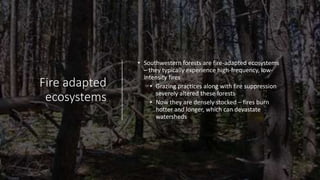
Fire adapted
ecosystems
• Southwestern forests are fire-adapted ecosystems
– they typically experience high-frequency, low-
intensity fires
• Grazing practices along with fire suppression
severely altered these forests
• Now they are densely stocked – fires burn
hotter and longer, which can devastate
watersheds
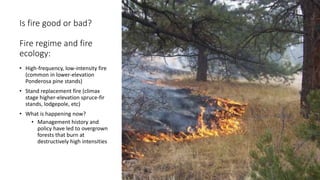
Is fire good or bad?
Fire regime and fire
ecology:
• High-frequency, low-intensity fire
(common in lower-elevation
Ponderosa pine stands)
• Stand replacement fire (climax
stage higher-elevation spruce-fir
stands, lodgepole, etc)
• What is happening now?
• Management history and
policy have led to overgrown
forests that burn at
destructively high intensities
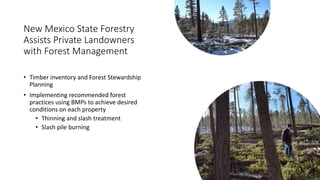
New Mexico State Forestry
Assists Private Landowners
with Forest Management
• Timber inventory and Forest Stewardship
Planning
• Implementing recommended forest
practices using BMPs to achieve desired
conditions on each property
• Thinning and slash treatment
• Slash pile burning
How does the process
work?
• Landowners typically reach out with
questions on funding & management
• The District office connects landowners
with a forester to schedule a site visit
• Foresters help landowners determine
their forest management goals and how
to best achieve them
• Objectives may be forest health,
creating defensible space around
homes, community efforts for
creating firewise communities,
improving aesthetics, commercial
timber harvest, etc
• Funding sources may be available to
assist with forest thinning projects
Non-Federal Lands
Program
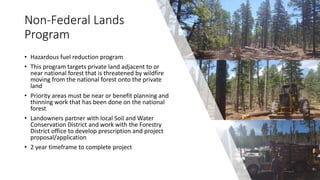
• Hazardous fuel reduction program
• This program targets private land adjacent to or
near national forest that is threatened by wildfire
moving from the national forest onto the private
land
• Priority areas must be near or benefit planning and
thinning work that has been done on the national
forest
• Landowners partner with local Soil and Water
Conservation District and work with the Forestry
District office to develop prescription and project
proposal/application
• 2 year timeframe to complete project
Forest Health Improvement
• Landowner must have a Forest Stewardship Plan to
apply for funding for thinning
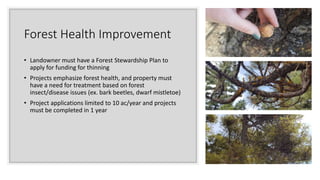
• Projects emphasize forest health, and property must
have a need for treatment based on forest
insect/disease issues (ex. bark beetles, dwarf mistletoe)
• Project applications limited to 10 ac/year and projects
must be completed in 1 year
Management
objectives vary
• Property size, location, timber type and
landowner abilities influence how the property
will be managed
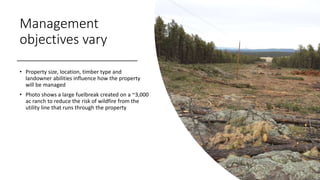
• Photo shows a large fuelbreak created on a ~3,000
ac ranch to reduce the risk of wildfire from the
utility line that runs through the property
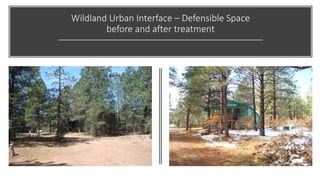
Wildland Urban Interface – Defensible Space
before and after treatment
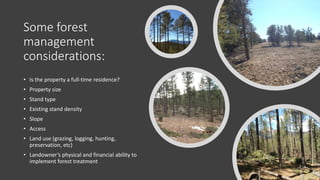
Some forest
management
considerations:
• Is the property a full-time residence?
• Property size
• Stand type
• Existing stand density
• Slope
• Access
• Land use (grazing, logging, hunting,
preservation, etc)
• Landowner’s physical and financial ability to
implement forest treatment

Forest Management & Why It's Important

  • 1.
    Forest Management What is forestmanagement and why is it important?
  • 2.
    Forest Management Impacts Communities Healthy forests providewater -- critical for sustaining agricultural production and community populations across NM and the southwest Other vital resources -- wood, recreation, wildlife, grazing, etc Unmanaged forests can become unhealthy, and also dangerous to people and property Increased fire risk threatens nearby communities
  • 3.
    Past management • Historicand pre-historic humans altered landscapes and natural resources • Hunting, gathering • Wood-cutting – native and & European communities in the southwest harvested wood for heat, cooking, & construction • Controlled burning, as a management tool • Grazing animals • All of these activities had major, lasting effects
  • 4.
    Forest management historytidbit: 1910 Big Blowup • Fires in Idaho, Washington and Montana burned over 3 million acres on public and private land and killed at least 85 people (nationally over 5 million acres burned that year) • Newly formed US Forest Service developed a policy to quickly extinguish all wildfires • This management decision had serious implications for forests across the US for the next 100+ years
  • 5.
    Fire adapted ecosystems • Southwesternforests are fire-adapted ecosystems – they typically experience high-frequency, low- intensity fires • Grazing practices along with fire suppression severely altered these forests • Now they are densely stocked – fires burn hotter and longer, which can devastate watersheds
  • 6.
    Is fire goodor bad? Fire regime and fire ecology: • High-frequency, low-intensity fire (common in lower-elevation Ponderosa pine stands) • Stand replacement fire (climax stage higher-elevation spruce-fir stands, lodgepole, etc) • What is happening now? • Management history and policy have led to overgrown forests that burn at destructively high intensities
  • 7.
    New Mexico StateForestry Assists Private Landowners with Forest Management • Timber inventory and Forest Stewardship Planning • Implementing recommended forest practices using BMPs to achieve desired conditions on each property • Thinning and slash treatment • Slash pile burning
  • 8.
    How does theprocess work? • Landowners typically reach out with questions on funding & management • The District office connects landowners with a forester to schedule a site visit • Foresters help landowners determine their forest management goals and how to best achieve them • Objectives may be forest health, creating defensible space around homes, community efforts for creating firewise communities, improving aesthetics, commercial timber harvest, etc • Funding sources may be available to assist with forest thinning projects
  • 9.
    Non-Federal Lands Program • Hazardousfuel reduction program • This program targets private land adjacent to or near national forest that is threatened by wildfire moving from the national forest onto the private land • Priority areas must be near or benefit planning and thinning work that has been done on the national forest • Landowners partner with local Soil and Water Conservation District and work with the Forestry District office to develop prescription and project proposal/application • 2 year timeframe to complete project
  • 10.
    Forest Health Improvement •Landowner must have a Forest Stewardship Plan to apply for funding for thinning • Projects emphasize forest health, and property must have a need for treatment based on forest insect/disease issues (ex. bark beetles, dwarf mistletoe) • Project applications limited to 10 ac/year and projects must be completed in 1 year
  • 11.
    Management objectives vary • Propertysize, location, timber type and landowner abilities influence how the property will be managed • Photo shows a large fuelbreak created on a ~3,000 ac ranch to reduce the risk of wildfire from the utility line that runs through the property
  • 12.
    Wildland Urban Interface– Defensible Space before and after treatment
  • 13.
    Some forest management considerations: • Isthe property a full-time residence? • Property size • Stand type • Existing stand density • Slope • Access • Land use (grazing, logging, hunting, preservation, etc) • Landowner’s physical and financial ability to implement forest treatment