WETLANDS
Presenter: Mr. Bhartendu Vimal
Guest Faculty-Asst. Prof.
College of Fisheries, Kishanganj, BASU, Patna
WETLANDS
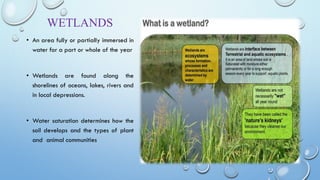
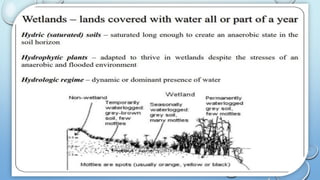
• An area fully or partially immersed in
water for a part or whole of the year
• Wetlands are found along the
shorelines of oceans, lakes, rivers and
in local depressions.
• Water saturation determines how the
soil develops and the types of plant
and animal communities
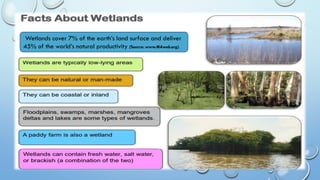
Wetlands cover 7% of the earth’s land surface and deliver
45% of the world’s natural productivity (Source: www.MAweb.org).
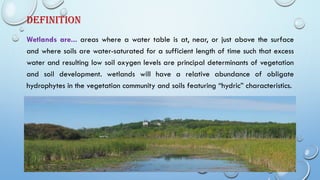
Wetlands are... areas where a water table is at, near, or just above the surface
and where soils are water-saturated for a sufficient length of time such that excess
water and resulting low soil oxygen levels are principal determinants of vegetation
and soil development. wetlands will have a relative abundance of obligate
hydrophytes in the vegetation community and soils featuring “hydric” characteristics.
DEFINITION
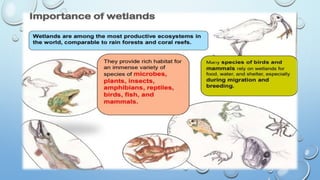
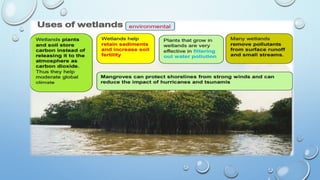
IMPORTANCE OF WETLANDS
• Ecosystem goods provided by the wetlands mainly include: water for irrigation, fisheries, non-timber forest
products, water supply and recreation.
• Wetlands such as tanks, ponds, lakes, and reservoirs have long been providing multiple-use water services include
water for irrigation, domestic needs, fisheries and recreational uses, ground-water recharge, flood control and silt
capture
• Major services include: carbon sequestration, flood control, groundwater recharge, nutrient removal, toxics
retention and biodiversity maintenance
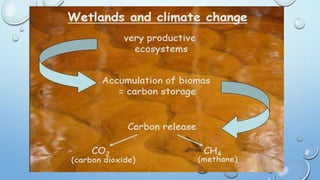
• Swamps, mangroves, peat lands, mires and marshes play an important role in carbon cycle.
• Wetland sediments are the long-term stores of carbon, short-term stores are in wetland existing biomass (plants,
animals, bacteria and fungi) and dissolved components in the surface and groundwater
• Wetlands act as a sink for contaminants in many agricultural and urban landscapes.
• Wetlands help to lessen the impacts of flooding by absorbing water and reducing the speed at which flood water
flows.
• Wetlands are important in supporting species diversity as some vertebrates and invertebrates depend on wetlands
for their entire life cycle while others only associate with these areas during particular stages of their life.
• Thus James (1995) has rightly termed these areas as Nature’s Kidney.”
IMPORTANCE OF WETLANDS
❖ Integral to a healthy environment
❖ Socio-economic importance
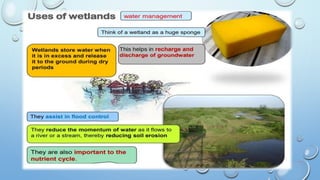
• Flood Control→ peatlands and wet grasslands act as sponges, absorbing rainfall and controlling itsflow
into streams
• Help to retain water during dry periods, water tablestable
• Provide clean water→ they act as the earth’s filters
• Wetlands removes pollutants from water
• Add moisture to the atmosphere
• Wetlands capture and retain rainfall, it prevent sediments from being washed into
lakes and rivers
• Productive environment
• Maintain biological diversity
• Important feeding, breeding and drinking areas for wildlife
• A source of life for people and wildlife
• Food supply
• Shoreline and storm protection: Coastal wetlands act as frontline defenses
against potential devastation Physical barriers that slows down storm
surges and tidal waves
• Cultural value
• Materials and medicines
• Recreation areas
• Vital habitat: 40% species and 12% of animal species
• A refuge for migrating birds
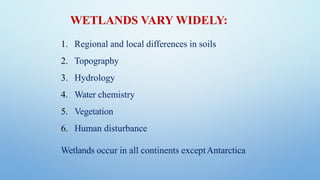
WETLANDS VARY WIDELY:
1. Regional and local differences in soils
2. Topography
3. Hydrology
4. Water chemistry
5. Vegetation
6. Human disturbance
Wetlands occur in all continents exceptAntarctica
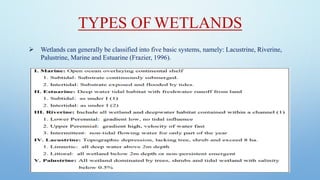
TYPES OF WETLANDS
➢ Wetlands can generally be classified into five basic systems, namely: Lacustrine, Riverine,
Palustrine, Marine and Estuarine (Frazier, 1996).
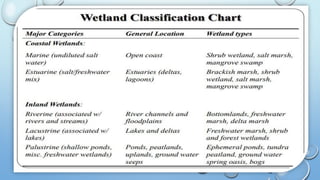
TIDAL OR COASTALWETLANDS
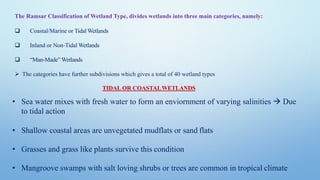
• Sea water mixes with fresh water to form an enviornment of varying salinities → Due
to tidal action
• Shallow coastal areas are unvegetated mudflats or sand flats
• Grasses and grass like plants survive this condition
• Mangroove swamps with salt loving shrubs or trees are common in tropical climate
The Ramsar Classification of Wetland Type, divides wetlands into three main categories, namely:
❑ Coastal/Marine or TidalWetlands
❑ Inland or Non-Tidal Wetlands
❑ “Man-Made” Wetlands
➢ The categories have further subdivisions which gives a total of 40 wetland types
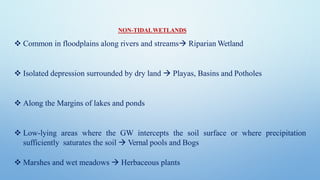
NON-TIDALWETLANDS
❖ Common in floodplains along rivers and streams→ Riparian Wetland
❖ Isolated depression surrounded by dry land → Playas, Basins and Potholes
❖ Along the Margins of lakes and ponds
❖ Low-lying areas where the GW intercepts the soil surface or where precipitation
sufficiently saturates the soil → Vernal pools and Bogs
❖ Marshes and wet meadows → Herbaceous plants
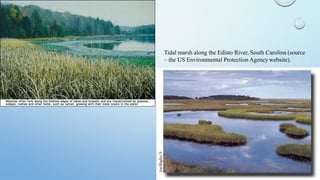
Tidal marsh along the Edisto River, South Carolina (source
– the US Environmental Protection Agency website).
CREEK
❖ A tidal inlet, typically as a salt marsh or mangrove swamps. The stream is thetidal
stream.
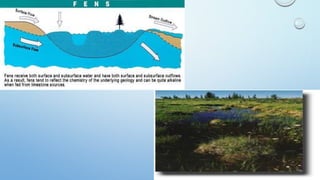
FEN
• Wetland fed by surface or groundwater.
• Flora is characterised by their water chemistry
• Fens are alkaline rather than acid areas
• Characterized by peaty soil, dominated by grasslike plants, grasses, sedges and reeds
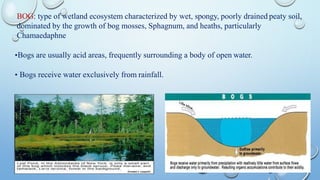
BOG: type of wetland ecosystem characterized by wet, spongy, poorly drained peaty soil,
dominated by the growth of bog mosses, Sphagnum, and heaths, particularly
Chamaedaphne
•Bogs are usually acid areas, frequently surrounding a body of open water.
• Bogs receive water exclusively from rainfall.
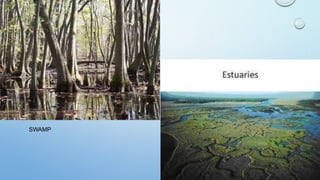
SWAMPS
• Temporary or permanent inundation of large areas of land by shallow bodies of
water
→ hummocks present
→ Aquaticvegetation
→ Shrubs are present
Slow-moving water associated with adjacent rivers or lake
ESTUARY
• Semi enclosed coastal body of water with one or more rivers flowing into it or the
river meets the sea
• High biological productivity
• Characterized by sedimentation
• pH, salinity and water level changes depending on the river and the ocean
SWAMP
FJORD
▪ Long narrow estuary with steep sides, created in a glacially carved valley that filled
by rising sea water levels
LAGOON
▪ Shallow salt or brackish water separated from deeper sea by a shallow sandbanks,
coral reefs….
▪ The enclosed body of water behind a barrier reef enclosed by an atoll reef
RAMSAR WETLAND TYPE
❑ COASTAL/MARINE OR TIDALWETLANDS
A. Permanent shallow marine waters less than six metres deep at low tide; includes sea bays and straits.
B. Marine subtidal aquatic beds; includes kelp beds, sea-grass beds, tropical marine meadows.
C. Coral reefs.
D. Rocky marine shores; includes rocky offshore islands, sea cliffs.
E. Sand, shingle or pebble shores; includes sand bars, spits and sandy islets; includes dune systems.
F. Estuarine waters; permanent water of estuaries and estuarine systems of deltas.
G. Intertidal mud, sand or salt flats.
H. Intertidal marshes; includes salt marshes, salt meadows, saltings, raised salt marshes; includes tidal brackish and
freshwater marshes.
I. Intertidal forested wetlands; includes mangrove swamps, nipah swamps and tidal freshwater swamp forests.
J. Coastal brackish/saline lagoons; brackish to saline lagoons with at least one relatively narrow connection to the
sea.
K. Coastal freshwater lagoons; includes freshwater delta lagoons.
RAMSAR WETLAND TYPE
❑ INLAND OR NON-TIDAL WETLANDS
L. Permanent inland deltas.
M. Permanent rivers/streams/creeks; includes waterfalls.
N. Seasonal/intermittent/irregular rivers/streams/creeks.
O. Permanent freshwater lakes (over 8 ha); includes large oxbow lakes.
P. seasonal/intermittent freshwater lakes (over 8 ha); includes floodplain lakes.
Q. Permanent saline/brackish/alkaline lakes.
R. Seasonal/intermittent saline/brackish/alkaline lakes and flats.*
Sp. Permanent saline/brackish/alkaline marshes/pools.
Ss. Seasonal/intermittent saline/brackish/alkaline marshes/ pools.*
Tp. Permanent freshwater marshes/pools; ponds (below 8 ha), marshes and swamps on inorganic soils; with emergent
vegetation water-logged for at least most of the growing season.
Ts. Seasonal/intermittent freshwater marshes/pools on inorganic soil; includes sloughs, potholes, seasonally flooded
meadows, sedge marshes.*
U. Non-forested peatlands; includes shrub or open bogs, swamps, fens.
Va. Alpine wetlands; includes alpine meadows, temporary waters from snowmelt.
Vt. Tundra wetlands; includes tundra pools, temporary waters from snowmelt.
W. Shrub-dominated wetlands; shrub swamps, shrub-dominated freshwater marsh, shrub carr, alder thicket; on inorganic
soils.*
Xf. Freshwater, tree-dominated wetlands; includes freshwater swamp forest, seasonally flooded forest, wooded swamps;
on inorganic soils.*
Xp. Forested peatlands; peatswamp forest.*
Y. Freshwater springs; oases.
Zg. Geothermal wetlands.
Zk. Subterranean karst and cave hydrological systems.
* as appropriate, includes: floodplain wetlands such as seasonally inundated grassland (including natural wet meadows), shrublands, woodlands or forest.
❑ "MAN-MADE" WETLANDS
1. Aquaculture (e.g. fish/shrimp) ponds.
2. Ponds; includes farm ponds, stock ponds, small tanks; (generally below 8 ha).
3. Irrigated land; includes irrigation channels and rice fields.
4. Seasonally flooded agricultural land.**
5. Salt exploitation sites; salt pans, salines, etc.
6. Water storage areas; reservoirs/barrages/dams/impoundments; (generally over 8 ha).
7. Excavations; gravel/brick/clay pits; borrow pits, mining pools.
8. Wastewater treatment areas; sewage farms, settling ponds, oxidation basins, etc.
9. Canals and drainage channels, ditches.
** to include intensively managed or grazed wet meadow or pasture.
RAMSAR WETLAND TYPE
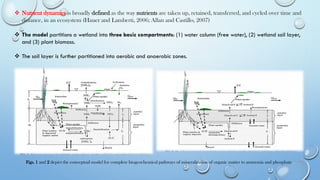
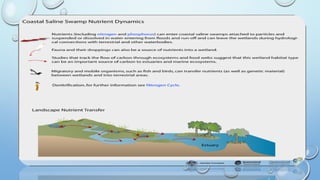
❖ Nutrient dynamics is broadly defined as the way nutrients are taken up, retained, transferred, and cycled over time and
distance, in an ecosystem (Hauer and Lamberti, 2006; Allan and Castillo, 2007)
❖ The model partitions a wetland into three basic compartments: (1) water column (free water), (2) wetland soil layer,
and (3) plant biomass.
❖ The soil layer is further partitioned into aerobic and anaerobic zones.
Figs. 1 and 2 depict the conceptual model for complete biogeochemical pathways of mineralization of organic matter to ammonia and phosphate
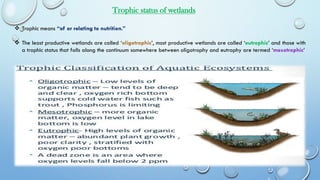
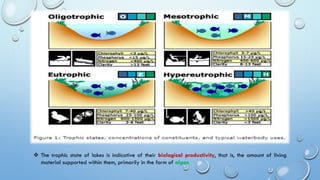
❖ Trophic means “of or relating to nutrition.”
❖ The least productive wetlands are called ‘oligotrophic’, most productive wetlands are called ‘eutrophic’ and those with
a trophic status that falls along the continuum somewhere between oligotrophy and eutrophy are termed ‘mesotrophic’
Trophic status of wetlands
❖ The trophic state of lakes is indicative of their biological productivity, that is, the amount of living
material supported within them, primarily in the form of algae
Distribution and extent of wetlands in India
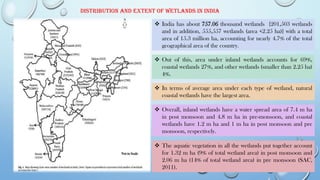
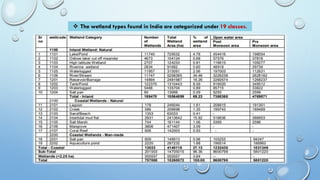
❖ India has about 757.06 thousand wetlands {201,503 wetlands
and in addition, 555,557 wetlands (area <2.25 ha)} with a total
area of 15.3 million ha, accounting for nearly 4.7% of the total
geographical area of the country.
❖ Out of this, area under inland wetlands accounts for 69%,
coastal wetlands 27%, and other wetlands (smaller than 2.25 ha)
4%.
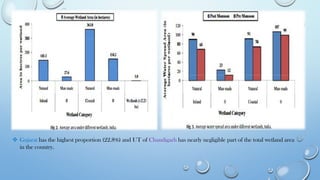
❖ In terms of average area under each type of wetland, natural
coastal wetlands have the largest area.
❖ Overall, inland wetlands have a water spread area of 7.4 m ha
in post monsoon and 4.8 m ha in pre-monsoon, and coastal
wetlands have 1.2 m ha and 1 m ha in post monsoon and pre
monsoon, respectively.
❖ The aquatic vegetation in all the wetlands put together account
for 1.32 m ha (9% of total wetland area) in post monsoon and
2.06 m ha (14% of total wetland area) in pre monsoon (SAC,
2011).
❖ Point Calimere in Tamilnadu, Ashtamudi, Sasthamkotta and
Vembanad-Kol lakes in Kerala; and Kolleru lake in Andhra Pradesh
are some of the natural wetland sites in South India
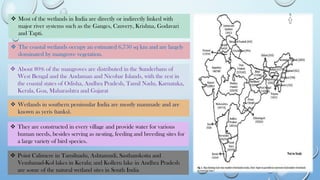
❖ Most of the wetlands in India are directly or indirectly linked with
major river systems such as the Ganges, Cauvery, Krishna, Godavari
and Tapti.
❖ The coastal wetlands occupy an estimated 6,750 sq km and are largely
dominated by mangrove vegetation.
❖ About 80% of the mangroves are distributed in the Sunderbans of
West Bengal and the Andaman and Nicobar Islands, with the rest in
the coastal states of Odisha, Andhra Pradesh, Tamil Nadu, Karnataka,
Kerala, Goa, Maharashtra and Gujarat
❖ Wetlands in southern peninsular India are mostly manmade and are
known as yeris (tanks).
❖ They are constructed in every village and provide water for various
human needs, besides serving as nesting, feeding and breeding sites for
a large variety of bird species.
✓ The reservoirs of the Deccan Plateau in the south, together with the lagoons and other wetlands of the southwest
coast.
✓ The vast saline expanses of Rajasthan, Gujarat and the Gulf of Kutch.
✓ The freshwater lakes and reservoirs from Gujarat eastwards through Rajasthan (Keoladeo Ghana National Park)
and Madhya Pradesh.
✓ The delta wetlands and lagoons of India’s east coast (Chilika Lake).
✓ The freshwater marshes of the Gangetic Plains and the floodplains of the Brahmaputra.
✓ The marshes and swamps in the hills of northeast India and the Himalayan foothills.
✓ The lakes and rivers of the mountain region of Kashmir and Ladakh.
✓ The mangroves and other wetlands of the Andaman and Nicobar Islands
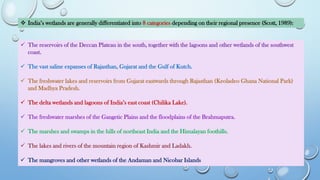
❖ India’s wetlands are generally differentiated into 8 categories depending on their regional presence (Scott, 1989):
❖ The wetland types found in India are categorized under 19 classes.
❖ Gujarat has the highest proportion (22.8%) and UT of Chandigarh has nearly negligible part of the total wetland area
in the country.
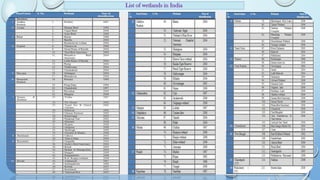
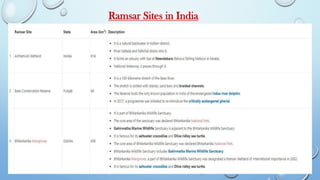
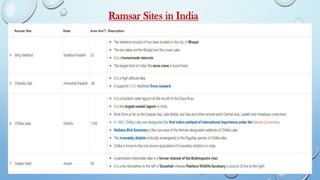
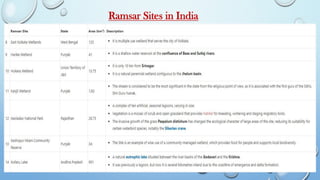
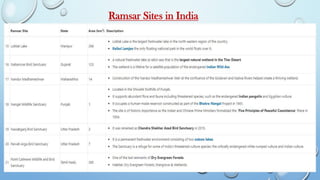
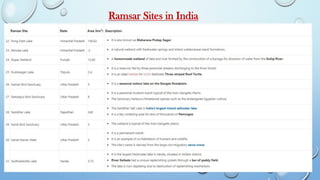
List of wetlands in India
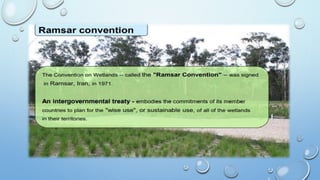
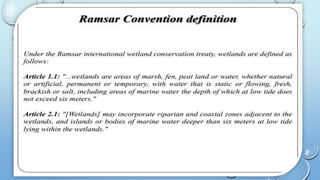
RAMSAR CONVENTION
✓ In February 2, 1971 convention on wetlands signed in Ramsar, Iran. Hence, also known as the Convention on Wetlands &
named after the city of Ramsar in Iran. The Ramsar convention entered into force in India on 1st February 1982.
✓ It is an intergovernmental/international treaty for “the conservation and sustainable use of wetlands” which provides the
framework for national action and international cooperation for the conservation and wise use of wetlands and their
resources
✓ The world’s first site was the Cobourg peninsula in Australia, designated in 1974.
✓ The largest sites are Rio negro in Brazil (120,000 sq. km), and Ngiri-Tumba-Maindombe in the Democratic Republic of
Congo and Queen Maud gulf in Canada; these Sites each cover over 60,000 square km.
✓ The most Ramsar Sites are the United Kingdom with 175 and Mexico with 142.
✓ For conservation and management of identified wetlands including Ramsar sites in the country, the Centrally Sponsored
Scheme of National Wetlands Conservation Programme (NWCP) was implemented till the year 2012-13.
✓ To have better synergy and to avoid overlap, the NWCP has been merged in February, 2013 with another scheme called
National Lake Conservation Plan (NLCP) into a new integrated scheme of ‘National Plan for Conservation of Aquatic Eco-
systems’ (NPCA) for holistic conservation of lakes and wetlands.
✓At the time of joining the convention, each contracting party
undertakes to designate at least one wetland site for inclusion in
the list of wetlands of international importance.
✓The inclusion of a “Ramsar site” in the list embodies the
government’s commitment to take the steps necessary to ensure
that its ecological character is maintained.
✓There are a total of 2,406 Ramsar Sites on the territories of 171
Ramsar contracting parties across the world, covering an area
of 254,343,085 ha, including 37 Ramsar sites in India.
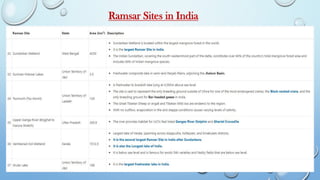
✓As of February 2020, there are 37 Ramsar Sites in India
covering area of 1,067,939 hectares (10679.39 km2)
THE RAMSAR SITES CRITERIA
❖ The nine criteria for identifying Wetlands of International Importance
➢ Group A: Sites containing representative, rare or unique wetland types
✓ Criterion 1: A wetland should be considered internationally important if it contains a representative, rare,
or unique example of a natural or near-natural wetland type found within the appropriate
biogeographic region.
➢ Group B: Sites of international importance for conserving biological diversity
(Criteria based on species and ecological communities)
✓ Criterion 2: A wetland should be considered internationally important if it supports vulnerable,
endangered, or critically endangered species or threatened ecological communities.
✓ Criterion 3: A wetland should be considered internationally important if it supports populations of plant
and/or animal species important for maintaining the biological diversity of a particular
biogeographic region.
✓ Criterion 4: A wetland should be considered internationally important if it supports plant and/or animal
species at a critical stage in their life cycles, or provides refuge during adverse conditions.
(Specific criteria based on waterbirds)
✓ Criterion 5: A wetland should be considered internationally important if it regularly supports 20,000 or more
water birds.
✓ Criterion 6: A wetland should be considered internationally important if it regularly supports 1% of the individuals
in a population of one species or subspecies of water bird
(Specific criteria based on fish)
✓ Criterion 7: A wetland should be considered internationally important if it supports a significant proportion of
indigenous fish subspecies, species or families, life-history stages, species interactions and/or
populations that are representative of wetland benefits and/or values and thereby contributes to global
biological diversity.
✓ Criterion 8: A wetland should be considered internationally important if it is an important source of food for fishes,
spawning ground, nursery and/or migration path on which fish stocks, either within the wetland or
elsewhere, depend.
(Specific criteria based on other taxa)
✓ Criterion 9: A wetland should be considered internationally important if it regularly supports 1% of the individuals
in a population of one species or subspecies of wetland-dependent non-avian animal species.
THE RAMSAR SITES CRITERIA
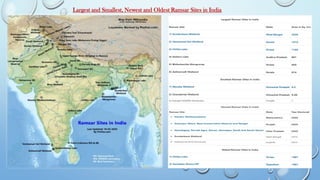
Largest and Smallest, Newest and Oldest Ramsar Sites in India
Ramsar Sites in India
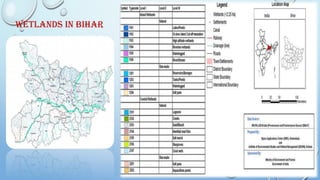
Wetlands in Bihar
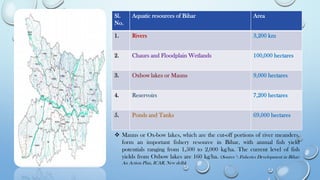
Sl.
No.
Aquatic resources of Bihar Area
1. Rivers 3,200 km
2. Chaurs and Floodplain Wetlands 100,000 hectares
3. Oxbow lakes or Mauns 9,000 hectares
4. Reservoirs 7,200 hectares
5. Ponds and Tanks 69,000 hectares
❖ Mauns or Ox-bow lakes, which are the cut-off portions of river meanders,
form an important fishery resource in Bihar, with annual fish yield
potentials ranging from 1,500 to 2,000 kg/ha. The current level of fish
yields from Oxbow lakes are 160 kg/ha. (Source*: Fisheries Development in Bihar:
An Action Plan, ICAR, New delhi)
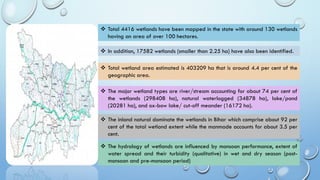
❖ Total 4416 wetlands have been mapped in the state with around 130 wetlands
having an area of over 100 hectares.
❖ In addition, 17582 wetlands (smaller than 2.25 ha) have also been identified.
❖ Total wetland area estimated is 403209 ha that is around 4.4 per cent of the
geographic area.
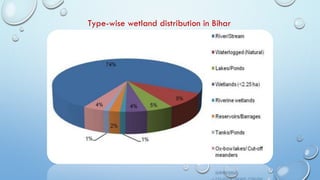
❖ The major wetland types are river/stream accounting for about 74 per cent of
the wetlands (298408 ha), natural waterlogged (34878 ha), lake/pond
(20281 ha), and ox-bow lake/ cut-off meander (16172 ha).
❖ The inland natural dominate the wetlands in Bihar which comprise about 92 per
cent of the total wetland extent while the manmade accounts for about 3.5 per
cent.
❖ The hydrology of wetlands are influenced by monsoon performance, extent of
water spread and their turbidity (qualitative) in wet and dry season (post-
monsoon and pre-monsoon period)
Type-wise wetland distribution in Bihar
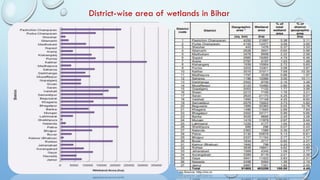
District-wise area of wetlands in Bihar
THREATS TO WETLANDS
▪ Anthropogenic pressures
▪ Rapidly expanding human evolution
▪ Development projects
▪ Improper use of watershed
▪ Converting floodplains to aquaculture
▪ Planting trees on bogs
▪ Draining marshes for agriculture
▪ Forestry and urban development
▪ Mining them for peat
WETLANDS

WETLANDS

  • 1.
    WETLANDS Presenter: Mr. BhartenduVimal Guest Faculty-Asst. Prof. College of Fisheries, Kishanganj, BASU, Patna
  • 2.
    WETLANDS • An areafully or partially immersed in water for a part or whole of the year • Wetlands are found along the shorelines of oceans, lakes, rivers and in local depressions. • Water saturation determines how the soil develops and the types of plant and animal communities
  • 3.
    Wetlands cover 7%of the earth’s land surface and deliver 45% of the world’s natural productivity (Source: www.MAweb.org).
  • 4.
    Wetlands are... areaswhere a water table is at, near, or just above the surface and where soils are water-saturated for a sufficient length of time such that excess water and resulting low soil oxygen levels are principal determinants of vegetation and soil development. wetlands will have a relative abundance of obligate hydrophytes in the vegetation community and soils featuring “hydric” characteristics. DEFINITION
  • 8.
    IMPORTANCE OF WETLANDS •Ecosystem goods provided by the wetlands mainly include: water for irrigation, fisheries, non-timber forest products, water supply and recreation. • Wetlands such as tanks, ponds, lakes, and reservoirs have long been providing multiple-use water services include water for irrigation, domestic needs, fisheries and recreational uses, ground-water recharge, flood control and silt capture • Major services include: carbon sequestration, flood control, groundwater recharge, nutrient removal, toxics retention and biodiversity maintenance • Swamps, mangroves, peat lands, mires and marshes play an important role in carbon cycle. • Wetland sediments are the long-term stores of carbon, short-term stores are in wetland existing biomass (plants, animals, bacteria and fungi) and dissolved components in the surface and groundwater • Wetlands act as a sink for contaminants in many agricultural and urban landscapes. • Wetlands help to lessen the impacts of flooding by absorbing water and reducing the speed at which flood water flows. • Wetlands are important in supporting species diversity as some vertebrates and invertebrates depend on wetlands for their entire life cycle while others only associate with these areas during particular stages of their life. • Thus James (1995) has rightly termed these areas as Nature’s Kidney.”
  • 9.
    IMPORTANCE OF WETLANDS ❖Integral to a healthy environment ❖ Socio-economic importance • Flood Control→ peatlands and wet grasslands act as sponges, absorbing rainfall and controlling itsflow into streams • Help to retain water during dry periods, water tablestable • Provide clean water→ they act as the earth’s filters • Wetlands removes pollutants from water • Add moisture to the atmosphere
  • 10.
    • Wetlands captureand retain rainfall, it prevent sediments from being washed into lakes and rivers • Productive environment • Maintain biological diversity • Important feeding, breeding and drinking areas for wildlife • A source of life for people and wildlife
  • 11.
    • Food supply •Shoreline and storm protection: Coastal wetlands act as frontline defenses against potential devastation Physical barriers that slows down storm surges and tidal waves • Cultural value • Materials and medicines • Recreation areas • Vital habitat: 40% species and 12% of animal species • A refuge for migrating birds
  • 14.
    WETLANDS VARY WIDELY: 1.Regional and local differences in soils 2. Topography 3. Hydrology 4. Water chemistry 5. Vegetation 6. Human disturbance Wetlands occur in all continents exceptAntarctica
  • 15.
    TYPES OF WETLANDS ➢Wetlands can generally be classified into five basic systems, namely: Lacustrine, Riverine, Palustrine, Marine and Estuarine (Frazier, 1996).
  • 18.
    TIDAL OR COASTALWETLANDS •Sea water mixes with fresh water to form an enviornment of varying salinities → Due to tidal action • Shallow coastal areas are unvegetated mudflats or sand flats • Grasses and grass like plants survive this condition • Mangroove swamps with salt loving shrubs or trees are common in tropical climate The Ramsar Classification of Wetland Type, divides wetlands into three main categories, namely: ❑ Coastal/Marine or TidalWetlands ❑ Inland or Non-Tidal Wetlands ❑ “Man-Made” Wetlands ➢ The categories have further subdivisions which gives a total of 40 wetland types
  • 19.
    NON-TIDALWETLANDS ❖ Common infloodplains along rivers and streams→ Riparian Wetland ❖ Isolated depression surrounded by dry land → Playas, Basins and Potholes ❖ Along the Margins of lakes and ponds ❖ Low-lying areas where the GW intercepts the soil surface or where precipitation sufficiently saturates the soil → Vernal pools and Bogs ❖ Marshes and wet meadows → Herbaceous plants
  • 20.
    Tidal marsh alongthe Edisto River, South Carolina (source – the US Environmental Protection Agency website).
  • 21.
    CREEK ❖ A tidalinlet, typically as a salt marsh or mangrove swamps. The stream is thetidal stream. FEN • Wetland fed by surface or groundwater. • Flora is characterised by their water chemistry • Fens are alkaline rather than acid areas • Characterized by peaty soil, dominated by grasslike plants, grasses, sedges and reeds
  • 23.
    BOG: type ofwetland ecosystem characterized by wet, spongy, poorly drained peaty soil, dominated by the growth of bog mosses, Sphagnum, and heaths, particularly Chamaedaphne •Bogs are usually acid areas, frequently surrounding a body of open water. • Bogs receive water exclusively from rainfall.
  • 24.
    SWAMPS • Temporary orpermanent inundation of large areas of land by shallow bodies of water → hummocks present → Aquaticvegetation → Shrubs are present Slow-moving water associated with adjacent rivers or lake ESTUARY • Semi enclosed coastal body of water with one or more rivers flowing into it or the river meets the sea • High biological productivity • Characterized by sedimentation • pH, salinity and water level changes depending on the river and the ocean
  • 25.
  • 26.
    FJORD ▪ Long narrowestuary with steep sides, created in a glacially carved valley that filled by rising sea water levels LAGOON ▪ Shallow salt or brackish water separated from deeper sea by a shallow sandbanks, coral reefs…. ▪ The enclosed body of water behind a barrier reef enclosed by an atoll reef
  • 27.
    RAMSAR WETLAND TYPE ❑COASTAL/MARINE OR TIDALWETLANDS A. Permanent shallow marine waters less than six metres deep at low tide; includes sea bays and straits. B. Marine subtidal aquatic beds; includes kelp beds, sea-grass beds, tropical marine meadows. C. Coral reefs. D. Rocky marine shores; includes rocky offshore islands, sea cliffs. E. Sand, shingle or pebble shores; includes sand bars, spits and sandy islets; includes dune systems. F. Estuarine waters; permanent water of estuaries and estuarine systems of deltas. G. Intertidal mud, sand or salt flats. H. Intertidal marshes; includes salt marshes, salt meadows, saltings, raised salt marshes; includes tidal brackish and freshwater marshes. I. Intertidal forested wetlands; includes mangrove swamps, nipah swamps and tidal freshwater swamp forests. J. Coastal brackish/saline lagoons; brackish to saline lagoons with at least one relatively narrow connection to the sea. K. Coastal freshwater lagoons; includes freshwater delta lagoons.
  • 28.
    RAMSAR WETLAND TYPE ❑INLAND OR NON-TIDAL WETLANDS L. Permanent inland deltas. M. Permanent rivers/streams/creeks; includes waterfalls. N. Seasonal/intermittent/irregular rivers/streams/creeks. O. Permanent freshwater lakes (over 8 ha); includes large oxbow lakes. P. seasonal/intermittent freshwater lakes (over 8 ha); includes floodplain lakes. Q. Permanent saline/brackish/alkaline lakes. R. Seasonal/intermittent saline/brackish/alkaline lakes and flats.* Sp. Permanent saline/brackish/alkaline marshes/pools. Ss. Seasonal/intermittent saline/brackish/alkaline marshes/ pools.* Tp. Permanent freshwater marshes/pools; ponds (below 8 ha), marshes and swamps on inorganic soils; with emergent vegetation water-logged for at least most of the growing season. Ts. Seasonal/intermittent freshwater marshes/pools on inorganic soil; includes sloughs, potholes, seasonally flooded meadows, sedge marshes.* U. Non-forested peatlands; includes shrub or open bogs, swamps, fens. Va. Alpine wetlands; includes alpine meadows, temporary waters from snowmelt. Vt. Tundra wetlands; includes tundra pools, temporary waters from snowmelt. W. Shrub-dominated wetlands; shrub swamps, shrub-dominated freshwater marsh, shrub carr, alder thicket; on inorganic soils.* Xf. Freshwater, tree-dominated wetlands; includes freshwater swamp forest, seasonally flooded forest, wooded swamps; on inorganic soils.* Xp. Forested peatlands; peatswamp forest.* Y. Freshwater springs; oases. Zg. Geothermal wetlands. Zk. Subterranean karst and cave hydrological systems. * as appropriate, includes: floodplain wetlands such as seasonally inundated grassland (including natural wet meadows), shrublands, woodlands or forest.
  • 29.
    ❑ "MAN-MADE" WETLANDS 1.Aquaculture (e.g. fish/shrimp) ponds. 2. Ponds; includes farm ponds, stock ponds, small tanks; (generally below 8 ha). 3. Irrigated land; includes irrigation channels and rice fields. 4. Seasonally flooded agricultural land.** 5. Salt exploitation sites; salt pans, salines, etc. 6. Water storage areas; reservoirs/barrages/dams/impoundments; (generally over 8 ha). 7. Excavations; gravel/brick/clay pits; borrow pits, mining pools. 8. Wastewater treatment areas; sewage farms, settling ponds, oxidation basins, etc. 9. Canals and drainage channels, ditches. ** to include intensively managed or grazed wet meadow or pasture. RAMSAR WETLAND TYPE
  • 30.
    ❖ Nutrient dynamicsis broadly defined as the way nutrients are taken up, retained, transferred, and cycled over time and distance, in an ecosystem (Hauer and Lamberti, 2006; Allan and Castillo, 2007) ❖ The model partitions a wetland into three basic compartments: (1) water column (free water), (2) wetland soil layer, and (3) plant biomass. ❖ The soil layer is further partitioned into aerobic and anaerobic zones. Figs. 1 and 2 depict the conceptual model for complete biogeochemical pathways of mineralization of organic matter to ammonia and phosphate
  • 32.
    ❖ Trophic means“of or relating to nutrition.” ❖ The least productive wetlands are called ‘oligotrophic’, most productive wetlands are called ‘eutrophic’ and those with a trophic status that falls along the continuum somewhere between oligotrophy and eutrophy are termed ‘mesotrophic’ Trophic status of wetlands
  • 33.
    ❖ The trophicstate of lakes is indicative of their biological productivity, that is, the amount of living material supported within them, primarily in the form of algae
  • 34.
    Distribution and extentof wetlands in India ❖ India has about 757.06 thousand wetlands {201,503 wetlands and in addition, 555,557 wetlands (area <2.25 ha)} with a total area of 15.3 million ha, accounting for nearly 4.7% of the total geographical area of the country. ❖ Out of this, area under inland wetlands accounts for 69%, coastal wetlands 27%, and other wetlands (smaller than 2.25 ha) 4%. ❖ In terms of average area under each type of wetland, natural coastal wetlands have the largest area. ❖ Overall, inland wetlands have a water spread area of 7.4 m ha in post monsoon and 4.8 m ha in pre-monsoon, and coastal wetlands have 1.2 m ha and 1 m ha in post monsoon and pre monsoon, respectively. ❖ The aquatic vegetation in all the wetlands put together account for 1.32 m ha (9% of total wetland area) in post monsoon and 2.06 m ha (14% of total wetland area) in pre monsoon (SAC, 2011).
  • 35.
    ❖ Point Calimerein Tamilnadu, Ashtamudi, Sasthamkotta and Vembanad-Kol lakes in Kerala; and Kolleru lake in Andhra Pradesh are some of the natural wetland sites in South India ❖ Most of the wetlands in India are directly or indirectly linked with major river systems such as the Ganges, Cauvery, Krishna, Godavari and Tapti. ❖ The coastal wetlands occupy an estimated 6,750 sq km and are largely dominated by mangrove vegetation. ❖ About 80% of the mangroves are distributed in the Sunderbans of West Bengal and the Andaman and Nicobar Islands, with the rest in the coastal states of Odisha, Andhra Pradesh, Tamil Nadu, Karnataka, Kerala, Goa, Maharashtra and Gujarat ❖ Wetlands in southern peninsular India are mostly manmade and are known as yeris (tanks). ❖ They are constructed in every village and provide water for various human needs, besides serving as nesting, feeding and breeding sites for a large variety of bird species.
  • 36.
    ✓ The reservoirsof the Deccan Plateau in the south, together with the lagoons and other wetlands of the southwest coast. ✓ The vast saline expanses of Rajasthan, Gujarat and the Gulf of Kutch. ✓ The freshwater lakes and reservoirs from Gujarat eastwards through Rajasthan (Keoladeo Ghana National Park) and Madhya Pradesh. ✓ The delta wetlands and lagoons of India’s east coast (Chilika Lake). ✓ The freshwater marshes of the Gangetic Plains and the floodplains of the Brahmaputra. ✓ The marshes and swamps in the hills of northeast India and the Himalayan foothills. ✓ The lakes and rivers of the mountain region of Kashmir and Ladakh. ✓ The mangroves and other wetlands of the Andaman and Nicobar Islands ❖ India’s wetlands are generally differentiated into 8 categories depending on their regional presence (Scott, 1989):
  • 37.
    ❖ The wetlandtypes found in India are categorized under 19 classes.
  • 38.
    ❖ Gujarat hasthe highest proportion (22.8%) and UT of Chandigarh has nearly negligible part of the total wetland area in the country.
  • 39.
  • 40.
    RAMSAR CONVENTION ✓ InFebruary 2, 1971 convention on wetlands signed in Ramsar, Iran. Hence, also known as the Convention on Wetlands & named after the city of Ramsar in Iran. The Ramsar convention entered into force in India on 1st February 1982. ✓ It is an intergovernmental/international treaty for “the conservation and sustainable use of wetlands” which provides the framework for national action and international cooperation for the conservation and wise use of wetlands and their resources ✓ The world’s first site was the Cobourg peninsula in Australia, designated in 1974. ✓ The largest sites are Rio negro in Brazil (120,000 sq. km), and Ngiri-Tumba-Maindombe in the Democratic Republic of Congo and Queen Maud gulf in Canada; these Sites each cover over 60,000 square km. ✓ The most Ramsar Sites are the United Kingdom with 175 and Mexico with 142. ✓ For conservation and management of identified wetlands including Ramsar sites in the country, the Centrally Sponsored Scheme of National Wetlands Conservation Programme (NWCP) was implemented till the year 2012-13. ✓ To have better synergy and to avoid overlap, the NWCP has been merged in February, 2013 with another scheme called National Lake Conservation Plan (NLCP) into a new integrated scheme of ‘National Plan for Conservation of Aquatic Eco- systems’ (NPCA) for holistic conservation of lakes and wetlands.
  • 41.
    ✓At the timeof joining the convention, each contracting party undertakes to designate at least one wetland site for inclusion in the list of wetlands of international importance. ✓The inclusion of a “Ramsar site” in the list embodies the government’s commitment to take the steps necessary to ensure that its ecological character is maintained. ✓There are a total of 2,406 Ramsar Sites on the territories of 171 Ramsar contracting parties across the world, covering an area of 254,343,085 ha, including 37 Ramsar sites in India. ✓As of February 2020, there are 37 Ramsar Sites in India covering area of 1,067,939 hectares (10679.39 km2)
  • 42.
    THE RAMSAR SITESCRITERIA ❖ The nine criteria for identifying Wetlands of International Importance ➢ Group A: Sites containing representative, rare or unique wetland types ✓ Criterion 1: A wetland should be considered internationally important if it contains a representative, rare, or unique example of a natural or near-natural wetland type found within the appropriate biogeographic region. ➢ Group B: Sites of international importance for conserving biological diversity (Criteria based on species and ecological communities) ✓ Criterion 2: A wetland should be considered internationally important if it supports vulnerable, endangered, or critically endangered species or threatened ecological communities. ✓ Criterion 3: A wetland should be considered internationally important if it supports populations of plant and/or animal species important for maintaining the biological diversity of a particular biogeographic region. ✓ Criterion 4: A wetland should be considered internationally important if it supports plant and/or animal species at a critical stage in their life cycles, or provides refuge during adverse conditions.
  • 43.
    (Specific criteria basedon waterbirds) ✓ Criterion 5: A wetland should be considered internationally important if it regularly supports 20,000 or more water birds. ✓ Criterion 6: A wetland should be considered internationally important if it regularly supports 1% of the individuals in a population of one species or subspecies of water bird (Specific criteria based on fish) ✓ Criterion 7: A wetland should be considered internationally important if it supports a significant proportion of indigenous fish subspecies, species or families, life-history stages, species interactions and/or populations that are representative of wetland benefits and/or values and thereby contributes to global biological diversity. ✓ Criterion 8: A wetland should be considered internationally important if it is an important source of food for fishes, spawning ground, nursery and/or migration path on which fish stocks, either within the wetland or elsewhere, depend. (Specific criteria based on other taxa) ✓ Criterion 9: A wetland should be considered internationally important if it regularly supports 1% of the individuals in a population of one species or subspecies of wetland-dependent non-avian animal species. THE RAMSAR SITES CRITERIA
  • 44.
    Largest and Smallest,Newest and Oldest Ramsar Sites in India
  • 45.
  • 46.
  • 47.
  • 48.
  • 49.
  • 50.
  • 51.
  • 52.
    Sl. No. Aquatic resources ofBihar Area 1. Rivers 3,200 km 2. Chaurs and Floodplain Wetlands 100,000 hectares 3. Oxbow lakes or Mauns 9,000 hectares 4. Reservoirs 7,200 hectares 5. Ponds and Tanks 69,000 hectares ❖ Mauns or Ox-bow lakes, which are the cut-off portions of river meanders, form an important fishery resource in Bihar, with annual fish yield potentials ranging from 1,500 to 2,000 kg/ha. The current level of fish yields from Oxbow lakes are 160 kg/ha. (Source*: Fisheries Development in Bihar: An Action Plan, ICAR, New delhi)
  • 53.
    ❖ Total 4416wetlands have been mapped in the state with around 130 wetlands having an area of over 100 hectares. ❖ In addition, 17582 wetlands (smaller than 2.25 ha) have also been identified. ❖ Total wetland area estimated is 403209 ha that is around 4.4 per cent of the geographic area. ❖ The major wetland types are river/stream accounting for about 74 per cent of the wetlands (298408 ha), natural waterlogged (34878 ha), lake/pond (20281 ha), and ox-bow lake/ cut-off meander (16172 ha). ❖ The inland natural dominate the wetlands in Bihar which comprise about 92 per cent of the total wetland extent while the manmade accounts for about 3.5 per cent. ❖ The hydrology of wetlands are influenced by monsoon performance, extent of water spread and their turbidity (qualitative) in wet and dry season (post- monsoon and pre-monsoon period)
  • 54.
  • 55.
    District-wise area ofwetlands in Bihar
  • 57.
    THREATS TO WETLANDS ▪Anthropogenic pressures ▪ Rapidly expanding human evolution ▪ Development projects ▪ Improper use of watershed ▪ Converting floodplains to aquaculture ▪ Planting trees on bogs ▪ Draining marshes for agriculture ▪ Forestry and urban development ▪ Mining them for peat