REINFORCED BRICKWORK
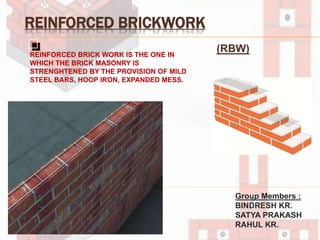
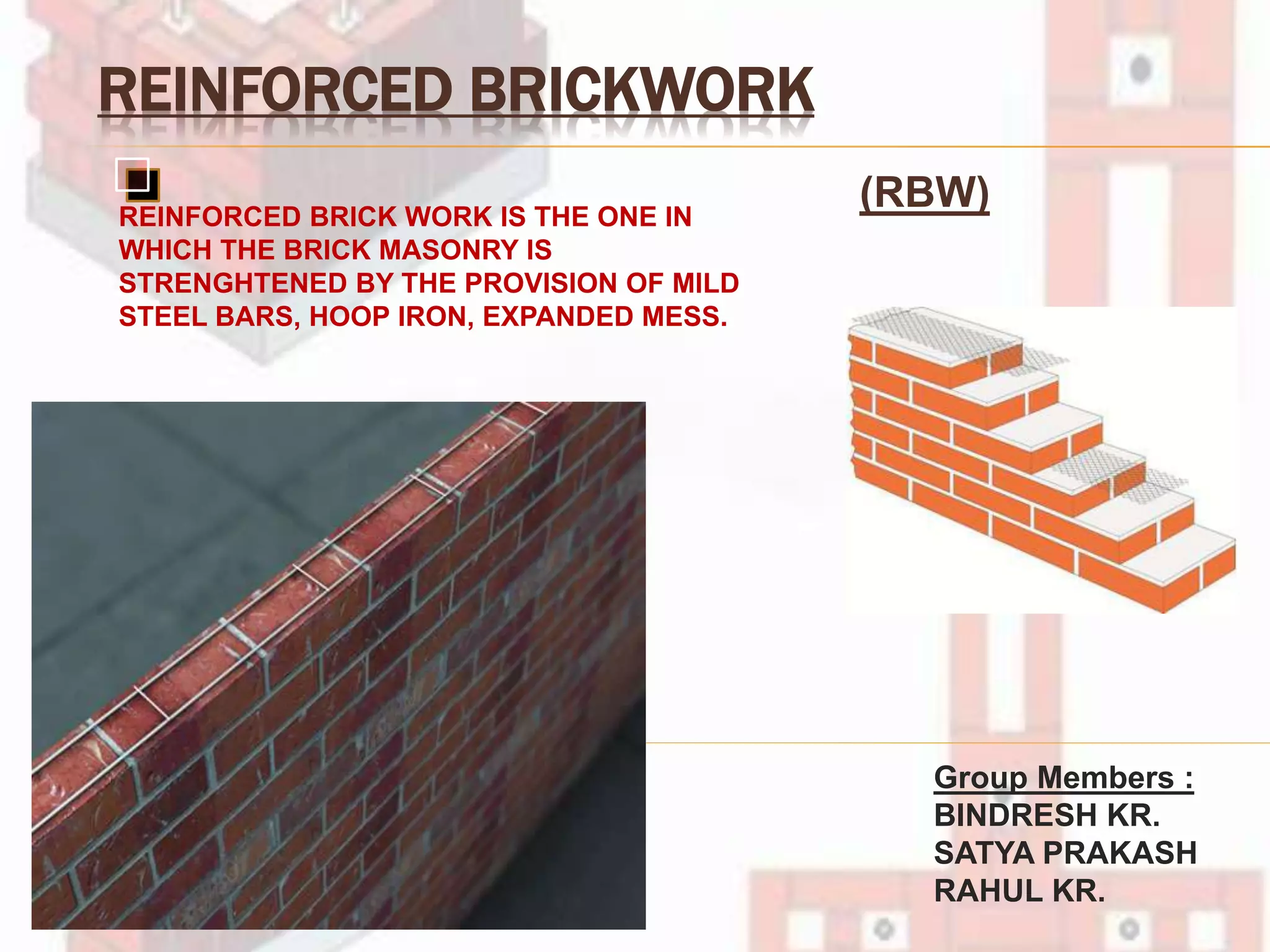
REINFORCED BRICK WORK IS THE ONE IN
WHICH THE BRICK MASONRY IS
STRENGHTENED BY THE PROVISION OF MILD
STEEL BARS, HOOP IRON, EXPANDED MESS.
(RBW)
Group Members :
BINDRESH KR.
SATYA PRAKASH
RAHUL KR.
INTRODUCTION
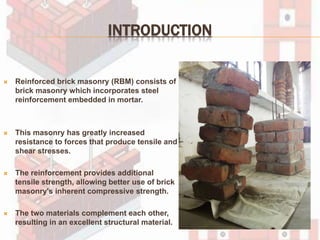
 Reinforced brick masonry (RBM) consists of
brick masonry which incorporates steel
reinforcement embedded in mortar.
 This masonry has greatly increased
resistance to forces that produce tensile and
shear stresses.
 The reinforcement provides additional
tensile strength, allowing better use of brick
masonry's inherent compressive strength.
 The two materials complement each other,
resulting in an excellent structural material.
HISTORY
Brick masonry is one of the oldest forms of building
construction, and reinforcement has been used to
strengthen masonry since 1813.
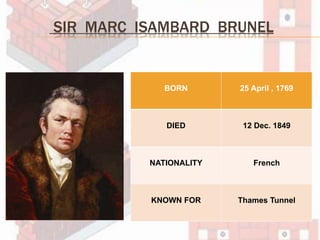
SIR MARC ISAMBARD BRUNEL
BORN 25 April , 1769
DIED 12 Dec. 1849
NATIONALITY French
KNOWN FOR Thames Tunnel
REINFORCED BRICK WORK USES
• FIRST CLASS
BRICK
CEMENT
MORTAR
•
REINFORCEMEN
T
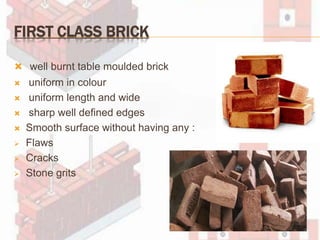
FIRST CLASS BRICK
 well burnt table moulded brick
 uniform in colour
 uniform length and wide
 sharp well defined edges
 Smooth surface without having any :
 Flaws
 Cracks
 Stone grits
FIRST CLASS BRICK
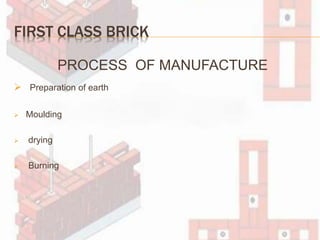
PROCESS OF MANUFACTURE
 Preparation of earth
 Moulding
 drying
 Burning
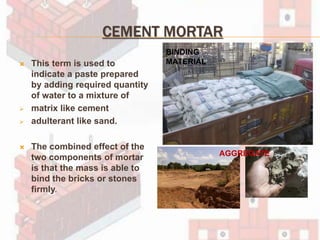
CEMENT MORTAR
 This term is used to
indicate a paste prepared
by adding required quantity
of water to a mixture of
 matrix like cement
 adulterant like sand.
 The combined effect of the
two components of mortar
is that the mass is able to
bind the bricks or stones
firmly.
BINDING
MATERIAL
AGGREGATE
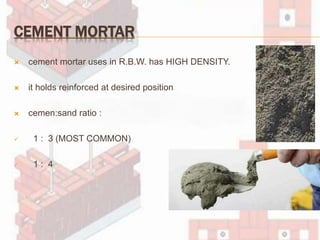
CEMENT MORTAR
 cement mortar uses in R.B.W. has HIGH DENSITY.
 it holds reinforced at desired position
 cemen:sand ratio :
 1 : 3 (MOST COMMON)
 1 : 4
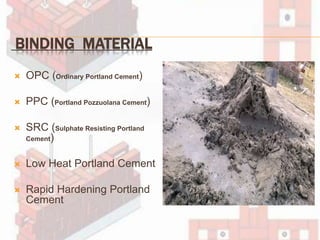
BINDING MATERIAL
 OPC (Ordinary Portland Cement)
 PPC (Portland Pozzuolana Cement)
 SRC (Sulphate Resisting Portland
Cement)
 Low Heat Portland Cement
 Rapid Hardening Portland
Cement
REINFORCEMENT
PRINCIPLES OF REINFORCEMENTS
 tension occurs when bending forces act on structural elements
such as
 beam
 cantilevers
 steel is excellent in resisting tension and can be incorporated into
brickwork as reinforcement
 the steel must be located in the masonry where tension is occur-
typically at the bottom of a horizontal beam and at the top of a
horizontal cantilever.
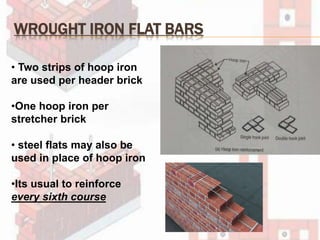
WROUGHT IRON FLAT BARS
• Two strips of hoop iron
are used per header brick
•One hoop iron per
stretcher brick
• steel flats may also be
used in place of hoop iron
•Its usual to reinforce
every sixth course
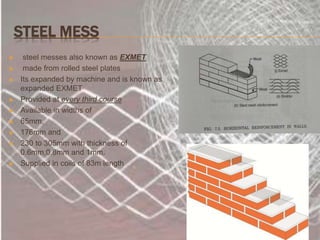
STEEL MESS
 steel messes also known as EXMET
 made from rolled steel plates
 Its expanded by machine and is known as
expanded EXMET
 Provided at every third course
 Available in widths of
 65mm,
 176mm and
 230 to 305mm with thickness of
0.6mm,0.8mm and 1mm.
 Supplied in coils of 83m length
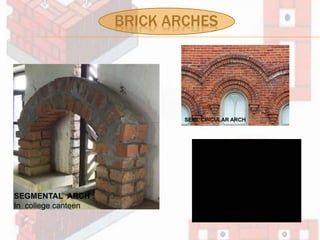
BRICK ARCHES
SEGMENTAL ARCH :
In college canteen
SEMI CIRCULAR ARCH
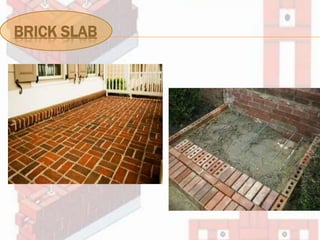
BRICK SLAB
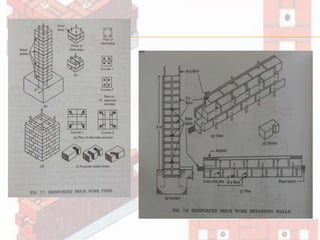
REIFORCED BRICK BEAM
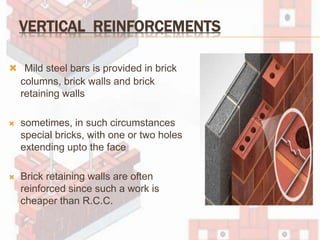
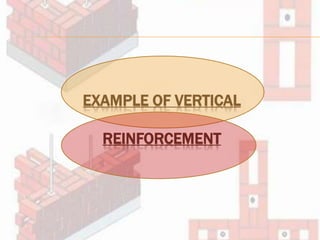
VERTICAL REINFORCEMENTS
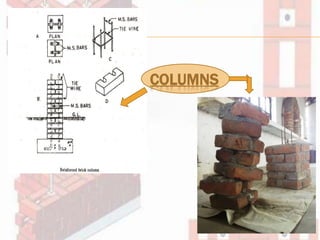
 Mild steel bars is provided in brick
columns, brick walls and brick
retaining walls
 sometimes, in such circumstances
special bricks, with one or two holes
extending upto the face
 Brick retaining walls are often
reinforced since such a work is
cheaper than R.C.C.
EXAMPLE OF VERTICAL
REINFORCEMENT
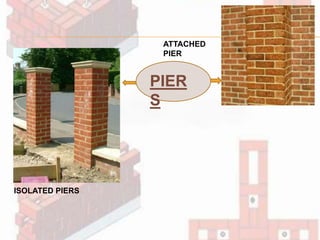
PIERS
ISOLATED PIERS
ATTACHED
PIER
PIER
S
COLUMNS
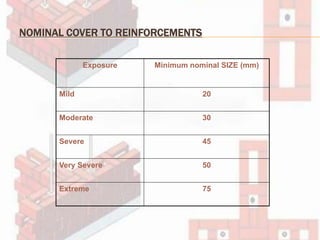
NOMINAL COVER TO REINFORCEMENTS
Exposure Minimum nominal SIZE (mm)
Mild 20
Moderate 30
Severe 45
Very Severe 50
Extreme 75
WATER
 Clean water to be used
in the preparation of
mortar.
 The pH of water not less
than 6.
 Sea water not to be used
in R.B.W.
Limits in Mixing Water
 Sulphates(as SO3)---
400mg/litre
 Chlorides (as Cl )---500mg/litre
CURING OF R.B.W.
 the act of maintaining controlled conditions for freshly
brick work for some definite period following the placing
and finishing operations to assure the proper hydration of
cement and proper hardening of brick work.
 Methods of Curing:
 Retaining formwork
 Shading of brick work
 Covering of surfaces with cotton mats
 Continuous sprinklings of exposed surfaces
 Ponding method
 Membrane curing
 Steam curing
 Electrical method of curing
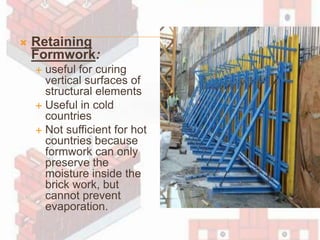
 Retaining
Formwork:
 useful for curing
vertical surfaces of
structural elements
 Useful in cold
countries
 Not sufficient for hot
countries because
formwork can only
preserve the
moisture inside the
brick work, but
cannot prevent
evaporation.
SHADING OF R.B.W.
 Essential in dry weather
 objective of shading to prevent the evaporation of water
 Also protects the surface from rain
 Limited application
Covering Surfaces with wet material:
• most widely used
Continuous sprinklings of exposed
surfaces
 Ponding method: most efficient method of curing.
suitable for construction of arches, roof slabs, lintel
etc.
 Membrane curing: membrane serves as a physical
barrier to prevent loss of moisture from the brick work
to be cured
 Steam curing: It leads to increase rate of strength
development
 Electrical method of curing: by passing alternate
current of low voltage
ADVANTAGE OF R.B.W. OVER R.C.C.
 Additional strength imparted to the masonry
 Low cost housing
 low labor cost
 Reinforced brick beams and lintels allow the designer to achieve
exposed brick on the underside of these element.
 It plays an important role in earthquake more better than R.C.C.
 Brick retaining walls are often reinforced since such a work is cheaper
than R.C.C
REASONS FOR DETORIATION
• Lower unit cement content.
• Presence of high chloride content
• Inadequate cement mortar cover to reinforcements
• Ingress of moisture
• Carbonation of mortar in the neighbourhood of steel
PREVENTION
 Basic principle of prevention of corrosion is to
maintain passivity of the embedded steel
reinforcement by the high alkalinity.
 By dipping the bars in hot tar
 In case of mess :
the metal in the coil form is coated with oil
and deep in asphaltum paint.
EXAMPLES
OF
REINFORCED BRICK
WORK
:
:
HOUSING IN U.S.
 Single storey building plan
 Less affordable housing plan
 9-10 storey housing plan
Reinforced brickwork

Reinforced brickwork

  • 1.
    REINFORCED BRICKWORK REINFORCED BRICKWORK IS THE ONE IN WHICH THE BRICK MASONRY IS STRENGHTENED BY THE PROVISION OF MILD STEEL BARS, HOOP IRON, EXPANDED MESS. (RBW) Group Members : BINDRESH KR. SATYA PRAKASH RAHUL KR.
  • 2.
    INTRODUCTION  Reinforced brickmasonry (RBM) consists of brick masonry which incorporates steel reinforcement embedded in mortar.  This masonry has greatly increased resistance to forces that produce tensile and shear stresses.  The reinforcement provides additional tensile strength, allowing better use of brick masonry's inherent compressive strength.  The two materials complement each other, resulting in an excellent structural material.
  • 3.
    HISTORY Brick masonry isone of the oldest forms of building construction, and reinforcement has been used to strengthen masonry since 1813.
  • 4.
    SIR MARC ISAMBARDBRUNEL BORN 25 April , 1769 DIED 12 Dec. 1849 NATIONALITY French KNOWN FOR Thames Tunnel
  • 5.
    REINFORCED BRICK WORKUSES • FIRST CLASS BRICK CEMENT MORTAR • REINFORCEMEN T
  • 6.
    FIRST CLASS BRICK well burnt table moulded brick  uniform in colour  uniform length and wide  sharp well defined edges  Smooth surface without having any :  Flaws  Cracks  Stone grits
  • 7.
    FIRST CLASS BRICK PROCESSOF MANUFACTURE  Preparation of earth  Moulding  drying  Burning
  • 8.
    CEMENT MORTAR  Thisterm is used to indicate a paste prepared by adding required quantity of water to a mixture of  matrix like cement  adulterant like sand.  The combined effect of the two components of mortar is that the mass is able to bind the bricks or stones firmly. BINDING MATERIAL AGGREGATE
  • 9.
    CEMENT MORTAR  cementmortar uses in R.B.W. has HIGH DENSITY.  it holds reinforced at desired position  cemen:sand ratio :  1 : 3 (MOST COMMON)  1 : 4
  • 10.
    BINDING MATERIAL  OPC(Ordinary Portland Cement)  PPC (Portland Pozzuolana Cement)  SRC (Sulphate Resisting Portland Cement)  Low Heat Portland Cement  Rapid Hardening Portland Cement
  • 11.
    REINFORCEMENT PRINCIPLES OF REINFORCEMENTS tension occurs when bending forces act on structural elements such as  beam  cantilevers  steel is excellent in resisting tension and can be incorporated into brickwork as reinforcement  the steel must be located in the masonry where tension is occur- typically at the bottom of a horizontal beam and at the top of a horizontal cantilever.
  • 12.
    WROUGHT IRON FLATBARS • Two strips of hoop iron are used per header brick •One hoop iron per stretcher brick • steel flats may also be used in place of hoop iron •Its usual to reinforce every sixth course
  • 13.
    STEEL MESS  steelmesses also known as EXMET  made from rolled steel plates  Its expanded by machine and is known as expanded EXMET  Provided at every third course  Available in widths of  65mm,  176mm and  230 to 305mm with thickness of 0.6mm,0.8mm and 1mm.  Supplied in coils of 83m length
  • 14.
    BRICK ARCHES SEGMENTAL ARCH: In college canteen SEMI CIRCULAR ARCH
  • 15.
  • 16.
  • 17.
    VERTICAL REINFORCEMENTS  Mildsteel bars is provided in brick columns, brick walls and brick retaining walls  sometimes, in such circumstances special bricks, with one or two holes extending upto the face  Brick retaining walls are often reinforced since such a work is cheaper than R.C.C.
  • 19.
  • 20.
  • 21.
  • 22.
    NOMINAL COVER TOREINFORCEMENTS Exposure Minimum nominal SIZE (mm) Mild 20 Moderate 30 Severe 45 Very Severe 50 Extreme 75
  • 23.
    WATER  Clean waterto be used in the preparation of mortar.  The pH of water not less than 6.  Sea water not to be used in R.B.W. Limits in Mixing Water  Sulphates(as SO3)--- 400mg/litre  Chlorides (as Cl )---500mg/litre
  • 24.
    CURING OF R.B.W. the act of maintaining controlled conditions for freshly brick work for some definite period following the placing and finishing operations to assure the proper hydration of cement and proper hardening of brick work.  Methods of Curing:  Retaining formwork  Shading of brick work  Covering of surfaces with cotton mats  Continuous sprinklings of exposed surfaces  Ponding method  Membrane curing  Steam curing  Electrical method of curing
  • 25.
     Retaining Formwork:  usefulfor curing vertical surfaces of structural elements  Useful in cold countries  Not sufficient for hot countries because formwork can only preserve the moisture inside the brick work, but cannot prevent evaporation.
  • 26.
    SHADING OF R.B.W. Essential in dry weather  objective of shading to prevent the evaporation of water  Also protects the surface from rain  Limited application Covering Surfaces with wet material: • most widely used Continuous sprinklings of exposed surfaces
  • 27.
     Ponding method:most efficient method of curing. suitable for construction of arches, roof slabs, lintel etc.  Membrane curing: membrane serves as a physical barrier to prevent loss of moisture from the brick work to be cured  Steam curing: It leads to increase rate of strength development  Electrical method of curing: by passing alternate current of low voltage
  • 28.
    ADVANTAGE OF R.B.W.OVER R.C.C.  Additional strength imparted to the masonry  Low cost housing  low labor cost  Reinforced brick beams and lintels allow the designer to achieve exposed brick on the underside of these element.  It plays an important role in earthquake more better than R.C.C.  Brick retaining walls are often reinforced since such a work is cheaper than R.C.C
  • 29.
    REASONS FOR DETORIATION •Lower unit cement content. • Presence of high chloride content • Inadequate cement mortar cover to reinforcements • Ingress of moisture • Carbonation of mortar in the neighbourhood of steel
  • 30.
    PREVENTION  Basic principleof prevention of corrosion is to maintain passivity of the embedded steel reinforcement by the high alkalinity.  By dipping the bars in hot tar  In case of mess : the metal in the coil form is coated with oil and deep in asphaltum paint.
  • 31.
  • 32.
  • 34.
    HOUSING IN U.S. Single storey building plan  Less affordable housing plan  9-10 storey housing plan