Linear CW Modulation
Roadmap


                                                11/23/2011 11:16 AM
1.   Bandpass Signals and Systems
2.   Double-Sideband Amplitude Modulation
3.   Modulators and Transmitters
4.   Suppressed-Sideband Amplitude Modulation
5.   Frequency Conversion and Demodulation


                                                       2
BANDPASS SIGNALS AND SYSTEMS


                                 11/23/2011 11:16 AM
•   Analog Message Conventions
•   Bandpass Signals
•   Bandpass Transmission
•   Bandwidth

                                        3
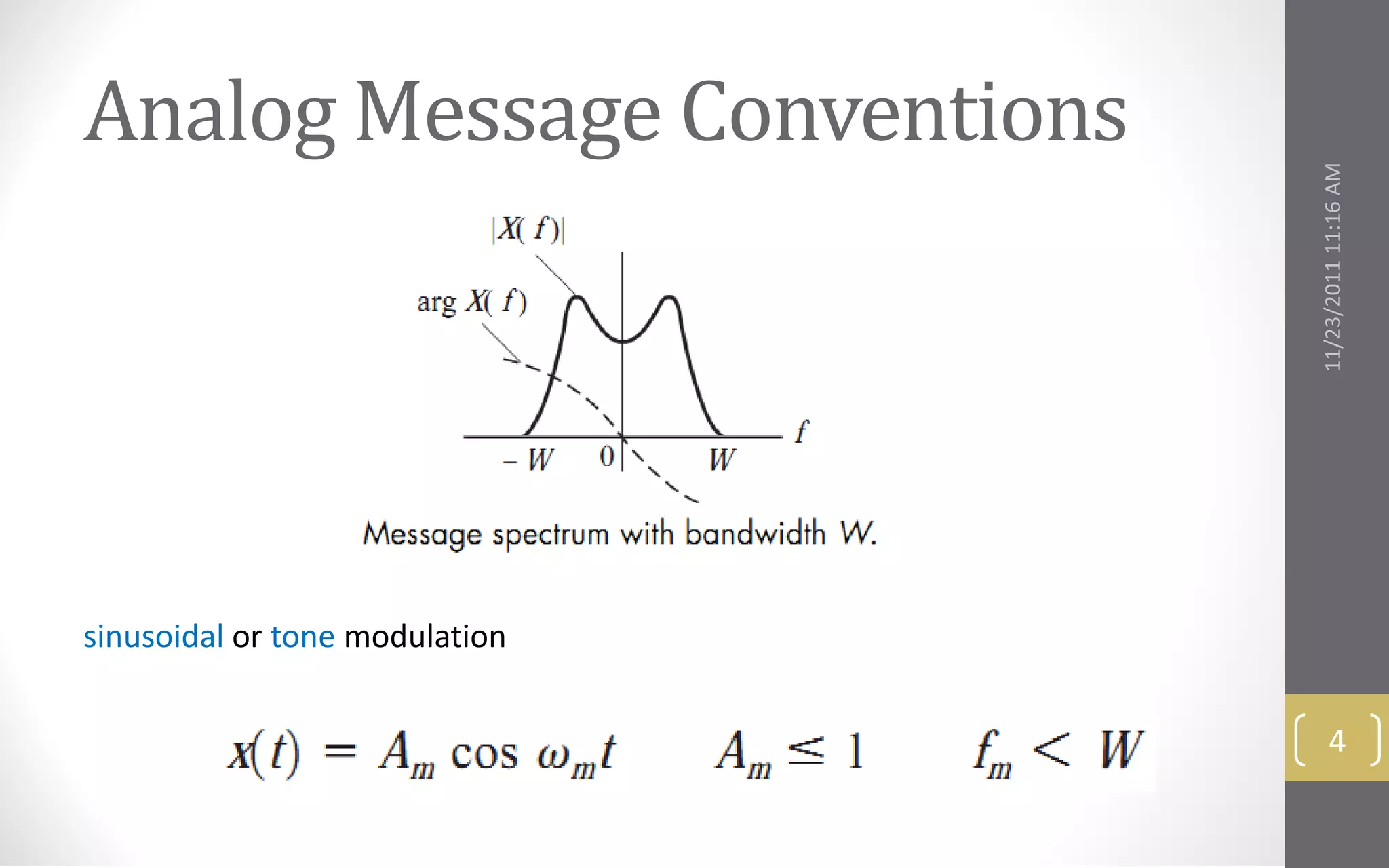
Analog Message Conventions


                                11/23/2011 11:16 AM
sinusoidal or tone modulation


                                       4
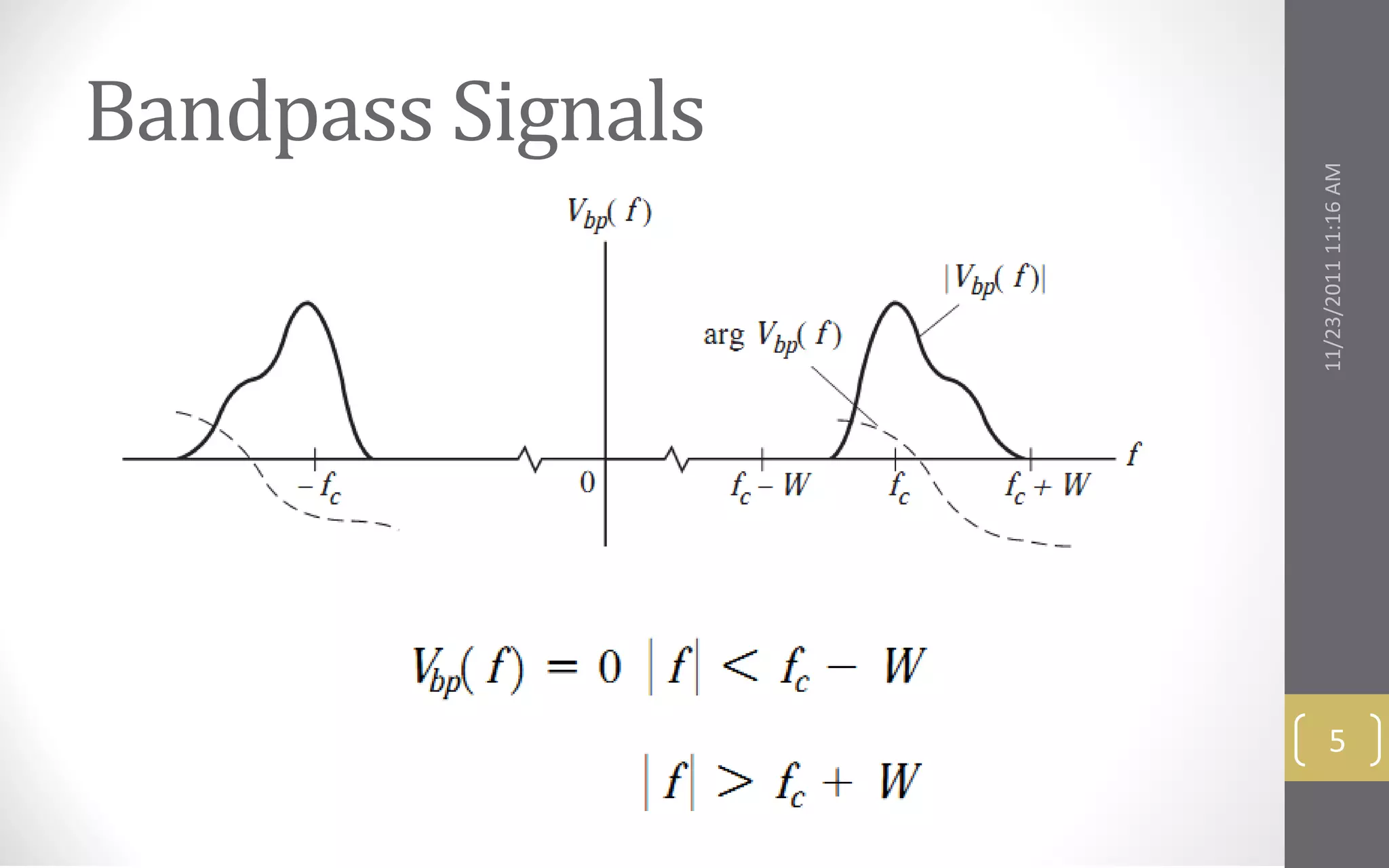
Bandpass Signals


5


    11/23/2011 11:16 AM
11/23/2011 11:16 AM
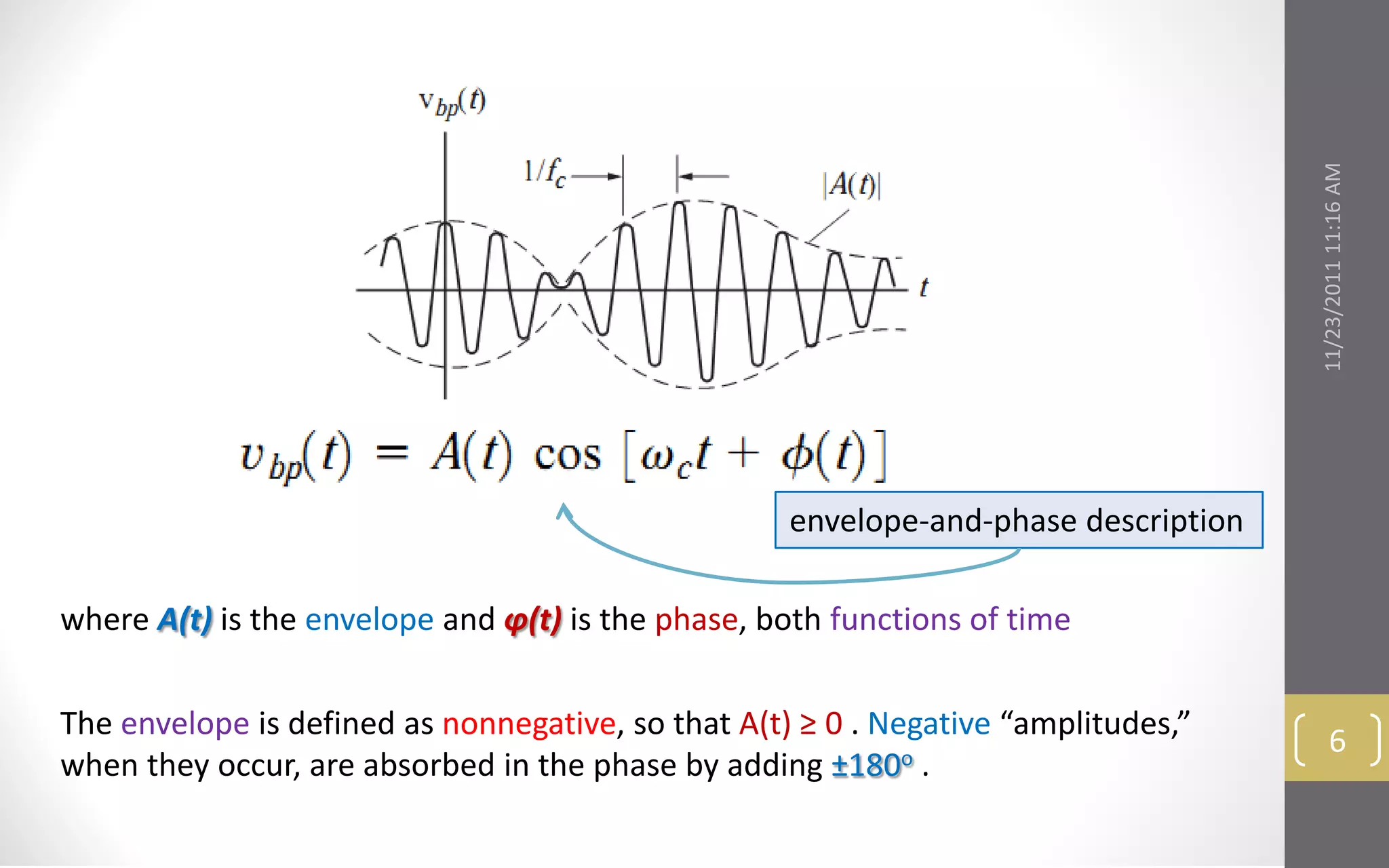
                                                    envelope-and-phase description

where A(t) is the envelope and φ(t) is the phase, both functions of time

The envelope is defined as nonnegative, so that A(t) ≥ 0 . Negative “amplitudes,”
                                                                                            6
when they occur, are absorbed in the phase by adding ±180o .
11/23/2011 11:16 AM
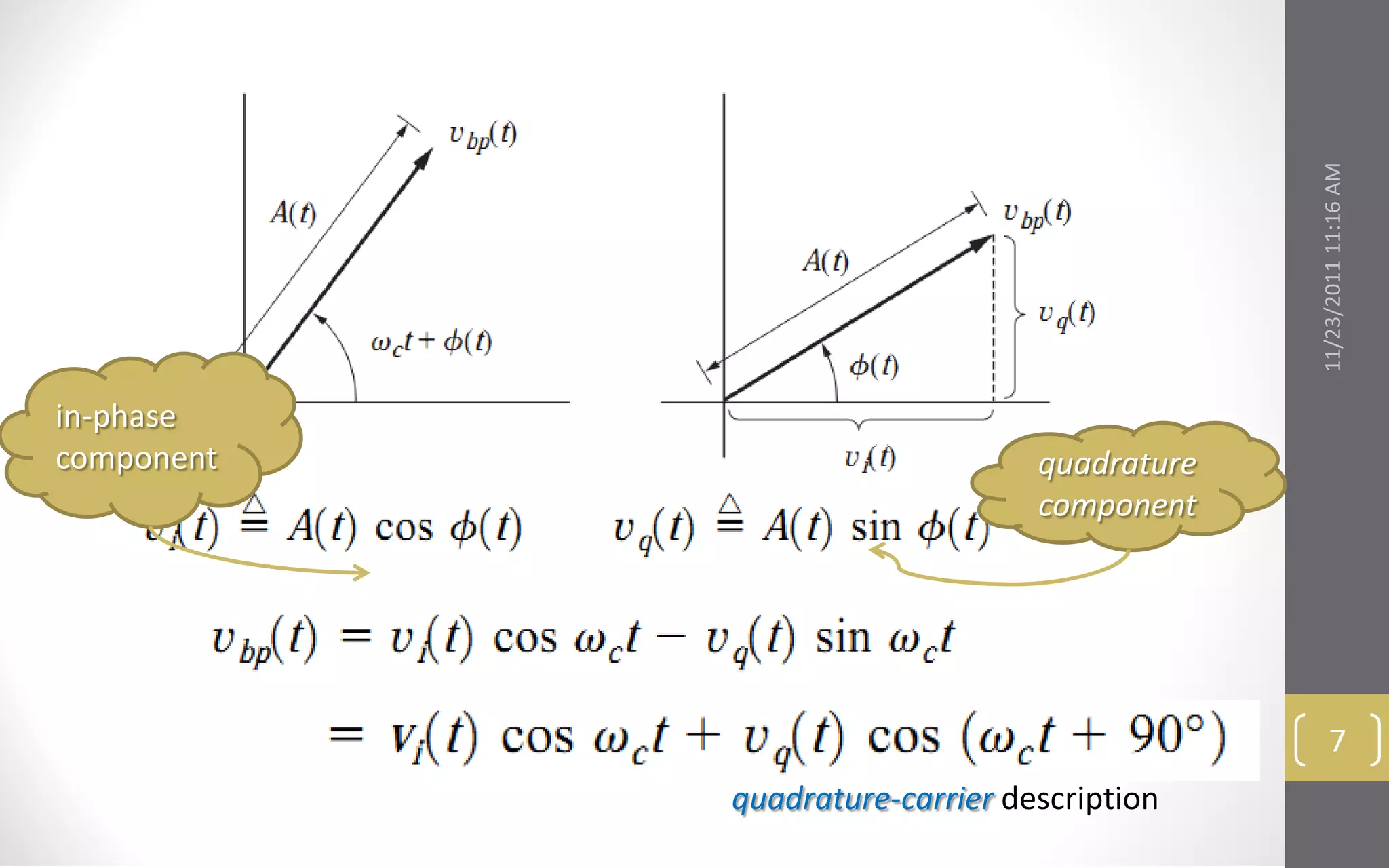
in-phase
component                        quadrature
                                 component


                                                     7
            quadrature-carrier description
DOUBLE-SIDEBAND AMPLITUDE


                                          11/23/2011 11:16 AM
MODULATION


•   AM Signals and Spectra
•   DSB Signals and Spectra
•   Tone Modulation and Phasor Analysis
                                                 8
AM Signals and Spectra


                                                                                   11/23/2011 11:16 AM
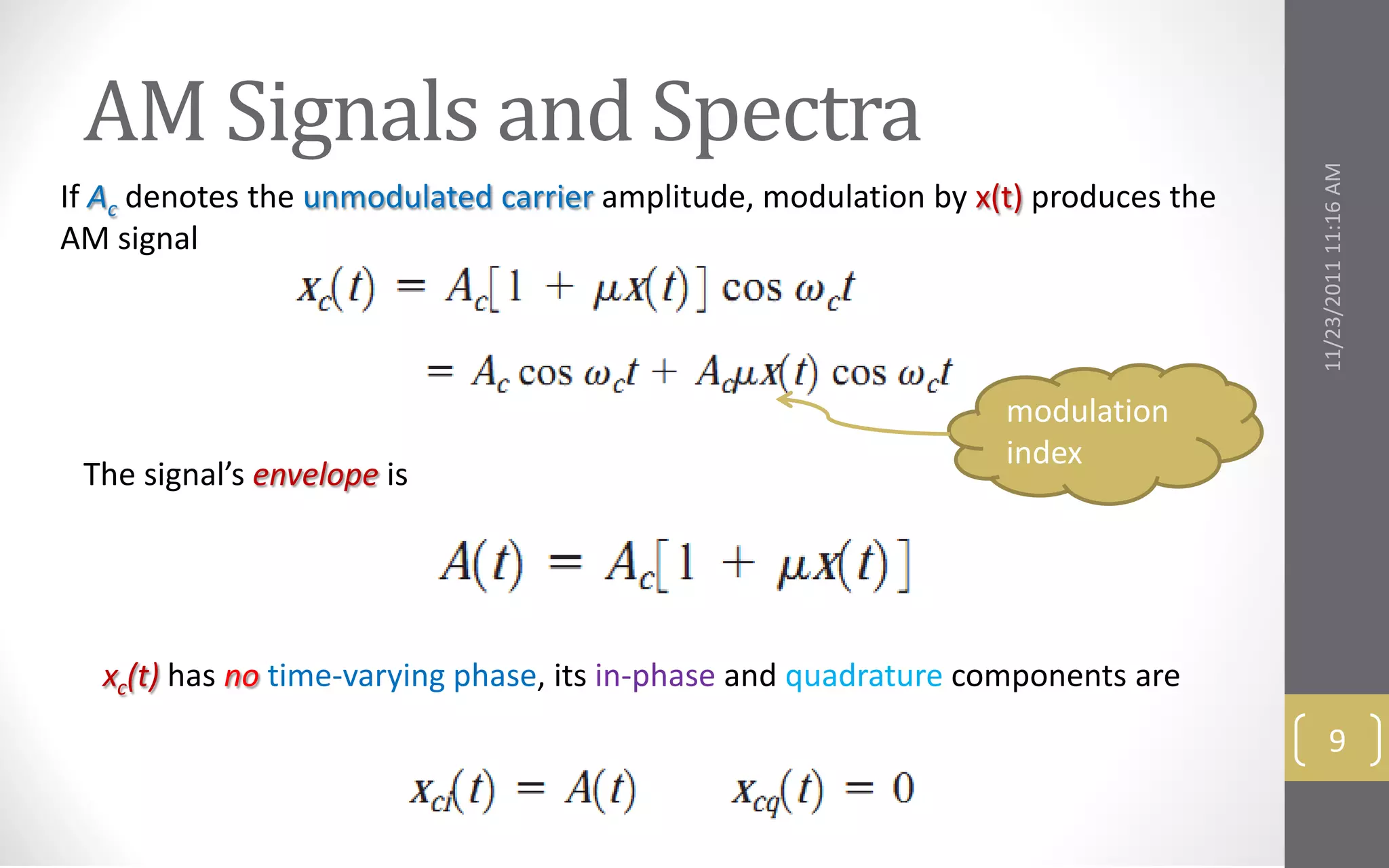
If Ac denotes the unmodulated carrier amplitude, modulation by x(t) produces the
AM signal


                                                                 modulation
                                                                 index
 The signal’s envelope is


  xc(t) has no time-varying phase, its in-phase and quadrature components are
                                                                                          9
11/23/2011 11:16 AM
10
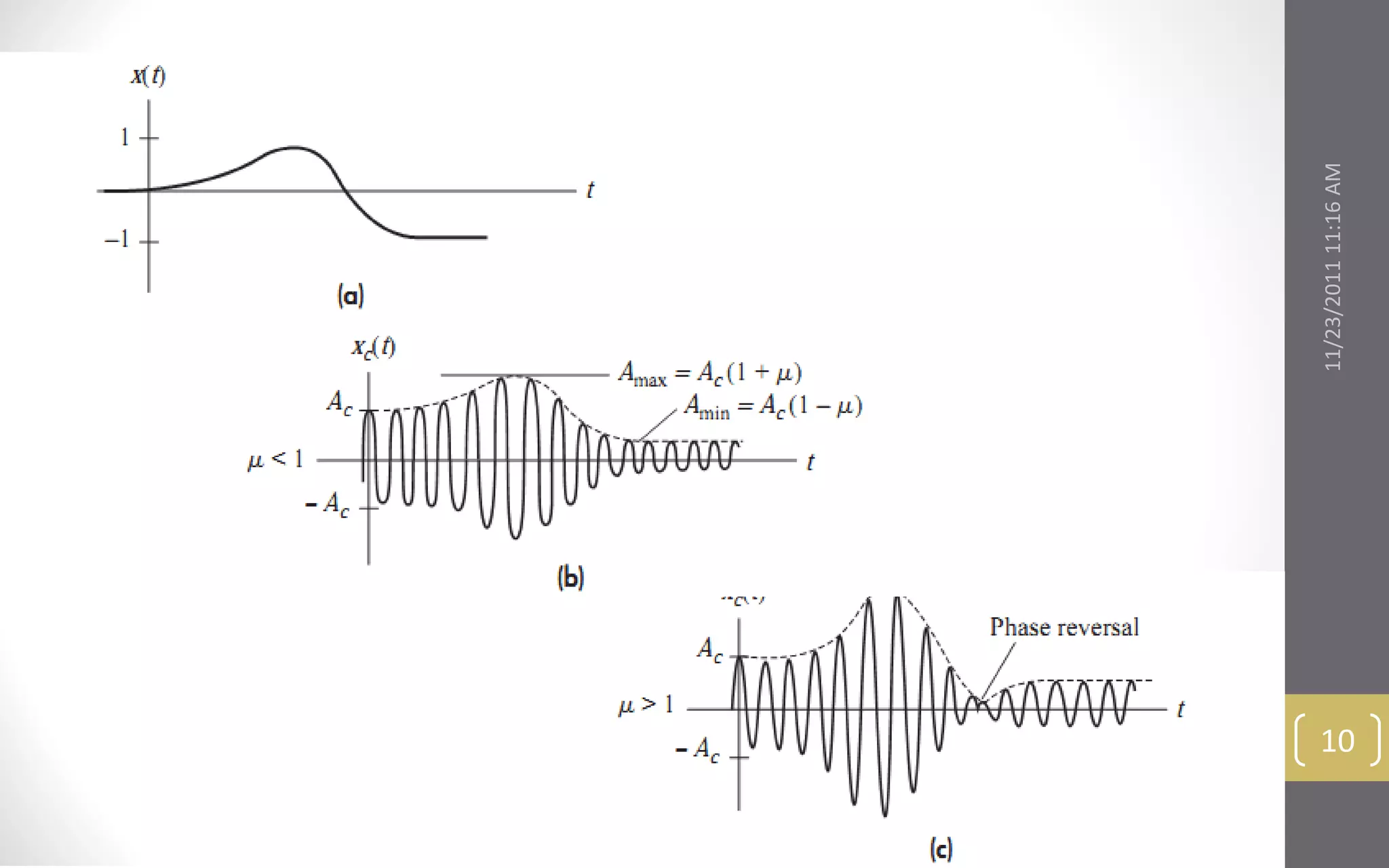
The envelope clearly reproduces the shape of if


                                                                                    11/23/2011 11:16 AM
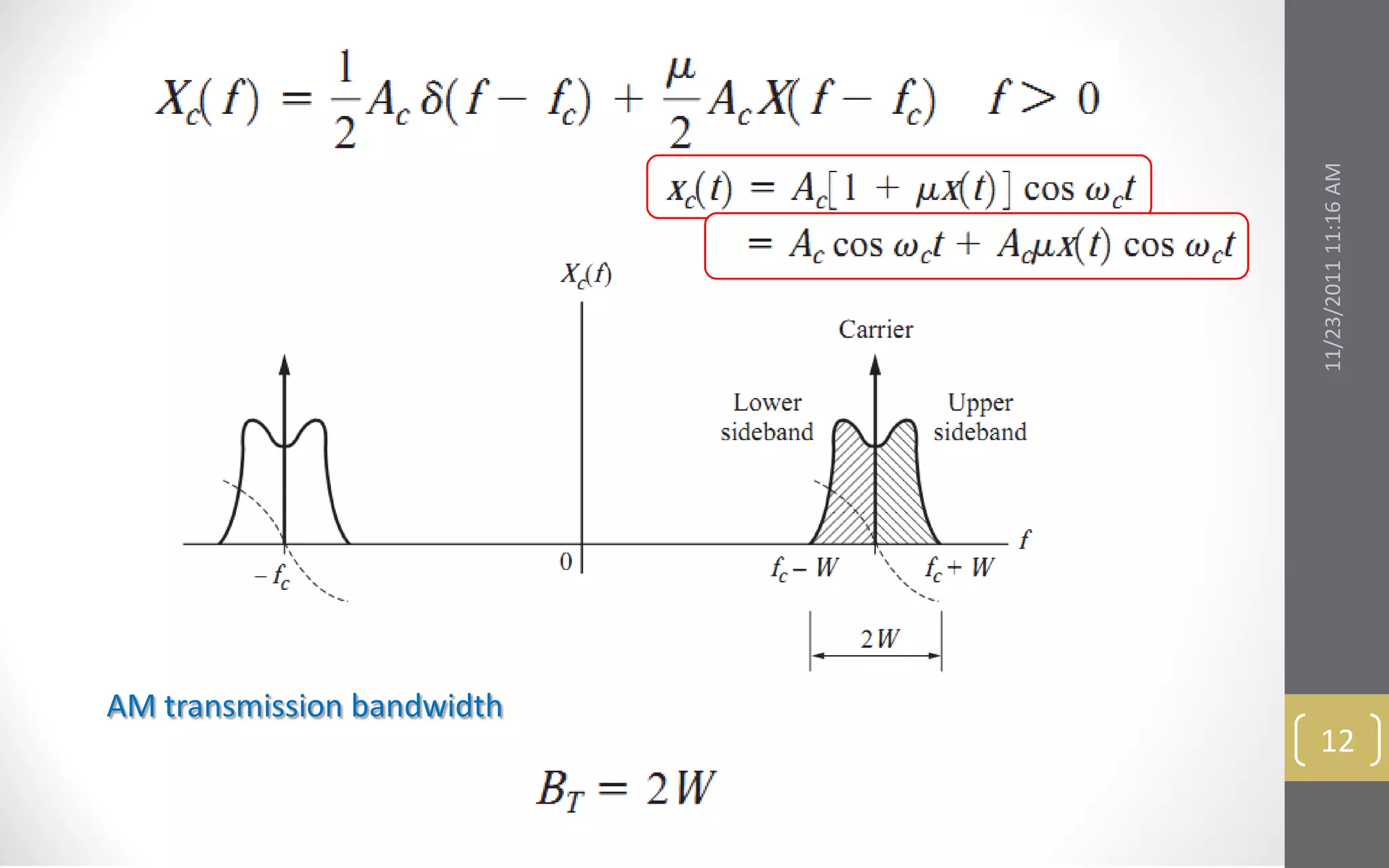
The condition fc >> W ensures that the carrier oscillates rapidly compared to the
time variation of x(t); otherwise, an envelope could not be visualized.

The condition μ ≤ 1 ensures that Ac[ 1 + μx(t) ] does not go negative.

       With 100 percent modulation (μ = 1), the envelope varies between Amin = 0
       and Amax = 2Ac .

      Overmodulation ( μ > 1), causes phase reversals and envelope distortion
                                                                                     11
11/23/2011 11:16 AM
AM transmission bandwidth
                             12
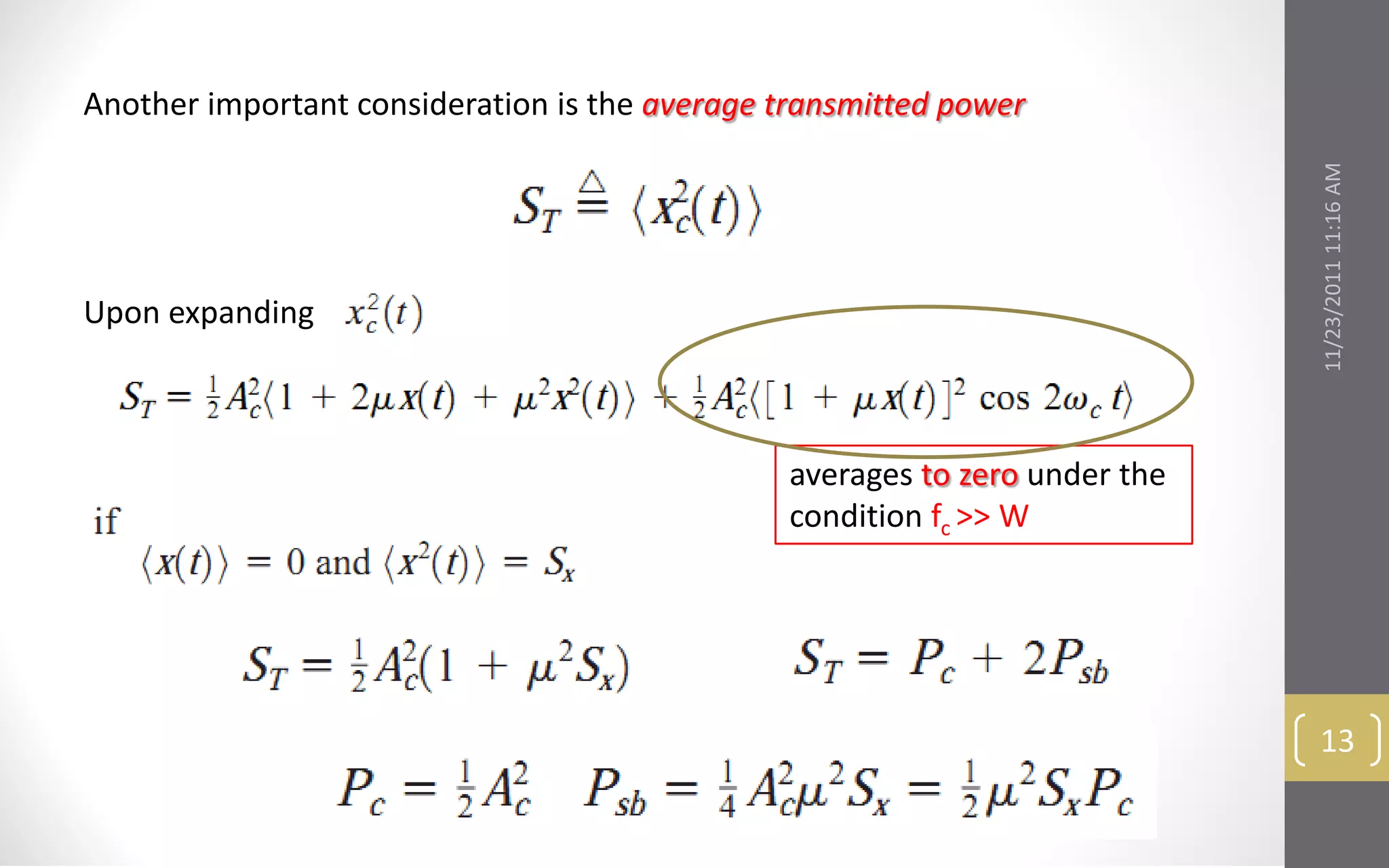
Another important consideration is the average transmitted power


                                                                            11/23/2011 11:16 AM
Upon expanding


                                               averages to zero under the
                                               condition fc >> W


                                                                             13
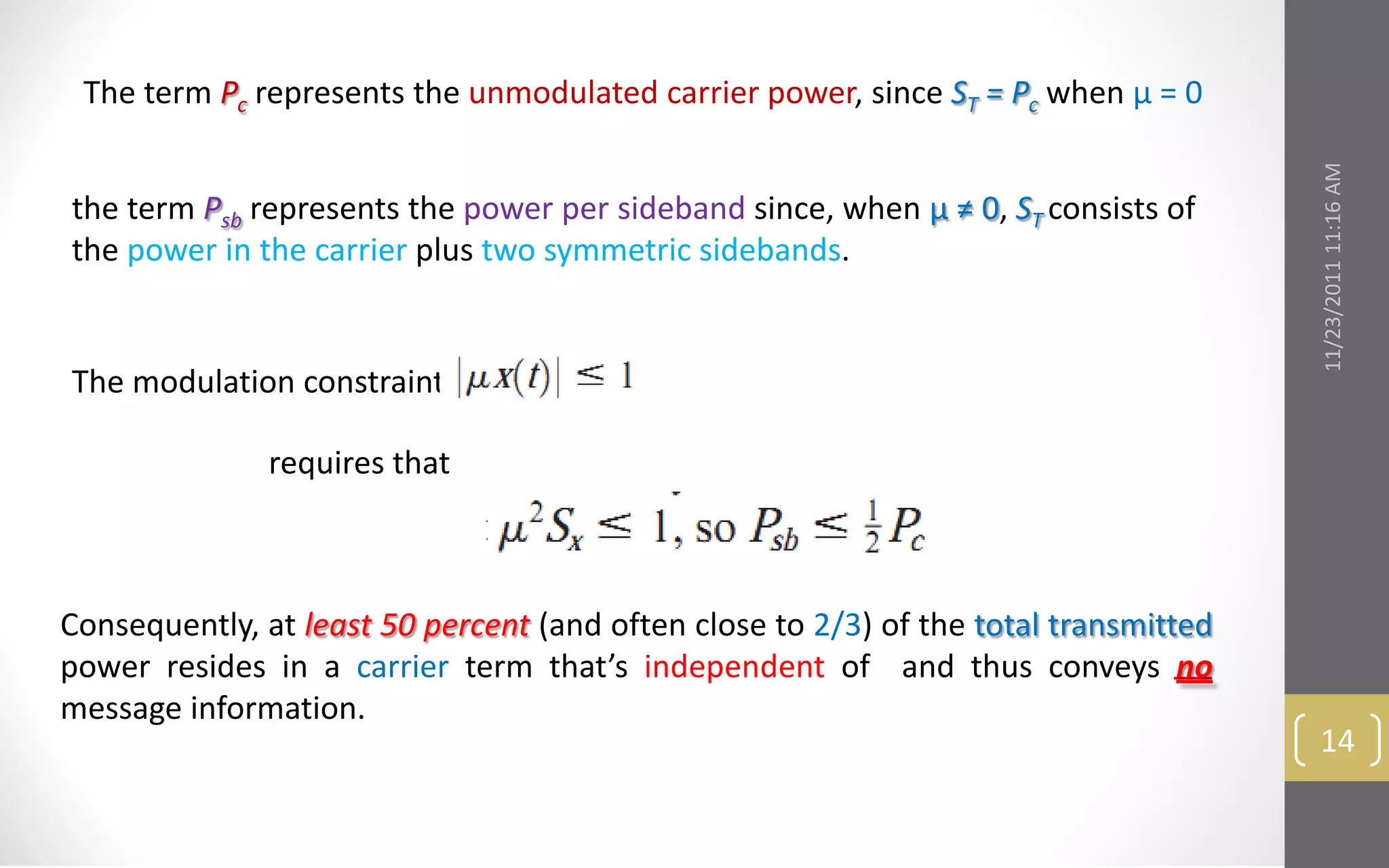
The term Pc represents the unmodulated carrier power, since ST = Pc when μ = 0


                                                                                      11/23/2011 11:16 AM
the term Psb represents the power per sideband since, when μ ≠ 0, ST consists of
the power in the carrier plus two symmetric sidebands.


The modulation constraint

               requires that


Consequently, at least 50 percent (and often close to 2/3) of the total transmitted
power resides in a carrier term that’s independent of and thus conveys no
message information.
                                                                                       14
DSB Signals and Spectra


                                                                             11/23/2011 11:16 AM
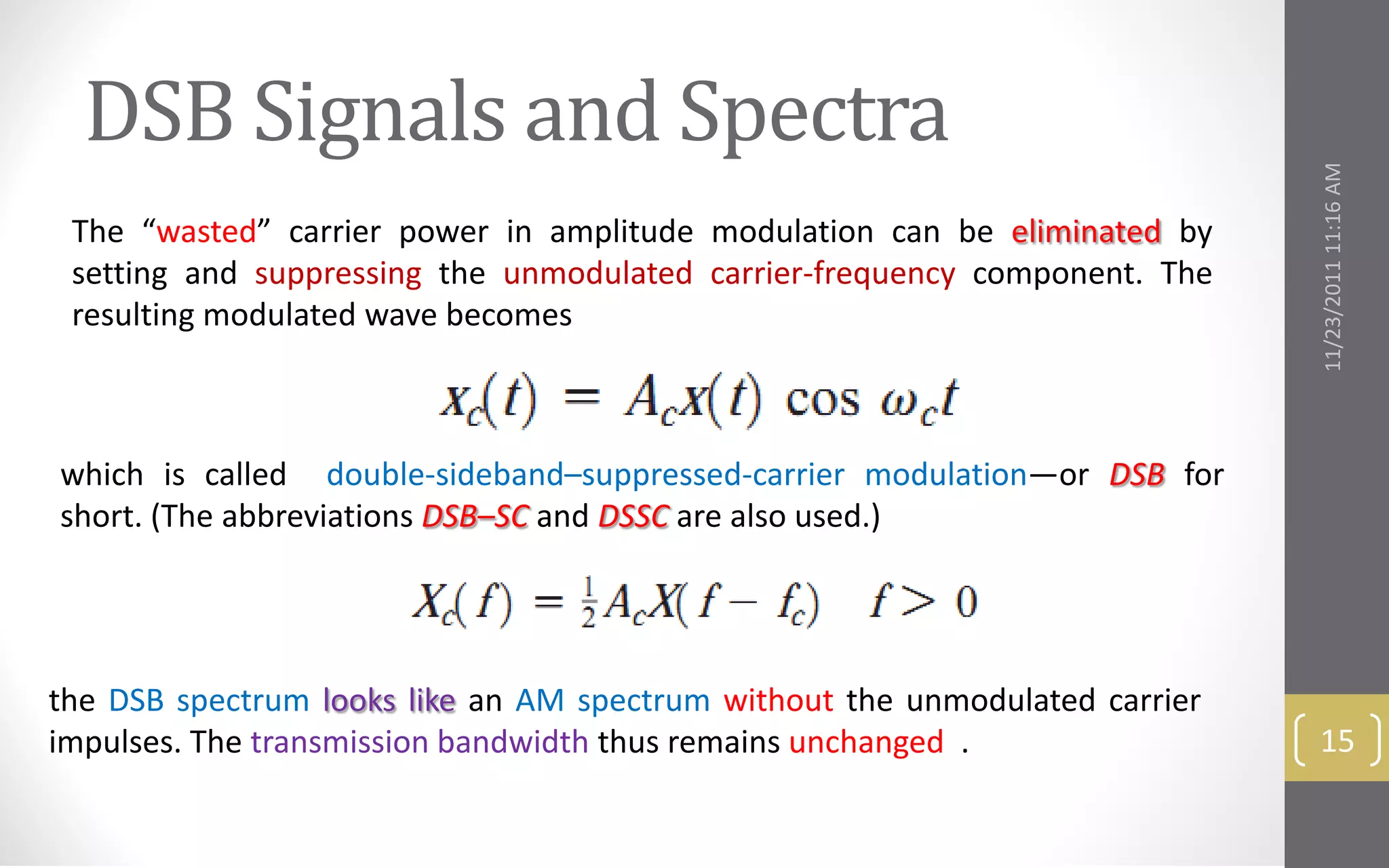
 The “wasted” carrier power in amplitude modulation can be eliminated by
 setting and suppressing the unmodulated carrier-frequency component. The
 resulting modulated wave becomes


which is called double-sideband–suppressed-carrier modulation—or DSB for
short. (The abbreviations DSB–SC and DSSC are also used.)


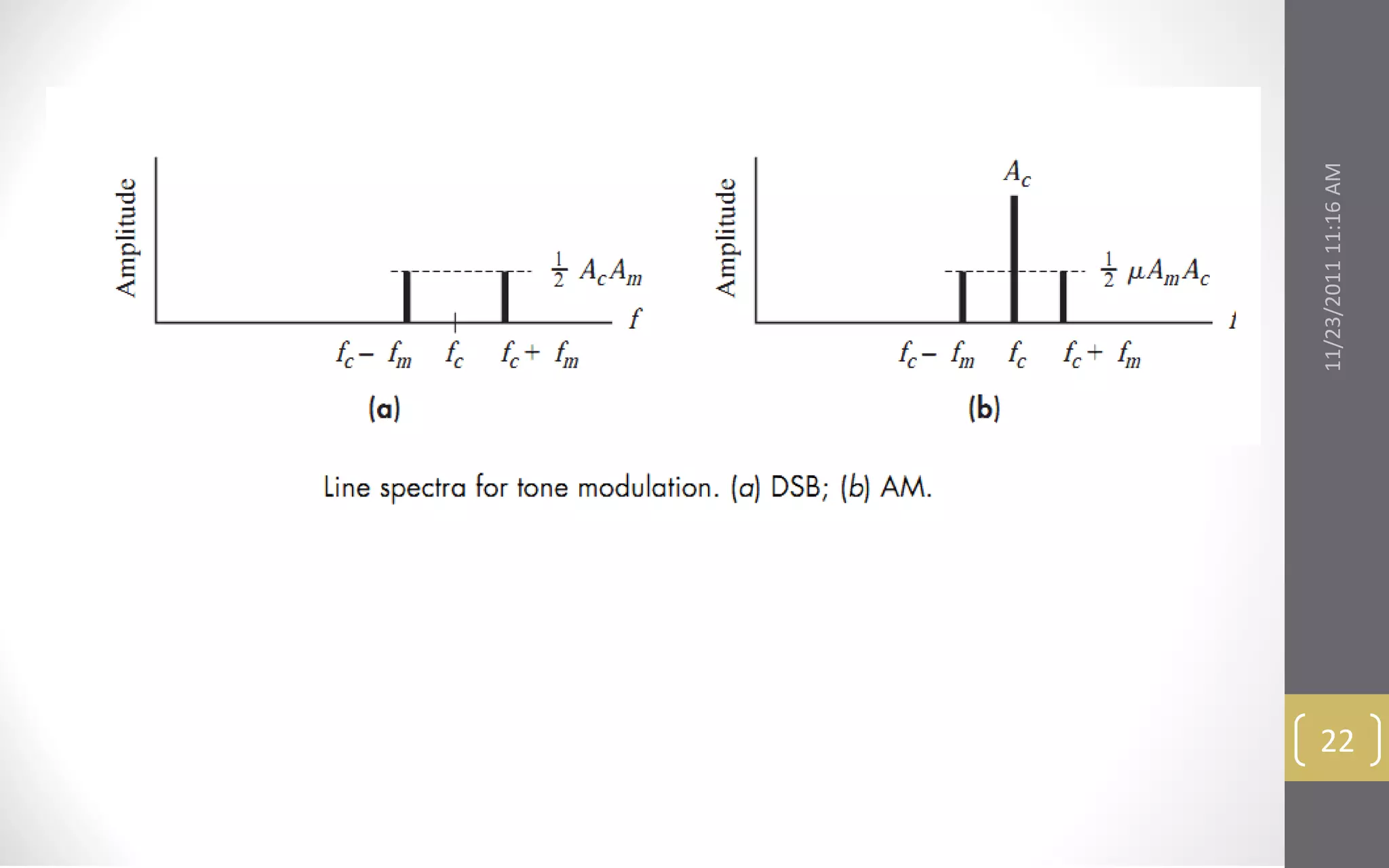
the DSB spectrum looks like an AM spectrum without the unmodulated carrier
impulses. The transmission bandwidth thus remains unchanged .                 15
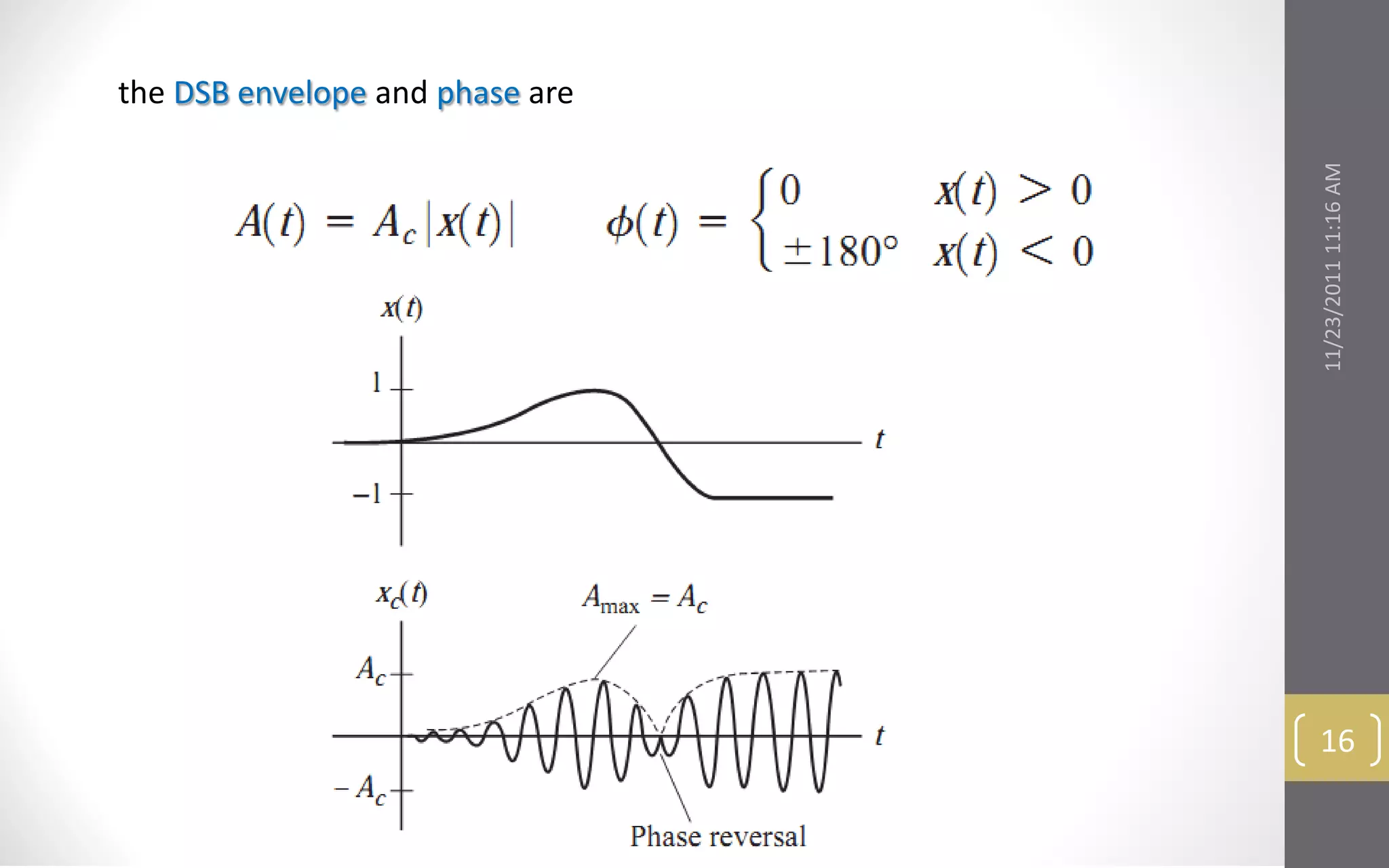
the DSB envelope and phase are


                                 11/23/2011 11:16 AM
                                  16
The envelope here takes the shape of |x(t)|, rather than x(t), and the modulated
 wave undergoes a phase reversal whenever x(t) crosses zero.


                                                                                    11/23/2011 11:16 AM
 Full recovery of the message requires knowledge of these phase reversals, and
 could not be accomplished by an envelope detector.

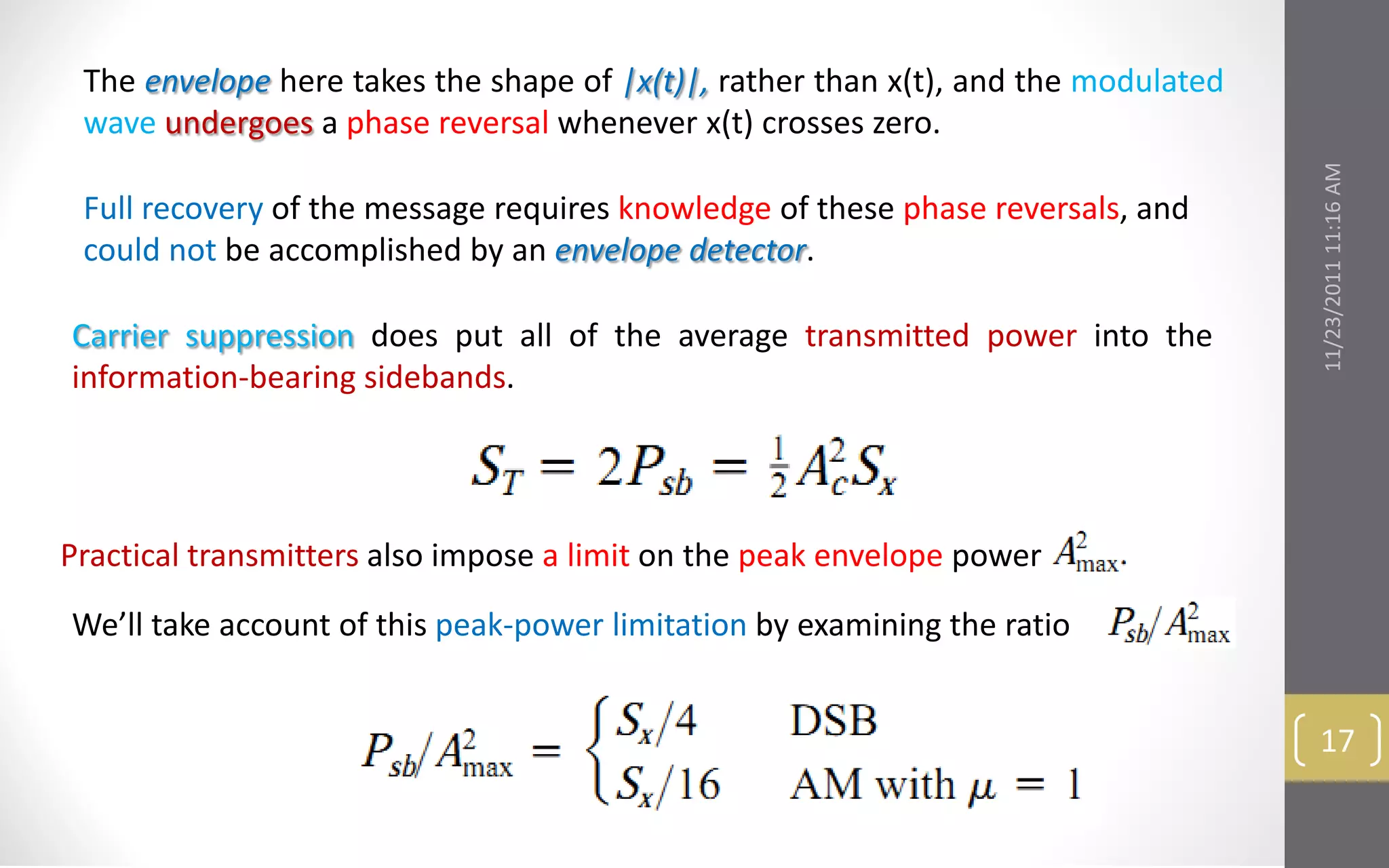
Carrier suppression does put all of the average transmitted power into the
information-bearing sidebands.


Practical transmitters also impose a limit on the peak envelope power

We’ll take account of this peak-power limitation by examining the ratio


                                                                                     17
11/23/2011 11:16 AM
  DSB conserves power but requires
 complicated demodulation circuitry,
whereas AM requires increased power
to permit simple envelope detection.


                                        18
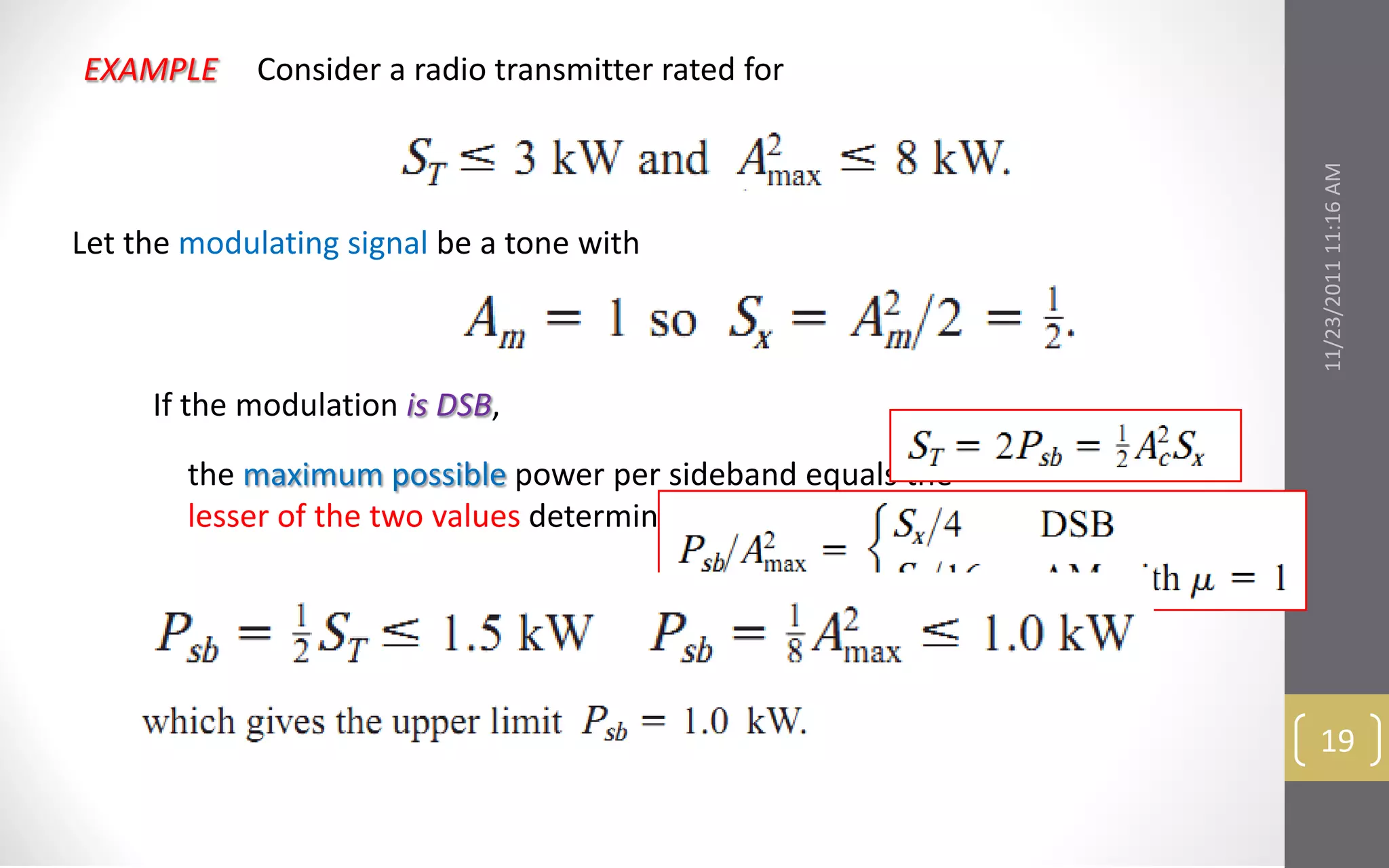
EXAMPLE      Consider a radio transmitter rated for


                                                             11/23/2011 11:16 AM
Let the modulating signal be a tone with


     If the modulation is DSB,

        the maximum possible power per sideband equals the
        lesser of the two values determined from


                                                              19
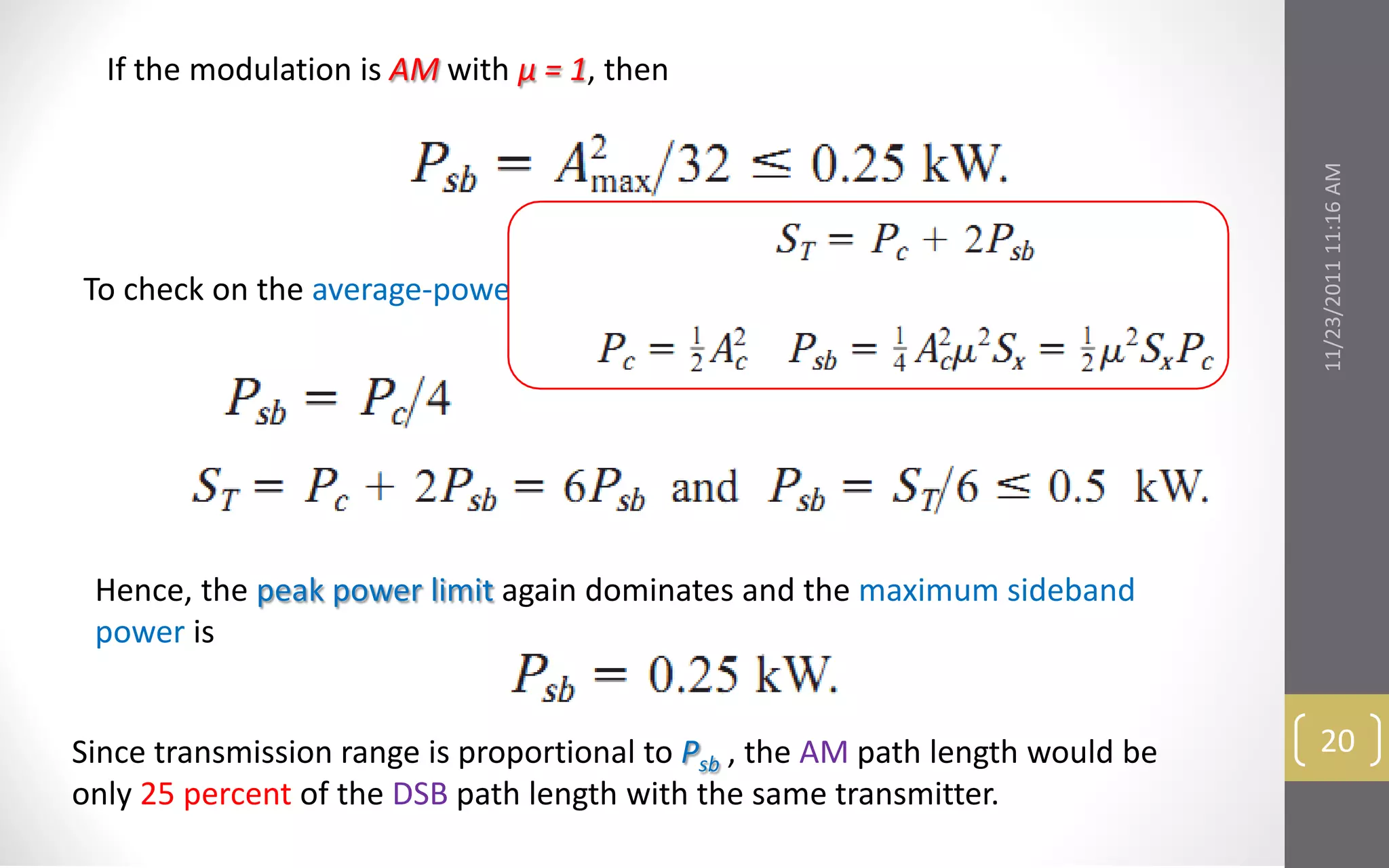
If the modulation is AM with μ = 1, then


                                                                                11/23/2011 11:16 AM
To check on the average-power limitation,


 Hence, the peak power limit again dominates and the maximum sideband
 power is


Since transmission range is proportional to Psb , the AM path length would be    20
only 25 percent of the DSB path length with the same transmitter.
Tone Modulation and Phasor
Analysis


                                       11/23/2011 11:16 AM
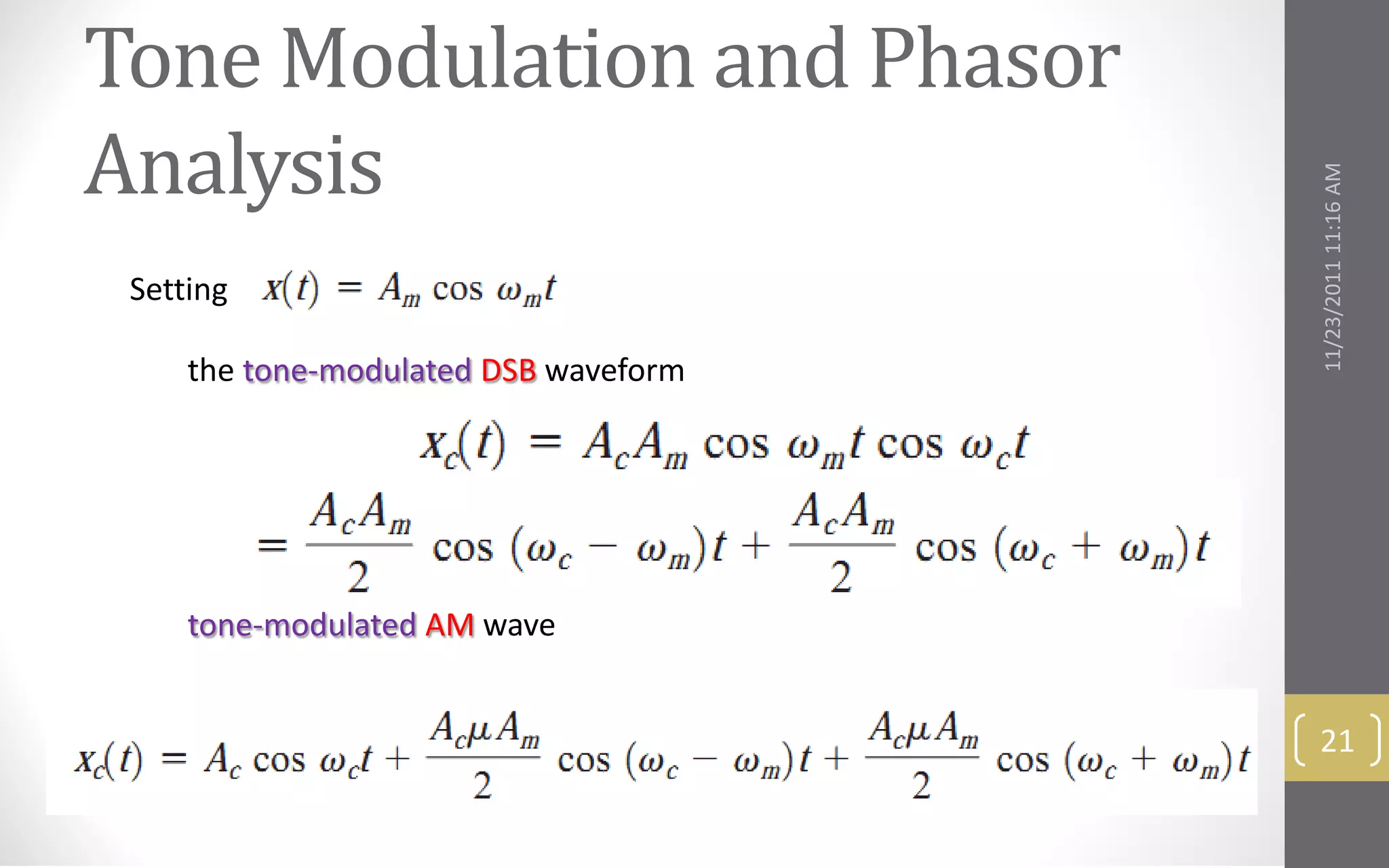
 Setting

     the tone-modulated DSB waveform


     tone-modulated AM wave


                                        21
11/23/2011 11:16 AM
22
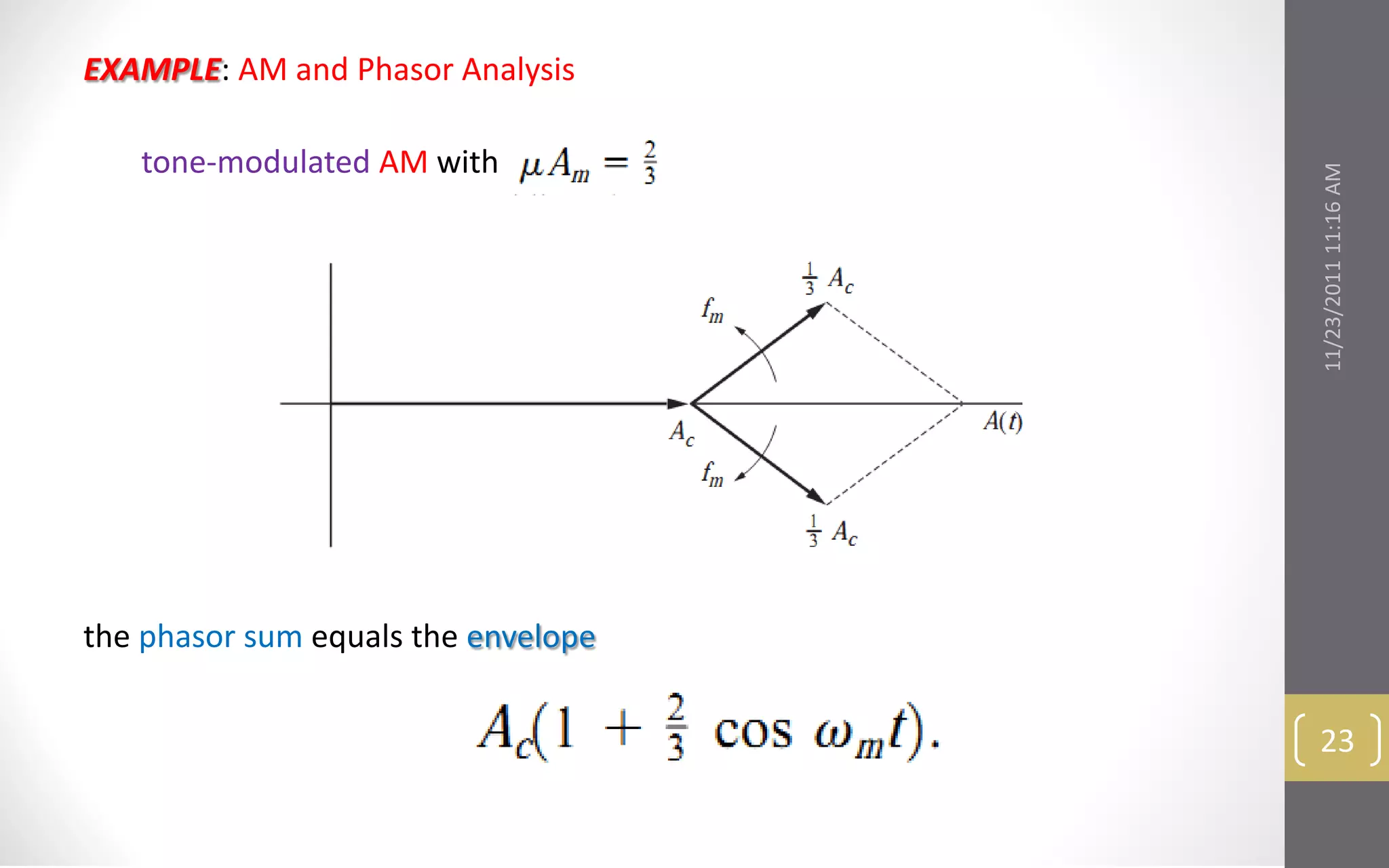
EXAMPLE: AM and Phasor Analysis

   tone-modulated AM with


                                     11/23/2011 11:16 AM
the phasor sum equals the envelope


                                      23
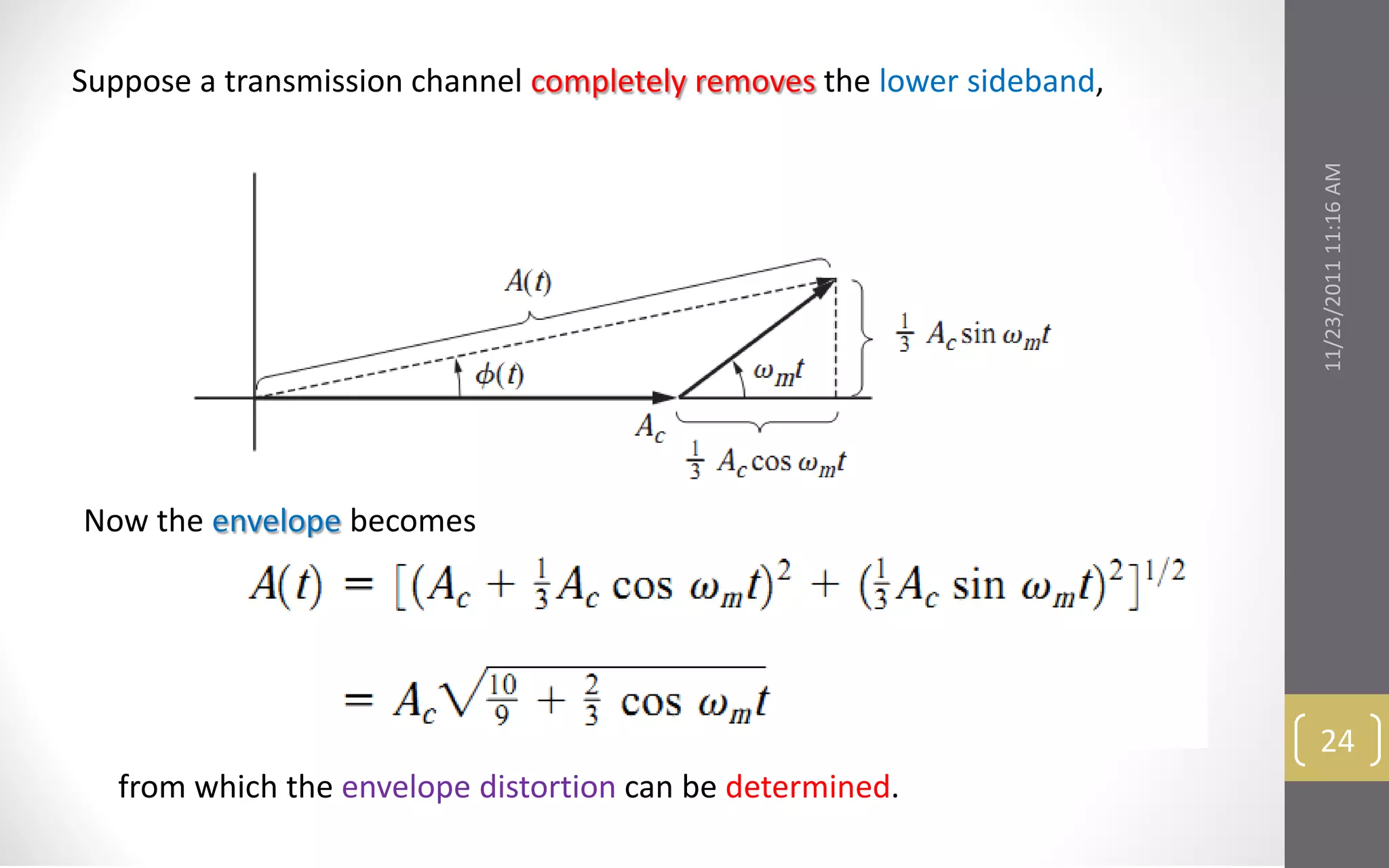
Suppose a transmission channel completely removes the lower sideband,


                                                                        11/23/2011 11:16 AM
Now the envelope becomes


                                                                         24
   from which the envelope distortion can be determined.
SUPPRESSED-SIDEBAND AMPLITUDE


                                11/23/2011 11:16 AM
MODULATION

•   SSB Signals and Spectra
•   SSB Generation
•   VSB Signals and Spectra
                                 25
11/23/2011 11:16 AM
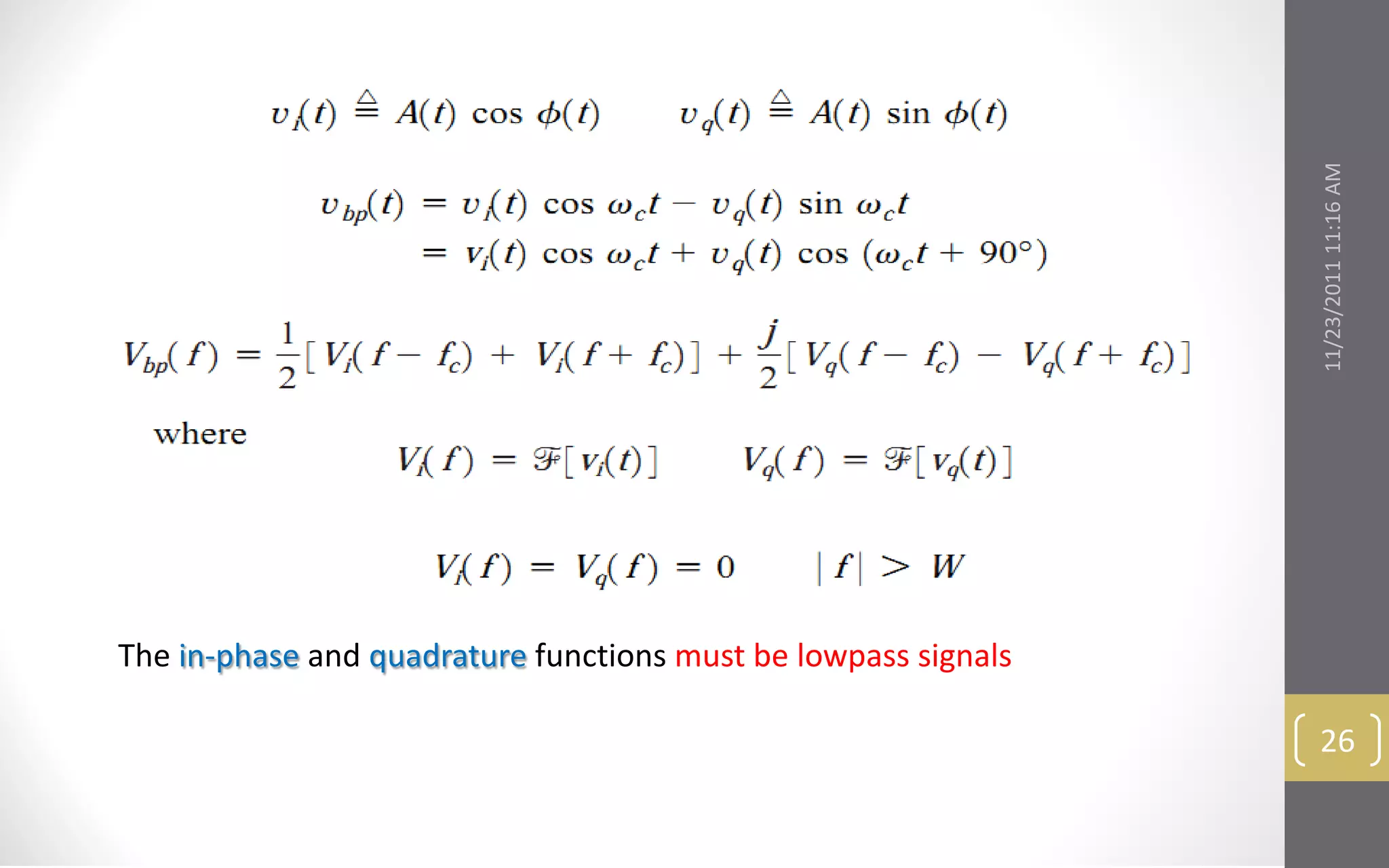
The in-phase and quadrature functions must be lowpass signals

                                                                 26
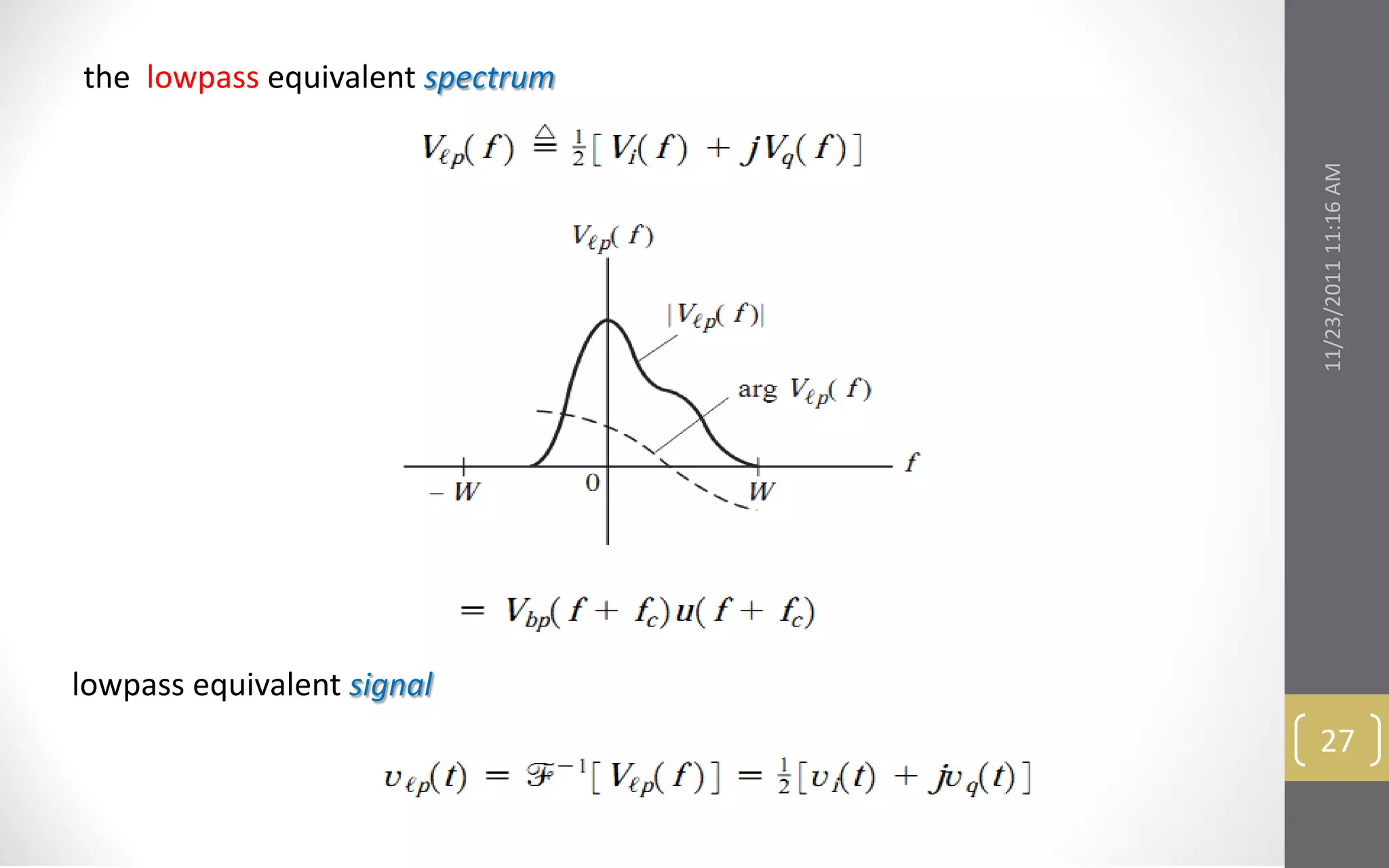
the lowpass equivalent spectrum


                                  11/23/2011 11:16 AM
lowpass equivalent signal
                                   27
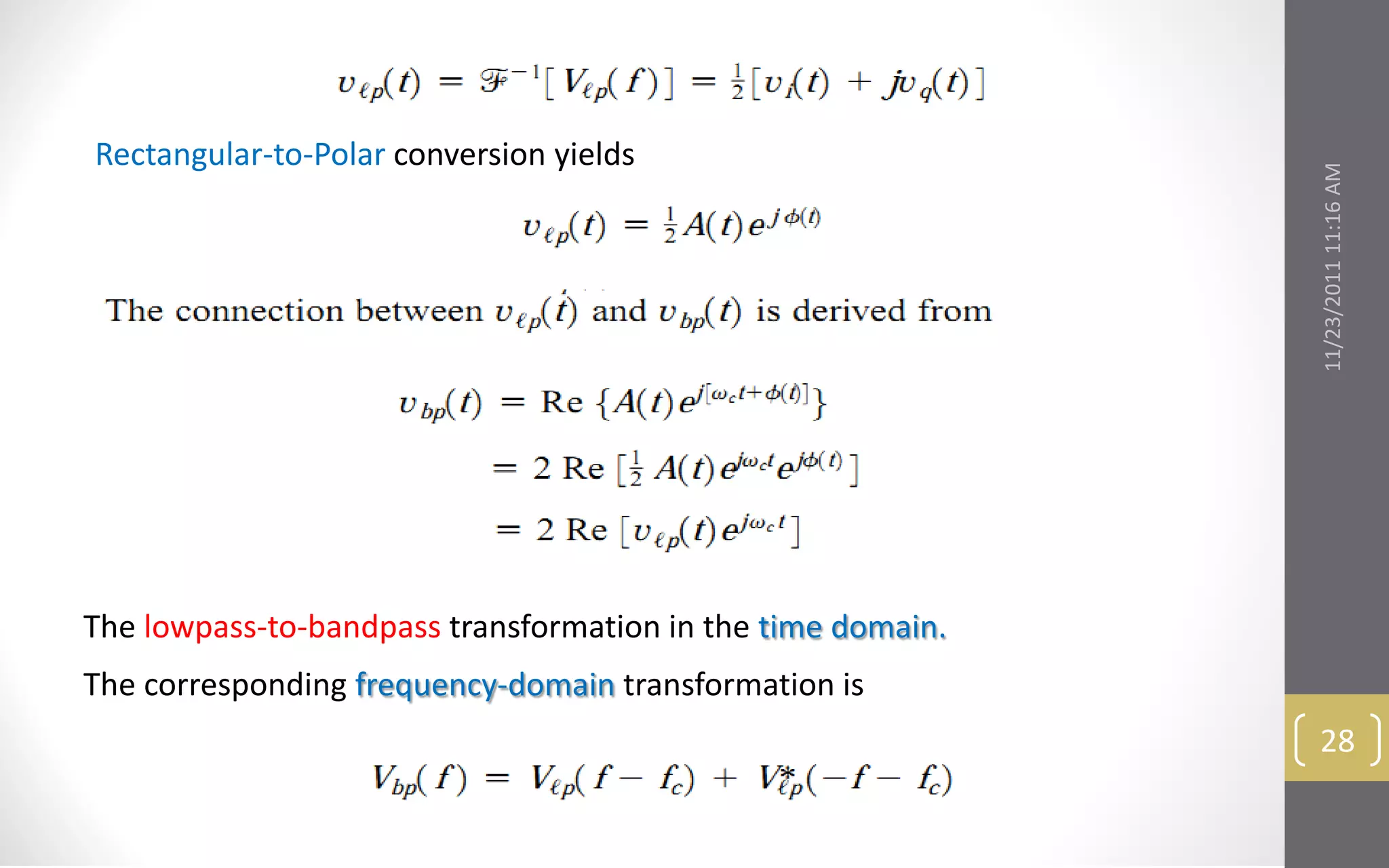
Rectangular-to-Polar conversion yields


                                                             11/23/2011 11:16 AM
The lowpass-to-bandpass transformation in the time domain.
The corresponding frequency-domain transformation is
                                                              28
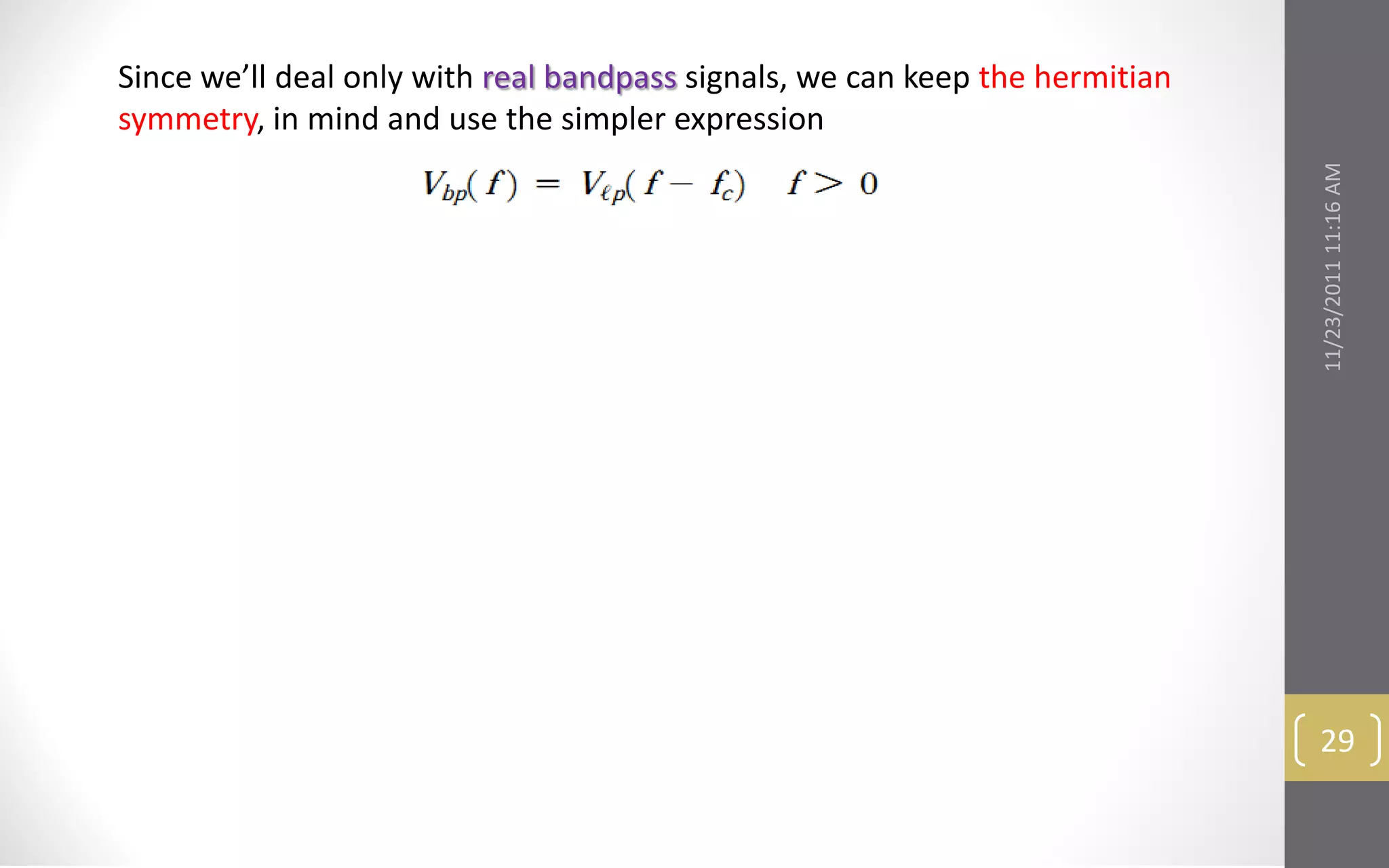
Since we’ll deal only with real bandpass signals, we can keep the hermitian
symmetry, in mind and use the simpler expression


                                                                              11/23/2011 11:16 AM
                                                                               29
11/23/2011 11:16 AM
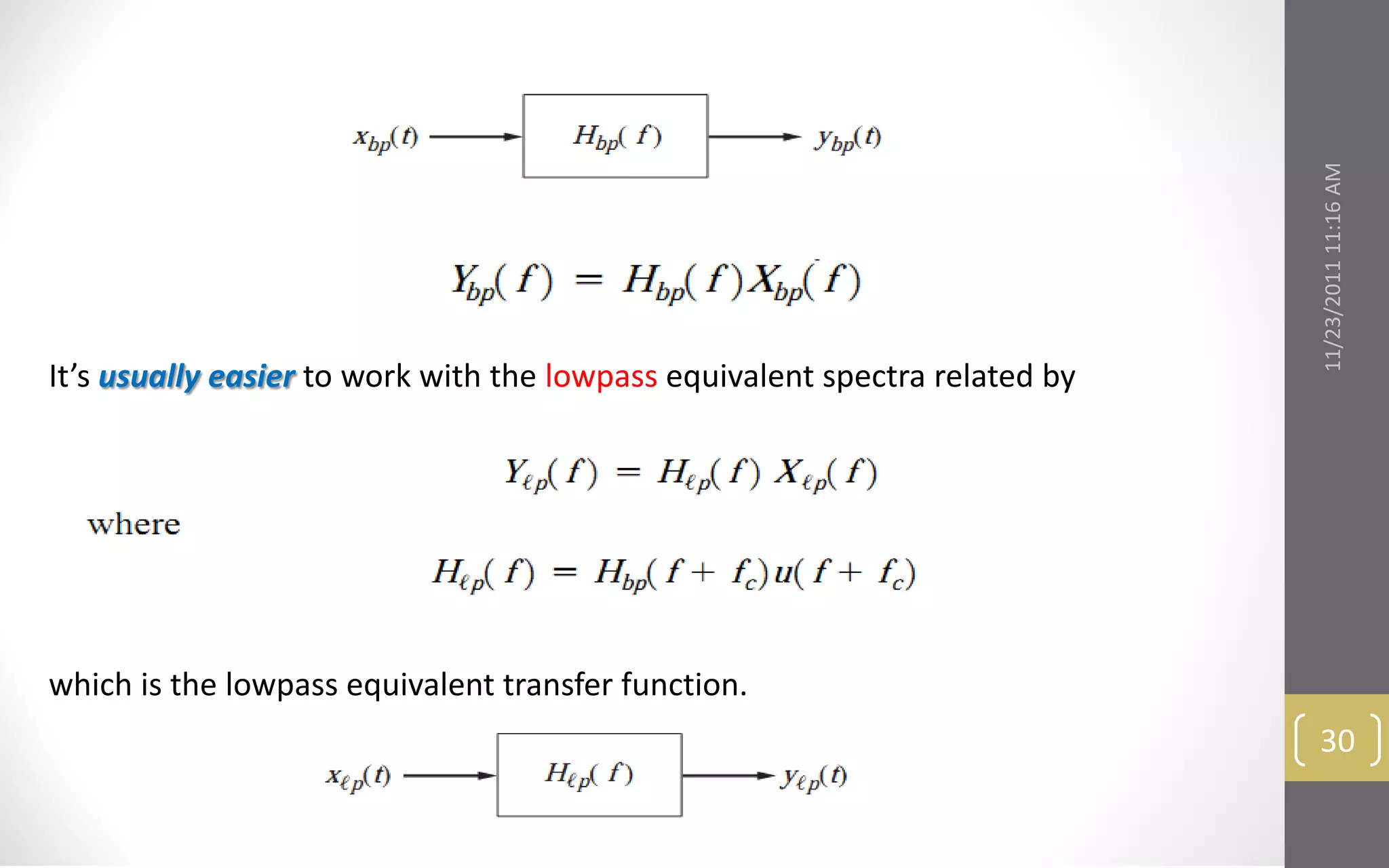
It’s usually easier to work with the lowpass equivalent spectra related by


which is the lowpass equivalent transfer function.
                                                                              30
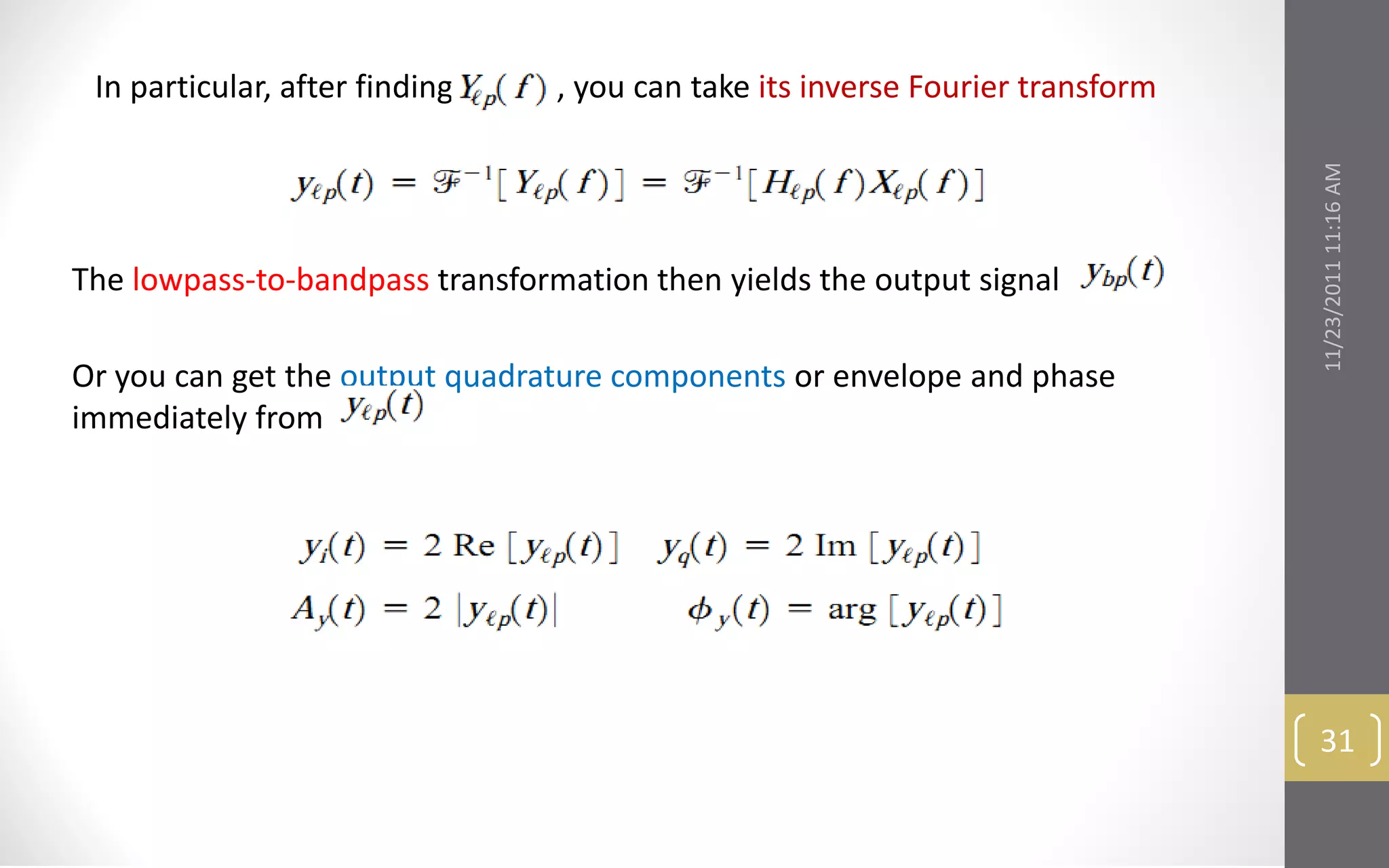
In particular, after finding    , you can take its inverse Fourier transform


                                                                                11/23/2011 11:16 AM
The lowpass-to-bandpass transformation then yields the output signal

Or you can get the output quadrature components or envelope and phase
immediately from


                                                                                 31
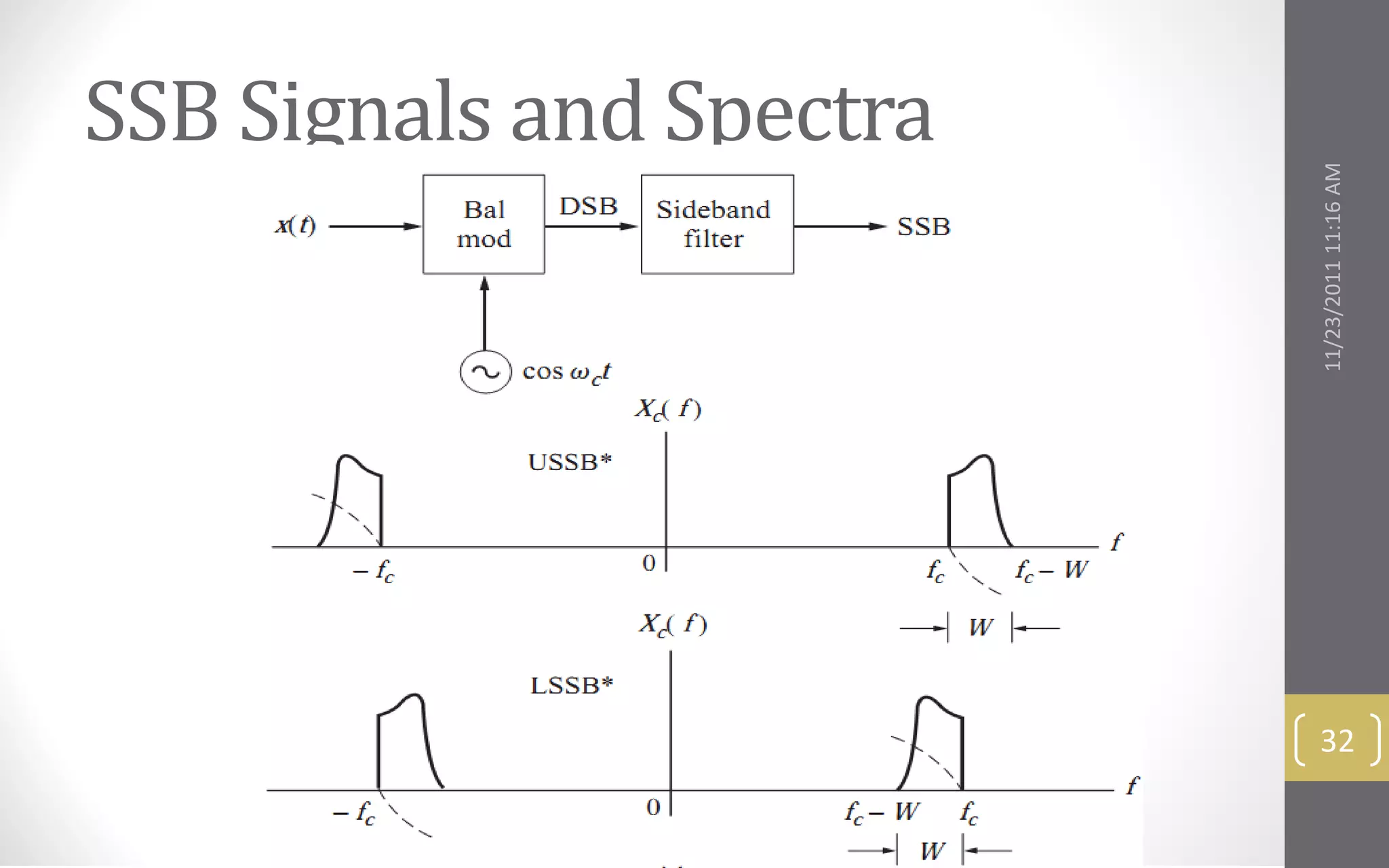
SSB Signals and Spectra


                          11/23/2011 11:16 AM
                           32
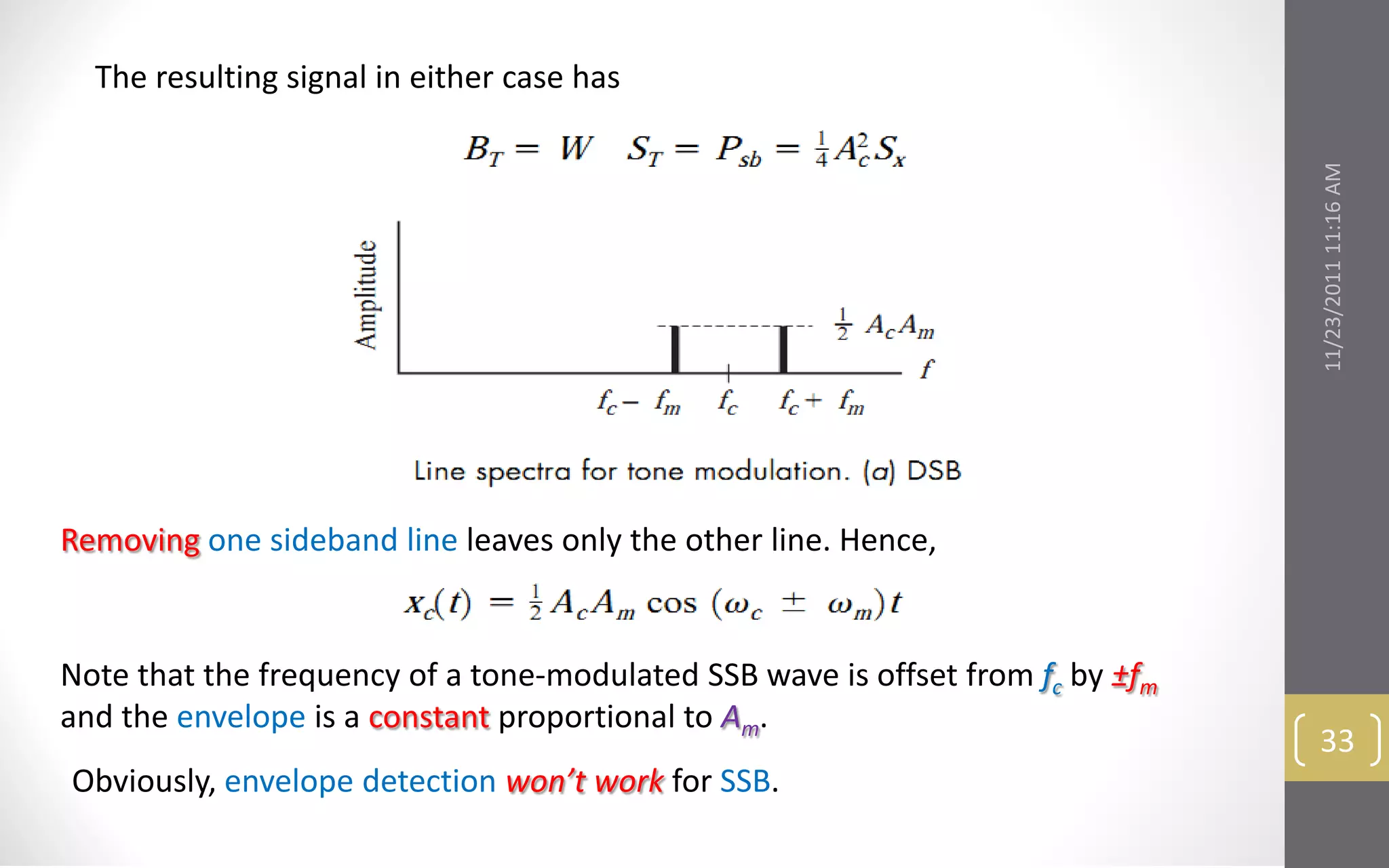
The resulting signal in either case has


                                                                                11/23/2011 11:16 AM
Removing one sideband line leaves only the other line. Hence,


Note that the frequency of a tone-modulated SSB wave is offset from fc by ±fm
and the envelope is a constant proportional to Am.
                                                                                 33
Obviously, envelope detection won’t work for SSB.
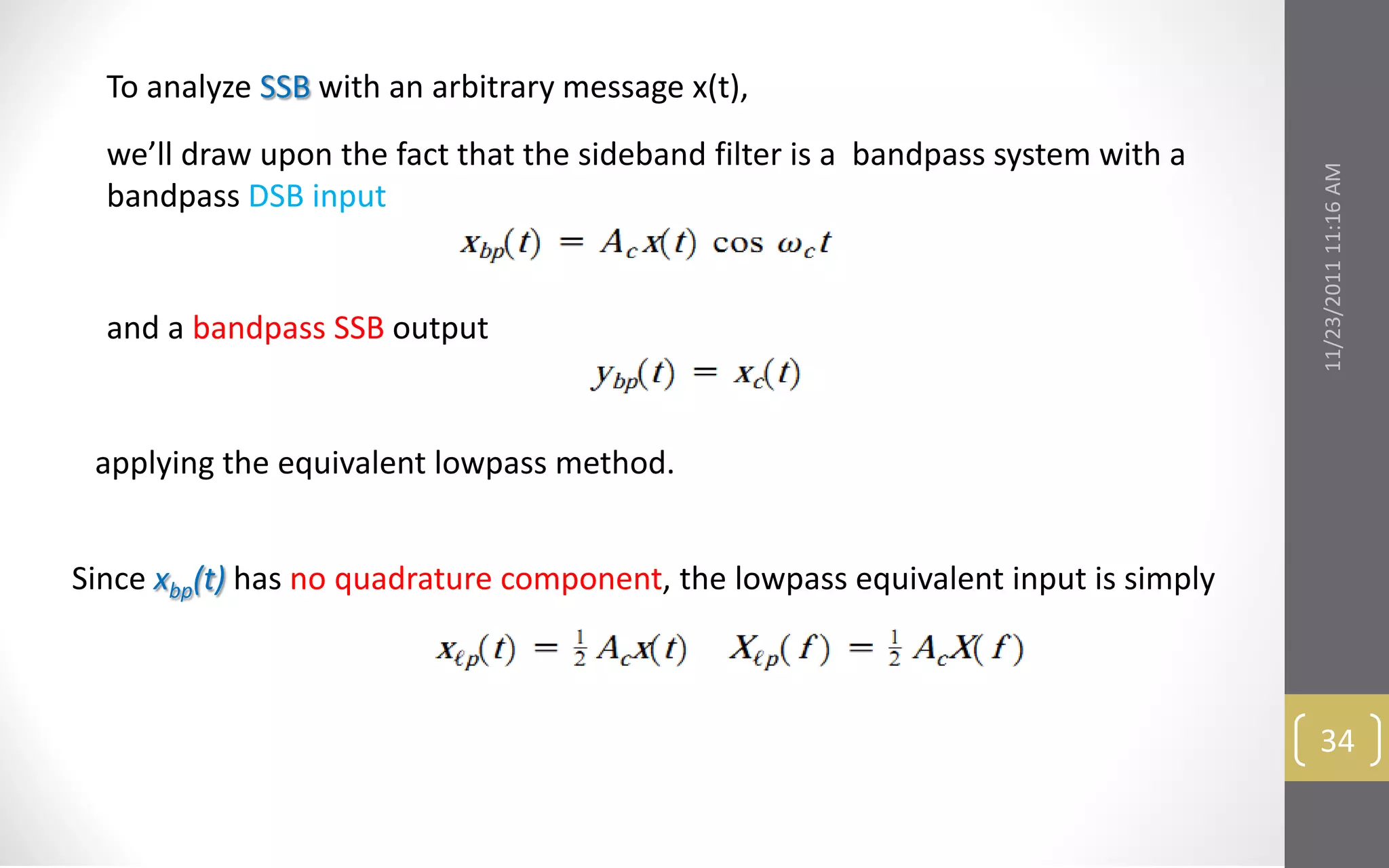
To analyze SSB with an arbitrary message x(t),
  we’ll draw upon the fact that the sideband filter is a bandpass system with a


                                                                                   11/23/2011 11:16 AM
  bandpass DSB input


  and a bandpass SSB output


 applying the equivalent lowpass method.


Since xbp(t) has no quadrature component, the lowpass equivalent input is simply


                                                                                    34
11/23/2011 11:16 AM
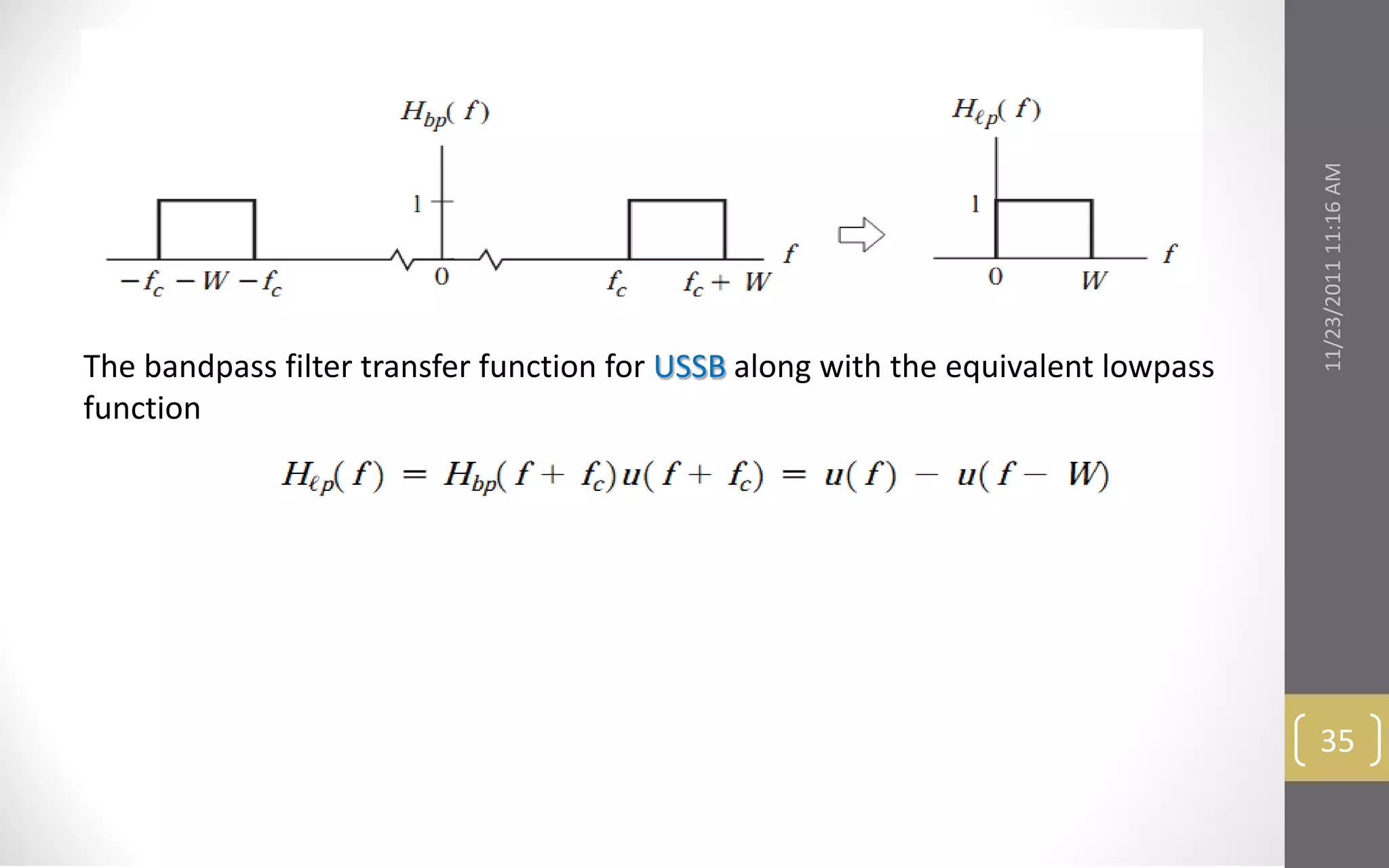
The bandpass filter transfer function for USSB along with the equivalent lowpass
function


                                                                                    35
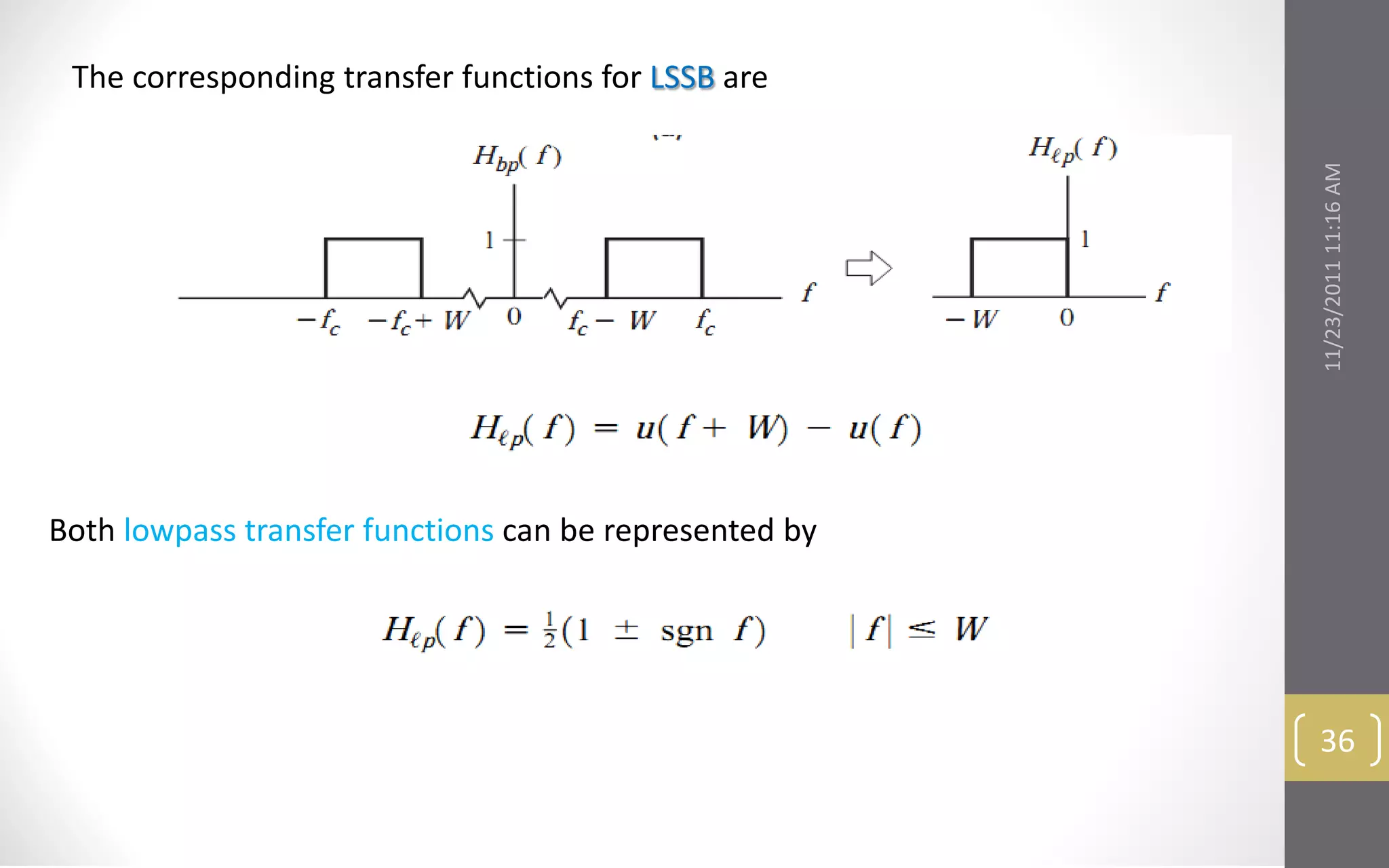
The corresponding transfer functions for LSSB are


                                                        11/23/2011 11:16 AM
Both lowpass transfer functions can be represented by


                                                         36
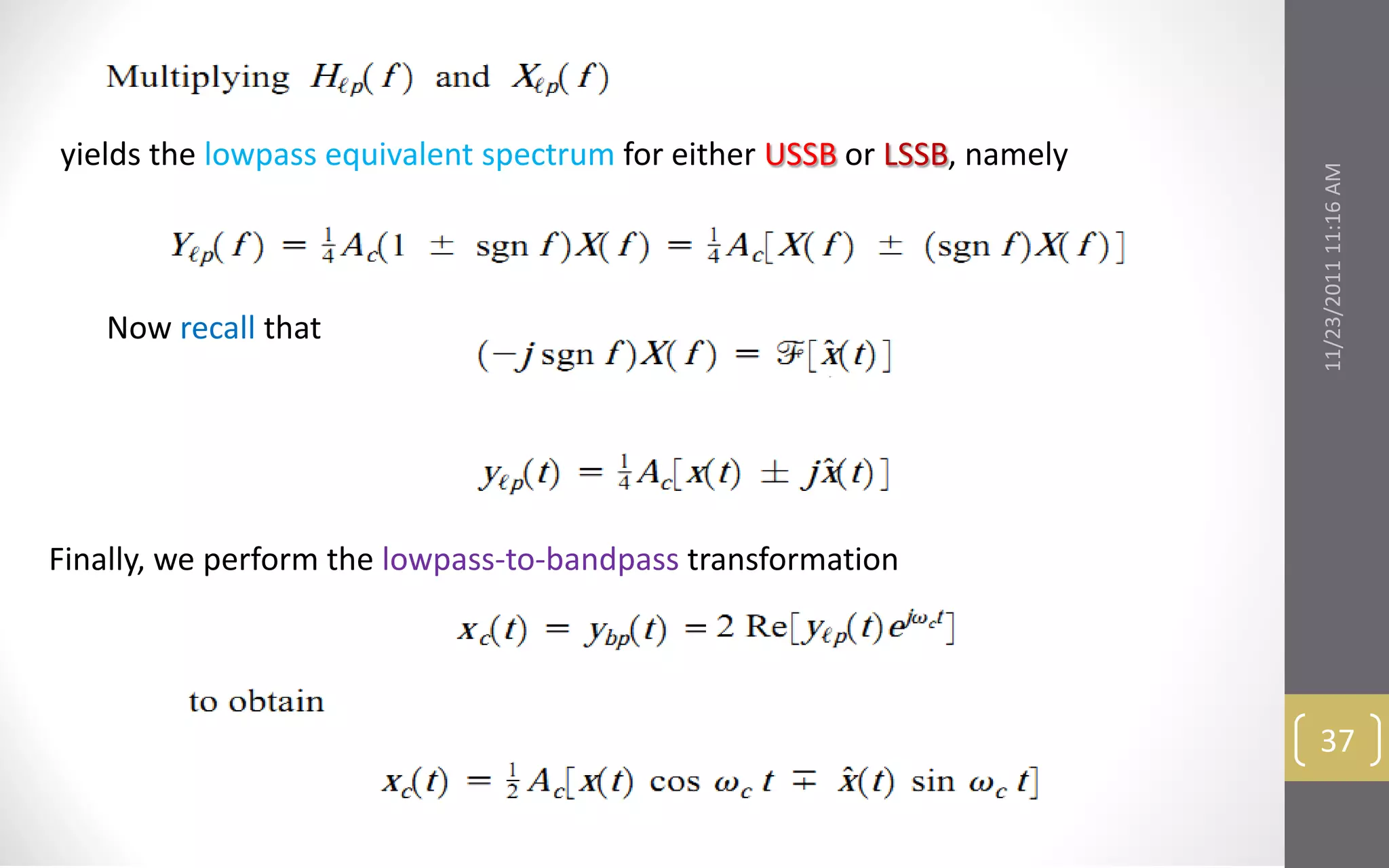
yields the lowpass equivalent spectrum for either USSB or LSSB, namely


                                                                         11/23/2011 11:16 AM
   Now recall that


Finally, we perform the lowpass-to-bandpass transformation


                                                                          37
SSB Generation


     11/23/2011 11:16 AM
38
VSB Signals and Spectra


                          11/23/2011 11:16 AM
                           39
Review Questions


     11/23/2011 11:16 AM
40
Problems to Ponder


                     11/23/2011 11:16 AM
                      41
Review Questions


     11/23/2011 11:16 AM
42
Problems to Ponder


                     11/23/2011 11:16 AM
                      43
MODULATORS AND TRANSMITTERS


                                         11/23/2011 11:16 AM
•   Product Modulators
•   Square-Law and Balanced Modulators
•   Switching Modulators
                                          44
Product Modulators


                     11/23/2011 11:16 AM
                      45
Square-Law and Balanced
Modulators


                          11/23/2011 11:16 AM
                           46
Switching Modulators


                       11/23/2011 11:16 AM
                        47
Review Questions


     11/23/2011 11:16 AM
48
Problems to Ponder


                     11/23/2011 11:16 AM
                      49
SUPPRESSED-SIDEBAND AMPLITUDE


                                11/23/2011 11:16 AM
MODULATION

•   SSB Signals and Spectra
•   SSB Generation
•   VSB Signals and Spectra
                                 50
SSB Signals and Spectra


                          11/23/2011 11:16 AM
                           51
SSB Generation


     11/23/2011 11:16 AM
52
VSB Signals and Spectra


                          11/23/2011 11:16 AM
                           53
Review Questions


     11/23/2011 11:16 AM
54
Problems to Ponder


                     11/23/2011 11:16 AM
                      55
FREQUENCY CONVERSION AND


                            11/23/2011 11:16 AM
DEMODULATION


•   Frequency Conversion
•   Synchronous Detection
•   Envelope Detection
                             56
Frequency Conversion


                       11/23/2011 11:16 AM
                        57
Synchronous Detection


                        11/23/2011 11:16 AM
                         58
Envelope Detection


                     11/23/2011 11:16 AM
                      59
Review Questions


     11/23/2011 11:16 AM
60
Problems to Ponder


                     11/23/2011 11:16 AM
                      61

Dsb lc,sc

  • 1.
  • 2.
    Roadmap 11/23/2011 11:16 AM 1. Bandpass Signals and Systems 2. Double-Sideband Amplitude Modulation 3. Modulators and Transmitters 4. Suppressed-Sideband Amplitude Modulation 5. Frequency Conversion and Demodulation 2
  • 3.
    BANDPASS SIGNALS ANDSYSTEMS 11/23/2011 11:16 AM • Analog Message Conventions • Bandpass Signals • Bandpass Transmission • Bandwidth 3
  • 4.
    Analog Message Conventions 11/23/2011 11:16 AM sinusoidal or tone modulation 4
  • 5.
    Bandpass Signals 5 11/23/2011 11:16 AM
  • 6.
    11/23/2011 11:16 AM envelope-and-phase description where A(t) is the envelope and φ(t) is the phase, both functions of time The envelope is defined as nonnegative, so that A(t) ≥ 0 . Negative “amplitudes,” 6 when they occur, are absorbed in the phase by adding ±180o .
  • 7.
    11/23/2011 11:16 AM in-phase component quadrature component 7 quadrature-carrier description
  • 8.
    DOUBLE-SIDEBAND AMPLITUDE 11/23/2011 11:16 AM MODULATION • AM Signals and Spectra • DSB Signals and Spectra • Tone Modulation and Phasor Analysis 8
  • 9.
    AM Signals andSpectra 11/23/2011 11:16 AM If Ac denotes the unmodulated carrier amplitude, modulation by x(t) produces the AM signal modulation index The signal’s envelope is xc(t) has no time-varying phase, its in-phase and quadrature components are 9
  • 10.
  • 11.
    The envelope clearlyreproduces the shape of if 11/23/2011 11:16 AM The condition fc >> W ensures that the carrier oscillates rapidly compared to the time variation of x(t); otherwise, an envelope could not be visualized. The condition μ ≤ 1 ensures that Ac[ 1 + μx(t) ] does not go negative. With 100 percent modulation (μ = 1), the envelope varies between Amin = 0 and Amax = 2Ac . Overmodulation ( μ > 1), causes phase reversals and envelope distortion 11
  • 12.
    11/23/2011 11:16 AM AMtransmission bandwidth 12
  • 13.
    Another important considerationis the average transmitted power 11/23/2011 11:16 AM Upon expanding averages to zero under the condition fc >> W 13
  • 14.
    The term Pcrepresents the unmodulated carrier power, since ST = Pc when μ = 0 11/23/2011 11:16 AM the term Psb represents the power per sideband since, when μ ≠ 0, ST consists of the power in the carrier plus two symmetric sidebands. The modulation constraint requires that Consequently, at least 50 percent (and often close to 2/3) of the total transmitted power resides in a carrier term that’s independent of and thus conveys no message information. 14
  • 15.
    DSB Signals andSpectra 11/23/2011 11:16 AM The “wasted” carrier power in amplitude modulation can be eliminated by setting and suppressing the unmodulated carrier-frequency component. The resulting modulated wave becomes which is called double-sideband–suppressed-carrier modulation—or DSB for short. (The abbreviations DSB–SC and DSSC are also used.) the DSB spectrum looks like an AM spectrum without the unmodulated carrier impulses. The transmission bandwidth thus remains unchanged . 15
  • 16.
    the DSB envelopeand phase are 11/23/2011 11:16 AM 16
  • 17.
    The envelope heretakes the shape of |x(t)|, rather than x(t), and the modulated wave undergoes a phase reversal whenever x(t) crosses zero. 11/23/2011 11:16 AM Full recovery of the message requires knowledge of these phase reversals, and could not be accomplished by an envelope detector. Carrier suppression does put all of the average transmitted power into the information-bearing sidebands. Practical transmitters also impose a limit on the peak envelope power We’ll take account of this peak-power limitation by examining the ratio 17
  • 18.
    11/23/2011 11:16 AM DSB conserves power but requires complicated demodulation circuitry, whereas AM requires increased power to permit simple envelope detection. 18
  • 19.
    EXAMPLE Consider a radio transmitter rated for 11/23/2011 11:16 AM Let the modulating signal be a tone with If the modulation is DSB, the maximum possible power per sideband equals the lesser of the two values determined from 19
  • 20.
    If the modulationis AM with μ = 1, then 11/23/2011 11:16 AM To check on the average-power limitation, Hence, the peak power limit again dominates and the maximum sideband power is Since transmission range is proportional to Psb , the AM path length would be 20 only 25 percent of the DSB path length with the same transmitter.
  • 21.
    Tone Modulation andPhasor Analysis 11/23/2011 11:16 AM Setting the tone-modulated DSB waveform tone-modulated AM wave 21
  • 22.
  • 23.
    EXAMPLE: AM andPhasor Analysis tone-modulated AM with 11/23/2011 11:16 AM the phasor sum equals the envelope 23
  • 24.
    Suppose a transmissionchannel completely removes the lower sideband, 11/23/2011 11:16 AM Now the envelope becomes 24 from which the envelope distortion can be determined.
  • 25.
    SUPPRESSED-SIDEBAND AMPLITUDE 11/23/2011 11:16 AM MODULATION • SSB Signals and Spectra • SSB Generation • VSB Signals and Spectra 25
  • 26.
    11/23/2011 11:16 AM Thein-phase and quadrature functions must be lowpass signals 26
  • 27.
    the lowpass equivalentspectrum 11/23/2011 11:16 AM lowpass equivalent signal 27
  • 28.
    Rectangular-to-Polar conversion yields 11/23/2011 11:16 AM The lowpass-to-bandpass transformation in the time domain. The corresponding frequency-domain transformation is 28
  • 29.
    Since we’ll dealonly with real bandpass signals, we can keep the hermitian symmetry, in mind and use the simpler expression 11/23/2011 11:16 AM 29
  • 30.
    11/23/2011 11:16 AM It’susually easier to work with the lowpass equivalent spectra related by which is the lowpass equivalent transfer function. 30
  • 31.
    In particular, afterfinding , you can take its inverse Fourier transform 11/23/2011 11:16 AM The lowpass-to-bandpass transformation then yields the output signal Or you can get the output quadrature components or envelope and phase immediately from 31
  • 32.
    SSB Signals andSpectra 11/23/2011 11:16 AM 32
  • 33.
    The resulting signalin either case has 11/23/2011 11:16 AM Removing one sideband line leaves only the other line. Hence, Note that the frequency of a tone-modulated SSB wave is offset from fc by ±fm and the envelope is a constant proportional to Am. 33 Obviously, envelope detection won’t work for SSB.
  • 34.
    To analyze SSBwith an arbitrary message x(t), we’ll draw upon the fact that the sideband filter is a bandpass system with a 11/23/2011 11:16 AM bandpass DSB input and a bandpass SSB output applying the equivalent lowpass method. Since xbp(t) has no quadrature component, the lowpass equivalent input is simply 34
  • 35.
    11/23/2011 11:16 AM Thebandpass filter transfer function for USSB along with the equivalent lowpass function 35
  • 36.
    The corresponding transferfunctions for LSSB are 11/23/2011 11:16 AM Both lowpass transfer functions can be represented by 36
  • 37.
    yields the lowpassequivalent spectrum for either USSB or LSSB, namely 11/23/2011 11:16 AM Now recall that Finally, we perform the lowpass-to-bandpass transformation 37
  • 38.
    SSB Generation 11/23/2011 11:16 AM 38
  • 39.
    VSB Signals andSpectra 11/23/2011 11:16 AM 39
  • 40.
    Review Questions 11/23/2011 11:16 AM 40
  • 41.
    Problems to Ponder 11/23/2011 11:16 AM 41
  • 42.
    Review Questions 11/23/2011 11:16 AM 42
  • 43.
    Problems to Ponder 11/23/2011 11:16 AM 43
  • 44.
    MODULATORS AND TRANSMITTERS 11/23/2011 11:16 AM • Product Modulators • Square-Law and Balanced Modulators • Switching Modulators 44
  • 45.
    Product Modulators 11/23/2011 11:16 AM 45
  • 46.
  • 47.
    Switching Modulators 11/23/2011 11:16 AM 47
  • 48.
    Review Questions 11/23/2011 11:16 AM 48
  • 49.
    Problems to Ponder 11/23/2011 11:16 AM 49
  • 50.
    SUPPRESSED-SIDEBAND AMPLITUDE 11/23/2011 11:16 AM MODULATION • SSB Signals and Spectra • SSB Generation • VSB Signals and Spectra 50
  • 51.
    SSB Signals andSpectra 11/23/2011 11:16 AM 51
  • 52.
    SSB Generation 11/23/2011 11:16 AM 52
  • 53.
    VSB Signals andSpectra 11/23/2011 11:16 AM 53
  • 54.
    Review Questions 11/23/2011 11:16 AM 54
  • 55.
    Problems to Ponder 11/23/2011 11:16 AM 55
  • 56.
    FREQUENCY CONVERSION AND 11/23/2011 11:16 AM DEMODULATION • Frequency Conversion • Synchronous Detection • Envelope Detection 56
  • 57.
    Frequency Conversion 11/23/2011 11:16 AM 57
  • 58.
    Synchronous Detection 11/23/2011 11:16 AM 58
  • 59.
    Envelope Detection 11/23/2011 11:16 AM 59
  • 60.
    Review Questions 11/23/2011 11:16 AM 60
  • 61.
    Problems to Ponder 11/23/2011 11:16 AM 61