TELE AVIV
BY PATRICK GEDDES
Indrajit koner
Deepika m.b
Introduction
• The character of a city can be perceived through the way in which its buildings comprise the urban spaces.
These urban spaces, streets, alleys and squares, which are formed between the buildings, are as important
to urban life as the buildings themselves, since they construct the space in which urban activity occurs.
• The character of Tel-Aviv’s urban spaces, especially in the residential quarters, is greatly influenced by a
particular housing type .
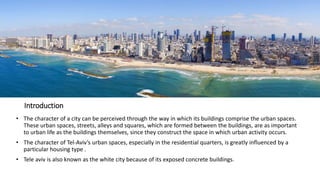
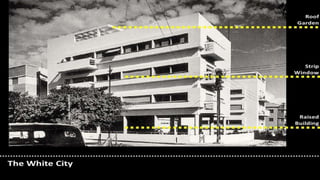
• Tele aviv is also known as the white city because of its exposed concrete buildings.
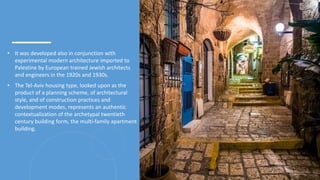
• It was developed also in conjunction with
experimental modern architecture imported to
Palestine by European trained Jewish architects
and engineers in the 1920s and 1930s.
• The Tel-Aviv housing type, looked upon as the
product of a planning scheme, of architectural
style, and of construction practices and
development modes, represents an authentic
contextualization of the archetypal twentieth
century building form, the multi-family apartment
building.
3
The beginning- jaffa
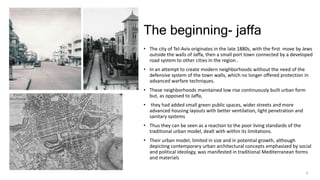
• The city of Tel-Aviv originates in the late 1880s, with the first move by Jews
outside the walls of Jaffa, then a small port town connected by a developed
road system to other cities in the region .
• In an attempt to create modern neighborhoods without the need of the
defensive system of the town walls, which no longer offered protection in
advanced warfare techniques.
• These neighborhoods maintained low rise continuously built urban form
but, as opposed to Jaffa,
• they had added small green public spaces, wider streets and more
advanced housing layouts with better ventilation, light penetration and
sanitary systems
• Thus they can be seen as a reaction to the poor living standards of the
traditional urban model, dealt with within its limitations.
• Their urban model, limited in size and in potential growth, although
depicting contemporary urban architectural concepts emphasized by social
and political ideology, was manifested in traditional Mediterranean forms
and materials
4
5
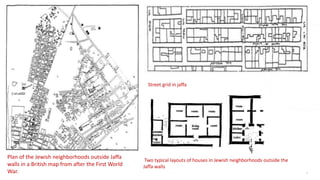
Plan of the Jewish neighborhoods outside Jaffa
walls in a British map from after the First World
War.
Two typical layouts of houses in Jewish neighborhoods outside the
Jaffa walls
Street grid in jaffa
PATRICK GEDDES – TELE AVIV
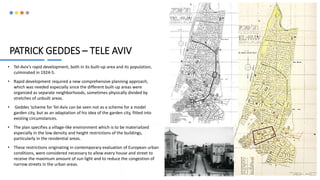
• Tel-Aviv’s rapid development, both in its built-up area and its population,
culminated in 1924-5.
• Rapid development required a new comprehensive planning approach,
which was needed especially since the different built-up areas were
organized as separate neighborhoods, sometimes physically divided by
stretches of unbuilt areas.
• Geddes ’scheme for Tel-Aviv can be seen not as a scheme for a model
garden city, but as an adaptation of his idea of the garden city, fitted into
existing circumstances.
• The plan specifies a village-like environment which is to be materialized
especially in the low density and height restrictions of the buildings,
particularly in the residential areas.
• These restrictions originating in contemporary evaluation of European urban
conditions, were considered necessary to allow every house and street to
receive the maximum amount of sun light and to reduce the congestion of
narrow streets in the urban areas.
6
PATRICK GEDDES – TELE AVIV
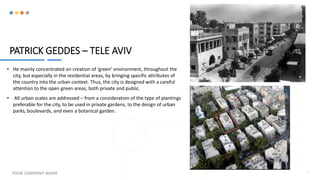
• He mainly concentrated on creation of ‘green’ environment, throughout the
city, but especially in the residential areas, by bringing specific attributes of
the country into the urban context. Thus, the city is designed with a careful
attention to the open green areas, both private and public.
• All urban scales are addressed – from a consideration of the type of plantings
preferable for the city, to be used in private gardens, to the design of urban
parks, boulevards, and even a botanical garden.
YOUR COMPANY NAME 7
METROPOLITAN SCALE
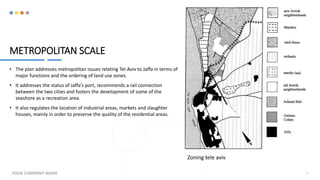
• The plan addresses metropolitan issues relating Tel-Aviv to Jaffa in terms of
major functions and the ordering of land use zones.
• It addresses the status of Jaffa’s port, recommends a rail connection
between the two cities and fosters the development of some of the
seashore as a recreation area.
• It also regulates the location of industrial areas, markets and slaughter
houses, mainly in order to preserve the quality of the residential areas.
YOUR COMPANY NAME 8
Zoning tele aviv
URBAN SCALE
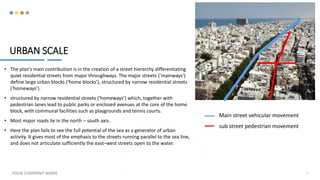
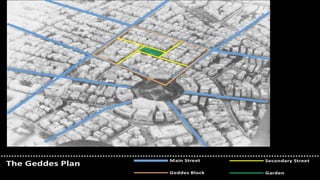
• The plan’s main contribution is in the creation of a street hierarchy differentiating
quiet residential streets from major throughways. The major streets (‘mainways’)
define large urban blocks (‘home blocks’), structured by narrow residential streets
(‘homeways’).
• structured by narrow residential streets (‘homeways’) which, together with
pedestrian lanes lead to public parks or enclosed avenues at the core of the home
block, with communal facilities such as playgrounds and tennis courts.
• Most major roads lie in the north – south axis.
• Here the plan fails to see the full potential of the sea as a generator of urban
activity. It gives most of the emphasis to the streets running parallel to the sea line,
and does not articulate sufficiently the east–west streets open to the water.
YOUR COMPANY NAME 9
Main street vehicular movement
sub street pedestrian movement
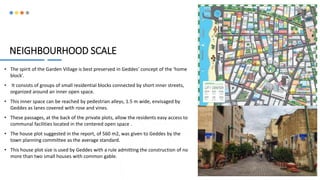
NEIGHBOURHOOD SCALE
• The spirit of the Garden Village is best preserved in Geddes’ concept of the ‘home
block’.
• It consists of groups of small residential blocks connected by short inner streets,
organized around an inner open space.
• This inner space can be reached by pedestrian alleys, 1.5 m wide, envisaged by
Geddes as lanes covered with rose and vines.
• These passages, at the back of the private plots, allow the residents easy access to
communal facilities located in the centered open space .
• The house plot suggested in the report, of 560 m2, was given to Geddes by the
town planning committee as the average standard.
• This house plot size is used by Geddes with a rule admitting the construction of no
more than two small houses with common gable.
10
YOUR COMPANY NAME 11
IMPLEMENTATION OF GEDDES
PLAN
• In an urban development condition driven by expectations for high capital gain on
the one hand, and by enormous housing demands on the other hand, an idealistic
plan as suggested by Geddes, with low density, extensive public amenities and vast
open spaces.
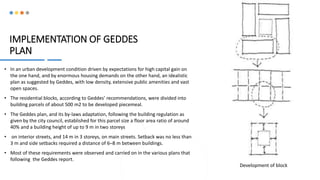
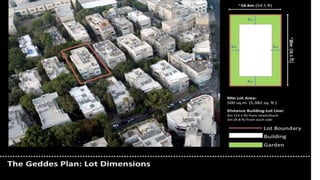
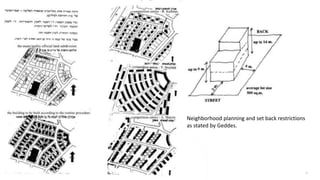
• The residential blocks, according to Geddes’ recommendations, were divided into
building parcels of about 500 m2 to be developed piecemeal.
• The Geddes plan, and its by-laws adaptation, following the building regulation as
given by the city council, established for this parcel size a floor area ratio of around
40% and a building height of up to 9 m in two storeys
• on interior streets, and 14 m in 3 storeys, on main streets. Setback was no less than
3 m and side setbacks required a distance of 6–8 m between buildings.
• Most of these requirements were observed and carried on in the various plans that
following the Geddes report.
Development of block
14
Neighborhood planning and set back restrictions
as stated by Geddes.
15
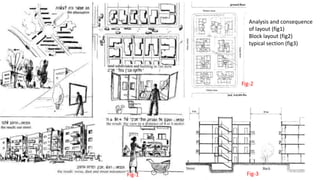
Analysis and consequence
of layout (fig1)
Block layout (fig2)
typical section (fig3)
Fig-1
Fig-2
Fig-3
16
17
Thank you

Tele aviv

  • 1.
    TELE AVIV BY PATRICKGEDDES Indrajit koner Deepika m.b
  • 2.
    Introduction • The characterof a city can be perceived through the way in which its buildings comprise the urban spaces. These urban spaces, streets, alleys and squares, which are formed between the buildings, are as important to urban life as the buildings themselves, since they construct the space in which urban activity occurs. • The character of Tel-Aviv’s urban spaces, especially in the residential quarters, is greatly influenced by a particular housing type . • Tele aviv is also known as the white city because of its exposed concrete buildings.
  • 3.
    • It wasdeveloped also in conjunction with experimental modern architecture imported to Palestine by European trained Jewish architects and engineers in the 1920s and 1930s. • The Tel-Aviv housing type, looked upon as the product of a planning scheme, of architectural style, and of construction practices and development modes, represents an authentic contextualization of the archetypal twentieth century building form, the multi-family apartment building. 3
  • 4.
    The beginning- jaffa •The city of Tel-Aviv originates in the late 1880s, with the first move by Jews outside the walls of Jaffa, then a small port town connected by a developed road system to other cities in the region . • In an attempt to create modern neighborhoods without the need of the defensive system of the town walls, which no longer offered protection in advanced warfare techniques. • These neighborhoods maintained low rise continuously built urban form but, as opposed to Jaffa, • they had added small green public spaces, wider streets and more advanced housing layouts with better ventilation, light penetration and sanitary systems • Thus they can be seen as a reaction to the poor living standards of the traditional urban model, dealt with within its limitations. • Their urban model, limited in size and in potential growth, although depicting contemporary urban architectural concepts emphasized by social and political ideology, was manifested in traditional Mediterranean forms and materials 4
  • 5.
    5 Plan of theJewish neighborhoods outside Jaffa walls in a British map from after the First World War. Two typical layouts of houses in Jewish neighborhoods outside the Jaffa walls Street grid in jaffa
  • 6.
    PATRICK GEDDES –TELE AVIV • Tel-Aviv’s rapid development, both in its built-up area and its population, culminated in 1924-5. • Rapid development required a new comprehensive planning approach, which was needed especially since the different built-up areas were organized as separate neighborhoods, sometimes physically divided by stretches of unbuilt areas. • Geddes ’scheme for Tel-Aviv can be seen not as a scheme for a model garden city, but as an adaptation of his idea of the garden city, fitted into existing circumstances. • The plan specifies a village-like environment which is to be materialized especially in the low density and height restrictions of the buildings, particularly in the residential areas. • These restrictions originating in contemporary evaluation of European urban conditions, were considered necessary to allow every house and street to receive the maximum amount of sun light and to reduce the congestion of narrow streets in the urban areas. 6
  • 7.
    PATRICK GEDDES –TELE AVIV • He mainly concentrated on creation of ‘green’ environment, throughout the city, but especially in the residential areas, by bringing specific attributes of the country into the urban context. Thus, the city is designed with a careful attention to the open green areas, both private and public. • All urban scales are addressed – from a consideration of the type of plantings preferable for the city, to be used in private gardens, to the design of urban parks, boulevards, and even a botanical garden. YOUR COMPANY NAME 7
  • 8.
    METROPOLITAN SCALE • Theplan addresses metropolitan issues relating Tel-Aviv to Jaffa in terms of major functions and the ordering of land use zones. • It addresses the status of Jaffa’s port, recommends a rail connection between the two cities and fosters the development of some of the seashore as a recreation area. • It also regulates the location of industrial areas, markets and slaughter houses, mainly in order to preserve the quality of the residential areas. YOUR COMPANY NAME 8 Zoning tele aviv
  • 9.
    URBAN SCALE • Theplan’s main contribution is in the creation of a street hierarchy differentiating quiet residential streets from major throughways. The major streets (‘mainways’) define large urban blocks (‘home blocks’), structured by narrow residential streets (‘homeways’). • structured by narrow residential streets (‘homeways’) which, together with pedestrian lanes lead to public parks or enclosed avenues at the core of the home block, with communal facilities such as playgrounds and tennis courts. • Most major roads lie in the north – south axis. • Here the plan fails to see the full potential of the sea as a generator of urban activity. It gives most of the emphasis to the streets running parallel to the sea line, and does not articulate sufficiently the east–west streets open to the water. YOUR COMPANY NAME 9 Main street vehicular movement sub street pedestrian movement
  • 10.
    NEIGHBOURHOOD SCALE • Thespirit of the Garden Village is best preserved in Geddes’ concept of the ‘home block’. • It consists of groups of small residential blocks connected by short inner streets, organized around an inner open space. • This inner space can be reached by pedestrian alleys, 1.5 m wide, envisaged by Geddes as lanes covered with rose and vines. • These passages, at the back of the private plots, allow the residents easy access to communal facilities located in the centered open space . • The house plot suggested in the report, of 560 m2, was given to Geddes by the town planning committee as the average standard. • This house plot size is used by Geddes with a rule admitting the construction of no more than two small houses with common gable. 10
  • 11.
  • 12.
    IMPLEMENTATION OF GEDDES PLAN •In an urban development condition driven by expectations for high capital gain on the one hand, and by enormous housing demands on the other hand, an idealistic plan as suggested by Geddes, with low density, extensive public amenities and vast open spaces. • The residential blocks, according to Geddes’ recommendations, were divided into building parcels of about 500 m2 to be developed piecemeal. • The Geddes plan, and its by-laws adaptation, following the building regulation as given by the city council, established for this parcel size a floor area ratio of around 40% and a building height of up to 9 m in two storeys • on interior streets, and 14 m in 3 storeys, on main streets. Setback was no less than 3 m and side setbacks required a distance of 6–8 m between buildings. • Most of these requirements were observed and carried on in the various plans that following the Geddes report. Development of block
  • 14.
    14 Neighborhood planning andset back restrictions as stated by Geddes.
  • 15.
    15 Analysis and consequence oflayout (fig1) Block layout (fig2) typical section (fig3) Fig-1 Fig-2 Fig-3
  • 16.
  • 17.