DEVELOPMENT
CONTROLS &
CHANDIGARH ARCHITECTURAL CONTROLS,
Ar Jit Kumar Gupta
Mail- jit.kumar19442@mail.com, 90410-26414
DEFINING DEVELOPMENT CONTROL,
 Development controls/ planning controls, / development
management:
 are the elements/process-- through which
 local government regulates
 land use and
 new building.
 It relies on a "plan-led system“
 whereby development plans are formed and
 the public is consulted.
DEVELOPMENT CONTROL?
 Development Control --is the process that regulates;
 -- development and use of land.
 It includes:
 -- construction of new buildings
 -- extension of existing ones
 -- change of use of buildings or
 ---Change of use of land to another use.
 -- Developing new houses/ industrial buildings / shops
important-- for sustaining economic success
 --Also important to protect / improve quality of
environment-- towns ,villages, countryside.
DEVELOPMENT CONTROLS
 Development controls defined as; -- the mechanism
 --through which entire process of urban development is regulated
 -- to achieve objective of promoting overall benefit of society and
 -- creating a distinct image of city.
 Controls include
 i. guiding the development
 ii use of land,
 iii curbing misuse of land
 iv promoting rational /orderly development of built environment.
Development controls -- required to meet situations and
contexts which are generally static they tend to become rigid and complex.
 --Looking at far reaching impact / implications of development controls on the:
 -- growth and development
 --character, fabric and personality of a city,
 --they need to be framed with great care and abundant caution.
 --Considering larger public interest and general welfare of community,
 --formulation of development control should satisfy basic requirements of ;
 --health, --safety-- convenience, --economy and --amenity.
TYPES OF DEVELOPMENT CONTROLS
 LAND SUB-DIVISION CONTOLS
 LAND USE CONTROLS
 ZONING CONTROLS
 DENSITY CONTROLS
 HEIGHT CONTROL
 GROUND COVEAGE CONTROL
 FLOOR AEA RATIO CONTROLS
 VOLUMETRIC CONTROLS
 SETBACK CONTROLS
 ARCHITECTURAL CONTROLS
 ADVERTISEMENT CONTROLS
 BOUNDARY WALL AND GATE CONTROLS
SUB- DIVISION CONTROL--LAND
 Subdivision Controls
 Subdivision Controls-- require developers to prepare raw land for
development that promotes-- public health and safety.
 Controls ensure:
 1. land can be developed without endangering public health and safety;
 2. developers to provide --for proper water, sewerage, drainage ; control
soil erosion and sedimentation;
 3. to Set standard/create a network of streets for rational traffic &
transportation.
 4. to plan that conserves energy or promotes use of renewable energy.
 5 Set standards for providing public utilities and services.
 6 Lay down proportion of land under different uses-
 --housing,
 -- commercial,
 --open spaces,
 --roads,
 --public amenities etc
ZONING
 Urban areas divided into districts -- to regulate use of land
 Zoning regulates --way developers can erect, construct,
reconstruct, alter, or use buildings and structures in each district.
 Zoning also
 1. Regulate s-- Height, number of stories; size of buildings and
other structures;
 2. Regulate -- % age of area of building lot that may be occupied;
 3. Regulates-- location, use of buildings, structures, and land for
residential, commercial, and other purposes; and
 4. Considering character of the district & suitability for particular
uses, with a view to conserving the value of buildings and
encouraging most appropriate use of land within municipality.
 5. Control extent to which people can develop land for a permitted
use.-- defining minimum lot size and floor area requirements ;
control number / size of homes
 --Setback to specify distance between a structure and lot's
boundaries.
SET BACK CONTROLS
 Setback – margins or open spaces in any plot of land where no
construction is permitted
 Land under setbacks belongs to owner – no construction permitted
 Maximum setbacks -- four- one on each side- front, Rear and sides
 Building with 4 setbacks – Detached building
 Building with 3 setbacks –Semi- Detached building
 Building with 2 setbacks – Terraced building
 Number of setbacks depends upon size of plot ; covered area
permitted at ground and Requirement of fire safety
 Larger the plot -- more are setbacks and larger such setbacks
 Setbacks ;;
 i. Provide space for widening roads when needed without damaging
buildings
 Ii. Pomoting urban design of area/ street picture by bringing uniformity
 Iii to Ensure adequate air, light and ventilation within /among buildings
 Iv To provide space for Parking within building without causing
congestion in area
 V. To create gardens/open spaces/landscape area within building
 Vi To protect buildings from street noise/ traffic
 Vii. To promote Privacy for residents
DENSITY CONTROL
 Density- defined ---as number of persons per unit area
 Housing density--- number of housing or dwelling units/per unit area
 Regulates number of houses/ population in any area/ building
 Avoids over -crowding in any area
 Helps in distribution of population in city/ area --- working out
amenities to be provides- open spaces, roads, schools, community
centre, shopping , health care etc
 Differentiates area into High/ Medium /Low density area
 Helps in planning area in terms of plot size -- with large size in low
density area
 Three types of density- Overall Density – at city level- average density
of population per unit area of the entire urban area
 --Gross Density- at Sector level- average density of population per unit
area of entire residential area
 -- Net Density– at Local Level- average density of population per unit of
housing area including local roads but excluding open spaces,
shopping, public institutions
 -- Net Density always highest and overall density always lowest
DENSITY CONTROL
 Density is regulated through regulating built area/ plot
area by defining
 -- setbacks to be provided in buildings
 - Maximum height of building
 --Size of plots
 --number of houses per unit area
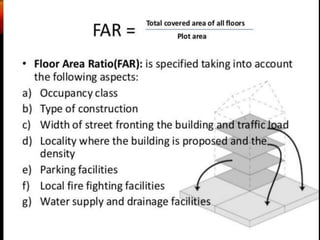
 -- Floor area Ratio
 Advantages of Density Controls:
 i. Facilitate proper layout
 2. Designing appropriate public amenities and services and
their distribution
 3 Ensures adequate light and ventilation to residences for
creating healthy environment
 4 Avoiding congestion/ over-crowding
 5 Stabilizing land values
HEIGHT CONTROLS
 Objectives –
i. to control height, volume and cubicle contents of building-
ii. Define Street width /setbacks to ensure air, light and
ventilation to , buildings- by fixing the light plane at an angle
of 45 degree/ 63.50 degree to the horizontal, giving a ratio of
1:1/2:1 with the width of road
-- Restriction on height of building depends on;
-- Nature of Building/ Type of Zone and Climatic conditions
Advantages of Height Zoning
1. --- To control development in area
2. -- solve problems involving traffic, congestion etc
3. -- improving street picture/ urban design
4. -- Ensuring adequate air , light and ventilation by avoiding
construction of tall buildings in a low height area.
5. -- Controlling land values and stabilizes them in preferred area
HEIGHT CONTROLS
 Height – helps in providing larger built area over any piece of land
 More the height-- more are the setbacks provided in building-- to
ensure air, light / ventilation in building/ surrounding buildings
 More the height-- lesser is ground coverage -- to provide more open
space at ground and larger space for parking
 Main objectives of Height control are to-- ensure adequate day-
lighting in the building and manage traffic and to provide space for
disaster management
 To achieve above objectives there are two options--
 -- to provide buildings of moderate height with less space between
them
 -- Buildings with more height and more space between them
 -- With more height- city of towers can be created
 Former pattern helps in creating-- streets of normal width with
buildings of low/ moderate height
 Latter pattern creates -- tower like buildings with wide roads
 Height controls helps in checking population density
 Height controls also regulates the needs of disaster management
Development
Controls-
Chandigarh
DEVELOPMENT CONTROLS- CHANDIGARH
 Chandigarh widely acclaimed as:
 -- Mecca of planning and architecture due to
 -- various innovations incorporated in
--planning,
 designing,
 -- development and
 -- management of capital city
city today is valued universally for:
 -- using mechanism of development controls
 -- for promoting
 --state of art development
 -- and quality built environment.
 In the absence of any statutory master plan,
 growth and development of Chandigarh
 -- exclusively regulated through
 --various development controls,
 -- put into operation
 --as integral part of
 city planning and
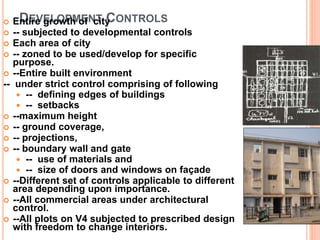
DEVELOPMENT CONTROLS Entire growth of city
 -- subjected to developmental controls
 Each area of city
 -- zoned to be used/develop for specific
purpose.
 --Entire built environment
-- under strict control comprising of following
 -- defining edges of buildings
 -- setbacks
 --maximum height
 -- ground coverage,
 -- projections,
 -- boundary wall and gate
 -- use of materials and
 -- size of doors and windows on façade
 --Different set of controls applicable to different
area depending upon importance.
 --All commercial areas under architectural
control.
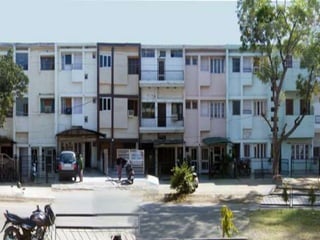
 --All plots on V4 subjected to prescribed design
with freedom to change interiors.
DEVELOPMENT CONTROLS
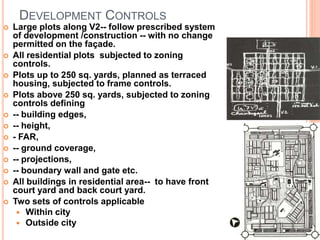
 Large plots along V2-- follow prescribed system
of development /construction -- with no change
permitted on the façade.
 All residential plots subjected to zoning
controls.
 Plots up to 250 sq. yards, planned as terraced
housing, subjected to frame controls.
 Plots above 250 sq. yards, subjected to zoning
controls defining
 -- building edges,
 -- height,
 - FAR,
 -- ground coverage,
 -- projections,
 -- boundary wall and gate etc.
 All buildings in residential area-- to have front
court yard and back court yard.
 Two sets of controls applicable
 Within city
 Outside city
DEVELOPMENT CONTROLS
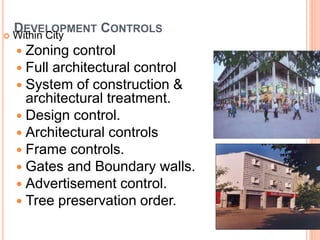
 Within City
 Zoning control
 Full architectural control
 System of construction &
architectural treatment.
 Design control.
 Architectural controls
 Frame controls.
 Gates and Boundary walls.
 Advertisement control.
 Tree preservation order.
DEVELOPMENT CONTROLS
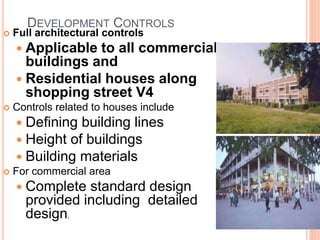
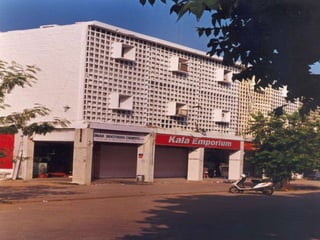
 Full architectural controls
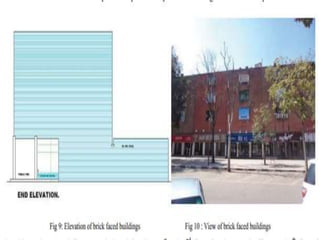
 Applicable to all commercial
buildings and
 Residential houses along
shopping street V4
 Controls related to houses include
 Defining building lines
 Height of buildings
 Building materials
 For commercial area
 Complete standard design
provided including detailed
design.
DEVELOPMENT CONTROLS
 .
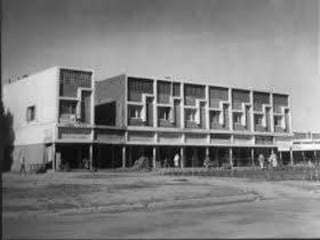
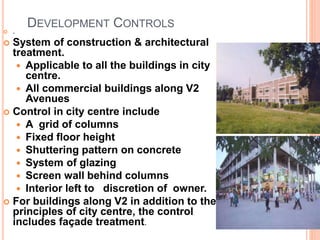
 System of construction & architectural
treatment.
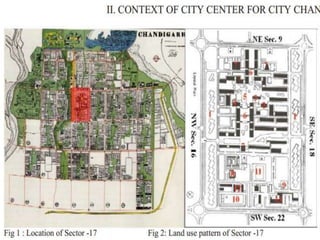
 Applicable to all the buildings in city
centre.
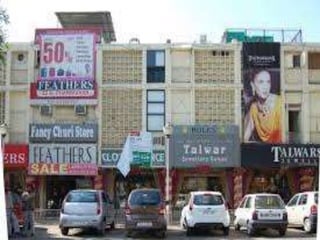
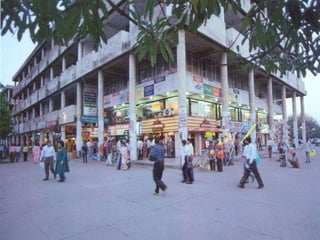
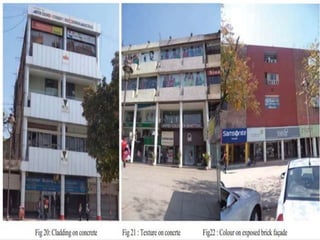
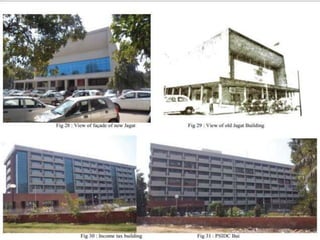
 All commercial buildings along V2
Avenues
 Control in city centre include
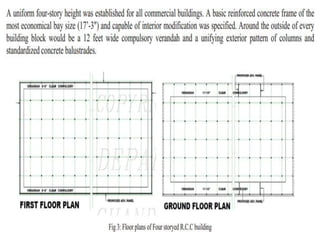
 A grid of columns
 Fixed floor height
 Shuttering pattern on concrete
 System of glazing
 Screen wall behind columns
 Interior left to discretion of owner.
 For buildings along V2 in addition to the
principles of city centre, the control
includes façade treatment.
DEVELOPMENT CONTROLS
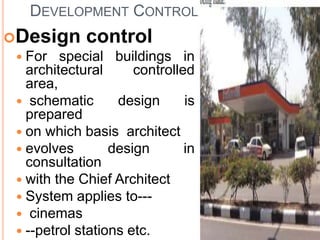
Design control
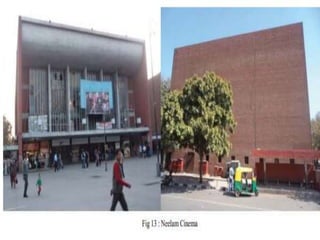
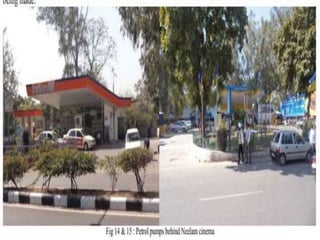
 For special buildings in
architectural controlled
area,
 schematic design is
prepared
 on which basis architect
 evolves design in
consultation
 with the Chief Architect
 System applies to---
 cinemas
 --petrol stations etc.
DEVELOPMENT CONTROLS
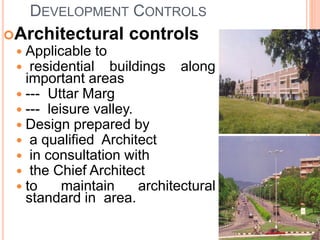
Architectural controls
 Applicable to
 residential buildings along
important areas
 --- Uttar Marg
 --- leisure valley.
 Design prepared by
 a qualified Architect
 in consultation with
 the Chief Architect
 to maintain architectural
standard in area.
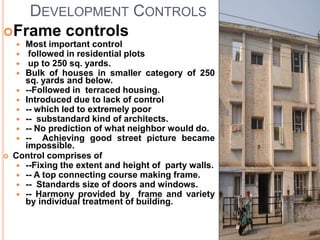
DEVELOPMENT CONTROLS
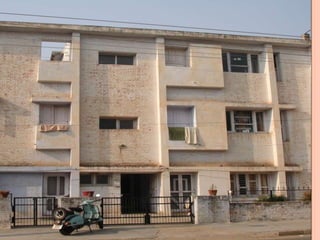
Frame controls
 Most important control
 followed in residential plots
 up to 250 sq. yards.
 Bulk of houses in smaller category of 250
sq. yards and below.
 --Followed in terraced housing.
 Introduced due to lack of control
 -- which led to extremely poor
 -- substandard kind of architects.
 -- No prediction of what neighbor would do.
 -- Achieving good street picture became
impossible.
 Control comprises of
 --Fixing the extent and height of party walls.
 -- A top connecting course making frame.
 -- Standards size of doors and windows.
 -- Harmony provided by frame and variety
by individual treatment of building.
DEVELOPMENT CONTROLS
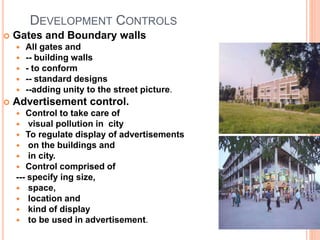
 Gates and Boundary walls
 All gates and
 -- building walls
 - to conform
 -- standard designs
 --adding unity to the street picture.
 Advertisement control.
 Control to take care of
 visual pollution in city
 To regulate display of advertisements
 on the buildings and
 in city.
 Control comprised of
--- specify ing size,
 space,
 location and
 kind of display
 to be used in advertisement.
DEVELOPMENT CONTROLS
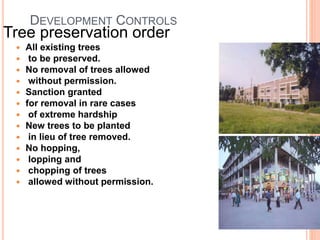
Tree preservation order
 All existing trees
 to be preserved.
 No removal of trees allowed
 without permission.
 Sanction granted
 for removal in rare cases
 of extreme hardship
 New trees to be planted
 in lieu of tree removed.
 No hopping,
 lopping and
 chopping of trees
 allowed without permission.

Development controls and Chandigarh Architectural controls

  • 1.
    DEVELOPMENT CONTROLS & CHANDIGARH ARCHITECTURALCONTROLS, Ar Jit Kumar Gupta Mail- jit.kumar19442@mail.com, 90410-26414
  • 2.
    DEFINING DEVELOPMENT CONTROL, Development controls/ planning controls, / development management:  are the elements/process-- through which  local government regulates  land use and  new building.  It relies on a "plan-led system“  whereby development plans are formed and  the public is consulted.
  • 3.
    DEVELOPMENT CONTROL?  DevelopmentControl --is the process that regulates;  -- development and use of land.  It includes:  -- construction of new buildings  -- extension of existing ones  -- change of use of buildings or  ---Change of use of land to another use.  -- Developing new houses/ industrial buildings / shops important-- for sustaining economic success  --Also important to protect / improve quality of environment-- towns ,villages, countryside.
  • 4.
    DEVELOPMENT CONTROLS  Developmentcontrols defined as; -- the mechanism  --through which entire process of urban development is regulated  -- to achieve objective of promoting overall benefit of society and  -- creating a distinct image of city.  Controls include  i. guiding the development  ii use of land,  iii curbing misuse of land  iv promoting rational /orderly development of built environment. Development controls -- required to meet situations and contexts which are generally static they tend to become rigid and complex.  --Looking at far reaching impact / implications of development controls on the:  -- growth and development  --character, fabric and personality of a city,  --they need to be framed with great care and abundant caution.  --Considering larger public interest and general welfare of community,  --formulation of development control should satisfy basic requirements of ;  --health, --safety-- convenience, --economy and --amenity.
  • 5.
    TYPES OF DEVELOPMENTCONTROLS  LAND SUB-DIVISION CONTOLS  LAND USE CONTROLS  ZONING CONTROLS  DENSITY CONTROLS  HEIGHT CONTROL  GROUND COVEAGE CONTROL  FLOOR AEA RATIO CONTROLS  VOLUMETRIC CONTROLS  SETBACK CONTROLS  ARCHITECTURAL CONTROLS  ADVERTISEMENT CONTROLS  BOUNDARY WALL AND GATE CONTROLS
  • 6.
    SUB- DIVISION CONTROL--LAND Subdivision Controls  Subdivision Controls-- require developers to prepare raw land for development that promotes-- public health and safety.  Controls ensure:  1. land can be developed without endangering public health and safety;  2. developers to provide --for proper water, sewerage, drainage ; control soil erosion and sedimentation;  3. to Set standard/create a network of streets for rational traffic & transportation.  4. to plan that conserves energy or promotes use of renewable energy.  5 Set standards for providing public utilities and services.  6 Lay down proportion of land under different uses-  --housing,  -- commercial,  --open spaces,  --roads,  --public amenities etc
  • 7.
    ZONING  Urban areasdivided into districts -- to regulate use of land  Zoning regulates --way developers can erect, construct, reconstruct, alter, or use buildings and structures in each district.  Zoning also  1. Regulate s-- Height, number of stories; size of buildings and other structures;  2. Regulate -- % age of area of building lot that may be occupied;  3. Regulates-- location, use of buildings, structures, and land for residential, commercial, and other purposes; and  4. Considering character of the district & suitability for particular uses, with a view to conserving the value of buildings and encouraging most appropriate use of land within municipality.  5. Control extent to which people can develop land for a permitted use.-- defining minimum lot size and floor area requirements ; control number / size of homes  --Setback to specify distance between a structure and lot's boundaries.
  • 8.
    SET BACK CONTROLS Setback – margins or open spaces in any plot of land where no construction is permitted  Land under setbacks belongs to owner – no construction permitted  Maximum setbacks -- four- one on each side- front, Rear and sides  Building with 4 setbacks – Detached building  Building with 3 setbacks –Semi- Detached building  Building with 2 setbacks – Terraced building  Number of setbacks depends upon size of plot ; covered area permitted at ground and Requirement of fire safety  Larger the plot -- more are setbacks and larger such setbacks  Setbacks ;;  i. Provide space for widening roads when needed without damaging buildings  Ii. Pomoting urban design of area/ street picture by bringing uniformity  Iii to Ensure adequate air, light and ventilation within /among buildings  Iv To provide space for Parking within building without causing congestion in area  V. To create gardens/open spaces/landscape area within building  Vi To protect buildings from street noise/ traffic  Vii. To promote Privacy for residents
  • 9.
    DENSITY CONTROL  Density-defined ---as number of persons per unit area  Housing density--- number of housing or dwelling units/per unit area  Regulates number of houses/ population in any area/ building  Avoids over -crowding in any area  Helps in distribution of population in city/ area --- working out amenities to be provides- open spaces, roads, schools, community centre, shopping , health care etc  Differentiates area into High/ Medium /Low density area  Helps in planning area in terms of plot size -- with large size in low density area  Three types of density- Overall Density – at city level- average density of population per unit area of the entire urban area  --Gross Density- at Sector level- average density of population per unit area of entire residential area  -- Net Density– at Local Level- average density of population per unit of housing area including local roads but excluding open spaces, shopping, public institutions  -- Net Density always highest and overall density always lowest
  • 10.
    DENSITY CONTROL  Densityis regulated through regulating built area/ plot area by defining  -- setbacks to be provided in buildings  - Maximum height of building  --Size of plots  --number of houses per unit area  -- Floor area Ratio  Advantages of Density Controls:  i. Facilitate proper layout  2. Designing appropriate public amenities and services and their distribution  3 Ensures adequate light and ventilation to residences for creating healthy environment  4 Avoiding congestion/ over-crowding  5 Stabilizing land values
  • 11.
    HEIGHT CONTROLS  Objectives– i. to control height, volume and cubicle contents of building- ii. Define Street width /setbacks to ensure air, light and ventilation to , buildings- by fixing the light plane at an angle of 45 degree/ 63.50 degree to the horizontal, giving a ratio of 1:1/2:1 with the width of road -- Restriction on height of building depends on; -- Nature of Building/ Type of Zone and Climatic conditions Advantages of Height Zoning 1. --- To control development in area 2. -- solve problems involving traffic, congestion etc 3. -- improving street picture/ urban design 4. -- Ensuring adequate air , light and ventilation by avoiding construction of tall buildings in a low height area. 5. -- Controlling land values and stabilizes them in preferred area
  • 12.
    HEIGHT CONTROLS  Height– helps in providing larger built area over any piece of land  More the height-- more are the setbacks provided in building-- to ensure air, light / ventilation in building/ surrounding buildings  More the height-- lesser is ground coverage -- to provide more open space at ground and larger space for parking  Main objectives of Height control are to-- ensure adequate day- lighting in the building and manage traffic and to provide space for disaster management  To achieve above objectives there are two options--  -- to provide buildings of moderate height with less space between them  -- Buildings with more height and more space between them  -- With more height- city of towers can be created  Former pattern helps in creating-- streets of normal width with buildings of low/ moderate height  Latter pattern creates -- tower like buildings with wide roads  Height controls helps in checking population density  Height controls also regulates the needs of disaster management
  • 14.
  • 15.
    DEVELOPMENT CONTROLS- CHANDIGARH Chandigarh widely acclaimed as:  -- Mecca of planning and architecture due to  -- various innovations incorporated in --planning,  designing,  -- development and  -- management of capital city city today is valued universally for:  -- using mechanism of development controls  -- for promoting  --state of art development  -- and quality built environment.  In the absence of any statutory master plan,  growth and development of Chandigarh  -- exclusively regulated through  --various development controls,  -- put into operation  --as integral part of  city planning and
  • 16.
    DEVELOPMENT CONTROLS Entiregrowth of city  -- subjected to developmental controls  Each area of city  -- zoned to be used/develop for specific purpose.  --Entire built environment -- under strict control comprising of following  -- defining edges of buildings  -- setbacks  --maximum height  -- ground coverage,  -- projections,  -- boundary wall and gate  -- use of materials and  -- size of doors and windows on façade  --Different set of controls applicable to different area depending upon importance.  --All commercial areas under architectural control.  --All plots on V4 subjected to prescribed design with freedom to change interiors.
  • 17.
    DEVELOPMENT CONTROLS  Largeplots along V2-- follow prescribed system of development /construction -- with no change permitted on the façade.  All residential plots subjected to zoning controls.  Plots up to 250 sq. yards, planned as terraced housing, subjected to frame controls.  Plots above 250 sq. yards, subjected to zoning controls defining  -- building edges,  -- height,  - FAR,  -- ground coverage,  -- projections,  -- boundary wall and gate etc.  All buildings in residential area-- to have front court yard and back court yard.  Two sets of controls applicable  Within city  Outside city
  • 18.
    DEVELOPMENT CONTROLS  WithinCity  Zoning control  Full architectural control  System of construction & architectural treatment.  Design control.  Architectural controls  Frame controls.  Gates and Boundary walls.  Advertisement control.  Tree preservation order.
  • 19.
    DEVELOPMENT CONTROLS  Fullarchitectural controls  Applicable to all commercial buildings and  Residential houses along shopping street V4  Controls related to houses include  Defining building lines  Height of buildings  Building materials  For commercial area  Complete standard design provided including detailed design.
  • 23.
    DEVELOPMENT CONTROLS  . System of construction & architectural treatment.  Applicable to all the buildings in city centre.  All commercial buildings along V2 Avenues  Control in city centre include  A grid of columns  Fixed floor height  Shuttering pattern on concrete  System of glazing  Screen wall behind columns  Interior left to discretion of owner.  For buildings along V2 in addition to the principles of city centre, the control includes façade treatment.
  • 35.
    DEVELOPMENT CONTROLS Design control For special buildings in architectural controlled area,  schematic design is prepared  on which basis architect  evolves design in consultation  with the Chief Architect  System applies to---  cinemas  --petrol stations etc.
  • 36.
    DEVELOPMENT CONTROLS Architectural controls Applicable to  residential buildings along important areas  --- Uttar Marg  --- leisure valley.  Design prepared by  a qualified Architect  in consultation with  the Chief Architect  to maintain architectural standard in area.
  • 38.
    DEVELOPMENT CONTROLS Frame controls Most important control  followed in residential plots  up to 250 sq. yards.  Bulk of houses in smaller category of 250 sq. yards and below.  --Followed in terraced housing.  Introduced due to lack of control  -- which led to extremely poor  -- substandard kind of architects.  -- No prediction of what neighbor would do.  -- Achieving good street picture became impossible.  Control comprises of  --Fixing the extent and height of party walls.  -- A top connecting course making frame.  -- Standards size of doors and windows.  -- Harmony provided by frame and variety by individual treatment of building.
  • 41.
    DEVELOPMENT CONTROLS  Gatesand Boundary walls  All gates and  -- building walls  - to conform  -- standard designs  --adding unity to the street picture.  Advertisement control.  Control to take care of  visual pollution in city  To regulate display of advertisements  on the buildings and  in city.  Control comprised of --- specify ing size,  space,  location and  kind of display  to be used in advertisement.
  • 42.
    DEVELOPMENT CONTROLS Tree preservationorder  All existing trees  to be preserved.  No removal of trees allowed  without permission.  Sanction granted  for removal in rare cases  of extreme hardship  New trees to be planted  in lieu of tree removed.  No hopping,  lopping and  chopping of trees  allowed without permission.