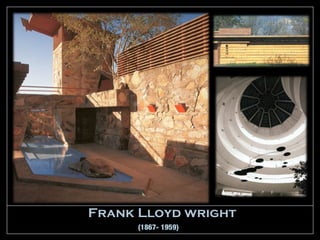
Frank Lloyd wright
      (1867- 1959)
About fr ank Lloyd wright

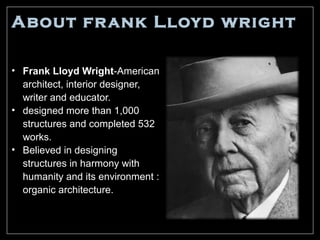
• Frank Lloyd Wright-American
  architect, interior designer,
  writer and educator.
• designed more than 1,000
  structures and completed 532
  works.
• Believed in designing
  structures in harmony with
  humanity and its environment :
  organic architecture.
About fr ank Lloyd
wright

•Philosophy best exemplified by Falling water (1935):
"the best all-time work of American architecture".

•a leader of the Prairie School movement of
architecture, developed the concept of the Usonian
home : his unique vision for urban planning in the
United States.
Education and work for
Silsbee (1885–1888)

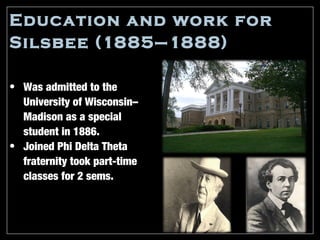
• Was admitted to the
  University of Wisconsin–
  Madison as a special
  student in 1886.
• Joined Phi Delta Theta
  fraternity took part-time
  classes for 2 sems.
Education and work for
Silsbee (1885–1888)
•Worked with Allan D. Conover, a professor of civil
engineering.
•Arrived in Chicago in search of employment.
•First impressions of Chicago: grimy neighborhoods, crowded
streets, and disappointing architecture, yet he was
determined to find work.
•Hired as a draftsman with the architectural firm of Joseph
Lyman Silsbee.
Education and work for
Silsbee (1885–1888)
•Accredited as the draftsman and the construction supervisor
—1886 Unity Chapel for Wright's family in Spring Green,
Wisconsin
•2 other family projects: the All Souls Church in Chicago for
his and the Hillside Home School in Spring Green.
•Feeling he was underpaid at Silsbee (at $8 a week), quit and
found work as a designer at the firm of Beers, Clay, and
Dutton.
•Soon realized was not ready to handle building design by
himself; left new job to return to Silsbee—with a raise in
salary.
Education and work for
Silsbee (1885–1888)
•Silsbee adhered mainly to Victorian and revivalist
architecture, Wright found his work to be more "gracefully
picturesque".
•After less than a year, passed in Silsbee's office, learned
that the Chicago firm of Adler & Sullivan was looking for
someone to make the finish drawings for the interior of the
Auditorium.
•Demonstrated himself as competent impressionist of Louis
Sullivan's ornamental designs 2 short interviews later, was
an official apprentice in the firm.
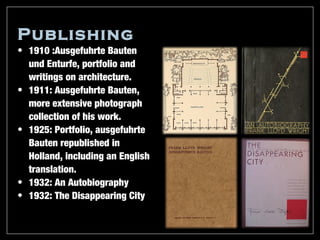
Publishing
• 1910 :Ausgefuhrte Bauten
  und Enturfe, portfolio and
  writings on architecture.
• 1911: Ausgefuhrte Bauten,
  more extensive photograph
  collection of his work.
• 1925: Portfolio, ausgefuhrte
  Bauten republished in
  Holland, including an English
  translation.
• 1932: An Autobiography
• 1932: The Disappearing City
Taliesin School of
Architecture
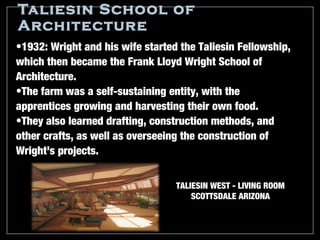
•1932: Wright and his wife started the Taliesin Fellowship,
which then became the Frank Lloyd Wright School of
Architecture.
•The farm was a self-sustaining entity, with the
apprentices growing and harvesting their own food.
•They also learned drafting, construction methods, and
other crafts, as well as overseeing the construction of
Wright’s projects.


                                  TALIESIN WEST - LIVING ROOM
                                      SCOTTSDALE ARIZONA
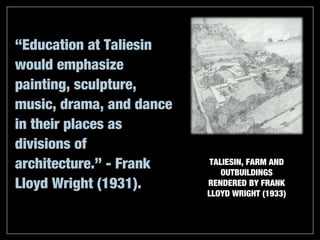
“Education at Taliesin
would emphasize
painting, sculpture,
music, drama, and dance
in their places as
divisions of
architecture.” - Frank     TALIESIN, FARM AND
                              OUTBUILDINGS
Lloyd Wright (1931).      RENDERED BY FRANK
                          LLOYD WRIGHT (1933)
Organic
           Architecture
   Return from Japan, gave many
   lectures and interviews on
   architecture.
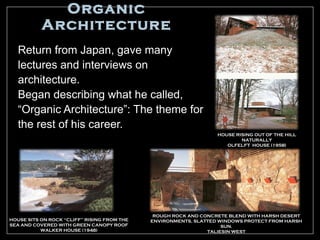
   Began describing what he called,
   “Organic Architecture”: The theme for
   the rest of his career.
                                                                  HOUSE RISING OUT OF THE HILL
                                                                          NATURALLY
                                                                     OLFELFT HOUSE (1958)


                                              ROUGH ROCK AND CONCRETE BLEND WITH HARSH DESERT
HOUSE SITS ON ROCK “CLIFF” RISING FROM THE   ENVIRONMENTS, SLATTED WINDOWS PROTECT FROM HARSH
SEA AND COVERED WITH GREEN CANOPY ROOF                              SUN.
           WALKER HOUSE (1948)                                 TALIESIN WEST
How he defined Organic Architecture changed often, as
he refined it, and also as the situation demanded.

•Integral to Site - houses designed to rise up out of the
site as it belonging.
•Integral to environment - built appropriately to climate.
•Integral to Individual - Each building built to
accommodate the lifestyle of the inhabitants way of life
and needs.
•Integral to Materials - details of the building were the
materials themselves
“one that is integral to site; integral to environment; integral
        to the life of the inhabitants. A house integral
with the nature of materials wherein glass is used as glass,
          stone as stone, wood as wood and all the
 elements of environment go into and throughout the house.
 Into this new integrity, once there, those who live in it will
take root and grow. And most of all belonging to the nature
               of its being.” Frank Lloyd Wright
Usonian houses
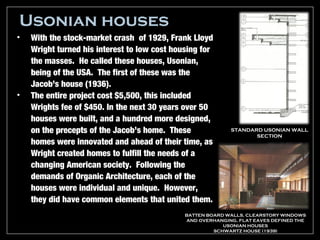
•   With the stock-market crash of 1929, Frank Lloyd
    Wright turned his interest to low cost housing for
    the masses. He called these houses, Usonian,
    being of the USA. The first of these was the
    Jacob’s house (1936).
•   The entire project cost $5,500, this included
    Wrights fee of $450. In the next 30 years over 50
    houses were built, and a hundred more designed,
    on the precepts of the Jacob’s home. These              STANDARD USONIAN WALL
                                                                   SECTION
    homes were innovated and ahead of their time, as
    Wright created homes to fulfill the needs of a
    changing American society. Following the
    demands of Organic Architecture, each of the
    houses were individual and unique. However,
    they did have common elements that united them.
                                              BATTEN BOARD WALLS, CLEARSTORY WINDOWS
                                              AND OVERHANGING, FLAT EAVES DEFINED THE
                                                          USONIAN HOUSES
                                                       SCHWARTZ HOUSE (1939)
Usonian houses


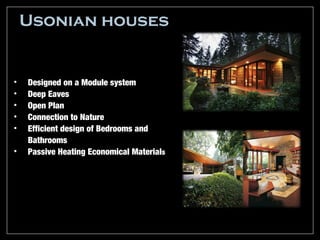
•   Designed on a Module system
•   Deep Eaves
•   Open Plan
•   Connection to Nature
•   Efficient design of Bedrooms and
    Bathrooms
•   Passive Heating Economical Materials
Usonian Housing Plans
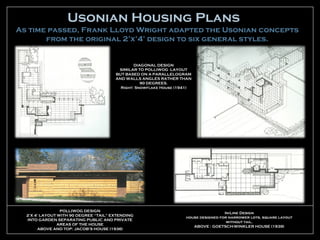
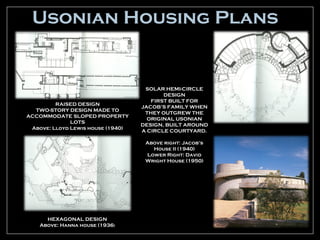
As time passed, Frank Lloyd Wright adapted the Usonian concepts
       from the original 2’x’4’ design to six general styles.


                                               DIAGONAL DESIGN
                                        SIMILAR TO POLLIWOG LAYOUT
                                       BUT BASED ON A PARALLELOGRAM
                                       AND WALLS ANGLES RATHER THAN
                                                  90 DEGREES.
                                         Right: Snowflake House (1941)


                 POLLIWOG DESIGN
                                                                                    In-Line Design
  2’X 4’ LAYOUT WITH 90 DEGREE “TAIL” EXTENDING
                                                                   house designed for narrower lots, square layout
  INTO GARDEN SEPARATING PUBLIC AND PRIVATE
                                                                                     without tail.
                AREAS OF THE HOUSE
                                                                      ABOVE : GOETSCH-WINKLER HOUSE (1939)
       ABOVE AND TOP: JACOB’S HOUSE (1936)
Usonian Housing Plans


                                    SOLAR HEMI-CIRCLE
                                          DESIGN
                                      FIRST BUILT FOR
         RAISED DESIGN
                                   JACOB’S FAMILY WHEN
  TWO-STORY DESIGN MADE TO
                                    THEY OUTGREW THE
ACCOMMODATE SLOPED PROPERTY
                                     ORIGINAL USONIAN
              LOTS
                                   DESIGN, BUILT AROUND
 Above: Lloyd Lewis house (1940)
                                   A CIRCLE COURTYARD.

                                    Above right: Jacob’s
                                      House II (1940)
                                    Lower Right: David
                                    Wright House (1950)


      HEXAGONAL DESIGN
    Above: Hanna house (1936)
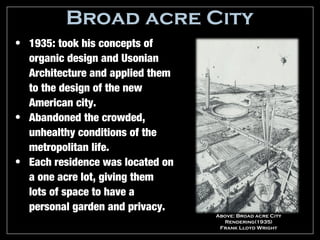
Broad acre City
• 1935: took his concepts of
  organic design and Usonian
  Architecture and applied them
  to the design of the new
  American city.
• Abandoned the crowded,
  unhealthy conditions of the
  metropolitan life.
• Each residence was located on
  a one acre lot, giving them
  lots of space to have a
  personal garden and privacy.
                                  Above: Broad acre City
                                    Rendering(1935)
                                   Frank Lloyd Wright
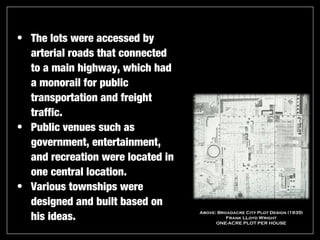
• The lots were accessed by
  arterial roads that connected
  to a main highway, which had
  a monorail for public
  transportation and freight
  traffic.
• Public venues such as
  government, entertainment,
  and recreation were located in
  one central location.
• Various townships were
  designed and built based on
  his ideas.
                                   Above: Broadacre City Plot Design (1935)
                                             Frank LLoyd Wright
                                         ONE-ACRE PLOT PER HOUSE
Popular Successes
• During latter years of his life he had become a
  household name.
• His plans were published in home and garden
  magazines, was interviewed on radio and television.
• Built hundreds of homes and buildings, and preached
  constantly the values of Usonian design and Organic
  Architecture.
• Two buildings however Stood above the rest in the
  minds of the general public that made him the great
  American architect.
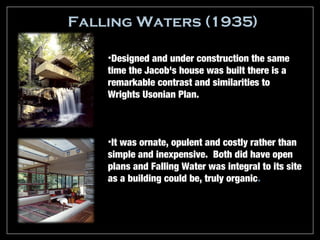
Falling Waters (1935)

    •Designed and under construction the same
    time the Jacob's house was built there is a
    remarkable contrast and similarities to
    Wrights Usonian Plan.


    •It was ornate, opulent and costly rather than
    simple and inexpensive. Both did have open
    plans and Falling Water was integral to its site
    as a building could be, truly organic.
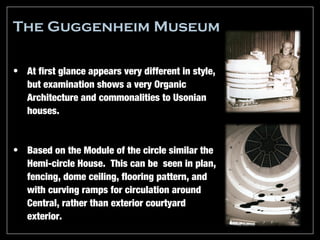
The Guggenheim Museum

• At first glance appears very different in style,
  but examination shows a very Organic
  Architecture and commonalities to Usonian
  houses.


• Based on the Module of the circle similar the
  Hemi-circle House. This can be seen in plan,
  fencing, dome ceiling, flooring pattern, and
  with curving ramps for circulation around
  Central, rather than exterior courtyard
  exterior.
Bibliography
• Frank Lloyd Wright Foundation
  Official Website
• Frank Lloyd Wright, Wisconsin
  Historical Society
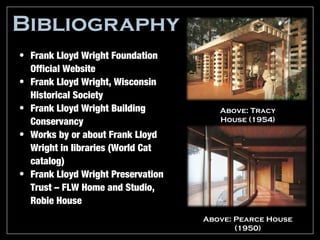
• Frank Lloyd Wright Building          Above: Tracy
  Conservancy                          House (1954)

• Works by or about Frank Lloyd
  Wright in libraries (World Cat
  catalog)
• Frank Lloyd Wright Preservation
  Trust – FLW Home and Studio,
  Robie House
                                    Above: Pearce House
                                           (1950)
THANK
 YOU
    BY:
    •SANKET SINGH
    •SURBHI JAIN
    •SAUMYA SARASWAT

frank lloyd wright

  • 1.
    Frank Lloyd wright (1867- 1959)
  • 2.
    About fr ankLloyd wright • Frank Lloyd Wright-American architect, interior designer, writer and educator. • designed more than 1,000 structures and completed 532 works. • Believed in designing structures in harmony with humanity and its environment : organic architecture.
  • 3.
    About fr ankLloyd wright •Philosophy best exemplified by Falling water (1935): "the best all-time work of American architecture". •a leader of the Prairie School movement of architecture, developed the concept of the Usonian home : his unique vision for urban planning in the United States.
  • 4.
    Education and workfor Silsbee (1885–1888) • Was admitted to the University of Wisconsin– Madison as a special student in 1886. • Joined Phi Delta Theta fraternity took part-time classes for 2 sems.
  • 5.
    Education and workfor Silsbee (1885–1888) •Worked with Allan D. Conover, a professor of civil engineering. •Arrived in Chicago in search of employment. •First impressions of Chicago: grimy neighborhoods, crowded streets, and disappointing architecture, yet he was determined to find work. •Hired as a draftsman with the architectural firm of Joseph Lyman Silsbee.
  • 6.
    Education and workfor Silsbee (1885–1888) •Accredited as the draftsman and the construction supervisor —1886 Unity Chapel for Wright's family in Spring Green, Wisconsin •2 other family projects: the All Souls Church in Chicago for his and the Hillside Home School in Spring Green. •Feeling he was underpaid at Silsbee (at $8 a week), quit and found work as a designer at the firm of Beers, Clay, and Dutton. •Soon realized was not ready to handle building design by himself; left new job to return to Silsbee—with a raise in salary.
  • 7.
    Education and workfor Silsbee (1885–1888) •Silsbee adhered mainly to Victorian and revivalist architecture, Wright found his work to be more "gracefully picturesque". •After less than a year, passed in Silsbee's office, learned that the Chicago firm of Adler & Sullivan was looking for someone to make the finish drawings for the interior of the Auditorium. •Demonstrated himself as competent impressionist of Louis Sullivan's ornamental designs 2 short interviews later, was an official apprentice in the firm.
  • 8.
    Publishing • 1910 :AusgefuhrteBauten und Enturfe, portfolio and writings on architecture. • 1911: Ausgefuhrte Bauten, more extensive photograph collection of his work. • 1925: Portfolio, ausgefuhrte Bauten republished in Holland, including an English translation. • 1932: An Autobiography • 1932: The Disappearing City
  • 9.
    Taliesin School of Architecture •1932:Wright and his wife started the Taliesin Fellowship, which then became the Frank Lloyd Wright School of Architecture. •The farm was a self-sustaining entity, with the apprentices growing and harvesting their own food. •They also learned drafting, construction methods, and other crafts, as well as overseeing the construction of Wright’s projects. TALIESIN WEST - LIVING ROOM SCOTTSDALE ARIZONA
  • 10.
    “Education at Taliesin wouldemphasize painting, sculpture, music, drama, and dance in their places as divisions of architecture.” - Frank TALIESIN, FARM AND OUTBUILDINGS Lloyd Wright (1931). RENDERED BY FRANK LLOYD WRIGHT (1933)
  • 11.
    Organic Architecture Return from Japan, gave many lectures and interviews on architecture. Began describing what he called, “Organic Architecture”: The theme for the rest of his career. HOUSE RISING OUT OF THE HILL NATURALLY OLFELFT HOUSE (1958) ROUGH ROCK AND CONCRETE BLEND WITH HARSH DESERT HOUSE SITS ON ROCK “CLIFF” RISING FROM THE ENVIRONMENTS, SLATTED WINDOWS PROTECT FROM HARSH SEA AND COVERED WITH GREEN CANOPY ROOF SUN. WALKER HOUSE (1948) TALIESIN WEST
  • 12.
    How he definedOrganic Architecture changed often, as he refined it, and also as the situation demanded. •Integral to Site - houses designed to rise up out of the site as it belonging. •Integral to environment - built appropriately to climate. •Integral to Individual - Each building built to accommodate the lifestyle of the inhabitants way of life and needs. •Integral to Materials - details of the building were the materials themselves
  • 13.
    “one that isintegral to site; integral to environment; integral to the life of the inhabitants. A house integral with the nature of materials wherein glass is used as glass, stone as stone, wood as wood and all the elements of environment go into and throughout the house. Into this new integrity, once there, those who live in it will take root and grow. And most of all belonging to the nature of its being.” Frank Lloyd Wright
  • 14.
    Usonian houses • With the stock-market crash of 1929, Frank Lloyd Wright turned his interest to low cost housing for the masses. He called these houses, Usonian, being of the USA. The first of these was the Jacob’s house (1936). • The entire project cost $5,500, this included Wrights fee of $450. In the next 30 years over 50 houses were built, and a hundred more designed, on the precepts of the Jacob’s home. These STANDARD USONIAN WALL SECTION homes were innovated and ahead of their time, as Wright created homes to fulfill the needs of a changing American society. Following the demands of Organic Architecture, each of the houses were individual and unique. However, they did have common elements that united them. BATTEN BOARD WALLS, CLEARSTORY WINDOWS AND OVERHANGING, FLAT EAVES DEFINED THE USONIAN HOUSES SCHWARTZ HOUSE (1939)
  • 15.
    Usonian houses • Designed on a Module system • Deep Eaves • Open Plan • Connection to Nature • Efficient design of Bedrooms and Bathrooms • Passive Heating Economical Materials
  • 16.
    Usonian Housing Plans Astime passed, Frank Lloyd Wright adapted the Usonian concepts from the original 2’x’4’ design to six general styles. DIAGONAL DESIGN SIMILAR TO POLLIWOG LAYOUT BUT BASED ON A PARALLELOGRAM AND WALLS ANGLES RATHER THAN 90 DEGREES. Right: Snowflake House (1941) POLLIWOG DESIGN In-Line Design 2’X 4’ LAYOUT WITH 90 DEGREE “TAIL” EXTENDING house designed for narrower lots, square layout INTO GARDEN SEPARATING PUBLIC AND PRIVATE without tail. AREAS OF THE HOUSE ABOVE : GOETSCH-WINKLER HOUSE (1939) ABOVE AND TOP: JACOB’S HOUSE (1936)
  • 17.
    Usonian Housing Plans SOLAR HEMI-CIRCLE DESIGN FIRST BUILT FOR RAISED DESIGN JACOB’S FAMILY WHEN TWO-STORY DESIGN MADE TO THEY OUTGREW THE ACCOMMODATE SLOPED PROPERTY ORIGINAL USONIAN LOTS DESIGN, BUILT AROUND Above: Lloyd Lewis house (1940) A CIRCLE COURTYARD. Above right: Jacob’s House II (1940) Lower Right: David Wright House (1950) HEXAGONAL DESIGN Above: Hanna house (1936)
  • 18.
    Broad acre City •1935: took his concepts of organic design and Usonian Architecture and applied them to the design of the new American city. • Abandoned the crowded, unhealthy conditions of the metropolitan life. • Each residence was located on a one acre lot, giving them lots of space to have a personal garden and privacy. Above: Broad acre City Rendering(1935) Frank Lloyd Wright
  • 19.
    • The lotswere accessed by arterial roads that connected to a main highway, which had a monorail for public transportation and freight traffic. • Public venues such as government, entertainment, and recreation were located in one central location. • Various townships were designed and built based on his ideas. Above: Broadacre City Plot Design (1935) Frank LLoyd Wright ONE-ACRE PLOT PER HOUSE
  • 20.
    Popular Successes • Duringlatter years of his life he had become a household name. • His plans were published in home and garden magazines, was interviewed on radio and television. • Built hundreds of homes and buildings, and preached constantly the values of Usonian design and Organic Architecture. • Two buildings however Stood above the rest in the minds of the general public that made him the great American architect.
  • 21.
    Falling Waters (1935) •Designed and under construction the same time the Jacob's house was built there is a remarkable contrast and similarities to Wrights Usonian Plan. •It was ornate, opulent and costly rather than simple and inexpensive. Both did have open plans and Falling Water was integral to its site as a building could be, truly organic.
  • 22.
    The Guggenheim Museum •At first glance appears very different in style, but examination shows a very Organic Architecture and commonalities to Usonian houses. • Based on the Module of the circle similar the Hemi-circle House. This can be seen in plan, fencing, dome ceiling, flooring pattern, and with curving ramps for circulation around Central, rather than exterior courtyard exterior.
  • 23.
    Bibliography • Frank LloydWright Foundation Official Website • Frank Lloyd Wright, Wisconsin Historical Society • Frank Lloyd Wright Building Above: Tracy Conservancy House (1954) • Works by or about Frank Lloyd Wright in libraries (World Cat catalog) • Frank Lloyd Wright Preservation Trust – FLW Home and Studio, Robie House Above: Pearce House (1950)
  • 24.
    THANK YOU BY: •SANKET SINGH •SURBHI JAIN •SAUMYA SARASWAT