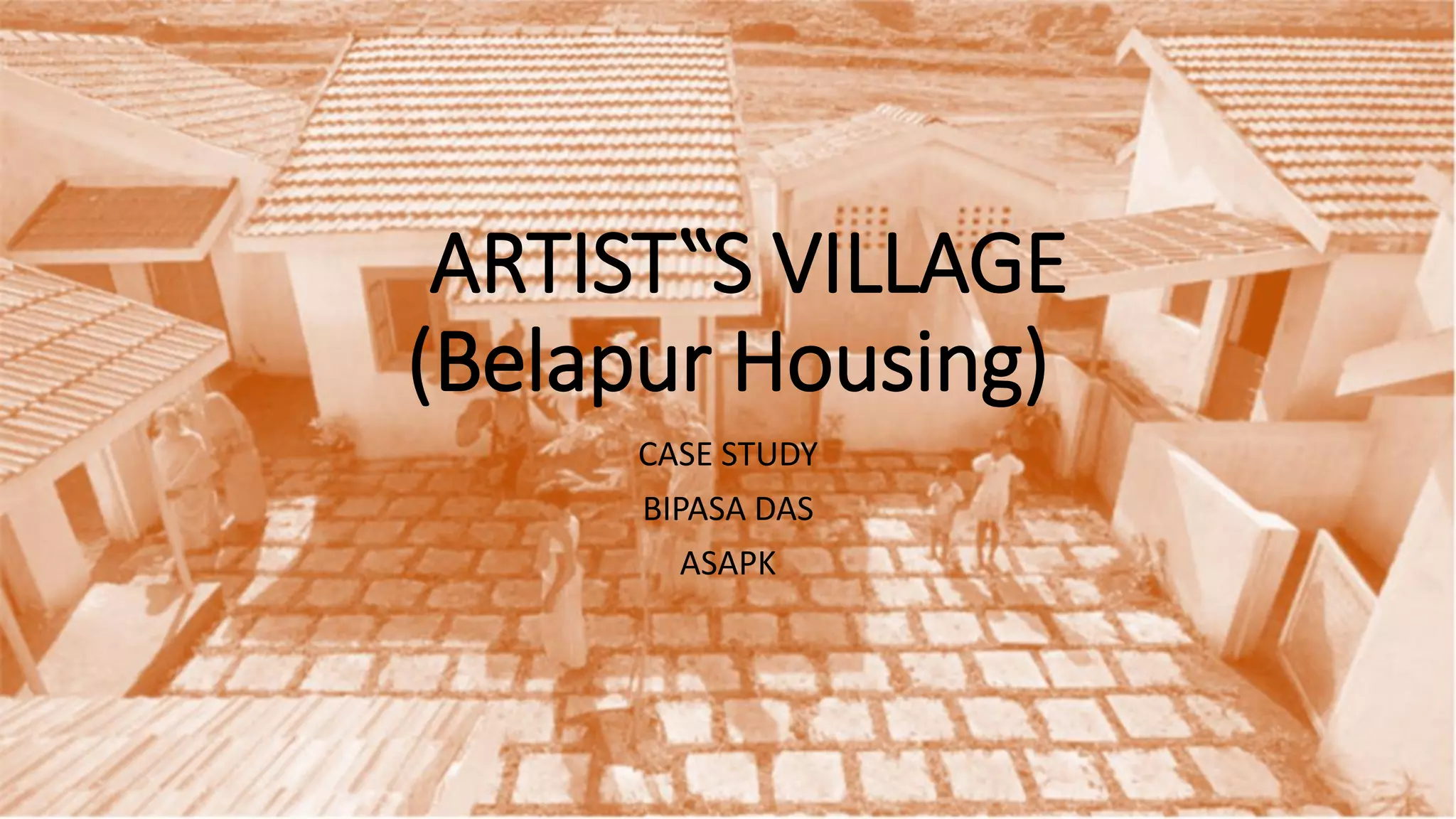
ARTIST‟S VILLAGE
(Belapur Housing)
CASE STUDY
BIPASA DAS
ASAPK
• It was proposed to be a residential
complex for mainly the artists.
• Being situated so far away from the main
centre of Mumbai, very few artists were
interested in buying these houses. As a result
the sale of these houses was finally
opened for the public, and not just restricted
for artists.
• Located on six hectares of land, this project
attempts to demonstrate how high densities
can be easily achieved within the context of a
low-rise typology, built with simple materials at
a human scale.
• The site plan was generated by a hierarchy of
community spaces.
• Each of these houses is on its own piece of
land, so that the families can have the
advantage of open-to-sky spaces.
INTRODUCTION
The Belapur Housing, generally known as the Artist‟s Village,
was a project done by CIDCO in Navi Mumbai.
PROJECT DATA
• Year of construction: 1986
• Architect: Charles Correa
• Developer: CIDCO
• Land Area: 5.4 hectares
• Built up Area: 33000 sqmt (approx.)
• Number of Dwelling Units: 550 (approx.)
• Density: 100units/hectare (500 people/hectare)
• Height: Ground+1 storey
• FSI (Floor Space Index) consumed: 0.5 to 0.6
OBJECTIVE
The project had one overriding principle:
Each unit would have its own individual site to allow for expansion.
The scheme catered to a wide range of income groups, from the
• lowest with budgets of Rs.20,000, to
• middle income groups (unit costs Rs.30-50,000), upto
• upper income levels with unit cost around Rs.1,80,000.
Belapur makes a statement which combines those principles Correa believes to be most
important in housing, namely:
• Equity,
• Incrementality,
• Pluralism,
• having Open-to-Sky spaces and
• Disaggregation of spaces to allow for participation in forming one’s own environment,
and to facilitate income generating activities.
SITE LOCATION
• The site, a 6 hectares land
area, in Belapur, is situated
2kms from the centre of
New Bombay.
• It is set in the midst of the
Belapur hills.
CLIMATE
Precipitation is the lowest in January, with an average
of 0 mm | 0.0 inch. Most precipitation falls in July,
with an average of 1117 mm | 44.0 inch.
At an average temperature of 30.1 °C | 86.2 °F, May
is the hottest month of the year. In January, the
average temperature is 23.5 °C | 74.3 °F. It is the
lowest average temperature of the whole year.
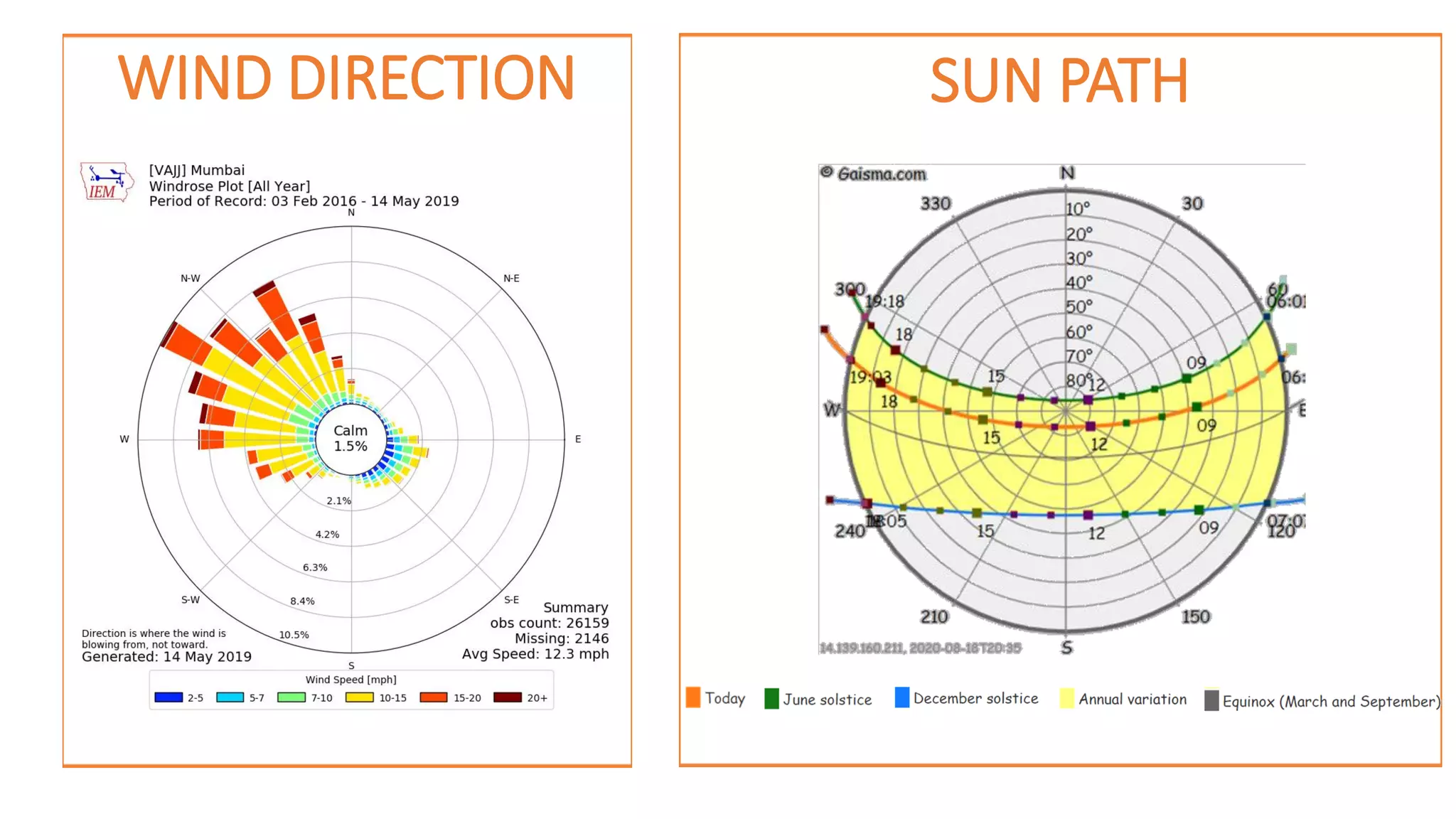
WIND DIRECTION SUN PATH
ACCESSIBILITY
• 2km from Belapur railway station
• 32km from Eastern Freeway
• 40 km from the airport
USER GROUP
• Originally built for artists
• Very few still reside
• Mixed occupancy
SERVICES ACTIVITIES ON SITE
• Water is supplied by the
NMMC through the
Morbe dam
• Electricity provided by
MSEB (Maharashtra
State Electricity Board)
• Residential
• Cleaning staff maintaining the
open spaces
• Few people into gardening
• Children in the playground
SITE CONTEXT
Water Supply
• There is no UGT for the
project.
• Each building has its own over
head tank either syntex or R.C.C
• Separate UGT for some
bungalows.
• WTP at sector-1.
• Timings of water-2 to 3hrs
morning and evening.
Drainage
Storm water is drained into the
main rivulet (nallah).
• No separate STP.
• Chaotic drainage system.
• Filled with water During monsoon
or else dry rest of the year.
• Waste water is directly drained
into municipal sewer.
PLANNING
• Individual houses rely on simple floor plans and building
methods, enabling local masons and craftspeople to
construct them.
• The village was produced with the idea that the
residents were going to alter it in many ways, making it
truly their own, therefore homes are freestanding, so
residents can add on to them as their families grow; and
differently priced plans appeal to a wide variety of
income levels.
HOUSEHOLD LEVEL PLANNING
• the variation in plot size was much smaller : from 45 sqm to 75 sqm, a ratio
less than 1:2.
• As this project catered to a wide range of income groups, the houses were
incremental - so that they could grow from a single lean-to roof (for the
very poor) to urban town-houses (for the well to do).
• Each house was sited on
its own piece of land.
• Only two of the sides had
mandatory setbacks to
follow, the other two sides
could be built right upto
the boundary line.
• The house sites are
arranged with toilets
located in pairs to
save on plumbing and
sanitation costs.
• Windows and other
openings were permitted
on any external wall that
abutted the courtyard,
but none opened onto a
neighbouring house.
• Therefore, each
house was
freestanding
and did not
share any walls
with its
neighbors,
making it truly
incremental
Typology
The village was produced with the idea that the residents were going to alter it in many
ways, making it truly their own, therefore homes are freestanding, so residents can
add on to them as their families grow; and differently priced plans appeal to a wide
variety of income levels.
Typology A
elevation
plan
Typology
Consists of an
• Entrance verandah
• With one room
• A kitchen
• Bath and toilet with a yard
• Courtyard
These houses consist of :
• 2 rooms
• A kitchen
• Bath & toilet with a yard &
courtyard
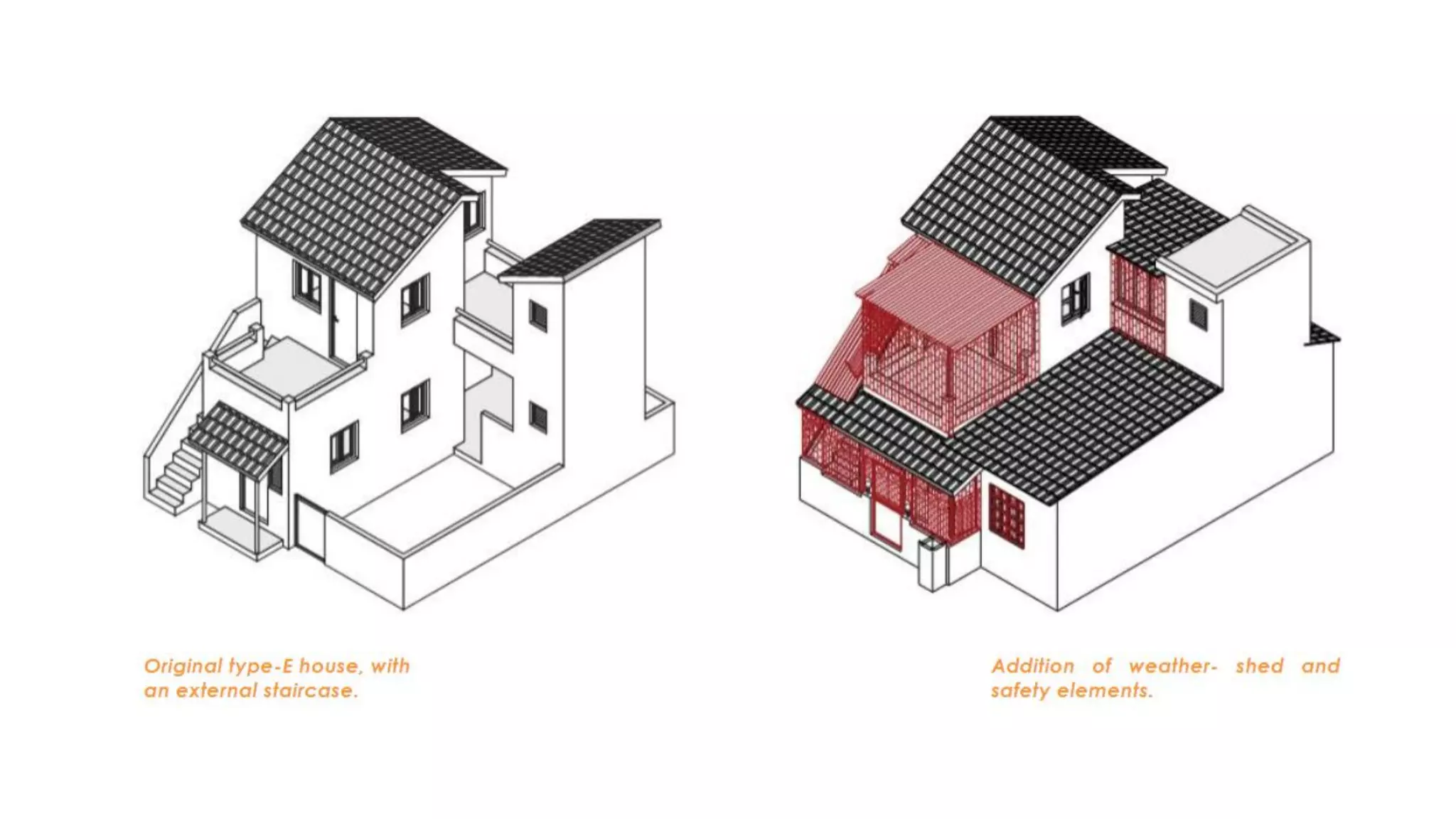
Typology E
These houses consist of:
• Double units one on the ground floor
with 2 rooms
• Kitchen
• Bath & toilet with yard &a courtyard
• Second on the first floor with room
• Terraces
• Bath & toilet
• Utility area
Planning Spaces
• The project is generated by a hierarchy of spaces. The first is the private
courtyard of single dwelling used as a space for outdoor activities during most of
the year.
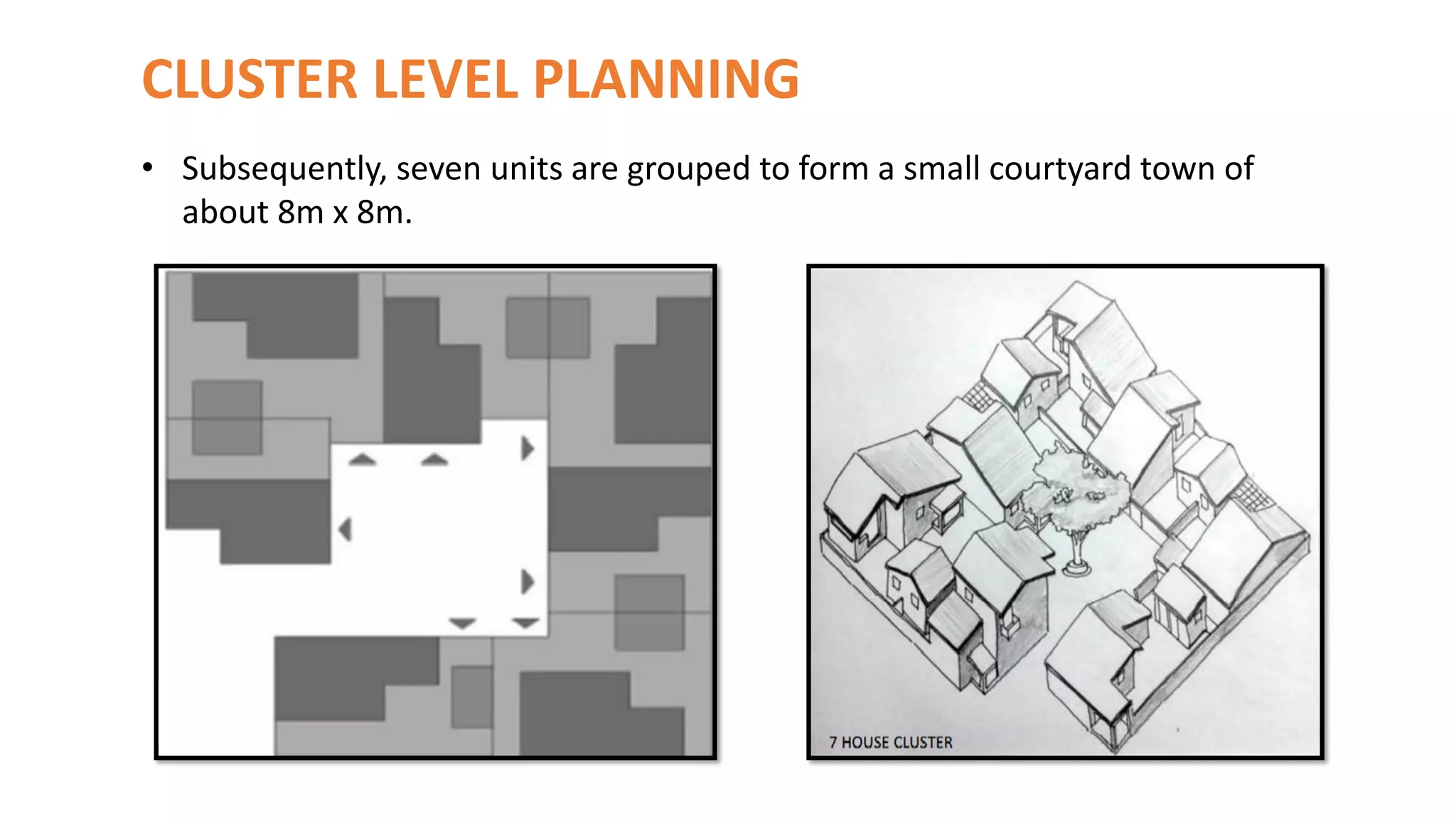
• Subsequently, seven units are grouped to form a small courtyard town of
about 8m x 8m.
CLUSTER LEVEL PLANNING
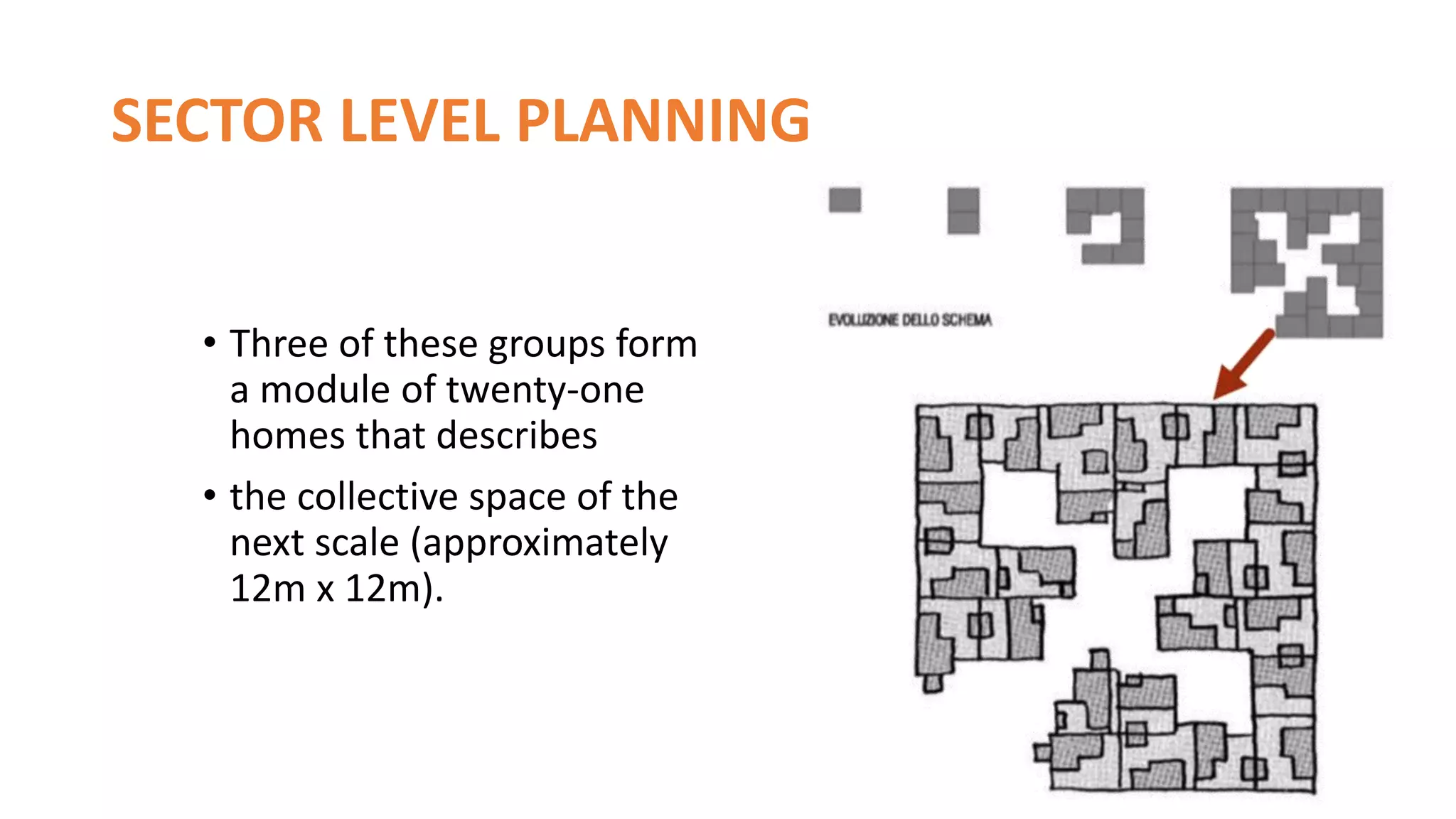
SECTOR LEVEL PLANNING
• Three of these groups form
a module of twenty-one
homes that describes
• the collective space of the
next scale (approximately
12m x 12m).
SUB-URBAN LEVEL PLANNING
• Three of such larger modules were
interlocked to define the next scale of community
space, approximately 20 X 20 metres.
• The spatial hierarchy continued till the neighborhood
spaces were formed, where the schools and other
public-use facilities were located.
SITE MAP
A
M
E
N
I
T
I
E
S
A
M
E
N
I
T
I
E
S
MATERIALS AND CONSTRUCTION
TECHNOLOGY:
• external walls of brick;
• roof structure covered with
wooden shingles.
MATERIALS:
• brick,
• plaster of white color,
• colorful wooden fixtures,
• Mangalore tile for roof,
• outdoor paving stone blocks.
CLIMATE RESPONSIVE
FEATURES
EVOLUTION OF THE IMPLEMENTED DESIGN
• The resemblance of Artist‟s Village to its initial design is very less.
Being built more than 20 years back, one can hardly tell that the
housing which stands there today ever looked like the one built by
Correa.
• As this particular scheme had a feature of being incremental, the
dwellers utilized it to its fullest and finally have come to a situation
where they have completely changed the design.
• Over the years, with an increase in the family size as well as income,
the needs and aspirations of the dwellers have increased.
• During a survey of this area, it was seen that most of the people have
bought the neighboring plot and built a new bigger house over it.
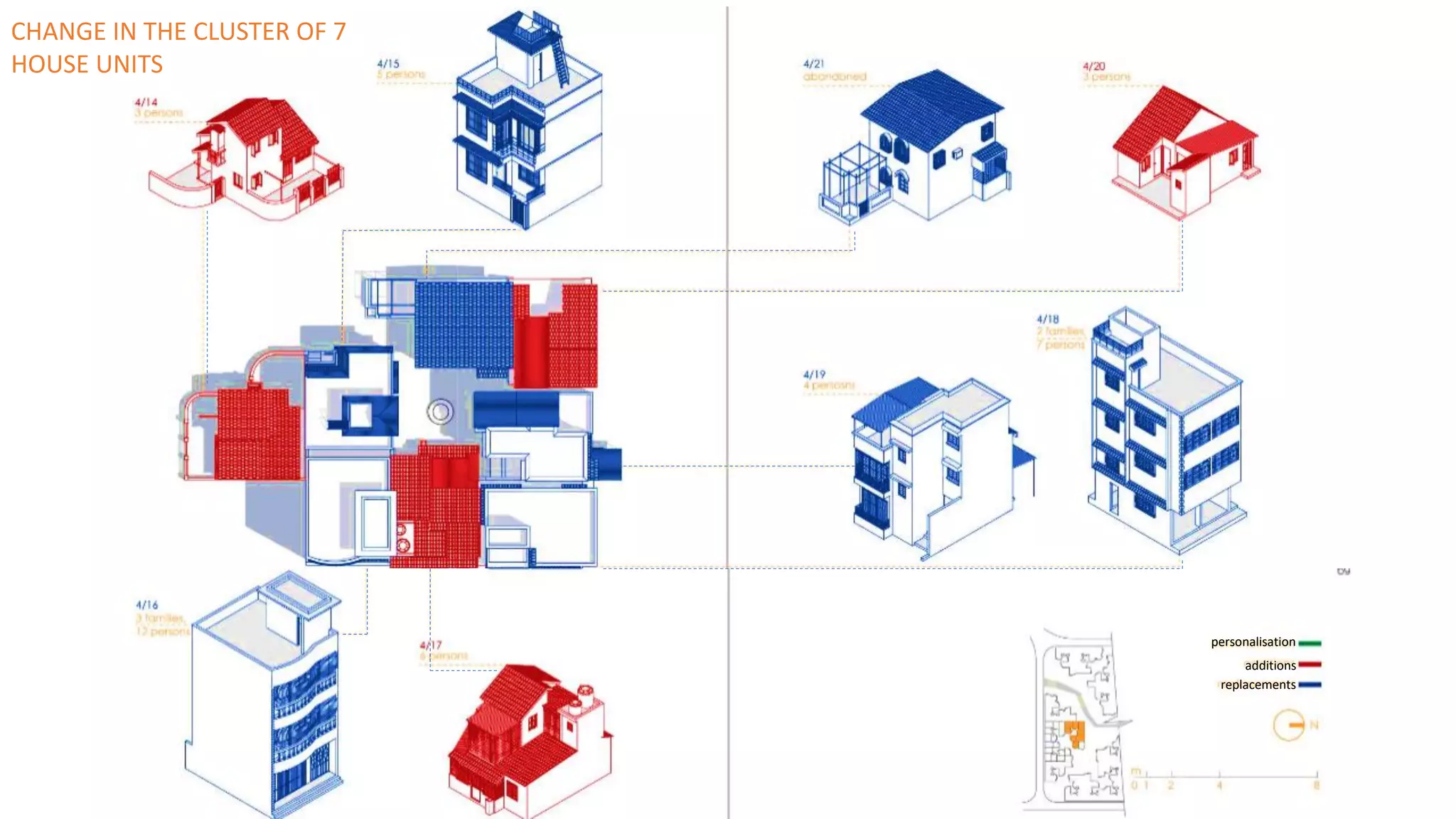
• On a unit level, residents have added different colours to their houses and
have treated the edges by adding patios,sit-outs,planters and low
compound walls and grills and so on. This has helped the houses gain their
identity so this has been categorised as PERSONALISATION.
• To improvise the house, the residents have introduced a new structure to
the house. These interventions add up to the original structure and has a
higher degree of transformation, so has categorised as ADDITION.
• For various reasons, number of residents have introduced a new layout.
Discarding the old design and constructing a new house on the same plot is
the most common and been categorised as REPLACEMENTS.
personalisation
additions
replacements
CHANGE IN THE CLUSTER OF 7
HOUSE UNITS
Original
Reconstructed Street-side reconstruction
PERSONALIZATION BY TREATING THE EDGE,
PAINTING ON THE WALL
Small interventions or changes in the look, without
changing the structure of the original design, are
included in this category. This includes the treatment of
the edge, painting, making patterns on the wall. This
category includes houses that have no changes in the
original design.
Freedom of Modification
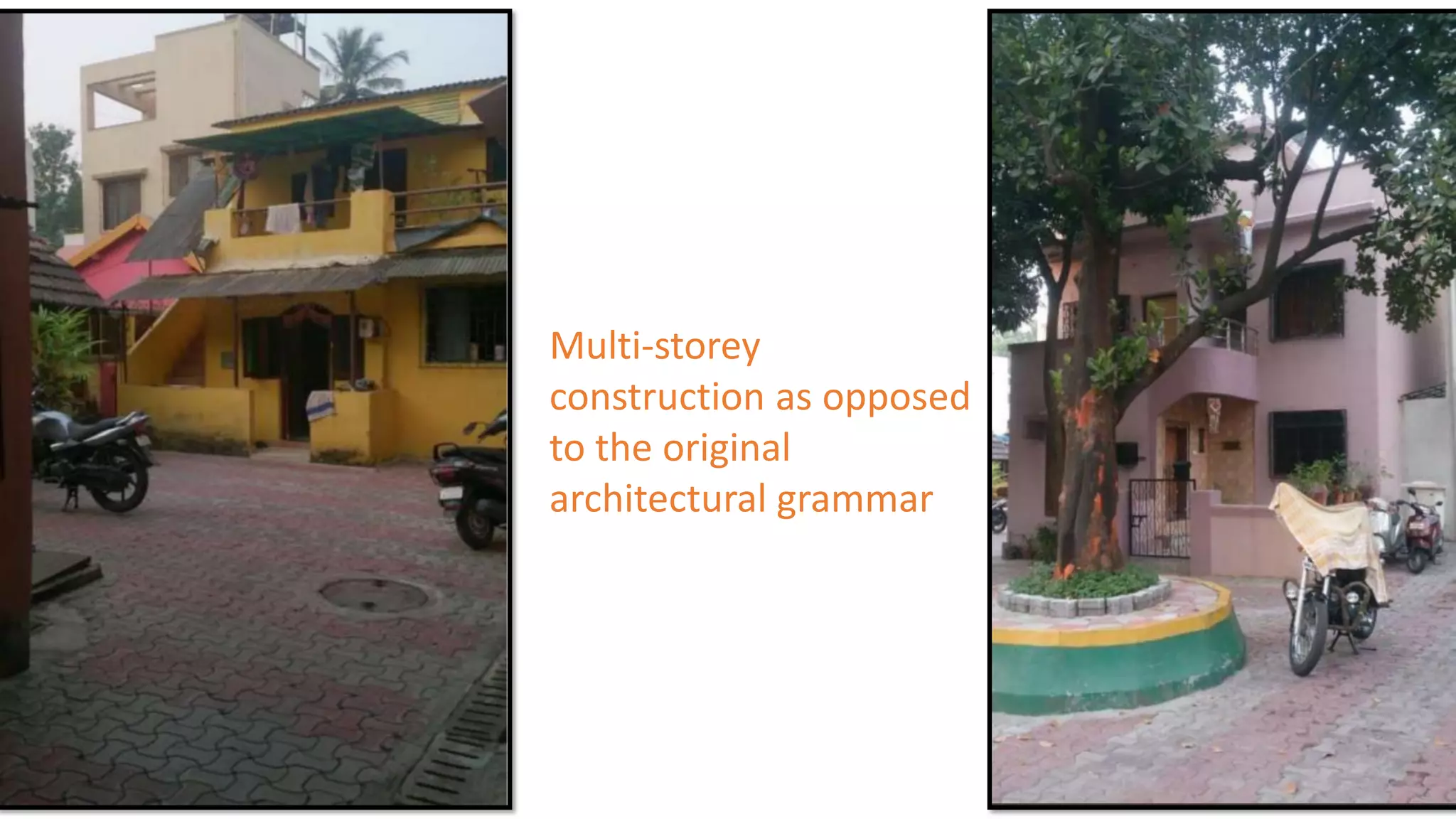
Multi-storey construction as opposed to the original architectural grammar
Multi-storey
construction as opposed
to the original
architectural grammar
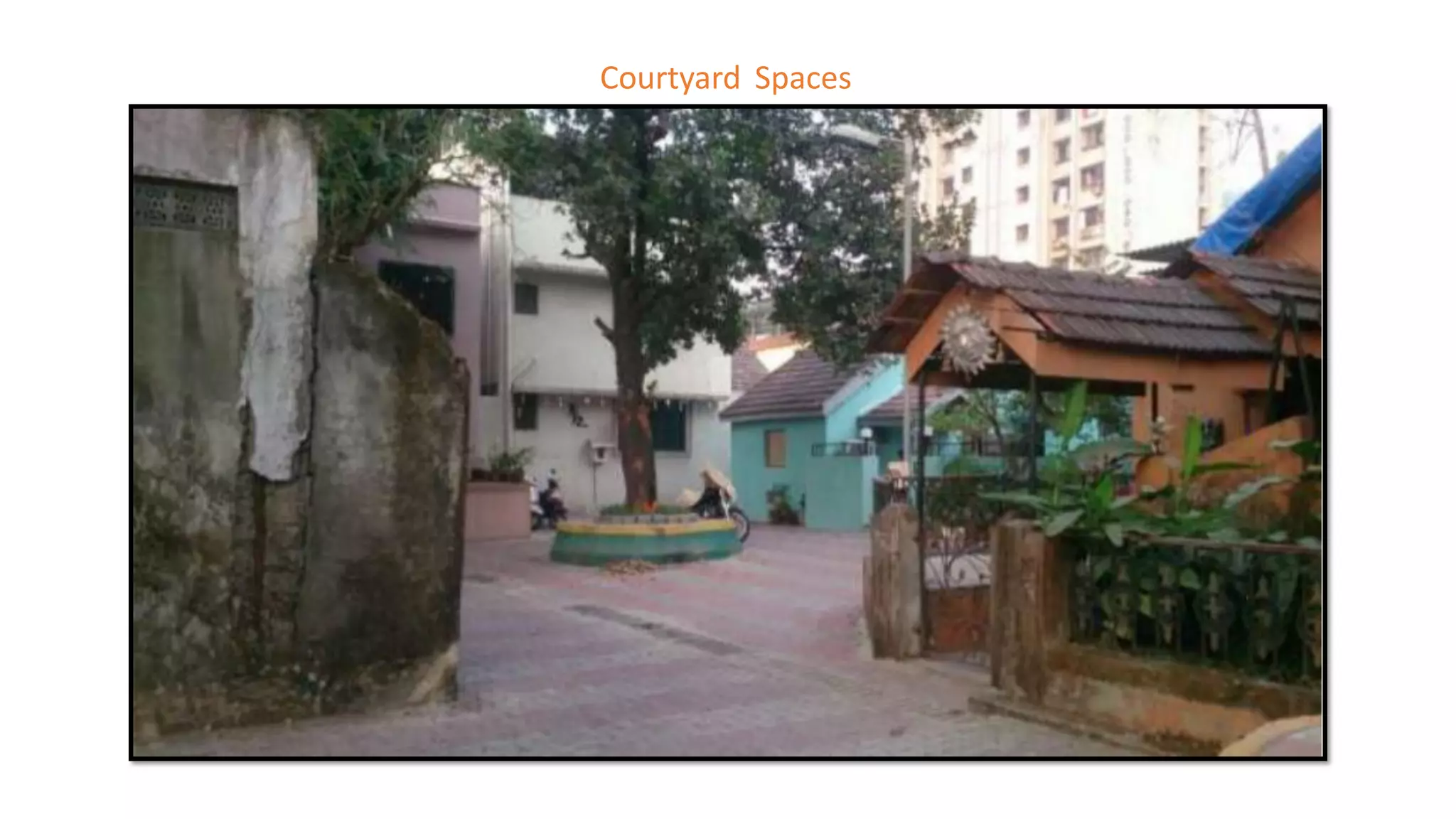
Courtyard Spaces
The courtyards surrounded by 7 houses was planned to be a community
space, but today it stands as a shabby place for parking.
LOW-COST HIGH END TRANSPORT
The Central Nallah
Parks and garden spaces
Reason for change
• Some inhabitants said they were very impractical (eg. toilets outside the
house).
• The concrete houses arose as a result of the changing aspirations of the
residents. They no longer wanted a ‘village’ or a rural backdrop. Modern
materials and technologies have thus been employed to a great extent.
• Proper spaces were not provided which is one of the major reasons why the
artisans sold their houses.
• Also, 20 years ago the transport facilities were not fully developed which was
another reason.
• Due to lack of commercial spaces, the houses facing the streets transformed
into shops, which were illegal.
• No proper provisions were made for parking, which resulted in encroachment
of open spaces due to parking.
• Cultural centre made for the artists to exhibit their works remained unused.
DRAWBACK
• Since many houses have become multi-storeyed now, the smaller houses which are in it’s
original state face natural air-ventilation problem. The bigger buildings block sunlight too.
• Multi -storeyed buildings which are very close to each other since the houses are placed
along the set-back allow lesser possibility of privacy
• Multi -storeyed buildings require wider stretch of foundation, hence plot owners are
compelled to by neighbouring plots.
DESIGN ACHIEVEMENTS
• The feel of the space is still intact.
• Ample amount of open and green spaces provided.
• The complex allowed people to modify their houses freely, whether
with a paintbrush or mortar - something that is never allowed in the
type of mass housing.
• Clusters help build a local community feeling.
• Allowed enhanced interactions which was the essence of a village.
• The green spaces and playgrounds are maintained by the NMMC.
CONCLUSION
• Character of that village is lost due to urbanization.
• Sense of security.
• Lots of green spaces creating a quite and cool environment.
• Intangible aspect of a village was taken care of very precisely, whereas the tangible
aspect of a village was lost.
Housing is an ever changing phenomena.It can be said that a house is a process, things
aren’t static and forces of time keep on changing.Some of the forces of time are changing
lifestyle., family structure and technology.
So even if the houses are custom made, it needs a dimension of flexibility in order for it to
fall rightly in future when a family undergoes these forces.
Bibliography
• https://www.gaisma.com/en/location/navi-mumbai.html
• https://mesonet.agron.iastate.edu/sites/windrose.phtml?station=VAJJ&net
work=IN__ASOS
• https://www.researchgate.net/publication/333133051_Housing_for_the_E
WS_-
_How_far_do_EWS_housing_schemes_fulfill_the_needs_of_its_users/link/
5cdd3159a6fdccc9ddb2975f/download
• https://architectopedia.com/belapur-housing-by-charles-correa-case-
study/
• https://s3.us-east-
1.amazonaws.com/media.archnet.org/system/publications/contents/7087/
original/DPC3963.pdf?1384808064
• www.google.com
THANK YOU

Artist's village Belapur

  • 1.
  • 2.
    • It wasproposed to be a residential complex for mainly the artists. • Being situated so far away from the main centre of Mumbai, very few artists were interested in buying these houses. As a result the sale of these houses was finally opened for the public, and not just restricted for artists. • Located on six hectares of land, this project attempts to demonstrate how high densities can be easily achieved within the context of a low-rise typology, built with simple materials at a human scale. • The site plan was generated by a hierarchy of community spaces. • Each of these houses is on its own piece of land, so that the families can have the advantage of open-to-sky spaces. INTRODUCTION The Belapur Housing, generally known as the Artist‟s Village, was a project done by CIDCO in Navi Mumbai.
  • 3.
    PROJECT DATA • Yearof construction: 1986 • Architect: Charles Correa • Developer: CIDCO • Land Area: 5.4 hectares • Built up Area: 33000 sqmt (approx.) • Number of Dwelling Units: 550 (approx.) • Density: 100units/hectare (500 people/hectare) • Height: Ground+1 storey • FSI (Floor Space Index) consumed: 0.5 to 0.6
  • 4.
    OBJECTIVE The project hadone overriding principle: Each unit would have its own individual site to allow for expansion. The scheme catered to a wide range of income groups, from the • lowest with budgets of Rs.20,000, to • middle income groups (unit costs Rs.30-50,000), upto • upper income levels with unit cost around Rs.1,80,000. Belapur makes a statement which combines those principles Correa believes to be most important in housing, namely: • Equity, • Incrementality, • Pluralism, • having Open-to-Sky spaces and • Disaggregation of spaces to allow for participation in forming one’s own environment, and to facilitate income generating activities.
  • 5.
    SITE LOCATION • Thesite, a 6 hectares land area, in Belapur, is situated 2kms from the centre of New Bombay. • It is set in the midst of the Belapur hills.
  • 6.
    CLIMATE Precipitation is thelowest in January, with an average of 0 mm | 0.0 inch. Most precipitation falls in July, with an average of 1117 mm | 44.0 inch. At an average temperature of 30.1 °C | 86.2 °F, May is the hottest month of the year. In January, the average temperature is 23.5 °C | 74.3 °F. It is the lowest average temperature of the whole year.
  • 7.
  • 8.
    ACCESSIBILITY • 2km fromBelapur railway station • 32km from Eastern Freeway • 40 km from the airport USER GROUP • Originally built for artists • Very few still reside • Mixed occupancy SERVICES ACTIVITIES ON SITE • Water is supplied by the NMMC through the Morbe dam • Electricity provided by MSEB (Maharashtra State Electricity Board) • Residential • Cleaning staff maintaining the open spaces • Few people into gardening • Children in the playground SITE CONTEXT
  • 9.
    Water Supply • Thereis no UGT for the project. • Each building has its own over head tank either syntex or R.C.C • Separate UGT for some bungalows. • WTP at sector-1. • Timings of water-2 to 3hrs morning and evening. Drainage Storm water is drained into the main rivulet (nallah). • No separate STP. • Chaotic drainage system. • Filled with water During monsoon or else dry rest of the year. • Waste water is directly drained into municipal sewer.
  • 10.
    PLANNING • Individual housesrely on simple floor plans and building methods, enabling local masons and craftspeople to construct them. • The village was produced with the idea that the residents were going to alter it in many ways, making it truly their own, therefore homes are freestanding, so residents can add on to them as their families grow; and differently priced plans appeal to a wide variety of income levels.
  • 11.
    HOUSEHOLD LEVEL PLANNING •the variation in plot size was much smaller : from 45 sqm to 75 sqm, a ratio less than 1:2. • As this project catered to a wide range of income groups, the houses were incremental - so that they could grow from a single lean-to roof (for the very poor) to urban town-houses (for the well to do).
  • 12.
    • Each housewas sited on its own piece of land. • Only two of the sides had mandatory setbacks to follow, the other two sides could be built right upto the boundary line. • The house sites are arranged with toilets located in pairs to save on plumbing and sanitation costs. • Windows and other openings were permitted on any external wall that abutted the courtyard, but none opened onto a neighbouring house. • Therefore, each house was freestanding and did not share any walls with its neighbors, making it truly incremental
  • 13.
    Typology The village wasproduced with the idea that the residents were going to alter it in many ways, making it truly their own, therefore homes are freestanding, so residents can add on to them as their families grow; and differently priced plans appeal to a wide variety of income levels.
  • 14.
  • 15.
    Typology Consists of an •Entrance verandah • With one room • A kitchen • Bath and toilet with a yard • Courtyard These houses consist of : • 2 rooms • A kitchen • Bath & toilet with a yard & courtyard
  • 16.
    Typology E These housesconsist of: • Double units one on the ground floor with 2 rooms • Kitchen • Bath & toilet with yard &a courtyard • Second on the first floor with room • Terraces • Bath & toilet • Utility area
  • 17.
    Planning Spaces • Theproject is generated by a hierarchy of spaces. The first is the private courtyard of single dwelling used as a space for outdoor activities during most of the year.
  • 18.
    • Subsequently, sevenunits are grouped to form a small courtyard town of about 8m x 8m. CLUSTER LEVEL PLANNING
  • 19.
    SECTOR LEVEL PLANNING •Three of these groups form a module of twenty-one homes that describes • the collective space of the next scale (approximately 12m x 12m).
  • 20.
    SUB-URBAN LEVEL PLANNING •Three of such larger modules were interlocked to define the next scale of community space, approximately 20 X 20 metres. • The spatial hierarchy continued till the neighborhood spaces were formed, where the schools and other public-use facilities were located.
  • 21.
  • 22.
  • 23.
  • 24.
    MATERIALS AND CONSTRUCTION TECHNOLOGY: •external walls of brick; • roof structure covered with wooden shingles. MATERIALS: • brick, • plaster of white color, • colorful wooden fixtures, • Mangalore tile for roof, • outdoor paving stone blocks.
  • 25.
  • 26.
    EVOLUTION OF THEIMPLEMENTED DESIGN • The resemblance of Artist‟s Village to its initial design is very less. Being built more than 20 years back, one can hardly tell that the housing which stands there today ever looked like the one built by Correa. • As this particular scheme had a feature of being incremental, the dwellers utilized it to its fullest and finally have come to a situation where they have completely changed the design. • Over the years, with an increase in the family size as well as income, the needs and aspirations of the dwellers have increased. • During a survey of this area, it was seen that most of the people have bought the neighboring plot and built a new bigger house over it.
  • 27.
    • On aunit level, residents have added different colours to their houses and have treated the edges by adding patios,sit-outs,planters and low compound walls and grills and so on. This has helped the houses gain their identity so this has been categorised as PERSONALISATION. • To improvise the house, the residents have introduced a new structure to the house. These interventions add up to the original structure and has a higher degree of transformation, so has categorised as ADDITION. • For various reasons, number of residents have introduced a new layout. Discarding the old design and constructing a new house on the same plot is the most common and been categorised as REPLACEMENTS.
  • 28.
  • 30.
  • 31.
    PERSONALIZATION BY TREATINGTHE EDGE, PAINTING ON THE WALL Small interventions or changes in the look, without changing the structure of the original design, are included in this category. This includes the treatment of the edge, painting, making patterns on the wall. This category includes houses that have no changes in the original design.
  • 32.
  • 33.
    Multi-storey construction asopposed to the original architectural grammar
  • 34.
    Multi-storey construction as opposed tothe original architectural grammar
  • 35.
  • 36.
    The courtyards surroundedby 7 houses was planned to be a community space, but today it stands as a shabby place for parking.
  • 37.
  • 38.
  • 40.
  • 41.
    Reason for change •Some inhabitants said they were very impractical (eg. toilets outside the house). • The concrete houses arose as a result of the changing aspirations of the residents. They no longer wanted a ‘village’ or a rural backdrop. Modern materials and technologies have thus been employed to a great extent. • Proper spaces were not provided which is one of the major reasons why the artisans sold their houses. • Also, 20 years ago the transport facilities were not fully developed which was another reason. • Due to lack of commercial spaces, the houses facing the streets transformed into shops, which were illegal. • No proper provisions were made for parking, which resulted in encroachment of open spaces due to parking. • Cultural centre made for the artists to exhibit their works remained unused.
  • 42.
    DRAWBACK • Since manyhouses have become multi-storeyed now, the smaller houses which are in it’s original state face natural air-ventilation problem. The bigger buildings block sunlight too. • Multi -storeyed buildings which are very close to each other since the houses are placed along the set-back allow lesser possibility of privacy • Multi -storeyed buildings require wider stretch of foundation, hence plot owners are compelled to by neighbouring plots.
  • 43.
    DESIGN ACHIEVEMENTS • Thefeel of the space is still intact. • Ample amount of open and green spaces provided. • The complex allowed people to modify their houses freely, whether with a paintbrush or mortar - something that is never allowed in the type of mass housing. • Clusters help build a local community feeling. • Allowed enhanced interactions which was the essence of a village. • The green spaces and playgrounds are maintained by the NMMC.
  • 44.
    CONCLUSION • Character ofthat village is lost due to urbanization. • Sense of security. • Lots of green spaces creating a quite and cool environment. • Intangible aspect of a village was taken care of very precisely, whereas the tangible aspect of a village was lost. Housing is an ever changing phenomena.It can be said that a house is a process, things aren’t static and forces of time keep on changing.Some of the forces of time are changing lifestyle., family structure and technology. So even if the houses are custom made, it needs a dimension of flexibility in order for it to fall rightly in future when a family undergoes these forces.
  • 45.
    Bibliography • https://www.gaisma.com/en/location/navi-mumbai.html • https://mesonet.agron.iastate.edu/sites/windrose.phtml?station=VAJJ&net work=IN__ASOS •https://www.researchgate.net/publication/333133051_Housing_for_the_E WS_- _How_far_do_EWS_housing_schemes_fulfill_the_needs_of_its_users/link/ 5cdd3159a6fdccc9ddb2975f/download • https://architectopedia.com/belapur-housing-by-charles-correa-case- study/ • https://s3.us-east- 1.amazonaws.com/media.archnet.org/system/publications/contents/7087/ original/DPC3963.pdf?1384808064 • www.google.com
  • 46.