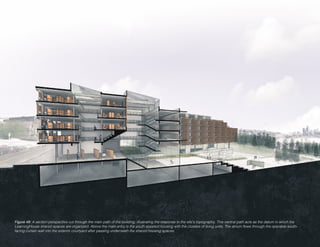
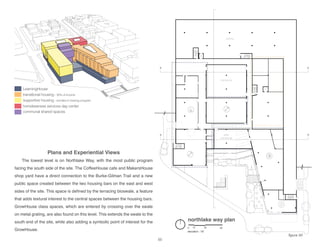
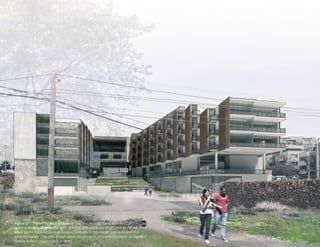
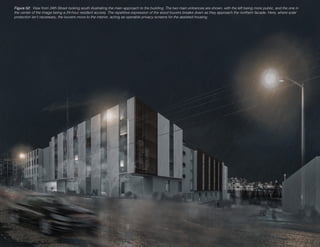
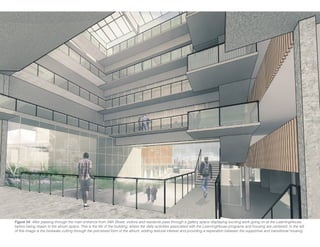
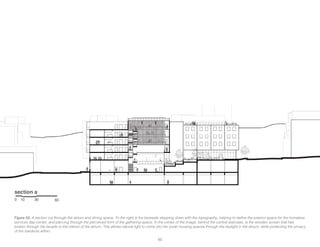
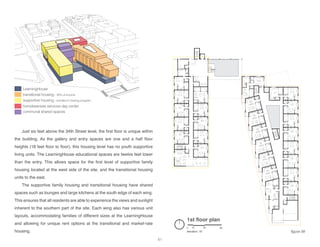
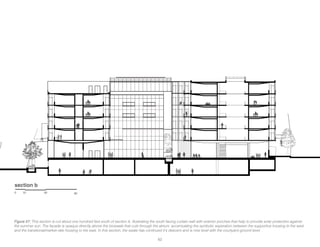
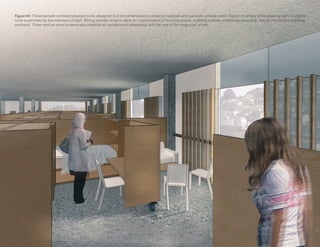
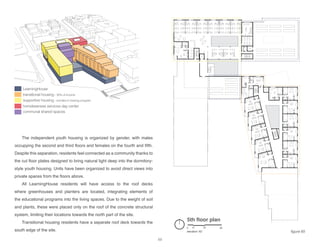
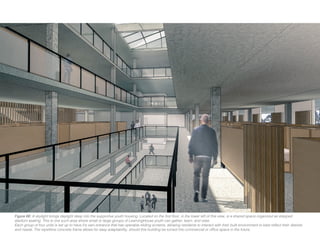
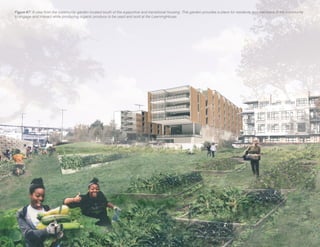
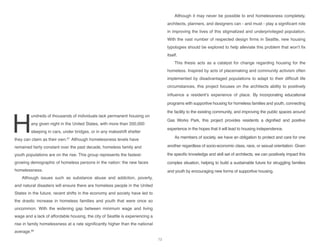
[Design for Dignity]
A Supportive Housing Community for Families and Youth
Jordan C. Inman
A thesis
submitted in partial fulfillment of
the requirements for the degree of
Master of Architecture
University of Washington
2014
Thesis Committee:
Rick Mohler
AnnMarie Borys
Gundula Proksch
Program Authorized to Offer Degree:
Architecture
© Copyright 2014
Jordan C. Inman
design
for
dignity
a supportive housing community
for families and youth
University of Washington
Abstract
Design for Dignity: A Supportive Housing Community for Families and Youth
Jordan C.Inman
Thesis Committee:
Associate Professor, Rick Mohler
Associate Professor, AnnMarie Borys
Assistant Professor, Gundula Proksch
	
	 Homelessness is not a recent social and cultural phenomenon in the United States, and chances
are it will not disappear anytime soon. Although chronic homelessness in middle-aged males is on the
decline, families and independent youth now represent the fastest growing demographic of homeless
persons in the nation, constituting more than 40 percent of the total homeless population. Although it
may never be possible to end homelessness completely, this thesis posits that architects, planners, and
designers can - and must - play a significant role in improving the lives of those who lack the most basic
of human needs: housing.
	 This proposal seeks to create a new supportive housing alternative, a transformation of the
existing typologies of housing for the homeless aimed at guiding struggling youth and parents along a
path to a sustainable, stable lifestyle. Inspired by acts of placemaking and community activism often
implemented by disadvantaged populations to adapt to their difficult life circumstances, this thesis
focuses on the architects ability to positively influence a resident’s experience of place.
	 By integrating educational programs with supportive housing that caters to the specific needs
of families and youth, connecting the facility to the existing community, and improving the public spaces
adjacent to the site, this project provides residents a dignified and positive experience that prepares
them for housing independence.
[Thank You]
	
	 It’s been a long journey, with seemingly countless friends, family members, and professors lending
a helping hand along the way.
	 I could not have achieved this without the unwavering support of my parents. They were there with
me from the very beginning when I attended architecture camp at Ball State University almost ten years
ago, and supported me when I decided to move across the country to attend the University of Washington
for graduate school. Your continued interest in my career is a blessing, and I thank you for everything you
have done to make my life wonderful.
	 No one understands what this process has involved better than my wife, Morgan. Without her to
lean on through the frustrating times, I would not have made it to the joyous times which we so love to share
together. Thank you for always caring for me, even when I was too caught up in school to return the favor!
	 Thanks to Bob Swain, a boss who always understands that school comes first regardless of the
stresses involved at the office.
	 To Janice Shimizu: I will always remember my third year of undergraduate studies at Ball State. Your
material studies curriculum is still the best studio I have ever taken, and has surely influenced the designer
I have become. Thank you.
	 To Tim Gray: thanks for giving me my first professional architecture experience at your firm in the
summer of 2012, and teaching me how to put together a construction set!
	 Finally, a large thanks to my thesis advisors: Sharon Sutton, Rick Mohler, AnnMarie Borys, and
Gundula Proksch. Without your help, feedback, and support these past few months, this journey would have
been rougher, and the view at the end would not have been nearly as grand!
[Table of Contents]
1. Introduction
	 Homelessness Throughout History
	 Homelessness Today
	 The Thesis
2. Theoretical Framework
	 The Changing Faces of Homelessness
	 Homeless Shelter as a Building Type
	 Order out of Chaos: Community Activism and Placemaking
	 The Power of Learning, Making, and Doing
3. Methods
	 Goals and Objectives
	 Neighborhood Selection
	 Site Selection
	 Program of Spaces
	 Design Methods
	 Delimits and Limits
	Summary
4. Site Analysis and Preliminary Findings
5. Conceptual Design Response
6. Final Design Response
	 Program
	Structure
	 Plans and Experiantial Views	
7. Conclusion
Appendix
Figures and Figure Sources
Endnotes
	 2
	 1
	 7
	 8
	 5
	 12
	 26
	 24
	 49
	 53
	 55
	23
	35
	42
	47
	72
	 16
	 28
	 19
	 28
	 33
	 34
	 34
	 5
1 [Introduction]
figure 1
H
omelessness is not a recent social and cultural phenomenon in
the United States, and chances are it will not disappear anytime
soon. The shortage of affordable housing, an eroding of work
opportunities, the widening gap between minimum wage and living wage,
continued gentrification of urban areas, and the weakening of family ties,
are just a few of the major factors contributing to homelessness in the
United States.1
The political, social, cultural, and economic issues surrounding
homelessness are complex, deeply rooted in stereotypes and prejudices,
so that even the most caring of citizens can overlook a homeless individual
altogether. At times when undesirable populations have reached unusually
high numbers, the resulting social and government responses to the issue
vary little throughout history, with efforts primarily focused on getting the
homeless away from public spaces and separating them from the rest of
the community. Rather than trying to help the disadvantaged revitalize and
stabilize their lives, decisions are typically made from the perspective of
the upper and middle classes, leaving entire underprivileged populations
“isolated from wealth, mainstream institutions, and social networks that
provide mobility and status attainment opportunities.”2
This introduction frames the issue of homelessness in the United
States. It provides an historical overview of social and economic factors
that have influenced societies current understanding of homelessness,
prior to outlining the intentions of this thesis.
Homelessness Throughout History
The apathy, unconcern, and disgust many Americans feel towards
those living on the street causes homeless populations to not only suffer
from the lack of housing, but also from the stigmas and stereotypes that
have evolved since the Colonial Ages.
Undesirable, Vagrant, Hobo
Homelessness is rooted in the
nation’s colonial history. By envisioning
land ownership as the legal mechanism
that could free them from the constraints
of their feudal European heritage,
many early settlers “sought to establish
property relations as the legal and moral
underpinning of the new colonies.”3
As a
means to protect their freedom and wealth
in the New World, colonies often invoked
strict settlement laws in which future
Figure 2: Homelessness is not a
recent issue, with little changing
throughout the nation’s history.
2
colonists must ask permission to settle
in an existing community. As colony
leaders saw certain individuals or
families unworthy for their community
for any variety of reasons, they were
forced to move along to the next
settlement in the hopes of finding a
home. These wandering undesirables
created a “large underclass of
poor…the country’s first homeless
population.”4
Despite a rising homeless
population as the early nineteenth
century economy changed the urban
landscapes of America, it was not until
after the Civil War that homelessness
became a social issue recognizable at
the national scale. The troops returning home from battle faced many of
the same mental issues as modern day veterans, yet the lack in medical
advancement meant that one out of thirteen Civil War veterans returned
home missing one or more limbs.5
These mental and physical changes of
the soldiers, as well as shifts in post-war culture and society, forced many
into homelessness. It was this new generation of veterans that would form
the first public face for homelessness: the hobo.
The train-hopping transient, often called a hobo or tramp, became an
archetype for the homeless population of this time, an identity that is still
commonly referenced in modern-day culture. Although often portrayed in
recent media as free-spirited protagonists living life on the road, public
opinion of the post-Civil War hobos and their lifestyle was severe, often
regarded by localities as “an undesirable character and a drain upon local
resources.”6
As a response to the rapid increase of homeless people, many
cities passed strict anti-vagrancy laws, predecessors of more recent laws
that criminalize activities of the homeless.7
With the Great Depression of the 1930s came a huge increase in
homelessness levels across the country, provoking the nation’s first
federal response to the issue. In 1933, the Federal Emergency Relief Act
(FERA) was inaugurated, accepting “as elementary that all needy persons
and their dependents should receive sufficient relief to prevent physical
suffering and to maintain a minimum standard of living.”8
As the post-World War II economy quickly pushed the United States into
the position of world superpower, homeless populations receded slightly
and tended to congregate around undesirable urban areas, known as skid
rows. These marginalized neighborhoods provided unskilled laborers,
troubled veterans, and other unsheltered persons easy access to basic
services and charitable missions. The underprivileged areas remained
the status quo well into the 1960s when urban planning policies began
drastically re-shaping the form and function of cities and, consequently, the
perception of the homeless.9
Urban Renewal and Globalization:
Post World War II United States
The growing populations of low-income and homeless people
centralizing around skid row neighborhoods during the mid-twentieth
century contributed to the undesirable atmosphere of these urban
areas, most of which had deteriorated prior to the increase in homeless
populations. As housing and neighborhoods became more substandard,
Figure 3: The Bowery Mission is a
homeless shelter that has existed in
New York City since the 19th century.
3
working-class and middle-class residents often opted to move out, leaving
only the poorest behind. In 1947, the Federal Housing Administration
recognized this to be an issue, writing that the “urban slums and blighted
areas have been spreading, becoming more intensified, and breaking out
in new spots. Collectively they have reached startling proportions.”10
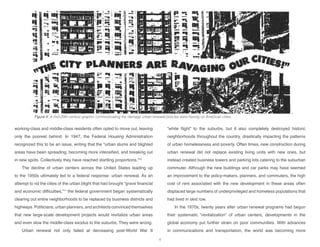
The decline of urban centers across the United States leading up
to the 1950s ultimately led to a federal response: urban renewal. As an
attempt to rid the cities of the urban blight that had brought “grave financial
and economic difficulties,”11
the federal government began systematically
clearing out entire neighborhoods to be replaced by business districts and
highways. Politicians, urban planners, and architects convinced themselves
that new large-scale development projects would revitalize urban areas
and even slow the middle-class exodus to the suburbs. They were wrong.
Urban renewal not only failed at decreasing post-World War II
“white flight” to the suburbs, but it also completely destroyed historic
neighborhoods throughout the country, drastically impacting the patterns
of urban homelessness and poverty. Often times, new construction during
urban renewal did not replace existing living units with new ones, but
instead created business towers and parking lots catering to the suburban
commuter. Although the new buildings and car parks may have seemed
an improvement to the policy-makers, planners, and commuters, the high
cost of rent associated with the new development in these areas often
displaced large numbers of underprivileged and homeless populations that
had lived in skid row.
In the 1970s, twenty years after urban renewal programs had begun
their systematic “revitalization” of urban centers, developments in the
global economy put further strain on poor communities. With advances
in communications and transportation, the world was becoming more
Figure 4: A mid-20th century graphic communicating the damage urban renewal policies were having on American cities.
4
connected in a process called globalization. This marked a shift in the
United States from a manufacturing economy to a service and knowledge
economy. “Although the benefits of globalization in terms of increased
international interconnectivity are indisputable, such benefits can have
profound costs for poor people.”12
By concentrating wealth and taking away job opportunities for
unskilled laborers, the radical increase in the mobility of capital and the
internationalization of production processes led to “an urban society
that is increasingly socially and spatially disconnected, fragmented, and
polarized.”13
Whereas poor urban communities used to provide essential
sources of cheap labor for localized, production-based economies, they
became “areas of abandonment and homelessness within an international
marketplace.”14
People that previously gathered around established skid rows now had
nowhere to go except into the city amongst the middle and upper class,
adding to tensions between the varying social groups. This undoubtedly
contributed to the crackdown on quality-of-life crimes throughout the end
of the twentieth century, in which the simple act of surviving as a homeless
person on the streets could be considered illegal.
Homelessness Today
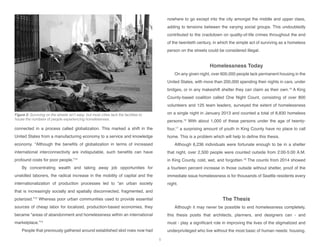
On any given night, over 600,000 people lack permanent housing in the
United States, with more than 200,000 spending their nights in cars, under
bridges, or in any makeshift shelter they can claim as their own.15
A King
County-based coalition called One Night Count, consisting of over 800
volunteers and 125 team leaders, surveyed the extent of homelessness
on a single night in January 2013 and counted a total of 8,830 homeless
persons.16
With about 1,000 of these persons under the age of twenty-
four,17
a surprising amount of youth in King County have no place to call
home. This is a problem which will help to define this thesis.
Although 6,236 individuals were fortunate enough to be in a shelter
that night, over 2,500 people were counted outside from 2:00-5:00 A.M.
in King County, cold, wet, and forgotten.18
The counts from 2014 showed
a fourteen percent increase in those outside without shelter, proof of the
immediate issue homelessness is for thousands of Seattle residents every
night.
The Thesis
Although it may never be possible to end homelessness completely,
this thesis posits that architects, planners, and designers can - and
must - play a significant role in improving the lives of the stigmatized and
underprivileged who live without the most basic of human needs: housing.
Figure 5: Surviving on the streets isn’t easy, but most cities lack the facilities to
house the numbers of people experiencing homelessness.
5
To help people regain control of their lives and move into permanent
independent housing, a variety of shelter types and services are needed
to cater to the specific needs of their unique occupants. In order to bring
about positive change, architects must look beyond the historical status
quo of housing the homeless. Instead, they must explore how the design
and programming of a housing facility for the homeless can help build a
supportive community for its residents.
This thesis is an architectural exploration of a supportive housing
community for homeless families and youth in Seattle, Washington. Inspired
by acts of placemaking and community activism often implemented by
disadvantaged populations to adapt to their difficult life circumstances, this
project focuses on the architects ability to positively influence a resident’s
experience of place. It seeks to restore a sense of dignity and hope for the
residents. By overlapping supportive housing with spaces for educational
programs and employment training in “hands-on” fields of work, residents
learn valuable transferable skills, work towards GEDs or professional
certificates, and gain experience in positive working environments. These
program participants will benefit from the support of the tight-knit community
formed throughout shared housing spaces.
How can incorporating a sense of place and community within a
newly envisioned homeless assistance facility restore dignity to those who
have just undergone extremely stressful and often degrading life events,
while successfully preparing them for independent living? As homeless
populations continue to evolve, how can thoughtful design and provision of
community-based services and employment training facilitate a shelter’s
ability to cater to families and youth struggling through different phases of
homelessness?
“The design of a shelter matters: to
thehomeless,tothosewhoworkwith
them, to the neighboring community,
and to society at large.”19
Sam Davis, architect
6
2 [Theoretical Framework]
figure 67
T
his thesis explores issues involving various elements that will
impact the design of a successful housing facility for homeless
families and youth. First, it assesses the recent shifts in homeless
demographics across the United States, examining possible causes of
the dramatic increase in family and youth homelessness. Next, it offers
observations on recent building designs transforming the way society
and local governments provide housing for homeless populations. This
is followed by an exploration into the ways community activism and
placemaking can help disadvantaged populations develop a sense of
order and belonging in their chaotic lives. Finally, this thesis employs the
power of learning and doing in the belief that educational and employment
training can positively impact an individual’s journey to obtaining financial
independence.
The Changing Faces of Homelessness
While homelessness levels across the United States have remained
fairly consistent over the past decade, homeless family and youth
populations are on the rise, representing the fastest-growing group of
homeless persons in the nation.20
According to the 2010 Annual Homeless
Assessment Report released by the U.S. Department of Housing and
Urban Development (HUD), homeless families increased 20 percent from
2007-2010, now representing about 35 percent of the national homeless
population, the highest in American history.21
Of the 6,236 King County
homeless persons counted in shelters or transitional programs during the
One Night Count of 2013, over 50 percent (3,000 people) were members of
families with children and about 1 percent (60 people) were unaccompanied
youth. This puts Seattle’s homeless family population significantly higher
than the national average.22
Although issues such as substance abuse and addiction, poverty,
and natural disasters will ensure there are homeless people in the United
States in the future, recent shifts in the economy and society have led to
the drastic increase in homeless families and youth that were once so
uncommon.
Loss of Housing
The economic downturn of 2007 and the related mortgage-lending
crisis, which caused more than seven million home foreclosures from
2007-2012, is perhaps the most significant factor in the increase of family
homelessness.23
Despite many considering this strictly a homeowners
issue, families who rent their homes were also affected by the housing
market crash. As landlords chose to sell their rental properties rather
8
than risking foreclosure, tenants would lose their housing with little or no
warning, putting many individuals and families at risk of homelessness. In
fact, a 2009 study by the National Coalition for the Homeless found that
renters of foreclosed units outnumbered the owner-occupiers of foreclosed
homes in shelters across the United States.24
The crumbling economy of the late 2000s led to massive employment
cuts for nearly every industry, business sector, and organization across the
country, pushing many low-income families who had always lived near the
poverty line, as well as many middle class families, into homelessness.
Even with a full-time job it is not guaranteed an individual can escape
poverty and homelessness, let alone support a family. Despite minimum
wage being raised 41 percent from 2006 to 2009 ($5.15 to $7.25), the
national minimum wage is still worth over 12 percent less than it was in
1967.25
The decline of wages has put housing out of reach for many blue-
collar workers in the United States, where renting a one or two-bedroom
apartment in any of the 50 states at fair market rent requires more outlay
than their income allows. Nationally, the average renter is earning about
$13.50 per hour, just 73 percent of the $18.46 per hour they would need to
safely pay rent for an average priced two-bedroom apartment.26
According
to the 2009 American Community Survey, 52 percent of all renters paid
greater than 30 percent of their income on housing, putting them at high
risk of becoming homeless. Even more startling is the 26 percent of renters
that lost more than 50 percent of their income on rent, with seven million
households across the United States at severe risk of losing their home.27
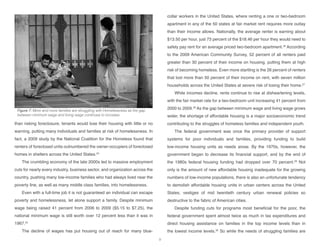
While incomes decline, rents continue to rise at disheartening levels,
with the fair market rate for a two-bedroom unit increasing 41 percent from
2000 to 2009.28
As the gap between minimum wage and living wage grows
wider, the shortage of affordable housing is a major socioeconomic trend
contributing to the struggles of homeless families and independent youth.
The federal government was once the primary provider of support
systems for poor individuals and families, providing funding to build
low-income housing units as needs arose. By the 1970s, however, the
government began to decrease its financial support, and by the end of
the 1980s federal housing funding had dropped over 70 percent.29
Not
only is the amount of new affordable housing inadequate for the growing
numbers of low-income populations, there is also an unfortunate tendency
to demolish affordable housing units in urban centers across the United
States, vestiges of mid twentieth century urban renewal policies so
destructive to the fabric of American cities.
Despite funding cuts for programs most beneficial for the poor, the
federal government spent almost twice as much in tax expenditures and
direct housing assistance on families in the top income levels than in
the lowest income levels.30
So while the needs of struggling families are
Figure 7: More and more families are struggling with Homelessness as the gap
between minimum wage and living wage continues to increase.
9
ignored and their issues compounded, the wealthiest households continue
to reap the benefits of a society where the rich get richer, and the poor get
poorer.
The drastic cuts in federal assistance for housing has led to a market in
which the demand clearly exceeds the supply, leading to overcrowded and
underfunded shelters, especially after the economic crisis of the late 2000s.
Consequently, families and individuals seeking housing often face long
waiting lists for both public housing and federal housing assistance options.
Although wait times vary by state and local resources, the average wait
time is 19-24 months for receiving Section 8 housing vouchers (accepted
by any landlord participating in the program) and 13-18 months for public
housing (specific properties managed by local housing authorities) in
Washington State. These wait times, which lie somewhere in the middle of
the national average, are nowhere near acceptable when considering the
emotional and physical strain the situation puts on individuals and families;
they are proof that significant action is needed to invoke positive change.
Effects of Homelessness on Children and Youth
The multi-faceted issues and problems brought about by homelessness
are sure to negatively impact the life of any individual, but the harmful effects
on children who experience this process can often be more damaging in
both the short-term and the long-term.
In 2009, the U.S. Department of Housing and Urban Development
(HUD) conducted a study of homeless families and children, examining the
negative effects of homelessness on the health and mental development
of children. Inadequate nutrition is a major problem, with hunger being
detrimental to the physical, social, emotional, and cognitive development of
children.31
The lack of stability associated with the homeless lifestyle adds
further stress and strain on their lives, with over 95 percent of homeless
children being forced to move at least once on an annual basis, and 40
percent attending at least two schools in the same school year.32
Although it is difficult to quantify, as many instances of abuse are never
reported, many young children experience violence either first hand or as a
witness during their struggles for shelter. These encounters not only leave
a child afraid, confused, and hopeless, but they also instill a sense of anger
and aggression that can lead to behavioral issues later in life. The constant
traumatic stresses experienced by homeless children result in “three times
the rate of emotional issues like anxiety, depression, sleep problems,
withdrawal, and aggression” when compared to children with homes.33
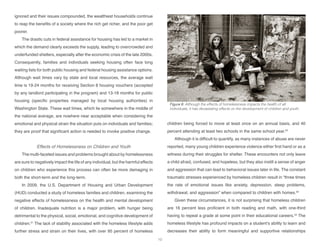
Given these circumstances, it is not surprising that homeless children
are 16 percent less proficient in both reading and math, with one-third
having to repeat a grade at some point in their educational careers.34
The
homeless lifestyle has profound impacts on a student’s ability to learn and
decreases their ability to form meaningful and supportive relationships
Figure 8: Although the effects of homelessness impacts the health of all
individuals, it has devastating effects on the development of children and youth.
10
with adults. This lack of trust ultimately impairs their likelihood to achieve
success in life.
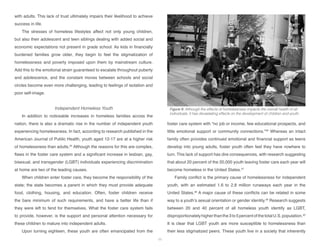
The stresses of homeless lifestyles affect not only young children,
but also their adolescent and teen siblings dealing with added social and
economic expectations not present in grade school. As kids in financially
burdened families grow older, they begin to feel the stigmatization of
homelessness and poverty imposed upon them by mainstream culture.
Add this to the emotional strain guaranteed to escalate throughout puberty
and adolescence, and the constant moves between schools and social
circles become even more challenging, leading to feelings of isolation and
poor self-image.
Independent Homeless Youth
In addition to noticeable increases in homeless families across the
nation, there is also a dramatic rise in the number of independent youth
experiencing homelessness. In fact, according to research published in the
American Journal of Public Health, youth aged 12-17 are at a higher risk
of homelessness than adults.35
Although the reasons for this are complex,
flaws in the foster care system and a significant increase in lesbian, gay,
bisexual, and transgender (LGBT) individuals experiencing discrimination
at home are two of the leading causes.
When children enter foster care, they become the responsibility of the
state; the state becomes a parent in which they must provide adequate
food, clothing, housing, and education. Often, foster children receive
the bare minimum of such requirements, and have a better life than if
they were left to fend for themselves. What the foster care system fails
to provide, however, is the support and personal attention necessary for
these children to mature into independent adults.
Upon turning eighteen, these youth are often emancipated from the
foster care system with “no job or income, few educational prospects, and
little emotional support or community connections.”36
Whereas an intact
family often provides continued emotional and financial support as teens
develop into young adults, foster youth often feel they have nowhere to
turn. This lack of support has dire consequences, with research suggesting
that about 20 percent of the 20,000 youth leaving foster care each year will
become homeless in the United States.37
Family conflict is the primary cause of homelessness for independent
youth, with an estimated 1.6 to 2.8 million runaways each year in the
United States.38
A major cause of these conflicts can be related in some
way to a youth’s sexual orientation or gender identity.39
Research suggests
between 20 and 40 percent of all homeless youth identify as LGBT,
disproportionatelyhigherthanthe3to5percentofthetotalU.S.population.40
It is clear that LGBT youth are more susceptible to homelessness than
their less stigmatized peers. These youth live in a society that inherently
Figure 9: Although the effects of homelessness impacts the overall health of all
individuals, it has devastating effects on the development of children and youth.
11
employee
area
Typical Shelter Approach: Warehousing the Poor
Figure 10: A typical shelter in 1930s Seattle [left] and a modern day shelter [right].
Little has changed over the centuries, where people are stuffed into large, empty
rooms with no privacy: warehouses for the poor.
discriminates against them, with stays in typical homeless shelters often
leading to further harassment and violence.
The rise in youth and family homelessness is caused by many
complicated factors not related to architecture, but the resulting problem
is one that should be explored by architects, designers, and developers in
an attempt to positively influence a homeless individuals path to financial
stability. Although there is a shortage of shelters and transitional housing
for all homeless persons, the need for residency options catering to
independent youth and families with children has never been greater.
The Homeless Shelter as a Building Type:
Case Studies
The negative stereotypes commonly associated with living conditions at
homeless shelters are based on historical precedent in which undesirable
homeless populations were kept in converted basements, garages, or
stairways of public buildings: warehouses for the poor.41
Although it seems
logical that providing any type of housing is better than none at all, these
shelters often did little to impact the lives of homeless persons in the long
term. Often, the residents would have such unpleasant experiences that
many preferred life on the streets to a bed in an institutionalized shelter. The
blank, monotonous spaces “of unrelenting sameness and regimentation,”42
in which even something as simple as privacy screens between beds are
considered expendable by management, strips the occupant of any dignity
they have left after being forced to seek residence in a shelter.
Not only are institutionalized shelters a horribly unpleasant place to
be, but they can also pose significant health risks to residents. Although
undermanaged shelters have issues with human waste and rodents
within the buildings, invisible airborne diseases, such as pneumonia and
tuberculosis, are the more serious issue regardless of the apparent upkeep
of the place. Harmful diseases, even ones that may not be as serious to
someone with access to health services, can easily be transmitted when
beds are packed together in close proximity.
Fortunately, a noticeable shift has taken place in the development,
design, and construction of homeless shelters and transitional housing
over the last ten to twenty years, with residents being treated like people
rather than cattle. While it is impossible to convince some of the “shelter-
resistant” homeless who have had traumatizing experiences, there is
significant support claiming that these new shelters have the potential
to decrease the scope of homelessness within the United States. These
12
facilities provide the residents with skills and resources that can lead to
financial independence living in permanent housing.
The following case studies are recent projects based on the belief that
higher quality housing for homeless populations not only improves the
experience of the residents, but also saves government resources over
time.
Bud Clark Commons
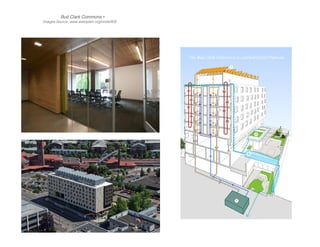
Designed by Holst Architecture and completed in June 2011, the Bud
Clark Commons (BCC) is a 106,000 square foot facility located on an old
brownfield site along the Willamette River in Portland, Oregon’s Old Town
district. This LEED Platinum project, honored in the AIAs Committee on
the Environment 2014 Top Ten Green List and a recipient of the 2012
AIA/HUD Secretary’s Award in the Creating Community Award, marks a
significant shift in attitudes about what a homeless shelter can offer it’s
residents. Named after Portland’s former Mayor Bud Clark, who proudly
claimed homelessness as his major agenda during his 1985-1992 term of
service, the principal at Holst Architecture explains that the BCC seeks to
“veer away from treating [the shelter] as just another place to warehouse
people.”
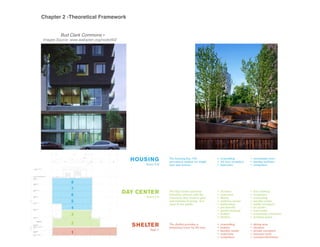
The Bud Clark Commons combines 130 transitional studio apartments,
a men’s shelter with 90 beds, in-house social services and counseling, and
various gathering spaces into one facility described as “the centerpiece
of Portland’s 10-Year Plan to End Homelessness.”43
Managed by the
Housing Authority of Portland, the BCC boasts many environmentally
efficient design features not typically included in public housing projects.
These promote financial sustainability and environmental stewardship
while distinguishing the facility within the community.
Perhaps the most noteworthy of the efficient solutions implemented
are the variety of passive house design strategies incorporated in the
352-square-foot transitional housing units. Internal heat gain from
occupants and appliances provide the majority of warmth needed, while
small heaters and a heat recovery unit making up the difference.44
	
Other energy efficient solutions effect the lighting and water usage of
the building. One of the largest solar hot water heating systems in the
Northwest provides over 80 percent of the buildings needs. Substantial
daylighting allows electric lighting to be used less than 50 percent of total
daylight hours. Rainwater harvesting through green roofs and bioswales
and a customized graywater-recycling system reduce water usage by over
50 percent.45
Overall, it is estimated that the system of energy-efficient
strategies result in an annual energy savings of about $60,000.46
Funded through a combination of low-income tax credits, HUD stimulus
packages, and urban renewal funding, the Bud Clark Commons completed
cost (excluding land) was $28.75 million.47
The BCC is an example of the
Housing First policy, the model adopted in 2010 by the U.S. Department
Figure 11: A street-view of the Bud Clark Commons. It’s lower levels consist of
significant services, while the more private housing units are above.
13
of Housing and Urban Development arguing that providing housing and
relevant services to the homeless populations saves money in the long
run.
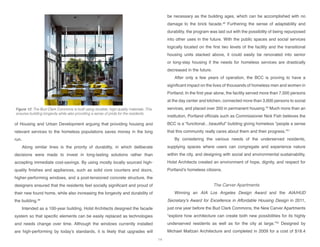
Along similar lines is the priority of durability, in which deliberate
decisions were made to invest in long-lasting solutions rather than
accepting immediate cost-savings. By using mostly locally sourced high-
quality finishes and appliances, such as solid core counters and doors,
higher-performing windows, and a post-tensioned concrete structure, the
designers ensured that the residents feel socially significant and proud of
their new found home, while also increasing the longevity and durability of
the building.48
Intended as a 100-year building, Holst Architects designed the facade
system so that specific elements can be easily replaced as technologies
and needs change over time. Although the windows currently installed
are high-performing by today’s standards, it is likely that upgrades will
be necessary as the building ages, which can be accomplished with no
damage to the brick facade.49
Furthering the sense of adaptability and
durability, the program was laid out with the possibility of being repurposed
into other uses in the future. With the public spaces and social services
logically located on the first two levels of the facility and the transitional
housing units stacked above, it could easily be renovated into senior
or long-stay housing if the needs for homeless services are drastically
decreased in the future.
After only a few years of operation, the BCC is proving to have a
significant impact on the lives of thousands of homeless men and women in
Portland. In the first year alone, the facility served more than 7,000 persons
at the day center and kitchen, connected more than 3,600 persons to social
services, and placed over 350 in permanent housing.50
Much more than an
institution, Portland officials such as Commissioner Nick Fish believes the
BCC is a “functional…beautiful” building giving homeless “people a sense
that this community really cares about them and their progress.”51
By considering the various needs of the underserved residents,
supplying spaces where users can congregate and experience nature
within the city, and designing with social and environmental sustainability,
Holst Architects created an environment of hope, dignity, and respect for
Portland’s homeless citizens.
The Carver Apartments
Winning an AIA Los Angeles Design Award and the AIA/HUD
Secretary’s Award for Excellence in Affordable Housing Design in 2011,
just one year before the Bud Clark Commons, the New Carver Apartments
“explore how architecture can create both new possibilities for its highly
underserved residents as well as for the city at large.”52
Designed by
Michael Maltzan Architecture and completed in 2009 for a cost of $18.4
Figure 12: The Bud Clark Commons is built using durable, high-quality materials. This
ensures building longevity while also providing a sense of pride for the residents.
14
million for the Skid Row Housing Trust, the project is funded by housing
tax credits, government money (from the city, county, and state), federal
subsidies, and private financing.
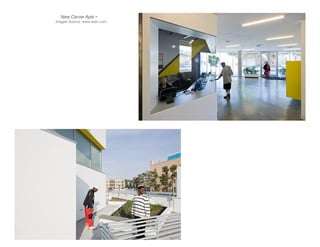
The New Carver Apartments are located on a noisy site directly
adjacent to the Santa Monica Freeway in the rapidly developing South Park
neighborhood of Los Angeles, with easy access to transit, grocery stores,
and commercial uses. Although the program and intended user is similar
to the Bud Clark Commons, the noise and views associated with the LA
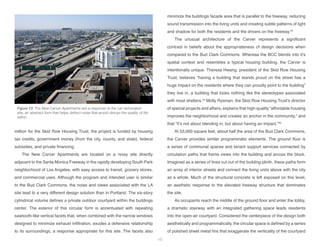
site lead to a very different design solution than in Portland. The six-story
cylindrical volume defines a private outdoor courtyard within the buildings
center. The exterior of this circular form is accentuated with repeating
sawtooth-like vertical facets that, when combined with the narrow windows
designed to minimize exhaust infiltration, exudes a defensive relationship
to its surroundings, a response appropriate for this site. The facets also
minimize the buildings facade area that is parallel to the freeway, reducing
sound transmission into the living units and creating subtle patterns of light
and shadow for both the residents and the drivers on the freeway.53
The unusual architecture of the Carver represents a significant
contrast in beliefs about the appropriateness of design decisions when
compared to the Bud Clark Commons. Whereas the BCC blends into it’s
spatial context and resembles a typical housing building, the Carver is
intentionally unique. Theresa Hwang, president of the Skid Row Housing
Trust, believes “having a building that stands proud on the street has a
huge impact on the residents where they can proudly point to the building”
they live in, a building that looks nothing like the stereotypes associated
with most shelters.54
Molly Rysman, the Skid Row Housing Trust’s director
of special projects and affairs, explains that high-quality “affordable housing
improves the neighborhood and creates an anchor in the community,” and
that “it’s not about blending in, but about having an impact.”55
At 53,000 square feet, about half the area of the Bud Clark Commons,
the Carver provides similar programmatic elements. The ground floor is
a series of communal spaces and tenant support services connected by
circulation paths that frame views into the building and across the block.
Imagined as a series of lines cut out of the building plinth, these paths form
an array of interior streets and connect the living units above with the city
as a whole. Much of the structural concrete is left exposed on this level,
an aesthetic response to the elevated freeway structure that dominates
the site.
As occupants reach the middle of the ground floor and enter the lobby,
a dramatic stairway with an integrated gathering space leads residents
into the open-air courtyard. Considered the centerpiece of the design both
aesthetically and programmatically, the circular space is defined by a series
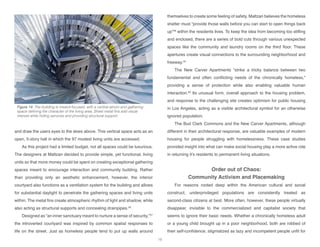
of polished sheet metal fins that exaggerate the verticality of the courtyard
Figure 13: The New Carver Apartments are a response to the car-dominated
site, an abstract form that helps deflect noise that would disrupt the quality of life
within.
15
and draw the users eyes to the skies above. This vertical space acts as an
open, 5-story hall in which the 97 modest living units are accessed.
As this project had a limited budget, not all spaces could be luxurious.
The designers at Maltzan decided to provide simple, yet functional, living
units so that more money could be spent on creating exceptional gathering
spaces meant to encourage interaction and community building. Rather
than providing only an aesthetic enhancement, however, the interior
courtyard also functions as a ventilation system for the building and allows
for substantial daylight to penetrate the gathering spaces and living units
within. The metal fins create atmospheric rhythm of light and shadow, while
also acting as structural supports and concealing drainpipes.56
Designed as “an inner sanctuary meant to nurture a sense of security,”57
the introverted courtyard was inspired by common spatial responses to
life on the street. Just as homeless people tend to put up walls around
themselves to create some feeling of safety, Maltzan believes the homeless
shelter must “provide those walls before you can start to open things back
up”58
within the residents lives. To keep the idea from becoming too stifling
and enclosed, there are a series of bold cuts through various unexpected
spaces like the community and laundry rooms on the third floor. These
apertures create visual connections to the surrounding neighborhood and
freeway.59
The New Carver Apartments “strike a tricky balance between two
fundamental and often conflicting needs of the chronically homeless,”
providing a sense of protection while also enabling valuable human
interaction.60
Its unusual form, overall approach to the housing problem,
and response to the challenging site creates optimism for public housing
in Los Angeles, acting as a visible architectural symbol for an otherwise
ignored population.
The Bud Clark Commons and the New Carver Apartments, although
different in their architectural response, are valuable examples of modern
housing for people struggling with homelessness. These case studies
provided insight into what can make social housing play a more active role
in returning it’s residents to permanent living situations.
Order out of Chaos:
Community Activism and Placemaking
For reasons rooted deep within the American cultural and social
construct, underprivileged populations are consistently treated as
second-class citizens at best. More often, however, these people virtually
disappear, invisible to the commercialized and capitalist society that
seems to ignore their basic needs. Whether a chronically homeless adult
or a young child brought up in a poor neighborhood, both are robbed of
their self-confidence, stigmatized as lazy and incompetent people unfit for
Figure 14: The building is inward-focused, with a central atrium and gathering
space defining the character of the living area. Sheet metal fins add visual
interest while hiding services and providing structural support.
16
the modern workplace, and alienated from community decision-making
processes.61
Both the homeless and those living in very poor communities
are often perceived not as victims of social and environmental injustice,
but as criminals posing a direct threat to society. This leaves the homeless
stranded from many communities and social interactions, leading to
increased feelings of isolation, sadness, and insignificance.
As a response to the lack of community and overall injustice experienced
through mainstream society, some marginalized individuals and groups
have taken it upon themselves to be the change they seek in the world
through localized acts of “resistance and hope.”62
From Space to Place
By “intentionally occupying [a space], changing it, caring for it, marking
it, or representing it in words or images,”63
groups or individuals take
responsibility for some of the changes they need in their environments
through an act called appropriating space. “Appropriation of space not
only provides a material resource necessary to meet needs for everyday
life - a place people can call their own - but also is a potential source
of both individual and collective empowerment.”64
Since homeless and
underprivileged individuals typically have little to no personal property
to occupy, this act can include claiming and adapting spaces without
permission. This is illegal, yet often tolerated when the situation involves
devalued and underutilized land. Appropriation becomes a process of
mutual adaption between the space and the inhabitant, in which individuals
assess their needs and subsequently transforms their environment,
resulting in a space more suitable for their lifestyle.65
Through a process of on-going work called placemaking, an idea
closely related to appropriating space, people “transform the places we
find ourselves into places in which we can truly dwell as individuals and
communities of people.”66
The process of making a place, of changing
and maintaining the physical world around you, can help establish a
connection with one’s surroundings. Even the simplest of interventions can
help someone better understand their environment, and by affecting some
aspect of this space through a deliberate act of placemaking, a person
implants part of his or her identity into the place itself.
As groups of people collaborate, working together towards a common
goal, placemaking becomes a valuable means of building relationships and
forming a sense of a community. In groups of people who are homeless or
poverty-stricken, often lacking a support network, this feeling of belonging
to a community becomes significant. While the homeless typically have no
influence over decisions in mainstream society, placemaking generates a
sense of empowerment that can motivate real change within a person’s
life.
When people other than professional planners and architects “decide
on how to make the world around them…by building and tearing buildings
down, cultivating land and planting gardens…mowing lawns, taking
over buildings, understanding and restoring cities,”67
they are taking
responsibility for their homes and community. Placemaking is significant
not only because of the relationships people have with places, but also
because it strengthens relationships among people in those places.
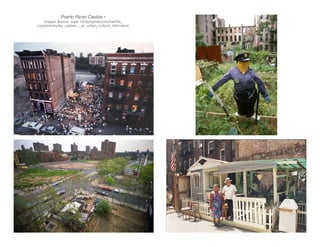
Puerto Rican Casitas
Typical to most lower class populations, a Puerto Rican community
in 1970s New York found themselves occupying landscapes of pollution,
disrepair, and violence. Basically invisible to the rest of society, particularly
those who make significant decisions that impact urban dwellers, a
collective of these Puerto Rican immigrants took it upon themselves to
17
restore their sense of identity in the South Bronx neighborhood of New
York. They achieved this by building impromptu encampments of casitas,
or little houses, in vacant lots throughout the urban landscape. These little
houses, often made from up-cycled or scrap materials, provide a family
and it’s surrounding community with a safe place for social interaction, a
play area for children, and a familiar space for religious and social events.
Typical to this culture’s vernacular residences where people lacked the
resources to own farms, the casitas often have small fenced-in yards that
promote the raising of chickens or pigs and the growing of fresh food.
“The corrugated metal gable roof, veranda, shuttered windows, and
vibrant colors evoke the Puerto Rican countryside of another era, and
assert a Puerto Rican presence in cities where they have been alternately
displaced by urban renewal”68
and gentrification.
The casita becomes the means through which this marginalized
community can articulate their national and personal identity, foster a
sense of belonging, and create a safe haven within the harsh realities
of inner-city life. By “tak[ing] an active role in reshaping landscapes of
despair into landscapes of hope,”69
the Puerto Rican casitas transform
fragmented urban landscapes into places rich with cultural significance
and identity, creating a better place for residents to thrive as individuals
and communities.
Community Gardens
Although community gardens are not a new idea, an awareness of the
negative effects associated with long-distance food distribution has led to
an increasing number of urban gardens and farms across the nation. This
desire for locally produced food has led to an estimated 18,000 community
gardens in the United States as of 2013.70
These gardens not only provide
their surrounding communities with fresh produce, but also draw people
from various backgrounds to work towards common goals, offering “unique
opportunities to establish relationships within and across physical and
social barriers.”71
Community gardens provide shared space that can be used as
an outdoor classroom, where youth can learn valuable skills in areas
like practical math, earth sciences, communication, and accepting
responsibilities. These gardens also promote healthy lifestyles and eating
habits, ensuring individuals and families are healthy and well fed for
generations to come.
Community gardens for disadvantaged populations have multiple
benefits in addition to those already mentioned, as the food produced
helps to alleviate part of the financial stress of feeding families. The surplus
of food can be sold at a profit, adding a means of income for financially
burdened families. These gardens also provide employment for students
Figure 15: The casitas created a significant cultural identity for the underserved
Puerto Rican community in New York, with this form of placemaking thriving in the
Bronx neighborhoods throughout the 1970s.
18
or homeless individuals struggling for income.
Whereas vacant lots often go unused, or promote activities that do
nothing to benefit the community at large, shared grow spaces are often
well maintained by the gardeners and require no maintenance or expense
from the local government. These attractive lots do much more to promote
a positive image in these marginalized communities than a vacant lot of
equivalent dimensions.
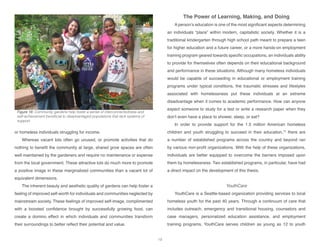
The inherent beauty and aesthetic quality of gardens can help foster a
feeling of improved self-worth for individuals and communities neglected by
mainstream society. These feelings of improved self-image, complimented
with a boosted confidence brought by successfully growing food, can
create a domino effect in which individuals and communities transform
their surroundings to better reflect their potential and value.
The Power of Learning, Making, and Doing
A person’s education is one of the most significant aspects determining
an individuals “place” within modern, capitalistic society. Whether it is a
traditional kindergarten through high school path meant to prepare a teen
for higher education and a future career, or a more hands-on employment
training program geared towards specific occupations, an individuals ability
to provide for themselves often depends on their educational background
and performance in these situations. Although many homeless individuals
would be capable of succeeding in educational or employment training
programs under typical conditions, the traumatic stresses and lifestyles
associated with homelessness put these individuals at an extreme
disadvantage when it comes to academic performance. How can anyone
expect someone to study for a test or write a research paper when they
don’t even have a place to shower, sleep, or eat?
In order to provide support for the 1.5 million American homeless
children and youth struggling to succeed in their education,72
there are
a number of established programs across the country and beyond ran
by various non-profit organizations. With the help of these organizations,
individuals are better equipped to overcome the barriers imposed upon
them by homelessness. Two established programs, in particular, have had
a direct impact on the development of this thesis.
YouthCare
YouthCare is a Seattle-based organization providing services to local
homeless youth for the past 40 years. Through a continuum of care that
includes outreach, emergency and transitional housing, counselors and
case managers, personalized education assistance, and employment
training programs, YouthCare serves children as young as 12 to youth
Figure 16: Community gardens help foster a sense of interconnectedness and
self-achievement beneficial to disadvantaged populations that lack systems of
support.
19
as old as 24. The mission of this organization is to build confidence and
self-sufficiency for these young people, getting them off the streets and
preparing them for a successful life. “For a homeless youth, outreach and
basic services and emergency shelter mean survival. For YouthCare, they
mean an opportunity to engage.”73
Although there is much to praise regarding their outreach program
and housing options catering to youth with various needs, what makes
YouthCare most significant in regards to this thesis is their educational and
employment training programs.
Their educational programs combine flexible diploma and GED-track
resources with individualized case management and housing services,
helping nearly 100 students earn their high school diploma and another 100
enroll in college over the last two years.74
They use personalized education
plans along with certified teachers and volunteers to help youth succeed at
a pace appropriate to their specific situation and learning needs.
YouthCare believes that the chances of success for a youth struggling
through homelessness increase dramatically when education is paired with
employment training. As most of the program participants have little work
experience, possess few of the skills employers seek, and lack confidence
and communication skills necessary in the workplace, YouthCare provides
employment training programs aimed at making them more employable.
They offer four distinct programs, each with unique areas of focus:75
The Tile Project is an art-based learning program where
students earn minimum wage creating art, learn to follow
instructions, and gain confidence working under superiors.
The Barista training program trains individuals how to
make a good cup of coffee, a very marketable skill in the
city of Seattle. On top of gaining experience behind the
espresso machine, participants learn how to appropriately
deal with customers in a service and sales industry requiring
good communication skills and an outgoing personality.
The YouthTech program is a 14-week college-level
course focusing on exploring the inner-workings of
personal computers. Participants disassemble a desktop
computer in their first few days, spend the following weeks
refurbishing machines for local organizations, and in the
final week reassemble the computer they started with that
becomes theirs to own. Upon completion of this program,
the youth gain Cisco certification and have a basic set
of skills needed to start a career path in the information
technology (IT) field.
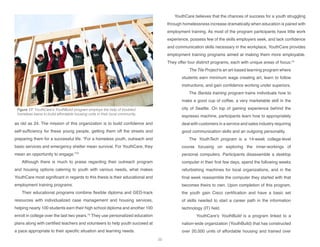
	 YouthCare’s YouthBuild is a program linked to a
nation-wide organization (YouthBuild) that has constructed
over 20,000 units of affordable housing and trained over
Figure 17: YouthCare’s YouthBuild program employs the help of troubled
homeless teens to build affordable housing units in their local community.
20
100,000 young people in the construction industry. The
YouthCare YouthBuild model is one of the few unique
programs that specifically recruit homeless youth for this
rigorous and rewarding experience. After six months,
participants have enough experience to earn industry
certifications, enabling them to apply for high-wage
positions and earn college credits.
As part of each training program listed above, YouthCare provide
assistance in developing resumes, learning valuable interviewing skills,
and conducting job searches. With this level of support, the residents are
more likely to succeed in obtaining their GED or high school diploma.
This employment training model has a high completion rate of 88 percent,
suggesting that the combination of education and employment training can
help homeless youth make steps towards a more stable future.
Out of the Dark
Out of the Dark is a social enterprise that restores and up-cycles
highly crafted furniture discarded by others. Based in High Wycombe,
England, an area once considered a mecca of British furniture making, this
organization uses a “workforce made up of troubled teenagers from the
local community, who find direction and self-discipline, learn a trade and
restore a sense of balance in their lives.”76
Through a referral scheme involving middle and high schools, the
police, social services, peers, and parents suggesting troubled youth for
the program, Out of the Dark works with about 90 young people a year at
varying levels of engagement.77
While most students are recommended for
a program treated similar to an after school project, there is a more intense
program for some of the students hand picked by the founder of Out of the
Dark, Jay Blades. This “trainee scheme” is a three-month apprentice-style
experience where the students volunteer their time to learn specific and
advanced skills in furniture restoration and craftsmanship. At the end of
this program, the students showing the best work ethic and skills are taken
on as employees.78
Out of the Dark confirms the profound psychological effect related
to the process of working with your hands and creating. The process of
creation, particularly involving something physically tangible, “affords an
opportunity to identify the uniqueness of personal characteristics, skills, and
intuitive ideas. It is a means for discovering limits and potentials through
the manipulation of external events”79
and resources. This creation serves
as a reflection of one’s capabilities, positively raising the creator’s sense
of self-worth and confidence and, ultimately, increasing their chances of a
stable and successful life.
The success of both Out of the Dark and the YouthCare employment
training programs have provided inspiration for the homeless assistance
facility proposed in this thesis.
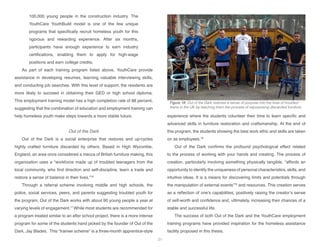
Figure 18: Out of the Dark restores a sense of purpose into the lives of troubled
teens in the UK by teaching them the process of repurposing discarded furniture.
21
Conclusions
This research has shown the need for expanded resources designed
to assist families and youth struggling with homelessness. In order to
create permanent positive effects in the lives of the increasing numbers
of homeless families and youth, however, society must provide these
people with more than a basic homeless shelter and a bowl of soup.
These struggling families and youth need community support and access
to programs that will help them achieve financial and emotional stability.
Whiletransitioningfromhomelessnesstoindependence,thispopulation
deserves housing options they are proud to call home, places where they
feel they belong. In order to foster a sense of community and support for
residents, new typologies should be explored combining assisted housing
with educational and employment training programs. A mixed-use building
such as this will prepare residents with the skills they need to achieve
housing independence, while encouraging interaction and networking
between residents undergoing similar life events and hurdles.
In order to create permanent
positive effects in the lives of the
increasing numbers of homeless
families and youth, society must
provide these people with more
than a basic homeless shelter
and a bowl of soup.
22
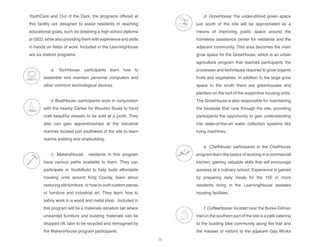
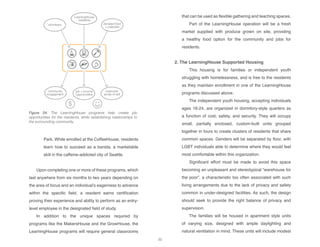
boatHouse
techHouse
makersHouse
growHouse
chefHouse
coffeeHouse
3 [Methods]
figure 19
T
he following is an overview of the methodologies, assumptions,
and overall goals associated with this design proposal. The
methods adopted represent how the research is synthesized into
the final design response.
Goals and Objectives
		
1. Provide a variety of residency options catering to families
and youth at different stages of homelessness.
This housing facility should provide unique assisted
housing units specifically for the demographic of families
with children and independent youth. The layout and
function of these units are dependent on the residents’
current life situation and needs, yet it is clear the two
distinct demographics should be separated to maintain a
level of security and safety appropriate to such a facility.
There should be a transitional housing component
operating separately, yet related to, the supportive
housing components. This provides a logical next step for
adolescents and families graduating out of the supportive
housing and moving closer to regaining independent living
and financial stability. Although aspects of the residential
components should be located on the site to be accessible
and welcoming at street-level, the actual apartments and
living quarters must be a place of comfort, privacy, and
safety.
2. Provide educational programs and services in-house to
assist in the process of returning to independent living.
The success of the YouthCare and Out of the Dark
educational and employment training models serve
as precedent for the types of programs that should be
included at this facility. In order to prepare the residents for
a life free from the burdens of homelessness, there will be
several programs in “hands-on” areas of study that youth
and parents at the facility must be enrolled in to maintain
their residency.
Although the residential components and training
programs will be intended for families and youth, there
should be general services such as counseling, housing
searches, and personal hygiene stations located
somewhere within the facility to assist homeless individuals
in need, regardless of their eligibility for the assisted
housing or training programs. The services included in
24
transitional housing
counseling
employee BOH
storage
media labs
small group spaces
meeting rooms
offices
cafe
materials donation
communal gathering
market
transitional housing
counseling
employee BOH
storage
media labs
small group spaces
meeting rooms
offices
cafe
materials donation
communal gathering
market
transitional housing
counseling
employee BOH
storage
media labs
small group spaces
meeting rooms
offices
cafe
materials donation
communal gathering
marketprivate
supportive housing
transitional housing
counseling
employee BOH
storage
employment training
dining hall
media labs
small group spaces
meeting rooms
offices
gallery
grow space
cafe
materials donation
communal gathering
market
communityprivate
supportive housing
transitional housing
counseling
employee BOH
storage
employment training
dining hall
media labs
small group spaces
meeting rooms
offices
gallery
grow space
cafe
materials donation
communal gathering
market
comthe Bud Clark Commons and the New Carver Apartments
act as starting points when determining useful services for
homeless individuals or families.
3. Create a housing community that contributes to the existing
neighborhood.
Locating the facility near an existing neighborhood
center or commercial district will help connect the residents
to the fabric of social relationships and job opportunities
already in place, helping them to feel socially significant.
Similar to a feeling of self-worth discovered through the
process of making and creating, this sense of belonging will
be beneficial during the residents’journey to independence.
The educational and employment training programs
discussed previously not only provide the residents with
skills to improve their lives, but also encourage interaction
betweenthoselivingintheneighboringFremont/Wallingford
community with residents of the assisted housing facility.
This engagement will help build a sense of community and
support for the residents that is centered around learning,
making, and doing. These training programs and their
placement on the site should improve upon current urban
conditions and lead to an improved public realm that is
beneficial to the community at large.
4. Restore a sense of hope and dignity for the underserved
homeless populations.
This housing facility should be a thoughtfully designed
building executed in quality construction detailing with
durable materials. Despite a higher initial cost, cities such
as Portland have found it worthwhile to use high-quality
materials like solid-core doors, high-performing windows,
and solid surface countertops. This contributes to the
overall goal of creating an environmentally conscious living
space for the underserved residents that will improve their
feelings of self-worth and value. A well-designed building
means seeking sustainability that includes financial, social,
and environmental performance measures.80
Taking advantage of resource conservation and
environmentally conscious building design techniques
can help provide a unique identity for the residents of the
assisted housing community, standing as a symbol within
the neighborhood that marks its significance and purpose.
As architect Sam Davis explains in his book, Designing
for the Homeless, “choice and self-determination are
cornerstones of dignity, and a homeless person has few
options.”81
With this in mind, there should be a diversity of
spaces with varying levels of privacy and enclosure at this
facility [figure 20], helping to create a sense of empowerment
Figure 20: A variety of spaces with different levels of enclosure help residents feel
empowered as they determine their own levels of privacy, a decision they don’t
usually get to make while living on the streets.
25
and individual control for the residents as they decide
where they spend their time throughout the day. These
varying levels of enclosure should be logically related to
who is using specific spaces, with a clear sense of what
is public and accessible to anyone passing through the
building, and what is private, only to be used by residents.
Regardless of architectural expression or form, this housing facility
should be a place that struggling families and independent youth will
be proud to call their home for however long they require the support
provided to them. Well-designed, beautiful spaces can restore dignity to
their residents and encourage the “shelter-resistant” to seek services and
assistance by “reassuring them that they are not entering a depressing
warehouse for the discarded.”82
Neighborhood Selection
By narrowing this project’s scope to central Seattle neighborhoods, in
which the concentration of homeless is significantly higher than other areas
of King County, the facility will be well placed to serve a large population.
Many factors determined the optimal neighborhood for the proposed
supportive housing community. In order to best serve the target
demographic, perhaps the most important aspect of siting the facility is its
relationship to families and youth in need. Also significant is how it will fit
within the network of services already existing for the desired demographic.
In addition, the facilities location within a given neighborhood is important in
determining the residents’ability to feel accepted by the existing community,
and for the broader community to reap the benefits sure to permeate from
the educational and employment training programs included in this facility.
The research included in this thesis yielded a database of services,
shelters, and the many resources available to Seattle residents seeking
relief from homelessness. This information was overlaid on a map of
Seattle that, when compared with the apparent homeless demographics
of certain areas, helped guide the process of determining where to locate
the facility.
Although homelessness may seem most severe around Pioneer
Square and Denny Way, a fairly strong network of services already exists in
this neighborhood catering to the high concentration of middle-aged males
that tend to congregate there. To successfully reach homeless families
and young people, the facility should be located further north. This places
the homeless assistance center closer to residential neighborhoods, an
appropriate area for families, and to the rising numbers of transient youth
gathering around the University District.
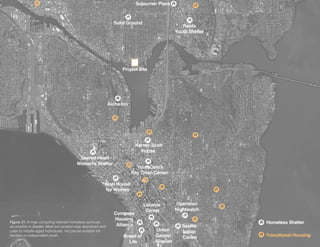
The services map [figure 21] shows that the central neighborhoods of
Fremont and Wallingford have fewer services and residence options for
disadvantaged populations than the adjacent neighborhoods of Ballard
and the University District. Situated just north of Lake Union, Fremont is
a centrally located neighborhood proclaiming itself as the “center of the
universe.”83
It is known to be full of creative and eccentric individuals, a
type of open-mindedness that should be helpful when incorporating a
homeless families and youth facility into their community. Although a non-
profit operates a small low-income housing project along 45th
Avenue, on
the fringes of where Fremont ends and Wallingford begins to the east, no
services or housing exist catering to homeless families and youth.
This areas shortage of services and low-income housing options, its
reputation for open-mindedness, and its central location within the city
of Seattle are all characteristics that make the Fremont and Wallingford
neighborhoods an optimal location for this project.
26
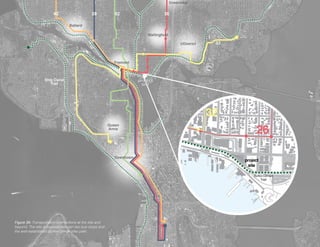
Figure 21: A map compiling relevant homeless services
accessible in Seattle. Most are located near downtown and
cater to middle-aged individuals, not places suitable for
families or independent youth.
27
34th St
Northlake Way
DensmoreAve
WoodlawnAve
vibrant
neighborhood
center
10-min.
walking
distance
acceptable site for
proposed shelter
typical location of
homeless shelters
typical location of
homeless shelters
20-min.
walking
distance
Site Selection
Several factors were considered prior to designating a specific site
within the Fremont and Wallingford area for the proposed homeless
assistance center. The site must be close to an existing neighborhood
center or commercial area, easily connecting residents to a community
and a network of job opportunities [figure 22]. It must be accessible by
public transportation and alternative means of transit such as biking, as it is
unlikely the residents can rely on personal automobiles for transportation.
As this is a facility aimed at helping families and youth, there must also be
relatively easy access to schools for various ages of children.
The chosen site is a block on the southeast edge of Fremont defined
by 34th
Street to the north, Densmore Avenue to the east, Northlake Way to
the South, and Woodlawn Avenue to the west [figure 23]. Perhaps the most
intriguing aspect of this site is its relationship to Gas Works Park. Although
considered a very significant park in Seattle for both historical reasons and
consistently high levels of use, the northwest portion of the park, a green
space adjacent to the project site, is noticeably underutilized and will be
appropriated in this thesis.
Program of Spaces
The proposed homeless assistance center can be broken up into
four basic programmatic elements: the LearningHouse educational and
employment training programs and some associated commercial uses,
supported housing for homeless families and youth, transitional housing,
and a homeless services day center.
1. The LearningHouse: Educational and Employment Training
Programs
The general name given to the collective group of
educational and employment training programs offered
at this facility is called the LearningHouse. Inspired by
Figure 23: Aerial view of the site located just north of Gas Works Park in the
Fremont/Wallingford neighborhoods of Seattle.
Figure 22: The project site must be able to integrate into an existing community,
while not causing tensions by being directly in the neighborhood center.
28
YouthCare and Out of the Dark, the programs offered at
this facility are designed to assist residents in reaching
educational goals, such as obtaining a high school diploma
or GED, while also providing them with experience and skills
in hands on fields of work. Included in the LearningHouse
are six distinct programs:
a. TechHouse: participants learn how to
assemble and maintain personal computers and
other common technological devices.
b BoatHouse: participants work in conjunction
with the nearby Center for Wooden Boats to hand
craft beautiful vessels to be sold at a profit. They
also can gain apprenticeships at the industrial
marinas located just southwest of the site to learn
marine welding and shipbuilding.
c. MakersHouse: residents in this program
have various paths available to them. They can
participate in YouthBuild to help build affordable
housing units around King County, learn about
restoring old furniture, or how to craft custom pieces
of furniture and industrial art. They learn how to
safely work in a wood and metal shop. Included in
this program will be a materials donation lab where
unwanted furniture and building materials can be
dropped off, later to be recycled and reimagined by
the MakersHouse program participants.
d. GrowHouse: the underutilized green space
just south of the site will be appropriated as a
means of improving public space around the
homeless assistance center for residents and the
adjacent community. This area becomes the main
grow space for the GrowHouse, which is an urban
agriculture program that teaches participants the
processes and techniques required to grow organic
fruits and vegetables. In addition to the large grow
space to the south there are greenhouses and
planters on the roof of the supportive housing units.
The GrowHouse is also responsible for maintaining
the bioswale that runs through the site, providing
participants the opportunity to gain understanding
into state-of-the-art water collection systems like
living machines.
e. ChefHouse: participants in the ChefHouse
program learn the basics of working in a commercial
kitchen, gaining valuable skills that will encourage
success at a culinary school. Experience is gained
by preparing daily meals for the 150 or more
residents living in the LearningHouse assisted
housing facilities.
f. CoffeeHouse: located near the Burke-Gilman
trail on the southern part of the site is a café catering
to the bustling bike community along the trail and
the masses of visitors to the adjacent Gas Works
boatHouse
techHouse
makersHouse
growHouse
chefHouse
coffeeHouse
boatHouse
techHouse
makersHouse
growHouse
chefHouse
boatHouse
techHouse
makersHouse
growHouse
chefHouse
makersHouse
growHouse
chefHouse
coffeeHouse
boatHouse
techHouse
makersHouse
growHouse
chefHouse
coffeeHouse
boatHouse
techHouse
makersHouse
growHouse
chefHouse
coffeeHouse
29
LearningHouse
residents
volunteers donated food
+ materials
community
engagement
job + income
opportunities
improved
sense of self
$
Park. While enrolled at the CoffeeHouse, residents
learn how to succeed as a barista, a marketable
skill in the caffeine-addicted city of Seattle.
Upon completing one or more of these programs, which
last anywhere from six months to two years depending on
the area of focus and an individual’s eagerness to advance
within the specific field, a resident earns certification
proving their experience and ability to perform as an entry-
level employee in the designated field of study.
In addition to the unique spaces required by
programs like the MakersHouse and the GrowHouse, the
LearningHouse programs will require general classrooms
that can be used as flexible gathering and teaching spaces.
Part of the LearningHouse operation will be a fresh
market supplied with produce grown on site, providing
a healthy food option for the community and jobs for
residents.
	
2. The LearningHouse Supported Housing
This housing is for families or independent youth
struggling with homelessness, and is free to the residents
as they maintain enrollment in one of the LearningHouse
programs discussed above.
The independent youth housing, accepting individuals
ages 16-24, are organized in dormitory-style quarters as
a function of cost, safety, and security. They will occupy
small, partially enclosed, custom-built units grouped
together in fours to create clusters of residents that share
common spaces. Genders will be separated by floor, with
LGBT individuals able to determine where they would feel
most comfortable within this organization.
Significant effort must be made to avoid this space
becoming an unpleasant and stereotypical “warehouse for
the poor”, a characteristic too often associated with such
living arrangements due to the lack of privacy and safety
common in under-designed facilities. As such, the design
should seek to provide the right balance of privacy and
supervision.
The families will be housed in apartment style units
of varying size, designed with ample daylighting and
natural ventilation in mind. These units will include modest
Figure 24: The LearningHouse programs help create job
opportunities for the residents, while establishing relationships to
the surrounding community.
30
independent male
independent female
supported
housing
(req’d to be actively
enrolled in a
LearningHouse
program)
families
employee area
Youth Shelter Spaces: Controlled Semi-Privacy in Small Groups
employee area
Family Shelter Spaces: Privacy and less Control
Figure 26: Independent youth [age16-24] will be housed in semi-private, partially
enclosed units clustered together in groups of four. These groups share common
spaces.
Figure 27: Families [young married couples or parents with children] living in
supportive housing will occupy apartment style units, with small kitchenettes and
bathrooms for increased privacy.
Figure 25: The supportive housing can accomodate over 100 independent youth,
and has 40 units for families of varying size. Residents must be involved in a
training program to maintain residency at the LearningHouse.
31
furnishings, kitchenettes, and private bathrooms to provide
privacy for the families living at the LearningHouse. Each
unit will also have a porch with fantastic south-facing views
to Gas Works Park, Lake Union, and downtown Seattle,
adding to the perceived sense of self-worth for the residents
while also helping to make the units feel larger than their
actual area of about 550-600 square feet.
Related to the LearningHouse assisted housing is a
dininghallintendedtofeedtheresidents,aswellasremaining
open to the public for any struggling families or individuals
unfortunate enough to lack resources to feed themselves.
The GrowHouses community garden should provide much
of the produce used in the kitchens, encouraging the idea
of eating locally as a means of boosting the health of both
the residents and the neighborhood economy.
Also connected to the assisted housing are a variety
of shared living spaces. As many of the individual private
spacesareintentionallysmall,thesesharedspacesbecome
very important meeting points and should be located
within the facility to take advantage of the positive aspects
associated with the site. It is in these shared spaces where
residents’ most clearly benefit from the strong communal
support system created through continued interaction and
communication.
	 3. Services
Operating as a separate entity from the LearningHouse,
a social services day center will include various entities and
organizations meant to assist and encourage homeless
individuals regardless of age or housing situation. A
personal hygiene center provides basic health care needs
and prepares residents with resources for job interviews
or other social events where appearance is important,
such as a clothing donation center and a salon or
barbershop. A counseling office will provide on-site case-
management advisors that can assist with legal matters,
as well as specialists meant to help residents cope with
issues that arise when a person loses their property, job,
and personal dignity. Many of these services could be
provided through local university practicums or work/study
situations, lowering the cost of supplying such services
and encouraging engagement between the surrounding
community and the homeless assistance center.
Accepting that a certain amount of homeless people
are shelter-resistant and may never voluntarily live in the
options available in the proposed facility, there will be a
social service included in the day center that works with city
officials and property owners around Seattle to designate
pieces of land where encampments and personal shelters
may be erected. Combined with the wood shop and
materials donation lab, which homeless individuals would
be allowed to use at designated times, these services
provide support for people who elect to live on the street
for any number of complicated reasons.
4. Transitional Housing
Traditional housing units are provided on site as an
option for residents graduating from the LearningHouse
32
1 BR-2BR Apt
transitional
housing
(residents pay 30%
of income on rent;
difference made up with
Section 8 vouchers)
1 BR-2BR Apt
market rate
housing
(located on top
floor with best views)
$
supportive housing and educational training programs.
Although located on the same site, this privately managed
apartment complex will be run separately from the
LearningHouse. Residents in the transitional housing will
pay 30 percent of their income for rent, a generally agreed
upon portion of one’s earnings that can safely go towards
living costs. People living in this building can be graduates
of the LearningHouse, but can also be any lower-income
individual eligible for subsidy programs like HUD’s Housing
Choice vouchers.84
As a means of producing income into the property
while encouraging interaction and networking between
different socio-economic classes, there will also be market-
rate housing interspersed within this transitional housing
complex.
All residents of this housing complex will have access
to the resources available at the LearningHouse, making
them attractive units for those interested in using the wood
and metal shop, having a personal plot at a p-patch, or a
garage to work on boats or bikes.
Design Methods
	 The design methodology for this thesis is based upon functional
analysis through a critique of existing precedents and an examination
of placemaking, community activism, and the transformative power of
learning and creating. This proposal seeks to create a new supportive
housing alternative, a transformation of the existing typologies of housing
the homeless, aimed at guiding independent youth and struggling parents
along a path to a sustainable, stable lifestyle. It will focus mainly on cultural,
social, and spatial aspects surrounding this issue, rather than a scientific
approach. The thesis will be program focused, realistic within the context
discussed in the theoretical framework.
The outcomes of the design phase will be evaluated by comparing
the final results against the objectives and goals laid out in earlier in this
section.
Figure 28: The 49 transitional housing units are interspersed with 17 market rate
units, encouraging socio-economic interaction. These units bring a source of
income to the site.
33
Delimits and Limits
This project is not an attempt to solve the complex issue of
homelessness. It is an architectural exploration into how thoughtful design
and the programming of creative activities and services can encourage
community building within a housing facility for the homeless, improving
the daily experience of the residents. So that efforts remain focused on
architecture-related issues, some assumptions must be made about
complexities that would influence a project if it were to be constructed.
As with any project at the scale of construction, financial backing is
a significant issue in the process of building a homeless residential and
services center. This project does not attempt to provide solutions for raising
funds. Rather, it assumes financial support through the U.S. Department of
Housing and Urban Development, Seattle Housing Authority, and various
donations gathered through local organizations. Similarly, the long process
of building a working relationship between the various organizations that
help to provide services for the residents and the shelter is not considered
in this architectural research.
Rather than going through the process of getting neighborhood
approval or holding public meetings about how this land might be used,
this academic exercise allows the author/designer to have final authority
on program and design decisions; an activist attitude relating this project
to the themes of appropriating space and placemaking found in the Puerto
Rican casita communities of New York. This freedom should produce a
more cohesive project by allowing programmatic and spatial ideas to be
implemented that may typically be rejected due to bureaucratic, political,
or financial reasons.
These assumptions have been made to decrease the scope of complex
issues inherent to the problem of homelessness and housing, allowing
efforts to be focused on creative problem solving and design issues
considered more relevant to architecture. The hopes are that the design
outcome can be a catalyst for change; an example of a new housing model
that will greatly benefit under-represented populations across the nation.
Summary
This thesis contends that providing dignified housing to the homeless
population is the best way to positively contribute to the issue of
homelessness in the United States. As homeless populations evolve
throughout the nation and in King County, housing must cater to the rapidly
rising demographic of youth and families, varying in organization and form
depending on the persons residency needs and life situation.
Inspired by acts of placemaking, community activism, and multiple
existing educational programs that have proven successful, this homeless
assistance center will allow for a variety of residency options that operate
in conjunction with the various LearningHouse training programs. The
support surrounding this community of residents helps prepare them for
independent life after the LearningHouse.
The aesthetic qualities of the homeless assistance center should not
be overbearing. Given the mix of residential and industrial-commercial
buildings in the area, this facility should appear as a mixed-use residential
housing block, standing as a respected symbol of the community it hopes to
create within. The well-crafted homeless assistance center should embody
a place welcoming and comfortable for the residents, able to restore a
sense of dignity and hope to marginalized families and young individuals
of King County.
34
4 [Site Analysis and Preliminary 	
Findings]
Figure 29: a view from 34th street looking South. Note the boarded up openings and
general disrepair of the exisiting building on site.
W
hen the site was selected for this project, an unused Metro
facilities building took up most of the 72,800 square foot block
of buildable area. What makes this site captivating is not
only it’s connection to Gas Works Park and a stunning view to downtown
Seattle, but also the fact that the existing building was not living up to
the sites potential. With boarded up windows and solid walls along all
four street edges, the vacant building did nothing to contribute to the life
and vitality of this neighborhood. Since this project takes inspiration from
communities appropriating urban spaces, improving this site’s connection
to the surrounding neighborhood became a driving force for this project.
In August of 2014, demolition of the Metro Facilities building began to
make way for a commercial office building, with construction to start in the
spring of 2015.
Site Logistics
Currently, the site is zoned as IC-45. Given the intent of this thesis,
however, it is proposed that the zoning be switched to NC2-65 to maximize
building potential and to relate to the mixed-use building east of the site,
also zoned NC2-65. Seattle has guidelines regarding the NC2-65 zoning
code, defining it as “a moderately sized pedestrian-oriented shopping area
that provides a full range of retail sales and services to the surrounding
neighborhood.”85
The site has a maximum floor area ratio (FAR) of 4.75,
determined by its mix of residential and commercial uses within the 65 foot
height limit.
There is a 30 foot grade change between 34th Street and Northlake
Way, with the high point of the site at the northeast corner at the intersection
of 34th Street and Densmore Avenue. This topographic change will come
to have a significant impact on the design of this housing community.
Along Northlake Avenue there is a 7 to 8 foot tall concrete wall that
Figure 30: demolition of the existing building began summer 2014.
36
residential
mixed-use
commercial / office
industrial / industrial commercial
park
project site
Figure 31: Existing building uses for the surrounding area. Light industrial uses dominate the area
southwest of the site, while the Wallingford residential neighborhood is located to the north.
Figure 32: Current construction and development near the site. Most notable is the new transfer
station and recycling center northeast of the site.
defines the green space within. This design plans to use this wall to provide
partial enclosure to the GrowHouse community garden. The wall will act as
an artifact in which a light-frame garden shed will be attached. This shed
holds various tools and equipment necessary for the garden, and acts as
a public pavilion for community activities in the garden.
Adjacencies and Development
The building uses adjacent to the site are fairly distinct in each
direction, with light marine industry to the southwest, a strong commercial
core along Stone Way to the west, Wallingford residential neighborhood
to the north, and Gas Works Park to the south [figure 31]. These various
building uses provide the designer of this facility the opportunity to relate
to existing conditions that are unique on each side of the site, a factor that
will influence the layout of the building.
It is clear to most anyone who frequents this area that it is going
through major transformation as the Fremont commercial district expands
east towards Stone Way and Gas Works Park. This thesis benefitted from
a detailed investigation into the current development impacting this site
and the surrounding neighborhood [figure 32].
There are a few projects in development worth noting. The first is a
transfer station located just northwest of the site, with a new recycling
center working in conjunction with the materials donation lab at the
LearningHouse. As useful building materials and discarded furniture come
into the recycling center, they can forward it to the MakersHouse to be
up-cycled and reborn as useful new objects. Also of significance are a few
residential and mixed-use buildings to the northeast, estimated to add over
175 living units to the area over the next few years. This rise in residents
will surely have an impact on the continuing development of the Fremont
and Wallingford neighborhoods.
Since the proposed supported housing community is for youth and
families with children, the sites relationship to existing schools is significant.
To determine if this site provides a variety of educational opportunities for
its residents and their children, a proximity map was developed [figure 34].
This study found there to be a preschool less than four blocks away, and
Figure 33: A view from Densmore Avenue looking west towards the newly cleared site. Here you can see the site’s proximity to Lake Union and the industrial uses along it’s shores.
38
Figure 34: a proximity map with 5-minute, 10-minute,
and 20-minute walking circumferences illustrated.
various middle and high schools about 15 to 20 minutes walking distance
to the north. In addition to the obvious proximity to Gas Works Park, there
are also a few p-patches and community parks to the north of the site. An
obvious resource lacking in this area is a variety of markets and groceries
that provide convenient access to fresh food, a resource that this proposal
will help to provide.
Transit Connections
As discussed in chapter three, the facilities relationship to the existing
King County Metro bus service is important, as it determines the residents
ability to travel within the city of Seattle and beyond. There are bus stops
for lines 26 and 32 just two blocks north of the site, where residents can
easily connect to the two major transportation hubs north of Seattle’s
downtown: central Fremont and the University District [figure 36]. With
these lines, residents have a direct connection to all of King County Metro
service areas.
As this is a housing facility catering mainly to young individuals, biking
also becomes a viable means of personal transportation. The Burke-Gilman
Trail, a well-established bike path connecting all of the neighborhoods north
of Lake Union, runs directly south of the building site, providing a major
circulation path that easily and safely connects the residents with Ballard,
Fremont center, the University District, and Lake Washington. With the
extensive series of bike paths merging with the Burke-Gilman Trail, biking
will be an essential method of transit for the residents of the proposed
housing facility, promoting healthy and environmentally-friendly lifestyles.
Figure 35: The site is located directly adjacent to the Burke-Gilman Trail and
an underutilized green space on the north edge of Gas Works Park. This image
illustrates one homeless individuals use of this space.
40
Figure 36: Transportation connections at the site and
beyond. The site is located between two bus stops and
the well-established Burke-Gilman bike path.
5 [Conceptual Design Response]
figure 37
E
arlyoninthedesignprocess,whileorganizingthevariousprogrammatic
functions of the proposed supportive housing community, building uses
were located to best connect the facility to the surrounding context.
Site Connections
Learning from the building use studies discussed in chapter four [figure
31], the main entrances to the LearningHouse and transitional housing are
placed at the northern edge of the site, connecting to the existing residential
fabric of the Wallingford neighborhood. These relationships were synthesized
from the diagram on the following page [figure 38].
The main spaces for the educational and employment training programs of
the LearningHouse are to be closest to the industrial and commercial centers
to the west and southwest, hoping to foster relationships that will benefit
residents and connect the facility to the existing community. This type of
relationship is especially beneficial for the BoatHouse and MakersHouse,
as the light industrial uses along the Lake Union waterfront can provide
opportunities for learning, working, and the sharing of resources. This
location also allows for convenient access to the Wallingford transfer
station currently under development, which can forward materials to the
MakersHouse to be used for various building and industrial art projects.
The large growing space on the northern edge of Gas Works Park will
reinvigorate the public realm along the south edge of the site. Near this
space will be the CoffeeHouse and the GrowHouse learning classrooms.
The CoffeeHouse offers a new lunch or drink option for visitors of Gas
Works or for daily commuters along the Burke-Gilman trail, providing
participants in the educational program with a steady supply of customers
to hone their barista skills. Locating the GrowHouse at the Northlake Way
street level allows for close access to the community garden, while also
relating to a landscapw design feature to be discussed later.
These relationships led to a design that holds the street edges along the
east, north, and west edges of the site where it seemed urban conditions
were already fairly well-defined.
Site Responses
By holding the street edge on three sides, the design was able to open
up to the south, strengthening it’s connection to the community garden
and taking advantage of the view to Lake Union and downtown Seattle
[figure 39]. Inspired by the interior courtyard created at the New Carver
Apartments, the building is to be centered around communal gathering
spaces where residents and visitors witness the life of the everyday
building. These communal spaces flow, both visually and physically, south
to a protected courtyard. This outdoor space is defined by housing wings to
43
Figure 38: The building is organized to take advantage
of existing conditions around the site, a response to
distinct uses and zoning to the south, west, and north.
44
the east and west, a fantastic view to Lake Union and Seattle to the south
in the background, and a water-filtration bioswale in the foreground.
This bioswale is a significant aspect of the design. As it cuts through the
building and site, it marks a symbolic break between the LearningHouse
supportive housing and the more independent transitional housing. This
allows the two separate buildings to be architecturally similar to achieve
a cohesive aesthetic, while maintaining a level of separation between the
two different housing cultures.
As the swale is designed to collect and filter water for use within the
building and as irrigation for the GrowHouse garden spaces, it starts at the
high point of the site and runs south, adjacent to what is defined as the
main circulation path for both visitors and residents moving north to south
(or vice versa) through the building and site.
This path responds to the topography of the site, establishing a datum
in which communal gathering spaces are organized. This circulation path,
which starts at 34th Street, will remain open to the public during normal
business hours. By inviting the community into the LearningHouse, their
understanding of the educational and employment training programs
is strengthened, leading to an increased awareness about the issues
surrounding family and youth homelessness. Along this path will also be
various opportunities for commercial activity, such as a gallery for the
display and sale of residents work at the MakersHouse, BoatHouse, and
TechHouse, as well as the CoffeeHouse at the south edge of the building.
Moving along this path, visitors experience most of the LearningHouse
educational training spaces and have direct interaction with the linear
bioswale. After continuing down a series of stepped terraces, the path
Figure 39: A series diagram showing how the building responds to the site. Centered around communal gathering spaces, the building opens up to the south to
take in views of Gas Works Park and Downtown Seattle. A bioswale differentiates building users and runs adjacent to the major circulation path through the site.
45
wallingford
gas works park
housing
welcome
gather
mech. donate makershouse
outdoor gather
grow
park
housing shared
space
shop yard
and bioswale crosses Northlake Way and leads directly to the GrowHouse
community garden at the north edge of Gas Works Park. This marks
the end of the path and completes the architectural experience of the
LearningHouse community that started along 34th Street and continued
through the public spaces of the building.
Figure 41: A sectional diagram looking east through the central circulation path that connects residents and visitors to the activities within the building and to the
surrounding site.
Figure 40: A diagram showing the swale [in blue] and the related growing spaces
[green]. The swale runs north to south along most of the site, connecting the
building and it’s occupants to the proposed community garden.
46
6 [Final Design Response]
figure 42
47
Figure 43: The site plan illustrates the newly established relationship to Gas Works
Park and the GrowHouse community garden. Also shown are the various grow
spaces on the roof, some of which are covered greenhouses to extend yield into the
winter. Note the swale extending between the atrium and the transitional housing
units. The parking entry is visible along Densmore Avenue.
private
supportive housing
transitional housing
counseling
employee BOH
storage
employment training
dining hall
media labs
small group spaces
meeting rooms
offices
gallery
grow space
cafe
materials donation
communal gathering
market
communal
T
he final design of the supportive housing community is a synthesis
of the site response diagrams discussed in chapter five. The result
is a 280,000 square foot supportive housing community hoping to
instill new urban life into this developing neighborhood.
As the design developed, the challenge of integrating so many
unique and demanding building programs began to present itself. For
design direction, the distinct programmatic elements were aligned with
the idea of creating a range of spaces with various levels of privacy and
enclosure, as discussed in chapter 3. The resulting diagram [figure 44]
helps to clarify the relationships between the LearningHouse supportive
housing, the LearningHouse educational programs, the transitional
housing, and the homeless services day center.
Program
The building has 4 distinct parts, as discussed in chapter three. The
LearningHouse educational and employment training programs take up
most of the lower two levels, except for a centrally located mechanical room
and a parking garage at the north end of the site catering to guests and
Figure 44: Diagram showing the spatial character of each major part of the building
program, with more private spaces being enclosed and public spaces being open.
49
LearningHouse
transitional housing - 30% of income
supportive housing - enrolled in training program
homelessness services day center
communal shared spaces
Figure 45: Diagram illustrating the four main uses of the housing community, with the
educational programs dominating the lower two floors and housing units making up
most of the upper floors.
50
LearningHouse
entry main atrium
LearningHouse
educational programs
supported family
housing
supported youth
housing
shared housing
space
residents of the transitional and market rate housing units. This parking
area doubles as a delivery zone, where large shipments can be dropped
off and picked up.
There are two main entrances to the LearningHouse along 34th Street,
that lead to a welcoming desk and gallery space displaying various work
underway at the educational programs. Visitors are directed towards a large
atrium, designed to break up the mass of the building and allow daylight to
penetrate the gathering and living spaces within. From this atrium, visitors
and residents can access the LearningHouse educational programs. As
they continue south, they pass through an operable curtain wall to the
exterior courtyard, where they can descend a series of steps to end at the
GrowHouse community garden.
From the main atrium, residents of the LearningHouse can access their
living quarters by ascending the central staircase to the supportive housing
that defines most of upper levels along the west and north sides of the site,
clearly differentiated from the more publicly accessible spaces below. Also
at these levels are shared housing spaces, located adjacent to the large
atrium and directly above the public spaces at street level, offering the
residents with some of the best views to downtown available on the site. It
is in these spaces that residents can study, work in small groups, or relax
and enjoy a special place in which they feel welcome.
The east side of the site mainly consists of the transitional housing
building, which has it’s own private entrance along Densmore Avenue that
relates to the adjacent mixed-use residential building.Although it is intended
that many of the residents who graduate out of the LearningHouse could
move into the transitional housing units as they work towards housing
independence, it is important that there remains a distinction between
the two. This separation reminds the LearningHouse residents that they
are aiming to move out of the supportive housing, while also ensuring the Figure 46: A series diagram showing major programmatic elements.
51
transitional
housing
fresh market
homeless services
day-center
parking and
delivery
market-rate occupants that they are not living at a homeless shelter.
The child care center is located on the south edge of the site
underneath the transitional housing, offering LearningHouse residents and
any other parent a safe, convenient daycare option. Not having to bring
their children to errands, tasks, or job interviews helps adults struggling
with homelessness to become more employable. This ultimately helps
them achieve a more stable lifestyle in which they can better provide for
their families.
On the northeast corner of the site is a fresh foods market. This
commercial venture, which sells produce grown by participants of the
GrowHouse, along with other small grocery items, provides residents of
the LearningHouse, transitional housing, and the Wallingford / Fremont
community a convenient grocery option which the area currently lacks.
Above the market is the homeless services day-center, aimed at
providing helpful services to all homeless individuals in need, with a detailed
description of services available in chapter 3. It has it’s own entrance along
34th Street, separated from the market and transitional housing entries
along Densmore Avenue. Although LearningHouse residents can find
many useful services here, it operates independently from the supportive
housing and educational programs.
Figure 47: A series diagram showing major programmatic elements.
52
Structure
The building is a concrete frame with light wood frame construction
above.
The durable concrete base accommodates heavily-used program
elements like the MakersHouse, the GrowHouse, and the BoatHouse, in
which there will be a fair amount of heavy and destructive activity that
could damage more delicate building materials.
The youth supportive housing along 34th Street and the main atrium,
two spaces for which the required span required was too great to accomplish
with wood, are also constructed of concrete. One benefit of this decision
is that the whole northern bar is easily adaptable for future use, should the
need arise. As it is a simple concrete frame system with columns spaced
at a distance of 20’ on center, it could one day be turned into an office or
other commercial occupancy building.
The balance of the building is light wood frame construction. This
method reduces the overall cost of the building and the time it takes to
complete.
This construction system, a hybrid ‘5 over 2’, is typical throughout the
city of Seattle, as the concrete provides a robust and fire-resistant base
upon which the rest of the building sits.
Figure 48: A diagram showing the structural organization of the building.
53
Figure 49: A section-perspective cut through the main path of the building, illustrating the response to the site’s topography. This central path acts as the datum in which the
LearningHouse shared spaces are organized. Above the main entry is the youth assisted housing with the clusters of living units. The atrium flows through the operable south-
facing curtain wall into the exterior courtyard after passing underneath the shared housing spaces.
LearningHouse
transitional housing - 30% of income
supportive housing - enrolled in training program
homelessness services day center
communal shared spaces
northlake way plan
elevation: -18’
0 10 30 60
parking
mechanical
water
mechanical
a
b
a
b
Plans and Experiential Views
The lowest level is on Northlake Way, with the most public program
facing the south side of the site. The CoffeeHouse cafe and MakersHouse
shop yard have a direct connection to the Burke-Gilman Trail and a new
public space created between the two housing bars on the east and west
sides of the site. This space is defined by the terracing bioswale, a feature
that adds textural interest to the central spaces between the housing bars.
GrowHouse class spaces, which are entered by crossing over the swale
on metal grating, are also found on this level. This extends the swale to the
south end of the site, while also adding a symbolic point of interest for the
GrowHouse.
figure 50
55
Figure 51: The public space between the two housing bars, with the CoffeeHouse
outdoor seating area to the right, and the MakersHouse shop yard to the left. Also
important is the bike lockers located centrally in the image, just in front of the
terraced swale. This bike share allows residents to conveniently move throughout
Seattle without paying for bus fare.
Figure 52: View from 34th Street looking south illustrating the main approach to the building. The two main entrances are shown, with the left being more public, and the one in
the center of the image being a 24-hour resident access. The repetitive expression of the wood louvers breaks down as they approach the northern facade. Here, where solar
protection isn’t necessary, the louvers move to the interior, acting as operable privacy screens for the assisted housing.
child care
gallery
market
offices
event
class
class
class
34th street plan
elevation: 0’, 12’
0 10 30 60
LearningHouse
transitional housing - 30% of income
supportive housing - enrolled in training program
homelessness services day center
communal shared spaces
cafeteria
kitchen
transitional
housing lobby
a
b
a
b
The 34th Street plan is the ‘main floor’ of the building, despite being
at two different elevations. The offices for the LearningHouse are located
at the northwest corner of the building just inside the two main entrances
along 34th Street [figure 52], and a central desk between the entries acts
as an information point. The main entry for the day center is located east
of the gallery, with an exterior waiting area strategically placed within
the planted bioswale. This provides a beautiful place for those seeking
services to wait without creating a large gathering along 34th Street that
might cause unwanted tensions amongst local residents.
After descending a staircase into the dining hall, visitors and residents
can explore the various spaces holding the LearningHouse educational
programs, or would continue through the south facing curtain wall into the
exterior courtyard.
58
figure 53
Figure 54: After passing through the main entrance from 34th Street, visitors and residents pass through a gallery space displaying exciting work going on at the LearningHouse,
before being drawn to the atrium space. This is the life of the building, where the daily activities associated with the LearningHouse programs and housing are centered. In the left
of this image is the bioswale cutting through the perceived form of the atrium, adding textural interest and providing a seperation between the supportive and transitional housing.
0 10 30 60
Figure 55: A section cut through the atrium and dining space. To the right is the bioswale stepping down with the topography, helping to define the exterior space for the homeless
services day-center, and piercing through the perceived form of the gathering space. In the center of the image, behind the central staircase, is the wooden screen that has
broken through the facade to the interior of the atrium. This allows natural light to come into the youth housing spaces through the skylight in the atrium, while protecting the privacy
of the residents within.
section a
60
LearningHouse
transitional housing - 30% of income
supportive housing - enrolled in training program
homelessness services day center
communal shared spaces
1st floor plan
elevation: 18’
0 10 30 60
Just six feet above the 34th Street level, the first floor is unique within
the building. As the gallery and entry spaces are one and a half floor
heights (18 feet floor to floor), this housing level has no youth supportive
living units. The LearningHouse educational spaces are twelve feet lower
than the entry. This allows space for the first level of supportive family
housing located at the west side of the site, and the transitional housing
units to the east.
The supportive family housing and transitional housing have shared
spaces such as lounges and large kitchens at the south edge of each wing.
This ensures that all residents are able to experience the views and sunlight
inherent to the southern part of the site. Each wing also has various unit
layouts, accommodating families of different sizes at the LearningHouse
and allowing for unique rent options at the transitional and market-rate
housing. figure 56
61
0 10 30 60
section b
Figure 57: This section is cut about one hundred feet south of section A, illustrating the south facing curtain wall with exterior porches that help to provide solar protection against
the summer sun. The facade is opaque directly above the bioswale that cuts through the atrium, accentuating the symbolic seperation between the supportive housing to the west
and the transtional/market-rate housing to the east. In this seciton, the swale has continued it’s descent and is now level with the courtyard ground level.
62
2nd floor plan
elevation: 29’
0 10 30 60
LearningHouse
transitional housing - 30% of income
supportive housing - enrolled in training program
homelessness services day center
communal shared spaces
All assisted family housing and transitional housing units have outdoor
porches, offering views and providing the sense of a larger personal space
in the modest size units. The ‘sawtooth’ form along the inner facade of the
transitional housing block is designed to maximize unit views to the south,
while also allowing the interior courtyard to draw visitors through the site.
The dominant feature on the facade is a system of vertical wood louvers
that define the various housing units within the building. These louvers not
only provide solar protection along harsh east and west facades, but also
act as privacy screens for the residents whose patios are organized for
views to the south. figure 58
63
The wood louvers were imagined specifically for the transitional housing
porches during the early design process. As each porch was adjacent to
it’s neighboring unit, privacy needed to be considered. This design allows
light to penetrate the interiors through the windows underneath the screen,
while blocking neighbors’ views inside [figure 60]. As the design developed,
the wood louvers became a defining element for all of the housing on site,
marking the programmatic function within.
Figure 60: Views to the exterior courtyard are maintained, while neighbors’
views into the transitional housing units are impeded. Without this screen,
privacy would be a serious issue along the west facade of the transitional
housing units.
Figure 59: The wood louvers block intense east and west sunlight from
overheating the housing units, while creating an architectural language helping to
define the housing within.
64
Figure 61: A view from a private porch in the transitional housing block, looking west
towards the supportive housing for families.
65
Figure 62: A view from a transitional housing porch, looking south towards
downtown. Note how the screen blocks views into neighbors living units.
66
3rd and 4th floor plan
elevation: 40’ at third floor, 51’ at fourth floor
0 10 30 60
LearningHouse
transitional housing - 30% of income
supportive housing - enrolled in training program
homelessness services day center
communal shared spaces
There is an apartment for the live-in LearningHouse staff on each floor,
located at the fulcrum between the youth and family housing. The staff
desk is directly outside their living unit, ensuring security and safety while
minimizing the number of required staff members.
Throughout the research for this thesis, it seemed the typical approach
to housing the homeless, resembles a warehouse with little or no privacy
for residents. This environment does little to contribute to the residents
path to housing independence. Many, particularly younger people or those
who have recently become homeless, would rather stay outside than in
these shelters.
In contrast to these poor conditions, independent youth at the
LearningHouse will occupy small, custom units grouped together in fours
to create clusters of residents that share common spaces. These common
spaces have access to natural light and ventilation, mimicking the porches
at the family and transitional housing units in both form and function.
67
figure 63
Figure 64: These partially enclosed plywood units, designed in 4 foot dimensions to conserve materials and cut costs, provide some degree of privacy while allowing many residents
to be supervised by few members of staff. Sliding wooden screens allow for customization of the living space, fostering a sense of personal ownership despite not being completely
enclosed. These vertical wood screens also establish an architectural relationship with the rest of the living units on site.
LearningHouse
transitional housing - 30% of income
supportive housing - enrolled in training program
homelessness services day center
communal shared spaces
5th floor plan
elevation: 62’
0 10 30 60
The independent youth housing is organized by gender, with males
occupying the second and third floors and females on the fourth and fifth.
Despite this separation, residents feel connected as a community thanks to
the cut floor plates designed to bring natural light deep into the dormitory-
style youth housing. Units have been organized to avoid direct views into
private spaces from the floors above.
All LearningHouse residents will have access to the roof decks
where greenhouses and planters are located, integrating elements of
the educational programs into the living spaces. Due to the weight of soil
and plants, these were placed only on the roof of the concrete structural
system, limiting their locations towards the north part of the site.
Transitional housing residents have a separate roof deck towards the
south edge of the site. figure 65
69
Figure 66: A skylight brings daylight deep into the supportive youth housing. Located on the first floor, in the lower left of this view, is a shared space organized as stepped
stadium seating. This is one such area where small or large groups of LearningHouse youth can gather, learn, and relax.
Each group of four units is set up to have it’s own entrance that has operable sliding screens, allowing residents to interact with their built environment to best reflect their desires
and needs. The repetitive concrete frame allows for easy adaptability, should this building be turned into commercial or office space in the future.
Figure 67: A view from the community garden located south of the supportive and transitional housing. This garden provides a place for residents and members of the community
to engage and interact while producing organic produce to be used and sold at the LearningHouse.
7 [Conclusion]
figure 68
H
undreds of thousands of individuals lack permanent housing on
any given night in the United States, with more than 200,000
sleeping in cars, under bridges, or in any makeshift shelter
they can claim as their own.87
Although homelessness levels have
remained fairly constant over the past decade, homeless family and
youth populations are on the rise. This group represents the fastest-
growing demographic of homeless persons in the nation: the new faces
homelessness.
Although issues such as substance abuse and addiction, poverty,
and natural disasters will ensure there are homeless people in the United
States in the future, recent shifts in the economy and society have led to
the drastic increase in homeless families and youth that were once so
uncommon. With the widening gap between minimum wage and living
wage and a lack of affordable housing, the city of Seattle is experiencing a
rise in family homelessness at a rate significantly higher than the national
average.88
Although it may never be possible to end homelessness completely,
architects, planners, and designers can - and must - play a significant role
in improving the lives of this stigmatized and underprivileged population.
With the vast number of respected design firms in Seattle, new housing
typologies should be explored to help alleviate this problem that won’t fix
itself.
This thesis acts as a catalyst for change regarding housing for the
homeless. Inspired by acts of placemaking and community activism often
implemented by disadvantaged populations to adapt to their difficult life
circumstances, this project focuses on the architects ability to positively
influence a resident’s experience of place. By incorporating educational
programs with supportive housing for homeless families and youth, connecting
the facility to the existing community, and improving the public spaces around
Gas Works Park, this project provides residents a dignified and positive
experience in the hopes that it will lead to housing independence.
As members of society, we have an obligation to protect and care for one
another regardless of socio-economic class, race, or sexual orientation. Given
the specific knowledge and skill set of architects, we can positively impact this
complex situation, helping to build a sustainable future for struggling families
and youth by encouraging new forms of supportive housing.
73
[Appendix]
Chapter 2 -Theoretical Framework
Images Source: www.aiatopten.org/node/402
Bud Clark Commons -
Images Source: www.aiatopten.org/node/402
Bud Clark Commons -
Images Source: www.iwan.com
New Carver Apts -
Images Source: www.12ozprophet.com/martha_
cooper/entry/las_casitas_-_an_urban_cultural_alternative
Puerto Rican Casitas -
Chapter 3 - Methodologies
Sun Study Wind Study
Regional Map
Chapter 4 - Additional Site Photos
Chapter 5 - Conceptual Design Response
24’-0”
24’-0”
Youth Housing Precedent and Concept Family Housing Precedent and Concept
Designing For the Homeless, Sam Davis http://architizer.com/projects/the-hegeman-supportive-housing/
Early Concept Sketches
Concept Section Development
housing
Ground Level Private Upper Levels
welcome and lobby
eat + gather
LearningHouse programs
services
assisted
+ market
rate
supported
families
supported
youth
housing
Ground Level Private Upper Levels
welcome and lobby
eat + gather
LearningHouse programs
services
assisted
+ market
rate
supported
families
supported
youth
housing
Ground Level Private Upper Levels
welcome and lobby
eat + gather
LearningHouse programs
services
assisted
+ market
rate
supported
families
supported
youth
Program Concept
cafe
market
Learning
House
families
lockers +
storage
employee
BOHWC
WC
supportive
housing
young
females
young
males
materials
donation
shop
space
pet
care
offices
maker
house
chef
house
tech
house
boat
house
grow
house
employment
center
health +
wellness
coffee
house
day center
services
health +
wellness
meeting
space
mail
center
large gathering
and dining hall
job
center
counseling
offices
media lab
transitional
housing
shared
kitchens
studio
living units
1-2 bedroom
family units
media
lab
shared event
+ gathering
space
Building Program Use Relationships
Chapter 6 - Site model
[Figures and Figure Sources]
1. New faces of homelessness
	 www.facinghomelessness.org
2. Colonial homelessness
	http://dhss.alaska.gov/gcdse/Pages/history/html_content_main.	
	aspx
3. The Bowery Mission
	http://www.bowery.org/reference/images/history2.jpg/
4. Urban renewal
	 https://www.flickr.com/photos/78175613@N00/5694287441/
5. Life on the streets
	 https://c2.staticflickr.com/6/5332/7050959515_86a8bcfb15.jpg
6.Theoretical framework
	 a. facinghomelessness.org/mohamed1
	 b. http://www.dwell.com/house-tours/article/commons-grounds
	 c. http://www.12ozprophet.com//martha_cooper/entry/las_		
		casitas_-_an_urban_cultural_alternative
	 d. outofthedark.org.uk
7. Family on the street
	http://www.theguardian.com/world/gallery/2012/jun/16/andy-hall-	
	greece
8. Children effected by homelessness
	 http://strangelyprogressive.files.wordpress.com/2013/10/		
	homeless1.jpg
9. Independent youth on the streets
	http://blog.endhomelessness.org/wp-content/uploads/2011/11/	
	homeless-youth.jpg
10. Warehousing the poor
	 a. UW digital archive
	 b. expatguidebook.com
11. Bud Clark Commons street view
	 http://www.aiatopten.org/node/402
12. Bud Clark Commons interior
	 http://www.aiatopten.org/node/402
13. The New Carver Apartments aerial view
	 http://iwan.com/photo_Carver_Apartments_Michael_Maltzan.		
	 php?plaat=2Carver-Apt-MMA-1851.jpg
14. The New Carver Apartments interior courtyard
	 http://iwan.com/photo_Carver_Apartments_Michael_Maltzan.
	 php?plaat=Carver-Apt-MMA-2138.jpg&hsize=&vsize=
15. Puerto Rican casita
	 http://www.12ozprophet.com/martha_cooper/entry/las_casitas_-_	
	an_urban_cultural_alternative
16. A group of youth at a community garden
	 http://dug.org/starting-a-school-garden/
17. YouthBuild construction site
	 http://helenair.com/news/local/education/groundbreaking-		
	 held-for-nd-youth-build-house/article_16d8d7e0-1eec-11e2-		
	 bae8-0019bb2963f4.html
18. Out of the Dark furniture restoration
	 outofthedark.org.uk
19. LearningHouse educational training programs
	
20. Diagram of spatial enclosure
21. Map of homelessness services in Seattle
	
22. Site selection diagram
23. Aerial view of site
	 bing.com/maps
24. LearningHouse training program benefits
25. LearningHouse occupancy
26. Diagram of supportive housing for independent youth
27. Diagram of supportive housing for families
28. Transitional housing occupancy
	
29. A photo of the site from 34th Street looking south
30. Demolition of the existing building on site
31. Diagram of the building uses for surrounding context
32. Diagram of current development in the area
33. Photo of the site from Densmore Avenue
34. Proximity map of site adjacencies
35. Photo of underutilized green space south of the site
36. Map of the transit connections and relationship to bike paths
37. Conceptual sketch of the buildings facade
38. Making connections to the surrounding building uses
39. Series diagram showing the building’s response to the site
40. Diagram illustrating the bioswale and growspaces on site.
41. Conceptual section diagram of the building organization
42. Rendering from the community garden
43. Site plan
44. Diagram exploring spatial character of varying building elements
45. Diagram of building program
46. Series diagram of building program
47. Series diagram of building program
48. Structural diagram illustrating concrete vs. wood frame construction
49. Section perspective through the main path of the building
50. Northlake Way floor plan
51. Building view from Northlake Way
52. Building approach from 34th Street at night
53. 34th street floor plan
54. Interior view of the main atrium
55. Section A through the atrium
56. First level floor plan
57. Section B through the bioswale and housing units
58. Second level floor plan
59. Diagram of vertical wood louvers
60. Diagram illustrating privacy benefits related to wood louvers
61. Exterior view from transitional housing looking west
62. Exterior view from transitional housing looking south
63. Third and fourth level floor plan
64. Interior view of supportive housing for independent youth
65. Fifth level floor plan
66. Interior view of supportive housing for independent youth
67. Exterior view from the community garden
68. Photo of the site from south
1. “Why Are People Homeless?” National Coalition for the Homeless. 		
	 July 2009. Web. 21 May 2014.
2. Sutton, Sharon E., and Susan P. Kemp. The Paradox of Urban 		
	 Space: Inequality and Transformation in Marginalized 			
	 Communities. 	 New York: Palgrave Macmillan, 2011. 14. Print.
	
3. Ibid.
4. Thompson, Tamara. Homelessness. Detroit: Greenhaven, 2012. 		
	 Print. 14.
5. Civil War Casualties. Civil War Trust, 2013. Web. 28 Apr. 2014. 		
	http://www.civilwar.org/.
6. Williams, Edward Ainsworth. Federal Aid for Relief. New York:
	 Columbia UP, 1939. 147. Print.
7. Thompson, Tamara. Homelessness. Detroit: Greenhaven, 2012. 15.
	Print.
8. Williams, Edward Ainsworth. Federal Aid for Relief. New York:
	 Columbia UP, 1939. 96. Print.
9. Thompson, Tamara. Homelessness. Detroit: Greenhaven, 2012. 15.
	Print.
10. “A Handbook on Urban Redevelopment for Cities in the United
	 States.” 1941. Washington, DC: Federal Housing 			
	Administration.
11. Ibid.
12. Sutton, Sharon E., and Susan P. Kemp. The Paradox of Urban
	 Space: Inequality and Transformation in Marginalized 			
	 Communities. New York: Palgrave Macmillan, 2011. 17. Print.
13. Marcuse, Peter, and Ronald Van. Kempen. Introduction. 	
	 Globalizing Cities: A New Spatial Order? Oxford: Blackwell, 		
	 2000. 7. Print.
14. Sutton, Sharon E., and Susan P. Kemp. The Paradox of Urban
	 Space: Inequality and Transformation in Marginalized 			
	 Communities. New York: PalgraveMacmillan, 2011. 18. Print.
15. United States. The U.S. Department of Housing and Urban
	 Development. Office of Community Planning and
	 Development. 2012 Point-in-Time Annual Homeless
	 Assessment Report. By Alvaro Cortes, Meghan Henry, RJ
	 De La Cruz, and Scott Brown. The U.S. Department of
	 Housing and Urban Development, n.d. Web. 12 May 2014.
16. “2014 Results.” One Night Count. The Seattle/King County
	 Coalition on Homelessness, 24 Jan. 2014. Web. 12 May 2014.
	 <http://www.homelessinfo.org/what_we_do/one_night_		
	count/2014_results.php>.
17. “Our Approach.” YouthCare. N.p., 2013. Web. 05 Nov. 2014.
18. “2014 Results.” One Night Count. The Seattle/King County 		
	 Coalition on Homelessness, 24 Jan. 2014. Web. 12 May 2014.
	 <http://www.homelessinfo.org/what_we_do/one_night_		
	count/2014_results.php>.
19. Ibid.
20. Thompson, Tamara. Homelessness. Detroit: Greenhaven, 2012. 		
	 15. Print.
21. United States. Department of Housing and Urban Development. 		
	 Office of Community Planning and Development. By HUD. 		
	 N.p., 2010. Web. 18 May 2014.
22. “Scope of Homelessness in King County- King County.” Scope 		
	 of Homelessness in King County- King County. Committee to 		
	 End Homelessness in King County, Oct. 2012. Web. 1 May 		
	2014.
23. Thompson, Tamara. Homelessness. Detroit: Greenhaven, 2012. 		
	 15. Print.
24. “Why Are People Homeless?” National Coalition for the Homeless. 	
	 July 2009. Web. 21 May 2014.
[Endnotes]
25. Mishel, Lawrence. “Declining Value of the Federal Minimum Wage 	
	 Is a Major Factor Driving Inequality.” Economic Policy Institute. 	
	 N.p., 21 Feb. 2013. Web. 06 June 2014.
26. Bassuk, Ellen L., MD. America’s Youngest Outcasts 2010. Rep. 		
	 The National Center on Family Homelessness, Dec. 2011. 		
	 Web. 6 June 2014.
27. Ibid.
28. “Why Are People Homeless?” National Coalition for the Homeless. 	
	 July 2009. Web. 21 May 2014.
29. Wright, James, and Rubin, Beth. “Is Homelessness a Housing 		
	Problem?” Housing Policy Debate 2. P. 949. 1991.
30. National Low Income Housing Coalition. “The Crisis in America’s 		
	 Housing.” 2005.
31. “Effects of Poverty, Hunger, and Homelessness on Children and
	 Youth.” www.apa.org. American Psychological 			
	 Association, n.d. Web. 01 June 2014.
32. The National Center on Family Homelessness. America’s 			
	 youngest outcasts: State report card on child homelessness. 		
	 Newton, MA: The National Center on Family Homelessness. 		
	2009.
33. Ibid.
34. Ibid.
35. Ringwalt, C., Greene, J., Robertson, M., & McPheeters, M. The 		
	 Prevalence of Homelessness Among Adolescents in the 		
	 United States. American Journal of Public Health. 1998. Vol. 		
	 88, Issue 9. Print.
36. Thompson, Tamara. Homelessness. Detroit: Greenhaven. 2012. 		
	 42. Print.
37. Ibid.
38. Hammer, H., Finkelhor, D., & Sedlak, A. Runaway / Thrownaway 		
	 Children: National Estimates and Characteristics. National
	 Incidence Studies of Missing, Abducted, Runaway, and
	 Thrownaway Children. Office of Juvenile Justice and 			
	 Delinquency Prevention. 2002.
39. Thompson, Tamara. Homelessness. Detroit: Greenhaven. 2012. 		
	 52. Print.
40. Ibid.
41. Davis, Sam. Designing for the Homeless: Architecture That 		
	 Works. Berkeley: U of California, 2004. 25. Print.
42. Ibid.
43. Hickman, Matt. “Supportive Housing Community in Portland 		
	 Recognized on AIA Top Green List.” Supportive Housing
	 Community in Portland Recognized on AIA Top Green List. 		
	 Mother Nature Network, 22 Apr. 2014. Web. 11 May 2014.
44. Fields, KJ, and Katie Weeks. “2014 AIA COTE Top Ten Winner: 		
	 Bud Clark Commons.” EcoBuildingPulse. N.p., 23 May 2014. 		
	 Web. 07 June 2014.
45. “Bud Clark Commons.” Top Ten Green Projects of 2014. American 	
	 Institute of Architects, n.d. Web. 07 June 2014. <http://www.		
	aiatopten.org/node/402>.
	
46. Hickman, Matt. “Supportive Housing Community in Portland 		
	 Recognized on AIA Top Green List.” Supportive Housing
	 Community in Portland Recognized on AIA Top Green List. 		
	 Mother Nature Network, 22 Apr. 2014. Web. 11 May 2014.
47. “Bud Clark Commons.” Top Ten Green Projects of 2014. American 	
	 Institute of Architects, n.d. Web. 07 June 2014. <http://www.		
	aiatopten.org/node/402>.
48. Ibid.
49. Ibid.
50. Ibid.
51. Hickman, Matt. “Supportive Housing Community in Portland 		
	 Recognized on AIA Top Green List.” MNN. Mother Nature 		
	 Network, 22 Apr. 2014. Web. 08 May 2014.
52. New Carver Apartments. Michael Maltzan Architecture, n.d. Web. 		
	 07 June 2014. <http://www.mmaltzan.com/projects/new-		
	carver-apartments/>.
53. “New Carver Apartments.” Michael Maltzan Architecture, n.d. Web.
	 15 Apr. 2014.
54. “How High Design Can Help the Homeless.” CityLab. N.p.,
	 18 June 2012. Web. 21 May 2014. <http://www.citylab.c
	 om/cityfixer/2012/06/how-high-design-can-help-			
	homeless/2295/>.
55. Zeiger, Mimi. “New Carver Apartments.” Architect Magazine. 		
	 American Institute of Architects, 27 Apr. 2010. Web. 08 June 		
	2014.
56. New Carver Apartments. Michael Maltzan Architecture, n.d. Web. 		
	 07 June 2014. <http://www.mmaltzan.com/projects/new-		
	carver-apartments/>.
	
57. Ouroussoff, Nicolai. “Designed to Help Uplift the Poor.” The New 		
	 York Times. The New York Times, 20 Feb. 2010. Web. 08 June 	
	2014.
58. Ibid.
59. Ibid.
60. Ibid.
61. Sutton, Sharon E., and Susan P. Kemp. The Paradox of Urban 		
	 Space: Inequality and Transformation in Marginalized 			
	 Communities. New York: Palgrave Macmillan, 2011. Print.
62. Schneekloth, Lynda H., and Robert G. Shibley. “Placemaking: 		
	 A Democratic Project.” Reconstruction 5.3 (Summer 2005). 		
	 N.p., Summer 2005. Web. 09 June 2014.
63. Sutton, Sharon E., and Susan P. Kemp. The Paradox of Urban 		
	 Space: Inequality and Transformation in Marginalized 			
	 Communities. New York: Palgrave Macmillan, 2011. 115. Print.
64. Feldman, Roberta, and Stall, Susan. The Dignity of Resistance: 		
	 Womm Residents’ Activism in Chicago Public Housing. New 		
	 York: Cambridge University Press. 2004. 185.
65 LLopart, Blanca Sala. “Anthropology and Architecture. 			
	 Appropriation of Living Space.” ELISAVA TdD. LISAVA Escola 	
	 Superior De Disseny, 2010. Web. 2 June 2014.
66. Schneekloth, Lynda H., and Robert G. Shibley. “Placemaking: 		
	 A Democratic Project.” Reconstruction 5.3 (Summer 2005). 		
	 N.p., Summer 2005. Web. 09 June 2014.
67. Ibid.
68. Sutton, Sharon E., and Susan P. Kemp. The Paradox of Urban 		
	 Space: Inequality and Transformation in Marginalized 			
	 Communities. New York: Palgrave Macmillan, 2011. 116. Print.
69. Aponte-Pares, Luis. “Casitas, Place, and Culture: Appropriating
	 Place in Puerto Rican Barrios,” Places, a Forum of 			
	 Environmental Design 11. 54. Winter 1997.
70. Sarich, Christina Christina. “Hidden Benefits of Community 		
	Gardens.” Popular Resistance. N.p., 17 June 2013. Web. 06 		
	 Dec. 2014.
71. Bremer, A., Jenkins, K. & Kanter, D. Community Gardens in 		
	 Milwaukee: Procedures for their longterm stability & their
	 import to the city. Milwaukee: University of Wisconsin, 			
	 Department of Urban Planning. 2003.
72. “Mission.” National Association for the Education of Homeless 		
	 Children and Youth. n.d. Web. 05 Dec. 2014.
73. “Engage.” Our Approach. YouthCare, 2013. Web. 06 Dec. 2014
74. “Education.” Our Programs. YouthCare, 2013. Web. 06 Dec. 2014
75. “Employment Training.” Our Programs. YouthCare, 2013. Web. 06 	
	 Dec. 2014
76. Matthews, Joseph, Bibi Van Der Zee, and Michael Tait. “Out of the
	 Dark.” The Guardian News and Media, 27 May 2014. Web. 30 	
	 May 2014.
77. “Referral Schemes.” The Young People. Out of the Dark, 2014. 		
	 Web. 07 Dec. 2014.	
78. Ibid.
79. Lowenfeld, Viktor, and W. Lambert Brittain. Creative and Mental 		
	 Growth. New York: Macmillan, 1975. Print.
80. “Bud Clark Commons.” AIA Top Ten. American Institute of 			
	 Architects, 2011. Web. 7 May 2014.
81. Davis, Sam. Designing for the Homeless: Architecture That Works. 	
	 Berkeley: U of California, 2004. 21. Print.
82. Davis, Sam. Designing for the Homeless: Architecture That Works. 	
	 Berkeley: U of California, 2004. 13. Print.
			
83. “Fremont, Seattle.” Fremont Seattle. Fremont Chamber of 		
	 Commerce, n.d. Web. 18 May 2014. <http://fremont.com/>.
84. “Housing Choice Voucher Program Section 8.” HUD.gov. U.S. 		
	 Department of Housing and Urban Development, n.d. Web. 08 	
	 Dec. 2014.
85. Seattle’s Commercial Zones. Seattle: n.p., 2012. Seattle.gov. City 	
	 of Seattle Department of Planning and Development. Web. 12 	
	 Sept. 2014.
86. “What Is Family Homelessness?” The National Center on Family 		
	 Homelessness, 2014. Web. 6 Dec. 2014.
87. The U.S. Department of Housing and Urban Development. Office 		
	 of Community Planning and Development. 2012 Point-in-Time
	 Annual HomelessAssessment Report. By Alvaro Cortes, Meghan
	 Henry, RJ De La Cruz, and Scott Brown. The U.S. Department of
	 Housing and Urban Development, n.d. Web. 12 May 2014.
88. “Scope of Homelessness in King County- King County.” Scope
	 of Homelessness in King County. Committee to End 			
	 Homelessness in King County, Oct. 2012. Web. 1 May 2014.

Inman thesis 2014 design for dignity

  • 1.
    [Design for Dignity] ASupportive Housing Community for Families and Youth Jordan C. Inman A thesis submitted in partial fulfillment of the requirements for the degree of Master of Architecture University of Washington 2014 Thesis Committee: Rick Mohler AnnMarie Borys Gundula Proksch Program Authorized to Offer Degree: Architecture
  • 2.
    © Copyright 2014 JordanC. Inman design for dignity a supportive housing community for families and youth
  • 3.
    University of Washington Abstract Designfor Dignity: A Supportive Housing Community for Families and Youth Jordan C.Inman Thesis Committee: Associate Professor, Rick Mohler Associate Professor, AnnMarie Borys Assistant Professor, Gundula Proksch Homelessness is not a recent social and cultural phenomenon in the United States, and chances are it will not disappear anytime soon. Although chronic homelessness in middle-aged males is on the decline, families and independent youth now represent the fastest growing demographic of homeless persons in the nation, constituting more than 40 percent of the total homeless population. Although it may never be possible to end homelessness completely, this thesis posits that architects, planners, and designers can - and must - play a significant role in improving the lives of those who lack the most basic of human needs: housing. This proposal seeks to create a new supportive housing alternative, a transformation of the existing typologies of housing for the homeless aimed at guiding struggling youth and parents along a path to a sustainable, stable lifestyle. Inspired by acts of placemaking and community activism often implemented by disadvantaged populations to adapt to their difficult life circumstances, this thesis focuses on the architects ability to positively influence a resident’s experience of place. By integrating educational programs with supportive housing that caters to the specific needs of families and youth, connecting the facility to the existing community, and improving the public spaces adjacent to the site, this project provides residents a dignified and positive experience that prepares them for housing independence.
  • 4.
    [Thank You] It’sbeen a long journey, with seemingly countless friends, family members, and professors lending a helping hand along the way. I could not have achieved this without the unwavering support of my parents. They were there with me from the very beginning when I attended architecture camp at Ball State University almost ten years ago, and supported me when I decided to move across the country to attend the University of Washington for graduate school. Your continued interest in my career is a blessing, and I thank you for everything you have done to make my life wonderful. No one understands what this process has involved better than my wife, Morgan. Without her to lean on through the frustrating times, I would not have made it to the joyous times which we so love to share together. Thank you for always caring for me, even when I was too caught up in school to return the favor! Thanks to Bob Swain, a boss who always understands that school comes first regardless of the stresses involved at the office. To Janice Shimizu: I will always remember my third year of undergraduate studies at Ball State. Your material studies curriculum is still the best studio I have ever taken, and has surely influenced the designer I have become. Thank you. To Tim Gray: thanks for giving me my first professional architecture experience at your firm in the summer of 2012, and teaching me how to put together a construction set! Finally, a large thanks to my thesis advisors: Sharon Sutton, Rick Mohler, AnnMarie Borys, and Gundula Proksch. Without your help, feedback, and support these past few months, this journey would have been rougher, and the view at the end would not have been nearly as grand!
  • 5.
    [Table of Contents] 1.Introduction Homelessness Throughout History Homelessness Today The Thesis 2. Theoretical Framework The Changing Faces of Homelessness Homeless Shelter as a Building Type Order out of Chaos: Community Activism and Placemaking The Power of Learning, Making, and Doing 3. Methods Goals and Objectives Neighborhood Selection Site Selection Program of Spaces Design Methods Delimits and Limits Summary 4. Site Analysis and Preliminary Findings 5. Conceptual Design Response 6. Final Design Response Program Structure Plans and Experiantial Views 7. Conclusion Appendix Figures and Figure Sources Endnotes 2 1 7 8 5 12 26 24 49 53 55 23 35 42 47 72 16 28 19 28 33 34 34 5
  • 6.
  • 7.
    H omelessness is nota recent social and cultural phenomenon in the United States, and chances are it will not disappear anytime soon. The shortage of affordable housing, an eroding of work opportunities, the widening gap between minimum wage and living wage, continued gentrification of urban areas, and the weakening of family ties, are just a few of the major factors contributing to homelessness in the United States.1 The political, social, cultural, and economic issues surrounding homelessness are complex, deeply rooted in stereotypes and prejudices, so that even the most caring of citizens can overlook a homeless individual altogether. At times when undesirable populations have reached unusually high numbers, the resulting social and government responses to the issue vary little throughout history, with efforts primarily focused on getting the homeless away from public spaces and separating them from the rest of the community. Rather than trying to help the disadvantaged revitalize and stabilize their lives, decisions are typically made from the perspective of the upper and middle classes, leaving entire underprivileged populations “isolated from wealth, mainstream institutions, and social networks that provide mobility and status attainment opportunities.”2 This introduction frames the issue of homelessness in the United States. It provides an historical overview of social and economic factors that have influenced societies current understanding of homelessness, prior to outlining the intentions of this thesis. Homelessness Throughout History The apathy, unconcern, and disgust many Americans feel towards those living on the street causes homeless populations to not only suffer from the lack of housing, but also from the stigmas and stereotypes that have evolved since the Colonial Ages. Undesirable, Vagrant, Hobo Homelessness is rooted in the nation’s colonial history. By envisioning land ownership as the legal mechanism that could free them from the constraints of their feudal European heritage, many early settlers “sought to establish property relations as the legal and moral underpinning of the new colonies.”3 As a means to protect their freedom and wealth in the New World, colonies often invoked strict settlement laws in which future Figure 2: Homelessness is not a recent issue, with little changing throughout the nation’s history. 2
  • 8.
    colonists must askpermission to settle in an existing community. As colony leaders saw certain individuals or families unworthy for their community for any variety of reasons, they were forced to move along to the next settlement in the hopes of finding a home. These wandering undesirables created a “large underclass of poor…the country’s first homeless population.”4 Despite a rising homeless population as the early nineteenth century economy changed the urban landscapes of America, it was not until after the Civil War that homelessness became a social issue recognizable at the national scale. The troops returning home from battle faced many of the same mental issues as modern day veterans, yet the lack in medical advancement meant that one out of thirteen Civil War veterans returned home missing one or more limbs.5 These mental and physical changes of the soldiers, as well as shifts in post-war culture and society, forced many into homelessness. It was this new generation of veterans that would form the first public face for homelessness: the hobo. The train-hopping transient, often called a hobo or tramp, became an archetype for the homeless population of this time, an identity that is still commonly referenced in modern-day culture. Although often portrayed in recent media as free-spirited protagonists living life on the road, public opinion of the post-Civil War hobos and their lifestyle was severe, often regarded by localities as “an undesirable character and a drain upon local resources.”6 As a response to the rapid increase of homeless people, many cities passed strict anti-vagrancy laws, predecessors of more recent laws that criminalize activities of the homeless.7 With the Great Depression of the 1930s came a huge increase in homelessness levels across the country, provoking the nation’s first federal response to the issue. In 1933, the Federal Emergency Relief Act (FERA) was inaugurated, accepting “as elementary that all needy persons and their dependents should receive sufficient relief to prevent physical suffering and to maintain a minimum standard of living.”8 As the post-World War II economy quickly pushed the United States into the position of world superpower, homeless populations receded slightly and tended to congregate around undesirable urban areas, known as skid rows. These marginalized neighborhoods provided unskilled laborers, troubled veterans, and other unsheltered persons easy access to basic services and charitable missions. The underprivileged areas remained the status quo well into the 1960s when urban planning policies began drastically re-shaping the form and function of cities and, consequently, the perception of the homeless.9 Urban Renewal and Globalization: Post World War II United States The growing populations of low-income and homeless people centralizing around skid row neighborhoods during the mid-twentieth century contributed to the undesirable atmosphere of these urban areas, most of which had deteriorated prior to the increase in homeless populations. As housing and neighborhoods became more substandard, Figure 3: The Bowery Mission is a homeless shelter that has existed in New York City since the 19th century. 3
  • 9.
    working-class and middle-classresidents often opted to move out, leaving only the poorest behind. In 1947, the Federal Housing Administration recognized this to be an issue, writing that the “urban slums and blighted areas have been spreading, becoming more intensified, and breaking out in new spots. Collectively they have reached startling proportions.”10 The decline of urban centers across the United States leading up to the 1950s ultimately led to a federal response: urban renewal. As an attempt to rid the cities of the urban blight that had brought “grave financial and economic difficulties,”11 the federal government began systematically clearing out entire neighborhoods to be replaced by business districts and highways. Politicians, urban planners, and architects convinced themselves that new large-scale development projects would revitalize urban areas and even slow the middle-class exodus to the suburbs. They were wrong. Urban renewal not only failed at decreasing post-World War II “white flight” to the suburbs, but it also completely destroyed historic neighborhoods throughout the country, drastically impacting the patterns of urban homelessness and poverty. Often times, new construction during urban renewal did not replace existing living units with new ones, but instead created business towers and parking lots catering to the suburban commuter. Although the new buildings and car parks may have seemed an improvement to the policy-makers, planners, and commuters, the high cost of rent associated with the new development in these areas often displaced large numbers of underprivileged and homeless populations that had lived in skid row. In the 1970s, twenty years after urban renewal programs had begun their systematic “revitalization” of urban centers, developments in the global economy put further strain on poor communities. With advances in communications and transportation, the world was becoming more Figure 4: A mid-20th century graphic communicating the damage urban renewal policies were having on American cities. 4
  • 10.
    connected in aprocess called globalization. This marked a shift in the United States from a manufacturing economy to a service and knowledge economy. “Although the benefits of globalization in terms of increased international interconnectivity are indisputable, such benefits can have profound costs for poor people.”12 By concentrating wealth and taking away job opportunities for unskilled laborers, the radical increase in the mobility of capital and the internationalization of production processes led to “an urban society that is increasingly socially and spatially disconnected, fragmented, and polarized.”13 Whereas poor urban communities used to provide essential sources of cheap labor for localized, production-based economies, they became “areas of abandonment and homelessness within an international marketplace.”14 People that previously gathered around established skid rows now had nowhere to go except into the city amongst the middle and upper class, adding to tensions between the varying social groups. This undoubtedly contributed to the crackdown on quality-of-life crimes throughout the end of the twentieth century, in which the simple act of surviving as a homeless person on the streets could be considered illegal. Homelessness Today On any given night, over 600,000 people lack permanent housing in the United States, with more than 200,000 spending their nights in cars, under bridges, or in any makeshift shelter they can claim as their own.15 A King County-based coalition called One Night Count, consisting of over 800 volunteers and 125 team leaders, surveyed the extent of homelessness on a single night in January 2013 and counted a total of 8,830 homeless persons.16 With about 1,000 of these persons under the age of twenty- four,17 a surprising amount of youth in King County have no place to call home. This is a problem which will help to define this thesis. Although 6,236 individuals were fortunate enough to be in a shelter that night, over 2,500 people were counted outside from 2:00-5:00 A.M. in King County, cold, wet, and forgotten.18 The counts from 2014 showed a fourteen percent increase in those outside without shelter, proof of the immediate issue homelessness is for thousands of Seattle residents every night. The Thesis Although it may never be possible to end homelessness completely, this thesis posits that architects, planners, and designers can - and must - play a significant role in improving the lives of the stigmatized and underprivileged who live without the most basic of human needs: housing. Figure 5: Surviving on the streets isn’t easy, but most cities lack the facilities to house the numbers of people experiencing homelessness. 5
  • 11.
    To help peopleregain control of their lives and move into permanent independent housing, a variety of shelter types and services are needed to cater to the specific needs of their unique occupants. In order to bring about positive change, architects must look beyond the historical status quo of housing the homeless. Instead, they must explore how the design and programming of a housing facility for the homeless can help build a supportive community for its residents. This thesis is an architectural exploration of a supportive housing community for homeless families and youth in Seattle, Washington. Inspired by acts of placemaking and community activism often implemented by disadvantaged populations to adapt to their difficult life circumstances, this project focuses on the architects ability to positively influence a resident’s experience of place. It seeks to restore a sense of dignity and hope for the residents. By overlapping supportive housing with spaces for educational programs and employment training in “hands-on” fields of work, residents learn valuable transferable skills, work towards GEDs or professional certificates, and gain experience in positive working environments. These program participants will benefit from the support of the tight-knit community formed throughout shared housing spaces. How can incorporating a sense of place and community within a newly envisioned homeless assistance facility restore dignity to those who have just undergone extremely stressful and often degrading life events, while successfully preparing them for independent living? As homeless populations continue to evolve, how can thoughtful design and provision of community-based services and employment training facilitate a shelter’s ability to cater to families and youth struggling through different phases of homelessness? “The design of a shelter matters: to thehomeless,tothosewhoworkwith them, to the neighboring community, and to society at large.”19 Sam Davis, architect 6
  • 12.
  • 13.
    T his thesis exploresissues involving various elements that will impact the design of a successful housing facility for homeless families and youth. First, it assesses the recent shifts in homeless demographics across the United States, examining possible causes of the dramatic increase in family and youth homelessness. Next, it offers observations on recent building designs transforming the way society and local governments provide housing for homeless populations. This is followed by an exploration into the ways community activism and placemaking can help disadvantaged populations develop a sense of order and belonging in their chaotic lives. Finally, this thesis employs the power of learning and doing in the belief that educational and employment training can positively impact an individual’s journey to obtaining financial independence. The Changing Faces of Homelessness While homelessness levels across the United States have remained fairly consistent over the past decade, homeless family and youth populations are on the rise, representing the fastest-growing group of homeless persons in the nation.20 According to the 2010 Annual Homeless Assessment Report released by the U.S. Department of Housing and Urban Development (HUD), homeless families increased 20 percent from 2007-2010, now representing about 35 percent of the national homeless population, the highest in American history.21 Of the 6,236 King County homeless persons counted in shelters or transitional programs during the One Night Count of 2013, over 50 percent (3,000 people) were members of families with children and about 1 percent (60 people) were unaccompanied youth. This puts Seattle’s homeless family population significantly higher than the national average.22 Although issues such as substance abuse and addiction, poverty, and natural disasters will ensure there are homeless people in the United States in the future, recent shifts in the economy and society have led to the drastic increase in homeless families and youth that were once so uncommon. Loss of Housing The economic downturn of 2007 and the related mortgage-lending crisis, which caused more than seven million home foreclosures from 2007-2012, is perhaps the most significant factor in the increase of family homelessness.23 Despite many considering this strictly a homeowners issue, families who rent their homes were also affected by the housing market crash. As landlords chose to sell their rental properties rather 8
  • 14.
    than risking foreclosure,tenants would lose their housing with little or no warning, putting many individuals and families at risk of homelessness. In fact, a 2009 study by the National Coalition for the Homeless found that renters of foreclosed units outnumbered the owner-occupiers of foreclosed homes in shelters across the United States.24 The crumbling economy of the late 2000s led to massive employment cuts for nearly every industry, business sector, and organization across the country, pushing many low-income families who had always lived near the poverty line, as well as many middle class families, into homelessness. Even with a full-time job it is not guaranteed an individual can escape poverty and homelessness, let alone support a family. Despite minimum wage being raised 41 percent from 2006 to 2009 ($5.15 to $7.25), the national minimum wage is still worth over 12 percent less than it was in 1967.25 The decline of wages has put housing out of reach for many blue- collar workers in the United States, where renting a one or two-bedroom apartment in any of the 50 states at fair market rent requires more outlay than their income allows. Nationally, the average renter is earning about $13.50 per hour, just 73 percent of the $18.46 per hour they would need to safely pay rent for an average priced two-bedroom apartment.26 According to the 2009 American Community Survey, 52 percent of all renters paid greater than 30 percent of their income on housing, putting them at high risk of becoming homeless. Even more startling is the 26 percent of renters that lost more than 50 percent of their income on rent, with seven million households across the United States at severe risk of losing their home.27 While incomes decline, rents continue to rise at disheartening levels, with the fair market rate for a two-bedroom unit increasing 41 percent from 2000 to 2009.28 As the gap between minimum wage and living wage grows wider, the shortage of affordable housing is a major socioeconomic trend contributing to the struggles of homeless families and independent youth. The federal government was once the primary provider of support systems for poor individuals and families, providing funding to build low-income housing units as needs arose. By the 1970s, however, the government began to decrease its financial support, and by the end of the 1980s federal housing funding had dropped over 70 percent.29 Not only is the amount of new affordable housing inadequate for the growing numbers of low-income populations, there is also an unfortunate tendency to demolish affordable housing units in urban centers across the United States, vestiges of mid twentieth century urban renewal policies so destructive to the fabric of American cities. Despite funding cuts for programs most beneficial for the poor, the federal government spent almost twice as much in tax expenditures and direct housing assistance on families in the top income levels than in the lowest income levels.30 So while the needs of struggling families are Figure 7: More and more families are struggling with Homelessness as the gap between minimum wage and living wage continues to increase. 9
  • 15.
    ignored and theirissues compounded, the wealthiest households continue to reap the benefits of a society where the rich get richer, and the poor get poorer. The drastic cuts in federal assistance for housing has led to a market in which the demand clearly exceeds the supply, leading to overcrowded and underfunded shelters, especially after the economic crisis of the late 2000s. Consequently, families and individuals seeking housing often face long waiting lists for both public housing and federal housing assistance options. Although wait times vary by state and local resources, the average wait time is 19-24 months for receiving Section 8 housing vouchers (accepted by any landlord participating in the program) and 13-18 months for public housing (specific properties managed by local housing authorities) in Washington State. These wait times, which lie somewhere in the middle of the national average, are nowhere near acceptable when considering the emotional and physical strain the situation puts on individuals and families; they are proof that significant action is needed to invoke positive change. Effects of Homelessness on Children and Youth The multi-faceted issues and problems brought about by homelessness are sure to negatively impact the life of any individual, but the harmful effects on children who experience this process can often be more damaging in both the short-term and the long-term. In 2009, the U.S. Department of Housing and Urban Development (HUD) conducted a study of homeless families and children, examining the negative effects of homelessness on the health and mental development of children. Inadequate nutrition is a major problem, with hunger being detrimental to the physical, social, emotional, and cognitive development of children.31 The lack of stability associated with the homeless lifestyle adds further stress and strain on their lives, with over 95 percent of homeless children being forced to move at least once on an annual basis, and 40 percent attending at least two schools in the same school year.32 Although it is difficult to quantify, as many instances of abuse are never reported, many young children experience violence either first hand or as a witness during their struggles for shelter. These encounters not only leave a child afraid, confused, and hopeless, but they also instill a sense of anger and aggression that can lead to behavioral issues later in life. The constant traumatic stresses experienced by homeless children result in “three times the rate of emotional issues like anxiety, depression, sleep problems, withdrawal, and aggression” when compared to children with homes.33 Given these circumstances, it is not surprising that homeless children are 16 percent less proficient in both reading and math, with one-third having to repeat a grade at some point in their educational careers.34 The homeless lifestyle has profound impacts on a student’s ability to learn and decreases their ability to form meaningful and supportive relationships Figure 8: Although the effects of homelessness impacts the health of all individuals, it has devastating effects on the development of children and youth. 10
  • 16.
    with adults. Thislack of trust ultimately impairs their likelihood to achieve success in life. The stresses of homeless lifestyles affect not only young children, but also their adolescent and teen siblings dealing with added social and economic expectations not present in grade school. As kids in financially burdened families grow older, they begin to feel the stigmatization of homelessness and poverty imposed upon them by mainstream culture. Add this to the emotional strain guaranteed to escalate throughout puberty and adolescence, and the constant moves between schools and social circles become even more challenging, leading to feelings of isolation and poor self-image. Independent Homeless Youth In addition to noticeable increases in homeless families across the nation, there is also a dramatic rise in the number of independent youth experiencing homelessness. In fact, according to research published in the American Journal of Public Health, youth aged 12-17 are at a higher risk of homelessness than adults.35 Although the reasons for this are complex, flaws in the foster care system and a significant increase in lesbian, gay, bisexual, and transgender (LGBT) individuals experiencing discrimination at home are two of the leading causes. When children enter foster care, they become the responsibility of the state; the state becomes a parent in which they must provide adequate food, clothing, housing, and education. Often, foster children receive the bare minimum of such requirements, and have a better life than if they were left to fend for themselves. What the foster care system fails to provide, however, is the support and personal attention necessary for these children to mature into independent adults. Upon turning eighteen, these youth are often emancipated from the foster care system with “no job or income, few educational prospects, and little emotional support or community connections.”36 Whereas an intact family often provides continued emotional and financial support as teens develop into young adults, foster youth often feel they have nowhere to turn. This lack of support has dire consequences, with research suggesting that about 20 percent of the 20,000 youth leaving foster care each year will become homeless in the United States.37 Family conflict is the primary cause of homelessness for independent youth, with an estimated 1.6 to 2.8 million runaways each year in the United States.38 A major cause of these conflicts can be related in some way to a youth’s sexual orientation or gender identity.39 Research suggests between 20 and 40 percent of all homeless youth identify as LGBT, disproportionatelyhigherthanthe3to5percentofthetotalU.S.population.40 It is clear that LGBT youth are more susceptible to homelessness than their less stigmatized peers. These youth live in a society that inherently Figure 9: Although the effects of homelessness impacts the overall health of all individuals, it has devastating effects on the development of children and youth. 11
  • 17.
    employee area Typical Shelter Approach:Warehousing the Poor Figure 10: A typical shelter in 1930s Seattle [left] and a modern day shelter [right]. Little has changed over the centuries, where people are stuffed into large, empty rooms with no privacy: warehouses for the poor. discriminates against them, with stays in typical homeless shelters often leading to further harassment and violence. The rise in youth and family homelessness is caused by many complicated factors not related to architecture, but the resulting problem is one that should be explored by architects, designers, and developers in an attempt to positively influence a homeless individuals path to financial stability. Although there is a shortage of shelters and transitional housing for all homeless persons, the need for residency options catering to independent youth and families with children has never been greater. The Homeless Shelter as a Building Type: Case Studies The negative stereotypes commonly associated with living conditions at homeless shelters are based on historical precedent in which undesirable homeless populations were kept in converted basements, garages, or stairways of public buildings: warehouses for the poor.41 Although it seems logical that providing any type of housing is better than none at all, these shelters often did little to impact the lives of homeless persons in the long term. Often, the residents would have such unpleasant experiences that many preferred life on the streets to a bed in an institutionalized shelter. The blank, monotonous spaces “of unrelenting sameness and regimentation,”42 in which even something as simple as privacy screens between beds are considered expendable by management, strips the occupant of any dignity they have left after being forced to seek residence in a shelter. Not only are institutionalized shelters a horribly unpleasant place to be, but they can also pose significant health risks to residents. Although undermanaged shelters have issues with human waste and rodents within the buildings, invisible airborne diseases, such as pneumonia and tuberculosis, are the more serious issue regardless of the apparent upkeep of the place. Harmful diseases, even ones that may not be as serious to someone with access to health services, can easily be transmitted when beds are packed together in close proximity. Fortunately, a noticeable shift has taken place in the development, design, and construction of homeless shelters and transitional housing over the last ten to twenty years, with residents being treated like people rather than cattle. While it is impossible to convince some of the “shelter- resistant” homeless who have had traumatizing experiences, there is significant support claiming that these new shelters have the potential to decrease the scope of homelessness within the United States. These 12
  • 18.
    facilities provide theresidents with skills and resources that can lead to financial independence living in permanent housing. The following case studies are recent projects based on the belief that higher quality housing for homeless populations not only improves the experience of the residents, but also saves government resources over time. Bud Clark Commons Designed by Holst Architecture and completed in June 2011, the Bud Clark Commons (BCC) is a 106,000 square foot facility located on an old brownfield site along the Willamette River in Portland, Oregon’s Old Town district. This LEED Platinum project, honored in the AIAs Committee on the Environment 2014 Top Ten Green List and a recipient of the 2012 AIA/HUD Secretary’s Award in the Creating Community Award, marks a significant shift in attitudes about what a homeless shelter can offer it’s residents. Named after Portland’s former Mayor Bud Clark, who proudly claimed homelessness as his major agenda during his 1985-1992 term of service, the principal at Holst Architecture explains that the BCC seeks to “veer away from treating [the shelter] as just another place to warehouse people.” The Bud Clark Commons combines 130 transitional studio apartments, a men’s shelter with 90 beds, in-house social services and counseling, and various gathering spaces into one facility described as “the centerpiece of Portland’s 10-Year Plan to End Homelessness.”43 Managed by the Housing Authority of Portland, the BCC boasts many environmentally efficient design features not typically included in public housing projects. These promote financial sustainability and environmental stewardship while distinguishing the facility within the community. Perhaps the most noteworthy of the efficient solutions implemented are the variety of passive house design strategies incorporated in the 352-square-foot transitional housing units. Internal heat gain from occupants and appliances provide the majority of warmth needed, while small heaters and a heat recovery unit making up the difference.44 Other energy efficient solutions effect the lighting and water usage of the building. One of the largest solar hot water heating systems in the Northwest provides over 80 percent of the buildings needs. Substantial daylighting allows electric lighting to be used less than 50 percent of total daylight hours. Rainwater harvesting through green roofs and bioswales and a customized graywater-recycling system reduce water usage by over 50 percent.45 Overall, it is estimated that the system of energy-efficient strategies result in an annual energy savings of about $60,000.46 Funded through a combination of low-income tax credits, HUD stimulus packages, and urban renewal funding, the Bud Clark Commons completed cost (excluding land) was $28.75 million.47 The BCC is an example of the Housing First policy, the model adopted in 2010 by the U.S. Department Figure 11: A street-view of the Bud Clark Commons. It’s lower levels consist of significant services, while the more private housing units are above. 13
  • 19.
    of Housing andUrban Development arguing that providing housing and relevant services to the homeless populations saves money in the long run. Along similar lines is the priority of durability, in which deliberate decisions were made to invest in long-lasting solutions rather than accepting immediate cost-savings. By using mostly locally sourced high- quality finishes and appliances, such as solid core counters and doors, higher-performing windows, and a post-tensioned concrete structure, the designers ensured that the residents feel socially significant and proud of their new found home, while also increasing the longevity and durability of the building.48 Intended as a 100-year building, Holst Architects designed the facade system so that specific elements can be easily replaced as technologies and needs change over time. Although the windows currently installed are high-performing by today’s standards, it is likely that upgrades will be necessary as the building ages, which can be accomplished with no damage to the brick facade.49 Furthering the sense of adaptability and durability, the program was laid out with the possibility of being repurposed into other uses in the future. With the public spaces and social services logically located on the first two levels of the facility and the transitional housing units stacked above, it could easily be renovated into senior or long-stay housing if the needs for homeless services are drastically decreased in the future. After only a few years of operation, the BCC is proving to have a significant impact on the lives of thousands of homeless men and women in Portland. In the first year alone, the facility served more than 7,000 persons at the day center and kitchen, connected more than 3,600 persons to social services, and placed over 350 in permanent housing.50 Much more than an institution, Portland officials such as Commissioner Nick Fish believes the BCC is a “functional…beautiful” building giving homeless “people a sense that this community really cares about them and their progress.”51 By considering the various needs of the underserved residents, supplying spaces where users can congregate and experience nature within the city, and designing with social and environmental sustainability, Holst Architects created an environment of hope, dignity, and respect for Portland’s homeless citizens. The Carver Apartments Winning an AIA Los Angeles Design Award and the AIA/HUD Secretary’s Award for Excellence in Affordable Housing Design in 2011, just one year before the Bud Clark Commons, the New Carver Apartments “explore how architecture can create both new possibilities for its highly underserved residents as well as for the city at large.”52 Designed by Michael Maltzan Architecture and completed in 2009 for a cost of $18.4 Figure 12: The Bud Clark Commons is built using durable, high-quality materials. This ensures building longevity while also providing a sense of pride for the residents. 14
  • 20.
    million for theSkid Row Housing Trust, the project is funded by housing tax credits, government money (from the city, county, and state), federal subsidies, and private financing. The New Carver Apartments are located on a noisy site directly adjacent to the Santa Monica Freeway in the rapidly developing South Park neighborhood of Los Angeles, with easy access to transit, grocery stores, and commercial uses. Although the program and intended user is similar to the Bud Clark Commons, the noise and views associated with the LA site lead to a very different design solution than in Portland. The six-story cylindrical volume defines a private outdoor courtyard within the buildings center. The exterior of this circular form is accentuated with repeating sawtooth-like vertical facets that, when combined with the narrow windows designed to minimize exhaust infiltration, exudes a defensive relationship to its surroundings, a response appropriate for this site. The facets also minimize the buildings facade area that is parallel to the freeway, reducing sound transmission into the living units and creating subtle patterns of light and shadow for both the residents and the drivers on the freeway.53 The unusual architecture of the Carver represents a significant contrast in beliefs about the appropriateness of design decisions when compared to the Bud Clark Commons. Whereas the BCC blends into it’s spatial context and resembles a typical housing building, the Carver is intentionally unique. Theresa Hwang, president of the Skid Row Housing Trust, believes “having a building that stands proud on the street has a huge impact on the residents where they can proudly point to the building” they live in, a building that looks nothing like the stereotypes associated with most shelters.54 Molly Rysman, the Skid Row Housing Trust’s director of special projects and affairs, explains that high-quality “affordable housing improves the neighborhood and creates an anchor in the community,” and that “it’s not about blending in, but about having an impact.”55 At 53,000 square feet, about half the area of the Bud Clark Commons, the Carver provides similar programmatic elements. The ground floor is a series of communal spaces and tenant support services connected by circulation paths that frame views into the building and across the block. Imagined as a series of lines cut out of the building plinth, these paths form an array of interior streets and connect the living units above with the city as a whole. Much of the structural concrete is left exposed on this level, an aesthetic response to the elevated freeway structure that dominates the site. As occupants reach the middle of the ground floor and enter the lobby, a dramatic stairway with an integrated gathering space leads residents into the open-air courtyard. Considered the centerpiece of the design both aesthetically and programmatically, the circular space is defined by a series of polished sheet metal fins that exaggerate the verticality of the courtyard Figure 13: The New Carver Apartments are a response to the car-dominated site, an abstract form that helps deflect noise that would disrupt the quality of life within. 15
  • 21.
    and draw theusers eyes to the skies above. This vertical space acts as an open, 5-story hall in which the 97 modest living units are accessed. As this project had a limited budget, not all spaces could be luxurious. The designers at Maltzan decided to provide simple, yet functional, living units so that more money could be spent on creating exceptional gathering spaces meant to encourage interaction and community building. Rather than providing only an aesthetic enhancement, however, the interior courtyard also functions as a ventilation system for the building and allows for substantial daylight to penetrate the gathering spaces and living units within. The metal fins create atmospheric rhythm of light and shadow, while also acting as structural supports and concealing drainpipes.56 Designed as “an inner sanctuary meant to nurture a sense of security,”57 the introverted courtyard was inspired by common spatial responses to life on the street. Just as homeless people tend to put up walls around themselves to create some feeling of safety, Maltzan believes the homeless shelter must “provide those walls before you can start to open things back up”58 within the residents lives. To keep the idea from becoming too stifling and enclosed, there are a series of bold cuts through various unexpected spaces like the community and laundry rooms on the third floor. These apertures create visual connections to the surrounding neighborhood and freeway.59 The New Carver Apartments “strike a tricky balance between two fundamental and often conflicting needs of the chronically homeless,” providing a sense of protection while also enabling valuable human interaction.60 Its unusual form, overall approach to the housing problem, and response to the challenging site creates optimism for public housing in Los Angeles, acting as a visible architectural symbol for an otherwise ignored population. The Bud Clark Commons and the New Carver Apartments, although different in their architectural response, are valuable examples of modern housing for people struggling with homelessness. These case studies provided insight into what can make social housing play a more active role in returning it’s residents to permanent living situations. Order out of Chaos: Community Activism and Placemaking For reasons rooted deep within the American cultural and social construct, underprivileged populations are consistently treated as second-class citizens at best. More often, however, these people virtually disappear, invisible to the commercialized and capitalist society that seems to ignore their basic needs. Whether a chronically homeless adult or a young child brought up in a poor neighborhood, both are robbed of their self-confidence, stigmatized as lazy and incompetent people unfit for Figure 14: The building is inward-focused, with a central atrium and gathering space defining the character of the living area. Sheet metal fins add visual interest while hiding services and providing structural support. 16
  • 22.
    the modern workplace,and alienated from community decision-making processes.61 Both the homeless and those living in very poor communities are often perceived not as victims of social and environmental injustice, but as criminals posing a direct threat to society. This leaves the homeless stranded from many communities and social interactions, leading to increased feelings of isolation, sadness, and insignificance. As a response to the lack of community and overall injustice experienced through mainstream society, some marginalized individuals and groups have taken it upon themselves to be the change they seek in the world through localized acts of “resistance and hope.”62 From Space to Place By “intentionally occupying [a space], changing it, caring for it, marking it, or representing it in words or images,”63 groups or individuals take responsibility for some of the changes they need in their environments through an act called appropriating space. “Appropriation of space not only provides a material resource necessary to meet needs for everyday life - a place people can call their own - but also is a potential source of both individual and collective empowerment.”64 Since homeless and underprivileged individuals typically have little to no personal property to occupy, this act can include claiming and adapting spaces without permission. This is illegal, yet often tolerated when the situation involves devalued and underutilized land. Appropriation becomes a process of mutual adaption between the space and the inhabitant, in which individuals assess their needs and subsequently transforms their environment, resulting in a space more suitable for their lifestyle.65 Through a process of on-going work called placemaking, an idea closely related to appropriating space, people “transform the places we find ourselves into places in which we can truly dwell as individuals and communities of people.”66 The process of making a place, of changing and maintaining the physical world around you, can help establish a connection with one’s surroundings. Even the simplest of interventions can help someone better understand their environment, and by affecting some aspect of this space through a deliberate act of placemaking, a person implants part of his or her identity into the place itself. As groups of people collaborate, working together towards a common goal, placemaking becomes a valuable means of building relationships and forming a sense of a community. In groups of people who are homeless or poverty-stricken, often lacking a support network, this feeling of belonging to a community becomes significant. While the homeless typically have no influence over decisions in mainstream society, placemaking generates a sense of empowerment that can motivate real change within a person’s life. When people other than professional planners and architects “decide on how to make the world around them…by building and tearing buildings down, cultivating land and planting gardens…mowing lawns, taking over buildings, understanding and restoring cities,”67 they are taking responsibility for their homes and community. Placemaking is significant not only because of the relationships people have with places, but also because it strengthens relationships among people in those places. Puerto Rican Casitas Typical to most lower class populations, a Puerto Rican community in 1970s New York found themselves occupying landscapes of pollution, disrepair, and violence. Basically invisible to the rest of society, particularly those who make significant decisions that impact urban dwellers, a collective of these Puerto Rican immigrants took it upon themselves to 17
  • 23.
    restore their senseof identity in the South Bronx neighborhood of New York. They achieved this by building impromptu encampments of casitas, or little houses, in vacant lots throughout the urban landscape. These little houses, often made from up-cycled or scrap materials, provide a family and it’s surrounding community with a safe place for social interaction, a play area for children, and a familiar space for religious and social events. Typical to this culture’s vernacular residences where people lacked the resources to own farms, the casitas often have small fenced-in yards that promote the raising of chickens or pigs and the growing of fresh food. “The corrugated metal gable roof, veranda, shuttered windows, and vibrant colors evoke the Puerto Rican countryside of another era, and assert a Puerto Rican presence in cities where they have been alternately displaced by urban renewal”68 and gentrification. The casita becomes the means through which this marginalized community can articulate their national and personal identity, foster a sense of belonging, and create a safe haven within the harsh realities of inner-city life. By “tak[ing] an active role in reshaping landscapes of despair into landscapes of hope,”69 the Puerto Rican casitas transform fragmented urban landscapes into places rich with cultural significance and identity, creating a better place for residents to thrive as individuals and communities. Community Gardens Although community gardens are not a new idea, an awareness of the negative effects associated with long-distance food distribution has led to an increasing number of urban gardens and farms across the nation. This desire for locally produced food has led to an estimated 18,000 community gardens in the United States as of 2013.70 These gardens not only provide their surrounding communities with fresh produce, but also draw people from various backgrounds to work towards common goals, offering “unique opportunities to establish relationships within and across physical and social barriers.”71 Community gardens provide shared space that can be used as an outdoor classroom, where youth can learn valuable skills in areas like practical math, earth sciences, communication, and accepting responsibilities. These gardens also promote healthy lifestyles and eating habits, ensuring individuals and families are healthy and well fed for generations to come. Community gardens for disadvantaged populations have multiple benefits in addition to those already mentioned, as the food produced helps to alleviate part of the financial stress of feeding families. The surplus of food can be sold at a profit, adding a means of income for financially burdened families. These gardens also provide employment for students Figure 15: The casitas created a significant cultural identity for the underserved Puerto Rican community in New York, with this form of placemaking thriving in the Bronx neighborhoods throughout the 1970s. 18
  • 24.
    or homeless individualsstruggling for income. Whereas vacant lots often go unused, or promote activities that do nothing to benefit the community at large, shared grow spaces are often well maintained by the gardeners and require no maintenance or expense from the local government. These attractive lots do much more to promote a positive image in these marginalized communities than a vacant lot of equivalent dimensions. The inherent beauty and aesthetic quality of gardens can help foster a feeling of improved self-worth for individuals and communities neglected by mainstream society. These feelings of improved self-image, complimented with a boosted confidence brought by successfully growing food, can create a domino effect in which individuals and communities transform their surroundings to better reflect their potential and value. The Power of Learning, Making, and Doing A person’s education is one of the most significant aspects determining an individuals “place” within modern, capitalistic society. Whether it is a traditional kindergarten through high school path meant to prepare a teen for higher education and a future career, or a more hands-on employment training program geared towards specific occupations, an individuals ability to provide for themselves often depends on their educational background and performance in these situations. Although many homeless individuals would be capable of succeeding in educational or employment training programs under typical conditions, the traumatic stresses and lifestyles associated with homelessness put these individuals at an extreme disadvantage when it comes to academic performance. How can anyone expect someone to study for a test or write a research paper when they don’t even have a place to shower, sleep, or eat? In order to provide support for the 1.5 million American homeless children and youth struggling to succeed in their education,72 there are a number of established programs across the country and beyond ran by various non-profit organizations. With the help of these organizations, individuals are better equipped to overcome the barriers imposed upon them by homelessness. Two established programs, in particular, have had a direct impact on the development of this thesis. YouthCare YouthCare is a Seattle-based organization providing services to local homeless youth for the past 40 years. Through a continuum of care that includes outreach, emergency and transitional housing, counselors and case managers, personalized education assistance, and employment training programs, YouthCare serves children as young as 12 to youth Figure 16: Community gardens help foster a sense of interconnectedness and self-achievement beneficial to disadvantaged populations that lack systems of support. 19
  • 25.
    as old as24. The mission of this organization is to build confidence and self-sufficiency for these young people, getting them off the streets and preparing them for a successful life. “For a homeless youth, outreach and basic services and emergency shelter mean survival. For YouthCare, they mean an opportunity to engage.”73 Although there is much to praise regarding their outreach program and housing options catering to youth with various needs, what makes YouthCare most significant in regards to this thesis is their educational and employment training programs. Their educational programs combine flexible diploma and GED-track resources with individualized case management and housing services, helping nearly 100 students earn their high school diploma and another 100 enroll in college over the last two years.74 They use personalized education plans along with certified teachers and volunteers to help youth succeed at a pace appropriate to their specific situation and learning needs. YouthCare believes that the chances of success for a youth struggling through homelessness increase dramatically when education is paired with employment training. As most of the program participants have little work experience, possess few of the skills employers seek, and lack confidence and communication skills necessary in the workplace, YouthCare provides employment training programs aimed at making them more employable. They offer four distinct programs, each with unique areas of focus:75 The Tile Project is an art-based learning program where students earn minimum wage creating art, learn to follow instructions, and gain confidence working under superiors. The Barista training program trains individuals how to make a good cup of coffee, a very marketable skill in the city of Seattle. On top of gaining experience behind the espresso machine, participants learn how to appropriately deal with customers in a service and sales industry requiring good communication skills and an outgoing personality. The YouthTech program is a 14-week college-level course focusing on exploring the inner-workings of personal computers. Participants disassemble a desktop computer in their first few days, spend the following weeks refurbishing machines for local organizations, and in the final week reassemble the computer they started with that becomes theirs to own. Upon completion of this program, the youth gain Cisco certification and have a basic set of skills needed to start a career path in the information technology (IT) field. YouthCare’s YouthBuild is a program linked to a nation-wide organization (YouthBuild) that has constructed over 20,000 units of affordable housing and trained over Figure 17: YouthCare’s YouthBuild program employs the help of troubled homeless teens to build affordable housing units in their local community. 20
  • 26.
    100,000 young peoplein the construction industry. The YouthCare YouthBuild model is one of the few unique programs that specifically recruit homeless youth for this rigorous and rewarding experience. After six months, participants have enough experience to earn industry certifications, enabling them to apply for high-wage positions and earn college credits. As part of each training program listed above, YouthCare provide assistance in developing resumes, learning valuable interviewing skills, and conducting job searches. With this level of support, the residents are more likely to succeed in obtaining their GED or high school diploma. This employment training model has a high completion rate of 88 percent, suggesting that the combination of education and employment training can help homeless youth make steps towards a more stable future. Out of the Dark Out of the Dark is a social enterprise that restores and up-cycles highly crafted furniture discarded by others. Based in High Wycombe, England, an area once considered a mecca of British furniture making, this organization uses a “workforce made up of troubled teenagers from the local community, who find direction and self-discipline, learn a trade and restore a sense of balance in their lives.”76 Through a referral scheme involving middle and high schools, the police, social services, peers, and parents suggesting troubled youth for the program, Out of the Dark works with about 90 young people a year at varying levels of engagement.77 While most students are recommended for a program treated similar to an after school project, there is a more intense program for some of the students hand picked by the founder of Out of the Dark, Jay Blades. This “trainee scheme” is a three-month apprentice-style experience where the students volunteer their time to learn specific and advanced skills in furniture restoration and craftsmanship. At the end of this program, the students showing the best work ethic and skills are taken on as employees.78 Out of the Dark confirms the profound psychological effect related to the process of working with your hands and creating. The process of creation, particularly involving something physically tangible, “affords an opportunity to identify the uniqueness of personal characteristics, skills, and intuitive ideas. It is a means for discovering limits and potentials through the manipulation of external events”79 and resources. This creation serves as a reflection of one’s capabilities, positively raising the creator’s sense of self-worth and confidence and, ultimately, increasing their chances of a stable and successful life. The success of both Out of the Dark and the YouthCare employment training programs have provided inspiration for the homeless assistance facility proposed in this thesis. Figure 18: Out of the Dark restores a sense of purpose into the lives of troubled teens in the UK by teaching them the process of repurposing discarded furniture. 21
  • 27.
    Conclusions This research hasshown the need for expanded resources designed to assist families and youth struggling with homelessness. In order to create permanent positive effects in the lives of the increasing numbers of homeless families and youth, however, society must provide these people with more than a basic homeless shelter and a bowl of soup. These struggling families and youth need community support and access to programs that will help them achieve financial and emotional stability. Whiletransitioningfromhomelessnesstoindependence,thispopulation deserves housing options they are proud to call home, places where they feel they belong. In order to foster a sense of community and support for residents, new typologies should be explored combining assisted housing with educational and employment training programs. A mixed-use building such as this will prepare residents with the skills they need to achieve housing independence, while encouraging interaction and networking between residents undergoing similar life events and hurdles. In order to create permanent positive effects in the lives of the increasing numbers of homeless families and youth, society must provide these people with more than a basic homeless shelter and a bowl of soup. 22
  • 28.
  • 29.
    T he following isan overview of the methodologies, assumptions, and overall goals associated with this design proposal. The methods adopted represent how the research is synthesized into the final design response. Goals and Objectives 1. Provide a variety of residency options catering to families and youth at different stages of homelessness. This housing facility should provide unique assisted housing units specifically for the demographic of families with children and independent youth. The layout and function of these units are dependent on the residents’ current life situation and needs, yet it is clear the two distinct demographics should be separated to maintain a level of security and safety appropriate to such a facility. There should be a transitional housing component operating separately, yet related to, the supportive housing components. This provides a logical next step for adolescents and families graduating out of the supportive housing and moving closer to regaining independent living and financial stability. Although aspects of the residential components should be located on the site to be accessible and welcoming at street-level, the actual apartments and living quarters must be a place of comfort, privacy, and safety. 2. Provide educational programs and services in-house to assist in the process of returning to independent living. The success of the YouthCare and Out of the Dark educational and employment training models serve as precedent for the types of programs that should be included at this facility. In order to prepare the residents for a life free from the burdens of homelessness, there will be several programs in “hands-on” areas of study that youth and parents at the facility must be enrolled in to maintain their residency. Although the residential components and training programs will be intended for families and youth, there should be general services such as counseling, housing searches, and personal hygiene stations located somewhere within the facility to assist homeless individuals in need, regardless of their eligibility for the assisted housing or training programs. The services included in 24
  • 30.
    transitional housing counseling employee BOH storage medialabs small group spaces meeting rooms offices cafe materials donation communal gathering market transitional housing counseling employee BOH storage media labs small group spaces meeting rooms offices cafe materials donation communal gathering market transitional housing counseling employee BOH storage media labs small group spaces meeting rooms offices cafe materials donation communal gathering marketprivate supportive housing transitional housing counseling employee BOH storage employment training dining hall media labs small group spaces meeting rooms offices gallery grow space cafe materials donation communal gathering market communityprivate supportive housing transitional housing counseling employee BOH storage employment training dining hall media labs small group spaces meeting rooms offices gallery grow space cafe materials donation communal gathering market comthe Bud Clark Commons and the New Carver Apartments act as starting points when determining useful services for homeless individuals or families. 3. Create a housing community that contributes to the existing neighborhood. Locating the facility near an existing neighborhood center or commercial district will help connect the residents to the fabric of social relationships and job opportunities already in place, helping them to feel socially significant. Similar to a feeling of self-worth discovered through the process of making and creating, this sense of belonging will be beneficial during the residents’journey to independence. The educational and employment training programs discussed previously not only provide the residents with skills to improve their lives, but also encourage interaction betweenthoselivingintheneighboringFremont/Wallingford community with residents of the assisted housing facility. This engagement will help build a sense of community and support for the residents that is centered around learning, making, and doing. These training programs and their placement on the site should improve upon current urban conditions and lead to an improved public realm that is beneficial to the community at large. 4. Restore a sense of hope and dignity for the underserved homeless populations. This housing facility should be a thoughtfully designed building executed in quality construction detailing with durable materials. Despite a higher initial cost, cities such as Portland have found it worthwhile to use high-quality materials like solid-core doors, high-performing windows, and solid surface countertops. This contributes to the overall goal of creating an environmentally conscious living space for the underserved residents that will improve their feelings of self-worth and value. A well-designed building means seeking sustainability that includes financial, social, and environmental performance measures.80 Taking advantage of resource conservation and environmentally conscious building design techniques can help provide a unique identity for the residents of the assisted housing community, standing as a symbol within the neighborhood that marks its significance and purpose. As architect Sam Davis explains in his book, Designing for the Homeless, “choice and self-determination are cornerstones of dignity, and a homeless person has few options.”81 With this in mind, there should be a diversity of spaces with varying levels of privacy and enclosure at this facility [figure 20], helping to create a sense of empowerment Figure 20: A variety of spaces with different levels of enclosure help residents feel empowered as they determine their own levels of privacy, a decision they don’t usually get to make while living on the streets. 25
  • 31.
    and individual controlfor the residents as they decide where they spend their time throughout the day. These varying levels of enclosure should be logically related to who is using specific spaces, with a clear sense of what is public and accessible to anyone passing through the building, and what is private, only to be used by residents. Regardless of architectural expression or form, this housing facility should be a place that struggling families and independent youth will be proud to call their home for however long they require the support provided to them. Well-designed, beautiful spaces can restore dignity to their residents and encourage the “shelter-resistant” to seek services and assistance by “reassuring them that they are not entering a depressing warehouse for the discarded.”82 Neighborhood Selection By narrowing this project’s scope to central Seattle neighborhoods, in which the concentration of homeless is significantly higher than other areas of King County, the facility will be well placed to serve a large population. Many factors determined the optimal neighborhood for the proposed supportive housing community. In order to best serve the target demographic, perhaps the most important aspect of siting the facility is its relationship to families and youth in need. Also significant is how it will fit within the network of services already existing for the desired demographic. In addition, the facilities location within a given neighborhood is important in determining the residents’ability to feel accepted by the existing community, and for the broader community to reap the benefits sure to permeate from the educational and employment training programs included in this facility. The research included in this thesis yielded a database of services, shelters, and the many resources available to Seattle residents seeking relief from homelessness. This information was overlaid on a map of Seattle that, when compared with the apparent homeless demographics of certain areas, helped guide the process of determining where to locate the facility. Although homelessness may seem most severe around Pioneer Square and Denny Way, a fairly strong network of services already exists in this neighborhood catering to the high concentration of middle-aged males that tend to congregate there. To successfully reach homeless families and young people, the facility should be located further north. This places the homeless assistance center closer to residential neighborhoods, an appropriate area for families, and to the rising numbers of transient youth gathering around the University District. The services map [figure 21] shows that the central neighborhoods of Fremont and Wallingford have fewer services and residence options for disadvantaged populations than the adjacent neighborhoods of Ballard and the University District. Situated just north of Lake Union, Fremont is a centrally located neighborhood proclaiming itself as the “center of the universe.”83 It is known to be full of creative and eccentric individuals, a type of open-mindedness that should be helpful when incorporating a homeless families and youth facility into their community. Although a non- profit operates a small low-income housing project along 45th Avenue, on the fringes of where Fremont ends and Wallingford begins to the east, no services or housing exist catering to homeless families and youth. This areas shortage of services and low-income housing options, its reputation for open-mindedness, and its central location within the city of Seattle are all characteristics that make the Fremont and Wallingford neighborhoods an optimal location for this project. 26
  • 32.
    Figure 21: Amap compiling relevant homeless services accessible in Seattle. Most are located near downtown and cater to middle-aged individuals, not places suitable for families or independent youth. 27
  • 33.
    34th St Northlake Way DensmoreAve WoodlawnAve vibrant neighborhood center 10-min. walking distance acceptablesite for proposed shelter typical location of homeless shelters typical location of homeless shelters 20-min. walking distance Site Selection Several factors were considered prior to designating a specific site within the Fremont and Wallingford area for the proposed homeless assistance center. The site must be close to an existing neighborhood center or commercial area, easily connecting residents to a community and a network of job opportunities [figure 22]. It must be accessible by public transportation and alternative means of transit such as biking, as it is unlikely the residents can rely on personal automobiles for transportation. As this is a facility aimed at helping families and youth, there must also be relatively easy access to schools for various ages of children. The chosen site is a block on the southeast edge of Fremont defined by 34th Street to the north, Densmore Avenue to the east, Northlake Way to the South, and Woodlawn Avenue to the west [figure 23]. Perhaps the most intriguing aspect of this site is its relationship to Gas Works Park. Although considered a very significant park in Seattle for both historical reasons and consistently high levels of use, the northwest portion of the park, a green space adjacent to the project site, is noticeably underutilized and will be appropriated in this thesis. Program of Spaces The proposed homeless assistance center can be broken up into four basic programmatic elements: the LearningHouse educational and employment training programs and some associated commercial uses, supported housing for homeless families and youth, transitional housing, and a homeless services day center. 1. The LearningHouse: Educational and Employment Training Programs The general name given to the collective group of educational and employment training programs offered at this facility is called the LearningHouse. Inspired by Figure 23: Aerial view of the site located just north of Gas Works Park in the Fremont/Wallingford neighborhoods of Seattle. Figure 22: The project site must be able to integrate into an existing community, while not causing tensions by being directly in the neighborhood center. 28
  • 34.
    YouthCare and Outof the Dark, the programs offered at this facility are designed to assist residents in reaching educational goals, such as obtaining a high school diploma or GED, while also providing them with experience and skills in hands on fields of work. Included in the LearningHouse are six distinct programs: a. TechHouse: participants learn how to assemble and maintain personal computers and other common technological devices. b BoatHouse: participants work in conjunction with the nearby Center for Wooden Boats to hand craft beautiful vessels to be sold at a profit. They also can gain apprenticeships at the industrial marinas located just southwest of the site to learn marine welding and shipbuilding. c. MakersHouse: residents in this program have various paths available to them. They can participate in YouthBuild to help build affordable housing units around King County, learn about restoring old furniture, or how to craft custom pieces of furniture and industrial art. They learn how to safely work in a wood and metal shop. Included in this program will be a materials donation lab where unwanted furniture and building materials can be dropped off, later to be recycled and reimagined by the MakersHouse program participants. d. GrowHouse: the underutilized green space just south of the site will be appropriated as a means of improving public space around the homeless assistance center for residents and the adjacent community. This area becomes the main grow space for the GrowHouse, which is an urban agriculture program that teaches participants the processes and techniques required to grow organic fruits and vegetables. In addition to the large grow space to the south there are greenhouses and planters on the roof of the supportive housing units. The GrowHouse is also responsible for maintaining the bioswale that runs through the site, providing participants the opportunity to gain understanding into state-of-the-art water collection systems like living machines. e. ChefHouse: participants in the ChefHouse program learn the basics of working in a commercial kitchen, gaining valuable skills that will encourage success at a culinary school. Experience is gained by preparing daily meals for the 150 or more residents living in the LearningHouse assisted housing facilities. f. CoffeeHouse: located near the Burke-Gilman trail on the southern part of the site is a café catering to the bustling bike community along the trail and the masses of visitors to the adjacent Gas Works boatHouse techHouse makersHouse growHouse chefHouse coffeeHouse boatHouse techHouse makersHouse growHouse chefHouse boatHouse techHouse makersHouse growHouse chefHouse makersHouse growHouse chefHouse coffeeHouse boatHouse techHouse makersHouse growHouse chefHouse coffeeHouse boatHouse techHouse makersHouse growHouse chefHouse coffeeHouse 29
  • 35.
    LearningHouse residents volunteers donated food +materials community engagement job + income opportunities improved sense of self $ Park. While enrolled at the CoffeeHouse, residents learn how to succeed as a barista, a marketable skill in the caffeine-addicted city of Seattle. Upon completing one or more of these programs, which last anywhere from six months to two years depending on the area of focus and an individual’s eagerness to advance within the specific field, a resident earns certification proving their experience and ability to perform as an entry- level employee in the designated field of study. In addition to the unique spaces required by programs like the MakersHouse and the GrowHouse, the LearningHouse programs will require general classrooms that can be used as flexible gathering and teaching spaces. Part of the LearningHouse operation will be a fresh market supplied with produce grown on site, providing a healthy food option for the community and jobs for residents. 2. The LearningHouse Supported Housing This housing is for families or independent youth struggling with homelessness, and is free to the residents as they maintain enrollment in one of the LearningHouse programs discussed above. The independent youth housing, accepting individuals ages 16-24, are organized in dormitory-style quarters as a function of cost, safety, and security. They will occupy small, partially enclosed, custom-built units grouped together in fours to create clusters of residents that share common spaces. Genders will be separated by floor, with LGBT individuals able to determine where they would feel most comfortable within this organization. Significant effort must be made to avoid this space becoming an unpleasant and stereotypical “warehouse for the poor”, a characteristic too often associated with such living arrangements due to the lack of privacy and safety common in under-designed facilities. As such, the design should seek to provide the right balance of privacy and supervision. The families will be housed in apartment style units of varying size, designed with ample daylighting and natural ventilation in mind. These units will include modest Figure 24: The LearningHouse programs help create job opportunities for the residents, while establishing relationships to the surrounding community. 30
  • 36.
    independent male independent female supported housing (req’dto be actively enrolled in a LearningHouse program) families employee area Youth Shelter Spaces: Controlled Semi-Privacy in Small Groups employee area Family Shelter Spaces: Privacy and less Control Figure 26: Independent youth [age16-24] will be housed in semi-private, partially enclosed units clustered together in groups of four. These groups share common spaces. Figure 27: Families [young married couples or parents with children] living in supportive housing will occupy apartment style units, with small kitchenettes and bathrooms for increased privacy. Figure 25: The supportive housing can accomodate over 100 independent youth, and has 40 units for families of varying size. Residents must be involved in a training program to maintain residency at the LearningHouse. 31
  • 37.
    furnishings, kitchenettes, andprivate bathrooms to provide privacy for the families living at the LearningHouse. Each unit will also have a porch with fantastic south-facing views to Gas Works Park, Lake Union, and downtown Seattle, adding to the perceived sense of self-worth for the residents while also helping to make the units feel larger than their actual area of about 550-600 square feet. Related to the LearningHouse assisted housing is a dininghallintendedtofeedtheresidents,aswellasremaining open to the public for any struggling families or individuals unfortunate enough to lack resources to feed themselves. The GrowHouses community garden should provide much of the produce used in the kitchens, encouraging the idea of eating locally as a means of boosting the health of both the residents and the neighborhood economy. Also connected to the assisted housing are a variety of shared living spaces. As many of the individual private spacesareintentionallysmall,thesesharedspacesbecome very important meeting points and should be located within the facility to take advantage of the positive aspects associated with the site. It is in these shared spaces where residents’ most clearly benefit from the strong communal support system created through continued interaction and communication. 3. Services Operating as a separate entity from the LearningHouse, a social services day center will include various entities and organizations meant to assist and encourage homeless individuals regardless of age or housing situation. A personal hygiene center provides basic health care needs and prepares residents with resources for job interviews or other social events where appearance is important, such as a clothing donation center and a salon or barbershop. A counseling office will provide on-site case- management advisors that can assist with legal matters, as well as specialists meant to help residents cope with issues that arise when a person loses their property, job, and personal dignity. Many of these services could be provided through local university practicums or work/study situations, lowering the cost of supplying such services and encouraging engagement between the surrounding community and the homeless assistance center. Accepting that a certain amount of homeless people are shelter-resistant and may never voluntarily live in the options available in the proposed facility, there will be a social service included in the day center that works with city officials and property owners around Seattle to designate pieces of land where encampments and personal shelters may be erected. Combined with the wood shop and materials donation lab, which homeless individuals would be allowed to use at designated times, these services provide support for people who elect to live on the street for any number of complicated reasons. 4. Transitional Housing Traditional housing units are provided on site as an option for residents graduating from the LearningHouse 32
  • 38.
    1 BR-2BR Apt transitional housing (residentspay 30% of income on rent; difference made up with Section 8 vouchers) 1 BR-2BR Apt market rate housing (located on top floor with best views) $ supportive housing and educational training programs. Although located on the same site, this privately managed apartment complex will be run separately from the LearningHouse. Residents in the transitional housing will pay 30 percent of their income for rent, a generally agreed upon portion of one’s earnings that can safely go towards living costs. People living in this building can be graduates of the LearningHouse, but can also be any lower-income individual eligible for subsidy programs like HUD’s Housing Choice vouchers.84 As a means of producing income into the property while encouraging interaction and networking between different socio-economic classes, there will also be market- rate housing interspersed within this transitional housing complex. All residents of this housing complex will have access to the resources available at the LearningHouse, making them attractive units for those interested in using the wood and metal shop, having a personal plot at a p-patch, or a garage to work on boats or bikes. Design Methods The design methodology for this thesis is based upon functional analysis through a critique of existing precedents and an examination of placemaking, community activism, and the transformative power of learning and creating. This proposal seeks to create a new supportive housing alternative, a transformation of the existing typologies of housing the homeless, aimed at guiding independent youth and struggling parents along a path to a sustainable, stable lifestyle. It will focus mainly on cultural, social, and spatial aspects surrounding this issue, rather than a scientific approach. The thesis will be program focused, realistic within the context discussed in the theoretical framework. The outcomes of the design phase will be evaluated by comparing the final results against the objectives and goals laid out in earlier in this section. Figure 28: The 49 transitional housing units are interspersed with 17 market rate units, encouraging socio-economic interaction. These units bring a source of income to the site. 33
  • 39.
    Delimits and Limits Thisproject is not an attempt to solve the complex issue of homelessness. It is an architectural exploration into how thoughtful design and the programming of creative activities and services can encourage community building within a housing facility for the homeless, improving the daily experience of the residents. So that efforts remain focused on architecture-related issues, some assumptions must be made about complexities that would influence a project if it were to be constructed. As with any project at the scale of construction, financial backing is a significant issue in the process of building a homeless residential and services center. This project does not attempt to provide solutions for raising funds. Rather, it assumes financial support through the U.S. Department of Housing and Urban Development, Seattle Housing Authority, and various donations gathered through local organizations. Similarly, the long process of building a working relationship between the various organizations that help to provide services for the residents and the shelter is not considered in this architectural research. Rather than going through the process of getting neighborhood approval or holding public meetings about how this land might be used, this academic exercise allows the author/designer to have final authority on program and design decisions; an activist attitude relating this project to the themes of appropriating space and placemaking found in the Puerto Rican casita communities of New York. This freedom should produce a more cohesive project by allowing programmatic and spatial ideas to be implemented that may typically be rejected due to bureaucratic, political, or financial reasons. These assumptions have been made to decrease the scope of complex issues inherent to the problem of homelessness and housing, allowing efforts to be focused on creative problem solving and design issues considered more relevant to architecture. The hopes are that the design outcome can be a catalyst for change; an example of a new housing model that will greatly benefit under-represented populations across the nation. Summary This thesis contends that providing dignified housing to the homeless population is the best way to positively contribute to the issue of homelessness in the United States. As homeless populations evolve throughout the nation and in King County, housing must cater to the rapidly rising demographic of youth and families, varying in organization and form depending on the persons residency needs and life situation. Inspired by acts of placemaking, community activism, and multiple existing educational programs that have proven successful, this homeless assistance center will allow for a variety of residency options that operate in conjunction with the various LearningHouse training programs. The support surrounding this community of residents helps prepare them for independent life after the LearningHouse. The aesthetic qualities of the homeless assistance center should not be overbearing. Given the mix of residential and industrial-commercial buildings in the area, this facility should appear as a mixed-use residential housing block, standing as a respected symbol of the community it hopes to create within. The well-crafted homeless assistance center should embody a place welcoming and comfortable for the residents, able to restore a sense of dignity and hope to marginalized families and young individuals of King County. 34
  • 40.
    4 [Site Analysisand Preliminary Findings] Figure 29: a view from 34th street looking South. Note the boarded up openings and general disrepair of the exisiting building on site.
  • 41.
    W hen the sitewas selected for this project, an unused Metro facilities building took up most of the 72,800 square foot block of buildable area. What makes this site captivating is not only it’s connection to Gas Works Park and a stunning view to downtown Seattle, but also the fact that the existing building was not living up to the sites potential. With boarded up windows and solid walls along all four street edges, the vacant building did nothing to contribute to the life and vitality of this neighborhood. Since this project takes inspiration from communities appropriating urban spaces, improving this site’s connection to the surrounding neighborhood became a driving force for this project. In August of 2014, demolition of the Metro Facilities building began to make way for a commercial office building, with construction to start in the spring of 2015. Site Logistics Currently, the site is zoned as IC-45. Given the intent of this thesis, however, it is proposed that the zoning be switched to NC2-65 to maximize building potential and to relate to the mixed-use building east of the site, also zoned NC2-65. Seattle has guidelines regarding the NC2-65 zoning code, defining it as “a moderately sized pedestrian-oriented shopping area that provides a full range of retail sales and services to the surrounding neighborhood.”85 The site has a maximum floor area ratio (FAR) of 4.75, determined by its mix of residential and commercial uses within the 65 foot height limit. There is a 30 foot grade change between 34th Street and Northlake Way, with the high point of the site at the northeast corner at the intersection of 34th Street and Densmore Avenue. This topographic change will come to have a significant impact on the design of this housing community. Along Northlake Avenue there is a 7 to 8 foot tall concrete wall that Figure 30: demolition of the existing building began summer 2014. 36
  • 42.
    residential mixed-use commercial / office industrial/ industrial commercial park project site Figure 31: Existing building uses for the surrounding area. Light industrial uses dominate the area southwest of the site, while the Wallingford residential neighborhood is located to the north. Figure 32: Current construction and development near the site. Most notable is the new transfer station and recycling center northeast of the site.
  • 43.
    defines the greenspace within. This design plans to use this wall to provide partial enclosure to the GrowHouse community garden. The wall will act as an artifact in which a light-frame garden shed will be attached. This shed holds various tools and equipment necessary for the garden, and acts as a public pavilion for community activities in the garden. Adjacencies and Development The building uses adjacent to the site are fairly distinct in each direction, with light marine industry to the southwest, a strong commercial core along Stone Way to the west, Wallingford residential neighborhood to the north, and Gas Works Park to the south [figure 31]. These various building uses provide the designer of this facility the opportunity to relate to existing conditions that are unique on each side of the site, a factor that will influence the layout of the building. It is clear to most anyone who frequents this area that it is going through major transformation as the Fremont commercial district expands east towards Stone Way and Gas Works Park. This thesis benefitted from a detailed investigation into the current development impacting this site and the surrounding neighborhood [figure 32]. There are a few projects in development worth noting. The first is a transfer station located just northwest of the site, with a new recycling center working in conjunction with the materials donation lab at the LearningHouse. As useful building materials and discarded furniture come into the recycling center, they can forward it to the MakersHouse to be up-cycled and reborn as useful new objects. Also of significance are a few residential and mixed-use buildings to the northeast, estimated to add over 175 living units to the area over the next few years. This rise in residents will surely have an impact on the continuing development of the Fremont and Wallingford neighborhoods. Since the proposed supported housing community is for youth and families with children, the sites relationship to existing schools is significant. To determine if this site provides a variety of educational opportunities for its residents and their children, a proximity map was developed [figure 34]. This study found there to be a preschool less than four blocks away, and Figure 33: A view from Densmore Avenue looking west towards the newly cleared site. Here you can see the site’s proximity to Lake Union and the industrial uses along it’s shores. 38
  • 44.
    Figure 34: aproximity map with 5-minute, 10-minute, and 20-minute walking circumferences illustrated.
  • 45.
    various middle andhigh schools about 15 to 20 minutes walking distance to the north. In addition to the obvious proximity to Gas Works Park, there are also a few p-patches and community parks to the north of the site. An obvious resource lacking in this area is a variety of markets and groceries that provide convenient access to fresh food, a resource that this proposal will help to provide. Transit Connections As discussed in chapter three, the facilities relationship to the existing King County Metro bus service is important, as it determines the residents ability to travel within the city of Seattle and beyond. There are bus stops for lines 26 and 32 just two blocks north of the site, where residents can easily connect to the two major transportation hubs north of Seattle’s downtown: central Fremont and the University District [figure 36]. With these lines, residents have a direct connection to all of King County Metro service areas. As this is a housing facility catering mainly to young individuals, biking also becomes a viable means of personal transportation. The Burke-Gilman Trail, a well-established bike path connecting all of the neighborhoods north of Lake Union, runs directly south of the building site, providing a major circulation path that easily and safely connects the residents with Ballard, Fremont center, the University District, and Lake Washington. With the extensive series of bike paths merging with the Burke-Gilman Trail, biking will be an essential method of transit for the residents of the proposed housing facility, promoting healthy and environmentally-friendly lifestyles. Figure 35: The site is located directly adjacent to the Burke-Gilman Trail and an underutilized green space on the north edge of Gas Works Park. This image illustrates one homeless individuals use of this space. 40
  • 46.
    Figure 36: Transportationconnections at the site and beyond. The site is located between two bus stops and the well-established Burke-Gilman bike path.
  • 47.
    5 [Conceptual DesignResponse] figure 37
  • 48.
    E arlyoninthedesignprocess,whileorganizingthevariousprogrammatic functions of theproposed supportive housing community, building uses were located to best connect the facility to the surrounding context. Site Connections Learning from the building use studies discussed in chapter four [figure 31], the main entrances to the LearningHouse and transitional housing are placed at the northern edge of the site, connecting to the existing residential fabric of the Wallingford neighborhood. These relationships were synthesized from the diagram on the following page [figure 38]. The main spaces for the educational and employment training programs of the LearningHouse are to be closest to the industrial and commercial centers to the west and southwest, hoping to foster relationships that will benefit residents and connect the facility to the existing community. This type of relationship is especially beneficial for the BoatHouse and MakersHouse, as the light industrial uses along the Lake Union waterfront can provide opportunities for learning, working, and the sharing of resources. This location also allows for convenient access to the Wallingford transfer station currently under development, which can forward materials to the MakersHouse to be used for various building and industrial art projects. The large growing space on the northern edge of Gas Works Park will reinvigorate the public realm along the south edge of the site. Near this space will be the CoffeeHouse and the GrowHouse learning classrooms. The CoffeeHouse offers a new lunch or drink option for visitors of Gas Works or for daily commuters along the Burke-Gilman trail, providing participants in the educational program with a steady supply of customers to hone their barista skills. Locating the GrowHouse at the Northlake Way street level allows for close access to the community garden, while also relating to a landscapw design feature to be discussed later. These relationships led to a design that holds the street edges along the east, north, and west edges of the site where it seemed urban conditions were already fairly well-defined. Site Responses By holding the street edge on three sides, the design was able to open up to the south, strengthening it’s connection to the community garden and taking advantage of the view to Lake Union and downtown Seattle [figure 39]. Inspired by the interior courtyard created at the New Carver Apartments, the building is to be centered around communal gathering spaces where residents and visitors witness the life of the everyday building. These communal spaces flow, both visually and physically, south to a protected courtyard. This outdoor space is defined by housing wings to 43
  • 49.
    Figure 38: Thebuilding is organized to take advantage of existing conditions around the site, a response to distinct uses and zoning to the south, west, and north. 44
  • 50.
    the east andwest, a fantastic view to Lake Union and Seattle to the south in the background, and a water-filtration bioswale in the foreground. This bioswale is a significant aspect of the design. As it cuts through the building and site, it marks a symbolic break between the LearningHouse supportive housing and the more independent transitional housing. This allows the two separate buildings to be architecturally similar to achieve a cohesive aesthetic, while maintaining a level of separation between the two different housing cultures. As the swale is designed to collect and filter water for use within the building and as irrigation for the GrowHouse garden spaces, it starts at the high point of the site and runs south, adjacent to what is defined as the main circulation path for both visitors and residents moving north to south (or vice versa) through the building and site. This path responds to the topography of the site, establishing a datum in which communal gathering spaces are organized. This circulation path, which starts at 34th Street, will remain open to the public during normal business hours. By inviting the community into the LearningHouse, their understanding of the educational and employment training programs is strengthened, leading to an increased awareness about the issues surrounding family and youth homelessness. Along this path will also be various opportunities for commercial activity, such as a gallery for the display and sale of residents work at the MakersHouse, BoatHouse, and TechHouse, as well as the CoffeeHouse at the south edge of the building. Moving along this path, visitors experience most of the LearningHouse educational training spaces and have direct interaction with the linear bioswale. After continuing down a series of stepped terraces, the path Figure 39: A series diagram showing how the building responds to the site. Centered around communal gathering spaces, the building opens up to the south to take in views of Gas Works Park and Downtown Seattle. A bioswale differentiates building users and runs adjacent to the major circulation path through the site. 45
  • 51.
    wallingford gas works park housing welcome gather mech.donate makershouse outdoor gather grow park housing shared space shop yard and bioswale crosses Northlake Way and leads directly to the GrowHouse community garden at the north edge of Gas Works Park. This marks the end of the path and completes the architectural experience of the LearningHouse community that started along 34th Street and continued through the public spaces of the building. Figure 41: A sectional diagram looking east through the central circulation path that connects residents and visitors to the activities within the building and to the surrounding site. Figure 40: A diagram showing the swale [in blue] and the related growing spaces [green]. The swale runs north to south along most of the site, connecting the building and it’s occupants to the proposed community garden. 46
  • 52.
    6 [Final DesignResponse] figure 42 47
  • 53.
    Figure 43: Thesite plan illustrates the newly established relationship to Gas Works Park and the GrowHouse community garden. Also shown are the various grow spaces on the roof, some of which are covered greenhouses to extend yield into the winter. Note the swale extending between the atrium and the transitional housing units. The parking entry is visible along Densmore Avenue.
  • 54.
    private supportive housing transitional housing counseling employeeBOH storage employment training dining hall media labs small group spaces meeting rooms offices gallery grow space cafe materials donation communal gathering market communal T he final design of the supportive housing community is a synthesis of the site response diagrams discussed in chapter five. The result is a 280,000 square foot supportive housing community hoping to instill new urban life into this developing neighborhood. As the design developed, the challenge of integrating so many unique and demanding building programs began to present itself. For design direction, the distinct programmatic elements were aligned with the idea of creating a range of spaces with various levels of privacy and enclosure, as discussed in chapter 3. The resulting diagram [figure 44] helps to clarify the relationships between the LearningHouse supportive housing, the LearningHouse educational programs, the transitional housing, and the homeless services day center. Program The building has 4 distinct parts, as discussed in chapter three. The LearningHouse educational and employment training programs take up most of the lower two levels, except for a centrally located mechanical room and a parking garage at the north end of the site catering to guests and Figure 44: Diagram showing the spatial character of each major part of the building program, with more private spaces being enclosed and public spaces being open. 49
  • 55.
    LearningHouse transitional housing -30% of income supportive housing - enrolled in training program homelessness services day center communal shared spaces Figure 45: Diagram illustrating the four main uses of the housing community, with the educational programs dominating the lower two floors and housing units making up most of the upper floors. 50
  • 56.
    LearningHouse entry main atrium LearningHouse educationalprograms supported family housing supported youth housing shared housing space residents of the transitional and market rate housing units. This parking area doubles as a delivery zone, where large shipments can be dropped off and picked up. There are two main entrances to the LearningHouse along 34th Street, that lead to a welcoming desk and gallery space displaying various work underway at the educational programs. Visitors are directed towards a large atrium, designed to break up the mass of the building and allow daylight to penetrate the gathering and living spaces within. From this atrium, visitors and residents can access the LearningHouse educational programs. As they continue south, they pass through an operable curtain wall to the exterior courtyard, where they can descend a series of steps to end at the GrowHouse community garden. From the main atrium, residents of the LearningHouse can access their living quarters by ascending the central staircase to the supportive housing that defines most of upper levels along the west and north sides of the site, clearly differentiated from the more publicly accessible spaces below. Also at these levels are shared housing spaces, located adjacent to the large atrium and directly above the public spaces at street level, offering the residents with some of the best views to downtown available on the site. It is in these spaces that residents can study, work in small groups, or relax and enjoy a special place in which they feel welcome. The east side of the site mainly consists of the transitional housing building, which has it’s own private entrance along Densmore Avenue that relates to the adjacent mixed-use residential building.Although it is intended that many of the residents who graduate out of the LearningHouse could move into the transitional housing units as they work towards housing independence, it is important that there remains a distinction between the two. This separation reminds the LearningHouse residents that they are aiming to move out of the supportive housing, while also ensuring the Figure 46: A series diagram showing major programmatic elements. 51
  • 57.
    transitional housing fresh market homeless services day-center parkingand delivery market-rate occupants that they are not living at a homeless shelter. The child care center is located on the south edge of the site underneath the transitional housing, offering LearningHouse residents and any other parent a safe, convenient daycare option. Not having to bring their children to errands, tasks, or job interviews helps adults struggling with homelessness to become more employable. This ultimately helps them achieve a more stable lifestyle in which they can better provide for their families. On the northeast corner of the site is a fresh foods market. This commercial venture, which sells produce grown by participants of the GrowHouse, along with other small grocery items, provides residents of the LearningHouse, transitional housing, and the Wallingford / Fremont community a convenient grocery option which the area currently lacks. Above the market is the homeless services day-center, aimed at providing helpful services to all homeless individuals in need, with a detailed description of services available in chapter 3. It has it’s own entrance along 34th Street, separated from the market and transitional housing entries along Densmore Avenue. Although LearningHouse residents can find many useful services here, it operates independently from the supportive housing and educational programs. Figure 47: A series diagram showing major programmatic elements. 52
  • 58.
    Structure The building isa concrete frame with light wood frame construction above. The durable concrete base accommodates heavily-used program elements like the MakersHouse, the GrowHouse, and the BoatHouse, in which there will be a fair amount of heavy and destructive activity that could damage more delicate building materials. The youth supportive housing along 34th Street and the main atrium, two spaces for which the required span required was too great to accomplish with wood, are also constructed of concrete. One benefit of this decision is that the whole northern bar is easily adaptable for future use, should the need arise. As it is a simple concrete frame system with columns spaced at a distance of 20’ on center, it could one day be turned into an office or other commercial occupancy building. The balance of the building is light wood frame construction. This method reduces the overall cost of the building and the time it takes to complete. This construction system, a hybrid ‘5 over 2’, is typical throughout the city of Seattle, as the concrete provides a robust and fire-resistant base upon which the rest of the building sits. Figure 48: A diagram showing the structural organization of the building. 53
  • 59.
    Figure 49: Asection-perspective cut through the main path of the building, illustrating the response to the site’s topography. This central path acts as the datum in which the LearningHouse shared spaces are organized. Above the main entry is the youth assisted housing with the clusters of living units. The atrium flows through the operable south- facing curtain wall into the exterior courtyard after passing underneath the shared housing spaces.
  • 60.
    LearningHouse transitional housing -30% of income supportive housing - enrolled in training program homelessness services day center communal shared spaces northlake way plan elevation: -18’ 0 10 30 60 parking mechanical water mechanical a b a b Plans and Experiential Views The lowest level is on Northlake Way, with the most public program facing the south side of the site. The CoffeeHouse cafe and MakersHouse shop yard have a direct connection to the Burke-Gilman Trail and a new public space created between the two housing bars on the east and west sides of the site. This space is defined by the terracing bioswale, a feature that adds textural interest to the central spaces between the housing bars. GrowHouse class spaces, which are entered by crossing over the swale on metal grating, are also found on this level. This extends the swale to the south end of the site, while also adding a symbolic point of interest for the GrowHouse. figure 50 55
  • 61.
    Figure 51: Thepublic space between the two housing bars, with the CoffeeHouse outdoor seating area to the right, and the MakersHouse shop yard to the left. Also important is the bike lockers located centrally in the image, just in front of the terraced swale. This bike share allows residents to conveniently move throughout Seattle without paying for bus fare.
  • 62.
    Figure 52: Viewfrom 34th Street looking south illustrating the main approach to the building. The two main entrances are shown, with the left being more public, and the one in the center of the image being a 24-hour resident access. The repetitive expression of the wood louvers breaks down as they approach the northern facade. Here, where solar protection isn’t necessary, the louvers move to the interior, acting as operable privacy screens for the assisted housing.
  • 63.
    child care gallery market offices event class class class 34th streetplan elevation: 0’, 12’ 0 10 30 60 LearningHouse transitional housing - 30% of income supportive housing - enrolled in training program homelessness services day center communal shared spaces cafeteria kitchen transitional housing lobby a b a b The 34th Street plan is the ‘main floor’ of the building, despite being at two different elevations. The offices for the LearningHouse are located at the northwest corner of the building just inside the two main entrances along 34th Street [figure 52], and a central desk between the entries acts as an information point. The main entry for the day center is located east of the gallery, with an exterior waiting area strategically placed within the planted bioswale. This provides a beautiful place for those seeking services to wait without creating a large gathering along 34th Street that might cause unwanted tensions amongst local residents. After descending a staircase into the dining hall, visitors and residents can explore the various spaces holding the LearningHouse educational programs, or would continue through the south facing curtain wall into the exterior courtyard. 58 figure 53
  • 64.
    Figure 54: Afterpassing through the main entrance from 34th Street, visitors and residents pass through a gallery space displaying exciting work going on at the LearningHouse, before being drawn to the atrium space. This is the life of the building, where the daily activities associated with the LearningHouse programs and housing are centered. In the left of this image is the bioswale cutting through the perceived form of the atrium, adding textural interest and providing a seperation between the supportive and transitional housing.
  • 65.
    0 10 3060 Figure 55: A section cut through the atrium and dining space. To the right is the bioswale stepping down with the topography, helping to define the exterior space for the homeless services day-center, and piercing through the perceived form of the gathering space. In the center of the image, behind the central staircase, is the wooden screen that has broken through the facade to the interior of the atrium. This allows natural light to come into the youth housing spaces through the skylight in the atrium, while protecting the privacy of the residents within. section a 60
  • 66.
    LearningHouse transitional housing -30% of income supportive housing - enrolled in training program homelessness services day center communal shared spaces 1st floor plan elevation: 18’ 0 10 30 60 Just six feet above the 34th Street level, the first floor is unique within the building. As the gallery and entry spaces are one and a half floor heights (18 feet floor to floor), this housing level has no youth supportive living units. The LearningHouse educational spaces are twelve feet lower than the entry. This allows space for the first level of supportive family housing located at the west side of the site, and the transitional housing units to the east. The supportive family housing and transitional housing have shared spaces such as lounges and large kitchens at the south edge of each wing. This ensures that all residents are able to experience the views and sunlight inherent to the southern part of the site. Each wing also has various unit layouts, accommodating families of different sizes at the LearningHouse and allowing for unique rent options at the transitional and market-rate housing. figure 56 61
  • 67.
    0 10 3060 section b Figure 57: This section is cut about one hundred feet south of section A, illustrating the south facing curtain wall with exterior porches that help to provide solar protection against the summer sun. The facade is opaque directly above the bioswale that cuts through the atrium, accentuating the symbolic seperation between the supportive housing to the west and the transtional/market-rate housing to the east. In this seciton, the swale has continued it’s descent and is now level with the courtyard ground level. 62
  • 68.
    2nd floor plan elevation:29’ 0 10 30 60 LearningHouse transitional housing - 30% of income supportive housing - enrolled in training program homelessness services day center communal shared spaces All assisted family housing and transitional housing units have outdoor porches, offering views and providing the sense of a larger personal space in the modest size units. The ‘sawtooth’ form along the inner facade of the transitional housing block is designed to maximize unit views to the south, while also allowing the interior courtyard to draw visitors through the site. The dominant feature on the facade is a system of vertical wood louvers that define the various housing units within the building. These louvers not only provide solar protection along harsh east and west facades, but also act as privacy screens for the residents whose patios are organized for views to the south. figure 58 63
  • 69.
    The wood louverswere imagined specifically for the transitional housing porches during the early design process. As each porch was adjacent to it’s neighboring unit, privacy needed to be considered. This design allows light to penetrate the interiors through the windows underneath the screen, while blocking neighbors’ views inside [figure 60]. As the design developed, the wood louvers became a defining element for all of the housing on site, marking the programmatic function within. Figure 60: Views to the exterior courtyard are maintained, while neighbors’ views into the transitional housing units are impeded. Without this screen, privacy would be a serious issue along the west facade of the transitional housing units. Figure 59: The wood louvers block intense east and west sunlight from overheating the housing units, while creating an architectural language helping to define the housing within. 64
  • 70.
    Figure 61: Aview from a private porch in the transitional housing block, looking west towards the supportive housing for families. 65
  • 71.
    Figure 62: Aview from a transitional housing porch, looking south towards downtown. Note how the screen blocks views into neighbors living units. 66
  • 72.
    3rd and 4thfloor plan elevation: 40’ at third floor, 51’ at fourth floor 0 10 30 60 LearningHouse transitional housing - 30% of income supportive housing - enrolled in training program homelessness services day center communal shared spaces There is an apartment for the live-in LearningHouse staff on each floor, located at the fulcrum between the youth and family housing. The staff desk is directly outside their living unit, ensuring security and safety while minimizing the number of required staff members. Throughout the research for this thesis, it seemed the typical approach to housing the homeless, resembles a warehouse with little or no privacy for residents. This environment does little to contribute to the residents path to housing independence. Many, particularly younger people or those who have recently become homeless, would rather stay outside than in these shelters. In contrast to these poor conditions, independent youth at the LearningHouse will occupy small, custom units grouped together in fours to create clusters of residents that share common spaces. These common spaces have access to natural light and ventilation, mimicking the porches at the family and transitional housing units in both form and function. 67 figure 63
  • 73.
    Figure 64: Thesepartially enclosed plywood units, designed in 4 foot dimensions to conserve materials and cut costs, provide some degree of privacy while allowing many residents to be supervised by few members of staff. Sliding wooden screens allow for customization of the living space, fostering a sense of personal ownership despite not being completely enclosed. These vertical wood screens also establish an architectural relationship with the rest of the living units on site.
  • 74.
    LearningHouse transitional housing -30% of income supportive housing - enrolled in training program homelessness services day center communal shared spaces 5th floor plan elevation: 62’ 0 10 30 60 The independent youth housing is organized by gender, with males occupying the second and third floors and females on the fourth and fifth. Despite this separation, residents feel connected as a community thanks to the cut floor plates designed to bring natural light deep into the dormitory- style youth housing. Units have been organized to avoid direct views into private spaces from the floors above. All LearningHouse residents will have access to the roof decks where greenhouses and planters are located, integrating elements of the educational programs into the living spaces. Due to the weight of soil and plants, these were placed only on the roof of the concrete structural system, limiting their locations towards the north part of the site. Transitional housing residents have a separate roof deck towards the south edge of the site. figure 65 69
  • 75.
    Figure 66: Askylight brings daylight deep into the supportive youth housing. Located on the first floor, in the lower left of this view, is a shared space organized as stepped stadium seating. This is one such area where small or large groups of LearningHouse youth can gather, learn, and relax. Each group of four units is set up to have it’s own entrance that has operable sliding screens, allowing residents to interact with their built environment to best reflect their desires and needs. The repetitive concrete frame allows for easy adaptability, should this building be turned into commercial or office space in the future.
  • 76.
    Figure 67: Aview from the community garden located south of the supportive and transitional housing. This garden provides a place for residents and members of the community to engage and interact while producing organic produce to be used and sold at the LearningHouse.
  • 77.
  • 78.
    H undreds of thousandsof individuals lack permanent housing on any given night in the United States, with more than 200,000 sleeping in cars, under bridges, or in any makeshift shelter they can claim as their own.87 Although homelessness levels have remained fairly constant over the past decade, homeless family and youth populations are on the rise. This group represents the fastest- growing demographic of homeless persons in the nation: the new faces homelessness. Although issues such as substance abuse and addiction, poverty, and natural disasters will ensure there are homeless people in the United States in the future, recent shifts in the economy and society have led to the drastic increase in homeless families and youth that were once so uncommon. With the widening gap between minimum wage and living wage and a lack of affordable housing, the city of Seattle is experiencing a rise in family homelessness at a rate significantly higher than the national average.88 Although it may never be possible to end homelessness completely, architects, planners, and designers can - and must - play a significant role in improving the lives of this stigmatized and underprivileged population. With the vast number of respected design firms in Seattle, new housing typologies should be explored to help alleviate this problem that won’t fix itself. This thesis acts as a catalyst for change regarding housing for the homeless. Inspired by acts of placemaking and community activism often implemented by disadvantaged populations to adapt to their difficult life circumstances, this project focuses on the architects ability to positively influence a resident’s experience of place. By incorporating educational programs with supportive housing for homeless families and youth, connecting the facility to the existing community, and improving the public spaces around Gas Works Park, this project provides residents a dignified and positive experience in the hopes that it will lead to housing independence. As members of society, we have an obligation to protect and care for one another regardless of socio-economic class, race, or sexual orientation. Given the specific knowledge and skill set of architects, we can positively impact this complex situation, helping to build a sustainable future for struggling families and youth by encouraging new forms of supportive housing. 73
  • 79.
  • 80.
    Chapter 2 -TheoreticalFramework Images Source: www.aiatopten.org/node/402 Bud Clark Commons -
  • 81.
  • 82.
  • 83.
  • 84.
    Chapter 3 -Methodologies Sun Study Wind Study
  • 85.
  • 86.
    Chapter 4 -Additional Site Photos
  • 87.
    Chapter 5 -Conceptual Design Response 24’-0” 24’-0” Youth Housing Precedent and Concept Family Housing Precedent and Concept Designing For the Homeless, Sam Davis http://architizer.com/projects/the-hegeman-supportive-housing/
  • 88.
  • 89.
  • 90.
  • 91.
  • 92.
    housing Ground Level PrivateUpper Levels welcome and lobby eat + gather LearningHouse programs services assisted + market rate supported families supported youth housing Ground Level Private Upper Levels welcome and lobby eat + gather LearningHouse programs services assisted + market rate supported families supported youth housing Ground Level Private Upper Levels welcome and lobby eat + gather LearningHouse programs services assisted + market rate supported families supported youth Program Concept
  • 93.
    cafe market Learning House families lockers + storage employee BOHWC WC supportive housing young females young males materials donation shop space pet care offices maker house chef house tech house boat house grow house employment center health + wellness coffee house daycenter services health + wellness meeting space mail center large gathering and dining hall job center counseling offices media lab transitional housing shared kitchens studio living units 1-2 bedroom family units media lab shared event + gathering space Building Program Use Relationships
  • 94.
    Chapter 6 -Site model
  • 95.
    [Figures and FigureSources] 1. New faces of homelessness www.facinghomelessness.org 2. Colonial homelessness http://dhss.alaska.gov/gcdse/Pages/history/html_content_main. aspx 3. The Bowery Mission http://www.bowery.org/reference/images/history2.jpg/ 4. Urban renewal https://www.flickr.com/photos/78175613@N00/5694287441/ 5. Life on the streets https://c2.staticflickr.com/6/5332/7050959515_86a8bcfb15.jpg 6.Theoretical framework a. facinghomelessness.org/mohamed1 b. http://www.dwell.com/house-tours/article/commons-grounds c. http://www.12ozprophet.com//martha_cooper/entry/las_ casitas_-_an_urban_cultural_alternative d. outofthedark.org.uk 7. Family on the street http://www.theguardian.com/world/gallery/2012/jun/16/andy-hall- greece 8. Children effected by homelessness http://strangelyprogressive.files.wordpress.com/2013/10/ homeless1.jpg 9. Independent youth on the streets http://blog.endhomelessness.org/wp-content/uploads/2011/11/ homeless-youth.jpg 10. Warehousing the poor a. UW digital archive b. expatguidebook.com 11. Bud Clark Commons street view http://www.aiatopten.org/node/402 12. Bud Clark Commons interior http://www.aiatopten.org/node/402 13. The New Carver Apartments aerial view http://iwan.com/photo_Carver_Apartments_Michael_Maltzan. php?plaat=2Carver-Apt-MMA-1851.jpg 14. The New Carver Apartments interior courtyard http://iwan.com/photo_Carver_Apartments_Michael_Maltzan. php?plaat=Carver-Apt-MMA-2138.jpg&hsize=&vsize= 15. Puerto Rican casita http://www.12ozprophet.com/martha_cooper/entry/las_casitas_-_ an_urban_cultural_alternative 16. A group of youth at a community garden http://dug.org/starting-a-school-garden/ 17. YouthBuild construction site http://helenair.com/news/local/education/groundbreaking- held-for-nd-youth-build-house/article_16d8d7e0-1eec-11e2- bae8-0019bb2963f4.html 18. Out of the Dark furniture restoration outofthedark.org.uk 19. LearningHouse educational training programs 20. Diagram of spatial enclosure 21. Map of homelessness services in Seattle 22. Site selection diagram 23. Aerial view of site bing.com/maps 24. LearningHouse training program benefits 25. LearningHouse occupancy 26. Diagram of supportive housing for independent youth 27. Diagram of supportive housing for families
  • 96.
    28. Transitional housingoccupancy 29. A photo of the site from 34th Street looking south 30. Demolition of the existing building on site 31. Diagram of the building uses for surrounding context 32. Diagram of current development in the area 33. Photo of the site from Densmore Avenue 34. Proximity map of site adjacencies 35. Photo of underutilized green space south of the site 36. Map of the transit connections and relationship to bike paths 37. Conceptual sketch of the buildings facade 38. Making connections to the surrounding building uses 39. Series diagram showing the building’s response to the site 40. Diagram illustrating the bioswale and growspaces on site. 41. Conceptual section diagram of the building organization 42. Rendering from the community garden 43. Site plan 44. Diagram exploring spatial character of varying building elements 45. Diagram of building program 46. Series diagram of building program 47. Series diagram of building program 48. Structural diagram illustrating concrete vs. wood frame construction 49. Section perspective through the main path of the building 50. Northlake Way floor plan 51. Building view from Northlake Way 52. Building approach from 34th Street at night 53. 34th street floor plan 54. Interior view of the main atrium 55. Section A through the atrium 56. First level floor plan 57. Section B through the bioswale and housing units 58. Second level floor plan 59. Diagram of vertical wood louvers 60. Diagram illustrating privacy benefits related to wood louvers 61. Exterior view from transitional housing looking west 62. Exterior view from transitional housing looking south 63. Third and fourth level floor plan 64. Interior view of supportive housing for independent youth 65. Fifth level floor plan 66. Interior view of supportive housing for independent youth 67. Exterior view from the community garden 68. Photo of the site from south
  • 97.
    1. “Why ArePeople Homeless?” National Coalition for the Homeless. July 2009. Web. 21 May 2014. 2. Sutton, Sharon E., and Susan P. Kemp. The Paradox of Urban Space: Inequality and Transformation in Marginalized Communities. New York: Palgrave Macmillan, 2011. 14. Print. 3. Ibid. 4. Thompson, Tamara. Homelessness. Detroit: Greenhaven, 2012. Print. 14. 5. Civil War Casualties. Civil War Trust, 2013. Web. 28 Apr. 2014. http://www.civilwar.org/. 6. Williams, Edward Ainsworth. Federal Aid for Relief. New York: Columbia UP, 1939. 147. Print. 7. Thompson, Tamara. Homelessness. Detroit: Greenhaven, 2012. 15. Print. 8. Williams, Edward Ainsworth. Federal Aid for Relief. New York: Columbia UP, 1939. 96. Print. 9. Thompson, Tamara. Homelessness. Detroit: Greenhaven, 2012. 15. Print. 10. “A Handbook on Urban Redevelopment for Cities in the United States.” 1941. Washington, DC: Federal Housing Administration. 11. Ibid. 12. Sutton, Sharon E., and Susan P. Kemp. The Paradox of Urban Space: Inequality and Transformation in Marginalized Communities. New York: Palgrave Macmillan, 2011. 17. Print. 13. Marcuse, Peter, and Ronald Van. Kempen. Introduction. Globalizing Cities: A New Spatial Order? Oxford: Blackwell, 2000. 7. Print. 14. Sutton, Sharon E., and Susan P. Kemp. The Paradox of Urban Space: Inequality and Transformation in Marginalized Communities. New York: PalgraveMacmillan, 2011. 18. Print. 15. United States. The U.S. Department of Housing and Urban Development. Office of Community Planning and Development. 2012 Point-in-Time Annual Homeless Assessment Report. By Alvaro Cortes, Meghan Henry, RJ De La Cruz, and Scott Brown. The U.S. Department of Housing and Urban Development, n.d. Web. 12 May 2014. 16. “2014 Results.” One Night Count. The Seattle/King County Coalition on Homelessness, 24 Jan. 2014. Web. 12 May 2014. <http://www.homelessinfo.org/what_we_do/one_night_ count/2014_results.php>. 17. “Our Approach.” YouthCare. N.p., 2013. Web. 05 Nov. 2014. 18. “2014 Results.” One Night Count. The Seattle/King County Coalition on Homelessness, 24 Jan. 2014. Web. 12 May 2014. <http://www.homelessinfo.org/what_we_do/one_night_ count/2014_results.php>. 19. Ibid. 20. Thompson, Tamara. Homelessness. Detroit: Greenhaven, 2012. 15. Print. 21. United States. Department of Housing and Urban Development. Office of Community Planning and Development. By HUD. N.p., 2010. Web. 18 May 2014. 22. “Scope of Homelessness in King County- King County.” Scope of Homelessness in King County- King County. Committee to End Homelessness in King County, Oct. 2012. Web. 1 May 2014. 23. Thompson, Tamara. Homelessness. Detroit: Greenhaven, 2012. 15. Print. 24. “Why Are People Homeless?” National Coalition for the Homeless. July 2009. Web. 21 May 2014. [Endnotes]
  • 98.
    25. Mishel, Lawrence.“Declining Value of the Federal Minimum Wage Is a Major Factor Driving Inequality.” Economic Policy Institute. N.p., 21 Feb. 2013. Web. 06 June 2014. 26. Bassuk, Ellen L., MD. America’s Youngest Outcasts 2010. Rep. The National Center on Family Homelessness, Dec. 2011. Web. 6 June 2014. 27. Ibid. 28. “Why Are People Homeless?” National Coalition for the Homeless. July 2009. Web. 21 May 2014. 29. Wright, James, and Rubin, Beth. “Is Homelessness a Housing Problem?” Housing Policy Debate 2. P. 949. 1991. 30. National Low Income Housing Coalition. “The Crisis in America’s Housing.” 2005. 31. “Effects of Poverty, Hunger, and Homelessness on Children and Youth.” www.apa.org. American Psychological Association, n.d. Web. 01 June 2014. 32. The National Center on Family Homelessness. America’s youngest outcasts: State report card on child homelessness. Newton, MA: The National Center on Family Homelessness. 2009. 33. Ibid. 34. Ibid. 35. Ringwalt, C., Greene, J., Robertson, M., & McPheeters, M. The Prevalence of Homelessness Among Adolescents in the United States. American Journal of Public Health. 1998. Vol. 88, Issue 9. Print. 36. Thompson, Tamara. Homelessness. Detroit: Greenhaven. 2012. 42. Print. 37. Ibid. 38. Hammer, H., Finkelhor, D., & Sedlak, A. Runaway / Thrownaway Children: National Estimates and Characteristics. National Incidence Studies of Missing, Abducted, Runaway, and Thrownaway Children. Office of Juvenile Justice and Delinquency Prevention. 2002. 39. Thompson, Tamara. Homelessness. Detroit: Greenhaven. 2012. 52. Print. 40. Ibid. 41. Davis, Sam. Designing for the Homeless: Architecture That Works. Berkeley: U of California, 2004. 25. Print. 42. Ibid. 43. Hickman, Matt. “Supportive Housing Community in Portland Recognized on AIA Top Green List.” Supportive Housing Community in Portland Recognized on AIA Top Green List. Mother Nature Network, 22 Apr. 2014. Web. 11 May 2014. 44. Fields, KJ, and Katie Weeks. “2014 AIA COTE Top Ten Winner: Bud Clark Commons.” EcoBuildingPulse. N.p., 23 May 2014. Web. 07 June 2014. 45. “Bud Clark Commons.” Top Ten Green Projects of 2014. American Institute of Architects, n.d. Web. 07 June 2014. <http://www. aiatopten.org/node/402>. 46. Hickman, Matt. “Supportive Housing Community in Portland Recognized on AIA Top Green List.” Supportive Housing Community in Portland Recognized on AIA Top Green List. Mother Nature Network, 22 Apr. 2014. Web. 11 May 2014. 47. “Bud Clark Commons.” Top Ten Green Projects of 2014. American Institute of Architects, n.d. Web. 07 June 2014. <http://www. aiatopten.org/node/402>. 48. Ibid. 49. Ibid. 50. Ibid.
  • 99.
    51. Hickman, Matt.“Supportive Housing Community in Portland Recognized on AIA Top Green List.” MNN. Mother Nature Network, 22 Apr. 2014. Web. 08 May 2014. 52. New Carver Apartments. Michael Maltzan Architecture, n.d. Web. 07 June 2014. <http://www.mmaltzan.com/projects/new- carver-apartments/>. 53. “New Carver Apartments.” Michael Maltzan Architecture, n.d. Web. 15 Apr. 2014. 54. “How High Design Can Help the Homeless.” CityLab. N.p., 18 June 2012. Web. 21 May 2014. <http://www.citylab.c om/cityfixer/2012/06/how-high-design-can-help- homeless/2295/>. 55. Zeiger, Mimi. “New Carver Apartments.” Architect Magazine. American Institute of Architects, 27 Apr. 2010. Web. 08 June 2014. 56. New Carver Apartments. Michael Maltzan Architecture, n.d. Web. 07 June 2014. <http://www.mmaltzan.com/projects/new- carver-apartments/>. 57. Ouroussoff, Nicolai. “Designed to Help Uplift the Poor.” The New York Times. The New York Times, 20 Feb. 2010. Web. 08 June 2014. 58. Ibid. 59. Ibid. 60. Ibid. 61. Sutton, Sharon E., and Susan P. Kemp. The Paradox of Urban Space: Inequality and Transformation in Marginalized Communities. New York: Palgrave Macmillan, 2011. Print. 62. Schneekloth, Lynda H., and Robert G. Shibley. “Placemaking: A Democratic Project.” Reconstruction 5.3 (Summer 2005). N.p., Summer 2005. Web. 09 June 2014. 63. Sutton, Sharon E., and Susan P. Kemp. The Paradox of Urban Space: Inequality and Transformation in Marginalized Communities. New York: Palgrave Macmillan, 2011. 115. Print. 64. Feldman, Roberta, and Stall, Susan. The Dignity of Resistance: Womm Residents’ Activism in Chicago Public Housing. New York: Cambridge University Press. 2004. 185. 65 LLopart, Blanca Sala. “Anthropology and Architecture. Appropriation of Living Space.” ELISAVA TdD. LISAVA Escola Superior De Disseny, 2010. Web. 2 June 2014. 66. Schneekloth, Lynda H., and Robert G. Shibley. “Placemaking: A Democratic Project.” Reconstruction 5.3 (Summer 2005). N.p., Summer 2005. Web. 09 June 2014. 67. Ibid. 68. Sutton, Sharon E., and Susan P. Kemp. The Paradox of Urban Space: Inequality and Transformation in Marginalized Communities. New York: Palgrave Macmillan, 2011. 116. Print. 69. Aponte-Pares, Luis. “Casitas, Place, and Culture: Appropriating Place in Puerto Rican Barrios,” Places, a Forum of Environmental Design 11. 54. Winter 1997. 70. Sarich, Christina Christina. “Hidden Benefits of Community Gardens.” Popular Resistance. N.p., 17 June 2013. Web. 06 Dec. 2014. 71. Bremer, A., Jenkins, K. & Kanter, D. Community Gardens in Milwaukee: Procedures for their longterm stability & their import to the city. Milwaukee: University of Wisconsin, Department of Urban Planning. 2003. 72. “Mission.” National Association for the Education of Homeless Children and Youth. n.d. Web. 05 Dec. 2014. 73. “Engage.” Our Approach. YouthCare, 2013. Web. 06 Dec. 2014 74. “Education.” Our Programs. YouthCare, 2013. Web. 06 Dec. 2014 75. “Employment Training.” Our Programs. YouthCare, 2013. Web. 06 Dec. 2014 76. Matthews, Joseph, Bibi Van Der Zee, and Michael Tait. “Out of the Dark.” The Guardian News and Media, 27 May 2014. Web. 30 May 2014.
  • 100.
    77. “Referral Schemes.”The Young People. Out of the Dark, 2014. Web. 07 Dec. 2014. 78. Ibid. 79. Lowenfeld, Viktor, and W. Lambert Brittain. Creative and Mental Growth. New York: Macmillan, 1975. Print. 80. “Bud Clark Commons.” AIA Top Ten. American Institute of Architects, 2011. Web. 7 May 2014. 81. Davis, Sam. Designing for the Homeless: Architecture That Works. Berkeley: U of California, 2004. 21. Print. 82. Davis, Sam. Designing for the Homeless: Architecture That Works. Berkeley: U of California, 2004. 13. Print. 83. “Fremont, Seattle.” Fremont Seattle. Fremont Chamber of Commerce, n.d. Web. 18 May 2014. <http://fremont.com/>. 84. “Housing Choice Voucher Program Section 8.” HUD.gov. U.S. Department of Housing and Urban Development, n.d. Web. 08 Dec. 2014. 85. Seattle’s Commercial Zones. Seattle: n.p., 2012. Seattle.gov. City of Seattle Department of Planning and Development. Web. 12 Sept. 2014. 86. “What Is Family Homelessness?” The National Center on Family Homelessness, 2014. Web. 6 Dec. 2014. 87. The U.S. Department of Housing and Urban Development. Office of Community Planning and Development. 2012 Point-in-Time Annual HomelessAssessment Report. By Alvaro Cortes, Meghan Henry, RJ De La Cruz, and Scott Brown. The U.S. Department of Housing and Urban Development, n.d. Web. 12 May 2014. 88. “Scope of Homelessness in King County- King County.” Scope of Homelessness in King County. Committee to End Homelessness in King County, Oct. 2012. Web. 1 May 2014.