History OF ARCHITECTURE
MODULE - 4
CONTENT
1. MUGHAL ARCHITECTURE
• MUGHAL GARDENS
• TAJ MAHAL
• AKBAR’S TOMB
• ITMAUD UD DAULA
• DIWAN -I-AM
• RED FORT
2. COLONIAL ARCHITECTURE
• EARLY PHASE –ESTABLISHMENT OF FORTS
• WAREHOUSES
• BUILDING TYPOLOGIES
• ARCHITECTURAL CHARACTER OF COLONIAL INDIAN ARCHITECTURE
MUGHAL GARDENS
INTRODUCTION
• MUGHAL GARDENS ARE THE GROUP OF GARDENS BUILT BY THE MUGHALS
IN THE ISLAMIC STYLE OF ARCHITECTURE.
TYPICAL FEATURES-
• POOLS
• FOUNTAINS
• CANALS INSIDE THE GARDENS
• RIVER FRONT GARDENS THAN FORTRESS GARDENS
• MUGHAL GARDENS ARE DIVIDED INTO THREE SECTIONS-
1. RECTANGULAR PEAL GARDEN
2. LONG BUTTERFLY GARDEN
3. CIRCULAR GARDENS
4. TERRACED GARDEN
• The founder of the Mughal empire, BABUR , described his favourite
type of garden as a CHARBAGH (diving the garden into four equal
quarters )
• Humayun , his son, does not seem to have had much time for
building.
• Akbar built several gardens first in Delhi, then in Agra, Akbar’s new
capital.
• Akbar’s heir, JAHANGIR, did not build as much, but he helped to
layout the famous Shalimar garden and was known for his great
love for flowers.
• Jahangir’s son, SHAH JAHAN, marks the apex of mugal garden
architecture and floral design.
• He is famous for the contruction of taj mahal and the Red Fort
which contains the Mahtab Bagh.
MUGHAL GARDENS
TAJ MAHAL COMPLEX
 Location : Agra (Bank of river Yamuna).
 Built in 1631-1653.
 Built by SHAH JAHAN’s Garden planners and architects .
TAJ MAHAL COMPLEX
 The Taj Mahal Complex covers an area of 42 acres(579.2m x 304m) in total
with the terrain gradually sloping from south to north, towards the river
Yamuna in the form of descending terraces.
TAJ MAHAL
 THE GARDEN SQUARE PLAN MEASURING 304.8 METRES EACH SIDE.
 THE FIRST PART CONTAINS A FORE COURT.
 THE SECOND PART CONTAINS SENANT QUATERS ON THE WEST SIDE AND
ROYAL TOMBS ON EASTERN SIDE.
 THE THIRD PART IS ENTERED BY A MAIN GATE ( DARWAZA ) ON THE
SOUTHERN SIDE LEADING NORTH TO THE CHARBAGH WITH AN
ORNAMENTAL POOL.
 THE FOURTH PART ENCLOSES THE TAJ MAHAL AT THE CENTER AND ON
THE WEST SIDE IS A MOSQUE AND EASTERN SIDE IS ‘NUHMAN KHANA’
(GUEST HOUSE).
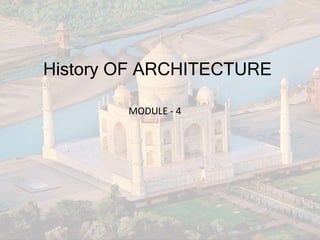
VIEW OF TAJ MAHAL
ITMA-UD-DAULAH
• LOCATION : AGRA , UTTAR PRADESH
• OFTEN REFFERED AS JEWEL BOX AND BABY TAJ
• BUILT IN BETWEEN 1622 AND 1628IT WAS MAINLY BUILT WITH RED SANDSTONE AN D WHITE
MARBLE DECORATIONS
• IT WAS MAINLY MADE OF RED SAND STONE AND WHITE MARBLE.
• IT WAS LOCATED ON THE RIGHT BANK OF RIVER YAMUNA.
• THE MAUSOLEUM IS SET IN A LARGE CRUCIFORM GARDEN CRISS CROSS BY WATER COURSES
AND WALKWAYS
• THE MAUSOLEUM COVERS ABOUT 23sqm AND IS BUILT ON A BASE OF 50sqm AND 1m HIGH
• ON EACH CORNER ARE HEXAGONL TOWERS,ABOUT 13m TALL
• LIGHT PENETRATES TO THE INTERIOR THROUGH DELICATE JALI
• MANY OF NUR JAHAN’S RELATIVES ARE INTERRED IN THE MAUSOLEUM
AKBAR’S TOMB
• LOCATION:SIKANDRA NEAR AGRA
• BUILT IN – 1612 – 1613
• AKBAR HIMSELF SELECTED THE SITE AND
DESIGNED HIS TOMB.
• IT WAS COMPLETED BY HIS SON JAHANGIR
• IT WAS DESIGNED ON THE IDEAS OF A
BUDDHIST VIHARA
• IT IS SITUATED IN THE CENTRE OF CHAR BAGH
• THE ENCLOSED WALL MEASURES 105sqm
HAS GATEWAYS ON ALL FOUR SIDES
• THE TOMB BUILDING IS FOUR TIERED
SUMMOUNTED BY A MARBLE PAVILLION
CONTAINING A FALSE TOMB.
• THE REAL TOMB IS IN THE BASEMENT
• THE MATERIALS USED IS MAINLY RED
SANDSTONE AND SOME FEATURES ENRICHED
WITH WHITE MARBLE.
• DECORATIVE FLORAL PATTERNS AND GEOMETRIC PATTERNS AND CALLIGRAPHIC DESIGNS
WERE USED FOR DECORATION PURPOSE.
• IT HAS A SQUARE COURT MEASURING 10FT PER SIDE WHICH IS OPEN TO SKY
• AT THE CENTRE OF THE COURTYARD IS A SQUARE PLATFORM ON WHICH THE WHITE MARBLE
UNATOPH TOMB (FAKE TOMB) IS LAID OUT.
• IT HAS A HUGE GARDEN WITH A CANAL THAT DOESN’T HAVE WATER THESE DAYS
DIWAN-I AAM
• The diwan-I-aam or hall of audience is located in the red fort of Delhi was where
the Mughal emperor shah Jahan and his successors heard grievances from the
public
• The inner main court to which the Nakkar Khana led was 540 ft. broad and 420 ft.
deep and surrounded by arcade galleries
• The front hall open on three sides and backed by a set of rooms were made of red
sandstone. The hall is 100ft by 60ft and divided into 27 square bays on a system of
columns which support the arches and the roof is spanned by sandstone beams
• The ceilings were painted with gold
RED FORT
• Red fort was built by Shah Jahan and was originally called quila-i-Mubarak
• Red fort is made of red sandstone and the plan is octagonal
• The fortified citadel has two gateways called Lahore and Delhi gates
• The walls of the fort extend up to 2kms and is 33m high.
• The prominent buildings in red fort are Diwan-I-aam and Diwan-I-khas and Rang
Mahal
• It interiors are made of marble
• The fortified citadel has two gateways called Lahore and Delhi gates
• The walls of the fort extend up to 2kms and is 33m high.
• The prominent buildings in red fort are Diwan-I-aam and Diwan-I-khas and Rang
Mahal
• It interiors are made of marble
COLONIAL ARCHITECTURE
 COLONIAL ARCHITECTURE IS AN ARCHITECTURAL STYLE FROM A MOTHER
COUNTRY THAT HAS BEN INCORPORATED INTO THE BUILDINGS OF SETTLEMENTS
OR COLONIES IN DISTANT LOCATIONS.
 IT FOLLOWED VARIOUS TYPES OF ARCHITECTURAL STYLES-
GOTHIC, IMPERIAL, CHRISTIAN ENGLISH RENAISSANCE AND VICTORIAN.
 THE DUCTCH, PORTUGUESE AND THE FRENCH MADE THEIR PRESENCE FELT
THROUGH THEIR BUILDINGS BUT IT WAS THE ENGLISH WHO HAD A LASTING
IMPACT ON ARCHITECTURE.
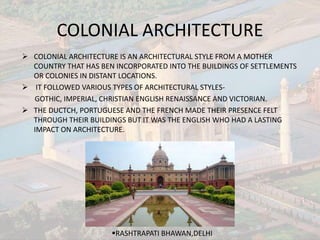
RASHTRAPATI BHAWAN,DELHI
VARIOUS MASTERPIECES OF COLONIAL
ARCHITECTURE IN INDIA
PARLIMENT HOUSE,DELHI
INDIA GATE,DELHI
SUPREME COURT OF INDIA,DELHI
GATEWAY OF INDIA,MUMBAI
TAJ MAHAL PALACE HOTEL,MUMBAI
CHHATRA PATI SHIVAJI TERMINUS,MUMBAI
MUNICIPAL CORPORATION BUILDING ,MUMBAI
IN THE BEGINNING OF THE COLONIAL RULE THERE ATTEMPTS AT
CREATING AUTHORITY THROUGH CLASSICAL PROTOTYPES.
IN ITS LATER PHASE THE COLONIAL ARCHITECTURE CULMINATED INTO
WHAT IS CALLED THE INDO-SARACENIC ARCHITECTURE.
THE INDO-SARACENIC ACHITECTURE COMBINED THE FEATURES OF
HINDU, ISLAMIC AND WESTERN ELEMENTS.
 large numbers over the whole empire. Colonial architecture in India
followed developments not only from metropolis but also took inspiration
from existing architecture in India.
 From the mid nineteenth century it became a norm for the Anglo-Indian
church builders to follow the model set by the revivers of the many
combinations of Gothic in England. In many cases imperialism was the sole
guiding force rather than practicality. On many occasions heavier styles
than Gothic were employed. This can be seen in the Mutiny Memorial
Church at Kanpur and the last garrison church in New Delhi.
 The Italian Gothic was seen to be well adapted to conditions in India.
COLONIAL ARCHITECTURE

Module 4 ppt-1

  • 1.
  • 2.
    CONTENT 1. MUGHAL ARCHITECTURE •MUGHAL GARDENS • TAJ MAHAL • AKBAR’S TOMB • ITMAUD UD DAULA • DIWAN -I-AM • RED FORT 2. COLONIAL ARCHITECTURE • EARLY PHASE –ESTABLISHMENT OF FORTS • WAREHOUSES • BUILDING TYPOLOGIES • ARCHITECTURAL CHARACTER OF COLONIAL INDIAN ARCHITECTURE
  • 3.
    MUGHAL GARDENS INTRODUCTION • MUGHALGARDENS ARE THE GROUP OF GARDENS BUILT BY THE MUGHALS IN THE ISLAMIC STYLE OF ARCHITECTURE. TYPICAL FEATURES- • POOLS • FOUNTAINS • CANALS INSIDE THE GARDENS • RIVER FRONT GARDENS THAN FORTRESS GARDENS • MUGHAL GARDENS ARE DIVIDED INTO THREE SECTIONS- 1. RECTANGULAR PEAL GARDEN 2. LONG BUTTERFLY GARDEN 3. CIRCULAR GARDENS 4. TERRACED GARDEN
  • 4.
    • The founderof the Mughal empire, BABUR , described his favourite type of garden as a CHARBAGH (diving the garden into four equal quarters ) • Humayun , his son, does not seem to have had much time for building. • Akbar built several gardens first in Delhi, then in Agra, Akbar’s new capital. • Akbar’s heir, JAHANGIR, did not build as much, but he helped to layout the famous Shalimar garden and was known for his great love for flowers. • Jahangir’s son, SHAH JAHAN, marks the apex of mugal garden architecture and floral design. • He is famous for the contruction of taj mahal and the Red Fort which contains the Mahtab Bagh. MUGHAL GARDENS
  • 5.
    TAJ MAHAL COMPLEX Location : Agra (Bank of river Yamuna).  Built in 1631-1653.  Built by SHAH JAHAN’s Garden planners and architects .
  • 6.
    TAJ MAHAL COMPLEX The Taj Mahal Complex covers an area of 42 acres(579.2m x 304m) in total with the terrain gradually sloping from south to north, towards the river Yamuna in the form of descending terraces.
  • 7.
    TAJ MAHAL  THEGARDEN SQUARE PLAN MEASURING 304.8 METRES EACH SIDE.  THE FIRST PART CONTAINS A FORE COURT.  THE SECOND PART CONTAINS SENANT QUATERS ON THE WEST SIDE AND ROYAL TOMBS ON EASTERN SIDE.  THE THIRD PART IS ENTERED BY A MAIN GATE ( DARWAZA ) ON THE SOUTHERN SIDE LEADING NORTH TO THE CHARBAGH WITH AN ORNAMENTAL POOL.  THE FOURTH PART ENCLOSES THE TAJ MAHAL AT THE CENTER AND ON THE WEST SIDE IS A MOSQUE AND EASTERN SIDE IS ‘NUHMAN KHANA’ (GUEST HOUSE).
  • 8.
  • 9.
    ITMA-UD-DAULAH • LOCATION :AGRA , UTTAR PRADESH • OFTEN REFFERED AS JEWEL BOX AND BABY TAJ • BUILT IN BETWEEN 1622 AND 1628IT WAS MAINLY BUILT WITH RED SANDSTONE AN D WHITE MARBLE DECORATIONS
  • 10.
    • IT WASMAINLY MADE OF RED SAND STONE AND WHITE MARBLE. • IT WAS LOCATED ON THE RIGHT BANK OF RIVER YAMUNA. • THE MAUSOLEUM IS SET IN A LARGE CRUCIFORM GARDEN CRISS CROSS BY WATER COURSES AND WALKWAYS • THE MAUSOLEUM COVERS ABOUT 23sqm AND IS BUILT ON A BASE OF 50sqm AND 1m HIGH • ON EACH CORNER ARE HEXAGONL TOWERS,ABOUT 13m TALL • LIGHT PENETRATES TO THE INTERIOR THROUGH DELICATE JALI • MANY OF NUR JAHAN’S RELATIVES ARE INTERRED IN THE MAUSOLEUM
  • 11.
    AKBAR’S TOMB • LOCATION:SIKANDRANEAR AGRA • BUILT IN – 1612 – 1613 • AKBAR HIMSELF SELECTED THE SITE AND DESIGNED HIS TOMB. • IT WAS COMPLETED BY HIS SON JAHANGIR • IT WAS DESIGNED ON THE IDEAS OF A BUDDHIST VIHARA • IT IS SITUATED IN THE CENTRE OF CHAR BAGH • THE ENCLOSED WALL MEASURES 105sqm HAS GATEWAYS ON ALL FOUR SIDES • THE TOMB BUILDING IS FOUR TIERED SUMMOUNTED BY A MARBLE PAVILLION CONTAINING A FALSE TOMB. • THE REAL TOMB IS IN THE BASEMENT • THE MATERIALS USED IS MAINLY RED SANDSTONE AND SOME FEATURES ENRICHED WITH WHITE MARBLE.
  • 12.
    • DECORATIVE FLORALPATTERNS AND GEOMETRIC PATTERNS AND CALLIGRAPHIC DESIGNS WERE USED FOR DECORATION PURPOSE. • IT HAS A SQUARE COURT MEASURING 10FT PER SIDE WHICH IS OPEN TO SKY • AT THE CENTRE OF THE COURTYARD IS A SQUARE PLATFORM ON WHICH THE WHITE MARBLE UNATOPH TOMB (FAKE TOMB) IS LAID OUT. • IT HAS A HUGE GARDEN WITH A CANAL THAT DOESN’T HAVE WATER THESE DAYS
  • 13.
    DIWAN-I AAM • Thediwan-I-aam or hall of audience is located in the red fort of Delhi was where the Mughal emperor shah Jahan and his successors heard grievances from the public • The inner main court to which the Nakkar Khana led was 540 ft. broad and 420 ft. deep and surrounded by arcade galleries
  • 14.
    • The fronthall open on three sides and backed by a set of rooms were made of red sandstone. The hall is 100ft by 60ft and divided into 27 square bays on a system of columns which support the arches and the roof is spanned by sandstone beams • The ceilings were painted with gold
  • 16.
    RED FORT • Redfort was built by Shah Jahan and was originally called quila-i-Mubarak • Red fort is made of red sandstone and the plan is octagonal • The fortified citadel has two gateways called Lahore and Delhi gates • The walls of the fort extend up to 2kms and is 33m high. • The prominent buildings in red fort are Diwan-I-aam and Diwan-I-khas and Rang Mahal • It interiors are made of marble
  • 17.
    • The fortifiedcitadel has two gateways called Lahore and Delhi gates • The walls of the fort extend up to 2kms and is 33m high. • The prominent buildings in red fort are Diwan-I-aam and Diwan-I-khas and Rang Mahal • It interiors are made of marble
  • 19.
    COLONIAL ARCHITECTURE  COLONIALARCHITECTURE IS AN ARCHITECTURAL STYLE FROM A MOTHER COUNTRY THAT HAS BEN INCORPORATED INTO THE BUILDINGS OF SETTLEMENTS OR COLONIES IN DISTANT LOCATIONS.  IT FOLLOWED VARIOUS TYPES OF ARCHITECTURAL STYLES- GOTHIC, IMPERIAL, CHRISTIAN ENGLISH RENAISSANCE AND VICTORIAN.  THE DUCTCH, PORTUGUESE AND THE FRENCH MADE THEIR PRESENCE FELT THROUGH THEIR BUILDINGS BUT IT WAS THE ENGLISH WHO HAD A LASTING IMPACT ON ARCHITECTURE. RASHTRAPATI BHAWAN,DELHI
  • 20.
    VARIOUS MASTERPIECES OFCOLONIAL ARCHITECTURE IN INDIA PARLIMENT HOUSE,DELHI INDIA GATE,DELHI SUPREME COURT OF INDIA,DELHI
  • 21.
    GATEWAY OF INDIA,MUMBAI TAJMAHAL PALACE HOTEL,MUMBAI CHHATRA PATI SHIVAJI TERMINUS,MUMBAI
  • 22.
    MUNICIPAL CORPORATION BUILDING,MUMBAI IN THE BEGINNING OF THE COLONIAL RULE THERE ATTEMPTS AT CREATING AUTHORITY THROUGH CLASSICAL PROTOTYPES. IN ITS LATER PHASE THE COLONIAL ARCHITECTURE CULMINATED INTO WHAT IS CALLED THE INDO-SARACENIC ARCHITECTURE. THE INDO-SARACENIC ACHITECTURE COMBINED THE FEATURES OF HINDU, ISLAMIC AND WESTERN ELEMENTS.
  • 23.
     large numbersover the whole empire. Colonial architecture in India followed developments not only from metropolis but also took inspiration from existing architecture in India.  From the mid nineteenth century it became a norm for the Anglo-Indian church builders to follow the model set by the revivers of the many combinations of Gothic in England. In many cases imperialism was the sole guiding force rather than practicality. On many occasions heavier styles than Gothic were employed. This can be seen in the Mutiny Memorial Church at Kanpur and the last garrison church in New Delhi.  The Italian Gothic was seen to be well adapted to conditions in India. COLONIAL ARCHITECTURE