Board Games
Week 3 Presentation for
TEFL2YL EVO sessions 2018
by Nives Torresi & Sheryl McCoy
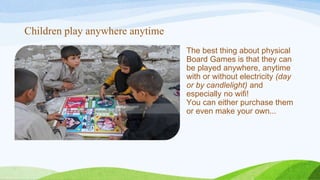
Children play anywhere anytime
The best thing about physical
Board Games is that they can
be played anywhere, anytime
with or without electricity (day
or by candlelight) and
especially no wifi!
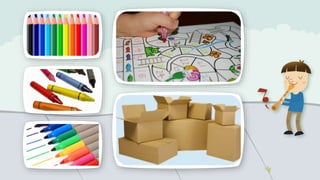
You can either purchase them
or even make your own...
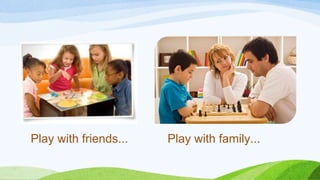
Play with friends... Play with family...
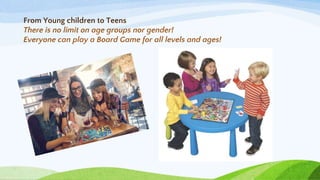
From Young children to Teens
There is no limit on age groups nor gender!
Everyone can play a Board Game for all levels and ages!
Board Games for EFL
Understanding how Board Games can
be used to effectively promote
language acquisition
Theory and related discussions...
• Game based learning for Language acquisition (EFL)
• Theory of ‘Gamification’ (e.g. MineCraft)
• Playing Games boost self confidence
• Games in preschool & elementary schools for basic learning
principles
• Authentic learning
• “In education, authentic learning is an instructional approach that allows
students to explore, discuss, and meaningfully construct concepts and
relationships in contexts that involve real-world problems and projects that
are relevant to the learner.”
Board Games for EFL
Board Games themes
• Learning Vocabulary
• Phrase construction
• Phrasal Verbs
• Collocations
• Tenses
• Conditionals
• Adjectives
• Irregular Verbs
• Nouns
• Numbers
Objectives
• Elicit speech
• Enhance memory retention
• Repetition in relax mode
• Build on basic Grammar
• Reinforce fluency
• Reinforce Pronunciation
• Image descriptions
• Build on ‘small talk’
Board Games and Language Acquisition for EFL
● Controlled Vocabulary
● Accept and learn from mistakes
● Types of conversations and skills for fun interactions
○ Have fun learning and being social
○ ASK for HELP.
■ Give children a chance to ask questions in English.
● Where and the other 5 W words & How
● Now - Expressing the present situation
● Other similar words
■ Listen to others, wait time, and reply appropriately
○ Use of controlled vocabulary assisted by common words
○ Careful, thoughtful answers
Games are ...
● Fun → promote relaxed environment
● Competitive → promotes natural competitiveness
● Challenging → creates new paths in learning
● Group oriented → promotes social bonding
● Easy to introduce new vocabulary
● A way to reinforce grammatical forms
● Good to learn Phrasal Verbs
● Great to instigate spoken forms → natural communication
● Excellent tool for Teacher to complement a topic
Through games Children and Teens learn…
skills!
• Planning
• Strategy
• Commitment
• Engagement
• Focus
• Problem solving
• Decision making
• Communication
• Teamwork
• Creativity
• Leadership
• Critical thinking
• Collaboration
• Negotiation
• Responsability
• To ask Questions
• Cultural awareness
• Peer to Peer learning
• To take charge of their learning
• To be more confident
Games also have some drawbacks…
• Create extra workload on the Teacher
• Create stress in competitiveness activity
• Promote alienation if not checked
• Does not guarantee engagement
• Can become boring and repetitive
• May be opposed by Stakeholders and Parents
• May create class divisions rather than working teams
• Promote the talkers leaving behind the shy students
• Not necessarily build confidence in students lacking confidence
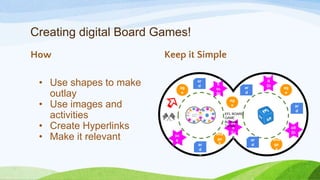
Creating digital Board Games!
How
• Use shapes to make
outlay
• Use images and
activities
• Create Hyperlinks
• Make it relevant
Keep it Simple
B
ac
k
to
St
ar
t
Ro
ll
Di
ce
R
oll
Di
ce
Mi
ss
a
Tu
rn
B
ac
k
2
Im
ag
e
1
C
ar
d
1
C
ar
d
2
C
ar
d
3
C
ar
d
4
C
ar
d
5
Im
ag
e
2
Im
ag
e
3
Ima
ge
4
Ima
ge
5
EFL BOARD
GAME
By Nives
Torresi
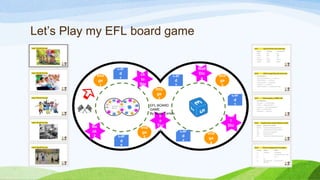
Let’s Play my EFL board game
Ba
ck
to
Sta
rt
Roll
Dic
e
Rol
l
Dic
e
Mis
s
a
Tur
n
Ba
ck
2
Ima
ge
1
Car
d
1
Car
d
2
Car
d
3
Car
d
4
Car
d
5
Ima
ge
2
Ima
ge
3
Ima
ge
4
Ima
ge
5
EFL BOARD
GAME
By Nives Torresi
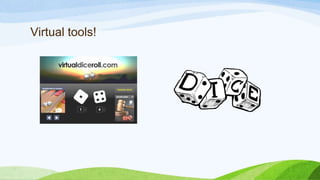
Virtual tools!
Create your very own Board Game!
Links
http://www.toolsforeducators.com/b
oardgames/
Watch the video first…
Sheryl on Digital Game Boards for
TEFL2YL EVO 2018
Activity
Make your own Board Game,
either using the link on the left or
create your own in Google slides.
Create a Video Tutorial of your
process and steps to make your
Board Game, no need for slides
just a Video!
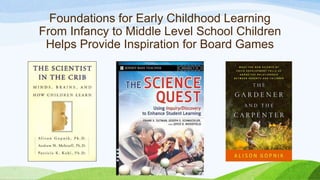
Foundations for Early Childhood Learning
From Infancy to Middle Level School Children
Helps Provide Inspiration for Board Games
Bookmark links
http://www.education.vic.gov.au/about/research/Pages/techga
melearn.aspx
http://www.education.vic.gov.au/school/teachers/support/Page
s/innovatehere.aspx?Redirect=1
http://www.education.vic.gov.au/Documents/about/research/fin
dingsreport.pdf
http://www.newmedia.org/game-based-learning--what-it-is-
why-it-works-and-where-its-going.html
http://www.slideshare.net/autnes/gamification-vsgamebased-
learning-theories-methods-and-controversies-by-sherry-jones
https://pixelearning.files.wordpress.com/2012/08/final_info.jpg
https://ed655-2012.community.uaf.edu/2012/10/05/article-
review-3-learning-theory-and-game-based-learning-owen/
http://www.slideshare.net/NivesTorresi/efl-talks-answers-
board-games-in-the-classroom
http://www.slideshare.net/NivesTorresi/making-a-board-game
http://www.games-ed.co.uk/resources/Games-Based-Situated-
Learning-v1.pdf
Here we have added some links to Web
content related to the use of Board
Games and Game Based Learning
theory.
Most of these have been personally
read and included in this presentation as
part of the research for related
documentation.
Bookmark links
What is Inteligence? a copy of a talk given by Daniel Dennett called What is Intelligence?, The
Darwin College Lectures, ed. Jean Khalfa, Cambridge, Cambridge Univ. Press. 1994 Website cited
on January 23, 2018.
Benefits of bilingualism for young children
a discussion - how and how well do young children learn two languages affects how much they may
gain from this process. The truly bilingual young child develops greatly from the helpful benefits of
their knowledge of two languages. (CLIL is an example of ways to develop this bilingualism)
What Reading Does for the Mind Lack of exposure and practice on the part of the less-skilled
reader delays the development of automaticity and speed at the word recognition level. This
correlates well with a child’s first language acquisition, as well as second language acquisition
Scientist in the Crib - The Book a brief discussion and recommendation from other developmental
scientists. You may love this book so much that you want to order it. There is a link to Amazon, but
you can always ask your local bookstore to order it. There are also second hand bookstores that sell
wonderful copies of the book.
Scientist in the Crib - A review that explicitly provides some information about learning language and
how the young child’s brain works as the child grows. Why adults can't hear certain sounds, but they
could discriminate them as children.
Scientist in the Crib - an excerpt
The Gardener and the Carpenter Parents and caregivers can learn from current scientific research
that shows more productive development comes when we are gardeners, not carpenters. Amazing
research.
The Gardener and the Carpenter - the book It’s newer (2016) and can usually be ordered by your
local bookstore.
Here we have added some links to Web
content related to the use of Board
Games and Game Based Learning
theory.
Most of these have been personally
read and included in this presentation as
part of the research for related
documentation.
Image attributions
Slide 1, 23 - TESOL EVO 2018 official Logo (used here with permission)
Slide 2, 23 - Teaching EFL to Young Learners Logo (used here with permission)
Slide 4 - https://media.gettyimages.com/photos/afghan-children-play-a-ludo-board-game-its-playing-board-
seen-adorned-picture-id185023212
Slide 5 - https://psychologymum.files.wordpress.com/2015/09/children-playing-board-game.jpg
https://manhattanpsychologygroup.com/wp-content/uploads/2016/01/17415972_l.jpg
Slide 6 - https://i.ytimg.com/vi/LWVBsETWPCo/maxresdefault.jpg
https://cdn.images.express.co.uk/img/dynamic/130/590x/secondary/Board-game-741917.jpg
Slide 7 - http://myroyalrae.com/wp-content/uploads/2014/04/writing-board.jpg
http://www.quickbrownbox.com.au/images/products/Stock_Box_Group.png
https://s-media-cache-ak0.pinimg.com/originals/ed/05/03/ed050342a304ae43fb344446cb8f5c79.jpg
http://stuffyoudontwant.com/wp-content/uploads/2012/01/crayons.jpg
http://thumbs3.ebaystatic.com/d/l225/pict/201487015478_1.jpg
Slide 14, 15 - English EFL course 2017 Board Game created by Nives Torresi
Slide 17 - http://www.virtualdiceroll.com/ and http://www.shodor.org/~rebeccat/diceLogo.png
Slide 19 - Wiley Publisher Website for The Science Quest
https://www.barnesandnoble.com/w/the-scientist-in-the-crib-alison-m-gopnik/1110778479
http://alisongopnik.com/TheGardenerAndTheCarpenter.htm
Presentation Slides - Rainbow theme MICROSOFT Office templates
Thank you
for watching another presentation by
Nives Torresi & Sheryl McCoy
about Nives about Sheryl

Tefl2 yl evo 2018 board games

  • 3.
    Board Games Week 3Presentation for TEFL2YL EVO sessions 2018 by Nives Torresi & Sheryl McCoy
  • 4.
    Children play anywhereanytime The best thing about physical Board Games is that they can be played anywhere, anytime with or without electricity (day or by candlelight) and especially no wifi! You can either purchase them or even make your own...
  • 5.
    Play with friends...Play with family...
  • 6.
    From Young childrento Teens There is no limit on age groups nor gender! Everyone can play a Board Game for all levels and ages!
  • 8.
    Board Games forEFL Understanding how Board Games can be used to effectively promote language acquisition
  • 9.
    Theory and relateddiscussions... • Game based learning for Language acquisition (EFL) • Theory of ‘Gamification’ (e.g. MineCraft) • Playing Games boost self confidence • Games in preschool & elementary schools for basic learning principles • Authentic learning • “In education, authentic learning is an instructional approach that allows students to explore, discuss, and meaningfully construct concepts and relationships in contexts that involve real-world problems and projects that are relevant to the learner.”
  • 10.
    Board Games forEFL Board Games themes • Learning Vocabulary • Phrase construction • Phrasal Verbs • Collocations • Tenses • Conditionals • Adjectives • Irregular Verbs • Nouns • Numbers Objectives • Elicit speech • Enhance memory retention • Repetition in relax mode • Build on basic Grammar • Reinforce fluency • Reinforce Pronunciation • Image descriptions • Build on ‘small talk’
  • 11.
    Board Games andLanguage Acquisition for EFL ● Controlled Vocabulary ● Accept and learn from mistakes ● Types of conversations and skills for fun interactions ○ Have fun learning and being social ○ ASK for HELP. ■ Give children a chance to ask questions in English. ● Where and the other 5 W words & How ● Now - Expressing the present situation ● Other similar words ■ Listen to others, wait time, and reply appropriately ○ Use of controlled vocabulary assisted by common words ○ Careful, thoughtful answers
  • 12.
    Games are ... ●Fun → promote relaxed environment ● Competitive → promotes natural competitiveness ● Challenging → creates new paths in learning ● Group oriented → promotes social bonding ● Easy to introduce new vocabulary ● A way to reinforce grammatical forms ● Good to learn Phrasal Verbs ● Great to instigate spoken forms → natural communication ● Excellent tool for Teacher to complement a topic
  • 13.
    Through games Childrenand Teens learn… skills! • Planning • Strategy • Commitment • Engagement • Focus • Problem solving • Decision making • Communication • Teamwork • Creativity • Leadership • Critical thinking • Collaboration • Negotiation • Responsability • To ask Questions • Cultural awareness • Peer to Peer learning • To take charge of their learning • To be more confident
  • 14.
    Games also havesome drawbacks… • Create extra workload on the Teacher • Create stress in competitiveness activity • Promote alienation if not checked • Does not guarantee engagement • Can become boring and repetitive • May be opposed by Stakeholders and Parents • May create class divisions rather than working teams • Promote the talkers leaving behind the shy students • Not necessarily build confidence in students lacking confidence
  • 15.
    Creating digital BoardGames! How • Use shapes to make outlay • Use images and activities • Create Hyperlinks • Make it relevant Keep it Simple B ac k to St ar t Ro ll Di ce R oll Di ce Mi ss a Tu rn B ac k 2 Im ag e 1 C ar d 1 C ar d 2 C ar d 3 C ar d 4 C ar d 5 Im ag e 2 Im ag e 3 Ima ge 4 Ima ge 5 EFL BOARD GAME By Nives Torresi
  • 16.
    Let’s Play myEFL board game Ba ck to Sta rt Roll Dic e Rol l Dic e Mis s a Tur n Ba ck 2 Ima ge 1 Car d 1 Car d 2 Car d 3 Car d 4 Car d 5 Ima ge 2 Ima ge 3 Ima ge 4 Ima ge 5 EFL BOARD GAME By Nives Torresi
  • 17.
  • 18.
    Create your veryown Board Game! Links http://www.toolsforeducators.com/b oardgames/ Watch the video first… Sheryl on Digital Game Boards for TEFL2YL EVO 2018 Activity Make your own Board Game, either using the link on the left or create your own in Google slides. Create a Video Tutorial of your process and steps to make your Board Game, no need for slides just a Video!
  • 19.
    Foundations for EarlyChildhood Learning From Infancy to Middle Level School Children Helps Provide Inspiration for Board Games
  • 20.
    Bookmark links http://www.education.vic.gov.au/about/research/Pages/techga melearn.aspx http://www.education.vic.gov.au/school/teachers/support/Page s/innovatehere.aspx?Redirect=1 http://www.education.vic.gov.au/Documents/about/research/fin dingsreport.pdf http://www.newmedia.org/game-based-learning--what-it-is- why-it-works-and-where-its-going.html http://www.slideshare.net/autnes/gamification-vsgamebased- learning-theories-methods-and-controversies-by-sherry-jones https://pixelearning.files.wordpress.com/2012/08/final_info.jpg https://ed655-2012.community.uaf.edu/2012/10/05/article- review-3-learning-theory-and-game-based-learning-owen/ http://www.slideshare.net/NivesTorresi/efl-talks-answers- board-games-in-the-classroom http://www.slideshare.net/NivesTorresi/making-a-board-game http://www.games-ed.co.uk/resources/Games-Based-Situated- Learning-v1.pdf Here wehave added some links to Web content related to the use of Board Games and Game Based Learning theory. Most of these have been personally read and included in this presentation as part of the research for related documentation.
  • 21.
    Bookmark links What isInteligence? a copy of a talk given by Daniel Dennett called What is Intelligence?, The Darwin College Lectures, ed. Jean Khalfa, Cambridge, Cambridge Univ. Press. 1994 Website cited on January 23, 2018. Benefits of bilingualism for young children a discussion - how and how well do young children learn two languages affects how much they may gain from this process. The truly bilingual young child develops greatly from the helpful benefits of their knowledge of two languages. (CLIL is an example of ways to develop this bilingualism) What Reading Does for the Mind Lack of exposure and practice on the part of the less-skilled reader delays the development of automaticity and speed at the word recognition level. This correlates well with a child’s first language acquisition, as well as second language acquisition Scientist in the Crib - The Book a brief discussion and recommendation from other developmental scientists. You may love this book so much that you want to order it. There is a link to Amazon, but you can always ask your local bookstore to order it. There are also second hand bookstores that sell wonderful copies of the book. Scientist in the Crib - A review that explicitly provides some information about learning language and how the young child’s brain works as the child grows. Why adults can't hear certain sounds, but they could discriminate them as children. Scientist in the Crib - an excerpt The Gardener and the Carpenter Parents and caregivers can learn from current scientific research that shows more productive development comes when we are gardeners, not carpenters. Amazing research. The Gardener and the Carpenter - the book It’s newer (2016) and can usually be ordered by your local bookstore. Here we have added some links to Web content related to the use of Board Games and Game Based Learning theory. Most of these have been personally read and included in this presentation as part of the research for related documentation.
  • 22.
    Image attributions Slide 1,23 - TESOL EVO 2018 official Logo (used here with permission) Slide 2, 23 - Teaching EFL to Young Learners Logo (used here with permission) Slide 4 - https://media.gettyimages.com/photos/afghan-children-play-a-ludo-board-game-its-playing-board- seen-adorned-picture-id185023212 Slide 5 - https://psychologymum.files.wordpress.com/2015/09/children-playing-board-game.jpg https://manhattanpsychologygroup.com/wp-content/uploads/2016/01/17415972_l.jpg Slide 6 - https://i.ytimg.com/vi/LWVBsETWPCo/maxresdefault.jpg https://cdn.images.express.co.uk/img/dynamic/130/590x/secondary/Board-game-741917.jpg Slide 7 - http://myroyalrae.com/wp-content/uploads/2014/04/writing-board.jpg http://www.quickbrownbox.com.au/images/products/Stock_Box_Group.png https://s-media-cache-ak0.pinimg.com/originals/ed/05/03/ed050342a304ae43fb344446cb8f5c79.jpg http://stuffyoudontwant.com/wp-content/uploads/2012/01/crayons.jpg http://thumbs3.ebaystatic.com/d/l225/pict/201487015478_1.jpg Slide 14, 15 - English EFL course 2017 Board Game created by Nives Torresi Slide 17 - http://www.virtualdiceroll.com/ and http://www.shodor.org/~rebeccat/diceLogo.png Slide 19 - Wiley Publisher Website for The Science Quest https://www.barnesandnoble.com/w/the-scientist-in-the-crib-alison-m-gopnik/1110778479 http://alisongopnik.com/TheGardenerAndTheCarpenter.htm Presentation Slides - Rainbow theme MICROSOFT Office templates
  • 23.
    Thank you for watchinganother presentation by Nives Torresi & Sheryl McCoy about Nives about Sheryl