it’s all children’s games
playing with pre-primary and primary learners
Masha Andrievich
Trendy English Games, April 2o17
What are we talking about today?
- how play in general reflects child development
- implications for teaching
- generic game types to offer to various age
groups
- games for pre-schoolers and primary children
- resources
Why do children play at all?
👑 main child play researchers - J. Piaget, E.
Eriksson, L .Vygotsky, F. Buytendijk, K. Gross 👑
play is an exercise
human beings play games because they are young
play is an essential vehicle for development
younger children (3.5 – 5 y.o)
– learn holistically
– have limited motor skills
– enjoy exploring the world of objects around
– more self-centred rather than interested in
communication with peers
– in most cases, no literacy skills or just the
beginning
how do we respond to these age needs?
– use movement
– ensure we offer games where speaking,
listening and movement are all involved
– build up on the interest to objects
– help young students build social interaction
skills
so, what are the games, then?
1 – Realia/ Single-object games
–> the idea is to create together an object to
expose the language you’ve chosen
1. provide a model
2. help create an object
3. model the language (2-3-4 phrases)
4. practice!
2 – Movement games – Good old TPR 
- Robots
- Animal party
- Yes/No Borderline
- Games with Picture Flashcards
*clear and short instructions
don’t forget to change roles!
3 – early stage Board games
– Memory (start with less pairs)
– Big Dice games
– Spinner games
– Domino
– Snap
*teach Classroom language for the game – “it’s
your turn”, “no, sorry”, “I’m first!” etc
primary learners (7-9 y.o)
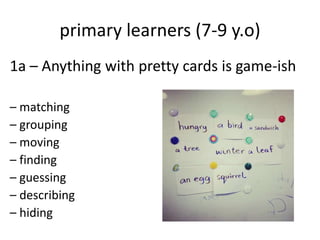
1a – Anything with pretty cards is game-ish
– matching
– grouping
– moving
– finding
– guessing
– describing
– hiding
1b – enhancing Resource pack games
2 more stages: language focus (pre) and recall (post)
1 choose an area to focus on before going into the
Activity (potentially difficult/add more for vocab
development)
2 set the task (“We’re going to play a game. But before
let’s look at..”) and go through the language
3 Model the Activity + allow time
4 Feedback
5 Recap (learners use the language from the Activity and
your language focus)
2 – Board games
– choose games that are rich in language
– chose games for skills development
- Happy families type
- BrainBox
- Guess who?
- DK games – Very Silly Sentences, etc
- Scholastic Games pack
- Djeco games
3 – Drama games
– Charades
– Statues
– Do the opposite
– Simon says
Recap?
– 3 types of games for younger children?
Realia game
Beginner board games
Movement games
– 3+ types of games for older children?
Pretty cards activities
Resource pack games enhanced
Board games
Drama games
Resources
Resources
+Carold Read’s list of flashcard “games”
http://www.carolread.com/wp-content/uploads/2014/08/flashcards.pdf
Thank you for coming!
andmasha@gmail.com
fromtheclass.wordpress.com
facebook.com/andmasha

Pre primary and primary games

  • 1.
    it’s all children’sgames playing with pre-primary and primary learners Masha Andrievich Trendy English Games, April 2o17
  • 2.
    What are wetalking about today? - how play in general reflects child development - implications for teaching - generic game types to offer to various age groups - games for pre-schoolers and primary children - resources
  • 3.
    Why do childrenplay at all? 👑 main child play researchers - J. Piaget, E. Eriksson, L .Vygotsky, F. Buytendijk, K. Gross 👑 play is an exercise human beings play games because they are young play is an essential vehicle for development
  • 4.
    younger children (3.5– 5 y.o) – learn holistically – have limited motor skills – enjoy exploring the world of objects around – more self-centred rather than interested in communication with peers – in most cases, no literacy skills or just the beginning
  • 5.
    how do werespond to these age needs? – use movement – ensure we offer games where speaking, listening and movement are all involved – build up on the interest to objects – help young students build social interaction skills
  • 6.
    so, what arethe games, then? 1 – Realia/ Single-object games
  • 7.
    –> the ideais to create together an object to expose the language you’ve chosen 1. provide a model 2. help create an object 3. model the language (2-3-4 phrases) 4. practice!
  • 8.
    2 – Movementgames – Good old TPR  - Robots - Animal party - Yes/No Borderline - Games with Picture Flashcards *clear and short instructions don’t forget to change roles!
  • 9.
    3 – earlystage Board games – Memory (start with less pairs) – Big Dice games – Spinner games – Domino – Snap *teach Classroom language for the game – “it’s your turn”, “no, sorry”, “I’m first!” etc
  • 10.
    primary learners (7-9y.o) 1a – Anything with pretty cards is game-ish – matching – grouping – moving – finding – guessing – describing – hiding
  • 11.
    1b – enhancingResource pack games
  • 13.
    1b – enhancingResource pack games 2 more stages: language focus (pre) and recall (post) 1 choose an area to focus on before going into the Activity (potentially difficult/add more for vocab development) 2 set the task (“We’re going to play a game. But before let’s look at..”) and go through the language 3 Model the Activity + allow time 4 Feedback 5 Recap (learners use the language from the Activity and your language focus)
  • 14.
    2 – Boardgames – choose games that are rich in language – chose games for skills development - Happy families type - BrainBox - Guess who? - DK games – Very Silly Sentences, etc - Scholastic Games pack - Djeco games
  • 15.
    3 – Dramagames – Charades – Statues – Do the opposite – Simon says
  • 16.
    Recap? – 3 typesof games for younger children? Realia game Beginner board games Movement games – 3+ types of games for older children? Pretty cards activities Resource pack games enhanced Board games Drama games
  • 17.
  • 18.
    Resources +Carold Read’s listof flashcard “games” http://www.carolread.com/wp-content/uploads/2014/08/flashcards.pdf
  • 19.
    Thank you forcoming! andmasha@gmail.com fromtheclass.wordpress.com facebook.com/andmasha