Online Implementation of
AB 705 in Math
By Fred Feldon & Lisa Lee
Coastline Community College
Third Annual Acceleration Across California Conference
Sacramento, CA
February 23, 2019
This presentation is available at
http://www.slideshare.net/ffeldon
Agenda
• Intro
• What We’re Doing At Coastline
• What Makes a Good Online Course
• What Makes a Good Online Support Course
• What We’re Doing in College Algebra
• What We’re Doing in Statistics
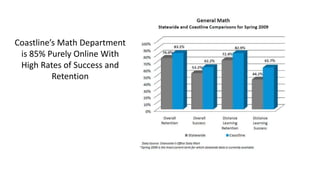
Coastline’s Math Department
is 85% Purely Online With
High Rates of Success and
Retention
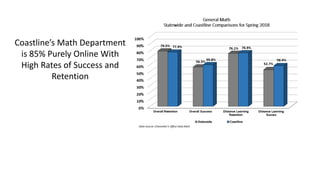
Coastline’s Math Department
is 85% Purely Online With
High Rates of Success and
Retention
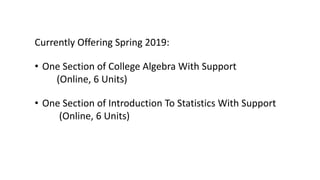
Currently Offering Spring 2019:
• One Section of College Algebra With Support
(Online, 6 Units)
• One Section of Introduction To Statistics With Support
(Online, 6 Units)
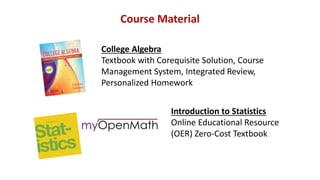
College Algebra
Textbook with Corequisite Solution, Course
Management System, Integrated Review,
Personalized Homework
Introduction to Statistics
Online Educational Resource
(OER) Zero-Cost Textbook
Course Material
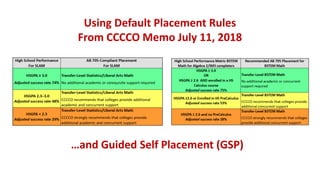
Using Default Placement Rules
From CCCCO Memo July 11, 2018
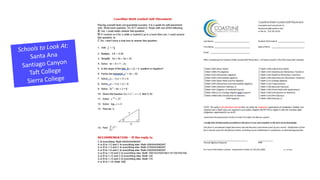
…and Guided Self Placement (GSP)
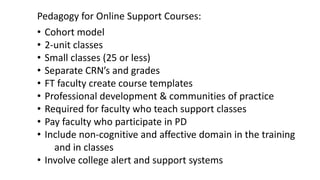
Pedagogy for Online Support Courses:
• Cohort model
• 2-unit classes
• Small classes (25 or less)
• Separate CRN’s and grades
• FT faculty create course templates
• Professional development & communities of practice
• Required for faculty who teach support classes
• Pay faculty who participate in PD
• Include non-cognitive and affective domain in the training
and in classes
• Involve college alert and support systems
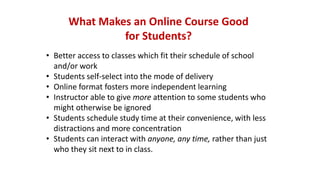
What Makes an Online Course Good
for Students?
• Better access to classes which fit their schedule of school
and/or work
• Students self-select into the mode of delivery
• Online format fosters more independent learning
• Instructor able to give more attention to some students who
might otherwise be ignored
• Students schedule study time at their convenience, with less
distractions and more concentration
• Students can interact with anyone, any time, rather than just
who they sit next to in class.
What Makes an Online Course Good
for Faculty?
• Increased flexibility
• Teach from any location, any time
• Online format fosters more independent learning
• Anonymity of the Internet: Everyone is equal
“On the Internet, nobody knows you’re a dog!”
What Makes an Online Course Good
for Faculty? (Cont’d)
• Increased flexibility
• Teach from any location, any time
• Online format fosters more independent learning
• Anonymity of the Internet: Everyone is equal
• Feeling of community is possible!
• Equally rewarding and enjoyable
• Number of students you can reach individually increases
• Students can collaborate easier
• Students do more on their own—the role of authority is more
spread out
What Makes an Online Course Good
for Faculty? (Cont’d)
• Assessments (homework & quizzes) are interactive and
scored automatically, saving time
• Changes to course can be made in real time
• You have time to think and research before answering
questions
• Students expect more technology from higher education
• Amount of voicemails decrease
• Interaction can and should replicate in-class discussion
• Supplemental and enrichment material can be more timely
A Few Tips
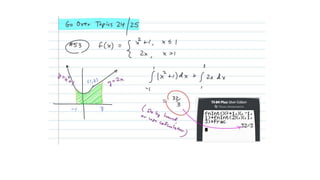
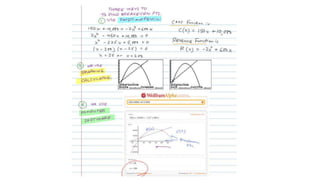
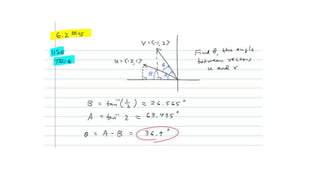
• Use a Tablet PC
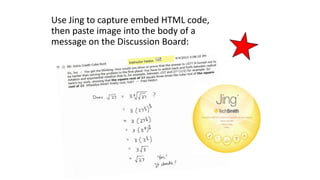
Use Jing to capture embed HTML code,
then paste image into the body of a
message on the Discussion Board:
A Few Tips (Cont’d)
• Use a Tablet PC
• Discourage the use of email: encourage use of Discussion Board
“That’s a great question! Could you do me a favor? Other students may
be wondering the same thing. Could you please post it on the Discussion
Board? That way, we can help everyone. I or another student will reply
right away. Thanks. I appreciate it!”
• Your first priority is discussion (before email)
• Teach students to communicate mathematically
• Demonstrate the behavior you want students to emulate
• Lure students to Discussion Board
• Welcome videos and emails
• Frequent low-stakes interaction, practice and feedback
• Proactive, specific feedback: struggling students, high achievers,
etc.
A Few Tips (Cont’d)
• Be flexible; allow students to work ahead or catch up if they fall behind
• Drop No Shows and Inactive students but allow them to catch up and
be reinstated in the class
• Maintain academic quality and rigor (same as onsite classes)
• Exams MUST be Proctored, show ID, show your work, and worth a
significant percentage (2/3 or more) of their final course grade
• Create and randomly distribute multiple forms of the exams
• Consider individuals who may need to finish late (give them an F then
change their grade later)
• Give assignments that are peer evaluated
• Ask students to explain their thinking, justify their answers; ask
frequent open-ended questions that may not have one, right answer*
*More on this later…
A Few Tips (Cont’d)
• Supplement and enrich the course with instructor-created
material
• Personalize the course with your voice, with videos, with your
hobby, background, interests, sense of humor, etc.
What Makes a Good Online
Support Course?
• All the above PLUS
• Concurrent enrollment of cohorts in transfer courses
• Low-unit concurrent support (one- to two-units)
• Backwards design and just-in-time remediation
• Integrate intentional strategies, policies and activities to
address the affective side of learning
• Help accelerate acquisition of college-level skills
• Integrate academic affairs and student services (e.g.
counseling, mentoring, and guidance to students’ goals)
Sources for Affective Domain
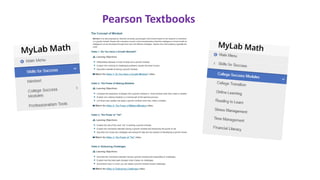
Pearson Textbooks
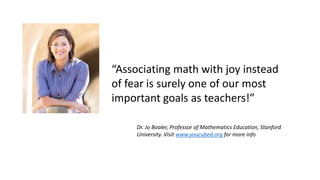
“Associating math with joy instead
of fear is surely one of our most
important goals as teachers!”
Dr. Jo Boaler, Professor of Mathematics Education, Stanford
University. Visit www.youcubed.org for more info
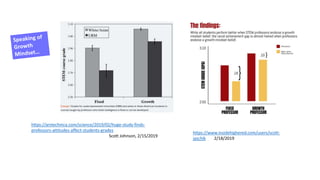
https://arstechnica.com/science/2019/02/huge-study-finds-
professors-attitudes-affect-students-grades
Scott Johnson, 2/15/2019
https://www.insidehighered.com/users/scott-
jaschik 2/18/2019
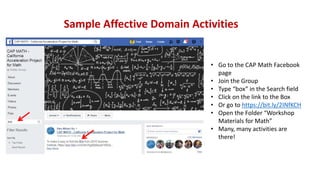
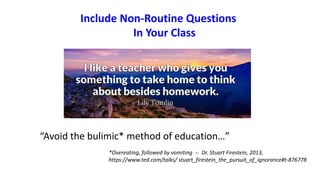
Sample Affective Domain Activities
• Go to the CAP Math Facebook
page
• Join the Group
• Type “box” in the Search field
• Click on the link to the Box
• Or go to https://bit.ly/2INfKCH
• Open the Folder “Workshop
Materials for Math”
• Many, many activities are
there!
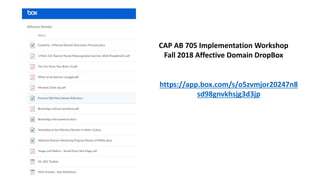
CAP AB 705 Implementation Workshop
Fall 2018 Affective Domain DropBox
https://app.box.com/s/o5zvmjor20247n8
sd98gnvkhsjg3d3jp
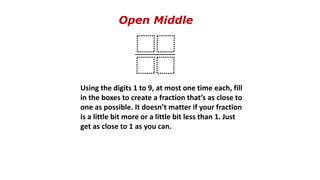
Include Non-Routine Questions
In Your Class
“Avoid the bulimic* method of education…”
*Overeating, followed by vomiting -- Dr. Stuart Firestein, 2013,
https://www.ted.com/talks/ stuart_firestein_the_pursuit_of_ignorance#t-876778
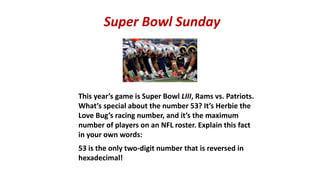
Open Middle
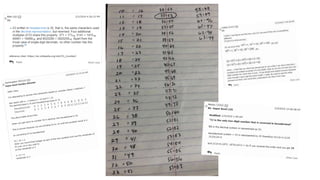
Using the digits 1 to 9, at most one time each, fill
in the boxes to create a fraction that’s as close to
one as possible. It doesn’t matter if your fraction
is a little bit more or a little bit less than 1. Just
get as close to 1 as you can.
Super Bowl Sunday
This year’s game is Super Bowl LIII, Rams vs. Patriots.
What’s special about the number 53? It’s Herbie the
Love Bug’s racing number, and it’s the maximum
number of players on an NFL roster. Explain this fact
in your own words:
53 is the only two-digit number that is reversed in
hexadecimal!
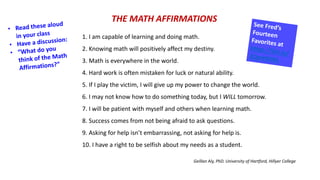
THE MATH AFFIRMATIONS
1. I am capable of learning and doing math.
2. Knowing math will positively affect my destiny.
3. Math is everywhere in the world.
4. Hard work is often mistaken for luck or natural ability.
5. If I play the victim, I will give up my power to change the world.
6. I may not know how to do something today, but I WILL tomorrow.
7. I will be patient with myself and others when learning math.
8. Success comes from not being afraid to ask questions.
9. Asking for help isn’t embarrassing, not asking for help is.
10. I have a right to be selfish about my needs as a student.
Geillan Aly, PhD. University of Hartford, Hillyer College
PatrickJMT
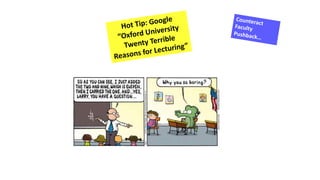
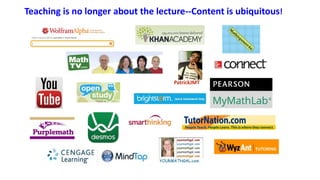
Teaching is no longer about the lecture--Content is ubiquitous!
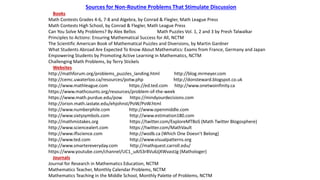
Sources for Non-Routine Problems That Stimulate Discussion
Books
Math Contests Grades 4-6, 7-8 and Algebra, by Conrad & Flegler, Math League Press
Math Contests High School, by Conrad & Flegler, Math League Press
Can You Solve My Problems? By Alex Bellos Math Puzzles Vol. 1, 2 and 3 by Presh Talwalkar
Principles to Actions: Ensuring Mathematical Success for All, NCTM
The Scientific American Book of Mathematical Puzzles and Diversions, by Martin Gardner
What Students Abroad Are Expected To Know About Mathematics: Exams from France, Germany and Japan
Empowering Students by Promoting Active Learning in Mathematics, NCTM
Challenging Math Problems, by Terry Stickels
Websites
http://mathforum.org/problems_puzzles_landing.html http://blog.mrmeyer.com
http://cemc.uwaterloo.ca/resources/potw.php http://donsteward.blogspot.co.uk
http://www.mathleague.com https://ed.ted.com http://www.onetwoinfinity.ca
https://www.mathcounts.org/resources/problem-of-the-week
https://www.math.purdue.edu/pow https://mindyourdecisions.com
http://orion.math.iastate.edu/ehjohnst/PoW/PoW.html
http://www.numberphile.com http://www.openmiddle.com
http://www.sixtysymbols.com http://www.estimation180.com
http://mathmistakes.org https://twitter.com/ExploreMTBoS (Math Twitter Blogosphere)
http://www.sciencealert.com https://twitter.com/MathVault
http://www.iflscience.com http://wodb.ca (Which One Doesn’t Belong)
http://www.ted.com http://www.visualpatterns.org
http://www.smartereveryday.com http://mathquest.carroll.edu/
https://www.youtube.com/channel/UC1_uAIS3r8Vu6JjXWvastJg (Mathologer)
Journals
Journal for Research in Mathematics Education, NCTM
Mathematics Teacher, Monthly Calendar Problems, NCTM
Mathematics Teaching in the Middle School, Monthly Palette of Problems, NCTM
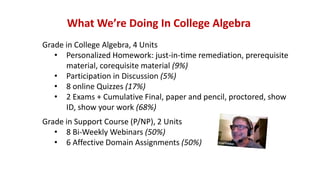
What We’re Doing In College Algebra
Grade in College Algebra, 4 Units
• Personalized Homework: just-in-time remediation, prerequisite
material, corequisite material (9%)
• Participation in Discussion (5%)
• 8 online Quizzes (17%)
• 2 Exams + Cumulative Final, paper and pencil, proctored, show
ID, show your work (68%)
Grade in Support Course (P/NP), 2 Units
• 8 Bi-Weekly Webinars (50%)
• 6 Affective Domain Assignments (50%)
What We’re Doing In Statistics
Statistics Pathway
 Two-course Statistics Pathway created in Fall 2016
 No prerequisite
 Completion of college-level math in two semesters
Statistics Pathway
Shortcut to Success
 Statistics Pathway 1: Math C046
 Statistics Pathway 2: Math C146
Statistics Pathway 1
 Statistics Pathway 1: Math C046
 Selected Algebra
 Just-In-Time Remedial Math
 Descriptive Statistics
Statistics Pathway 2
 Statistics Pathway 2: Math C146
 Selected Algebra
 Probability
 Inferential Statistics
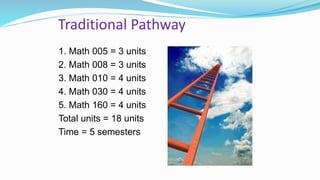
Traditional Pathway
1. Math 005 = 3 units
2. Math 008 = 3 units
3. Math 010 = 4 units
4. Math 030 = 4 units
5. Math 160 = 4 units
Total units = 18 units
Time = 5 semesters
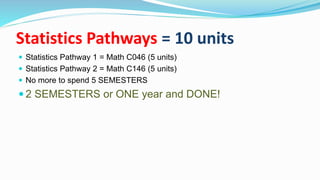
Statistics Pathways = 10 units
 Statistics Pathway 1 = Math C046 (5 units)
 Statistics Pathway 2 = Math C146 (5 units)
 No more to spend 5 SEMESTERS
 2 SEMESTERS or ONE year and DONE!
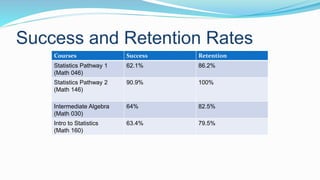
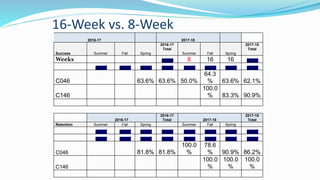
Success and Retention Rates
Courses Success Retention
Statistics Pathway 1
(Math 046)
62.1% 86.2%
Statistics Pathway 2
(Math 146)
90.9% 100%
Intermediate Algebra
(Math 030)
64% 82.5%
Intro to Statistics
(Math 160)
63.4% 79.5%
AB 705
AB 705 requires community college districts to maximize the
probability that a student will enter
and complete transfer-level coursework in math and English within a
one-year timeframe by
utilizing assessment measures that include high school performance
to achieve this goal.
AB 705
The goal of AB 705 is to ensure that students are not
placed into remedial courses that may delay or deter their
educational progress unless evidence suggests they are
highly unlikely to succeed in the college-level course.
AB 705
Community colleges are prohibited from requiring students to take
a prerequisite course
unless they are highly unlikely to succeed in
a higher-level course without it, pursuant to Section
55003 of Title 5 of the California Code of Regulations,
…...
AB 705 Implementation
 Funding from the Basic Skills Student Outcomes and Acceleration
Program (BSSOAP) was granted to Math Department
 Developing new curriculum
 Forming AB 705 faculty community learners
 Meeting to share strategies to implement AB 705
 Providing supplies for the meetings
 Attending AB 705 implementation workshops
What We’re Doing In
Introduction to Statistics
 Grade in Introduction to Statistics, 4 Units
• Personalized Homework: just-in-time remediation, prerequisite material,
corequisite material (9%)
• Participation in Discussion (5%)
• 8 online Quizzes (17%)
• 2 Exams + Cumulative Final, paper and pencil, proctored, show ID, show
your work (68%)
 Grade in Support Course (P/NP), 2 Units
• 8 Bi-Weekly Webinars (50%)
• 6 Affective Domain Assignments (25%)
• 6 Online Quizzes (25%)
Activities
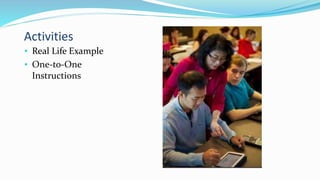
• Real Life Example
• One-to-One
Instructions
Embedded
Tutoring
• Join
Discussions
Forums
• Offer Online
Tutoring via
Skype
Activity-Based
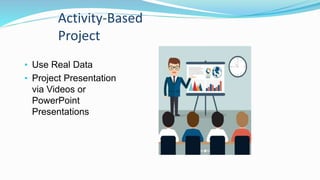
Project
• Use Real Data
• Project Presentation
via Videos or
PowerPoint
Presentations
Technology
• Graphing
Calculator TI-84
Plus (CE)
• Cell Phone (for
Activities)
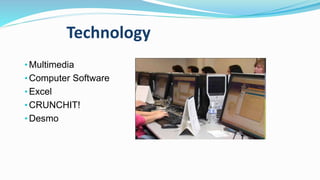
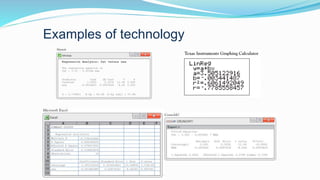
Technology
• Multimedia
• Computer Software
• Excel
• CRUNCHIT!
• Desmo
Examples of technology
Affective Domain
The affective domain describes learning objectives that emphasize a
feeling tone, an emotion, or a degree of acceptance or rejection.
Affective objectives vary from simple attention to selected
phenomena to complex but internally consistent qualities of
character and conscience. We found a large number of such
objectives in the literature expressed as interests, attitudes,
appreciations, values, and emotional sets or biases. [from Krathwohl
et al, 1964 ]
Affective Domain
 Significantly enhance, inhibit or even prevent student learning.
 The affective domain includes factors such as student motivation,
attitudes, perceptions and values.
 Teachers can increase their effectiveness by considering the affective
domain in planning courses
 Delivering lectures and activities, and assessing student learning. ( from
Teach the Earth
the portal for Earth Education)
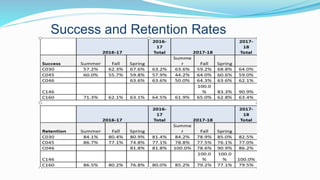
16-Week vs. 8-Week
2016-17 2017-18
Success Summer Fall Spring
2016-17
Total
Summer Fall Spring
2017-18
Total
Weeks 63.2% 8 16 16 64.0%
60.0% 55.7% 59.8% 57.9% 44.2% 64.0% 60.6% 59.0%
C046 63.6% 63.6% 50.0%
64.3
% 63.6% 62.1%
C146
100.0
% 83.3% 90.9%
2016-17
2016-17
Total 2017-18
2017-18
Total
Retention Summer Fall Spring Summer Fall Spring
84.1% 80.4% 80.9% 81.4% 84.2% 78.9% 85.0% 82.5%
86.7% 77.1% 74.8% 77.1% 78.8% 77.5% 76.1% 77.0%
C046 81.8% 81.8%
100.0
%
78.6
% 90.9% 86.2%
C146
100.0
%
100.0
%
100.0
%
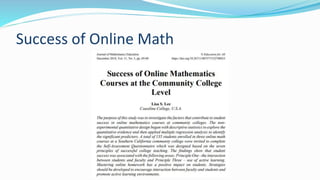
Article - Success of Online Math
 Congratulations on your paper being published in the December Issue of the Journal of Mathematics Education. You can
find your published article at http://educationforatoz.com/journalofmatheducation.html

 Please share the link of your article with your colleagues and with your professional communities in order to disseminate
your research broadly.

 Thank you for your hard work in writing and revising your paper and publishing with JME. We hope you have enjoyed
the process of publishing with JME and continue to submit your future research papers to JME. We would also
appreciate any help you can provide in reviewing articles for future issues of JME.

 Have a wonderful year 2019!

 Yours Truly,

 Editor of the December Issue of Journal of Mathematics Education (JME)
 Shuhua An, Ph.D.
 http://www.educationforatoz.net
Journal of Mathematics Education
Success of Online Math
Implications
 Fall 2018, “New” Pathway = Math 046 (5
units) + Math 160 (4 units), chosen by
students
 AB 705, new Co-requisite Pathway = Math
096 (2 units) + Math 160 (4 units),
 Spring 2019 Math 096 will be piloted, Cohort
Model. Full implementation to be offered in
Fall 2019.
 Will it be more successful? More data!
Stay Tuned.
Questions?
llee@coastline.edu
Thank You!
ffeldon@coastline.edu
llee@coastline.edu
This presentation is available at
http://www.slideshare.net/ffeldon

Online Implementation of AB 705 In Math

  • 1.
    Online Implementation of AB705 in Math By Fred Feldon & Lisa Lee Coastline Community College Third Annual Acceleration Across California Conference Sacramento, CA February 23, 2019
  • 2.
    This presentation isavailable at http://www.slideshare.net/ffeldon
  • 3.
    Agenda • Intro • WhatWe’re Doing At Coastline • What Makes a Good Online Course • What Makes a Good Online Support Course • What We’re Doing in College Algebra • What We’re Doing in Statistics
  • 4.
    Coastline’s Math Department is85% Purely Online With High Rates of Success and Retention
  • 5.
    Coastline’s Math Department is85% Purely Online With High Rates of Success and Retention
  • 6.
    Currently Offering Spring2019: • One Section of College Algebra With Support (Online, 6 Units) • One Section of Introduction To Statistics With Support (Online, 6 Units)
  • 7.
    College Algebra Textbook withCorequisite Solution, Course Management System, Integrated Review, Personalized Homework Introduction to Statistics Online Educational Resource (OER) Zero-Cost Textbook Course Material
  • 8.
    Using Default PlacementRules From CCCCO Memo July 11, 2018 …and Guided Self Placement (GSP)
  • 10.
    Pedagogy for OnlineSupport Courses: • Cohort model • 2-unit classes • Small classes (25 or less) • Separate CRN’s and grades • FT faculty create course templates • Professional development & communities of practice • Required for faculty who teach support classes • Pay faculty who participate in PD • Include non-cognitive and affective domain in the training and in classes • Involve college alert and support systems
  • 11.
    What Makes anOnline Course Good for Students? • Better access to classes which fit their schedule of school and/or work • Students self-select into the mode of delivery • Online format fosters more independent learning • Instructor able to give more attention to some students who might otherwise be ignored • Students schedule study time at their convenience, with less distractions and more concentration • Students can interact with anyone, any time, rather than just who they sit next to in class.
  • 12.
    What Makes anOnline Course Good for Faculty? • Increased flexibility • Teach from any location, any time • Online format fosters more independent learning • Anonymity of the Internet: Everyone is equal
  • 13.
    “On the Internet,nobody knows you’re a dog!”
  • 15.
    What Makes anOnline Course Good for Faculty? (Cont’d) • Increased flexibility • Teach from any location, any time • Online format fosters more independent learning • Anonymity of the Internet: Everyone is equal • Feeling of community is possible! • Equally rewarding and enjoyable • Number of students you can reach individually increases • Students can collaborate easier • Students do more on their own—the role of authority is more spread out
  • 16.
    What Makes anOnline Course Good for Faculty? (Cont’d) • Assessments (homework & quizzes) are interactive and scored automatically, saving time • Changes to course can be made in real time • You have time to think and research before answering questions • Students expect more technology from higher education • Amount of voicemails decrease • Interaction can and should replicate in-class discussion • Supplemental and enrichment material can be more timely
  • 17.
    A Few Tips •Use a Tablet PC
  • 18.
    Use Jing tocapture embed HTML code, then paste image into the body of a message on the Discussion Board:
  • 22.
    A Few Tips(Cont’d) • Use a Tablet PC • Discourage the use of email: encourage use of Discussion Board “That’s a great question! Could you do me a favor? Other students may be wondering the same thing. Could you please post it on the Discussion Board? That way, we can help everyone. I or another student will reply right away. Thanks. I appreciate it!” • Your first priority is discussion (before email) • Teach students to communicate mathematically • Demonstrate the behavior you want students to emulate • Lure students to Discussion Board • Welcome videos and emails • Frequent low-stakes interaction, practice and feedback • Proactive, specific feedback: struggling students, high achievers, etc.
  • 23.
    A Few Tips(Cont’d) • Be flexible; allow students to work ahead or catch up if they fall behind • Drop No Shows and Inactive students but allow them to catch up and be reinstated in the class • Maintain academic quality and rigor (same as onsite classes) • Exams MUST be Proctored, show ID, show your work, and worth a significant percentage (2/3 or more) of their final course grade • Create and randomly distribute multiple forms of the exams • Consider individuals who may need to finish late (give them an F then change their grade later) • Give assignments that are peer evaluated • Ask students to explain their thinking, justify their answers; ask frequent open-ended questions that may not have one, right answer* *More on this later…
  • 24.
    A Few Tips(Cont’d) • Supplement and enrich the course with instructor-created material • Personalize the course with your voice, with videos, with your hobby, background, interests, sense of humor, etc.
  • 25.
    What Makes aGood Online Support Course? • All the above PLUS • Concurrent enrollment of cohorts in transfer courses • Low-unit concurrent support (one- to two-units) • Backwards design and just-in-time remediation • Integrate intentional strategies, policies and activities to address the affective side of learning • Help accelerate acquisition of college-level skills • Integrate academic affairs and student services (e.g. counseling, mentoring, and guidance to students’ goals)
  • 26.
  • 27.
  • 28.
    “Associating math withjoy instead of fear is surely one of our most important goals as teachers!” Dr. Jo Boaler, Professor of Mathematics Education, Stanford University. Visit www.youcubed.org for more info
  • 29.
  • 30.
    Sample Affective DomainActivities • Go to the CAP Math Facebook page • Join the Group • Type “box” in the Search field • Click on the link to the Box • Or go to https://bit.ly/2INfKCH • Open the Folder “Workshop Materials for Math” • Many, many activities are there!
  • 31.
    CAP AB 705Implementation Workshop Fall 2018 Affective Domain DropBox https://app.box.com/s/o5zvmjor20247n8 sd98gnvkhsjg3d3jp
  • 36.
    Include Non-Routine Questions InYour Class “Avoid the bulimic* method of education…” *Overeating, followed by vomiting -- Dr. Stuart Firestein, 2013, https://www.ted.com/talks/ stuart_firestein_the_pursuit_of_ignorance#t-876778
  • 37.
    Open Middle Using thedigits 1 to 9, at most one time each, fill in the boxes to create a fraction that’s as close to one as possible. It doesn’t matter if your fraction is a little bit more or a little bit less than 1. Just get as close to 1 as you can.
  • 38.
    Super Bowl Sunday Thisyear’s game is Super Bowl LIII, Rams vs. Patriots. What’s special about the number 53? It’s Herbie the Love Bug’s racing number, and it’s the maximum number of players on an NFL roster. Explain this fact in your own words: 53 is the only two-digit number that is reversed in hexadecimal!
  • 40.
    THE MATH AFFIRMATIONS 1.I am capable of learning and doing math. 2. Knowing math will positively affect my destiny. 3. Math is everywhere in the world. 4. Hard work is often mistaken for luck or natural ability. 5. If I play the victim, I will give up my power to change the world. 6. I may not know how to do something today, but I WILL tomorrow. 7. I will be patient with myself and others when learning math. 8. Success comes from not being afraid to ask questions. 9. Asking for help isn’t embarrassing, not asking for help is. 10. I have a right to be selfish about my needs as a student. Geillan Aly, PhD. University of Hartford, Hillyer College
  • 42.
    PatrickJMT Teaching is nolonger about the lecture--Content is ubiquitous!
  • 43.
    Sources for Non-RoutineProblems That Stimulate Discussion Books Math Contests Grades 4-6, 7-8 and Algebra, by Conrad & Flegler, Math League Press Math Contests High School, by Conrad & Flegler, Math League Press Can You Solve My Problems? By Alex Bellos Math Puzzles Vol. 1, 2 and 3 by Presh Talwalkar Principles to Actions: Ensuring Mathematical Success for All, NCTM The Scientific American Book of Mathematical Puzzles and Diversions, by Martin Gardner What Students Abroad Are Expected To Know About Mathematics: Exams from France, Germany and Japan Empowering Students by Promoting Active Learning in Mathematics, NCTM Challenging Math Problems, by Terry Stickels Websites http://mathforum.org/problems_puzzles_landing.html http://blog.mrmeyer.com http://cemc.uwaterloo.ca/resources/potw.php http://donsteward.blogspot.co.uk http://www.mathleague.com https://ed.ted.com http://www.onetwoinfinity.ca https://www.mathcounts.org/resources/problem-of-the-week https://www.math.purdue.edu/pow https://mindyourdecisions.com http://orion.math.iastate.edu/ehjohnst/PoW/PoW.html http://www.numberphile.com http://www.openmiddle.com http://www.sixtysymbols.com http://www.estimation180.com http://mathmistakes.org https://twitter.com/ExploreMTBoS (Math Twitter Blogosphere) http://www.sciencealert.com https://twitter.com/MathVault http://www.iflscience.com http://wodb.ca (Which One Doesn’t Belong) http://www.ted.com http://www.visualpatterns.org http://www.smartereveryday.com http://mathquest.carroll.edu/ https://www.youtube.com/channel/UC1_uAIS3r8Vu6JjXWvastJg (Mathologer) Journals Journal for Research in Mathematics Education, NCTM Mathematics Teacher, Monthly Calendar Problems, NCTM Mathematics Teaching in the Middle School, Monthly Palette of Problems, NCTM
  • 44.
    What We’re DoingIn College Algebra Grade in College Algebra, 4 Units • Personalized Homework: just-in-time remediation, prerequisite material, corequisite material (9%) • Participation in Discussion (5%) • 8 online Quizzes (17%) • 2 Exams + Cumulative Final, paper and pencil, proctored, show ID, show your work (68%) Grade in Support Course (P/NP), 2 Units • 8 Bi-Weekly Webinars (50%) • 6 Affective Domain Assignments (50%)
  • 45.
    What We’re DoingIn Statistics
  • 46.
    Statistics Pathway  Two-courseStatistics Pathway created in Fall 2016  No prerequisite  Completion of college-level math in two semesters
  • 47.
    Statistics Pathway Shortcut toSuccess  Statistics Pathway 1: Math C046  Statistics Pathway 2: Math C146
  • 48.
    Statistics Pathway 1 Statistics Pathway 1: Math C046  Selected Algebra  Just-In-Time Remedial Math  Descriptive Statistics
  • 49.
    Statistics Pathway 2 Statistics Pathway 2: Math C146  Selected Algebra  Probability  Inferential Statistics
  • 50.
    Traditional Pathway 1. Math005 = 3 units 2. Math 008 = 3 units 3. Math 010 = 4 units 4. Math 030 = 4 units 5. Math 160 = 4 units Total units = 18 units Time = 5 semesters
  • 51.
    Statistics Pathways =10 units  Statistics Pathway 1 = Math C046 (5 units)  Statistics Pathway 2 = Math C146 (5 units)  No more to spend 5 SEMESTERS  2 SEMESTERS or ONE year and DONE!
  • 52.
  • 53.
    Success and RetentionRates Courses Success Retention Statistics Pathway 1 (Math 046) 62.1% 86.2% Statistics Pathway 2 (Math 146) 90.9% 100% Intermediate Algebra (Math 030) 64% 82.5% Intro to Statistics (Math 160) 63.4% 79.5%
  • 54.
    AB 705 AB 705requires community college districts to maximize the probability that a student will enter and complete transfer-level coursework in math and English within a one-year timeframe by utilizing assessment measures that include high school performance to achieve this goal.
  • 55.
    AB 705 The goalof AB 705 is to ensure that students are not placed into remedial courses that may delay or deter their educational progress unless evidence suggests they are highly unlikely to succeed in the college-level course.
  • 56.
    AB 705 Community collegesare prohibited from requiring students to take a prerequisite course unless they are highly unlikely to succeed in a higher-level course without it, pursuant to Section 55003 of Title 5 of the California Code of Regulations, …...
  • 57.
    AB 705 Implementation Funding from the Basic Skills Student Outcomes and Acceleration Program (BSSOAP) was granted to Math Department  Developing new curriculum  Forming AB 705 faculty community learners  Meeting to share strategies to implement AB 705  Providing supplies for the meetings  Attending AB 705 implementation workshops
  • 58.
    What We’re DoingIn Introduction to Statistics  Grade in Introduction to Statistics, 4 Units • Personalized Homework: just-in-time remediation, prerequisite material, corequisite material (9%) • Participation in Discussion (5%) • 8 online Quizzes (17%) • 2 Exams + Cumulative Final, paper and pencil, proctored, show ID, show your work (68%)  Grade in Support Course (P/NP), 2 Units • 8 Bi-Weekly Webinars (50%) • 6 Affective Domain Assignments (25%) • 6 Online Quizzes (25%)
  • 59.
    Activities • Real LifeExample • One-to-One Instructions
  • 60.
  • 61.
    Activity-Based Project • Use RealData • Project Presentation via Videos or PowerPoint Presentations
  • 62.
    Technology • Graphing Calculator TI-84 Plus(CE) • Cell Phone (for Activities)
  • 63.
    Technology • Multimedia • ComputerSoftware • Excel • CRUNCHIT! • Desmo
  • 64.
  • 65.
    Affective Domain The affectivedomain describes learning objectives that emphasize a feeling tone, an emotion, or a degree of acceptance or rejection. Affective objectives vary from simple attention to selected phenomena to complex but internally consistent qualities of character and conscience. We found a large number of such objectives in the literature expressed as interests, attitudes, appreciations, values, and emotional sets or biases. [from Krathwohl et al, 1964 ]
  • 66.
    Affective Domain  Significantlyenhance, inhibit or even prevent student learning.  The affective domain includes factors such as student motivation, attitudes, perceptions and values.  Teachers can increase their effectiveness by considering the affective domain in planning courses  Delivering lectures and activities, and assessing student learning. ( from Teach the Earth the portal for Earth Education)
  • 67.
    16-Week vs. 8-Week 2016-172017-18 Success Summer Fall Spring 2016-17 Total Summer Fall Spring 2017-18 Total Weeks 63.2% 8 16 16 64.0% 60.0% 55.7% 59.8% 57.9% 44.2% 64.0% 60.6% 59.0% C046 63.6% 63.6% 50.0% 64.3 % 63.6% 62.1% C146 100.0 % 83.3% 90.9% 2016-17 2016-17 Total 2017-18 2017-18 Total Retention Summer Fall Spring Summer Fall Spring 84.1% 80.4% 80.9% 81.4% 84.2% 78.9% 85.0% 82.5% 86.7% 77.1% 74.8% 77.1% 78.8% 77.5% 76.1% 77.0% C046 81.8% 81.8% 100.0 % 78.6 % 90.9% 86.2% C146 100.0 % 100.0 % 100.0 %
  • 68.
    Article - Successof Online Math  Congratulations on your paper being published in the December Issue of the Journal of Mathematics Education. You can find your published article at http://educationforatoz.com/journalofmatheducation.html   Please share the link of your article with your colleagues and with your professional communities in order to disseminate your research broadly.   Thank you for your hard work in writing and revising your paper and publishing with JME. We hope you have enjoyed the process of publishing with JME and continue to submit your future research papers to JME. We would also appreciate any help you can provide in reviewing articles for future issues of JME.   Have a wonderful year 2019!   Yours Truly,   Editor of the December Issue of Journal of Mathematics Education (JME)  Shuhua An, Ph.D.  http://www.educationforatoz.net
  • 69.
  • 70.
  • 71.
    Implications  Fall 2018,“New” Pathway = Math 046 (5 units) + Math 160 (4 units), chosen by students  AB 705, new Co-requisite Pathway = Math 096 (2 units) + Math 160 (4 units),  Spring 2019 Math 096 will be piloted, Cohort Model. Full implementation to be offered in Fall 2019.  Will it be more successful? More data! Stay Tuned.
  • 72.
  • 73.
    Thank You! ffeldon@coastline.edu llee@coastline.edu This presentationis available at http://www.slideshare.net/ffeldon

Editor's Notes

  • #44 Centre for Education in Mathematics and Computing, University of Waterloo (Ontario, Canada), Problem of the Week, Grade Levels 3/4 - 11/12 Mathologer example: “10 of the Greatest Math Movie Bloopers!” Smarter Everyday example: “Mantis Murder Shrimp” has a stomatopod dactyl club body part in the shape of a hyperbolic paraboloid!
  • #73 Chapter 5