Gamification: Communicating
with Digital Natives
Deborah Healey
American English Institute/Dept. of Linguistics
University of Oregon
sites.google.com/site/gamificationforelteachers/
Agenda
 Digital natives and digital immigrants
 What’s gamification?
 Gamifying education
 Game mechanics
 Classroom applications
 What can you do?
© 2013 D. Healey, dhealey@uoregon.edu
Digital natives and immigrants
Marc Prensky (2001)
Generational divide
“Digital natives” vs “digital immigrants”
Current research
Some skills
A lot to learn
© 2013 D. Healey, dhealey@uoregon.edu
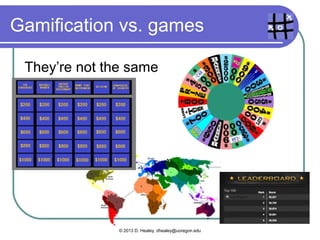
Gamification vs. games
They’re not the same
© 2013 D. Healey, dhealey@uoregon.edu
What is gamification?
What do you think?
© 2013 D. Healey, dhealey@uoregon.edu
What’s with “gamification”?
 2009: No news articles
about gamification
 2011: 27 news stories,
5 on education
 2013 – 2 months: 275
and 38
 308,000 Google hits
for “gamification in
education”
© 2013 D. Healey, dhealey@uoregon.edu
Gamification
Gamification is adding elements of
games and gaming to regular activities
that we may not normally think of as
games.
Business
Training
Education
© 2013 D. Healey, dhealey@uoregon.edu
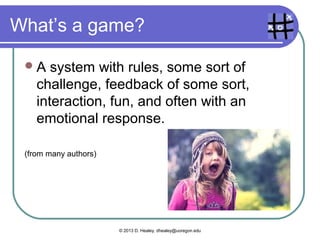
What’s a game?
A system with rules, some sort of
challenge, feedback of some sort,
interaction, fun, and often with an
emotional response.
(from many authors)
© 2013 D. Healey, dhealey@uoregon.edu
Which ones are games?
© 2013 D. Healey, dhealey@uoregon.edu
Which ones are games?
Rules - challenge – feedback – interaction – fun –
emotional response
Hangman with this month’s vocabulary
words
A?N?M?
T! L!
© 2013 D. Healey, dhealey@uoregon.edu
www.manythings.org/
Game? Thumbs up/down
© 2013 D. Healey, dhealey@uoregon.edu
http://eslgamesworld.com
Rules - challenge – feedback – interaction – fun – emotional response
Thumbs up/down
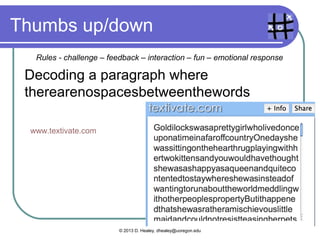
Decoding a paragraph where
therearenospacesbetweenthewords
www.textivate.com
© 2013 D. Healey, dhealey@uoregon.edu
Rules - challenge – feedback – interaction – fun – emotional response
Thumbs up/down
Finding information in a reading to use in
solving a puzzle
Short mysteries, online or printed
http://www.squidoo.com/minutemysteries
http://www.5minutemystery.com
© 2013 D. Healey, dhealey@uoregon.edu
Rules - challenge – feedback – interaction – fun – emotional response
Games?
Spelling bee where participants work in
teams
Writing contest where the winning entry
is published
© 2013 D. Healey, dhealey@uoregon.edu
Rules - challenge – feedback – interaction – fun – emotional response
Classroom activities
We’ll talk about gamifying these later
 Responding to questions about a 10-minute
video clip
 Memorizing vocabulary for a weekly quiz
 Highlighting the transition words in a reading
 Doing a workbook exercise about the past
tense
 Doing a presentation about a favorite vacation
 Writing a compare/contrast paragraph
© 2013 D. Healey, dhealey@uoregon.edu
Gamifying education
video
www.penny-arcade.com/patv/episode/gamifying-education
© 2013 D. Healey, dhealey@uoregon.edu
Kapp, 2012: Elements
Game mechanics –points, levels, and
badges (PBL), scoring, time constraints
Aesthetics – a visually or otherwise
interesting environment that creates a
different “feel” to the activity (pp.9-11)
Game thinking – competition,
cooperation, exploration, storytelling
© 2013 D. Healey, dhealey@uoregon.edu
Not students - players
© 2013 D. Healey, dhealey@uoregon.edu
Why do we care?
Demographics
 Digital natives
Engagement
Extrinsic => intrinsic motivation
It’s our world
© 2013 D. Healey, dhealey@uoregon.edu
Game mechanics
gamification.org
© 2013 D. Healey, dhealey@uoregon.edu
Teachers use these
 Cascading Information Theory –
breaking up information into bits
 Curriculum in teaching
 Achievements – where learners have
accomplished something relative to others
 “Achievers” – I’m better than others
 Community Collaboration – working together
to solve a problem or do a task.
 Group work in teaching
 “Socializers”
Images from http://www.gamification.org/wiki/Game_Mechanics
© 2013 D. Healey, dhealey@uoregon.edu
More that we use now
 Points – giving numerical value for
actions
 Grades in teaching
 Loss Aversion – avoiding punishment
 Grading, often
 Behavioral Momentum – the
tendency to keep doing something
 Fun Once, Fun Always – classroom routines
Images from http://www.gamification.org/wiki/Game_Mechanics
© 2013 D. Healey, dhealey@uoregon.edu
What we could add
Countdown– having only a certain
amount of time to do something
 Homework, tests, activities
Levels – more points = more rewards
 Start at 0 and add points to grades
Penny Arcade video
www.penny-arcade.com/patv/episode/gamifying-education
Images from http://www.gamification.org/wiki/Game_Mechanics
© 2013 D. Healey, dhealey@uoregon.edu
What we could add
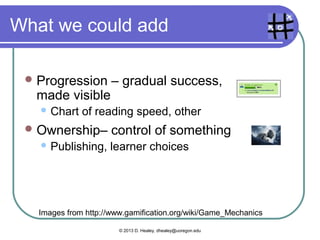
Progression – gradual success,
made visible
 Chart of reading speed, other
Ownership– control of something
 Publishing, learner choices
Images from http://www.gamification.org/wiki/Game_Mechanics
© 2013 D. Healey, dhealey@uoregon.edu
Project/task-based learning
 Blissful productivity – joy in work
 Discovery/Exploration
 “Explorers”
 Epic meaning – doing something big
 Projects outside the classroom, audience
 Quests/Challenges – overcoming
obstacles
 Virality – working with others
Images from http://www.gamification.org/wiki/Game_Mechanics
© 2013 D. Healey, dhealey@uoregon.edu
What could you do?
Let’s look back…
© 2013 D. Healey, dhealey@uoregon.edu
Game mechanics
Hangman in pairs
Countdown, behavioral momentum (“flow”),
community collaboration
Decoding a paragraph
Gamify: countdown, community
collaboration, points, achievement
Finding information in a reading
Discovery, challenge, achievement
© 2013 D. Healey, dhealey@uoregon.edu
Responding to questions about a 10-
minute video clip
Gamify: add points, teamwork, student-
generated questions [ownership]
Use a student-created video [epic meaning,
ownership, challenge, achievement]
Memorizing vocabulary for a weekly quiz
Gamify: teamwork, challenge, points with
flashcards, progress on a chart
© 2013 D. Healey, dhealey@uoregon.edu
Highlighting the transition words in a
reading
Gamify: teamwork, challenge, points,
achievement
Doing a workbook exercise about the
past tense
Gamify: countdown, teamwork, challenge,
points, achievement
Ownership if they make their own questions
© 2013 D. Healey, dhealey@uoregon.edu
Doing a presentation about a favorite
vacation or writing a compare/contrast
paragraph
Ownership; epic meaning if shared online;
points with a rubric; possibly a team effort
Progression – presentations/essays getting
longer, check off steps for the task
© 2013 D. Healey, dhealey@uoregon.edu
Your ideas?
Do you gamify already?
How could gamification help your
students?
Motivation – intrinsic and extrinsic
Retention
What would work for you?
© 2013 D. Healey, dhealey@uoregon.edu
Recap
What is gamification?
Teachers gamify a lot already
Game thinking
Competition, cooperation, exploration,
storytelling elements added to an everyday
activity
Why gamify?
Meet student needs (video online)
© 2013 D. Healey, dhealey@uoregon.edu
Q&A
Thanks!
dhealey@uoregon.edu
http://www.deborahhealey.com
sites.google.com/site/gamificationforelteachers/
© 2013 D. Healey, dhealey@uoregon.edu

Gamification keynote malaysia

  • 1.
    Gamification: Communicating with DigitalNatives Deborah Healey American English Institute/Dept. of Linguistics University of Oregon sites.google.com/site/gamificationforelteachers/
  • 2.
    Agenda  Digital nativesand digital immigrants  What’s gamification?  Gamifying education  Game mechanics  Classroom applications  What can you do? © 2013 D. Healey, dhealey@uoregon.edu
  • 3.
    Digital natives andimmigrants Marc Prensky (2001) Generational divide “Digital natives” vs “digital immigrants” Current research Some skills A lot to learn © 2013 D. Healey, dhealey@uoregon.edu
  • 4.
    Gamification vs. games They’renot the same © 2013 D. Healey, dhealey@uoregon.edu
  • 5.
    What is gamification? Whatdo you think? © 2013 D. Healey, dhealey@uoregon.edu
  • 6.
    What’s with “gamification”? 2009: No news articles about gamification  2011: 27 news stories, 5 on education  2013 – 2 months: 275 and 38  308,000 Google hits for “gamification in education” © 2013 D. Healey, dhealey@uoregon.edu
  • 7.
    Gamification Gamification is addingelements of games and gaming to regular activities that we may not normally think of as games. Business Training Education © 2013 D. Healey, dhealey@uoregon.edu
  • 8.
    What’s a game? Asystem with rules, some sort of challenge, feedback of some sort, interaction, fun, and often with an emotional response. (from many authors) © 2013 D. Healey, dhealey@uoregon.edu
  • 9.
    Which ones aregames? © 2013 D. Healey, dhealey@uoregon.edu
  • 10.
    Which ones aregames? Rules - challenge – feedback – interaction – fun – emotional response Hangman with this month’s vocabulary words A?N?M? T! L! © 2013 D. Healey, dhealey@uoregon.edu www.manythings.org/
  • 11.
    Game? Thumbs up/down ©2013 D. Healey, dhealey@uoregon.edu http://eslgamesworld.com Rules - challenge – feedback – interaction – fun – emotional response
  • 12.
    Thumbs up/down Decoding aparagraph where therearenospacesbetweenthewords www.textivate.com © 2013 D. Healey, dhealey@uoregon.edu Rules - challenge – feedback – interaction – fun – emotional response
  • 13.
    Thumbs up/down Finding informationin a reading to use in solving a puzzle Short mysteries, online or printed http://www.squidoo.com/minutemysteries http://www.5minutemystery.com © 2013 D. Healey, dhealey@uoregon.edu Rules - challenge – feedback – interaction – fun – emotional response
  • 14.
    Games? Spelling bee whereparticipants work in teams Writing contest where the winning entry is published © 2013 D. Healey, dhealey@uoregon.edu Rules - challenge – feedback – interaction – fun – emotional response
  • 15.
    Classroom activities We’ll talkabout gamifying these later  Responding to questions about a 10-minute video clip  Memorizing vocabulary for a weekly quiz  Highlighting the transition words in a reading  Doing a workbook exercise about the past tense  Doing a presentation about a favorite vacation  Writing a compare/contrast paragraph © 2013 D. Healey, dhealey@uoregon.edu
  • 16.
  • 17.
    Kapp, 2012: Elements Gamemechanics –points, levels, and badges (PBL), scoring, time constraints Aesthetics – a visually or otherwise interesting environment that creates a different “feel” to the activity (pp.9-11) Game thinking – competition, cooperation, exploration, storytelling © 2013 D. Healey, dhealey@uoregon.edu
  • 18.
    Not students -players © 2013 D. Healey, dhealey@uoregon.edu
  • 19.
    Why do wecare? Demographics  Digital natives Engagement Extrinsic => intrinsic motivation It’s our world © 2013 D. Healey, dhealey@uoregon.edu
  • 20.
    Game mechanics gamification.org © 2013D. Healey, dhealey@uoregon.edu
  • 21.
    Teachers use these Cascading Information Theory – breaking up information into bits  Curriculum in teaching  Achievements – where learners have accomplished something relative to others  “Achievers” – I’m better than others  Community Collaboration – working together to solve a problem or do a task.  Group work in teaching  “Socializers” Images from http://www.gamification.org/wiki/Game_Mechanics © 2013 D. Healey, dhealey@uoregon.edu
  • 22.
    More that weuse now  Points – giving numerical value for actions  Grades in teaching  Loss Aversion – avoiding punishment  Grading, often  Behavioral Momentum – the tendency to keep doing something  Fun Once, Fun Always – classroom routines Images from http://www.gamification.org/wiki/Game_Mechanics © 2013 D. Healey, dhealey@uoregon.edu
  • 23.
    What we couldadd Countdown– having only a certain amount of time to do something  Homework, tests, activities Levels – more points = more rewards  Start at 0 and add points to grades Penny Arcade video www.penny-arcade.com/patv/episode/gamifying-education Images from http://www.gamification.org/wiki/Game_Mechanics © 2013 D. Healey, dhealey@uoregon.edu
  • 24.
    What we couldadd Progression – gradual success, made visible  Chart of reading speed, other Ownership– control of something  Publishing, learner choices Images from http://www.gamification.org/wiki/Game_Mechanics © 2013 D. Healey, dhealey@uoregon.edu
  • 25.
    Project/task-based learning  Blissfulproductivity – joy in work  Discovery/Exploration  “Explorers”  Epic meaning – doing something big  Projects outside the classroom, audience  Quests/Challenges – overcoming obstacles  Virality – working with others Images from http://www.gamification.org/wiki/Game_Mechanics © 2013 D. Healey, dhealey@uoregon.edu
  • 26.
    What could youdo? Let’s look back… © 2013 D. Healey, dhealey@uoregon.edu
  • 27.
    Game mechanics Hangman inpairs Countdown, behavioral momentum (“flow”), community collaboration Decoding a paragraph Gamify: countdown, community collaboration, points, achievement Finding information in a reading Discovery, challenge, achievement © 2013 D. Healey, dhealey@uoregon.edu
  • 28.
    Responding to questionsabout a 10- minute video clip Gamify: add points, teamwork, student- generated questions [ownership] Use a student-created video [epic meaning, ownership, challenge, achievement] Memorizing vocabulary for a weekly quiz Gamify: teamwork, challenge, points with flashcards, progress on a chart © 2013 D. Healey, dhealey@uoregon.edu
  • 29.
    Highlighting the transitionwords in a reading Gamify: teamwork, challenge, points, achievement Doing a workbook exercise about the past tense Gamify: countdown, teamwork, challenge, points, achievement Ownership if they make their own questions © 2013 D. Healey, dhealey@uoregon.edu
  • 30.
    Doing a presentationabout a favorite vacation or writing a compare/contrast paragraph Ownership; epic meaning if shared online; points with a rubric; possibly a team effort Progression – presentations/essays getting longer, check off steps for the task © 2013 D. Healey, dhealey@uoregon.edu
  • 31.
    Your ideas? Do yougamify already? How could gamification help your students? Motivation – intrinsic and extrinsic Retention What would work for you? © 2013 D. Healey, dhealey@uoregon.edu
  • 32.
    Recap What is gamification? Teachersgamify a lot already Game thinking Competition, cooperation, exploration, storytelling elements added to an everyday activity Why gamify? Meet student needs (video online) © 2013 D. Healey, dhealey@uoregon.edu
  • 33.

Editor's Notes

  • #5 Poll – how many of you have heard of gamification? Could you define it? Please turn to your neighbor and explain the difference. http://assets.econsultancy.com/images/resized/0002/8017/teleflora-blog-full.jpg - leaderboard
  • #8 Make sense?
  • #9 a system with rules, some sort of challenge, feedback of some sort, interaction, and fun. An emotional response is part of many definitions of a game as well – players get caught up in the game. Image by Slyfoxy: http://fc03.deviantart.net/fs70/i/2011/195/a/4/winter_fun_by_slyfoxxy-d3qmgu6.jpg - removed by author's request
  • #11 Image from www.manythings.org/hmf/hm-clothes.html
  • #12 http://www.eslgamesworld.com/members/games/ClassroomGames/Quizshow/Verb%20Tenses%20Past,%20Future,%20Perfect%20Present/
  • #16 Necessary, but maybe not so much fun…
  • #17 Let’s take a quick look at some ideas about gamifying education in general, then look at what we can do in language education in particular
  • #18 Aesthetics may not be so much part of teachers’ use of games, but it can be
  • #19 There’s a different feel when we think of students as active PLAYERS
  • #20 Why has this become so popular? One reason is demographic – today’s digital natives aren’t patient people. We can say that they should learn by studying hard, and that’s true. We want to encourage intrinsic motivation to learn. But we know that engagement is a critical factor in learning, and engagement can encourage intrinsic motivation to emerge. By adding game elements – gamifying lessons – we can tap into our learners’ way of being in the world. And it’s not that hard to do. It’s being done in business routinely – frequent flyer programs, bank rewards cards, and more
  • #21 Gamification.org suggests 24 game mechanics, several of which teachers may already incorporate or could relatively easily add to their lessons http://gamification.org/wiki/Game_Mechanics#Game_Mechanics_Shortcuts
  • #22 Cascading Information Theory – breaking up information into bits so that each bit can be effectively learned; not getting all the information at once. We do this all the time; it’s called curriculum.  Achievements – where learners have accomplished something, and they know it. These may be made visible in a variety of ways. Teachers tend to do this a lot with their learners. Game theory calls those who are greatly motivated by achievement relative to others “Achievers” or “Killers.” Both need to know that they’re better than others, but the latter (“Killers”) want to have more power than others or power over others. Good teachers try to channel this desire for control into helping others. Sometimes it works.  Community Collaboration – working together to solve a problem or do a task. We call it “group work” in teaching. In game theory, “Socializers” are especially motivated by this. Women are more likely to be socializers and motivated by collaboration than young men, particularly “Achievers” and “Killers.”
  • #23 Points – giving numerical value for actions. We call them grades. We tend not to give points to a group or for routine activities, but we could.  Loss Aversion – not getting a reward, but avoiding punishment. Grading is often how teachers implement this.  Behavioral Momentum – the tendency of people who are doing something to keep doing it. This works in tandem with what SCVNGR calls Fun Once, Fun Always – activities that remain enjoyable, even with repetition. Classroom routines would fall into this category.
  • #24 If you don’t do it already… Countdown – having only a certain (generally short) amount of time to do something. As the deadline approaches, there is more activity on the part of players/learners. While we routinely include this with homework and tests, it’s also something that could be incorporated within a classroom lesson to gamify just about anything. The key is making sure that everyone can succeed sometime.  Levels – gaining more points leads to more or different rewards. If we changed grading so that learners started from zero points and added more, we would be doing something like this. A very interesting idea!
  • #25 If you don’t do it already…Progression – gradual success, typically via completing a series of tasks; the key is that progress is visual in some way. A chart of reading speed might be one example of this. It’s something that language teaching doesn’t always do well. Learners often don’t know where they are in their move toward language acquisition.  Ownership – feeling that you control something. Having learners publish their work to a broader audience can give this sense, as can giving learners more autonomy in choosing topics and tasks in the classroom.
  • #26 Blissful Productivity – the idea that people like working hard and feeling productive. It’s not work for its own sake, but the sense of productivity that makes this powerful. Task-based learning often exemplifies this.  Discovery/Exploration – people like certain kinds of surprises. Some learners are especially motivated by discovery. Game theory calls these people “explorers.”  Epic Meaning – the sense of accomplishing something big, like saving a world. Language teachers can approach this by having learners do projects that go outside the classroom and that have a large external audience.  Quests/Challenges – overcoming obstacles, either alone or with a team. Project- and task-based learning can use this. It’s another way of visualizing progress.  Virality – a game or task that works better with many people. Project-based learning is often characterized by team work.
  • #30 Highlighting the transition words in a reading: Turn it into a game – teamwork, challenge, points, achievement (all correct)
  • #31 Doing a presentation about a favorite vacation: Ownership, especially with own pictures; epic meaning if shared on slideshare; points with a rubric; possibly a team effort; progression if learners see that their presentations are getting longer over time or the task is broken into steps
  • #32 Group discussion
  • #33 Gamify to meet learner needs, expectations; motivate because everyone likes games of some sort Have game thinking and you can gamify just about anything http://www.youtube.com/watch?v=_A-ZVCjfWf8