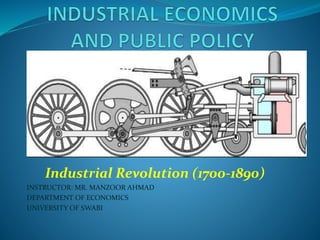
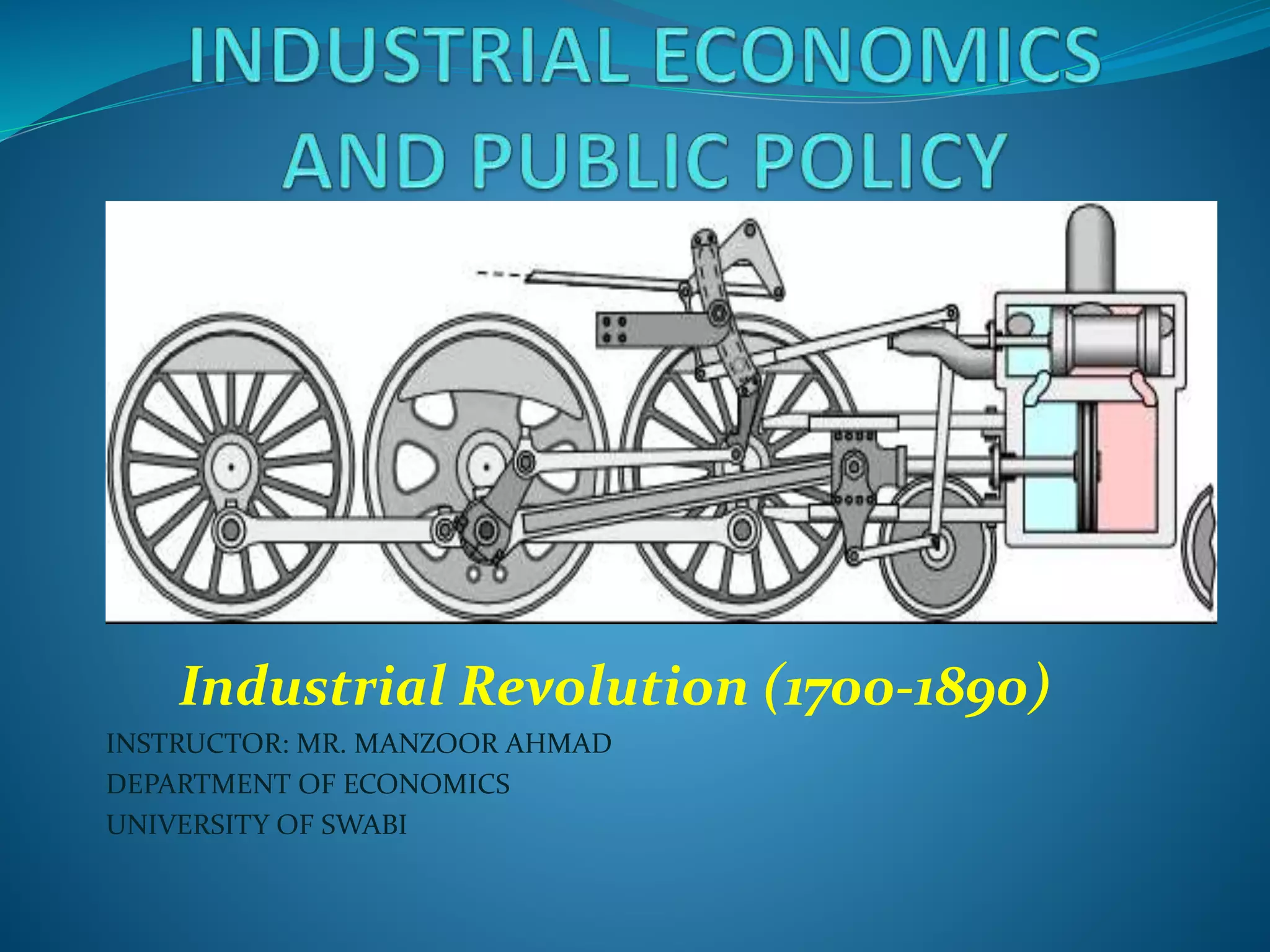
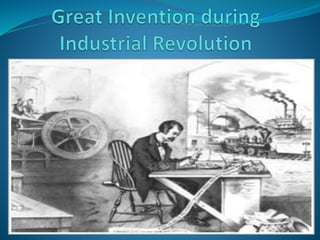
Industrial Revolution (1700-1890) 
INSTRUCTOR: MR. MANZOOR AHMAD 
DEPARTMENT OF ECONOMICS 
UNIVERSITY OF SWABI
What is Revolution 
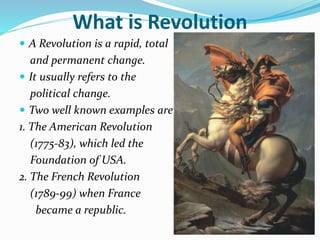
 A Revolution is a rapid, total 
and permanent change. 
 It usually refers to the 
political change. 
 Two well known examples are 
1. The American Revolution 
(1775-83), which led the 
Foundation of USA. 
2. The French Revolution 
(1789-99) when France 
became a republic.
Industrial Revolution 
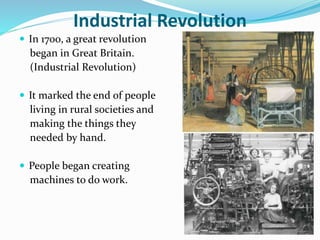
 In 1700, a great revolution 
began in Great Britain. 
(Industrial Revolution) 
 It marked the end of people 
living in rural societies and 
making the things they 
needed by hand. 
 People began creating 
machines to do work.
Industrial Revolution 
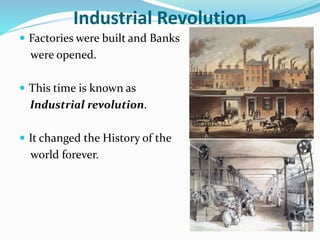
 Factories were built and Banks 
were opened. 
 This time is known as 
Industrial revolution. 
 It changed the History of the 
world forever.
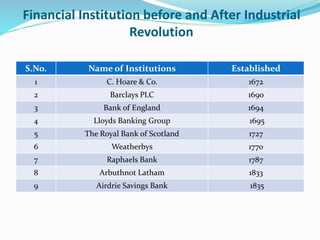
Financial Institution before and After Industrial 
Revolution 
S.No. Name of Institutions Established 
1 C. Hoare & Co. 1672 
2 Barclays PLC 1690 
3 Bank of England 1694 
4 Lloyds Banking Group 1695 
5 The Royal Bank of Scotland 1727 
6 Weatherbys 1770 
7 Raphaels Bank 1787 
8 Arbuthnot Latham 1833 
9 Airdrie Savings Bank 1835
Industrial Revolution 
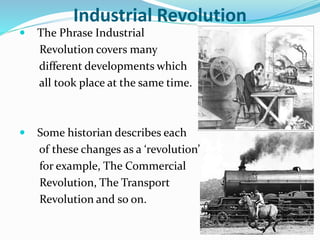
 The Phrase Industrial 
Revolution covers many 
different developments which 
all took place at the same time. 
 Some historian describes each 
of these changes as a ‘revolution’ 
for example, The Commercial 
Revolution, The Transport 
Revolution and so on.
Industrial Revolution 
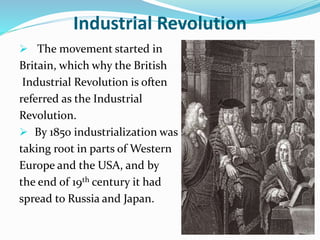
 The movement started in 
Britain, which why the British 
Industrial Revolution is often 
referred as the Industrial 
Revolution. 
 By 1850 industrialization was 
taking root in parts of Western 
Europe and the USA, and by 
the end of 19th century it had 
spread to Russia and Japan.
Industrial Revolution 
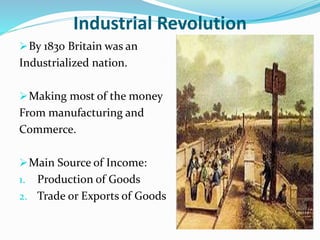
By 1830 Britain was an 
Industrialized nation. 
Making most of the money 
From manufacturing and 
Commerce. 
Main Source of Income: 
1. Production of Goods 
2. Trade or Exports of Goods
Industrial Revolution 
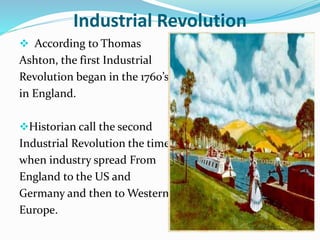
 According to Thomas 
Ashton, the first Industrial 
Revolution began in the 1760’s 
in England. 
Historian call the second 
Industrial Revolution the time 
when industry spread From 
England to the US and 
Germany and then toWestern 
Europe.
Big Changes After Industrial Revolution 
 The Industrial Revolution changed how things were 
produced and people lived. 
 During 1700’s and the 1800’s, new machines were 
being invented. 
 Before Industrial Revolution, England and America 
both were agriculture societies. 
 Most of the items that people used everyday like 
clothing and furniture, were made by hand.
Financial Factors 
 The Industrial Revolution in Britain depended on the 
following financial factors: 
1. Private Banking 
2. Stable Environment 
3. Capital Investment 
4. Capitalism
Major Development during 
Industrial Revolution 
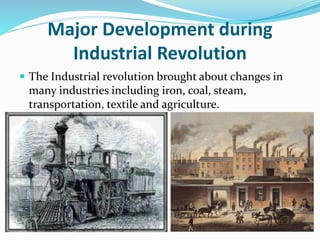
 The Industrial revolution brought about changes in 
many industries including iron, coal, steam, 
transportation, textile and agriculture.
1. Coal and Iron 
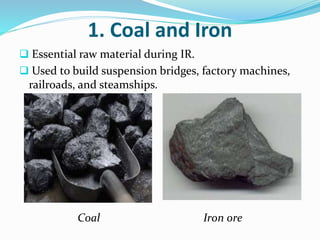
 Essential raw material during IR. 
 Used to build suspension bridges, factory machines, 
railroads, and steamships. 
Coal Iron ore
1. Coal and Iron 
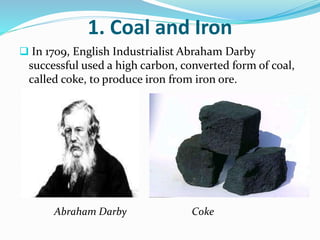
 In 1709, English Industrialist Abraham Darby 
successful used a high carbon, converted form of coal, 
called coke, to produce iron from iron ore. 
Abraham Darby Coke
1. Coal and Iron 
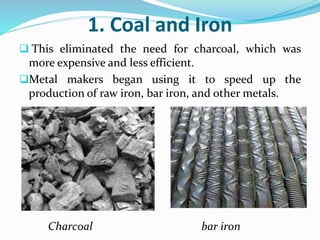
 This eliminated the need for charcoal, which was 
more expensive and less efficient. 
Metal makers began using it to speed up the 
production of raw iron, bar iron, and other metals. 
Charcoal bar iron
1. Coal and Iron 
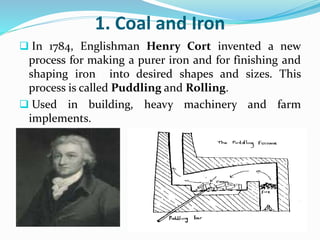
 In 1784, Englishman Henry Cort invented a new 
process for making a purer iron and for finishing and 
shaping iron into desired shapes and sizes. This 
process is called Puddling and Rolling. 
 Used in building, heavy machinery and farm 
implements.
2. Steam 
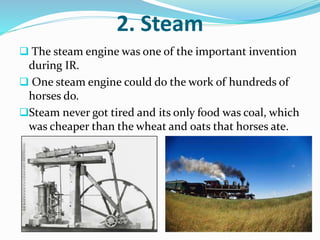
 The steam engine was one of the important invention 
during IR. 
 One steam engine could do the work of hundreds of 
horses do. 
Steam never got tired and its only food was coal, which 
was cheaper than the wheat and oats that horses ate.
2. Steam 
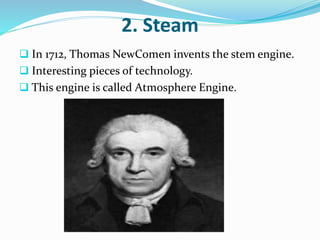
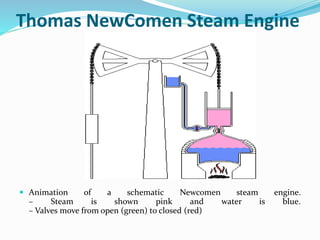
 In 1712, Thomas NewComen invents the stem engine. 
 Interesting pieces of technology. 
 This engine is called Atmosphere Engine.
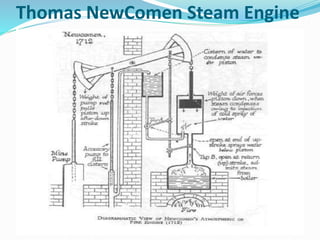
Thomas NewComen Steam Engine
Thomas NewComen Steam Engine 
 Animation of a schematic Newcomen steam engine. 
– Steam is shown pink and water is blue. 
– Valves move fromopen (green) to closed (red)
2. Steam 
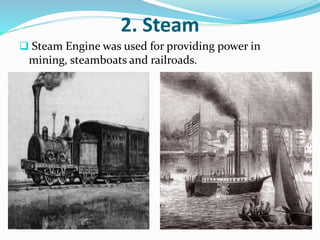
 Steam Engine was used for providing power in 
mining, steamboats and railroads.
2. Steam 
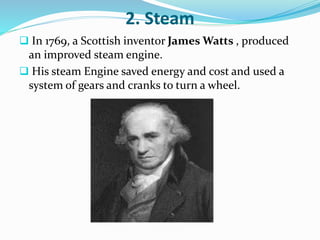
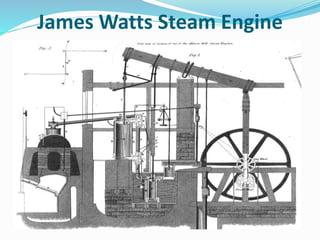
 In 1769, a Scottish inventor James Watts , produced 
an improved steam engine. 
 His steam Engine saved energy and cost and used a 
system of gears and cranks to turn a wheel.
James Watts Steam Engine
2. Transportation 
 The improvement of transportation greatly increased 
the success of the IR. 
 It became quicker and cheaper to transport people, 
raw materials, and finished product. 
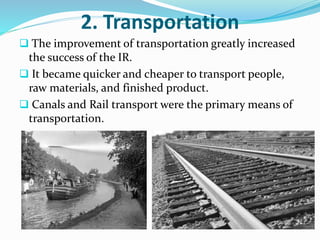
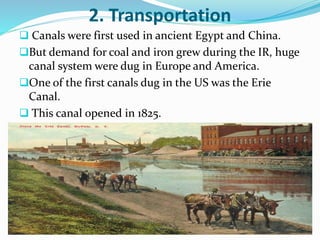
 Canals and Rail transport were the primary means of 
transportation.
2. Transportation 
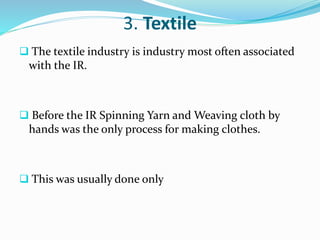
 Canals were first used in ancient Egypt and China. 
But demand for coal and iron grew during the IR, huge 
canal system were dug in Europe and America. 
One of the first canals dug in the US was the Erie 
Canal. 
 This canal opened in 1825.
3. Textile 
 The textile industry is industry most often associated 
with the IR. 
 Before the IR Spinning Yarn and Weaving cloth by 
hands was the only process for making clothes. 
 This was usually done only
3. Textile 
 Invention of textile machinery replaced the human 
labor that was needed to make cloth. 
 These invention included the 
Flying shuttle 
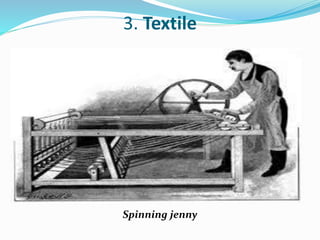
Spinning jenny 
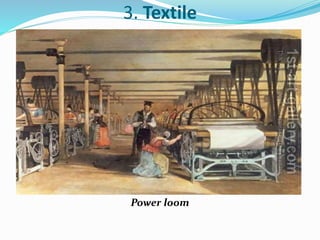
Power loom 
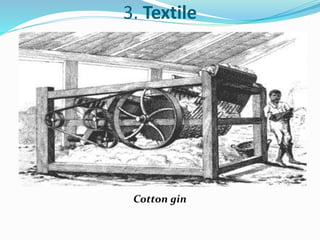
Cotton gin 
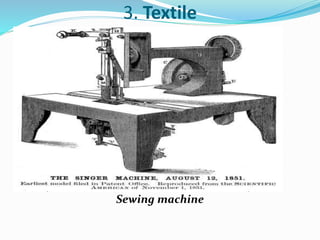
Sewing machine.
3. Textile 
Flying shuttle
3. Textile 
Spinning jenny
3. Textile 
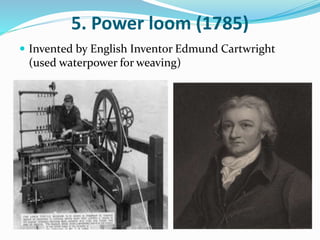
Power loom
3. Textile 
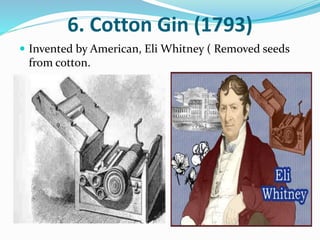
Cotton gin
3. Textile 
Sewing machine
4. Agriculture 
 Agriculture became an important source of raw 
materials for the textile industry as well food provider 
for the increasing population of the workers. 
 During IR, many agriculture implements were 
invented . 
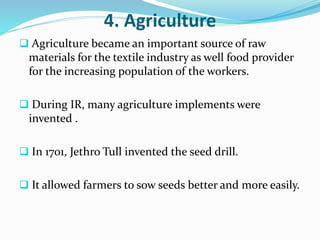
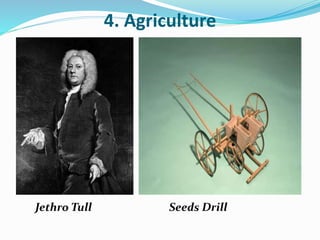
 In 1701, Jethro Tull invented the seed drill. 
 It allowed farmers to sow seeds better and more easily.
4. Agriculture 
Jethro Tull Seeds Drill
4. Agriculture 
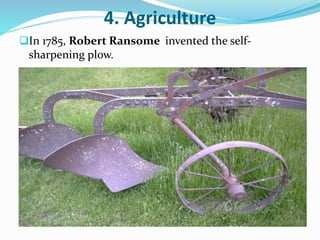
In 1785, Robert Ransome invented the self-sharpening 
plow.
4. Agriculture 
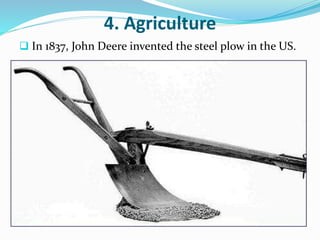
 In 1837, John Deere invented the steel plow in the US.
5. Factories Mass production 
Before IR, goods were produced in people’s home or in 
small workshop. 
Factories made possible to manufactured goods 
quicker and cheaper than ever before.
6. Power source 
Water was an important source for early industry and 
many machines are powered by Waterwheels. 
Steam power was developed and steam engines were 
used to pump water out of mine shafts and to power 
new systems. 
In addition, engines and furnaces were also fueled by 
coal. 
By the 1800’s coal was transported to factories by ship 
or train.
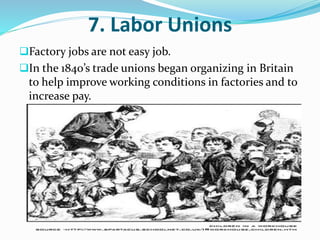
7. Labor Unions 
Factory jobs are not easy job. 
In the 1840’s trade unions began organizing in Britain 
to help improve working conditions in factories and to 
increase pay.
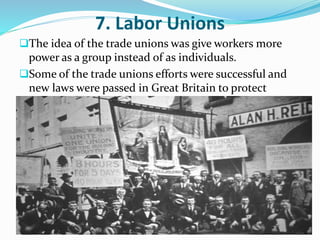
7. Labor Unions 
The idea of the trade unions was give workers more 
power as a group instead of as individuals. 
Some of the trade unions efforts were successful and 
new laws were passed in Great Britain to protect 
workers.
7. Labor Unions 
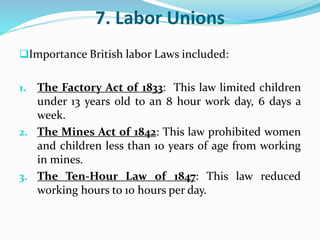
Importance British labor Laws included: 
1. The Factory Act of 1833: This law limited children 
under 13 years old to an 8 hour work day, 6 days a 
week. 
2. The Mines Act of 1842: This law prohibited women 
and children less than 10 years of age from working 
in mines. 
3. The Ten-Hour Law of 1847: This law reduced 
working hours to 10 hours per day.
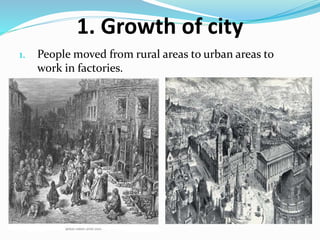
1. Growth of city 
1. People moved from rural areas to urban areas to 
work in factories.
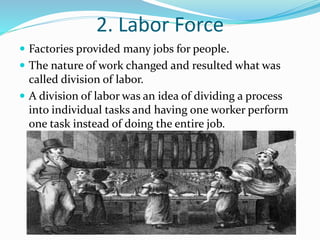
2. Labor Force 
 Factories provided many jobs for people. 
 The nature of work changed and resulted what was 
called division of labor. 
 A division of labor was an idea of dividing a process 
into individual tasks and having one worker perform 
one task instead of doing the entire job.
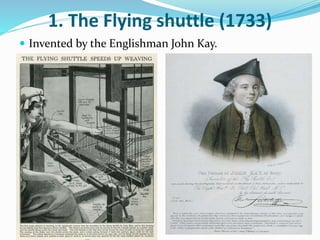
1. The Flying shuttle (1733) 
 Invented by the Englishman John Kay.
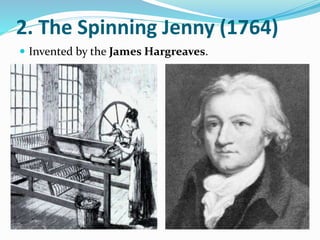
2. The Spinning Jenny (1764) 
 Invented by the James Hargreaves.
3. Spinning Water Frame (1769) 
 This invention designed by the English inventor 
Richard Arkwright.
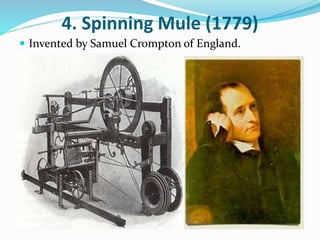
4. Spinning Mule (1779) 
 Invented by Samuel Crompton of England.
5. Power loom (1785) 
 Invented by English Inventor Edmund Cartwright 
(used waterpower for weaving)
6. Cotton Gin (1793) 
 Invented by American, Eli Whitney ( Removed seeds 
from cotton.

Industrial revolutions (1700-1890)

  • 1.
    Industrial Revolution (1700-1890) INSTRUCTOR: MR. MANZOOR AHMAD DEPARTMENT OF ECONOMICS UNIVERSITY OF SWABI
  • 2.
    What is Revolution  A Revolution is a rapid, total and permanent change.  It usually refers to the political change.  Two well known examples are 1. The American Revolution (1775-83), which led the Foundation of USA. 2. The French Revolution (1789-99) when France became a republic.
  • 3.
    Industrial Revolution In 1700, a great revolution began in Great Britain. (Industrial Revolution)  It marked the end of people living in rural societies and making the things they needed by hand.  People began creating machines to do work.
  • 4.
    Industrial Revolution Factories were built and Banks were opened.  This time is known as Industrial revolution.  It changed the History of the world forever.
  • 5.
    Financial Institution beforeand After Industrial Revolution S.No. Name of Institutions Established 1 C. Hoare & Co. 1672 2 Barclays PLC 1690 3 Bank of England 1694 4 Lloyds Banking Group 1695 5 The Royal Bank of Scotland 1727 6 Weatherbys 1770 7 Raphaels Bank 1787 8 Arbuthnot Latham 1833 9 Airdrie Savings Bank 1835
  • 6.
    Industrial Revolution The Phrase Industrial Revolution covers many different developments which all took place at the same time.  Some historian describes each of these changes as a ‘revolution’ for example, The Commercial Revolution, The Transport Revolution and so on.
  • 7.
    Industrial Revolution The movement started in Britain, which why the British Industrial Revolution is often referred as the Industrial Revolution.  By 1850 industrialization was taking root in parts of Western Europe and the USA, and by the end of 19th century it had spread to Russia and Japan.
  • 8.
    Industrial Revolution By1830 Britain was an Industrialized nation. Making most of the money From manufacturing and Commerce. Main Source of Income: 1. Production of Goods 2. Trade or Exports of Goods
  • 9.
    Industrial Revolution According to Thomas Ashton, the first Industrial Revolution began in the 1760’s in England. Historian call the second Industrial Revolution the time when industry spread From England to the US and Germany and then toWestern Europe.
  • 10.
    Big Changes AfterIndustrial Revolution  The Industrial Revolution changed how things were produced and people lived.  During 1700’s and the 1800’s, new machines were being invented.  Before Industrial Revolution, England and America both were agriculture societies.  Most of the items that people used everyday like clothing and furniture, were made by hand.
  • 11.
    Financial Factors The Industrial Revolution in Britain depended on the following financial factors: 1. Private Banking 2. Stable Environment 3. Capital Investment 4. Capitalism
  • 12.
    Major Development during Industrial Revolution  The Industrial revolution brought about changes in many industries including iron, coal, steam, transportation, textile and agriculture.
  • 13.
    1. Coal andIron  Essential raw material during IR.  Used to build suspension bridges, factory machines, railroads, and steamships. Coal Iron ore
  • 14.
    1. Coal andIron  In 1709, English Industrialist Abraham Darby successful used a high carbon, converted form of coal, called coke, to produce iron from iron ore. Abraham Darby Coke
  • 15.
    1. Coal andIron  This eliminated the need for charcoal, which was more expensive and less efficient. Metal makers began using it to speed up the production of raw iron, bar iron, and other metals. Charcoal bar iron
  • 16.
    1. Coal andIron  In 1784, Englishman Henry Cort invented a new process for making a purer iron and for finishing and shaping iron into desired shapes and sizes. This process is called Puddling and Rolling.  Used in building, heavy machinery and farm implements.
  • 17.
    2. Steam The steam engine was one of the important invention during IR.  One steam engine could do the work of hundreds of horses do. Steam never got tired and its only food was coal, which was cheaper than the wheat and oats that horses ate.
  • 18.
    2. Steam In 1712, Thomas NewComen invents the stem engine.  Interesting pieces of technology.  This engine is called Atmosphere Engine.
  • 19.
  • 20.
    Thomas NewComen SteamEngine  Animation of a schematic Newcomen steam engine. – Steam is shown pink and water is blue. – Valves move fromopen (green) to closed (red)
  • 21.
    2. Steam Steam Engine was used for providing power in mining, steamboats and railroads.
  • 22.
    2. Steam In 1769, a Scottish inventor James Watts , produced an improved steam engine.  His steam Engine saved energy and cost and used a system of gears and cranks to turn a wheel.
  • 23.
  • 24.
    2. Transportation The improvement of transportation greatly increased the success of the IR.  It became quicker and cheaper to transport people, raw materials, and finished product.  Canals and Rail transport were the primary means of transportation.
  • 25.
    2. Transportation Canals were first used in ancient Egypt and China. But demand for coal and iron grew during the IR, huge canal system were dug in Europe and America. One of the first canals dug in the US was the Erie Canal.  This canal opened in 1825.
  • 26.
    3. Textile The textile industry is industry most often associated with the IR.  Before the IR Spinning Yarn and Weaving cloth by hands was the only process for making clothes.  This was usually done only
  • 27.
    3. Textile Invention of textile machinery replaced the human labor that was needed to make cloth.  These invention included the Flying shuttle Spinning jenny Power loom Cotton gin Sewing machine.
  • 28.
  • 29.
  • 30.
  • 31.
  • 32.
  • 33.
    4. Agriculture Agriculture became an important source of raw materials for the textile industry as well food provider for the increasing population of the workers.  During IR, many agriculture implements were invented .  In 1701, Jethro Tull invented the seed drill.  It allowed farmers to sow seeds better and more easily.
  • 34.
    4. Agriculture JethroTull Seeds Drill
  • 35.
    4. Agriculture In1785, Robert Ransome invented the self-sharpening plow.
  • 36.
    4. Agriculture In 1837, John Deere invented the steel plow in the US.
  • 37.
    5. Factories Massproduction Before IR, goods were produced in people’s home or in small workshop. Factories made possible to manufactured goods quicker and cheaper than ever before.
  • 38.
    6. Power source Water was an important source for early industry and many machines are powered by Waterwheels. Steam power was developed and steam engines were used to pump water out of mine shafts and to power new systems. In addition, engines and furnaces were also fueled by coal. By the 1800’s coal was transported to factories by ship or train.
  • 39.
    7. Labor Unions Factory jobs are not easy job. In the 1840’s trade unions began organizing in Britain to help improve working conditions in factories and to increase pay.
  • 40.
    7. Labor Unions The idea of the trade unions was give workers more power as a group instead of as individuals. Some of the trade unions efforts were successful and new laws were passed in Great Britain to protect workers.
  • 41.
    7. Labor Unions Importance British labor Laws included: 1. The Factory Act of 1833: This law limited children under 13 years old to an 8 hour work day, 6 days a week. 2. The Mines Act of 1842: This law prohibited women and children less than 10 years of age from working in mines. 3. The Ten-Hour Law of 1847: This law reduced working hours to 10 hours per day.
  • 43.
    1. Growth ofcity 1. People moved from rural areas to urban areas to work in factories.
  • 44.
    2. Labor Force  Factories provided many jobs for people.  The nature of work changed and resulted what was called division of labor.  A division of labor was an idea of dividing a process into individual tasks and having one worker perform one task instead of doing the entire job.
  • 46.
    1. The Flyingshuttle (1733)  Invented by the Englishman John Kay.
  • 47.
    2. The SpinningJenny (1764)  Invented by the James Hargreaves.
  • 48.
    3. Spinning WaterFrame (1769)  This invention designed by the English inventor Richard Arkwright.
  • 49.
    4. Spinning Mule(1779)  Invented by Samuel Crompton of England.
  • 50.
    5. Power loom(1785)  Invented by English Inventor Edmund Cartwright (used waterpower for weaving)
  • 51.
    6. Cotton Gin(1793)  Invented by American, Eli Whitney ( Removed seeds from cotton.