1COLLEGE OF COMPUTER STUDIES
My Teacher Got IT v2.0
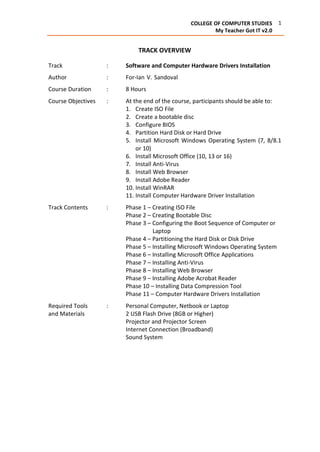
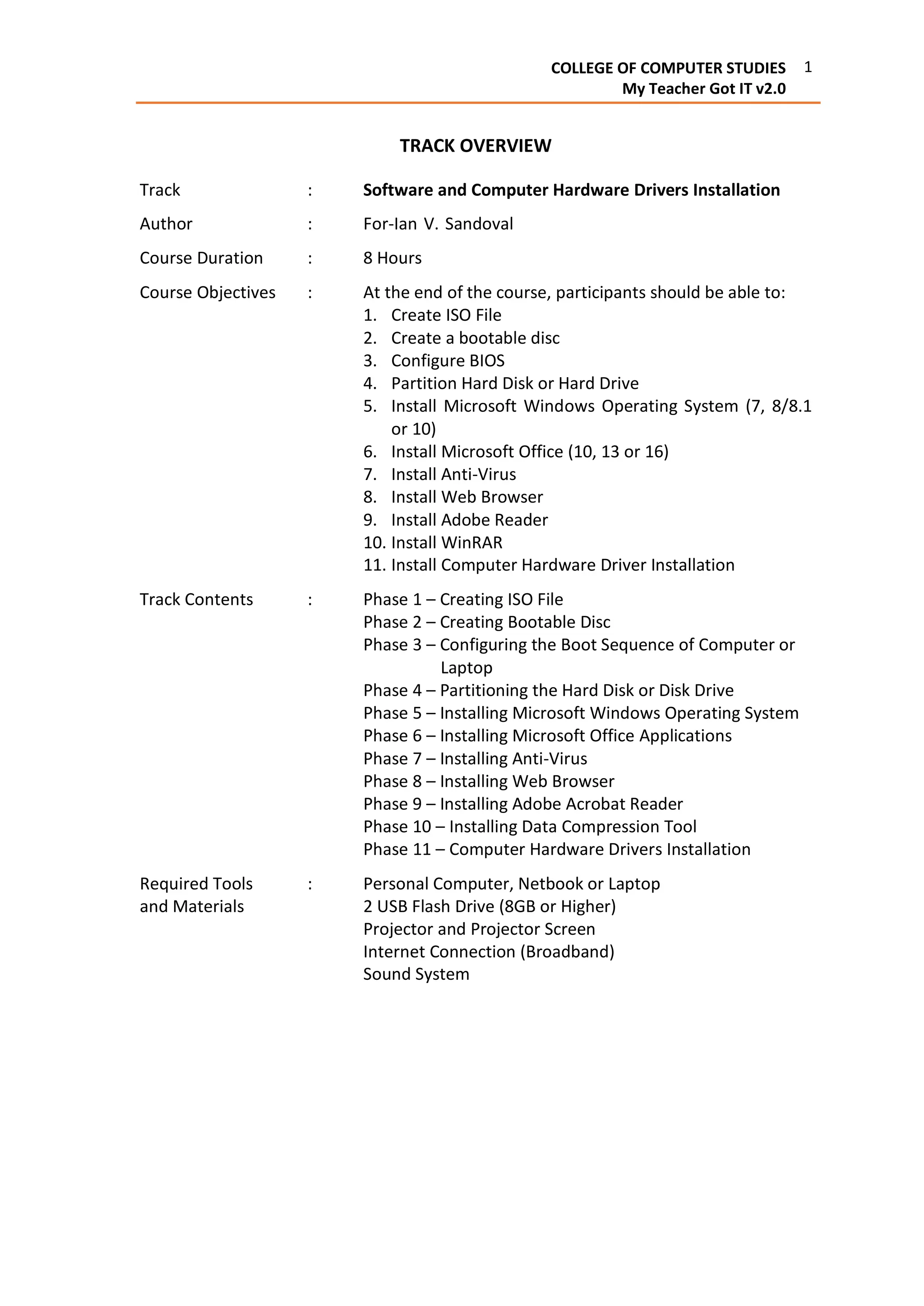
TRACK OVERVIEW
Track : Software and Computer Hardware Drivers Installation
Author : For-Ian V. Sandoval, Joel M. Bawica and Flaviano L. Urera
Course Duration : 8 Hours
Course Objectives : At the end of the course, participants should be able to:
1. Create ISO File
2. Create a bootable disc
3. Configure BIOS
4. Partition Hard Disk or Hard Drive
5. Install Microsoft Windows Operating System (7, 8/8.1
or 10)
6. Install Microsoft Office (10, 13 or 16)
7. Install Anti-Virus
8. Install Web Browser
9. Install Adobe Reader
10. Install WinRAR
11. Install Computer Hardware Driver Installation
Track Contents : Phase 1 – Creating ISO File
Phase 2 – Creating Bootable Disc
Phase 3 – Configuring the Boot Sequence of Computer or
Laptop
Phase 4 – Partitioning the Hard Disk or Disk Drive
Phase 5 – Installing Microsoft Windows Operating System
Phase 6 – Installing Microsoft Office Applications
Phase 7 – Installing Anti-Virus
Phase 8 – Installing Web Browser
Phase 9 – Installing Adobe Acrobat Reader
Phase 10 – Installing Data Compression Tool
Phase 11 – Computer Hardware Drivers Installation
Required Tools : Personal Computer, Netbook or Laptop
and Materials 2 USB Flash Drive (8GB or Higher)
Projector and Projector Screen
Internet Connection (Broadband)
Sound System
2COLLEGE OF COMPUTER STUDIES
My Teacher Got IT v2.0
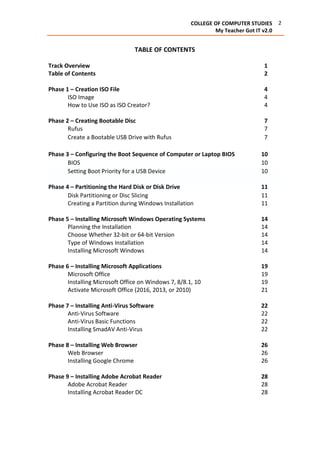
TABLE OF CONTENTS
Track Overview 1
Table of Contents 2
Phase 1 – Creation ISO File 4
ISO Image 4
How to Use ISO as ISO Creator? 4
Phase 2 – Creating Bootable Disc 7
Rufus 7
Create a Bootable USB Drive with Rufus 7
Phase 3 – Configuring the Boot Sequence of Computer or Laptop BIOS 10
BIOS 10
Setting Boot Priority for a USB Device 10
Phase 4 – Partitioning the Hard Disk or Disk Drive 11
Disk Partitioning or Disc Slicing 11
Creating a Partition during Windows Installation 11
Phase 5 – Installing Microsoft Windows Operating Systems 14
Planning the Installation 14
Choose Whether 32-bit or 64-bit Version 14
Type of Windows Installation 14
Installing Microsoft Windows 14
Phase 6 – Installing Microsoft Applications 19
Microsoft Office 19
Installing Microsoft Office on Windows 7, 8/8.1, 10 19
Activate Microsoft Office (2016, 2013, or 2010) 21
Phase 7 – Installing Anti-Virus Software 22
Anti-Virus Software 22
Anti-Virus Basic Functions 22
Installing SmadAV Anti-Virus 22
Phase 8 – Installing Web Browser 26
Web Browser 26
Installing Google Chrome 26
Phase 9 – Installing Adobe Acrobat Reader 28
Adobe Acrobat Reader 28
Installing Acrobat Reader DC 28
3COLLEGE OF COMPUTER STUDIES
My Teacher Got IT v2.0
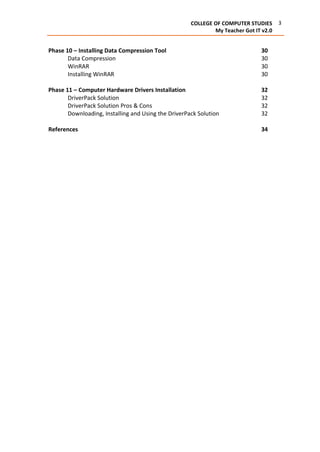
Phase 10 – Installing Data Compression Tool 30
Data Compression 30
WinRAR 30
Installing WinRAR 30
Phase 11 – Computer Hardware Drivers Installation 32
DriverPack Solution 32
DriverPack Solution Pros & Cons 32
Downloading, Installing and Using the DriverPack Solution 32
References 34
4COLLEGE OF COMPUTER STUDIES
My Teacher Got IT v2.0
PHASE 1 - CREATING ISO FILE
ISO IMAGE
 An archive file of an optical disc, a type of disk image composed of the data contents
from every written sector on an optical disc, including the optical disc file system
 The files usually have a file extension of .iso
 The name ISO is taken from the ISO 9660 file system used with CD-ROM media, but
what is known as an ISO image might also contain a UDF (ISO/IEC 13346) file system
(commonly used by DVDs and Blu-ray Discs)
 ISO images can be produced from optical discs by disk imaging software, or from a
collection of files by optical disc authoring software, or from a different disk image
file using conversion
 i.e. PowerISO, UltraISO, AVSDisc Creator, Daemon Tools Lite, WinCDEmu, PISMOFile
Mount, StarBurn, VirtualClone Drive, Phantom CD, MagicDisc, LC ISO Creator
How to Use PowerISO as ISO Creator?
A. Create iso file using the main program
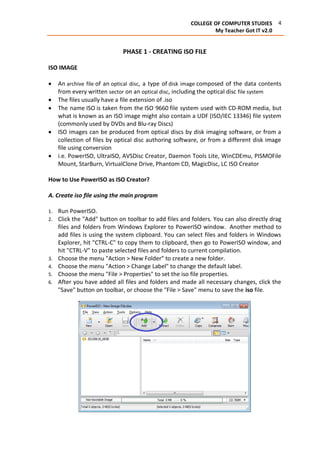
1. Run PowerISO.
2. Click the "Add" button on toolbar to add files and folders. You can also directly drag
files and folders from Windows Explorer to PowerISO window. Another method to
add files is using the system clipboard. You can select files and folders in Windows
Explorer, hit "CTRL-C" to copy them to clipboard, then go to PowerISO window, and
hit "CTRL-V" to paste selected files and folders to current compilation.
3. Choose the menu "Action > New Folder" to create a new folder.
4. Choose the menu "Action > Change Label" to change the default label.
5. Choose the menu "File > Properties" to set the iso file properties.
6. After you have added all files and folders and made all necessary changes, click the
"Save" button on toolbar, or choose the "File > Save" menu to save the iso file.
5COLLEGE OF COMPUTER STUDIES
My Teacher Got IT v2.0
B. Create iso file using the shell context menu:
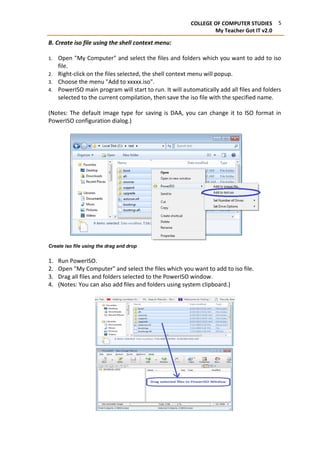
1. Open "My Computer" and select the files and folders which you want to add to iso
file.
2. Right-click on the files selected, the shell context menu will popup.
3. Choose the menu "Add to xxxxx.iso".
4. PowerISO main program will start to run. It will automatically add all files and folders
selected to the current compilation, then save the iso file with the specified name.
(Notes: The default image type for saving is DAA, you can change it to ISO format in
PowerISO configuration dialog.)
Create iso file using the drag and drop
1. Run PowerISO.
2. Open "My Computer" and select the files which you want to add to iso file.
3. Drag all files and folders selected to the PowerISO window.
4. (Notes: You can also add files and folders using system clipboard.)
6COLLEGE OF COMPUTER STUDIES
My Teacher Got IT v2.0
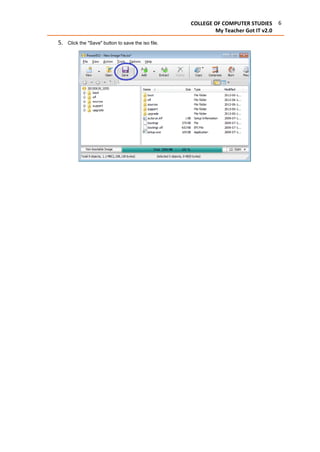
5. Click the "Save" button to save the iso file.
7COLLEGE OF COMPUTER STUDIES
My Teacher Got IT v2.0
PHASE 2 – CREATING BOOTABLE DISC
Rufus
 a tool for Windows that handles a lot of work formatting USB drives and making
them bootable
 it can burn most ISO files to USB very efficiently
 Features include burns any Windows ISO (XP, 7 or 8), burns any Linux-based ISO
(ArchLinux, Ubuntu, Knoppix, etc); burns a number of handy ISOs (Hiren's Boot CD,
FreeDOS, BartPE, Ultimate Boot CD); handles UEFI as well as legacy booting; handles
GPT as well as MBR partition tables
 Requirements: Rufus 1.4.9 or higher; Apple (or PC) running Windows XP or later
(preferably Windows 7+); Rufus application; ISO (supported operating systems);
and8 GB USB flash drive (minimum recommended)
Create a bootable USB drive with Rufus
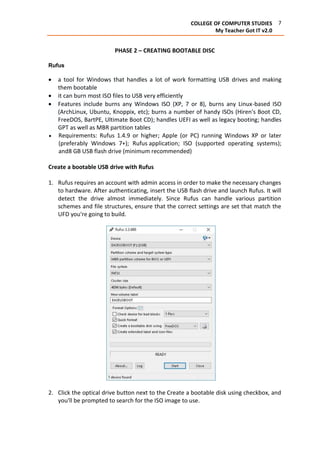
1. Rufus requires an account with admin access in order to make the necessary changes
to hardware. After authenticating, insert the USB flash drive and launch Rufus. It will
detect the drive almost immediately. Since Rufus can handle various partition
schemes and file structures, ensure that the correct settings are set that match the
UFD you're going to build.
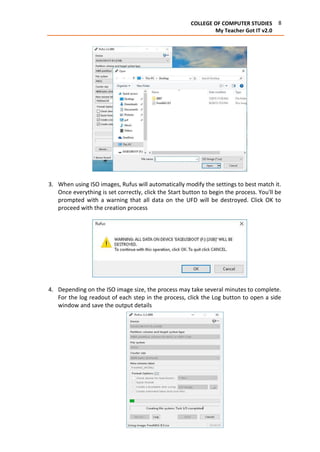
2. Click the optical drive button next to the Create a bootable disk using checkbox, and
you'll be prompted to search for the ISO image to use.
8COLLEGE OF COMPUTER STUDIES
My Teacher Got IT v2.0
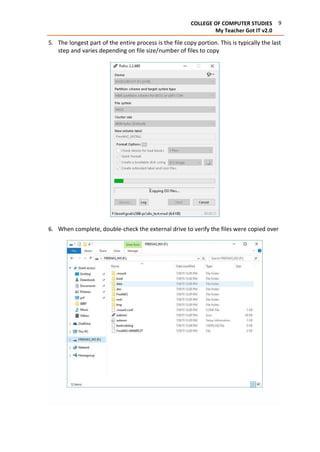
3. When using ISO images, Rufus will automatically modify the settings to best match it.
Once everything is set correctly, click the Start button to begin the process. You'll be
prompted with a warning that all data on the UFD will be destroyed. Click OK to
proceed with the creation process
4. Depending on the ISO image size, the process may take several minutes to complete.
For the log readout of each step in the process, click the Log button to open a side
window and save the output details
9COLLEGE OF COMPUTER STUDIES
My Teacher Got IT v2.0
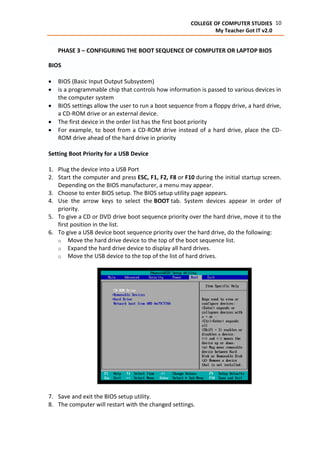
5. The longest part of the entire process is the file copy portion. This is typically the last
step and varies depending on file size/number of files to copy
6. When complete, double-check the external drive to verify the files were copied over
10COLLEGE OF COMPUTER STUDIES
My Teacher Got IT v2.0
PHASE 3 – CONFIGURING THE BOOT SEQUENCE OF COMPUTER OR LAPTOP BIOS
BIOS
 BIOS (Basic Input Output Subsystem)
 is a programmable chip that controls how information is passed to various devices in
the computer system
 BIOS settings allow the user to run a boot sequence from a floppy drive, a hard drive,
a CD-ROM drive or an external device.
 The first device in the order list has the first boot priority
 For example, to boot from a CD-ROM drive instead of a hard drive, place the CD-
ROM drive ahead of the hard drive in priority
Setting Boot Priority for a USB Device
1. Plug the device into a USB Port
2. Start the computer and press ESC, F1, F2, F8 or F10 during the initial startup screen.
Depending on the BIOS manufacturer, a menu may appear.
3. Choose to enter BIOS setup. The BIOS setup utility page appears.
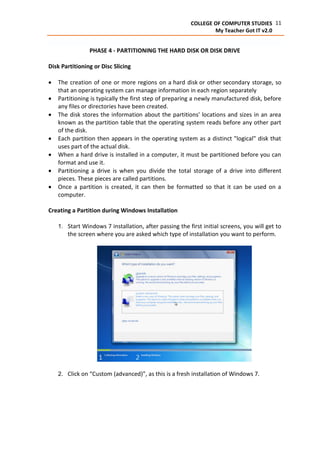
4. Use the arrow keys to select the BOOT tab. System devices appear in order of
priority.
5. To give a CD or DVD drive boot sequence priority over the hard drive, move it to the
first position in the list.
6. To give a USB device boot sequence priority over the hard drive, do the following:
o Move the hard drive device to the top of the boot sequence list.
o Expand the hard drive device to display all hard drives.
o Move the USB device to the top of the list of hard drives.
7. Save and exit the BIOS setup utility.
8. The computer will restart with the changed settings.
11COLLEGE OF COMPUTER STUDIES
My Teacher Got IT v2.0
PHASE 4 - PARTITIONING THE HARD DISK OR DISK DRIVE
Disk Partitioning or Disc Slicing
 The creation of one or more regions on a hard disk or other secondary storage, so
that an operating system can manage information in each region separately
 Partitioning is typically the first step of preparing a newly manufactured disk, before
any files or directories have been created.
 The disk stores the information about the partitions' locations and sizes in an area
known as the partition table that the operating system reads before any other part
of the disk.
 Each partition then appears in the operating system as a distinct "logical" disk that
uses part of the actual disk.
 When a hard drive is installed in a computer, it must be partitioned before you can
format and use it.
 Partitioning a drive is when you divide the total storage of a drive into different
pieces. These pieces are called partitions.
 Once a partition is created, it can then be formatted so that it can be used on a
computer.
Creating a Partition during Windows Installation
1. Start Windows 7 installation, after passing the first initial screens, you will get to
the screen where you are asked which type of installation you want to perform.
2. Click on “Custom (advanced)”, as this is a fresh installation of Windows 7.
12COLLEGE OF COMPUTER STUDIES
My Teacher Got IT v2.0
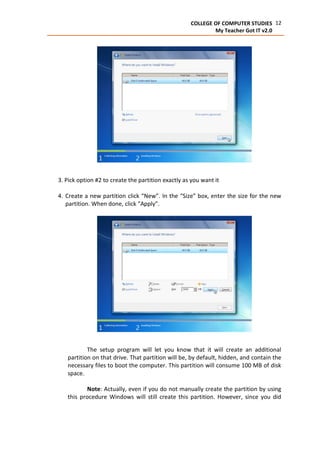
3. Pick option #2 to create the partition exactly as you want it
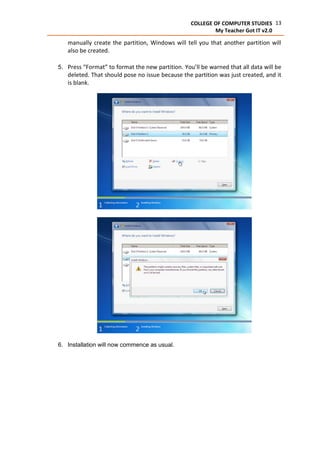
4. Create a new partition click “New”. In the “Size” box, enter the size for the new
partition. When done, click “Apply”.
The setup program will let you know that it will create an additional
partition on that drive. That partition will be, by default, hidden, and contain the
necessary files to boot the computer. This partition will consume 100 MB of disk
space.
Note: Actually, even if you do not manually create the partition by using
this procedure Windows will still create this partition. However, since you did
13COLLEGE OF COMPUTER STUDIES
My Teacher Got IT v2.0
manually create the partition, Windows will tell you that another partition will
also be created.
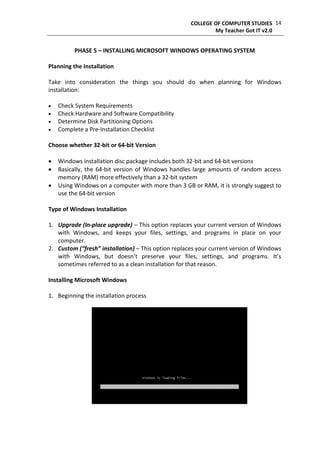
5. Press “Format” to format the new partition. You’ll be warned that all data will be
deleted. That should pose no issue because the partition was just created, and it
is blank.
6. Installation will now commence as usual.
14COLLEGE OF COMPUTER STUDIES
My Teacher Got IT v2.0
PHASE 5 – INSTALLING MICROSOFT WINDOWS OPERATING SYSTEM
Planning the Installation
Take into consideration the things you should do when planning for Windows
installation:
 Check System Requirements
 Check Hardware and Software Compatibility
 Determine Disk Partitioning Options
 Complete a Pre-Installation Checklist
Choose whether 32-bit or 64-bit Version
 Windows installation disc package includes both 32-bit and 64-bit versions
 Basically, the 64-bit version of Windows handles large amounts of random access
memory (RAM) more effectively than a 32-bit system
 Using Windows on a computer with more than 3 GB or RAM, it is strongly suggest to
use the 64-bit version
Type of Windows Installation
1. Upgrade (In-place upgrade) – This option replaces your current version of Windows
with Windows, and keeps your files, settings, and programs in place on your
computer.
2. Custom (“fresh” installation) – This option replaces your current version of Windows
with Windows, but doesn’t preserve your files, settings, and programs. It’s
sometimes referred to as a clean installation for that reason.
Installing Microsoft Windows
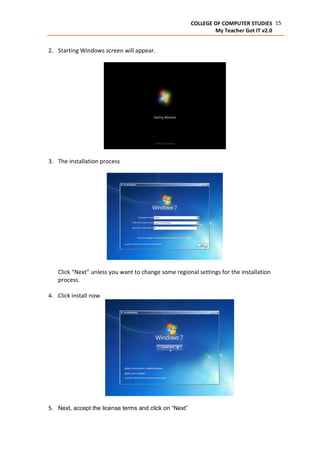
1. Beginning the installation process
15COLLEGE OF COMPUTER STUDIES
My Teacher Got IT v2.0
2. Starting Windows screen will appear.
3. The installation process
Click “Next” unless you want to change some regional settings for the installation
process.
4. Click install now
5. Next, accept the license terms and click on “Next”
16COLLEGE OF COMPUTER STUDIES
My Teacher Got IT v2.0
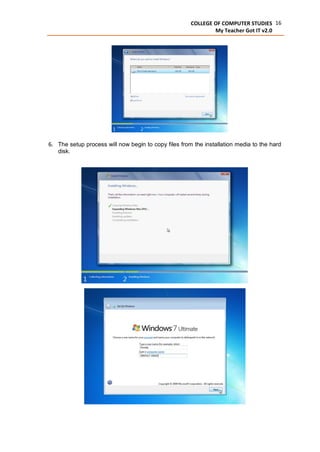
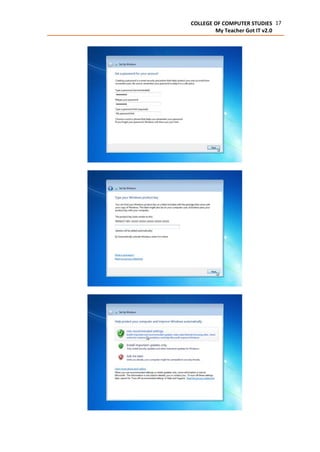
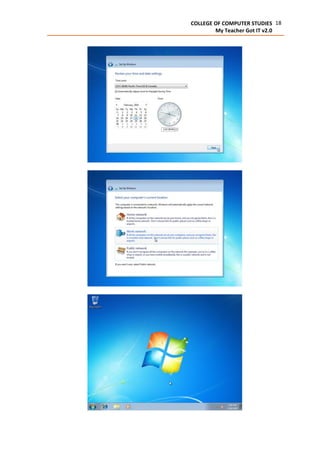
6. The setup process will now begin to copy files from the installation media to the hard
disk.
17COLLEGE OF COMPUTER STUDIES
My Teacher Got IT v2.0
18COLLEGE OF COMPUTER STUDIES
My Teacher Got IT v2.0
19COLLEGE OF COMPUTER STUDIES
My Teacher Got IT v2.0
PHASE 6 – INSTALLING MICROSOFT OFFICE APPLICATIONS
Microsoft Office
 An office suite of applications, servers, and services developed by Microsoft
 Bill Gates declared Microsoft Office on 1 August 1988, at COMDEX in Las Vegas
 The first version of Office included Microsoft Word, Microsoft Excel, and Microsoft
PowerPoint
 Office applications have expanded over the years extensively closer with shared
features such as a universal spell checker, OLE data integration and Visual Basic for
Applications scripting language
 Microsoft also positions Office as a advancement platform for line-of-business
software under the Office Business Applications brand
 Office is produced in several versions targeted towards different end-users and
computing environments such Office 2000, 2003, 2007, 2010, 2013, 365 and 2016
 The original version is the desktop version, available for PCs running the Windows
and macOS operating systems.
 The most current desktop version is Office 2016 for Windows and macOS, released
on 22 September 2015 and 9 July 2015
 Microsoft also developed Office Mobile, which are free-to-use versions of Office
applications for mobile devices
 Microsoft also produces and runs Office Online, a web-based version of core Office
apps, which is included as part of a Microsoft account.
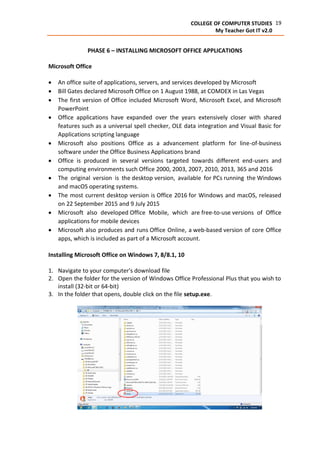
Installing Microsoft Office on Windows 7, 8/8.1, 10
1. Navigate to your computer's download file
2. Open the folder for the version of Windows Office Professional Plus that you wish to
install (32-bit or 64-bit)
3. In the folder that opens, double click on the file setup.exe.
20COLLEGE OF COMPUTER STUDIES
My Teacher Got IT v2.0
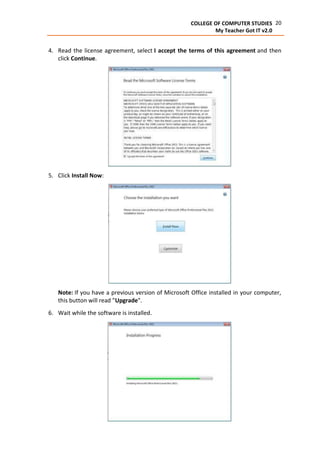
4. Read the license agreement, select I accept the terms of this agreement and then
click Continue.
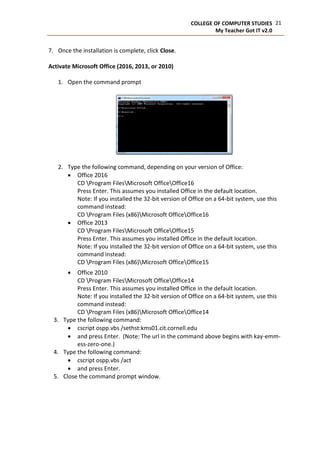
5. Click Install Now:
Note: If you have a previous version of Microsoft Office installed in your computer,
this button will read "Upgrade".
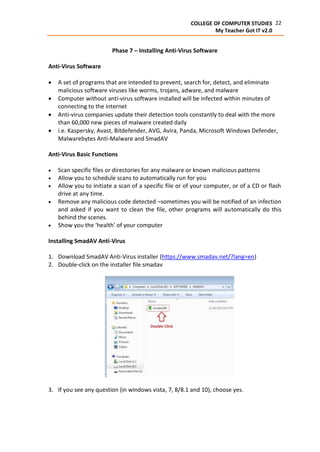
6. Wait while the software is installed.
21COLLEGE OF COMPUTER STUDIES
My Teacher Got IT v2.0
7. Once the installation is complete, click Close.
Activate Microsoft Office (2016, 2013, or 2010)
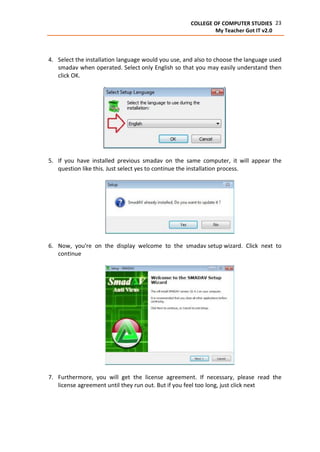
1. Open the command prompt
2. Type the following command, depending on your version of Office:
 Office 2016
CD Program FilesMicrosoft OfficeOffice16
Press Enter. This assumes you installed Office in the default location.
Note: If you installed the 32-bit version of Office on a 64-bit system, use this
command instead:
CD Program Files (x86)Microsoft OfficeOffice16
 Office 2013
CD Program FilesMicrosoft OfficeOffice15
Press Enter. This assumes you installed Office in the default location.
Note: If you installed the 32-bit version of Office on a 64-bit system, use this
command instead:
CD Program Files (x86)Microsoft OfficeOffice15
 Office 2010
CD Program FilesMicrosoft OfficeOffice14
Press Enter. This assumes you installed Office in the default location.
Note: If you installed the 32-bit version of Office on a 64-bit system, use this
command instead:
CD Program Files (x86)Microsoft OfficeOffice14
3. Type the following command:
 cscript ospp.vbs /sethst:kms01.cit.cornell.edu
 and press Enter. (Note: The url in the command above begins with kay-emm-
ess-zero-one.)
4. Type the following command:
 cscript ospp.vbs /act
 and press Enter.
5. Close the command prompt window.
22COLLEGE OF COMPUTER STUDIES
My Teacher Got IT v2.0
Phase 7 – Installing Anti-Virus Software
Anti-Virus Software
 A set of programs that are intended to prevent, search for, detect, and eliminate
malicious software viruses like worms, trojans, adware, and malware
 Computer without anti-virus software installed will be infected within minutes of
connecting to the internet
 Anti-virus companies update their detection tools constantly to deal with the more
than 60,000 new pieces of malware created daily
 i.e. Kaspersky, Avast, Bitdefender, AVG, Avira, Panda, Microsoft Windows Defender,
Malwarebytes Anti-Malware and SmadAV
Anti-Virus Basic Functions
 Scan specific files or directories for any malware or known malicious patterns
 Allow you to schedule scans to automatically run for you
 Allow you to initiate a scan of a specific file or of your computer, or of a CD or flash
drive at any time.
 Remove any malicious code detected –sometimes you will be notified of an infection
and asked if you want to clean the file, other programs will automatically do this
behind the scenes.
 Show you the ‘health’ of your computer
Installing SmadAV Anti-Virus
1. Download SmadAV Anti-Virus installer (https://www.smadav.net/?lang=en)
2. Double-click on the installer file smadav
3. If you see any question (in windows vista, 7, 8/8.1 and 10), choose yes.
23COLLEGE OF COMPUTER STUDIES
My Teacher Got IT v2.0
4. Select the installation language would you use, and also to choose the language used
smadav when operated. Select only English so that you may easily understand then
click OK.
5. If you have installed previous smadav on the same computer, it will appear the
question like this. Just select yes to continue the installation process.
6. Now, you're on the display welcome to the smadav setup wizard. Click next to
continue
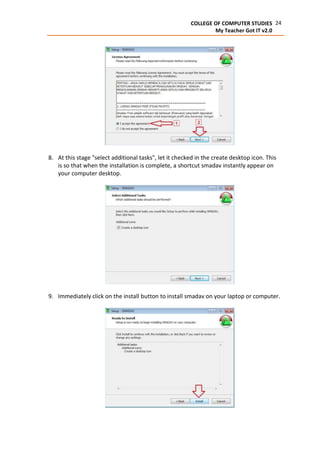
7. Furthermore, you will get the license agreement. If necessary, please read the
license agreement until they run out. But if you feel too long, just click next
24COLLEGE OF COMPUTER STUDIES
My Teacher Got IT v2.0
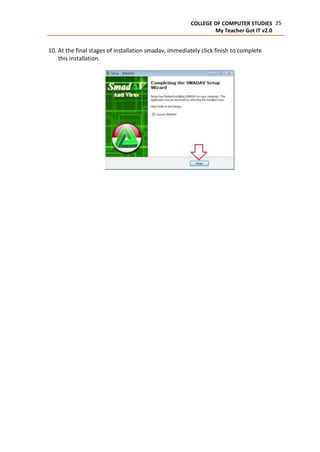
8. At this stage "select additional tasks", let it checked in the create desktop icon. This
is so that when the installation is complete, a shortcut smadav instantly appear on
your computer desktop.
9. Immediately click on the install button to install smadav on your laptop or computer.
25COLLEGE OF COMPUTER STUDIES
My Teacher Got IT v2.0
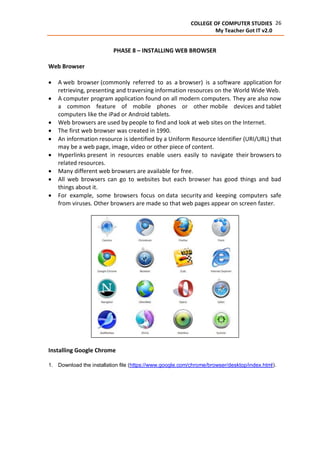
10. At the final stages of installation smadav, immediately click finish to complete
this installation.
26COLLEGE OF COMPUTER STUDIES
My Teacher Got IT v2.0
PHASE 8 – INSTALLING WEB BROWSER
Web Browser
 A web browser (commonly referred to as a browser) is a software application for
retrieving, presenting and traversing information resources on the World Wide Web.
 A computer program application found on all modern computers. They are also now
a common feature of mobile phones or other mobile devices and tablet
computers like the iPad or Android tablets.
 Web browsers are used by people to find and look at web sites on the Internet.
 The first web browser was created in 1990.
 An information resource is identified by a Uniform Resource Identifier (URI/URL) that
may be a web page, image, video or other piece of content.
 Hyperlinks present in resources enable users easily to navigate their browsers to
related resources.
 Many different web browsers are available for free.
 All web browsers can go to websites but each browser has good things and bad
things about it.
 For example, some browsers focus on data security and keeping computers safe
from viruses. Other browsers are made so that web pages appear on screen faster.
Installing Google Chrome
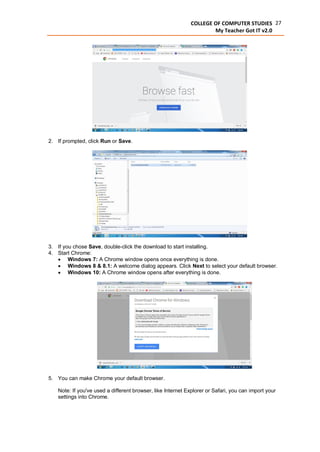
1. Download the installation file (https://www.google.com/chrome/browser/desktop/index.html).
27COLLEGE OF COMPUTER STUDIES
My Teacher Got IT v2.0
2. If prompted, click Run or Save.
3. If you chose Save, double-click the download to start installing.
4. Start Chrome:
 Windows 7: A Chrome window opens once everything is done.
 Windows 8 & 8.1: A welcome dialog appears. Click Next to select your default browser.
 Windows 10: A Chrome window opens after everything is done.
5. You can make Chrome your default browser.
Note: If you've used a different browser, like Internet Explorer or Safari, you can import your
settings into Chrome.
28COLLEGE OF COMPUTER STUDIES
My Teacher Got IT v2.0
PHASE 9 – INSTALLING ADOBE ACROBAT READER
Adobe Acrobat Reader
 A free global software standard for reliably viewing, printing, and commenting on
PDF documents
 Adobe Acrobat is a family of application software and Web services developed
by Adobe Systems
Installing Acrobat Reader DC
1. Close all versions of Reader. Close any browser that is displaying a PDF.
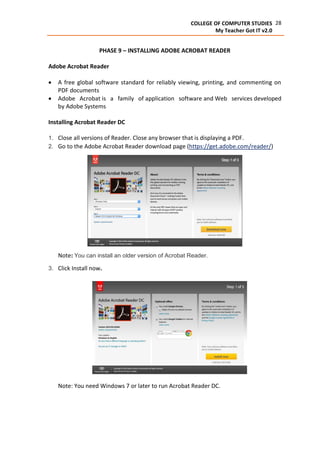
2. Go to the Adobe Acrobat Reader download page (https://get.adobe.com/reader/)
Note: You can install an older version of Acrobat Reader.
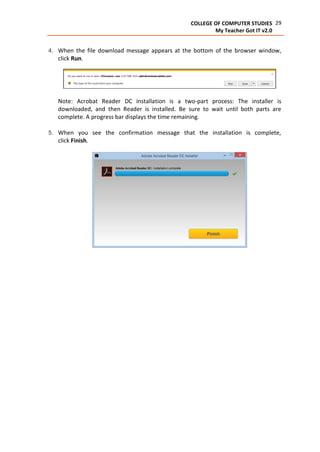
3. Click Install now.
Note: You need Windows 7 or later to run Acrobat Reader DC.
29COLLEGE OF COMPUTER STUDIES
My Teacher Got IT v2.0
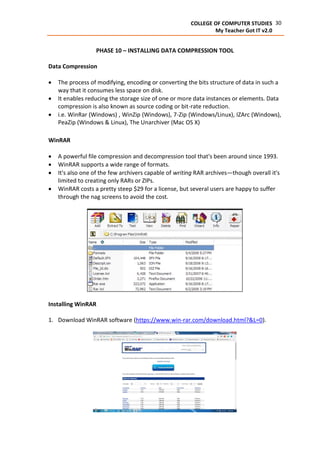
4. When the file download message appears at the bottom of the browser window,
click Run.
Note: Acrobat Reader DC installation is a two-part process: The installer is
downloaded, and then Reader is installed. Be sure to wait until both parts are
complete. A progress bar displays the time remaining.
5. When you see the confirmation message that the installation is complete,
click Finish.
30COLLEGE OF COMPUTER STUDIES
My Teacher Got IT v2.0
PHASE 10 – INSTALLING DATA COMPRESSION TOOL
Data Compression
 The process of modifying, encoding or converting the bits structure of data in such a
way that it consumes less space on disk.
 It enables reducing the storage size of one or more data instances or elements. Data
compression is also known as source coding or bit-rate reduction.
 i.e. WinRar (Windows) , WinZip (Windows), 7-Zip (Windows/Linux), IZArc (Windows),
PeaZip (Windows & Linux), The Unarchiver (Mac OS X)
WinRAR
 A powerful file compression and decompression tool that's been around since 1993.
 WinRAR supports a wide range of formats.
 It's also one of the few archivers capable of writing RAR archives—though overall it's
limited to creating only RARs or ZIPs.
 WinRAR costs a pretty steep $29 for a license, but several users are happy to suffer
through the nag screens to avoid the cost.
Installing WinRAR
1. Download WinRAR software (https://www.win-rar.com/download.html?&L=0).
31COLLEGE OF COMPUTER STUDIES
My Teacher Got IT v2.0
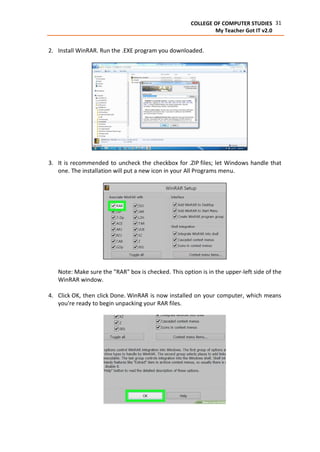
2. Install WinRAR. Run the .EXE program you downloaded.
3. It is recommended to uncheck the checkbox for .ZIP files; let Windows handle that
one. The installation will put a new icon in your All Programs menu.
Note: Make sure the "RAR" box is checked. This option is in the upper-left side of the
WinRAR window.
4. Click OK, then click Done. WinRAR is now installed on your computer, which means
you're ready to begin unpacking your RAR files.
32COLLEGE OF COMPUTER STUDIES
My Teacher Got IT v2.0
PHASE 11 – COMPUTER HARDWARE DRIVERS INSTALLATION
DriverPack Solution
 A free driver updater tool that finds the proper device drivers your computer needs,
downloads and installs it to your computer
 Easy to use and free
 A lightweight program that doesn't take long to download and connects to the
internet for free online driver updates
 portable and can be launched from any folder or hard drive or portable device, like
a flash drive
 Shows the driver version of the current driver as well as the version of the one that it
can downloaded to replace it
 Can list all the drivers, even the ones that don't need updated
DriverPack Solution Pros & Cons
Pros Cons
 Easy to use
 Supports automated, no-prompt
installs
 Quick downloads
 Supports bulk downloads
 Can download an offline version
that includes network drivers if
you don't have an internet
connection
 Cannot hide drivers from showing
up in future scans
 No option for scheduled scans
 Sometimes seems slower than it
should
 Includes a tool that can download
recommended software, but you
might accidentally click it and get
programs you don't want
Downloading, Installing and Using the DriverPack Solution
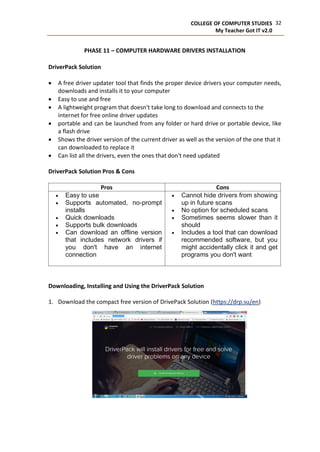
1. Download the compact free version of DrivePack Solution (https://drp.su/en)
33COLLEGE OF COMPUTER STUDIES
My Teacher Got IT v2.0
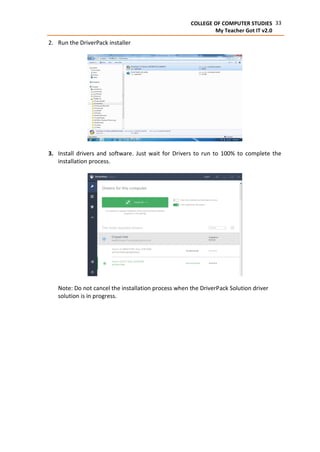
2. Run the DriverPack installer
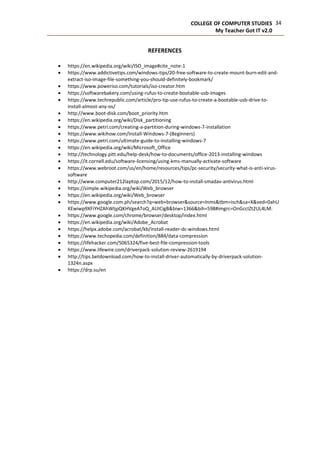
3. Install drivers and software. Just wait for Drivers to run to 100% to complete the
installation process.
Note: Do not cancel the installation process when the DriverPack Solution driver
solution is in progress.
34COLLEGE OF COMPUTER STUDIES
My Teacher Got IT v2.0
REFERENCES
 https://en.wikipedia.org/wiki/ISO_image#cite_note-1
 https://www.addictivetips.com/windows-tips/20-free-software-to-create-mount-burn-edit-and-
extract-iso-image-file-something-you-should-definitely-bookmark/
 https://www.poweriso.com/tutorials/iso-creator.htm
 https://softwarebakery.com/using-rufus-to-create-bootable-usb-images
 https://www.techrepublic.com/article/pro-tip-use-rufus-to-create-a-bootable-usb-drive-to-
install-almost-any-os/
 http://www.boot-disk.com/boot_priority.htm
 https://en.wikipedia.org/wiki/Disk_partitioning
 https://www.petri.com/creating-a-partition-during-windows-7-installation
 https://www.wikihow.com/Install-Windows-7-(Beginners)
 https://www.petri.com/ultimate-guide-to-installing-windows-7
 https://en.wikipedia.org/wiki/Microsoft_Office
 http://technology.pitt.edu/help-desk/how-to-documents/office-2013-installing-windows
 https://it.cornell.edu/software-licensing/using-kms-manually-activate-software
 https://www.webroot.com/us/en/home/resources/tips/pc-security/security-what-is-anti-virus-
software
 http://www.computer212laptop.com/2015/12/how-to-install-smadav-antivirus.html
 https://simple.wikipedia.org/wiki/Web_browser
 https://en.wikipedia.org/wiki/Web_browser
 https://www.google.com.ph/search?q=web+browser&source=lnms&tbm=isch&sa=X&ved=0ahU
KEwiwp9XFiYHZAhWIjpQKHVgeAToQ_AUICigB&biw=1366&bih=598#imgrc=OnGccIZt2UL4LM:
 https://www.google.com/chrome/browser/desktop/index.html
 https://en.wikipedia.org/wiki/Adobe_Acrobat
 https://helpx.adobe.com/acrobat/kb/install-reader-dc-windows.html
 https://www.techopedia.com/definition/884/data-compression
 https://lifehacker.com/5065324/five-best-file-compression-tools
 https://www.lifewire.com/driverpack-solution-review-2619194
 http://tips.betdownload.com/how-to-install-driver-automatically-by-driverpack-solution-
1324n.aspx
 https://drp.su/en

My Teacher Got IT v2.0 - Software Installation Track

  • 1.
    1COLLEGE OF COMPUTERSTUDIES My Teacher Got IT v2.0 TRACK OVERVIEW Track : Software and Computer Hardware Drivers Installation Author : For-Ian V. Sandoval, Joel M. Bawica and Flaviano L. Urera Course Duration : 8 Hours Course Objectives : At the end of the course, participants should be able to: 1. Create ISO File 2. Create a bootable disc 3. Configure BIOS 4. Partition Hard Disk or Hard Drive 5. Install Microsoft Windows Operating System (7, 8/8.1 or 10) 6. Install Microsoft Office (10, 13 or 16) 7. Install Anti-Virus 8. Install Web Browser 9. Install Adobe Reader 10. Install WinRAR 11. Install Computer Hardware Driver Installation Track Contents : Phase 1 – Creating ISO File Phase 2 – Creating Bootable Disc Phase 3 – Configuring the Boot Sequence of Computer or Laptop Phase 4 – Partitioning the Hard Disk or Disk Drive Phase 5 – Installing Microsoft Windows Operating System Phase 6 – Installing Microsoft Office Applications Phase 7 – Installing Anti-Virus Phase 8 – Installing Web Browser Phase 9 – Installing Adobe Acrobat Reader Phase 10 – Installing Data Compression Tool Phase 11 – Computer Hardware Drivers Installation Required Tools : Personal Computer, Netbook or Laptop and Materials 2 USB Flash Drive (8GB or Higher) Projector and Projector Screen Internet Connection (Broadband) Sound System
  • 2.
    2COLLEGE OF COMPUTERSTUDIES My Teacher Got IT v2.0 TABLE OF CONTENTS Track Overview 1 Table of Contents 2 Phase 1 – Creation ISO File 4 ISO Image 4 How to Use ISO as ISO Creator? 4 Phase 2 – Creating Bootable Disc 7 Rufus 7 Create a Bootable USB Drive with Rufus 7 Phase 3 – Configuring the Boot Sequence of Computer or Laptop BIOS 10 BIOS 10 Setting Boot Priority for a USB Device 10 Phase 4 – Partitioning the Hard Disk or Disk Drive 11 Disk Partitioning or Disc Slicing 11 Creating a Partition during Windows Installation 11 Phase 5 – Installing Microsoft Windows Operating Systems 14 Planning the Installation 14 Choose Whether 32-bit or 64-bit Version 14 Type of Windows Installation 14 Installing Microsoft Windows 14 Phase 6 – Installing Microsoft Applications 19 Microsoft Office 19 Installing Microsoft Office on Windows 7, 8/8.1, 10 19 Activate Microsoft Office (2016, 2013, or 2010) 21 Phase 7 – Installing Anti-Virus Software 22 Anti-Virus Software 22 Anti-Virus Basic Functions 22 Installing SmadAV Anti-Virus 22 Phase 8 – Installing Web Browser 26 Web Browser 26 Installing Google Chrome 26 Phase 9 – Installing Adobe Acrobat Reader 28 Adobe Acrobat Reader 28 Installing Acrobat Reader DC 28
  • 3.
    3COLLEGE OF COMPUTERSTUDIES My Teacher Got IT v2.0 Phase 10 – Installing Data Compression Tool 30 Data Compression 30 WinRAR 30 Installing WinRAR 30 Phase 11 – Computer Hardware Drivers Installation 32 DriverPack Solution 32 DriverPack Solution Pros & Cons 32 Downloading, Installing and Using the DriverPack Solution 32 References 34
  • 4.
    4COLLEGE OF COMPUTERSTUDIES My Teacher Got IT v2.0 PHASE 1 - CREATING ISO FILE ISO IMAGE  An archive file of an optical disc, a type of disk image composed of the data contents from every written sector on an optical disc, including the optical disc file system  The files usually have a file extension of .iso  The name ISO is taken from the ISO 9660 file system used with CD-ROM media, but what is known as an ISO image might also contain a UDF (ISO/IEC 13346) file system (commonly used by DVDs and Blu-ray Discs)  ISO images can be produced from optical discs by disk imaging software, or from a collection of files by optical disc authoring software, or from a different disk image file using conversion  i.e. PowerISO, UltraISO, AVSDisc Creator, Daemon Tools Lite, WinCDEmu, PISMOFile Mount, StarBurn, VirtualClone Drive, Phantom CD, MagicDisc, LC ISO Creator How to Use PowerISO as ISO Creator? A. Create iso file using the main program 1. Run PowerISO. 2. Click the "Add" button on toolbar to add files and folders. You can also directly drag files and folders from Windows Explorer to PowerISO window. Another method to add files is using the system clipboard. You can select files and folders in Windows Explorer, hit "CTRL-C" to copy them to clipboard, then go to PowerISO window, and hit "CTRL-V" to paste selected files and folders to current compilation. 3. Choose the menu "Action > New Folder" to create a new folder. 4. Choose the menu "Action > Change Label" to change the default label. 5. Choose the menu "File > Properties" to set the iso file properties. 6. After you have added all files and folders and made all necessary changes, click the "Save" button on toolbar, or choose the "File > Save" menu to save the iso file.
  • 5.
    5COLLEGE OF COMPUTERSTUDIES My Teacher Got IT v2.0 B. Create iso file using the shell context menu: 1. Open "My Computer" and select the files and folders which you want to add to iso file. 2. Right-click on the files selected, the shell context menu will popup. 3. Choose the menu "Add to xxxxx.iso". 4. PowerISO main program will start to run. It will automatically add all files and folders selected to the current compilation, then save the iso file with the specified name. (Notes: The default image type for saving is DAA, you can change it to ISO format in PowerISO configuration dialog.) Create iso file using the drag and drop 1. Run PowerISO. 2. Open "My Computer" and select the files which you want to add to iso file. 3. Drag all files and folders selected to the PowerISO window. 4. (Notes: You can also add files and folders using system clipboard.)
  • 6.
    6COLLEGE OF COMPUTERSTUDIES My Teacher Got IT v2.0 5. Click the "Save" button to save the iso file.
  • 7.
    7COLLEGE OF COMPUTERSTUDIES My Teacher Got IT v2.0 PHASE 2 – CREATING BOOTABLE DISC Rufus  a tool for Windows that handles a lot of work formatting USB drives and making them bootable  it can burn most ISO files to USB very efficiently  Features include burns any Windows ISO (XP, 7 or 8), burns any Linux-based ISO (ArchLinux, Ubuntu, Knoppix, etc); burns a number of handy ISOs (Hiren's Boot CD, FreeDOS, BartPE, Ultimate Boot CD); handles UEFI as well as legacy booting; handles GPT as well as MBR partition tables  Requirements: Rufus 1.4.9 or higher; Apple (or PC) running Windows XP or later (preferably Windows 7+); Rufus application; ISO (supported operating systems); and8 GB USB flash drive (minimum recommended) Create a bootable USB drive with Rufus 1. Rufus requires an account with admin access in order to make the necessary changes to hardware. After authenticating, insert the USB flash drive and launch Rufus. It will detect the drive almost immediately. Since Rufus can handle various partition schemes and file structures, ensure that the correct settings are set that match the UFD you're going to build. 2. Click the optical drive button next to the Create a bootable disk using checkbox, and you'll be prompted to search for the ISO image to use.
  • 8.
    8COLLEGE OF COMPUTERSTUDIES My Teacher Got IT v2.0 3. When using ISO images, Rufus will automatically modify the settings to best match it. Once everything is set correctly, click the Start button to begin the process. You'll be prompted with a warning that all data on the UFD will be destroyed. Click OK to proceed with the creation process 4. Depending on the ISO image size, the process may take several minutes to complete. For the log readout of each step in the process, click the Log button to open a side window and save the output details
  • 9.
    9COLLEGE OF COMPUTERSTUDIES My Teacher Got IT v2.0 5. The longest part of the entire process is the file copy portion. This is typically the last step and varies depending on file size/number of files to copy 6. When complete, double-check the external drive to verify the files were copied over
  • 10.
    10COLLEGE OF COMPUTERSTUDIES My Teacher Got IT v2.0 PHASE 3 – CONFIGURING THE BOOT SEQUENCE OF COMPUTER OR LAPTOP BIOS BIOS  BIOS (Basic Input Output Subsystem)  is a programmable chip that controls how information is passed to various devices in the computer system  BIOS settings allow the user to run a boot sequence from a floppy drive, a hard drive, a CD-ROM drive or an external device.  The first device in the order list has the first boot priority  For example, to boot from a CD-ROM drive instead of a hard drive, place the CD- ROM drive ahead of the hard drive in priority Setting Boot Priority for a USB Device 1. Plug the device into a USB Port 2. Start the computer and press ESC, F1, F2, F8 or F10 during the initial startup screen. Depending on the BIOS manufacturer, a menu may appear. 3. Choose to enter BIOS setup. The BIOS setup utility page appears. 4. Use the arrow keys to select the BOOT tab. System devices appear in order of priority. 5. To give a CD or DVD drive boot sequence priority over the hard drive, move it to the first position in the list. 6. To give a USB device boot sequence priority over the hard drive, do the following: o Move the hard drive device to the top of the boot sequence list. o Expand the hard drive device to display all hard drives. o Move the USB device to the top of the list of hard drives. 7. Save and exit the BIOS setup utility. 8. The computer will restart with the changed settings.
  • 11.
    11COLLEGE OF COMPUTERSTUDIES My Teacher Got IT v2.0 PHASE 4 - PARTITIONING THE HARD DISK OR DISK DRIVE Disk Partitioning or Disc Slicing  The creation of one or more regions on a hard disk or other secondary storage, so that an operating system can manage information in each region separately  Partitioning is typically the first step of preparing a newly manufactured disk, before any files or directories have been created.  The disk stores the information about the partitions' locations and sizes in an area known as the partition table that the operating system reads before any other part of the disk.  Each partition then appears in the operating system as a distinct "logical" disk that uses part of the actual disk.  When a hard drive is installed in a computer, it must be partitioned before you can format and use it.  Partitioning a drive is when you divide the total storage of a drive into different pieces. These pieces are called partitions.  Once a partition is created, it can then be formatted so that it can be used on a computer. Creating a Partition during Windows Installation 1. Start Windows 7 installation, after passing the first initial screens, you will get to the screen where you are asked which type of installation you want to perform. 2. Click on “Custom (advanced)”, as this is a fresh installation of Windows 7.
  • 12.
    12COLLEGE OF COMPUTERSTUDIES My Teacher Got IT v2.0 3. Pick option #2 to create the partition exactly as you want it 4. Create a new partition click “New”. In the “Size” box, enter the size for the new partition. When done, click “Apply”. The setup program will let you know that it will create an additional partition on that drive. That partition will be, by default, hidden, and contain the necessary files to boot the computer. This partition will consume 100 MB of disk space. Note: Actually, even if you do not manually create the partition by using this procedure Windows will still create this partition. However, since you did
  • 13.
    13COLLEGE OF COMPUTERSTUDIES My Teacher Got IT v2.0 manually create the partition, Windows will tell you that another partition will also be created. 5. Press “Format” to format the new partition. You’ll be warned that all data will be deleted. That should pose no issue because the partition was just created, and it is blank. 6. Installation will now commence as usual.
  • 14.
    14COLLEGE OF COMPUTERSTUDIES My Teacher Got IT v2.0 PHASE 5 – INSTALLING MICROSOFT WINDOWS OPERATING SYSTEM Planning the Installation Take into consideration the things you should do when planning for Windows installation:  Check System Requirements  Check Hardware and Software Compatibility  Determine Disk Partitioning Options  Complete a Pre-Installation Checklist Choose whether 32-bit or 64-bit Version  Windows installation disc package includes both 32-bit and 64-bit versions  Basically, the 64-bit version of Windows handles large amounts of random access memory (RAM) more effectively than a 32-bit system  Using Windows on a computer with more than 3 GB or RAM, it is strongly suggest to use the 64-bit version Type of Windows Installation 1. Upgrade (In-place upgrade) – This option replaces your current version of Windows with Windows, and keeps your files, settings, and programs in place on your computer. 2. Custom (“fresh” installation) – This option replaces your current version of Windows with Windows, but doesn’t preserve your files, settings, and programs. It’s sometimes referred to as a clean installation for that reason. Installing Microsoft Windows 1. Beginning the installation process
  • 15.
    15COLLEGE OF COMPUTERSTUDIES My Teacher Got IT v2.0 2. Starting Windows screen will appear. 3. The installation process Click “Next” unless you want to change some regional settings for the installation process. 4. Click install now 5. Next, accept the license terms and click on “Next”
  • 16.
    16COLLEGE OF COMPUTERSTUDIES My Teacher Got IT v2.0 6. The setup process will now begin to copy files from the installation media to the hard disk.
  • 17.
    17COLLEGE OF COMPUTERSTUDIES My Teacher Got IT v2.0
  • 18.
    18COLLEGE OF COMPUTERSTUDIES My Teacher Got IT v2.0
  • 19.
    19COLLEGE OF COMPUTERSTUDIES My Teacher Got IT v2.0 PHASE 6 – INSTALLING MICROSOFT OFFICE APPLICATIONS Microsoft Office  An office suite of applications, servers, and services developed by Microsoft  Bill Gates declared Microsoft Office on 1 August 1988, at COMDEX in Las Vegas  The first version of Office included Microsoft Word, Microsoft Excel, and Microsoft PowerPoint  Office applications have expanded over the years extensively closer with shared features such as a universal spell checker, OLE data integration and Visual Basic for Applications scripting language  Microsoft also positions Office as a advancement platform for line-of-business software under the Office Business Applications brand  Office is produced in several versions targeted towards different end-users and computing environments such Office 2000, 2003, 2007, 2010, 2013, 365 and 2016  The original version is the desktop version, available for PCs running the Windows and macOS operating systems.  The most current desktop version is Office 2016 for Windows and macOS, released on 22 September 2015 and 9 July 2015  Microsoft also developed Office Mobile, which are free-to-use versions of Office applications for mobile devices  Microsoft also produces and runs Office Online, a web-based version of core Office apps, which is included as part of a Microsoft account. Installing Microsoft Office on Windows 7, 8/8.1, 10 1. Navigate to your computer's download file 2. Open the folder for the version of Windows Office Professional Plus that you wish to install (32-bit or 64-bit) 3. In the folder that opens, double click on the file setup.exe.
  • 20.
    20COLLEGE OF COMPUTERSTUDIES My Teacher Got IT v2.0 4. Read the license agreement, select I accept the terms of this agreement and then click Continue. 5. Click Install Now: Note: If you have a previous version of Microsoft Office installed in your computer, this button will read "Upgrade". 6. Wait while the software is installed.
  • 21.
    21COLLEGE OF COMPUTERSTUDIES My Teacher Got IT v2.0 7. Once the installation is complete, click Close. Activate Microsoft Office (2016, 2013, or 2010) 1. Open the command prompt 2. Type the following command, depending on your version of Office:  Office 2016 CD Program FilesMicrosoft OfficeOffice16 Press Enter. This assumes you installed Office in the default location. Note: If you installed the 32-bit version of Office on a 64-bit system, use this command instead: CD Program Files (x86)Microsoft OfficeOffice16  Office 2013 CD Program FilesMicrosoft OfficeOffice15 Press Enter. This assumes you installed Office in the default location. Note: If you installed the 32-bit version of Office on a 64-bit system, use this command instead: CD Program Files (x86)Microsoft OfficeOffice15  Office 2010 CD Program FilesMicrosoft OfficeOffice14 Press Enter. This assumes you installed Office in the default location. Note: If you installed the 32-bit version of Office on a 64-bit system, use this command instead: CD Program Files (x86)Microsoft OfficeOffice14 3. Type the following command:  cscript ospp.vbs /sethst:kms01.cit.cornell.edu  and press Enter. (Note: The url in the command above begins with kay-emm- ess-zero-one.) 4. Type the following command:  cscript ospp.vbs /act  and press Enter. 5. Close the command prompt window.
  • 22.
    22COLLEGE OF COMPUTERSTUDIES My Teacher Got IT v2.0 Phase 7 – Installing Anti-Virus Software Anti-Virus Software  A set of programs that are intended to prevent, search for, detect, and eliminate malicious software viruses like worms, trojans, adware, and malware  Computer without anti-virus software installed will be infected within minutes of connecting to the internet  Anti-virus companies update their detection tools constantly to deal with the more than 60,000 new pieces of malware created daily  i.e. Kaspersky, Avast, Bitdefender, AVG, Avira, Panda, Microsoft Windows Defender, Malwarebytes Anti-Malware and SmadAV Anti-Virus Basic Functions  Scan specific files or directories for any malware or known malicious patterns  Allow you to schedule scans to automatically run for you  Allow you to initiate a scan of a specific file or of your computer, or of a CD or flash drive at any time.  Remove any malicious code detected –sometimes you will be notified of an infection and asked if you want to clean the file, other programs will automatically do this behind the scenes.  Show you the ‘health’ of your computer Installing SmadAV Anti-Virus 1. Download SmadAV Anti-Virus installer (https://www.smadav.net/?lang=en) 2. Double-click on the installer file smadav 3. If you see any question (in windows vista, 7, 8/8.1 and 10), choose yes.
  • 23.
    23COLLEGE OF COMPUTERSTUDIES My Teacher Got IT v2.0 4. Select the installation language would you use, and also to choose the language used smadav when operated. Select only English so that you may easily understand then click OK. 5. If you have installed previous smadav on the same computer, it will appear the question like this. Just select yes to continue the installation process. 6. Now, you're on the display welcome to the smadav setup wizard. Click next to continue 7. Furthermore, you will get the license agreement. If necessary, please read the license agreement until they run out. But if you feel too long, just click next
  • 24.
    24COLLEGE OF COMPUTERSTUDIES My Teacher Got IT v2.0 8. At this stage "select additional tasks", let it checked in the create desktop icon. This is so that when the installation is complete, a shortcut smadav instantly appear on your computer desktop. 9. Immediately click on the install button to install smadav on your laptop or computer.
  • 25.
    25COLLEGE OF COMPUTERSTUDIES My Teacher Got IT v2.0 10. At the final stages of installation smadav, immediately click finish to complete this installation.
  • 26.
    26COLLEGE OF COMPUTERSTUDIES My Teacher Got IT v2.0 PHASE 8 – INSTALLING WEB BROWSER Web Browser  A web browser (commonly referred to as a browser) is a software application for retrieving, presenting and traversing information resources on the World Wide Web.  A computer program application found on all modern computers. They are also now a common feature of mobile phones or other mobile devices and tablet computers like the iPad or Android tablets.  Web browsers are used by people to find and look at web sites on the Internet.  The first web browser was created in 1990.  An information resource is identified by a Uniform Resource Identifier (URI/URL) that may be a web page, image, video or other piece of content.  Hyperlinks present in resources enable users easily to navigate their browsers to related resources.  Many different web browsers are available for free.  All web browsers can go to websites but each browser has good things and bad things about it.  For example, some browsers focus on data security and keeping computers safe from viruses. Other browsers are made so that web pages appear on screen faster. Installing Google Chrome 1. Download the installation file (https://www.google.com/chrome/browser/desktop/index.html).
  • 27.
    27COLLEGE OF COMPUTERSTUDIES My Teacher Got IT v2.0 2. If prompted, click Run or Save. 3. If you chose Save, double-click the download to start installing. 4. Start Chrome:  Windows 7: A Chrome window opens once everything is done.  Windows 8 & 8.1: A welcome dialog appears. Click Next to select your default browser.  Windows 10: A Chrome window opens after everything is done. 5. You can make Chrome your default browser. Note: If you've used a different browser, like Internet Explorer or Safari, you can import your settings into Chrome.
  • 28.
    28COLLEGE OF COMPUTERSTUDIES My Teacher Got IT v2.0 PHASE 9 – INSTALLING ADOBE ACROBAT READER Adobe Acrobat Reader  A free global software standard for reliably viewing, printing, and commenting on PDF documents  Adobe Acrobat is a family of application software and Web services developed by Adobe Systems Installing Acrobat Reader DC 1. Close all versions of Reader. Close any browser that is displaying a PDF. 2. Go to the Adobe Acrobat Reader download page (https://get.adobe.com/reader/) Note: You can install an older version of Acrobat Reader. 3. Click Install now. Note: You need Windows 7 or later to run Acrobat Reader DC.
  • 29.
    29COLLEGE OF COMPUTERSTUDIES My Teacher Got IT v2.0 4. When the file download message appears at the bottom of the browser window, click Run. Note: Acrobat Reader DC installation is a two-part process: The installer is downloaded, and then Reader is installed. Be sure to wait until both parts are complete. A progress bar displays the time remaining. 5. When you see the confirmation message that the installation is complete, click Finish.
  • 30.
    30COLLEGE OF COMPUTERSTUDIES My Teacher Got IT v2.0 PHASE 10 – INSTALLING DATA COMPRESSION TOOL Data Compression  The process of modifying, encoding or converting the bits structure of data in such a way that it consumes less space on disk.  It enables reducing the storage size of one or more data instances or elements. Data compression is also known as source coding or bit-rate reduction.  i.e. WinRar (Windows) , WinZip (Windows), 7-Zip (Windows/Linux), IZArc (Windows), PeaZip (Windows & Linux), The Unarchiver (Mac OS X) WinRAR  A powerful file compression and decompression tool that's been around since 1993.  WinRAR supports a wide range of formats.  It's also one of the few archivers capable of writing RAR archives—though overall it's limited to creating only RARs or ZIPs.  WinRAR costs a pretty steep $29 for a license, but several users are happy to suffer through the nag screens to avoid the cost. Installing WinRAR 1. Download WinRAR software (https://www.win-rar.com/download.html?&L=0).
  • 31.
    31COLLEGE OF COMPUTERSTUDIES My Teacher Got IT v2.0 2. Install WinRAR. Run the .EXE program you downloaded. 3. It is recommended to uncheck the checkbox for .ZIP files; let Windows handle that one. The installation will put a new icon in your All Programs menu. Note: Make sure the "RAR" box is checked. This option is in the upper-left side of the WinRAR window. 4. Click OK, then click Done. WinRAR is now installed on your computer, which means you're ready to begin unpacking your RAR files.
  • 32.
    32COLLEGE OF COMPUTERSTUDIES My Teacher Got IT v2.0 PHASE 11 – COMPUTER HARDWARE DRIVERS INSTALLATION DriverPack Solution  A free driver updater tool that finds the proper device drivers your computer needs, downloads and installs it to your computer  Easy to use and free  A lightweight program that doesn't take long to download and connects to the internet for free online driver updates  portable and can be launched from any folder or hard drive or portable device, like a flash drive  Shows the driver version of the current driver as well as the version of the one that it can downloaded to replace it  Can list all the drivers, even the ones that don't need updated DriverPack Solution Pros & Cons Pros Cons  Easy to use  Supports automated, no-prompt installs  Quick downloads  Supports bulk downloads  Can download an offline version that includes network drivers if you don't have an internet connection  Cannot hide drivers from showing up in future scans  No option for scheduled scans  Sometimes seems slower than it should  Includes a tool that can download recommended software, but you might accidentally click it and get programs you don't want Downloading, Installing and Using the DriverPack Solution 1. Download the compact free version of DrivePack Solution (https://drp.su/en)
  • 33.
    33COLLEGE OF COMPUTERSTUDIES My Teacher Got IT v2.0 2. Run the DriverPack installer 3. Install drivers and software. Just wait for Drivers to run to 100% to complete the installation process. Note: Do not cancel the installation process when the DriverPack Solution driver solution is in progress.
  • 34.
    34COLLEGE OF COMPUTERSTUDIES My Teacher Got IT v2.0 REFERENCES  https://en.wikipedia.org/wiki/ISO_image#cite_note-1  https://www.addictivetips.com/windows-tips/20-free-software-to-create-mount-burn-edit-and- extract-iso-image-file-something-you-should-definitely-bookmark/  https://www.poweriso.com/tutorials/iso-creator.htm  https://softwarebakery.com/using-rufus-to-create-bootable-usb-images  https://www.techrepublic.com/article/pro-tip-use-rufus-to-create-a-bootable-usb-drive-to- install-almost-any-os/  http://www.boot-disk.com/boot_priority.htm  https://en.wikipedia.org/wiki/Disk_partitioning  https://www.petri.com/creating-a-partition-during-windows-7-installation  https://www.wikihow.com/Install-Windows-7-(Beginners)  https://www.petri.com/ultimate-guide-to-installing-windows-7  https://en.wikipedia.org/wiki/Microsoft_Office  http://technology.pitt.edu/help-desk/how-to-documents/office-2013-installing-windows  https://it.cornell.edu/software-licensing/using-kms-manually-activate-software  https://www.webroot.com/us/en/home/resources/tips/pc-security/security-what-is-anti-virus- software  http://www.computer212laptop.com/2015/12/how-to-install-smadav-antivirus.html  https://simple.wikipedia.org/wiki/Web_browser  https://en.wikipedia.org/wiki/Web_browser  https://www.google.com.ph/search?q=web+browser&source=lnms&tbm=isch&sa=X&ved=0ahU KEwiwp9XFiYHZAhWIjpQKHVgeAToQ_AUICigB&biw=1366&bih=598#imgrc=OnGccIZt2UL4LM:  https://www.google.com/chrome/browser/desktop/index.html  https://en.wikipedia.org/wiki/Adobe_Acrobat  https://helpx.adobe.com/acrobat/kb/install-reader-dc-windows.html  https://www.techopedia.com/definition/884/data-compression  https://lifehacker.com/5065324/five-best-file-compression-tools  https://www.lifewire.com/driverpack-solution-review-2619194  http://tips.betdownload.com/how-to-install-driver-automatically-by-driverpack-solution- 1324n.aspx  https://drp.su/en