SUPERCONDUCTOR
FAULT CURRENT LIMITER
(SFCL)
Contents
1. What is fault current?
2. Need for fault current limiter
3. Characteristics of an ideal fault current limiter
4. Traditional ways to limit fault current
5. New approaches using superconductors
6. How do SFCL works
7. Types of SFCL
8. Applications
9. Benefits of SFCL
10.Conclusion
What is fault current?
 Fault current is any abnormal electric current
that flows through a circuit during the electrical
fault conditions
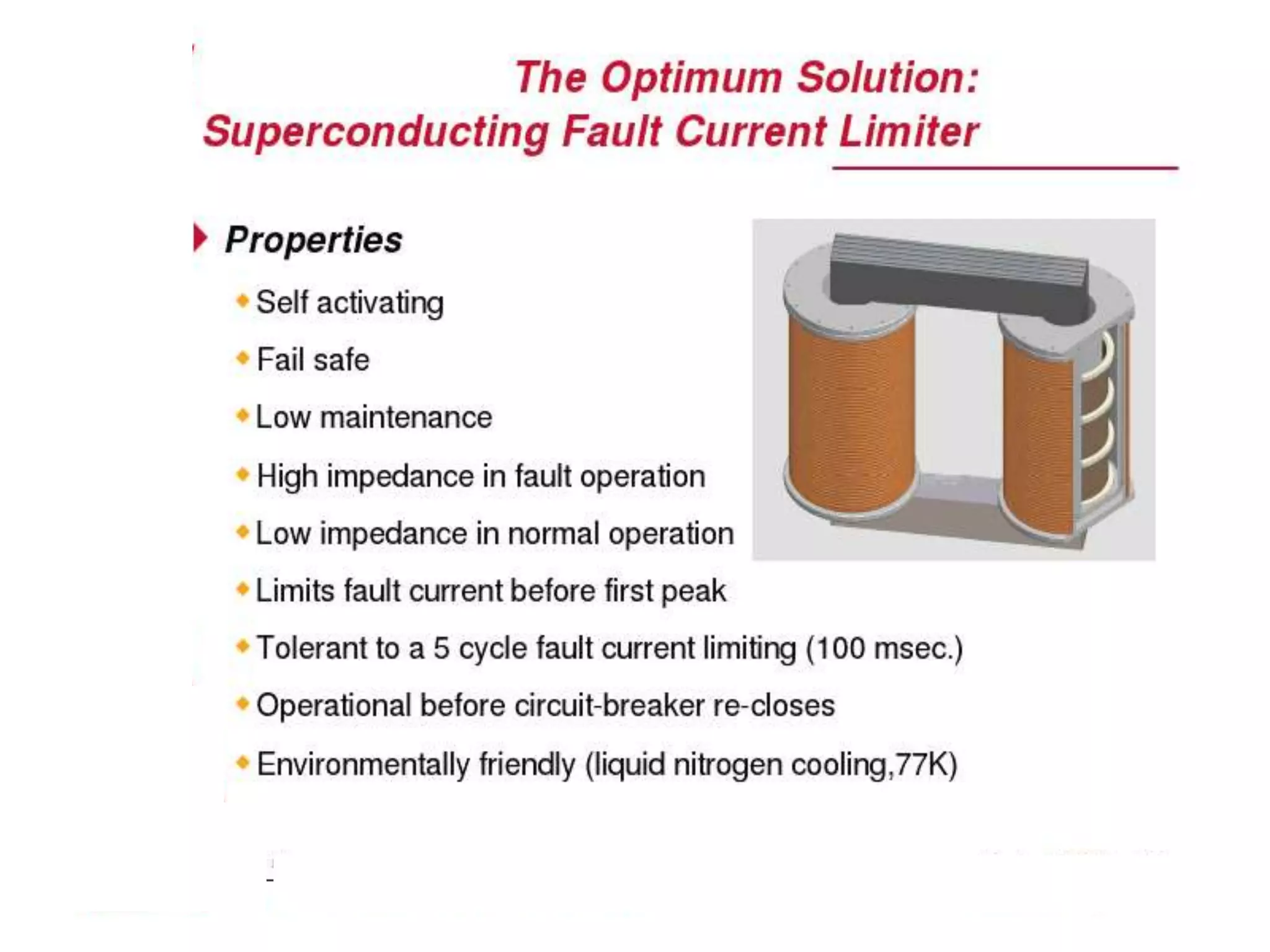
 Fault current limiter is a device which limits the
prospective fault current when a fault occurs.
 Superconducting fault current limiters are used
as effective way of fault current limiting.
Need for fault current limiter
 Increasing demand of
power and addition of more
generators, transformers
and large networks causes
higher stress on power
system.
 Higher stresses results in
higher probability of faults.
Characteristics of ideal
fault current limiter
 Have zero impedance throughout
normal operation
 Provides sufficiently large impedance
under fault conditions
 Provides rapid detection and initiation
of limiting action
 Provides immediate recovery of
normal operation after clearing fault
Traditional ways to limit fault
current
Following methods are used to limit fault current-:
 Circuit breakers with ultra-high fault
current rating
 High impedance transformers
 Current limiting fuses
 Air core reactors
 Reconfiguration of system by splitting
power buses
New approach using
superconductors
Superconductor
It is an element, inter-metallic alloy
or compound that will conduct electricity
without offering resistance below a certain
temperature.
Types of superconductors
 Low temperature superconductors(LTS)
 High temperature superconductors(HTS)
Cont..
 LTS are the substances that lose all resistivity
close to 4K, a temperature attainable only by
liquid helium.
 Examples of LTS - Lead and Mercury
 HTS are the substances that lose all
resistance below temperature mainly
attainable by liquid nitrogen (70K).
 Examples of HTS – YBCO, BSCCO etc.
How do SFCL work
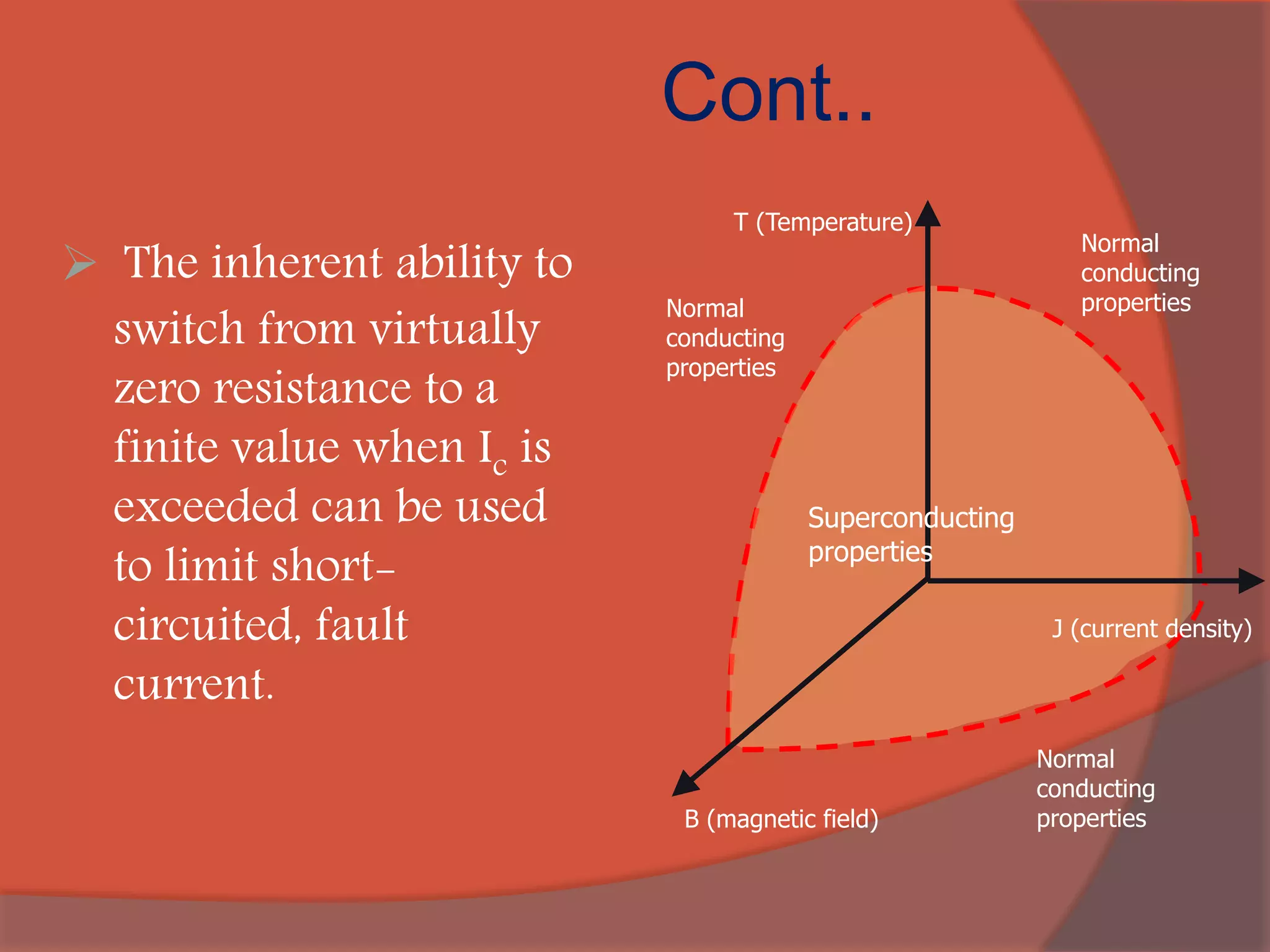
 when operated below critical parameters:
○ Temperature (Tc)
○ current (Ic)
○ Magnetic field (Hc)
○ Superconductors have virtually zero
resistance
 When operated above Tc, Ic, Hc, normal
state resistance is restored.
Cont..
 The inherent ability to
switch from virtually
zero resistance to a
finite value when Ic is
exceeded can be used
to limit short-
circuited, fault
current.
T (Temperature)
J (current density)
B (magnetic field)
Superconducting
properties
Normal
conducting
propertiesNormal
conducting
properties
Normal
conducting
properties
fault current
limited fault current
Fault Current Clamping
Mechanism
Types of Superconductor
FCL
 Resistive SFCL
 Inductive Shielded core SFCL
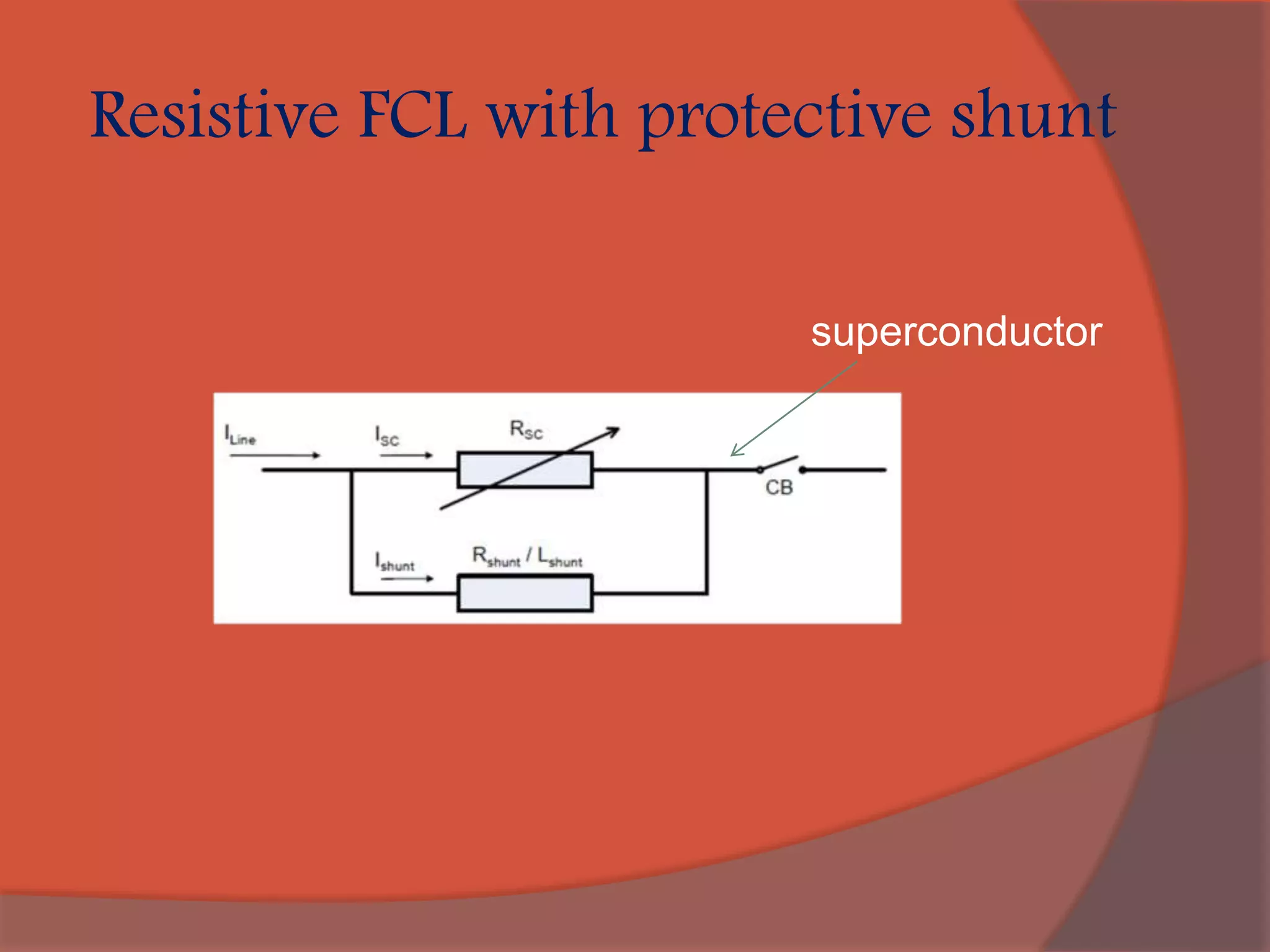
Resistive FCL with protective shunt
superconductor
Operation of Resistive SFCL
 To keep it superconducting, it is usually immersed in a
coolant that is chilled by a refrigerator.
 In case of a fault the inrush of current and magnetic field
take the super conductor into the transition region,
thereby the increasing resistance limits the fault current.
Inductive shielded core SFCL
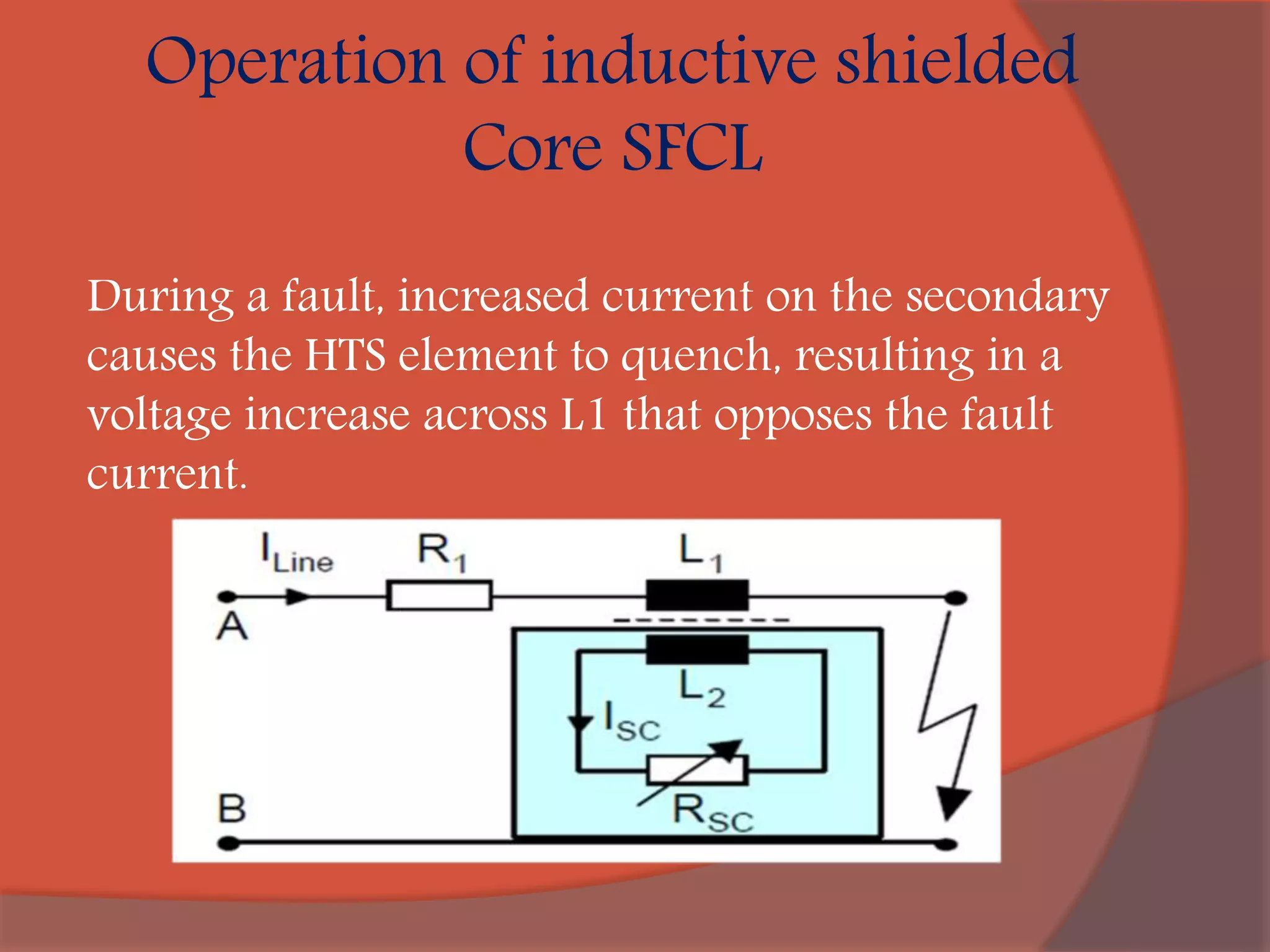
 Device resembles a transformer with the
secondary side shunted by an HTS element
 An electrical connection is made between
the line and the HTS element through
mutual coupling of AC coils via a magnetic
field
Operation of inductive shielded
Core SFCL
During a fault, increased current on the secondary
causes the HTS element to quench, resulting in a
voltage increase across L1 that opposes the fault
current.
Applications of SFCL
1) Fault-current limiter in the main position
Benefits of an FCL in this application include the following:
 a larger transformer can be used to meet increased demand on a
bus without breaker upgrades
 I2Rt damage to the transformer is limited
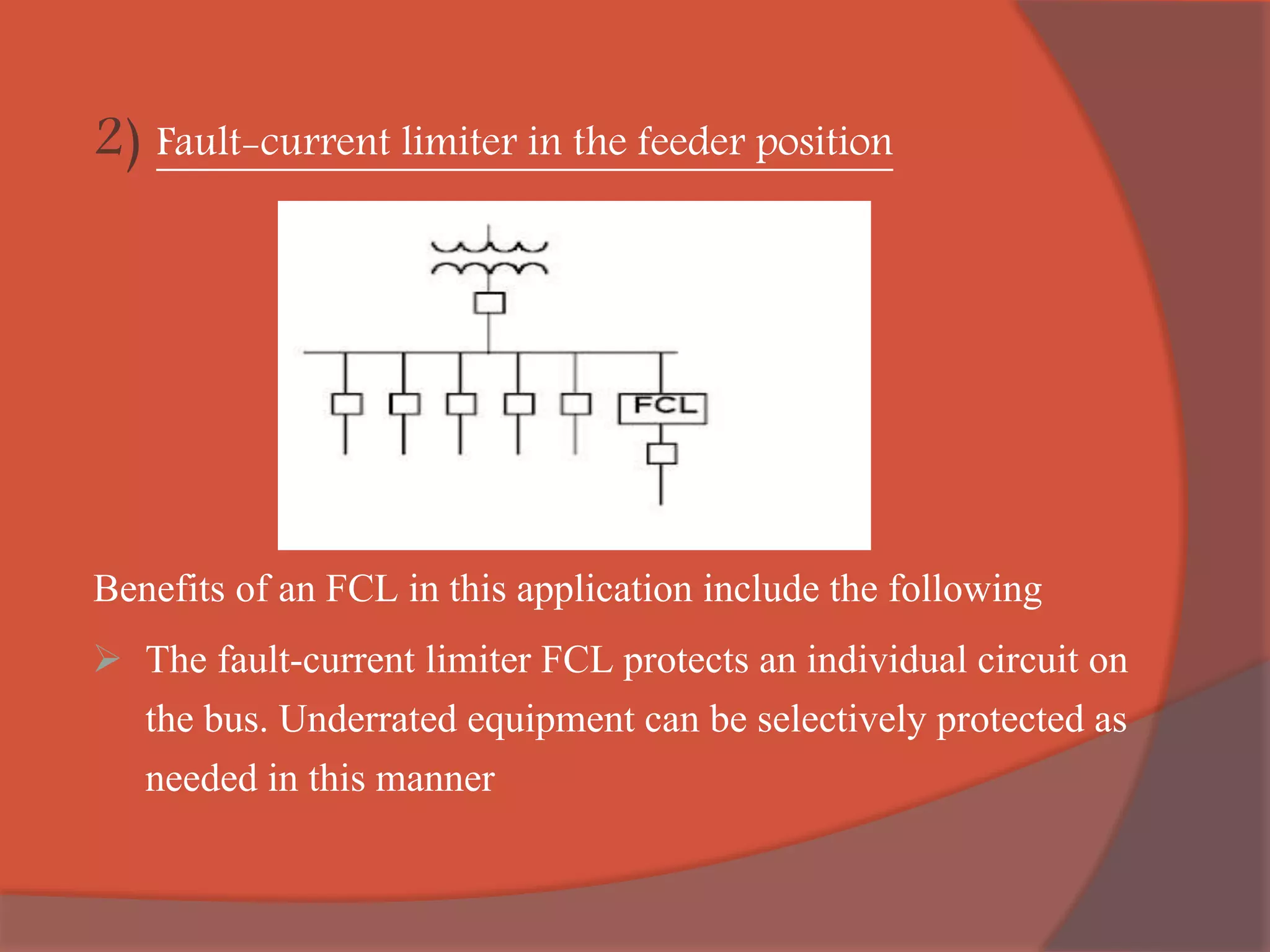
2) Fault-current limiter in the feeder position
Benefits of an FCL in this application include the following
 The fault-current limiter FCL protects an individual circuit on
the bus. Underrated equipment can be selectively protected as
needed in this manner
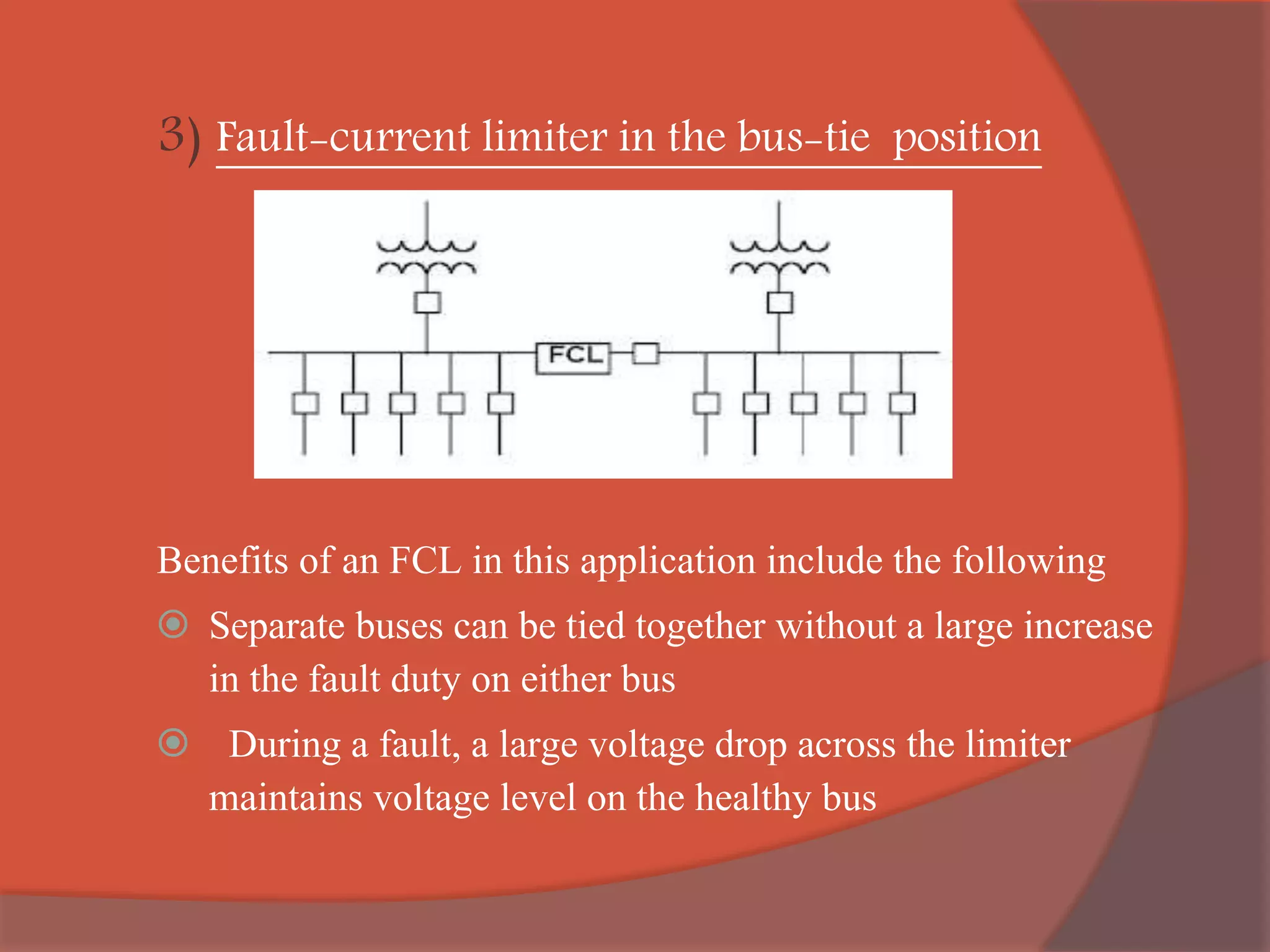
3) Fault-current limiter in the bus-tie position
Benefits of an FCL in this application include the following
 Separate buses can be tied together without a large increase
in the fault duty on either bus
 During a fault, a large voltage drop across the limiter
maintains voltage level on the healthy bus
Benefits of SFCL
In comparison to
conventional
technology, SFCL
provide –
 Over 100 times faster
response time
 10 to 20 times
shorter recovery time
 Time-adjustable
response functions
 1000 times the
number of full-
power protection
cycles
Conclusion
THANK YOU

SUPERCONDUCTOR FAULT CURRENT LIMITER

  • 1.
  • 2.
    Contents 1. What isfault current? 2. Need for fault current limiter 3. Characteristics of an ideal fault current limiter 4. Traditional ways to limit fault current 5. New approaches using superconductors 6. How do SFCL works 7. Types of SFCL 8. Applications 9. Benefits of SFCL 10.Conclusion
  • 3.
    What is faultcurrent?  Fault current is any abnormal electric current that flows through a circuit during the electrical fault conditions  Fault current limiter is a device which limits the prospective fault current when a fault occurs.  Superconducting fault current limiters are used as effective way of fault current limiting.
  • 4.
    Need for faultcurrent limiter  Increasing demand of power and addition of more generators, transformers and large networks causes higher stress on power system.  Higher stresses results in higher probability of faults.
  • 5.
    Characteristics of ideal faultcurrent limiter  Have zero impedance throughout normal operation  Provides sufficiently large impedance under fault conditions  Provides rapid detection and initiation of limiting action  Provides immediate recovery of normal operation after clearing fault
  • 6.
    Traditional ways tolimit fault current Following methods are used to limit fault current-:  Circuit breakers with ultra-high fault current rating  High impedance transformers  Current limiting fuses  Air core reactors  Reconfiguration of system by splitting power buses
  • 7.
    New approach using superconductors Superconductor Itis an element, inter-metallic alloy or compound that will conduct electricity without offering resistance below a certain temperature. Types of superconductors  Low temperature superconductors(LTS)  High temperature superconductors(HTS)
  • 8.
    Cont..  LTS arethe substances that lose all resistivity close to 4K, a temperature attainable only by liquid helium.  Examples of LTS - Lead and Mercury  HTS are the substances that lose all resistance below temperature mainly attainable by liquid nitrogen (70K).  Examples of HTS – YBCO, BSCCO etc.
  • 10.
    How do SFCLwork  when operated below critical parameters: ○ Temperature (Tc) ○ current (Ic) ○ Magnetic field (Hc) ○ Superconductors have virtually zero resistance  When operated above Tc, Ic, Hc, normal state resistance is restored.
  • 11.
    Cont..  The inherentability to switch from virtually zero resistance to a finite value when Ic is exceeded can be used to limit short- circuited, fault current. T (Temperature) J (current density) B (magnetic field) Superconducting properties Normal conducting propertiesNormal conducting properties Normal conducting properties
  • 12.
    fault current limited faultcurrent Fault Current Clamping Mechanism
  • 13.
    Types of Superconductor FCL Resistive SFCL  Inductive Shielded core SFCL
  • 14.
    Resistive FCL withprotective shunt superconductor
  • 15.
    Operation of ResistiveSFCL  To keep it superconducting, it is usually immersed in a coolant that is chilled by a refrigerator.  In case of a fault the inrush of current and magnetic field take the super conductor into the transition region, thereby the increasing resistance limits the fault current.
  • 16.
    Inductive shielded coreSFCL  Device resembles a transformer with the secondary side shunted by an HTS element  An electrical connection is made between the line and the HTS element through mutual coupling of AC coils via a magnetic field
  • 17.
    Operation of inductiveshielded Core SFCL During a fault, increased current on the secondary causes the HTS element to quench, resulting in a voltage increase across L1 that opposes the fault current.
  • 18.
    Applications of SFCL 1)Fault-current limiter in the main position Benefits of an FCL in this application include the following:  a larger transformer can be used to meet increased demand on a bus without breaker upgrades  I2Rt damage to the transformer is limited
  • 19.
    2) Fault-current limiterin the feeder position Benefits of an FCL in this application include the following  The fault-current limiter FCL protects an individual circuit on the bus. Underrated equipment can be selectively protected as needed in this manner
  • 20.
    3) Fault-current limiterin the bus-tie position Benefits of an FCL in this application include the following  Separate buses can be tied together without a large increase in the fault duty on either bus  During a fault, a large voltage drop across the limiter maintains voltage level on the healthy bus
  • 21.
    Benefits of SFCL Incomparison to conventional technology, SFCL provide –  Over 100 times faster response time  10 to 20 times shorter recovery time  Time-adjustable response functions  1000 times the number of full- power protection cycles
  • 22.
  • 23.