The Importance of Energy Storage
 The transition from non-renewable to environmentally
friendly and renewable sources of energy will not
happen overnight because the available green
technologies do not generate enough energy to meet
the demand.
 Developing new and improving the existing energy
storage devices and mediums to reduce energy loss to
the minimum, lower the costs of energy storage and
maintain a reliable power supply.
why is Energy Stored
 Energy storage uses various methods to store excess
energy to be used at a later time which in turn allows
the energy providers to balance between the demand
and supply.
 A number of devices and media are used to store
energy, while their selection depends primarily on the
source of energy and the use.
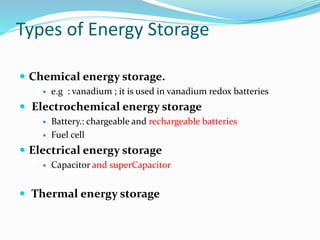
Types of Energy Storage
 Chemical energy storage.
 e.g : vanadium ; it is used in vanadium redox batteries
 Electrochemical energy storage
 Battery.: chargeable and rechargeable batteries
 Fuel cell
 Electrical energy storage
 Capacitor and superCapacitor
 Thermal energy storage
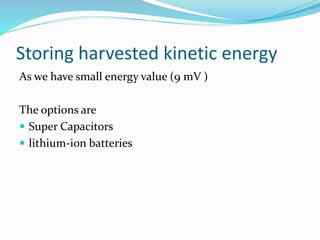
Storing harvested kinetic energy
As we have small energy value (9 mV )
The options are
 Super Capacitors
 lithium-ion batteries
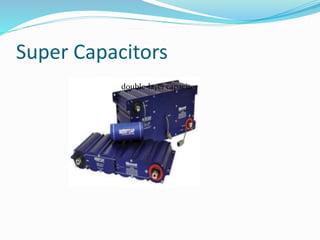
Super Capacitors
double-layer capacitor
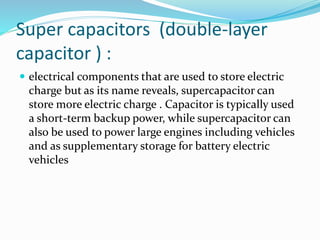
Super capacitors (double-layer
capacitor ) :
 electrical components that are used to store electric
charge but as its name reveals, supercapacitor can
store more electric charge . Capacitor is typically used
a short-term backup power, while supercapacitor can
also be used to power large engines including vehicles
and as supplementary storage for battery electric
vehicles
---
---
---
---
---
---
---
---
++
++
++
++
+
+








+
+
+
+
+
+
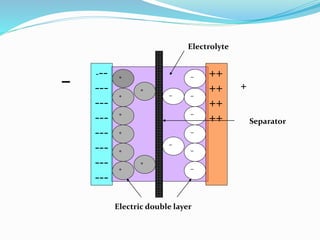
Electrolyte
Separator
Electric double layer
▬
+
Advantages
 Such energy storage has several advantages relative to
Batteries :
 Very high rates of charge and discharge.
 Good reversibility
.
 High efficiency (95% or more)
Disadvantages
 The amount of energy stored per unit weight is
considerably lower than that of an electrochemical
battery (3-5 W.h/kg for an ultracapacitor
compared to 30-40 W.h/kg for a battery).
 It is also The voltage varies with the energy stored.
To effectively store and recover energy requires
sophisticated electronic control and switching
equipment.
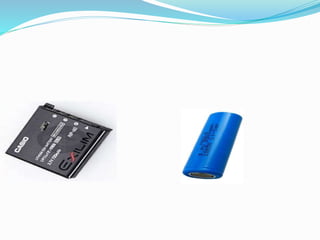
Li- Ion Battery
 Lithium Ion Batteries
 Energy storage device
 Conversion of chemical energy
 Closed system
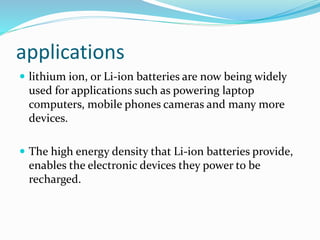
applications
 lithium ion, or Li-ion batteries are now being widely
used for applications such as powering laptop
computers, mobile phones cameras and many more
devices.
 The high energy density that Li-ion batteries provide,
enables the electronic devices they power to be
recharged.
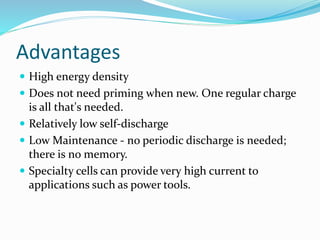
Advantages
 High energy density
 Does not need priming when new. One regular charge
is all that's needed.
 Relatively low self-discharge
 Low Maintenance - no periodic discharge is needed;
there is no memory.
 Specialty cells can provide very high current to
applications such as power tools.
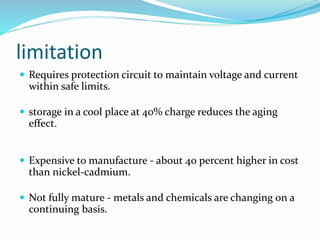
limitation
 Requires protection circuit to maintain voltage and current
within safe limits.
 storage in a cool place at 40% charge reduces the aging
effect.
 Expensive to manufacture - about 40 percent higher in cost
than nickel-cadmium.
 Not fully mature - metals and chemicals are changing on a
continuing basis.
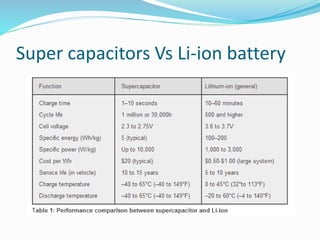
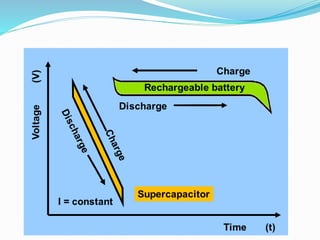
Super capacitors Vs Li-ion battery
future of supercapacitors
 http://www.wimp.com/supersupercapacitor/

Energy storage

  • 2.
    The Importance ofEnergy Storage  The transition from non-renewable to environmentally friendly and renewable sources of energy will not happen overnight because the available green technologies do not generate enough energy to meet the demand.  Developing new and improving the existing energy storage devices and mediums to reduce energy loss to the minimum, lower the costs of energy storage and maintain a reliable power supply.
  • 3.
    why is EnergyStored  Energy storage uses various methods to store excess energy to be used at a later time which in turn allows the energy providers to balance between the demand and supply.  A number of devices and media are used to store energy, while their selection depends primarily on the source of energy and the use.
  • 4.
    Types of EnergyStorage  Chemical energy storage.  e.g : vanadium ; it is used in vanadium redox batteries  Electrochemical energy storage  Battery.: chargeable and rechargeable batteries  Fuel cell  Electrical energy storage  Capacitor and superCapacitor  Thermal energy storage
  • 5.
    Storing harvested kineticenergy As we have small energy value (9 mV ) The options are  Super Capacitors  lithium-ion batteries
  • 6.
  • 7.
    Super capacitors (double-layer capacitor) :  electrical components that are used to store electric charge but as its name reveals, supercapacitor can store more electric charge . Capacitor is typically used a short-term backup power, while supercapacitor can also be used to power large engines including vehicles and as supplementary storage for battery electric vehicles
  • 8.
  • 9.
    Advantages  Such energystorage has several advantages relative to Batteries :  Very high rates of charge and discharge.  Good reversibility .  High efficiency (95% or more)
  • 10.
    Disadvantages  The amountof energy stored per unit weight is considerably lower than that of an electrochemical battery (3-5 W.h/kg for an ultracapacitor compared to 30-40 W.h/kg for a battery).  It is also The voltage varies with the energy stored. To effectively store and recover energy requires sophisticated electronic control and switching equipment.
  • 11.
    Li- Ion Battery Lithium Ion Batteries  Energy storage device  Conversion of chemical energy  Closed system
  • 13.
    applications  lithium ion,or Li-ion batteries are now being widely used for applications such as powering laptop computers, mobile phones cameras and many more devices.  The high energy density that Li-ion batteries provide, enables the electronic devices they power to be recharged.
  • 14.
    Advantages  High energydensity  Does not need priming when new. One regular charge is all that's needed.  Relatively low self-discharge  Low Maintenance - no periodic discharge is needed; there is no memory.  Specialty cells can provide very high current to applications such as power tools.
  • 15.
    limitation  Requires protectioncircuit to maintain voltage and current within safe limits.  storage in a cool place at 40% charge reduces the aging effect.  Expensive to manufacture - about 40 percent higher in cost than nickel-cadmium.  Not fully mature - metals and chemicals are changing on a continuing basis.
  • 16.
    Super capacitors VsLi-ion battery
  • 18.
    future of supercapacitors http://www.wimp.com/supersupercapacitor/