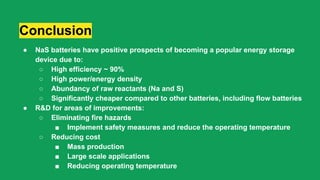
NaS batteries show potential as an energy storage solution due to their high efficiency and power/energy density. However, their high operating temperature poses fire hazards. Researchers are working to reduce the temperature to improve safety and lower costs. Sodium and sulfur are abundant materials, and NaS batteries have a longer lifetime than lithium-ion batteries. Mass production and larger-scale applications may also help reduce the overall cost of NaS batteries.


![Why is Energy Storage Important
Growth in renewable
energy technologies
requires better energy
storage solutions.
Many renewable energy
resources are intermittent.
- ie. Solar, Wind, and Wave
Mismatch between power
availability and demand.
Electricity demand vs wind supply graph [1]](https://image.slidesharecdn.com/86fe003f-36ca-4b71-9d77-6c57e24f269b-161219222940/85/NaS-Energy-Storage-3-2-320.jpg)
![NaS Batteries as Energy Storage
PEAK SHAVING
● Storage discharges
when demand is
above the upper limit.
● Storage charges when
demand is below the
lower limit.
Peak Shaving Case [1]](https://image.slidesharecdn.com/86fe003f-36ca-4b71-9d77-6c57e24f269b-161219222940/85/NaS-Energy-Storage-3-3-320.jpg)
![NaS Batteries as Energy Storage
LOAD LEVELING:
● Storage charges
excess power during
lower demand.
● Storage discharges
during higher
demand.
Load Leveling Case [1]](https://image.slidesharecdn.com/86fe003f-36ca-4b71-9d77-6c57e24f269b-161219222940/85/NaS-Energy-Storage-3-4-320.jpg)
![Comparison of Energy
Storage Technology
NaS POSITIVE CHARACTERISTICS:
● High power and energy density
● High efficiency ~ 90%
● Utility scale application:
- Power rating: 1 - 100 MW
- Capacity: 10- 1000 MWh
● Sodium and Sulfur: abundant
materials
Comparison of Energy Storage Technologies [2]](https://image.slidesharecdn.com/86fe003f-36ca-4b71-9d77-6c57e24f269b-161219222940/85/NaS-Energy-Storage-3-5-320.jpg)
![How NaS Batteries Work
NaS Battery Diagram [3]
Electrodes:
- Anode: liquid sodium
- Cathode: liquid sulfur
Electrolyte: beta alumina ceramics
System is completely sealed to:
- Prevent liquid sodium from spontaneously
burning when in contact with air and moisture.
- Maintain the high operating temperature
needed for the electrodes to remain molten,
and to promote desired reaction mechanisms.](https://image.slidesharecdn.com/86fe003f-36ca-4b71-9d77-6c57e24f269b-161219222940/85/NaS-Energy-Storage-3-6-320.jpg)
![How NaS Batteries Work
NaS Battery Operating Principles [3]
Discharge: Na donates
electron to the external
circuit. Na ions then pass
through the electrolyte to the
positive electrode, and form
Na polysulphide (Na2Sx).
Charge: Na2Sx decomposes,
and Na ions migrate back
through the electrolyte.](https://image.slidesharecdn.com/86fe003f-36ca-4b71-9d77-6c57e24f269b-161219222940/85/NaS-Energy-Storage-3-7-320.jpg)
![● Operating temperature:
○ 300-500 °C
● Temperature varies:
○ Charging - Temp ~
constant
○ Standby - Temp drop
○ Discharging - Temp rise
High operating temperature can
cause short circuiting, and is a fire
hazard [4].
NaS Challenge:
High Operating
Temperature](https://image.slidesharecdn.com/86fe003f-36ca-4b71-9d77-6c57e24f269b-161219222940/85/NaS-Energy-Storage-3-8-320.jpg)
![Case Study: Tsukuba Fire Incident in 2011
NGK has temporarily
halted production of
NaS batteries.
Restricted and
suspended usages of
existing NaS batteries
in 174 locations in
Japan and 5 other
countries.
Priority on reforming
NaS batteries until the
end of 2012.
NaS module layout [5]](https://image.slidesharecdn.com/86fe003f-36ca-4b71-9d77-6c57e24f269b-161219222940/85/NaS-Energy-Storage-3-9-320.jpg)
![Case Study: Prevention of Future Incidences
Fire prevention methods [5]
Operations
and
productions
resumed in
2012 after
modifications
were
implemented.](https://image.slidesharecdn.com/86fe003f-36ca-4b71-9d77-6c57e24f269b-161219222940/85/NaS-Energy-Storage-3-10-320.jpg)
![NaS Challenge: High Cost
● NaS batteries are cheaper
than other batteries, ie.
Li-ion, and can serve a
longer expected lifetime
(~ 15 yrs).
● Sodium and sulfur are
abundant and relatively
inexpensive.
Cost comparison of common battery technologies [6]](https://image.slidesharecdn.com/86fe003f-36ca-4b71-9d77-6c57e24f269b-161219222940/85/NaS-Energy-Storage-3-11-320.jpg)
![NaS Challenge: High Cost
Production cost makes up over 66% of the NaS
battery’s total cost:
● High operating temperature:
○ Equipments: thermal insulation, heaters,
temperature control, thermal enclosure, etc.
○ Expensive ceramic electrolytes
● Corrosive sodium polysulfides: insulators corrode
and become gradually conductive, increasing the
self-discharge rates, or crack.
○ Expensive thermal spraying coatings of Cr-Fe
alloys [8]
Typical NaS Cost Distribution [7]](https://image.slidesharecdn.com/86fe003f-36ca-4b71-9d77-6c57e24f269b-161219222940/85/NaS-Energy-Storage-3-12-320.jpg)
![NaS Challenge: High Cost
CURRENT COST REDUCTIONS:
● Mass production can
reduce production costs.
● Larger scale applications
reduce cost per kWh and
more economical.
Cost vs Production [7]](https://image.slidesharecdn.com/86fe003f-36ca-4b71-9d77-6c57e24f269b-161219222940/85/NaS-Energy-Storage-3-13-320.jpg)
![Next Step: Low Temperature NaS Battery
CURRENT R&D:
● Reduce operating Temp:
300 to 80 °C by
replacing anode with a
sodium potassium alloy.
● Cost reduced by ~ 50%,
mostly from battery
equipment.
Installed cost estimates [9]](https://image.slidesharecdn.com/86fe003f-36ca-4b71-9d77-6c57e24f269b-161219222940/85/NaS-Energy-Storage-3-14-320.jpg)


![References
[1] Sean Leavey. “The Future of Electricity Supply and Demand: Smart Devices Responding to The Grid’s Health”. 01-Nov-2013. [Online]. Available:
http://attackllama.com/2013/11/the-future-of-electricity-supply-and-demand-smart-devices-responding-to-the-grids-health/ [15-Mar-2016].
[2] “Energy Storage Technologies”. Energy Storage Technologies. [Online]. Available:
http://energystorage.org/energy-storage/energy-storage-technologies [15-Mar-2016].
[3] “NGK Insulators requests customers to stop using NAS batteries,” Semiconductor Portal. [Online]. Available: https://www.semiconportal.com/
en/archive/news/main-news/111026-ngk-nas-battery.html [15-Mar-2016].
[4] Zahrul Hussien et al. “Modeling of Sodium Sulfur Battery for Power System Applications”. Electrika, vol. 9, no. 2, 2007.
[5] “Q&A Concerning the NAS Battery Fire | NAS Battery Fire Incident and Response”. NGK Ltd. 15-Jun-2012. [Online]. Available: http://www.ngk.co.jp/
english/announce/111031_nas.html. [Accessed: 15-Mar-2016].
[6] Peter Singer. “Energy Storage: The Basics”. Energy Storage Trends. Nov-2010. [Online]. Available: http://energystoragetrends.blogspot.ca/
2010_11_01_archive.html [15-Mar-2016].
[7] Zhaoyin Wen. “Study on Energy Storage Technology of Sodium Sulfur Battery and it's Application in Power System”. International Conference on
Power System Technology. 2006. [Online]. Available: http://www.apmaths.uwo.ca/~mdavison/_library/natasha/batterytechnologies4.PDF [15-Mar-2016].
[8] A. Okuno et al. “Development of plasma sprayed corrosion protective coatings for sodium sulfur battery cell containers”. 12-May-2004. Materials
Information Society. Pp. 70-75. 15-Mar-2016.
[9] Gao Liu et al. “A Storage Revolution”. University of Berkeley. 12-Feb-2015. [Online]. Available:
http://ei.haas.berkeley.edu/education/c2m/docs/Sulfur%20and%20Sodium%20Metal%20Battery.pdf [15-Mar-2016].](https://image.slidesharecdn.com/86fe003f-36ca-4b71-9d77-6c57e24f269b-161219222940/85/NaS-Energy-Storage-3-18-320.jpg)


