EFFECTIVE TEAMWORK
OBJECTIVES
• To understand the importance of working
as team and the impact of team spirit on
achieving organization goals.
• To enhance participants skills when
practicing teamwork concepts.
• To be able to use techniques for handling
team interpersonal problems.
• To gain greater insight into:
– Why teams succeed and fail.
– Team norms, role and stages.
T O P I C S
• Why Teamwork
• How teams work
– Individual, Team and Task
– What is a team?
• Teams Vs. groups.!
– What is teamwork?
• How we see ourselves and others
– Team norms
– Team roles
• Role definitions
– Team functions
The Perfect Person
• Creative, imaginative
• Extrovert, enthusiastic, communicative.
• Confident and trusting.
• Dynamic, outgoing, seeks ways round obstacles.
• Sees all options. Judges accurately.
• Social, mild, perceptive and accommodating.
• Disciplined, reliable, conservative and efficient.
• Searches out errors and omissions. Delivers on
time.
• Single-minded, self-starting, dedicated. Provides
knowledge or technical skills in rare supply.
WHY TEAMWORK?
The Perfect Person
• It is difficult to find …
• But it is easy to find …or establish ..
The Perfect Team
HOW TEAMS WORK
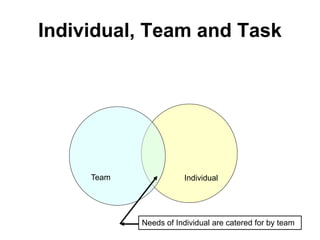
IndividualTeam
Needs of Individual are catered for by team
Individual, Team and Task
Individual
Task
Challenging tasks maintain
individual Interest
Team
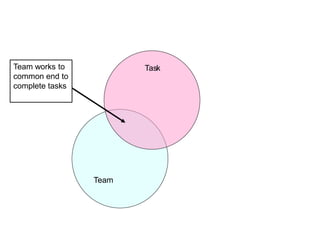
TaskTeam works to
common end to
complete tasks
IndividualTeam
TaskTeam works to
common end to
complete tasks
Needs of Individual are catered for by team
Challenging tasks maintain
individual Interest
Each individual
contributes to
team effort to
complete task
in hand
What is a team?
Teams Vs. Groups
• Outside the canteen
there's a group of
people waiting in a
lunch queue.
• They are all there for
the same reason.
– Are they a team?
• YES - NO
(NO) We agree. These people have a common purpose,
but they're not working together to achieve it!
They're not a team.
What is a team?
• We are in the
boardroom.
• There are seven
directors on the
Board.
• They meet four
times a year.
– Are they a team?
• YES - NO
(YES) We agree. It doesn't matter how often the Board meets
they still work together to a common purpose.
They're a team.
What is a team?
• In the call
centre,
• 60 staff are
answering
customer calls.
– Are they a
team?
• YES - NO
(NO) We agree. We'd argue that 60 people is too many
to be a manageable team.
A group this size would split into smaller teams.
What is a team?
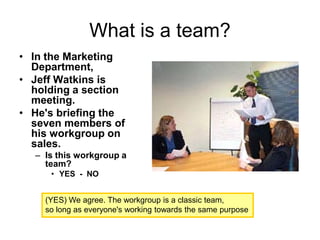
• In the Marketing
Department,
• Jeff Watkins is
holding a section
meeting.
• He's briefing the
seven members of
his workgroup on
sales.
– Is this workgroup a
team?
• YES - NO
(YES) We agree. The workgroup is a classic team,
so long as everyone's working towards the same purpose
What is a team?
• Work teams comprise fewer than
10 people who:
– Have a common purpose
– Are interdependent
• Teams can be:
– Hierarchical, with a strong leader
– Participative, with shared decisions and
management
– A mixture of both the above
What is Teamwork?
HOW WE SEE OURSELVES
AND OTHERS
Others Knowledge
MyKnowledge
WhatIDon’tknow
What Others Don’t know What Others know
WhatIDon’tknow
WhatIknow
What Others Don’t know
WhatIknow
What Others know
INTERPERSONAL
INTERACTION STRATEGIES
• Your basic strategy is to:
–MAXIMIZE THE ARENA
–(Open Interaction Area)
Others Knowledge
MyKnowledge
WhatIknow
WhatI
Don’t
know
What Others know
What Others
Don’t know
WhatIknow
What Others knowWhatI
Don’t
knowWhat
Others
Don’t know
UNKNOWN
BLIND SPOT
FACADE
OUR OBJECTIVE IS TO MAXIMIZE THE ARENA
MAXIMIZE THE ARENA
• Start with yourself.
– You are the main benefactor.
• Give information.
– To make your façade as transparent as possible.
• Encourage others to give information.
– To minimize the blind area.
• Join others in searching for more information.
– This minimizes the unknown area.
• Consult document, studies and work papers.
• Try your subordinate, peers and (even) your boss.
MAXIMIZE THE ARENA
• Develop an atmosphere of trust.
– Share with others.
– Allow them to participate and contribute.
– Accept their ideas and opinions.
– Conduct open discussion with them.
• Try to develop an …
– “I’M OK, You're OK” relationship.
Team Norms
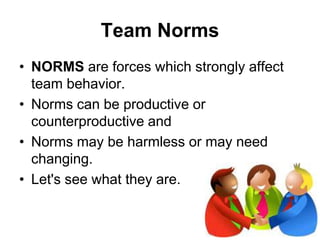
• NORMS are forces which strongly affect
team behavior.
• Norms can be productive or
counterproductive and
• Norms may be harmless or may need
changing.
• Let's see what they are.
Team Norms
• Think about teams you've been in.
• Have the team members shared in:
– Jokes and catchphrases?
– Styles of dress?
– Attitudes to working late?
– Standards of tidiness?
– Similar ideas about alcohol at
lunchtime?
Team Norms
• Norms are a team's rules about how
individuals should think and act.
• There are some important things to
remember about norms.
– NORMS ALWAYS EMERGE
– NORMS DEVELOP OVER TIME
– NORMS ARE GENERALLY UNSPOKEN
– NORMS ARE DIFFERENT IN EVERY TEAM
Team Norms
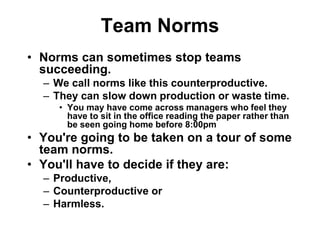
• Norms can sometimes stop teams
succeeding.
– We call norms like this counterproductive.
– They can slow down production or waste time.
• You may have come across managers who feel they
have to sit in the office reading the paper rather than
be seen going home before 8:00pm
• You're going to be taken on a tour of some
team norms.
• You'll have to decide if they are:
– Productive,
– Counterproductive or
– Harmless.
Team Norms
• THE SALES
DEPARTMENT
– We always have five
minutes fooling
around before getting
down to business at
meetings.
– Is this norm:
• Productive?
• Counterproductive?
• HARMLESS?
Productive
Team Norms
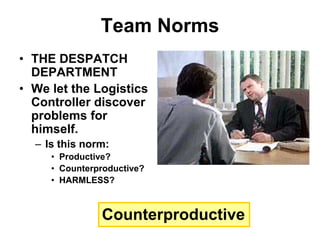
• THE DESPATCH
DEPARTMENT
• We let the Logistics
Controller discover
problems for
himself.
– Is this norm:
• Productive?
• Counterproductive?
• HARMLESS?
Counterproductive
Team Norms
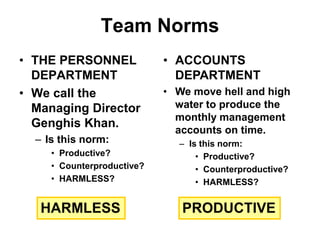
• THE PERSONNEL
DEPARTMENT
• We call the
Managing Director
Genghis Khan.
– Is this norm:
• Productive?
• Counterproductive?
• HARMLESS?
HARMLESS
• ACCOUNTS
DEPARTMENT
• We move hell and high
water to produce the
monthly management
accounts on time.
– Is this norm:
• Productive?
• Counterproductive?
• HARMLESS?
PRODUCTIVE
Team Norms
• To change a norm would you:
– Alter your behavior and hope the rest
will follow
– Discuss this norm with the group
– Try to identify allies in the group
“Discuss this norm with the group”
Yes. Norms are unspoken.
To change them you have to bring them out into the open.
Team Norms
• TIPS FOR SUCCESS
– When a norm is harmless go along with it
– When a norm is productive encourage it
– When a norm is counterproductive, bring it
out in the open
BUT, be careful! Norms are powerful things.
Treat them with care
Team Roles
• A successful team must have the right
mix of expertise to help achieve the
team's tasks.
• But teams are more than just a mix of
complementary skills.
• In all successful teams, each individual
has a role to fulfill.
• The team as a whole requires the right
mix of expertise, personalities, etc.
Team Roles
• The best known work on team
roles is by R.M.Belbin, who
identifies 9 essential roles, all
of which are associated with
PERSONALITY TRAITS,
such as extroversion,
enthusiasm, …etc,
THE NINE TEAM ROLES
As defined by R.M.Belbin
1. The PLANT:
– Creative, imaginative, unorthodox. Solves difficult problems.
2. The RESOURCE INVESTIGATOR:
– Extrovert, enthusiastic, communicative. Explores opportunities.
Develops contacts.
3. The CO-ORDINATOR:
– Mature, confident and trusting. A good chairman. Clarifies
goals, promotes decision-making.
4. The SHAPER:
– Dynamic, outgoing, highly strung. Challenges, pressurizes,
seeks ways round obstacles.
5. The MONITOR EVALUATOR:
– Sober, strategic and discerning. Sees all options. Judges
accurately.
THE NINE TEAM ROLES
As defined by R.M.Belbin
6. The TEAM WORKER:
– Social, mild, perceptive and accommodating.
Listens, builds, averts friction.
7. The IMPLEMENTER:
– Disciplined, reliable, conservative and efficient.
Turns ideas into practical actions.
8. The COMPLETER-FINISHER:
– Painstaking, conscientious, anxious. Searches out
errors and omissions. Delivers on time.
9. The SPECIALIST:
– Single-minded, self-starting, dedicated. Provides
knowledge or technical skills in rare supply.
Team Functions
The 6 functions that must be performed in a team.
• PLANNING
– Seeking all available information; defining team
objectives and tasks; making a workable plan
• INITIATING
– Briefing team on aims and plan; explaining why aim or
plan is necessary; allocating tasks to group members;
setting team standards
• CONTROLLING
– Maintaining team standards; influencing tempo;
ensuring all actions are taken towards objectives;
keeping discussion relevant; prodding group to
action/decision
Team Functions
The 6 functions that must be performed in a team.
• SUPPORTING
– Acceptance of persons and their contributions; encouraging
groups/individuals; disciplining groups/individuals; creating team
spirit; relieving tension with humor; reconciling disagreements or
getting others to explore them
• INFORMING
– Clarifying task and plan; giving new information to the team;
keeping everybody 'in the picture'; receiving information from the
team; summarizing ideas and suggestions clearly
• EVALUATING
– Checking the feasibility of an idea; testing the consequences of a
proposed solution; evaluating group performance; helping the
team to evaluate its own performance against standards

Team work

  • 1.
  • 2.
    OBJECTIVES • To understandthe importance of working as team and the impact of team spirit on achieving organization goals. • To enhance participants skills when practicing teamwork concepts. • To be able to use techniques for handling team interpersonal problems. • To gain greater insight into: – Why teams succeed and fail. – Team norms, role and stages.
  • 3.
    T O PI C S • Why Teamwork • How teams work – Individual, Team and Task – What is a team? • Teams Vs. groups.! – What is teamwork? • How we see ourselves and others – Team norms – Team roles • Role definitions – Team functions
  • 4.
    The Perfect Person •Creative, imaginative • Extrovert, enthusiastic, communicative. • Confident and trusting. • Dynamic, outgoing, seeks ways round obstacles. • Sees all options. Judges accurately. • Social, mild, perceptive and accommodating. • Disciplined, reliable, conservative and efficient. • Searches out errors and omissions. Delivers on time. • Single-minded, self-starting, dedicated. Provides knowledge or technical skills in rare supply. WHY TEAMWORK?
  • 5.
    The Perfect Person •It is difficult to find … • But it is easy to find …or establish .. The Perfect Team
  • 6.
  • 7.
    IndividualTeam Needs of Individualare catered for by team Individual, Team and Task
  • 8.
  • 9.
    Team TaskTeam works to commonend to complete tasks
  • 10.
    IndividualTeam TaskTeam works to commonend to complete tasks Needs of Individual are catered for by team Challenging tasks maintain individual Interest Each individual contributes to team effort to complete task in hand
  • 11.
    What is ateam? Teams Vs. Groups • Outside the canteen there's a group of people waiting in a lunch queue. • They are all there for the same reason. – Are they a team? • YES - NO (NO) We agree. These people have a common purpose, but they're not working together to achieve it! They're not a team.
  • 12.
    What is ateam? • We are in the boardroom. • There are seven directors on the Board. • They meet four times a year. – Are they a team? • YES - NO (YES) We agree. It doesn't matter how often the Board meets they still work together to a common purpose. They're a team.
  • 13.
    What is ateam? • In the call centre, • 60 staff are answering customer calls. – Are they a team? • YES - NO (NO) We agree. We'd argue that 60 people is too many to be a manageable team. A group this size would split into smaller teams.
  • 14.
    What is ateam? • In the Marketing Department, • Jeff Watkins is holding a section meeting. • He's briefing the seven members of his workgroup on sales. – Is this workgroup a team? • YES - NO (YES) We agree. The workgroup is a classic team, so long as everyone's working towards the same purpose
  • 15.
    What is ateam? • Work teams comprise fewer than 10 people who: – Have a common purpose – Are interdependent • Teams can be: – Hierarchical, with a strong leader – Participative, with shared decisions and management – A mixture of both the above
  • 16.
    What is Teamwork? HOWWE SEE OURSELVES AND OTHERS
  • 17.
    Others Knowledge MyKnowledge WhatIDon’tknow What OthersDon’t know What Others know WhatIDon’tknow WhatIknow What Others Don’t know WhatIknow What Others know
  • 18.
    INTERPERSONAL INTERACTION STRATEGIES • Yourbasic strategy is to: –MAXIMIZE THE ARENA –(Open Interaction Area)
  • 19.
    Others Knowledge MyKnowledge WhatIknow WhatI Don’t know What Othersknow What Others Don’t know WhatIknow What Others knowWhatI Don’t knowWhat Others Don’t know UNKNOWN BLIND SPOT FACADE OUR OBJECTIVE IS TO MAXIMIZE THE ARENA
  • 20.
    MAXIMIZE THE ARENA •Start with yourself. – You are the main benefactor. • Give information. – To make your façade as transparent as possible. • Encourage others to give information. – To minimize the blind area. • Join others in searching for more information. – This minimizes the unknown area. • Consult document, studies and work papers. • Try your subordinate, peers and (even) your boss.
  • 21.
    MAXIMIZE THE ARENA •Develop an atmosphere of trust. – Share with others. – Allow them to participate and contribute. – Accept their ideas and opinions. – Conduct open discussion with them. • Try to develop an … – “I’M OK, You're OK” relationship.
  • 22.
    Team Norms • NORMSare forces which strongly affect team behavior. • Norms can be productive or counterproductive and • Norms may be harmless or may need changing. • Let's see what they are.
  • 23.
    Team Norms • Thinkabout teams you've been in. • Have the team members shared in: – Jokes and catchphrases? – Styles of dress? – Attitudes to working late? – Standards of tidiness? – Similar ideas about alcohol at lunchtime?
  • 24.
    Team Norms • Normsare a team's rules about how individuals should think and act. • There are some important things to remember about norms. – NORMS ALWAYS EMERGE – NORMS DEVELOP OVER TIME – NORMS ARE GENERALLY UNSPOKEN – NORMS ARE DIFFERENT IN EVERY TEAM
  • 25.
    Team Norms • Normscan sometimes stop teams succeeding. – We call norms like this counterproductive. – They can slow down production or waste time. • You may have come across managers who feel they have to sit in the office reading the paper rather than be seen going home before 8:00pm • You're going to be taken on a tour of some team norms. • You'll have to decide if they are: – Productive, – Counterproductive or – Harmless.
  • 26.
    Team Norms • THESALES DEPARTMENT – We always have five minutes fooling around before getting down to business at meetings. – Is this norm: • Productive? • Counterproductive? • HARMLESS? Productive
  • 27.
    Team Norms • THEDESPATCH DEPARTMENT • We let the Logistics Controller discover problems for himself. – Is this norm: • Productive? • Counterproductive? • HARMLESS? Counterproductive
  • 28.
    Team Norms • THEPERSONNEL DEPARTMENT • We call the Managing Director Genghis Khan. – Is this norm: • Productive? • Counterproductive? • HARMLESS? HARMLESS • ACCOUNTS DEPARTMENT • We move hell and high water to produce the monthly management accounts on time. – Is this norm: • Productive? • Counterproductive? • HARMLESS? PRODUCTIVE
  • 29.
    Team Norms • Tochange a norm would you: – Alter your behavior and hope the rest will follow – Discuss this norm with the group – Try to identify allies in the group “Discuss this norm with the group” Yes. Norms are unspoken. To change them you have to bring them out into the open.
  • 30.
    Team Norms • TIPSFOR SUCCESS – When a norm is harmless go along with it – When a norm is productive encourage it – When a norm is counterproductive, bring it out in the open BUT, be careful! Norms are powerful things. Treat them with care
  • 31.
    Team Roles • Asuccessful team must have the right mix of expertise to help achieve the team's tasks. • But teams are more than just a mix of complementary skills. • In all successful teams, each individual has a role to fulfill. • The team as a whole requires the right mix of expertise, personalities, etc.
  • 32.
    Team Roles • Thebest known work on team roles is by R.M.Belbin, who identifies 9 essential roles, all of which are associated with PERSONALITY TRAITS, such as extroversion, enthusiasm, …etc,
  • 33.
    THE NINE TEAMROLES As defined by R.M.Belbin 1. The PLANT: – Creative, imaginative, unorthodox. Solves difficult problems. 2. The RESOURCE INVESTIGATOR: – Extrovert, enthusiastic, communicative. Explores opportunities. Develops contacts. 3. The CO-ORDINATOR: – Mature, confident and trusting. A good chairman. Clarifies goals, promotes decision-making. 4. The SHAPER: – Dynamic, outgoing, highly strung. Challenges, pressurizes, seeks ways round obstacles. 5. The MONITOR EVALUATOR: – Sober, strategic and discerning. Sees all options. Judges accurately.
  • 34.
    THE NINE TEAMROLES As defined by R.M.Belbin 6. The TEAM WORKER: – Social, mild, perceptive and accommodating. Listens, builds, averts friction. 7. The IMPLEMENTER: – Disciplined, reliable, conservative and efficient. Turns ideas into practical actions. 8. The COMPLETER-FINISHER: – Painstaking, conscientious, anxious. Searches out errors and omissions. Delivers on time. 9. The SPECIALIST: – Single-minded, self-starting, dedicated. Provides knowledge or technical skills in rare supply.
  • 35.
    Team Functions The 6functions that must be performed in a team. • PLANNING – Seeking all available information; defining team objectives and tasks; making a workable plan • INITIATING – Briefing team on aims and plan; explaining why aim or plan is necessary; allocating tasks to group members; setting team standards • CONTROLLING – Maintaining team standards; influencing tempo; ensuring all actions are taken towards objectives; keeping discussion relevant; prodding group to action/decision
  • 36.
    Team Functions The 6functions that must be performed in a team. • SUPPORTING – Acceptance of persons and their contributions; encouraging groups/individuals; disciplining groups/individuals; creating team spirit; relieving tension with humor; reconciling disagreements or getting others to explore them • INFORMING – Clarifying task and plan; giving new information to the team; keeping everybody 'in the picture'; receiving information from the team; summarizing ideas and suggestions clearly • EVALUATING – Checking the feasibility of an idea; testing the consequences of a proposed solution; evaluating group performance; helping the team to evaluate its own performance against standards