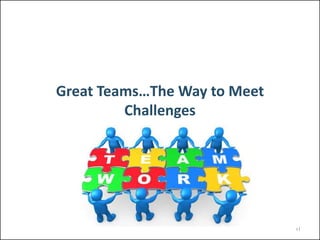
Great Teams…The Way to Meet
Challenges

#1
Why Teams?
• When several people
use their skills and
knowledge together,
the result should be a
better project.
• People working
together can sustain
the enthusiasm and
lend support needed
to complete the
project.
#2
How do Teams Work Best?
Teams succeed when
members have:
• commitment to common
objectives;
• defined roles and
responsibilities;
• effective decision systems,
communication and work
procedures; and,
• good personal relationships.
#3
Stages in Team Building

Forming

Storming

Norming

Adjourning

Performing

#4
Stage 1: FORMING
Team
– Define team
– Determine
individual roles
– Develop trust and
communication
– Develop norms

Task
– Define problem
and strategy
– Identify
information
needed

#5
Team Roles - Leader
– Encourage and maintain open

communication.
– Help the team develop and follow
team norms.
– Help the team focus on the task.
– Deal constructively with conflict.

#6
Team Roles - Recorder
– Keep a record of team meetings.
– Maintain a record of team

assignments
– Maintain a record of the team's work.
#7
Team Roles – PR Person
– Contact resource people outside of

the team.
– Correspond with the team's mentor.
– Work to maintain good

communication among team
members.
#8
Team Norms
– How do we support

each other?

– What do we do

when we have
problems?

– What are my

responsibilities to
the team?
#9
From Individuals

A Group

• Help members understand each other:
– Myers-Briggs Type Indicator (MBTI)
•
•
•
•

Extraverts ------------------ Introverts
Sensors --------------------- iNtuitive
Thinker --------------------- Feelers
Judger ---------------------- Perceiver

By selecting one from each category, we define our
personality type, ESTJ, ENTJ…INFP

#10
Stage 2: STORMING
During the Storming stage team members:
– realize that the task is more difficult than
they imagined;
– have fluctuations in attitude about chances
of success;
– may be resistant to the task; and,
– have poor collaboration.

#11
Storming Diagnosis
• Do we have common goals and objectives?
• Do we agree on roles and responsibilities?
• Do our task, communication, and decision
systems work?
• Do we have adequate interpersonal skills?

#12
Negotiating Conflict
• Separate problem issues from people issues.
• Be soft on people, hard on problem.
• Look for underlying needs, goals of each party
rather than specific solutions.
#13
Addressing the Problem
• State your views in clear non-judgmental
language.
• Clarify the core issues.
• Listen carefully to each person’s point of view.
• Check understanding by restating the core
issues.

#14
Stage 3: Norming
• During this stage members accept:
– their team;
– team rules and procedures;
– their roles in the team; and,
– the individuality of fellow members.
• Team members realize that they are not going
to crash-and-burn and start helping each
other.
#15
Behaviors
• Competitive relationships become more
cooperative.
• There is a willingness to confront issues
and solve problems.
• Teams develop the ability to express criticism
constructively.
• There is a sense of team spirit.
#16
Giving Constructive Feedback
• Be descriptive.
• Don't use labels.

• Don’t exaggerate.
• Don’t be judgmental.
• Speak for yourself.
#17
Giving Constructive Feedback
• Use “I” messages.
• Restrict your feedback to things you know for
certain.
• Help people hear and accept your
compliments when giving positive feedback.

#18
Receiving Feedback
•
•
•
•
•

Listen carefully.
Ask questions for clarity.
Acknowledge the feedback.
Acknowledge the valid points.
Take time to sort out what you heard.

#19
Stage 4: PERFORMING
Team members have:
– gained insight into personal and team
processes;
– a better understanding of each other’s
strengths and weaknesses;
– gained the ability to prevent or work
through group conflict and resolve
differences; and,
– developed a close attachment to the team.
#20
Stage 5: ADJOURNING
• After more than a decade of presenting the
stages of team formation, Tuckman revised his
work and introduced a fifth phase in the
formation of a team, which is called the
Adjourning or Transforming stage.
• It is the final stage wherein a team achieves its
goals and completes tasks.
• During this time, team effort is recognized along
with the contribution of each member to the
success of the team.
#21
Stage 5: ADJOURNING
• After which, the team is then dissolved from
its formation
• This is about completion and disengagement,
both from the tasks and the group members.
• Individuals will be proud of having achieved
much and glad to have been part of such an
enjoyable group.
• They need to recognise what they've done,
and consciously move on.
#22
#23
Recipe for Successful Team
• Commitment to shared goals and
objectives
• Clearly define roles and responsibilities
– Use best skills of each
– Allows each to develop in all areas

#24
Recipe for Successful Team
• Effective systems and
processes
– Clear communication
– Beneficial team
behaviors; well-defined
decision procedures and
ground rules
– Balanced participation
– Awareness of the group
process
– Good personal
relationships
#25
#26

Team building

  • 1.
    Great Teams…The Wayto Meet Challenges #1
  • 2.
    Why Teams? • Whenseveral people use their skills and knowledge together, the result should be a better project. • People working together can sustain the enthusiasm and lend support needed to complete the project. #2
  • 3.
    How do TeamsWork Best? Teams succeed when members have: • commitment to common objectives; • defined roles and responsibilities; • effective decision systems, communication and work procedures; and, • good personal relationships. #3
  • 4.
    Stages in TeamBuilding Forming Storming Norming Adjourning Performing #4
  • 5.
    Stage 1: FORMING Team –Define team – Determine individual roles – Develop trust and communication – Develop norms Task – Define problem and strategy – Identify information needed #5
  • 6.
    Team Roles -Leader – Encourage and maintain open communication. – Help the team develop and follow team norms. – Help the team focus on the task. – Deal constructively with conflict. #6
  • 7.
    Team Roles -Recorder – Keep a record of team meetings. – Maintain a record of team assignments – Maintain a record of the team's work. #7
  • 8.
    Team Roles –PR Person – Contact resource people outside of the team. – Correspond with the team's mentor. – Work to maintain good communication among team members. #8
  • 9.
    Team Norms – Howdo we support each other? – What do we do when we have problems? – What are my responsibilities to the team? #9
  • 10.
    From Individuals A Group •Help members understand each other: – Myers-Briggs Type Indicator (MBTI) • • • • Extraverts ------------------ Introverts Sensors --------------------- iNtuitive Thinker --------------------- Feelers Judger ---------------------- Perceiver By selecting one from each category, we define our personality type, ESTJ, ENTJ…INFP #10
  • 11.
    Stage 2: STORMING Duringthe Storming stage team members: – realize that the task is more difficult than they imagined; – have fluctuations in attitude about chances of success; – may be resistant to the task; and, – have poor collaboration. #11
  • 12.
    Storming Diagnosis • Dowe have common goals and objectives? • Do we agree on roles and responsibilities? • Do our task, communication, and decision systems work? • Do we have adequate interpersonal skills? #12
  • 13.
    Negotiating Conflict • Separateproblem issues from people issues. • Be soft on people, hard on problem. • Look for underlying needs, goals of each party rather than specific solutions. #13
  • 14.
    Addressing the Problem •State your views in clear non-judgmental language. • Clarify the core issues. • Listen carefully to each person’s point of view. • Check understanding by restating the core issues. #14
  • 15.
    Stage 3: Norming •During this stage members accept: – their team; – team rules and procedures; – their roles in the team; and, – the individuality of fellow members. • Team members realize that they are not going to crash-and-burn and start helping each other. #15
  • 16.
    Behaviors • Competitive relationshipsbecome more cooperative. • There is a willingness to confront issues and solve problems. • Teams develop the ability to express criticism constructively. • There is a sense of team spirit. #16
  • 17.
    Giving Constructive Feedback •Be descriptive. • Don't use labels. • Don’t exaggerate. • Don’t be judgmental. • Speak for yourself. #17
  • 18.
    Giving Constructive Feedback •Use “I” messages. • Restrict your feedback to things you know for certain. • Help people hear and accept your compliments when giving positive feedback. #18
  • 19.
    Receiving Feedback • • • • • Listen carefully. Askquestions for clarity. Acknowledge the feedback. Acknowledge the valid points. Take time to sort out what you heard. #19
  • 20.
    Stage 4: PERFORMING Teammembers have: – gained insight into personal and team processes; – a better understanding of each other’s strengths and weaknesses; – gained the ability to prevent or work through group conflict and resolve differences; and, – developed a close attachment to the team. #20
  • 21.
    Stage 5: ADJOURNING •After more than a decade of presenting the stages of team formation, Tuckman revised his work and introduced a fifth phase in the formation of a team, which is called the Adjourning or Transforming stage. • It is the final stage wherein a team achieves its goals and completes tasks. • During this time, team effort is recognized along with the contribution of each member to the success of the team. #21
  • 22.
    Stage 5: ADJOURNING •After which, the team is then dissolved from its formation • This is about completion and disengagement, both from the tasks and the group members. • Individuals will be proud of having achieved much and glad to have been part of such an enjoyable group. • They need to recognise what they've done, and consciously move on. #22
  • 23.
  • 24.
    Recipe for SuccessfulTeam • Commitment to shared goals and objectives • Clearly define roles and responsibilities – Use best skills of each – Allows each to develop in all areas #24
  • 25.
    Recipe for SuccessfulTeam • Effective systems and processes – Clear communication – Beneficial team behaviors; well-defined decision procedures and ground rules – Balanced participation – Awareness of the group process – Good personal relationships #25
  • 26.