working in TEAMS
5 ELEMENTS OF EFFECTIVE TEAMS Goals Roles Processes Relationships Interfaces
Questions for Work Teams What will the teams do? What skills will be required? What training will be required? What type of reward system? What support will the team receive?
PERCEIVED BENEFITS OF TEAM Reduced duplication of effort Increased cooperation Innovative ideas Better decisions Motivated staff Improved product and quality service Increased productivity
PERCEIVED BENEFITS OF TEAMS More flexibility Increased commitment Less destructive conflict Better interpersonal skills Higher standards of performance
HELPING TEAM EFFECTIVENESS Key issues Getting Started Orienting Team Players Training for Team Success Developing Team Leadership Rewarding Team Performance
TEAM DEVELOPMENT PROCESS Team Features Commitment Trust/Courtesy Purpose Communication Involvement Process
EFFECTIVE TEAMS? Measured from the organisation’s point of view ? Measured from the team’s point of view? Are the two points of view the same - should they be?
TEAM AND INDIVIDUAL GOALS Team goals must be in harmony with those of the organisation - remember this is how you will be judged. If the team succeeds the individual succeeds - this means individual work goals must satisfy both the individual and the team.
Teams 2008 . . . “ Happy people make happy teams and happy teams get GREAT results for organisations”
TEAMS 2008 . . . What make an Effective Team?
WHAT IS AN “EFFECTIVE TEAM” Implies a measurement of  performance Need a  ‘base figure’  to measure from Need to know the  purpose  of the team to ensure an appropriate measurement (performance indicator)
Effective Teams  -  Prentice and Rabey -  “Empowering Supervisors - Leading Winning Teams”  p 82 Clear Work Objectives Good communication - up and down Work together harmoniously Keen to achieve results Grievances discussed fully and frankly Change is discussed prior to it happening Trusted to do a job on their own Process improvement Group exercises its own discipline
EFFECTIVE TEAMS  -   Chaousis Leadership - shared Goals - team purpose and performance goals Decision making - participative / consensus Regular review of performance Linkage with other teams in organisation Relationships - trust
“ T.E.A.M.S.”   - James Lundy Communication, Coordination and Cooperation Mutual trust and understanding agreed upon expectations awareness of potential benefits commitments to make them work open feedback regarding feelings anticipation of ways to resolve any potential differences
“ SUPERVISION IN ACTION”   George and Cole  p192 Clear challenging goals - members committed to their achievement Self directed - don’t wait to be told Honest, open communication Involvement and enjoyment - cohesive Group norms in line with the organisation Conflict is seen as positive - involved and dealt with constructively Multi skilled
ANANTARAMAN   in Stott and Walker Clear cooperative goals - and commitment to them Accurate, effective communication of ideas and feelings Distributed participation and leadership High level of trust Appropriate decision making and problem solving procedures Productive controversy Acceptance and support among team Cohesive Manage power and conflict constructively
KAZEMAK   in Stott and Walker Goals and objectives understood and agreed Conflict dealt with constructively shared leadership Abilities are used open and participatory communication Creativity encouraged Support for team’s controls and procedures Established problem solving and decision making approaches Evaluate functions and processes regularly Understand roles, responsibilities and limits of authority
HITT   in Stott and Walker Common agreement on high expectations for team Commitment to common goals Honest and open communication Assumed responsibility for work to be done Common access to information Climate of trust support for decisions Win-Win approach Focus on process as well as results Feeling that you can influence what happens
5 ELEMENTS OF EFFECTIVE TEAMS Goals Roles Processes Relationships Interfaces
TEAMS 2008 . . . Team Goals?
TEAM GOALS . . ? Purpose Vision Ground rules Page 23 of  High Energy Teams Manual
TEAMS 2008 . . . Team Roles
COMMON ROLES IN TEAMS Three main categories Group Task Roles Group Maintenance Roles Self - Oriented Roles
SELF -ORIENTED ROLES Helper - maintainer Aggressor Blocker Fact finder - reporter Linker – socializer –  others?
TEAM MAINTENANCE ROLES Encourager Harmoniser Gatekeeper Standard Setter Observer
TEAM TASK ROLES Planner Instigator Quality checker Delegater ?
TEAMS 2008 Team Processes
TEAM PROCESSES? A series of actions/tasks that produce results Processes describe how we will work together to reach our goals. Planning Problem solving Conflict resolution Continuous improvements/others?
TEAMS 2008 . . . How Teams Form
STAGES OF TEAM DEVELOPMENT Forming Storming Norming Performing Departing/Reforming
FORMING Orientation to task Dependency on “Leader” Testing out inter-personal relationships Discovering the ground rules
Storming Resistance to task demands Interpersonal conflict Exploring areas of disagreement Struggle for group leadership
NORMING Building cohesiveness Developing consensus about norms Clarifying roles Informal leader may emerge
Performing . . . Energy channeled into task Roles clear and functional Norms support teamwork Solutions begin to emerge for the previous problems
Mourning Goals accomplished Prepare for disengagement Dependency on “Leader” Some regret at the disbanding Termination of the group
TEAMS 2008 Team Relationships
RELATIONSHIPS That which binds the team together: Values Communications Trust Openness Collaboration
TEAMS 2008  . . . Team Interfaces?
TEAM INTERFACES . . . How a team relates to other teams! Examples?
DEVELOPING GOOD TEAMS . . . What skills do we need? What skills do we have?  Where do we want to be? How will we get these skills? How should we work together/treat each other? What recognition do we get? How do/will we celebrate our successes?
TEAMS 2008   What is the culture of the Team?
What type of culture is present? People oriented Innovative Participative Decentralised Fast Acting Situational Task oriented Conservative Autocratic Centralised Reflective “ By the book”
Organisational Culture? Norms and expectations of how people behave and treat each other. Philosophy, spirit or drive of the organisation. Values beliefs and ways of thinking. To constitute a culture it must be shared by members and taught to new members.
Organisational Culture? Quality of the relationships that exist between people at work Unwritten rules which govern behaviour - the feeling part of the organisation A reflection of leadership style
Organisational Culture   - Indicators Style of correspondence The informal communication network - the grapevine Who has the power and how they use it What gets rewarded / frowned on Sequence of steps necessary to initiate action or get approval How conflict is handled
CULTURE AND TEAM EFFECTIVENESS Will depend on   How much the culture aids in reaching the goals of the organisation. How evenly spread and wide spread the culture is. How strongly held the values are. Culture can enhance team effectiveness or drain team energy
CULTURAL IDEAL - Barham in Stott and Walker p431 Both growth and results oriented but believe work should be fun Promote confidence in organisations ability to handle the future Welcome change as an opportunity - not a threat Foster customer awareness - aim for high levels of quality and service Believe in providing a challenging and supportive environment  to encourage initiative and responsibility at all levels
CULTURAL IDEAL - Barham in Stott and Walker Stress teamwork and ability of each individual to contribute Emphasize results rather than process Very open - little emphasis on status Strong emphasis on high quality communication, consultation and listening Believe in integrity and fair dealing Are more tolerant of “unconventional” people and encourage creative ways of doing things
ORGANISATIONAL CULTURE -  and development   Trust is an important component Trust involves risk taking Takes time to develop
THE IMPACT OF TRUST - ON PEOPLE   People enjoy working Staff and managers feel valued Extra work taken on willingly  -  no exploitation Two way respect and common courtesy Constructive conflict resolution Mistakes handled supportively -  seen as a learning experience Ideas shared freely -  all good ideas considered
THE IMPACT OF TRUST - ON PROCESS Managers don’t use power as a threat Managers not threatened by staff using devolved authority Minimal forms and procedures Few sacred cows Team rewards predominate - no rewards for “yes” person
CULTURE - AND COMPLEXITY Culture is not simple  - it is overlaid by national cultures and sub cultures. National cultures - often a greater influence Must understand the impact -  authority Subcultures - for specialised problems or situations
TEAMS 2008 . . . What Makes People Tick? – Understanding others
Understanding how other people see life is the key to understanding the “people business.”
MYERS-BRIGGS TYPE INDICATOR Relates to personality preferences in the way we acquire information and make decisions:  Extraversion - Introversion Sensing - Intuition Thinking - Feeling Judgment - Perception
EXTRAVERSION - INTROVERSION Like variety and action Act quickly  Friendly and easy to know Seek out others to talk things through “ Shallow” Like quiet for concentration Think before acting Reserved hard to know Seek time alone to think things through “ Withdrawn”
SENSING - INTUITION Like practical things Start at beginning and work step by step Careful about details Seldom make errors of fact Not inspired Imagine possibilities Jump in anywhere - make inferences Ignore details Perhaps make errors of fact May follow inspiration whether good or bad
THINKING - FEELING Put things in logical order Predict outcomes logically Tend to be firm - tough minded May hurt feelings “ Arrogant” Like harmony and make it happen Consider effects of decisions on people Sympathetic Dislike telling people unpleasant things “ Woolly-Minded”
JUDGMENT - PERCEPTION Work best with a plan Like to get things finished Decide too quickly Want only the essentials to start a task “ Demanding” “rigid” Enjoy flexibility in work Curious Adapt well to changing conditions Last minute operators Procrastinators “ disorganised”
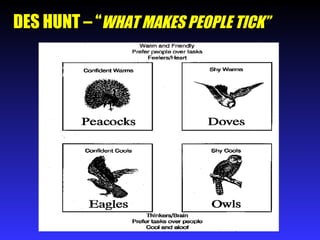
DES HUNT – “ WHAT MAKES PEOPLE TICK”
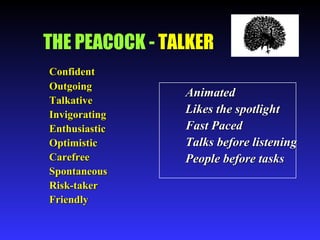
THE PEACOCK -  TALKER Confident Outgoing Talkative Invigorating Enthusiastic Optimistic Carefree Spontaneous Risk-taker Friendly Animated Likes the spotlight Fast Paced Talks before listening People before tasks
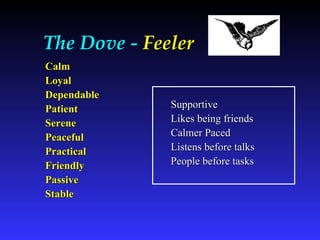
The Dove -  Feeler Calm Loyal Dependable Patient Serene Peaceful Practical Friendly Passive Stable Supportive Likes being friends Calmer Paced Listens before talks People before tasks
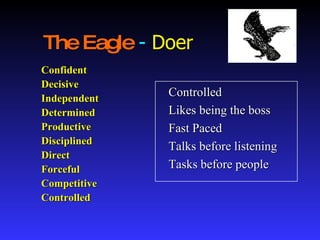
The Eagle  -  Doer Confident Decisive Independent Determined Productive Disciplined Direct Forceful Competitive Controlled Controlled Likes being the boss Fast Paced Talks before listening Tasks before people
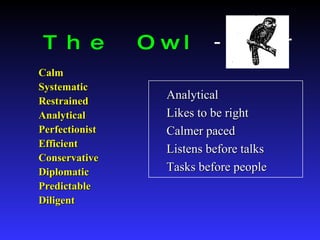
The Owl   - Thinker Calm Systematic Restrained Analytical Perfectionist Efficient Conservative Diplomatic Predictable Diligent Analytical Likes to be right Calmer paced Listens before talks Tasks before people
TEAMS 2008 . . . Lets have a go!
TEAMS 2008 . . . Understanding People – and how to handle them!
THE DICTATOR This type bully, cajole and intimidate. They are blunt to the point of being insulting. They are constantly demanding and brutally critical. These folk can cause ulcers!
HANDLING THE DICTATOR Keep focused on solutions.  Sit quietly until they have  wound down. Then say: “I can see this is a big problem for you. Let’s see what we can do to solve it!” Ask them to leave.  Say: “I can’t listen to you when you are using that tone of voice”. Say their name loudly  if you think they might become violent!  It will help.
THE KNOW IT ALL These are the experts on everything. They can be very arrogant, and they usually have an opinion on every issue. Yet when they’re wrong they tend to pass the buck or become very defensive!
HANDLING THE KNOW IT ALL Acknowledge their accomplishments and point out a way the two of you can work together. Example:   “Your idea is very good and it sounds like that coupled with my systems and expertise, we could make a difference!” Let them know that great minds think alike!
THE  YES  PEOPLE They will agree with anything, promise any deadline, yet they rarely deliver. While they are always sorry (and can be charming), you cannot trust them to do what they say!
DEALING WITH THE YES PEOPLE Three ways of ensuring that YES People will keep their word and save yourself STRESS: Tie their promise to a sense of personal integrity: “Do I have your word on this?” Recap the agreement’s main points. Get even the informal in writing!
THE  PASSIVES You can recognise the passive by their deadpan expressions and their weak handshakes. Avoiding conflict and controversy at all costs, these people never offer ideas or opinions, and never let you know where you stand!
HOW TO WORK WITH PASSIVES Set a clear example of the behaviour you want demonstrated by rewarding all the people who voice their opinions and take the initiative. The more passive types will observe this and normally take action. Some times the passive type will share their opinions and comments in a private setting!
The  “NO”  PEOPLE This type can be both negative and pessimistic, they are quick to point out why something won’t work. They are inflexible and do not like change. They can put stress on you by throwing a wet blanket over the whole of your initiatives.
DEALING  WITH THE “NO” PEOPLE   Minimise their contact with others. Show the advantages for THEM! Do change management in small pieces. Never use negative communication back to them - keep it positive!
THE  COMPLAINERS They are of the opinion that nothing ever goes their way. You have the feeling they would rather complain about things than change them. Even if they are sometimes right in what they say, their negativity and nit-picking can turn people off and cause you great amounts of stress! And because the squeaky wheel gets the oil, others often miss out!
DEALLING WITH COMPLAINERS Listen to the complaint. Set them straight, DO NOT allow them to reinforce their beliefs about a situation. Get them to focus off positions  (who’s right and who’s wrong).  Have them examine the others person’s behaviour and motivations to understand their position!
DEALING WITH  ANGER “ If you are patient in one moment of anger, you will escape a hundred days of sorrow”  -  Old Chinese proverb
DEALING WITH ANGER When faced with an angry person who is VERY likely to cause your stress try the following: Stay focussed on the situation and the outcome you want. Don’t get distracted by the other person’s anger. Don’t take insults personally.
UNDERSTANDING ANGER Anger is normally a defence mechanism. Occurs when things are not going a person’s way. Has in it a sense of RIGHT - a belief that one’s personal rights are being violated. Results in a narrowing of focus and priorities - angry people cannot see the big picture.
INTERACTION DURING CONFLICT DEMONSTRATE RESPECT - This is displayed in listening, in body language, in the choice of your words. Communication is  not always accurate  during conflict and anger. Sometimes people are talking about two different things without realising it - people can be in basic agreement with out realising it -  CHECK!!
INTERACTION DURING CONFLICT Listen carefully to try and discover what the issue is that has caused the anger. State your views, once you have made sure you have correctly understood these and reflected back the other person’s feelings about the situation. RESIST the temptation to strike back. If you can reflect the person’s anger in an empathetic way you will be surprised how much it will defuse the situation.
INTERACTION DURING CONFLICT REMEMBER in emotionally charged situations people can withhold important information. Try not to forget or to side-step major issues and encourage the other person to do likewise. REMEMBER exaggeration is also a problem during angry situations!
UNDERSTANDING CONFLICT LEVELS There are a number of clues that can help us to understand the level of conflict we are in and what to do about it. Early intervention can often avoid a really difficult situation developing and can prevent you a great deal of stress!
UNDERSTANDING CONFLICT LEVELS DISCOMFORTS - Nothing is said. It may be difficult to identify what the problem is, but things just don’t feel right. INCIDENTS - This takes the form of a minor outward clash, no real significant internal reactions take place.
UNDERSTANDING CONFLICT LEVELS MISUNDERSTANDINGS - The parties have begun to have negative images and perceptions of each other. It is still relatively easy to fix the problem at this stage. TENSIONS - Negative attitudes and stances are added to negative images and perceptions. Tend to become fixed over time and hard to resolve.
UNDERSTANDING CONFLICT LEVELS CRISIS - Behaviour is affected, normal functioning becomes difficult, extreme gestures are contemplated, if not executed.  This is when personal and social conflicts become really serious. Developed by Social Ecology Associates.
MANAGING OUR EMOTIONS Four helpful questions to ask yourself when you are angry, hurt or frightened. 1. Why am I feeling like this? 2. What do I want to change? 3. What do I need in order to get over this feeling? 4. Whose problem is it?
9 STEPS TO HANDLING COMPLAINTS SUCCESSFULLY Validate the other person’s point of view and their emotions. Listen carefully without interruptions. Remain positive and project a desire to help. Display empathy, don’t argue. Probe the problems using open questions - get the facts. Use assertive communications skills. Confirm that you understand the issue. Explore alternatives for resolution. Reach agreement with the other party.
WHAT DO  UPSET  PEOPLE WANT? To be taken seriously To be treated with respect Immediate action Compensation/restitution Someone to be reprimanded To see that the problem never occurs again To be listened to
WORDS THAT ADD  FU EL  TO THE FIRE You’re crazy I know how you feel I don’t know why you are so upset You’re way off base You are not making any sense That’s definitely wrong Did you really say?
USE THE 3 F’s “ I understand how you could  feel  that way. Others have  felt  that way too. And they have  found,  after an explanation, that this policy protected them, so it made sense!”
AGGRESSION Aggression can be used in three areas: Emotional Motivational Behavioural
TEAMS 2008 . . . The Importance and Ways of Developing Teams
TEAM DEVELOPMENT   -  Stott & Walker p84 Individual Motivation Commitment Attitudes Abilities Participation Task Goals Targets Processes Organisation Structure Support Rewards Culture
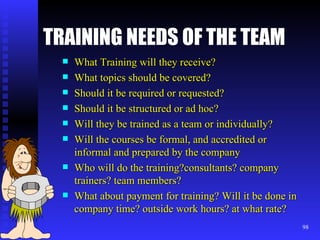
TRAINING NEEDS OF THE TEAM What Training will they receive? What topics should be covered? Should it be required or requested? Should it be structured or ad hoc? Will they be trained as a team or individually? Will the courses be formal, and accredited or informal and prepared by the company Who will do the training?consultants? company trainers? team members? What about payment for training? Will it be done in company time? outside work hours? at what rate?
TEAM DEVELOPMENT   -  Stott & Walker p84 Leadership Communication Coordination Cooperation Cohesiveness Behavioral Roles Interpersonal Skills Influencing Skills Conflict Problem Analysis Decision Making Team Meetings Norms, Values Conformity
SOME OPTIONS FOR STAFF DEVELOPMENT Mentoring Job or Work Rotation Secondment Special Projects Work Shadowing Coaching
5 ELEMENTS OF EFFECTIVE TEAMS Goals Roles Processes Relationships Interfaces
TEAMS 2008 . . . Thanks for attending!
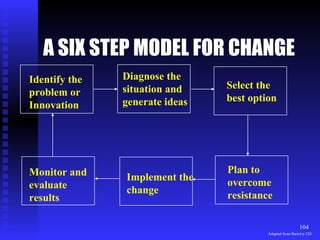
TO INFLUENCE CHANGE YOU MUST Identify a gap in performance Identify where you want to be  - goal Recognise the need for change Diagnose the problem/s Develop alternative solutions Select the most appropriate one Implement it Evaluate it against the desired outcome
A SIX STEP MODEL FOR CHANGE Identify the  problem or  Innovation Diagnose the  situation and  generate ideas Select the  best option Plan to  overcome  resistance Implement the change Monitor and  evaluate  results Adapted from Bartol p 238
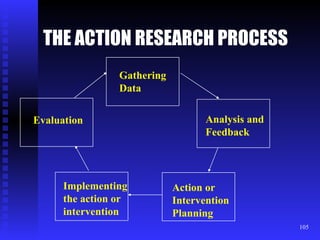
THE ACTION RESEARCH PROCESS Gathering Data Analysis and  Feedback Action or  Intervention Planning Implementing the action or  intervention Evaluation
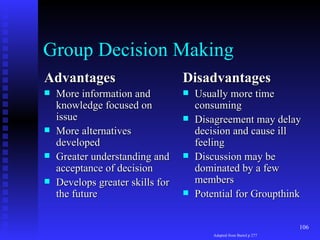
Group Decision Making Advantages More information and knowledge focused on issue More alternatives developed Greater understanding and acceptance of decision Develops greater skills for the future Disadvantages Usually more time consuming Disagreement may delay decision and cause ill feeling Discussion may be dominated by a few members Potential for Groupthink Adapted from Bartol p 277
Teams Are being used increasingly in organisations Tasks they are being asked to manage are more complex Change will be needed in a number of areas within an organisation, and it will require careful planning
Responsibilities of Teams Performing a range of job functions Achieving quality (& quantity) of products and/or services Monitoring cost Continuous Improvement Solving problems General housekeeping / Safety Training other team members
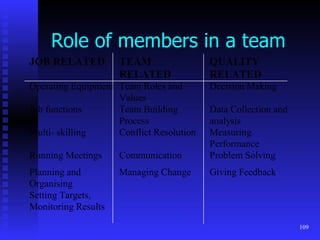
Role of members in a team
Continuous Development Self Directed  - Lifelong Learning this requires . . . rapid communication of priority  availability of  learning facilities and resources as part of working life recognition by the employee that they share ownership of organisations learning plan recognition that the employee is able to create a personal development plan
Continuous Development Operational plans must take into account the learning implications for employees Clear understanding by everyone of their responsibilities You have a responsibility for your own self development and the training  and development of those you manage
Implications . . . identification and assessing the competencies of individuals providing ways for people to learn and develop skills reviewing staff development needs and career aspirations  establishing and reviewing objectives and performance measures
Rating Methods Results Oriented focuses on performance results Behaviour Oriented focuses on employee behaviour that represents gradations of performance that can be used as reference points on various job dimensions
The Upside and the Downside clearly defined roles better understanding focuses attention on important issues ownership of the process better motivation time consuming setting measurable targets can be difficult may lead to inflexibility tendency to focus on items easily measured
Alternative approaches Education and Communication Participation and Involvement Facilitation and Support Negotiation and Agreement Manipulation and Co-optation Explicit / Implicit Coercion
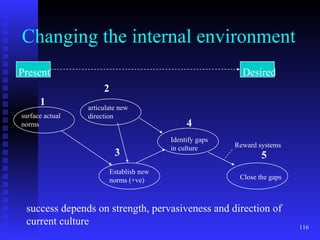
Changing the internal environment Present Desired 1 2 3 4 5 surface actual  norms Establish new norms (+ve) Identify gaps  in culture Close the gaps Reward systems success depends on strength, pervasiveness and direction of  current culture articulate new  direction
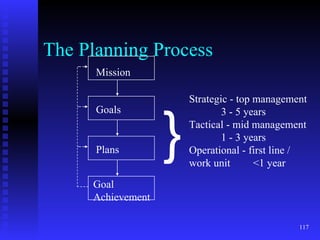
The Planning Process Mission Goals Plans Goal  Achievement Strategic - top management 3 - 5 years Tactical - mid management 1 - 3 years Operational - first line /  work unit  <1 year }
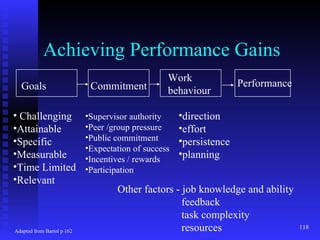
Achieving Performance Gains Other factors - job knowledge and ability feedback task complexity resources Adapted from Bartol p 162 Goals Commitment Work  behaviour Performance Challenging Attainable Specific Measurable Time Limited Relevant Supervisor authority Peer /group pressure Public commitment Expectation of success Incentives / rewards Participation direction effort persistence planning
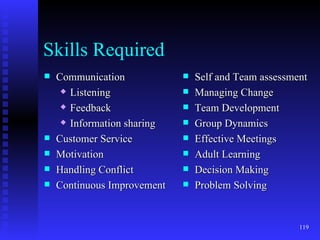
Skills Required Communication Listening Feedback Information sharing Customer Service Motivation Handling Conflict Continuous Improvement Self and Team assessment Managing Change Team Development Group Dynamics Effective Meetings Adult Learning Decision Making Problem Solving
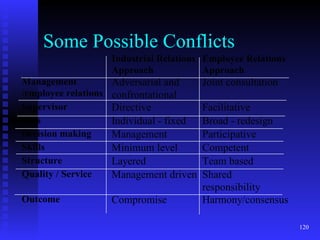
Some Possible Conflicts
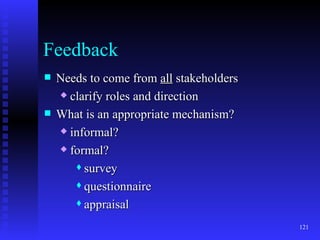
Feedback Needs to come from  all  stakeholders clarify roles and direction What is an appropriate mechanism? informal? formal? survey questionnaire appraisal
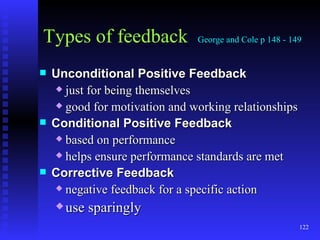
Types of feedback   George and Cole p 148 - 149 Unconditional Positive Feedback just for being themselves good for motivation and working relationships Conditional Positive Feedback based on performance helps ensure performance standards are met Corrective Feedback negative feedback for a specific action use sparingly
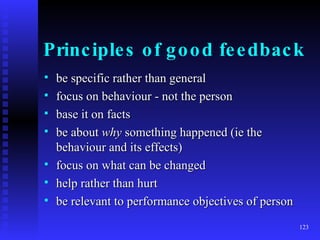
Principles of good feedback be specific rather than general focus on behaviour - not the person base it on facts be about  why  something happened (ie the behaviour and its effects) focus on what can be changed help rather than hurt be relevant to performance objectives of person
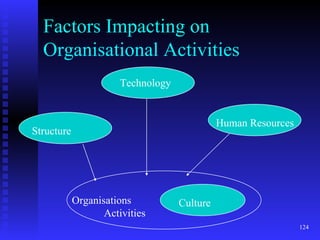
Factors Impacting on Organisational Activities Culture Organisations  Activities Structure Technology Human Resources
Why is an organisation like it is? Natural selection model - found a niche which suits it - determined by the environment Resource Dependency model - adapted to make the environment more    suitable  - to reduce dependency
Deming on Quality “ Good quality does not necessarily mean high quality.  It means a predictable degree of uniformity and dependability at low cost, with a quality  suited to the market.” “ It is good management to reduce the variation in quality characteristics ...” “ 90 - 94% of the waste is built into the system and can only be eliminated through fundamental changes initiated by management” “ I never said it would be easy: I only said that it would work”
Deming and his 14 points create constancy of purpose towards improvement Adopt a philosophy of customer satisfaction Cease mass inspections Move away from price to quality as a measure Improve systems of production and service constantly -(Kaizen) Training is vital and should include philosophy of the organisation Managers should become  leaders
Deming and his 14 points  (continued) Create a climate of trust and innovation Break down barriers between departments Eliminate numerical goals - focus on success in improvement Eliminate MBO and quotas-need leadership Stress quality not numbers Education and self improvement are essential for all The transformation is everybody’s responsibility -take action
The Challenge How to  develop  and  reward  a continuous improvement culture in an organisation. Stakeholders Customers / Clients Suppliers Management Employees Unions Shareholders / Owners
A process to improve performance Establish goals Plan the work Negotiate roles Establish performance criteria Plan for feedback
Objectives of Appraisal provide 2 way feedback of performance over a period of time give management information on performance of individual or team tell individuals what their strengths and weaknesses are provide information for reviewing training and development needs
Objectives of Appraisal -  continued provide an inventory of skills, competence, qualifications, and talents provide relevant information for reviewing salary, promotion or other rewards provide input for human resource planning, career planning and succession planning
Benefits of an appraisal system For the Organisation: standard information about its employees facility to develop individuals based on this information ability to plan its human resource needs more accurately adapted from “Managing People” - Rosemary Thomson p 103
Benefits of an appraisal system For the Manager: objective guidelines for assessing staff gains a better understanding of staff needs improved relations with staff adapted from “Managing People” - Rosemary Thomson p 103
Benefits of an appraisal system For the individual opportunity to discuss work objectively ability to evaluate performance ability to consider future training and development needs improved relations with manager adapted from “Managing People” - Rosemary Thomson p 103
Rewards - Individual or Team In the past reward has been to individuals With teams, should monetary reward be individual or team based? Should rewards be based on specific work groups or the organisation as a whole? As a general rule it is important to find ways of rewarding team achievement rather than individual
Possible Reward Schemes suggestion schemes to allow a creative look at their jobs Gift certificates Award points to be converted to cash payments Time / room for meetings
Possible Reward Schemes  (contd) Company supported learning / training Lump Sum Bonuses Profit Sharing Gain sharing Payment for Skills / Knowledge Risk - Reward Systems
Team and Individual Goals Goals or targets should be : realistic specific relate to a time frame measurable -  quantity, quality , cost related to the organisations goals The team should be accountable
A conflict Manager must often play the roles of Leader  - assign work, establish standards of performance and provide resources Coach  - provide support and encouragement to reach desired level of performance Judge  - evaluate objectively Are these compatible?  Trust and Openness
The SWOT Analysis S - Strengths   (Internal) W - Weaknesses  (Internal) O -  Opportunities  (External) T - Threats   (External)
STRENGTHS Internal characteristic of firm that has the potential for improving the firm’s competitive situation better technological skills cost advantages good competitive skills reputation
WEAKNESSES Internal characteristic that leaves the firm potentially vulnerable  no strategic direction obsolete facilities poor distribution network limited finance missing key skills or competence
OPPORTUNITIES An environmental condition that offers potential for improving the organisation’s situation  reduced trade barriers in export markets government programs market opportunities in related products (diversification) complacency of industry rivals
THREATS An environmental condition that has the potential to undermine the organisation’s competitive situation low cost competitors entering the market sales of substitute products increasing new legislation which will incur greater cost change in buyer tastes adverse demographic changes
What Options are there for change? Adapt to suit the existing environmental elements attempt to influence the environment favorably shift away from the threatening environment - a change in direction
TEAM TASK ROLES Initiator - Contributor Information Seeker Information Giver Co-coordinator Orientor (Direction Keeper) Energiser
EFFECTIVE TEAMS . . . Need goals clearly defined in order to: Provide guidance Help members clarify what is to be done Ensure ownership If this is not done task related problems will occur.
DEVELOPING GOOD TEAMS . . . Who are we? Where are we know? Where do we want to be? How will we get there? What is expected of us? What helps do we need? How effective are we?
SADIE  MODEL -  Magerison and McCann Sharing information Analysing information Developing options and selecting  Implement  Evaluate
ANALYSIS FROM ELEMENTS Symbolism  - language, or acts which convey meaning. Myths  - past events often embellished Rituals  - planned sets of activities - what beliefs or values are being reinforced Heroes and Sinners -  ie managerial practice in regard to treatment of subordinates and promotion Physical layout - what does it suggest about the organisation? Sacred Cows
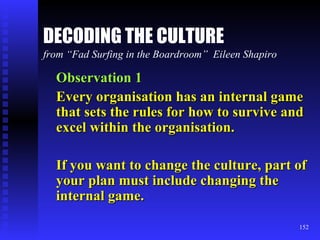
DECODING THE CULTURE from “Fad Surfing in the Boardroom”  Eileen Shapiro Observation 1 Every organisation has an internal game that sets the rules for how to survive and excel within the organisation. If you want to change the culture, part of your plan must include changing the internal game.
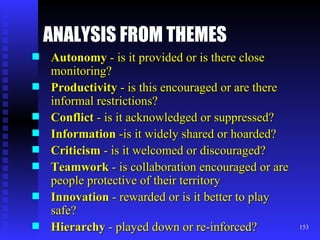
ANALYSIS FROM THEMES Autonomy  - is it provided or is there close monitoring? Productivity  - is this encouraged or are there informal restrictions? Conflict  - is it acknowledged or suppressed? Information  -is it widely shared or hoarded? Criticism  - is it welcomed or discouraged? Teamwork  - is collaboration encouraged or are people protective of their territory Innovation  - rewarded or is it better to play safe? Hierarchy  - played down or re-inforced?
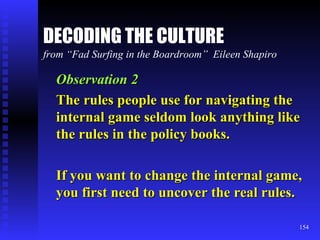
DECODING THE CULTURE from “Fad Surfing in the Boardroom”  Eileen Shapiro Observation 2 The rules people use for navigating the internal game seldom look anything like the rules in the policy books. If you want to change the internal game, you first need to uncover the real rules.
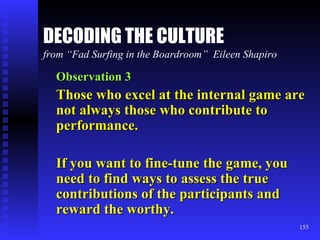
DECODING THE CULTURE from “Fad Surfing in the Boardroom”  Eileen Shapiro Observation 3 Those who excel at the internal game are not always those who contribute to performance. If you want to fine-tune the game, you need to find ways to assess the true contributions of the participants and reward the worthy.
THREE AREAS OF AGGRESSION   EMOTIONAL  -  Something happens to make a person angry. MOTIVATIONAL   - There is an intention to hurt another person. BEHAVIOURAL  - It is a response to something/someone of a threat.
THREE AREAS OF AGGRESSION “ The person was angry  (emotional)  because the payment was late again, so he worked out a plan  (motivational)  to get back at the organisation in some way. First thing in the morning he went down to the office and threw  (behavioural)  a chair through the window”

Working In Teams (Tafe) Powerpoint Slides Revised

  • 1.
  • 2.
    5 ELEMENTS OFEFFECTIVE TEAMS Goals Roles Processes Relationships Interfaces
  • 3.
    Questions for WorkTeams What will the teams do? What skills will be required? What training will be required? What type of reward system? What support will the team receive?
  • 4.
    PERCEIVED BENEFITS OFTEAM Reduced duplication of effort Increased cooperation Innovative ideas Better decisions Motivated staff Improved product and quality service Increased productivity
  • 5.
    PERCEIVED BENEFITS OFTEAMS More flexibility Increased commitment Less destructive conflict Better interpersonal skills Higher standards of performance
  • 6.
    HELPING TEAM EFFECTIVENESSKey issues Getting Started Orienting Team Players Training for Team Success Developing Team Leadership Rewarding Team Performance
  • 7.
    TEAM DEVELOPMENT PROCESSTeam Features Commitment Trust/Courtesy Purpose Communication Involvement Process
  • 8.
    EFFECTIVE TEAMS? Measuredfrom the organisation’s point of view ? Measured from the team’s point of view? Are the two points of view the same - should they be?
  • 9.
    TEAM AND INDIVIDUALGOALS Team goals must be in harmony with those of the organisation - remember this is how you will be judged. If the team succeeds the individual succeeds - this means individual work goals must satisfy both the individual and the team.
  • 10.
    Teams 2008 .. . “ Happy people make happy teams and happy teams get GREAT results for organisations”
  • 11.
    TEAMS 2008 .. . What make an Effective Team?
  • 12.
    WHAT IS AN“EFFECTIVE TEAM” Implies a measurement of performance Need a ‘base figure’ to measure from Need to know the purpose of the team to ensure an appropriate measurement (performance indicator)
  • 13.
    Effective Teams - Prentice and Rabey - “Empowering Supervisors - Leading Winning Teams” p 82 Clear Work Objectives Good communication - up and down Work together harmoniously Keen to achieve results Grievances discussed fully and frankly Change is discussed prior to it happening Trusted to do a job on their own Process improvement Group exercises its own discipline
  • 14.
    EFFECTIVE TEAMS - Chaousis Leadership - shared Goals - team purpose and performance goals Decision making - participative / consensus Regular review of performance Linkage with other teams in organisation Relationships - trust
  • 15.
    “ T.E.A.M.S.” - James Lundy Communication, Coordination and Cooperation Mutual trust and understanding agreed upon expectations awareness of potential benefits commitments to make them work open feedback regarding feelings anticipation of ways to resolve any potential differences
  • 16.
    “ SUPERVISION INACTION” George and Cole p192 Clear challenging goals - members committed to their achievement Self directed - don’t wait to be told Honest, open communication Involvement and enjoyment - cohesive Group norms in line with the organisation Conflict is seen as positive - involved and dealt with constructively Multi skilled
  • 17.
    ANANTARAMAN in Stott and Walker Clear cooperative goals - and commitment to them Accurate, effective communication of ideas and feelings Distributed participation and leadership High level of trust Appropriate decision making and problem solving procedures Productive controversy Acceptance and support among team Cohesive Manage power and conflict constructively
  • 18.
    KAZEMAK in Stott and Walker Goals and objectives understood and agreed Conflict dealt with constructively shared leadership Abilities are used open and participatory communication Creativity encouraged Support for team’s controls and procedures Established problem solving and decision making approaches Evaluate functions and processes regularly Understand roles, responsibilities and limits of authority
  • 19.
    HITT in Stott and Walker Common agreement on high expectations for team Commitment to common goals Honest and open communication Assumed responsibility for work to be done Common access to information Climate of trust support for decisions Win-Win approach Focus on process as well as results Feeling that you can influence what happens
  • 20.
    5 ELEMENTS OFEFFECTIVE TEAMS Goals Roles Processes Relationships Interfaces
  • 21.
    TEAMS 2008 .. . Team Goals?
  • 22.
    TEAM GOALS .. ? Purpose Vision Ground rules Page 23 of High Energy Teams Manual
  • 23.
    TEAMS 2008 .. . Team Roles
  • 24.
    COMMON ROLES INTEAMS Three main categories Group Task Roles Group Maintenance Roles Self - Oriented Roles
  • 25.
    SELF -ORIENTED ROLESHelper - maintainer Aggressor Blocker Fact finder - reporter Linker – socializer – others?
  • 26.
    TEAM MAINTENANCE ROLESEncourager Harmoniser Gatekeeper Standard Setter Observer
  • 27.
    TEAM TASK ROLESPlanner Instigator Quality checker Delegater ?
  • 28.
    TEAMS 2008 TeamProcesses
  • 29.
    TEAM PROCESSES? Aseries of actions/tasks that produce results Processes describe how we will work together to reach our goals. Planning Problem solving Conflict resolution Continuous improvements/others?
  • 30.
    TEAMS 2008 .. . How Teams Form
  • 31.
    STAGES OF TEAMDEVELOPMENT Forming Storming Norming Performing Departing/Reforming
  • 32.
    FORMING Orientation totask Dependency on “Leader” Testing out inter-personal relationships Discovering the ground rules
  • 33.
    Storming Resistance totask demands Interpersonal conflict Exploring areas of disagreement Struggle for group leadership
  • 34.
    NORMING Building cohesivenessDeveloping consensus about norms Clarifying roles Informal leader may emerge
  • 35.
    Performing . .. Energy channeled into task Roles clear and functional Norms support teamwork Solutions begin to emerge for the previous problems
  • 36.
    Mourning Goals accomplishedPrepare for disengagement Dependency on “Leader” Some regret at the disbanding Termination of the group
  • 37.
    TEAMS 2008 TeamRelationships
  • 38.
    RELATIONSHIPS That whichbinds the team together: Values Communications Trust Openness Collaboration
  • 39.
    TEAMS 2008 . . . Team Interfaces?
  • 40.
    TEAM INTERFACES .. . How a team relates to other teams! Examples?
  • 41.
    DEVELOPING GOOD TEAMS. . . What skills do we need? What skills do we have? Where do we want to be? How will we get these skills? How should we work together/treat each other? What recognition do we get? How do/will we celebrate our successes?
  • 42.
    TEAMS 2008 What is the culture of the Team?
  • 43.
    What type ofculture is present? People oriented Innovative Participative Decentralised Fast Acting Situational Task oriented Conservative Autocratic Centralised Reflective “ By the book”
  • 44.
    Organisational Culture? Normsand expectations of how people behave and treat each other. Philosophy, spirit or drive of the organisation. Values beliefs and ways of thinking. To constitute a culture it must be shared by members and taught to new members.
  • 45.
    Organisational Culture? Qualityof the relationships that exist between people at work Unwritten rules which govern behaviour - the feeling part of the organisation A reflection of leadership style
  • 46.
    Organisational Culture - Indicators Style of correspondence The informal communication network - the grapevine Who has the power and how they use it What gets rewarded / frowned on Sequence of steps necessary to initiate action or get approval How conflict is handled
  • 47.
    CULTURE AND TEAMEFFECTIVENESS Will depend on How much the culture aids in reaching the goals of the organisation. How evenly spread and wide spread the culture is. How strongly held the values are. Culture can enhance team effectiveness or drain team energy
  • 48.
    CULTURAL IDEAL -Barham in Stott and Walker p431 Both growth and results oriented but believe work should be fun Promote confidence in organisations ability to handle the future Welcome change as an opportunity - not a threat Foster customer awareness - aim for high levels of quality and service Believe in providing a challenging and supportive environment to encourage initiative and responsibility at all levels
  • 49.
    CULTURAL IDEAL -Barham in Stott and Walker Stress teamwork and ability of each individual to contribute Emphasize results rather than process Very open - little emphasis on status Strong emphasis on high quality communication, consultation and listening Believe in integrity and fair dealing Are more tolerant of “unconventional” people and encourage creative ways of doing things
  • 50.
    ORGANISATIONAL CULTURE - and development Trust is an important component Trust involves risk taking Takes time to develop
  • 51.
    THE IMPACT OFTRUST - ON PEOPLE People enjoy working Staff and managers feel valued Extra work taken on willingly - no exploitation Two way respect and common courtesy Constructive conflict resolution Mistakes handled supportively - seen as a learning experience Ideas shared freely - all good ideas considered
  • 52.
    THE IMPACT OFTRUST - ON PROCESS Managers don’t use power as a threat Managers not threatened by staff using devolved authority Minimal forms and procedures Few sacred cows Team rewards predominate - no rewards for “yes” person
  • 53.
    CULTURE - ANDCOMPLEXITY Culture is not simple - it is overlaid by national cultures and sub cultures. National cultures - often a greater influence Must understand the impact - authority Subcultures - for specialised problems or situations
  • 54.
    TEAMS 2008 .. . What Makes People Tick? – Understanding others
  • 55.
    Understanding how otherpeople see life is the key to understanding the “people business.”
  • 56.
    MYERS-BRIGGS TYPE INDICATORRelates to personality preferences in the way we acquire information and make decisions: Extraversion - Introversion Sensing - Intuition Thinking - Feeling Judgment - Perception
  • 57.
    EXTRAVERSION - INTROVERSIONLike variety and action Act quickly Friendly and easy to know Seek out others to talk things through “ Shallow” Like quiet for concentration Think before acting Reserved hard to know Seek time alone to think things through “ Withdrawn”
  • 58.
    SENSING - INTUITIONLike practical things Start at beginning and work step by step Careful about details Seldom make errors of fact Not inspired Imagine possibilities Jump in anywhere - make inferences Ignore details Perhaps make errors of fact May follow inspiration whether good or bad
  • 59.
    THINKING - FEELINGPut things in logical order Predict outcomes logically Tend to be firm - tough minded May hurt feelings “ Arrogant” Like harmony and make it happen Consider effects of decisions on people Sympathetic Dislike telling people unpleasant things “ Woolly-Minded”
  • 60.
    JUDGMENT - PERCEPTIONWork best with a plan Like to get things finished Decide too quickly Want only the essentials to start a task “ Demanding” “rigid” Enjoy flexibility in work Curious Adapt well to changing conditions Last minute operators Procrastinators “ disorganised”
  • 61.
    DES HUNT –“ WHAT MAKES PEOPLE TICK”
  • 62.
    THE PEACOCK - TALKER Confident Outgoing Talkative Invigorating Enthusiastic Optimistic Carefree Spontaneous Risk-taker Friendly Animated Likes the spotlight Fast Paced Talks before listening People before tasks
  • 63.
    The Dove - Feeler Calm Loyal Dependable Patient Serene Peaceful Practical Friendly Passive Stable Supportive Likes being friends Calmer Paced Listens before talks People before tasks
  • 64.
    The Eagle - Doer Confident Decisive Independent Determined Productive Disciplined Direct Forceful Competitive Controlled Controlled Likes being the boss Fast Paced Talks before listening Tasks before people
  • 65.
    The Owl - Thinker Calm Systematic Restrained Analytical Perfectionist Efficient Conservative Diplomatic Predictable Diligent Analytical Likes to be right Calmer paced Listens before talks Tasks before people
  • 66.
    TEAMS 2008 .. . Lets have a go!
  • 67.
    TEAMS 2008 .. . Understanding People – and how to handle them!
  • 68.
    THE DICTATOR Thistype bully, cajole and intimidate. They are blunt to the point of being insulting. They are constantly demanding and brutally critical. These folk can cause ulcers!
  • 69.
    HANDLING THE DICTATORKeep focused on solutions. Sit quietly until they have wound down. Then say: “I can see this is a big problem for you. Let’s see what we can do to solve it!” Ask them to leave. Say: “I can’t listen to you when you are using that tone of voice”. Say their name loudly if you think they might become violent! It will help.
  • 70.
    THE KNOW ITALL These are the experts on everything. They can be very arrogant, and they usually have an opinion on every issue. Yet when they’re wrong they tend to pass the buck or become very defensive!
  • 71.
    HANDLING THE KNOWIT ALL Acknowledge their accomplishments and point out a way the two of you can work together. Example: “Your idea is very good and it sounds like that coupled with my systems and expertise, we could make a difference!” Let them know that great minds think alike!
  • 72.
    THE YES PEOPLE They will agree with anything, promise any deadline, yet they rarely deliver. While they are always sorry (and can be charming), you cannot trust them to do what they say!
  • 73.
    DEALING WITH THEYES PEOPLE Three ways of ensuring that YES People will keep their word and save yourself STRESS: Tie their promise to a sense of personal integrity: “Do I have your word on this?” Recap the agreement’s main points. Get even the informal in writing!
  • 74.
    THE PASSIVESYou can recognise the passive by their deadpan expressions and their weak handshakes. Avoiding conflict and controversy at all costs, these people never offer ideas or opinions, and never let you know where you stand!
  • 75.
    HOW TO WORKWITH PASSIVES Set a clear example of the behaviour you want demonstrated by rewarding all the people who voice their opinions and take the initiative. The more passive types will observe this and normally take action. Some times the passive type will share their opinions and comments in a private setting!
  • 76.
    The “NO” PEOPLE This type can be both negative and pessimistic, they are quick to point out why something won’t work. They are inflexible and do not like change. They can put stress on you by throwing a wet blanket over the whole of your initiatives.
  • 77.
    DEALING WITHTHE “NO” PEOPLE Minimise their contact with others. Show the advantages for THEM! Do change management in small pieces. Never use negative communication back to them - keep it positive!
  • 78.
    THE COMPLAINERSThey are of the opinion that nothing ever goes their way. You have the feeling they would rather complain about things than change them. Even if they are sometimes right in what they say, their negativity and nit-picking can turn people off and cause you great amounts of stress! And because the squeaky wheel gets the oil, others often miss out!
  • 79.
    DEALLING WITH COMPLAINERSListen to the complaint. Set them straight, DO NOT allow them to reinforce their beliefs about a situation. Get them to focus off positions (who’s right and who’s wrong). Have them examine the others person’s behaviour and motivations to understand their position!
  • 80.
    DEALING WITH ANGER “ If you are patient in one moment of anger, you will escape a hundred days of sorrow” - Old Chinese proverb
  • 81.
    DEALING WITH ANGERWhen faced with an angry person who is VERY likely to cause your stress try the following: Stay focussed on the situation and the outcome you want. Don’t get distracted by the other person’s anger. Don’t take insults personally.
  • 82.
    UNDERSTANDING ANGER Angeris normally a defence mechanism. Occurs when things are not going a person’s way. Has in it a sense of RIGHT - a belief that one’s personal rights are being violated. Results in a narrowing of focus and priorities - angry people cannot see the big picture.
  • 83.
    INTERACTION DURING CONFLICTDEMONSTRATE RESPECT - This is displayed in listening, in body language, in the choice of your words. Communication is not always accurate during conflict and anger. Sometimes people are talking about two different things without realising it - people can be in basic agreement with out realising it - CHECK!!
  • 84.
    INTERACTION DURING CONFLICTListen carefully to try and discover what the issue is that has caused the anger. State your views, once you have made sure you have correctly understood these and reflected back the other person’s feelings about the situation. RESIST the temptation to strike back. If you can reflect the person’s anger in an empathetic way you will be surprised how much it will defuse the situation.
  • 85.
    INTERACTION DURING CONFLICTREMEMBER in emotionally charged situations people can withhold important information. Try not to forget or to side-step major issues and encourage the other person to do likewise. REMEMBER exaggeration is also a problem during angry situations!
  • 86.
    UNDERSTANDING CONFLICT LEVELSThere are a number of clues that can help us to understand the level of conflict we are in and what to do about it. Early intervention can often avoid a really difficult situation developing and can prevent you a great deal of stress!
  • 87.
    UNDERSTANDING CONFLICT LEVELSDISCOMFORTS - Nothing is said. It may be difficult to identify what the problem is, but things just don’t feel right. INCIDENTS - This takes the form of a minor outward clash, no real significant internal reactions take place.
  • 88.
    UNDERSTANDING CONFLICT LEVELSMISUNDERSTANDINGS - The parties have begun to have negative images and perceptions of each other. It is still relatively easy to fix the problem at this stage. TENSIONS - Negative attitudes and stances are added to negative images and perceptions. Tend to become fixed over time and hard to resolve.
  • 89.
    UNDERSTANDING CONFLICT LEVELSCRISIS - Behaviour is affected, normal functioning becomes difficult, extreme gestures are contemplated, if not executed. This is when personal and social conflicts become really serious. Developed by Social Ecology Associates.
  • 90.
    MANAGING OUR EMOTIONSFour helpful questions to ask yourself when you are angry, hurt or frightened. 1. Why am I feeling like this? 2. What do I want to change? 3. What do I need in order to get over this feeling? 4. Whose problem is it?
  • 91.
    9 STEPS TOHANDLING COMPLAINTS SUCCESSFULLY Validate the other person’s point of view and their emotions. Listen carefully without interruptions. Remain positive and project a desire to help. Display empathy, don’t argue. Probe the problems using open questions - get the facts. Use assertive communications skills. Confirm that you understand the issue. Explore alternatives for resolution. Reach agreement with the other party.
  • 92.
    WHAT DO UPSET PEOPLE WANT? To be taken seriously To be treated with respect Immediate action Compensation/restitution Someone to be reprimanded To see that the problem never occurs again To be listened to
  • 93.
    WORDS THAT ADD FU EL TO THE FIRE You’re crazy I know how you feel I don’t know why you are so upset You’re way off base You are not making any sense That’s definitely wrong Did you really say?
  • 94.
    USE THE 3F’s “ I understand how you could feel that way. Others have felt that way too. And they have found, after an explanation, that this policy protected them, so it made sense!”
  • 95.
    AGGRESSION Aggression canbe used in three areas: Emotional Motivational Behavioural
  • 96.
    TEAMS 2008 .. . The Importance and Ways of Developing Teams
  • 97.
    TEAM DEVELOPMENT - Stott & Walker p84 Individual Motivation Commitment Attitudes Abilities Participation Task Goals Targets Processes Organisation Structure Support Rewards Culture
  • 98.
    TRAINING NEEDS OFTHE TEAM What Training will they receive? What topics should be covered? Should it be required or requested? Should it be structured or ad hoc? Will they be trained as a team or individually? Will the courses be formal, and accredited or informal and prepared by the company Who will do the training?consultants? company trainers? team members? What about payment for training? Will it be done in company time? outside work hours? at what rate?
  • 99.
    TEAM DEVELOPMENT - Stott & Walker p84 Leadership Communication Coordination Cooperation Cohesiveness Behavioral Roles Interpersonal Skills Influencing Skills Conflict Problem Analysis Decision Making Team Meetings Norms, Values Conformity
  • 100.
    SOME OPTIONS FORSTAFF DEVELOPMENT Mentoring Job or Work Rotation Secondment Special Projects Work Shadowing Coaching
  • 101.
    5 ELEMENTS OFEFFECTIVE TEAMS Goals Roles Processes Relationships Interfaces
  • 102.
    TEAMS 2008 .. . Thanks for attending!
  • 103.
    TO INFLUENCE CHANGEYOU MUST Identify a gap in performance Identify where you want to be - goal Recognise the need for change Diagnose the problem/s Develop alternative solutions Select the most appropriate one Implement it Evaluate it against the desired outcome
  • 104.
    A SIX STEPMODEL FOR CHANGE Identify the problem or Innovation Diagnose the situation and generate ideas Select the best option Plan to overcome resistance Implement the change Monitor and evaluate results Adapted from Bartol p 238
  • 105.
    THE ACTION RESEARCHPROCESS Gathering Data Analysis and Feedback Action or Intervention Planning Implementing the action or intervention Evaluation
  • 106.
    Group Decision MakingAdvantages More information and knowledge focused on issue More alternatives developed Greater understanding and acceptance of decision Develops greater skills for the future Disadvantages Usually more time consuming Disagreement may delay decision and cause ill feeling Discussion may be dominated by a few members Potential for Groupthink Adapted from Bartol p 277
  • 107.
    Teams Are beingused increasingly in organisations Tasks they are being asked to manage are more complex Change will be needed in a number of areas within an organisation, and it will require careful planning
  • 108.
    Responsibilities of TeamsPerforming a range of job functions Achieving quality (& quantity) of products and/or services Monitoring cost Continuous Improvement Solving problems General housekeeping / Safety Training other team members
  • 109.
    Role of membersin a team
  • 110.
    Continuous Development SelfDirected - Lifelong Learning this requires . . . rapid communication of priority availability of learning facilities and resources as part of working life recognition by the employee that they share ownership of organisations learning plan recognition that the employee is able to create a personal development plan
  • 111.
    Continuous Development Operationalplans must take into account the learning implications for employees Clear understanding by everyone of their responsibilities You have a responsibility for your own self development and the training and development of those you manage
  • 112.
    Implications . .. identification and assessing the competencies of individuals providing ways for people to learn and develop skills reviewing staff development needs and career aspirations establishing and reviewing objectives and performance measures
  • 113.
    Rating Methods ResultsOriented focuses on performance results Behaviour Oriented focuses on employee behaviour that represents gradations of performance that can be used as reference points on various job dimensions
  • 114.
    The Upside andthe Downside clearly defined roles better understanding focuses attention on important issues ownership of the process better motivation time consuming setting measurable targets can be difficult may lead to inflexibility tendency to focus on items easily measured
  • 115.
    Alternative approaches Educationand Communication Participation and Involvement Facilitation and Support Negotiation and Agreement Manipulation and Co-optation Explicit / Implicit Coercion
  • 116.
    Changing the internalenvironment Present Desired 1 2 3 4 5 surface actual norms Establish new norms (+ve) Identify gaps in culture Close the gaps Reward systems success depends on strength, pervasiveness and direction of current culture articulate new direction
  • 117.
    The Planning ProcessMission Goals Plans Goal Achievement Strategic - top management 3 - 5 years Tactical - mid management 1 - 3 years Operational - first line / work unit <1 year }
  • 118.
    Achieving Performance GainsOther factors - job knowledge and ability feedback task complexity resources Adapted from Bartol p 162 Goals Commitment Work behaviour Performance Challenging Attainable Specific Measurable Time Limited Relevant Supervisor authority Peer /group pressure Public commitment Expectation of success Incentives / rewards Participation direction effort persistence planning
  • 119.
    Skills Required CommunicationListening Feedback Information sharing Customer Service Motivation Handling Conflict Continuous Improvement Self and Team assessment Managing Change Team Development Group Dynamics Effective Meetings Adult Learning Decision Making Problem Solving
  • 120.
  • 121.
    Feedback Needs tocome from all stakeholders clarify roles and direction What is an appropriate mechanism? informal? formal? survey questionnaire appraisal
  • 122.
    Types of feedback George and Cole p 148 - 149 Unconditional Positive Feedback just for being themselves good for motivation and working relationships Conditional Positive Feedback based on performance helps ensure performance standards are met Corrective Feedback negative feedback for a specific action use sparingly
  • 123.
    Principles of goodfeedback be specific rather than general focus on behaviour - not the person base it on facts be about why something happened (ie the behaviour and its effects) focus on what can be changed help rather than hurt be relevant to performance objectives of person
  • 124.
    Factors Impacting onOrganisational Activities Culture Organisations Activities Structure Technology Human Resources
  • 125.
    Why is anorganisation like it is? Natural selection model - found a niche which suits it - determined by the environment Resource Dependency model - adapted to make the environment more suitable - to reduce dependency
  • 126.
    Deming on Quality“ Good quality does not necessarily mean high quality. It means a predictable degree of uniformity and dependability at low cost, with a quality suited to the market.” “ It is good management to reduce the variation in quality characteristics ...” “ 90 - 94% of the waste is built into the system and can only be eliminated through fundamental changes initiated by management” “ I never said it would be easy: I only said that it would work”
  • 127.
    Deming and his14 points create constancy of purpose towards improvement Adopt a philosophy of customer satisfaction Cease mass inspections Move away from price to quality as a measure Improve systems of production and service constantly -(Kaizen) Training is vital and should include philosophy of the organisation Managers should become leaders
  • 128.
    Deming and his14 points (continued) Create a climate of trust and innovation Break down barriers between departments Eliminate numerical goals - focus on success in improvement Eliminate MBO and quotas-need leadership Stress quality not numbers Education and self improvement are essential for all The transformation is everybody’s responsibility -take action
  • 129.
    The Challenge Howto develop and reward a continuous improvement culture in an organisation. Stakeholders Customers / Clients Suppliers Management Employees Unions Shareholders / Owners
  • 130.
    A process toimprove performance Establish goals Plan the work Negotiate roles Establish performance criteria Plan for feedback
  • 131.
    Objectives of Appraisalprovide 2 way feedback of performance over a period of time give management information on performance of individual or team tell individuals what their strengths and weaknesses are provide information for reviewing training and development needs
  • 132.
    Objectives of Appraisal- continued provide an inventory of skills, competence, qualifications, and talents provide relevant information for reviewing salary, promotion or other rewards provide input for human resource planning, career planning and succession planning
  • 133.
    Benefits of anappraisal system For the Organisation: standard information about its employees facility to develop individuals based on this information ability to plan its human resource needs more accurately adapted from “Managing People” - Rosemary Thomson p 103
  • 134.
    Benefits of anappraisal system For the Manager: objective guidelines for assessing staff gains a better understanding of staff needs improved relations with staff adapted from “Managing People” - Rosemary Thomson p 103
  • 135.
    Benefits of anappraisal system For the individual opportunity to discuss work objectively ability to evaluate performance ability to consider future training and development needs improved relations with manager adapted from “Managing People” - Rosemary Thomson p 103
  • 136.
    Rewards - Individualor Team In the past reward has been to individuals With teams, should monetary reward be individual or team based? Should rewards be based on specific work groups or the organisation as a whole? As a general rule it is important to find ways of rewarding team achievement rather than individual
  • 137.
    Possible Reward Schemessuggestion schemes to allow a creative look at their jobs Gift certificates Award points to be converted to cash payments Time / room for meetings
  • 138.
    Possible Reward Schemes (contd) Company supported learning / training Lump Sum Bonuses Profit Sharing Gain sharing Payment for Skills / Knowledge Risk - Reward Systems
  • 139.
    Team and IndividualGoals Goals or targets should be : realistic specific relate to a time frame measurable - quantity, quality , cost related to the organisations goals The team should be accountable
  • 140.
    A conflict Managermust often play the roles of Leader - assign work, establish standards of performance and provide resources Coach - provide support and encouragement to reach desired level of performance Judge - evaluate objectively Are these compatible? Trust and Openness
  • 141.
    The SWOT AnalysisS - Strengths (Internal) W - Weaknesses (Internal) O - Opportunities (External) T - Threats (External)
  • 142.
    STRENGTHS Internal characteristicof firm that has the potential for improving the firm’s competitive situation better technological skills cost advantages good competitive skills reputation
  • 143.
    WEAKNESSES Internal characteristicthat leaves the firm potentially vulnerable no strategic direction obsolete facilities poor distribution network limited finance missing key skills or competence
  • 144.
    OPPORTUNITIES An environmentalcondition that offers potential for improving the organisation’s situation reduced trade barriers in export markets government programs market opportunities in related products (diversification) complacency of industry rivals
  • 145.
    THREATS An environmentalcondition that has the potential to undermine the organisation’s competitive situation low cost competitors entering the market sales of substitute products increasing new legislation which will incur greater cost change in buyer tastes adverse demographic changes
  • 146.
    What Options arethere for change? Adapt to suit the existing environmental elements attempt to influence the environment favorably shift away from the threatening environment - a change in direction
  • 147.
    TEAM TASK ROLESInitiator - Contributor Information Seeker Information Giver Co-coordinator Orientor (Direction Keeper) Energiser
  • 148.
    EFFECTIVE TEAMS .. . Need goals clearly defined in order to: Provide guidance Help members clarify what is to be done Ensure ownership If this is not done task related problems will occur.
  • 149.
    DEVELOPING GOOD TEAMS. . . Who are we? Where are we know? Where do we want to be? How will we get there? What is expected of us? What helps do we need? How effective are we?
  • 150.
    SADIE MODEL- Magerison and McCann Sharing information Analysing information Developing options and selecting Implement Evaluate
  • 151.
    ANALYSIS FROM ELEMENTSSymbolism - language, or acts which convey meaning. Myths - past events often embellished Rituals - planned sets of activities - what beliefs or values are being reinforced Heroes and Sinners - ie managerial practice in regard to treatment of subordinates and promotion Physical layout - what does it suggest about the organisation? Sacred Cows
  • 152.
    DECODING THE CULTUREfrom “Fad Surfing in the Boardroom” Eileen Shapiro Observation 1 Every organisation has an internal game that sets the rules for how to survive and excel within the organisation. If you want to change the culture, part of your plan must include changing the internal game.
  • 153.
    ANALYSIS FROM THEMESAutonomy - is it provided or is there close monitoring? Productivity - is this encouraged or are there informal restrictions? Conflict - is it acknowledged or suppressed? Information -is it widely shared or hoarded? Criticism - is it welcomed or discouraged? Teamwork - is collaboration encouraged or are people protective of their territory Innovation - rewarded or is it better to play safe? Hierarchy - played down or re-inforced?
  • 154.
    DECODING THE CULTUREfrom “Fad Surfing in the Boardroom” Eileen Shapiro Observation 2 The rules people use for navigating the internal game seldom look anything like the rules in the policy books. If you want to change the internal game, you first need to uncover the real rules.
  • 155.
    DECODING THE CULTUREfrom “Fad Surfing in the Boardroom” Eileen Shapiro Observation 3 Those who excel at the internal game are not always those who contribute to performance. If you want to fine-tune the game, you need to find ways to assess the true contributions of the participants and reward the worthy.
  • 156.
    THREE AREAS OFAGGRESSION EMOTIONAL - Something happens to make a person angry. MOTIVATIONAL - There is an intention to hurt another person. BEHAVIOURAL - It is a response to something/someone of a threat.
  • 157.
    THREE AREAS OFAGGRESSION “ The person was angry (emotional) because the payment was late again, so he worked out a plan (motivational) to get back at the organisation in some way. First thing in the morning he went down to the office and threw (behavioural) a chair through the window”