SOFT SKILLS
  Team Work
What is a
 Team???
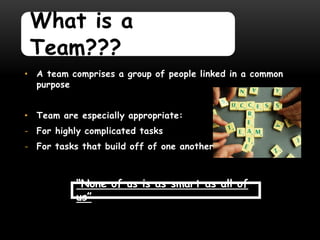
• A team comprises a group of people linked in a common
  purpose


• Team are especially appropriate:
- For highly complicated tasks
- For tasks that build off of one another


           “None of us is as smart as all of
           us”
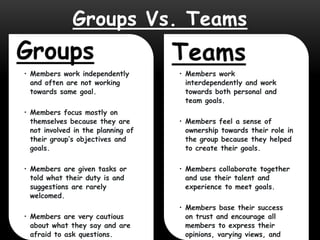
Groups Vs. Teams

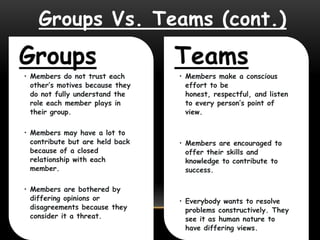
• Members work independently        • Members work
  and often are not working           interdependently and work
  towards same goal.                  towards both personal and
                                      team goals.
• Members focus mostly on
  themselves because they are       • Members feel a sense of
  not involved in the planning of     ownership towards their role in
  their group’s objectives and        the group because they helped
  goals.                              to create their goals.

• Members are given tasks or        • Members collaborate together
  told what their duty is and         and use their talent and
  suggestions are rarely              experience to meet goals.
  welcomed.
                                    • Members base their success
• Members are very cautious           on trust and encourage all
  about what they say and are         members to express their
  afraid to ask questions.            opinions, varying views, and
Groups Vs. Teams (cont.)

• Members do not trust each      • Members make a conscious
  other’s motives because they     effort to be
  do not fully understand the      honest, respectful, and listen
  role each member plays in        to every person’s point of
  their group.                     view.

• Members may have a lot to
  contribute but are held back   • Members are encouraged to
  because of a closed              offer their skills and
  relationship with each           knowledge to contribute to
  member.                          success.

• Members are bothered by
  differing opinions or          • Everybody wants to resolve
  disagreements because they       problems constructively. They
  consider it a threat.            see it as human nature to
                                   have differing views.
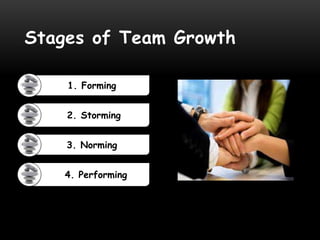
Stages of Team Growth

    1. Forming


    2. Storming


    3. Norming


    4. Performing
Stage 1: Forming

• Members cautiously explore the boundaries of acceptable
  group behaviour.


• They search for their position within the group and test
  the leader’s guidance.


• It is normal for little team progress to occur during this
  stage.
Stage 2: Storming

• Storming is probably the most difficult stage for the
  group.


• Members often become impatient about the lack of
  progress, but are still inexperienced with working as a
  team.


• Members may argue about actions to take.


• Much of their energy is focused on each other.
Stage 3: Norming

• During this stage, team members accept the team and
  begin to reconcile differences.


• Emotional conflict is reduced – relationships become more
  cooperative.


• The team is able to concentrate more on their work.


• They start to make significant progress.
Stage 4:
  Performing
• Team members have discovered and accepted each
  other’s strengths and weaknesses, and have learned what
  their roles are.


• Members are open and trusting.


• Many good ideas are produced because they are not
  afraid to offer ideas and suggestions.


• Much is accomplished and team satisfaction and loyalty is
  high.
Performing
Stage:ACCOMPLISHMENTS

• Grade, Production, Efficiency


• Trust, Openness


• New Ideas and Results


• Many teams do not ever get to this point.
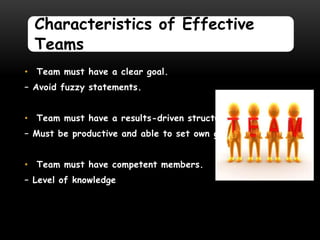
Characteristics of Effective
  Teams
• Team must have a clear goal.
– Avoid fuzzy statements.


• Team must have a results-driven structure.
– Must be productive and able to set own goals


• Team must have competent members.
– Level of knowledge
Characteristics of Effective Teams
(cont.)

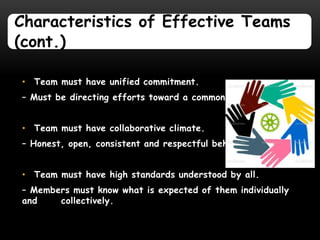
• Team must have unified commitment.
– Must be directing efforts toward a common goal


• Team must have collaborative climate.
– Honest, open, consistent and respectful behaviour.


• Team must have high standards understood by all.
– Members must know what is expected of them individually
and    collectively.
Characteristics of Effective Teams
(cont.)

 • Team must receive external support and encouragement.
 – Praise works just as well motivating teams as it does
 individuals.


 • Team must have principled leadership.
 – Someone needs to lead the effort.
Are You a Team
Player?
• Would you rather work alone or with a group?


• Do people like working with you?


• Are you flexible in adjusting to new situations or new
  work demands?


• Are you willing to help out another team member if they
  are struggling?
Important
 Items

When you meet your goal:
• What is the next step?
• What is your next goal?
• What could be improved?


Look towards the future to continue improvement.
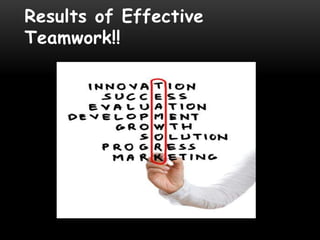
Results of Effective
Teamwork!!
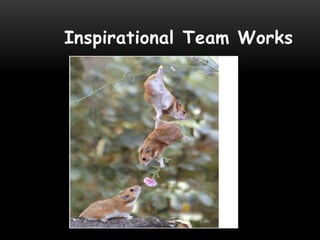
Inspirational Team Works
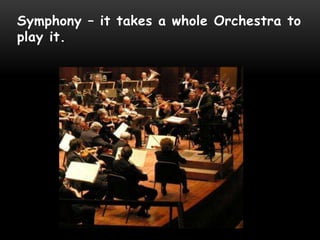
Symphony – it takes a whole Orchestra to
play it.
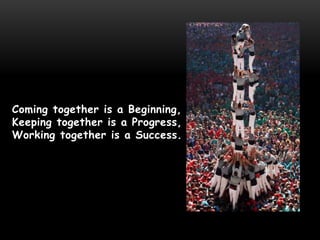
Coming together is a Beginning,
Keeping together is a Progress,
Working together is a Success.
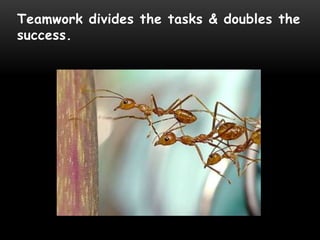
Teamwork divides the tasks & doubles the
success.
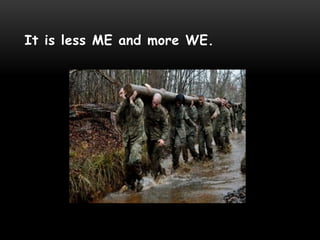
It is less ME and more WE.
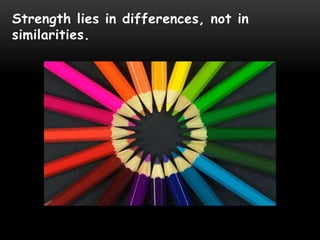
Strength lies in differences, not in
similarities.
Teamwork

Teamwork

  • 1.
    SOFT SKILLS Team Work
  • 2.
    What is a Team??? • A team comprises a group of people linked in a common purpose • Team are especially appropriate: - For highly complicated tasks - For tasks that build off of one another “None of us is as smart as all of us”
  • 3.
    Groups Vs. Teams •Members work independently • Members work and often are not working interdependently and work towards same goal. towards both personal and team goals. • Members focus mostly on themselves because they are • Members feel a sense of not involved in the planning of ownership towards their role in their group’s objectives and the group because they helped goals. to create their goals. • Members are given tasks or • Members collaborate together told what their duty is and and use their talent and suggestions are rarely experience to meet goals. welcomed. • Members base their success • Members are very cautious on trust and encourage all about what they say and are members to express their afraid to ask questions. opinions, varying views, and
  • 4.
    Groups Vs. Teams(cont.) • Members do not trust each • Members make a conscious other’s motives because they effort to be do not fully understand the honest, respectful, and listen role each member plays in to every person’s point of their group. view. • Members may have a lot to contribute but are held back • Members are encouraged to because of a closed offer their skills and relationship with each knowledge to contribute to member. success. • Members are bothered by differing opinions or • Everybody wants to resolve disagreements because they problems constructively. They consider it a threat. see it as human nature to have differing views.
  • 5.
    Stages of TeamGrowth 1. Forming 2. Storming 3. Norming 4. Performing
  • 6.
    Stage 1: Forming •Members cautiously explore the boundaries of acceptable group behaviour. • They search for their position within the group and test the leader’s guidance. • It is normal for little team progress to occur during this stage.
  • 7.
    Stage 2: Storming •Storming is probably the most difficult stage for the group. • Members often become impatient about the lack of progress, but are still inexperienced with working as a team. • Members may argue about actions to take. • Much of their energy is focused on each other.
  • 8.
    Stage 3: Norming •During this stage, team members accept the team and begin to reconcile differences. • Emotional conflict is reduced – relationships become more cooperative. • The team is able to concentrate more on their work. • They start to make significant progress.
  • 9.
    Stage 4: Performing • Team members have discovered and accepted each other’s strengths and weaknesses, and have learned what their roles are. • Members are open and trusting. • Many good ideas are produced because they are not afraid to offer ideas and suggestions. • Much is accomplished and team satisfaction and loyalty is high.
  • 10.
    Performing Stage:ACCOMPLISHMENTS • Grade, Production,Efficiency • Trust, Openness • New Ideas and Results • Many teams do not ever get to this point.
  • 11.
    Characteristics of Effective Teams • Team must have a clear goal. – Avoid fuzzy statements. • Team must have a results-driven structure. – Must be productive and able to set own goals • Team must have competent members. – Level of knowledge
  • 12.
    Characteristics of EffectiveTeams (cont.) • Team must have unified commitment. – Must be directing efforts toward a common goal • Team must have collaborative climate. – Honest, open, consistent and respectful behaviour. • Team must have high standards understood by all. – Members must know what is expected of them individually and collectively.
  • 13.
    Characteristics of EffectiveTeams (cont.) • Team must receive external support and encouragement. – Praise works just as well motivating teams as it does individuals. • Team must have principled leadership. – Someone needs to lead the effort.
  • 14.
    Are You aTeam Player? • Would you rather work alone or with a group? • Do people like working with you? • Are you flexible in adjusting to new situations or new work demands? • Are you willing to help out another team member if they are struggling?
  • 15.
    Important Items When youmeet your goal: • What is the next step? • What is your next goal? • What could be improved? Look towards the future to continue improvement.
  • 16.
  • 17.
  • 18.
    Symphony – ittakes a whole Orchestra to play it.
  • 19.
    Coming together isa Beginning, Keeping together is a Progress, Working together is a Success.
  • 20.
    Teamwork divides thetasks & doubles the success.
  • 21.
    It is lessME and more WE.
  • 22.
    Strength lies indifferences, not in similarities.