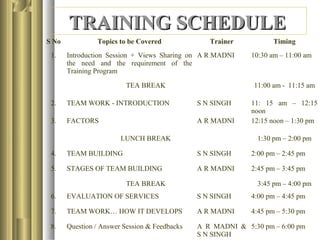
S No Topics to be Covered Trainer Timing
1. Introduction Session + Views Sharing on
the need and the requirement of the
Training Program
A R MADNI 10:30 am – 11:00 am
TEA BREAK 11:00 am - 11:15 am
2. TEAM WORK - INTRODUCTION S N SINGH 11: 15 am – 12:15
noon
3. FACTORS A R MADNI 12:15 noon – 1:30 pm
LUNCH BREAK 1:30 pm – 2:00 pm
4. TEAM BUILDING S N SINGH 2:00 pm – 2:45 pm
5. STAGES OF TEAM BUILDING A R MADNI 2:45 pm – 3:45 pm
TEA BREAK 3:45 pm – 4:00 pm
6. EVALUATION OF SERVICES S N SINGH 4:00 pm – 4:45 pm
7. TEAM WORK… HOW IT DEVELOPS A R MADNI 4:45 pm – 5:30 pm
8. Question / Answer Session & Feedbacks A R MADNI &
S N SINGH
5:30 pm – 6:00 pm
TRAINING SCHEDULETRAINING SCHEDULE
KNOW YOUR TRAINERKNOW YOUR TRAINER
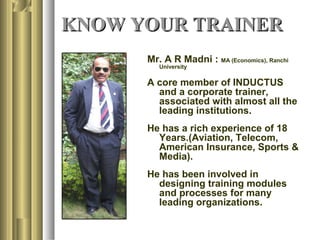
Mr. A R Madni : MA (Economics), Ranchi
University
A core member of INDUCTUS
and a corporate trainer,
associated with almost all the
leading institutions.
He has a rich experience of 18
Years.(Aviation, Telecom,
American Insurance, Sports &
Media).
He has been involved in
designing training modules
and processes for many
leading organizations.
KNOW YOUR TRAINERKNOW YOUR TRAINER
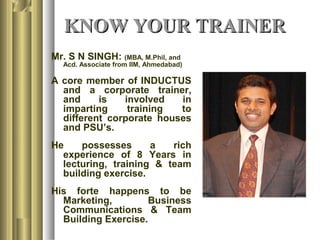
Mr. S N SINGH: (MBA, M.Phil, and
Acd. Associate from IIM, Ahmedabad)
A core member of INDUCTUS
and a corporate trainer,
and is involved in
imparting training to
different corporate houses
and PSU’s.
He possesses a rich
experience of 8 Years in
lecturing, training & team
building exercise.
His forte happens to be
Marketing, Business
Communications & Team
Building Exercise.
TEAM BUILDINGTEAM BUILDING
“Coming together is a beginning
Keeping together is progress and
Working together is success”
What is team?
In a team,
 People depend on each other
 May or may not work in the
same physical location
 Combine to achieve something
together
Team work…..Why?
Rationale for a Team Approach
Teams are a part of everyone's life.
You're a member of a family team, a
staff team, school, health care and
community teams.
So it's appropriate that you
understand how to function effectively
as a team member.
Teamwork .... What Is It?
A team is defined as a group (a
collection of people) who interact to
achieve a common goal, but an
effective, well-functioning team is
much more than this.
Participants in an effective team care
about the group's well-being. They
skillfully combine appropriate
individual talents with a positive team
spirit to achieve results.
Benefits of Working Through
Teams
 Enhances creativity
 Increases organizational agility
 Lessens cost
 Improves productivity
 Improves communication
 Boosts flexibility
 Stimulates individual commitment
 Improves customer satisfaction
 Promotes job satisfaction
Basis of a Team
• Mutual Trust
• Communication
• Role Identity
• Assurance
• Delight
• Shared Accountability
Essential Qualities of a Team
Player
1. Adaptable
2. Committed
3. Communicative
4. Competent
5. Disciplined
6. Enthusiastic
7. Self-Improving
8. Solution-orientated
Key Factors to Successful
Performance of a Team –
S.C.O.R.E
S – Strategy
C - Clear Roles and Responsibility
O - Open Communication
R - Rapid Response
E - Effective Leadership
Key factors to successful
performance of a team – S.C.O.R.E
 Strategy:
 Shared purpose
 Clearly articulated values and ground rules
 Understanding of risks and opportunities facing the team
 Clear categorization of the overall responsibilities of the team
 Clear Roles and Responsibilities:
 Clear definition of roles and responsibilities
 Responsibility shared by all members
 Specific objectives to measure individual results
Key factors to successful
performance of a team – S.C.O.R.E
 Open communication:
 Respect for individual differences
 Open communication environment among team members
 Rapid response:
 Rapid response to the team’s problems
 Effective management to change in the internal and external
environment
 Effective Leadership:
 Team leader who is able to help members achieve the
Team Building
The process of working with a team
to clarify its task and how team
members can work together to
achieve it.
A strategy that can help groups to
develop into a real team is “team
building”
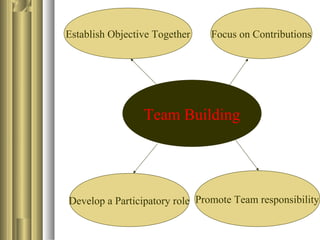
Team Building
Establish Objective Together
Develop a Participatory role
Focus on Contributions
Promote Team responsibility
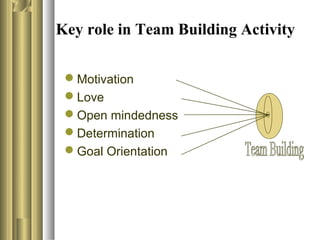
Key role in Team Building Activity
Motivation
Love
Open mindedness
Determination
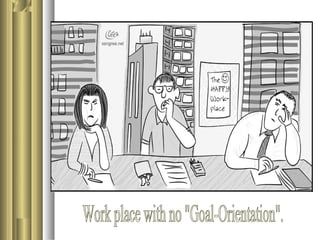
Goal Orientation
Importance of Team Building
Activity
Leads one’s mind to creativity.
Encourage one to take initiative.
Combined effort to single target.
Provide space for individual growth.
Broaden one’s vision.
Rewards and recognition moves side by
side.
Impact of Team Building
Activity
Groom one’s personality.
Broaden the Vision.
Feeling of ‘WE’ flourish.
Developing trust among co-
workers.
Sense of responsibility develop
instead of blaming
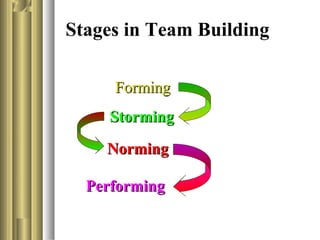
Stages in Team Building
FormingForming
StormingStorming
NormingNorming
PerformingPerforming
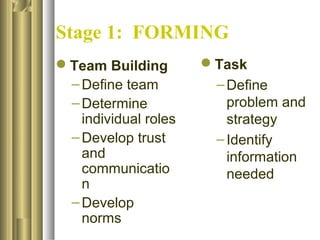
Stage 1: FORMING
Team Building
–Define team
–Determine
individual roles
–Develop trust
and
communicatio
n
–Develop
norms
Task
–Define
problem and
strategy
–Identify
information
needed
Team Roles - Leader
Encourage and maintain open
communication.
Help the team develop and
follow team norms.
Help the team focus on the
task.
Deal constructively with
conflict.
Stage 2: STORMINGStage 2: STORMING
During the Storming stage team
members:
–realize that the task is more difficult
than they imagined
–have fluctuations in attitude about
chances of success
–may be resistant to the task and
–have poor collaboration.
Storming Diagnosis
Do we have common goals and
objectives?
Do we agree on roles and
responsibilities?
Do our task, communication, and
decision systems work?
Do we have adequate interpersonal
skills?
Stage 3: NormingStage 3: Norming
During this stage members
accept:
–their team;
–team rules and procedures
–their roles in the team and
–the individuality of fellow
members.
Stage 4: PERFORMINGStage 4: PERFORMING
Team members have:
–a better understanding of each
other’s strengths and
weaknesses;
–gained the ability to prevent
group conflict and resolve
differences; and,
–developed a close attachment
to the team.
Unity is Strength
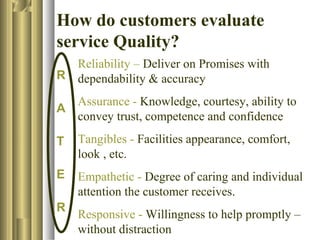
How do customers evaluate
service Quality?
R
A
T
E
R
Reliability – Deliver on Promises with
dependability & accuracy
Assurance - Knowledge, courtesy, ability to
convey trust, competence and confidence
Tangibles - Facilities appearance, comfort,
look , etc.
Empathetic - Degree of caring and individual
attention the customer receives.
Responsive - Willingness to help promptly –
without distraction
Reliability - The Service Promise
Organizational commitments
– Promises made via advertising,
marketing, policies, contracts, etc.
Common Expectations
– Customer expectations are often based
on assumptions and past experience
Personal Promises
– Agent to customer promises
Assurance & Tangibles
Assurance Factor
– Product Knowledge & Company Knowledge
– Listening Skills – Active listening skills
– Communications Skills - includes verbal and
written (in-person, phone, and email service)
– Problem-Solving Skill
Tangibles
– Take pride in your environment, yourself, your
workspace and any forward-facing delivery
mechanisms
Empathy & Responsiveness
Empathy
– Recognize the Emotional State of the
Customer; validate their feelings
– Treat each person as an individual
Responsiveness
– Respond quickly
– Set Expectations – deliver on those
expectations
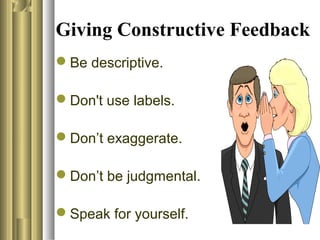
Giving Constructive Feedback
Be descriptive.
Don't use labels.
Don’t exaggerate.
Don’t be judgmental.
Speak for yourself.
Receiving Feedback
Listen carefully.
Ask questions for clarity.
Acknowledge the feedback.
Acknowledge the valid points.
Take time to sort out what you
heard.
Factors that promote good working
relationships
Staff meetings-with
agenda and sufficient
time to discuss
Job descriptions with
annual review
Knowledge of others'
job descriptions and
responsibilities
Common criteria for
personnel evaluation
Trust, Courtesy and
Loyalty
Respect for others in
spite of professional
differences
Agreed upon priorities
Willingness to talk over
problems
Cooperation
Constructive criticism
Respect for
professionalism
regardless of person's
sex, age, and race
Factors that hinder good working
relationships
Lack of
understanding of
others' jobs and
responsibilities
Unwillingness to
compromise
Poor communication
Competition among
staff for individual
prestige and
recognition
Negative and
destructive criticism
Lack of leadership
Gossip
Lack of trust
Negative and sarcastic
remarks
Lack of common goals
Disloyalty to staff and
organization
No evaluation and/or
feedback from
supervisors
Uneven work loads
Lack of confidence in
fellow workers
No opportunities for staff
meetings
Team work ... How Does
It Develop ?
1. Build the team
Engage every member in team
Spend time on team development
Meet regularly and frequently for a purpose
Determine and agree team roles
Discuss, determine and agree rewards for
good performance
Agree on approach to delegation and
empowerment
Promote the team and its work within the
agency and partnerships
2. Engage team through work
 Delegate and empower appropriately
 Promote debate and discussion on where we are, where we
want to be, and how we should get there – use brainstorming
 Ensure that all the team has discussed, contributed to and
committed itself to the work tasks and objectives
 Try to reach consensus decisions
 Make sure the combined purpose and importance of the
team’s work is understood by everyone Keep everyone
informed on progress
3. Ensure clarity of definition of
key roles and tasks
Develop individual roles
Ensure job descriptions and job
plans are up-to-date and accurate
Ensure goals are realistic and
achievable
4. Develop the team and
organization
Ensure new staff are induced
Identify individual and team training needs
Ensure personal development plans are
produced and implemented
Engage others in wider organizational
development matters
5. Foster a culture of innovation
and creativity
Encourage ‘thinking outside the box’,
reframing the problem, and risk taking
Minimize criticism of failure
Reward and publicize innovation and
creativity
Team building

Team building

  • 3.
    S No Topicsto be Covered Trainer Timing 1. Introduction Session + Views Sharing on the need and the requirement of the Training Program A R MADNI 10:30 am – 11:00 am TEA BREAK 11:00 am - 11:15 am 2. TEAM WORK - INTRODUCTION S N SINGH 11: 15 am – 12:15 noon 3. FACTORS A R MADNI 12:15 noon – 1:30 pm LUNCH BREAK 1:30 pm – 2:00 pm 4. TEAM BUILDING S N SINGH 2:00 pm – 2:45 pm 5. STAGES OF TEAM BUILDING A R MADNI 2:45 pm – 3:45 pm TEA BREAK 3:45 pm – 4:00 pm 6. EVALUATION OF SERVICES S N SINGH 4:00 pm – 4:45 pm 7. TEAM WORK… HOW IT DEVELOPS A R MADNI 4:45 pm – 5:30 pm 8. Question / Answer Session & Feedbacks A R MADNI & S N SINGH 5:30 pm – 6:00 pm TRAINING SCHEDULETRAINING SCHEDULE
  • 4.
    KNOW YOUR TRAINERKNOWYOUR TRAINER Mr. A R Madni : MA (Economics), Ranchi University A core member of INDUCTUS and a corporate trainer, associated with almost all the leading institutions. He has a rich experience of 18 Years.(Aviation, Telecom, American Insurance, Sports & Media). He has been involved in designing training modules and processes for many leading organizations.
  • 5.
    KNOW YOUR TRAINERKNOWYOUR TRAINER Mr. S N SINGH: (MBA, M.Phil, and Acd. Associate from IIM, Ahmedabad) A core member of INDUCTUS and a corporate trainer, and is involved in imparting training to different corporate houses and PSU’s. He possesses a rich experience of 8 Years in lecturing, training & team building exercise. His forte happens to be Marketing, Business Communications & Team Building Exercise.
  • 6.
  • 8.
    “Coming together isa beginning Keeping together is progress and Working together is success”
  • 10.
    What is team? Ina team,  People depend on each other  May or may not work in the same physical location  Combine to achieve something together
  • 11.
    Team work…..Why? Rationale fora Team Approach Teams are a part of everyone's life. You're a member of a family team, a staff team, school, health care and community teams. So it's appropriate that you understand how to function effectively as a team member.
  • 12.
    Teamwork .... WhatIs It? A team is defined as a group (a collection of people) who interact to achieve a common goal, but an effective, well-functioning team is much more than this. Participants in an effective team care about the group's well-being. They skillfully combine appropriate individual talents with a positive team spirit to achieve results.
  • 13.
    Benefits of WorkingThrough Teams  Enhances creativity  Increases organizational agility  Lessens cost  Improves productivity  Improves communication  Boosts flexibility  Stimulates individual commitment  Improves customer satisfaction  Promotes job satisfaction
  • 14.
    Basis of aTeam • Mutual Trust • Communication • Role Identity • Assurance • Delight • Shared Accountability
  • 15.
    Essential Qualities ofa Team Player 1. Adaptable 2. Committed 3. Communicative 4. Competent 5. Disciplined 6. Enthusiastic 7. Self-Improving 8. Solution-orientated
  • 16.
    Key Factors toSuccessful Performance of a Team – S.C.O.R.E S – Strategy C - Clear Roles and Responsibility O - Open Communication R - Rapid Response E - Effective Leadership
  • 17.
    Key factors tosuccessful performance of a team – S.C.O.R.E  Strategy:  Shared purpose  Clearly articulated values and ground rules  Understanding of risks and opportunities facing the team  Clear categorization of the overall responsibilities of the team  Clear Roles and Responsibilities:  Clear definition of roles and responsibilities  Responsibility shared by all members  Specific objectives to measure individual results
  • 18.
    Key factors tosuccessful performance of a team – S.C.O.R.E  Open communication:  Respect for individual differences  Open communication environment among team members  Rapid response:  Rapid response to the team’s problems  Effective management to change in the internal and external environment  Effective Leadership:  Team leader who is able to help members achieve the
  • 19.
    Team Building The processof working with a team to clarify its task and how team members can work together to achieve it. A strategy that can help groups to develop into a real team is “team building”
  • 20.
    Team Building Establish ObjectiveTogether Develop a Participatory role Focus on Contributions Promote Team responsibility
  • 21.
    Key role inTeam Building Activity Motivation Love Open mindedness Determination Goal Orientation
  • 25.
    Importance of TeamBuilding Activity Leads one’s mind to creativity. Encourage one to take initiative. Combined effort to single target. Provide space for individual growth. Broaden one’s vision. Rewards and recognition moves side by side.
  • 26.
    Impact of TeamBuilding Activity Groom one’s personality. Broaden the Vision. Feeling of ‘WE’ flourish. Developing trust among co- workers. Sense of responsibility develop instead of blaming
  • 27.
    Stages in TeamBuilding FormingForming StormingStorming NormingNorming PerformingPerforming
  • 28.
    Stage 1: FORMING TeamBuilding –Define team –Determine individual roles –Develop trust and communicatio n –Develop norms Task –Define problem and strategy –Identify information needed
  • 29.
    Team Roles -Leader Encourage and maintain open communication. Help the team develop and follow team norms. Help the team focus on the task. Deal constructively with conflict.
  • 30.
    Stage 2: STORMINGStage2: STORMING During the Storming stage team members: –realize that the task is more difficult than they imagined –have fluctuations in attitude about chances of success –may be resistant to the task and –have poor collaboration.
  • 31.
    Storming Diagnosis Do wehave common goals and objectives? Do we agree on roles and responsibilities? Do our task, communication, and decision systems work? Do we have adequate interpersonal skills?
  • 32.
    Stage 3: NormingStage3: Norming During this stage members accept: –their team; –team rules and procedures –their roles in the team and –the individuality of fellow members.
  • 33.
    Stage 4: PERFORMINGStage4: PERFORMING Team members have: –a better understanding of each other’s strengths and weaknesses; –gained the ability to prevent group conflict and resolve differences; and, –developed a close attachment to the team.
  • 34.
  • 35.
    How do customersevaluate service Quality? R A T E R Reliability – Deliver on Promises with dependability & accuracy Assurance - Knowledge, courtesy, ability to convey trust, competence and confidence Tangibles - Facilities appearance, comfort, look , etc. Empathetic - Degree of caring and individual attention the customer receives. Responsive - Willingness to help promptly – without distraction
  • 36.
    Reliability - TheService Promise Organizational commitments – Promises made via advertising, marketing, policies, contracts, etc. Common Expectations – Customer expectations are often based on assumptions and past experience Personal Promises – Agent to customer promises
  • 37.
    Assurance & Tangibles AssuranceFactor – Product Knowledge & Company Knowledge – Listening Skills – Active listening skills – Communications Skills - includes verbal and written (in-person, phone, and email service) – Problem-Solving Skill Tangibles – Take pride in your environment, yourself, your workspace and any forward-facing delivery mechanisms
  • 38.
    Empathy & Responsiveness Empathy –Recognize the Emotional State of the Customer; validate their feelings – Treat each person as an individual Responsiveness – Respond quickly – Set Expectations – deliver on those expectations
  • 39.
    Giving Constructive Feedback Bedescriptive. Don't use labels. Don’t exaggerate. Don’t be judgmental. Speak for yourself.
  • 40.
    Receiving Feedback Listen carefully. Askquestions for clarity. Acknowledge the feedback. Acknowledge the valid points. Take time to sort out what you heard.
  • 41.
    Factors that promotegood working relationships Staff meetings-with agenda and sufficient time to discuss Job descriptions with annual review Knowledge of others' job descriptions and responsibilities Common criteria for personnel evaluation Trust, Courtesy and Loyalty Respect for others in spite of professional differences Agreed upon priorities Willingness to talk over problems Cooperation Constructive criticism Respect for professionalism regardless of person's sex, age, and race
  • 42.
    Factors that hindergood working relationships Lack of understanding of others' jobs and responsibilities Unwillingness to compromise Poor communication Competition among staff for individual prestige and recognition Negative and destructive criticism Lack of leadership Gossip Lack of trust Negative and sarcastic remarks Lack of common goals Disloyalty to staff and organization No evaluation and/or feedback from supervisors Uneven work loads Lack of confidence in fellow workers No opportunities for staff meetings
  • 43.
    Team work ...How Does It Develop ?
  • 44.
    1. Build theteam Engage every member in team Spend time on team development Meet regularly and frequently for a purpose Determine and agree team roles Discuss, determine and agree rewards for good performance Agree on approach to delegation and empowerment Promote the team and its work within the agency and partnerships
  • 45.
    2. Engage teamthrough work  Delegate and empower appropriately  Promote debate and discussion on where we are, where we want to be, and how we should get there – use brainstorming  Ensure that all the team has discussed, contributed to and committed itself to the work tasks and objectives  Try to reach consensus decisions  Make sure the combined purpose and importance of the team’s work is understood by everyone Keep everyone informed on progress
  • 46.
    3. Ensure clarityof definition of key roles and tasks Develop individual roles Ensure job descriptions and job plans are up-to-date and accurate Ensure goals are realistic and achievable
  • 47.
    4. Develop theteam and organization Ensure new staff are induced Identify individual and team training needs Ensure personal development plans are produced and implemented Engage others in wider organizational development matters
  • 48.
    5. Foster aculture of innovation and creativity Encourage ‘thinking outside the box’, reframing the problem, and risk taking Minimize criticism of failure Reward and publicize innovation and creativity

Editor's Notes

  • #32 As a teacher, you can help your students when they are in the “storming” stage, by focusing their attention on the questions above. The students may want to answer the first question both in general terms and more specifically, in conjunction with their project goals.