



Teamwork
Ahmad Thanin
What is a team?
Teamwork is based on the five ‘C’
COMPLEMENTARITY COORDINATION COMMUNICATION CONFIDENCE COMMITMENT
A team is a small number of people with complementary skills who
are committed to a common purpose, performance goals, and
approach for which they hold themselves mutually accountable.
Why use teams?
Most of today’s business assignments are addressed by
multidisciplinary teams.
Team building is an important part of the modern workforce.
Team building is an important part of your preparation for
engineering practice.
Advantages
and
challenges
Advantage:
• When the group works together,
the accomplishment will surpass
any results associated with one
individual.
• Every person can contribute in
some way.
Challenge:
• Any team member functioning
independently of other team
members or competing with them
will reduce the performance of
the team – EVERYONE’S Outcome.
• No member’s contributions should
ever be automatically disregarded.
Vision of the team
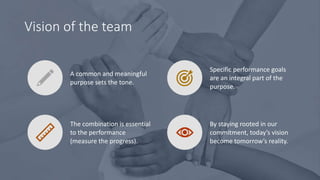
A common and meaningful
purpose sets the tone.
Specific performance goals
are an integral part of the
purpose.
The combination is essential
to the performance
(measure the progress).
By staying rooted in our
commitment, today’s vision
become tomorrow’s reality.
What teammates do?
TEAMMATES INCONVENIENCE THEMSELVES TO HELP EACH OTHER.
TEAMMATES DEMONSTRATE PATIENCE AND CONCERN FOR EACH OTHER.
TEAMMATES ENJOY EACH OTHERS' SUCCESSES AND AVOID ENVY AND JEALOUSLY.
TEAMMATES SHOW COMPASSION FOR EACH OTHER, THEY CAN IDENTIFY WITH THE PAIN OF
OTHERS, AND THEY ARE COMPELLED TO HELP RELIEVE IT.
TEAMMATES FORGIVE EACH OTHER, THEY BELIEVE OTHERS WILL RESPOND TO FORGIVENESS WITH
A DEEP SENSE OF APPRECIATION AND A DESIRE TO ACT RESPONSIBLY.
Remember
Together
Everyone
Accomplishes
More
With
Organization
Responsibility, and
Knowledge
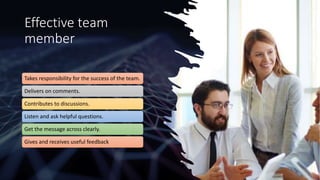
Effective team
member
Takes responsibility for the success of the team.
Delivers on comments.
Contributes to discussions.
Listen and ask helpful questions.
Get the message across clearly.
Gives and receives useful feedback
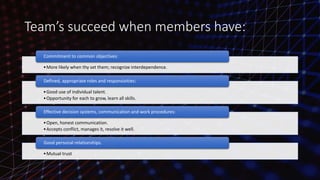
Team’s succeed when members have:
•More likely when thy set them; recognize interdependence.
Commitment to common objectives:
•Good use of individual talent.
•Opportunity for each to grow, learn all skills.
Defined, appropriate roles and responsivities:
•Open, honest communication.
•Accepts conflict, manages it, resolve it well.
Effective decision systems, communication and work procedures:
•Mutual trust
Good personal relationships.
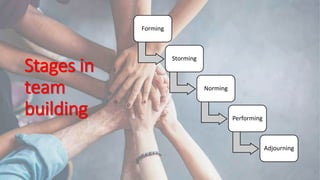
Stages in
team
building
Forming
Storming
Norming
Performing
Adjourning
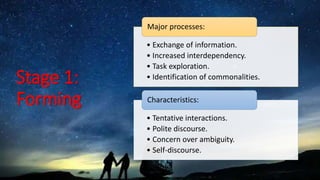
Stage 1:
Forming
• Exchange of information.
• Increased interdependency.
• Task exploration.
• Identification of commonalities.
Major processes:
• Tentative interactions.
• Polite discourse.
• Concern over ambiguity.
• Self-discourse.
Characteristics:
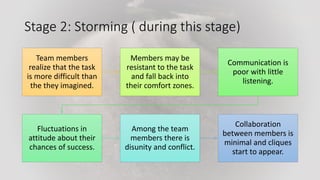
Stage 2: Storming ( during this stage)
Team members
realize that the task
is more difficult than
the they imagined.
Members may be
resistant to the task
and fall back into
their comfort zones.
Communication is
poor with little
listening.
Fluctuations in
attitude about their
chances of success.
Among the team
members there is
disunity and conflict.
Collaboration
between members is
minimal and cliques
start to appear.
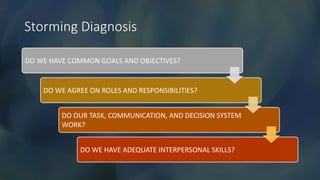
Storming Diagnosis
DO WE HAVE COMMON GOALS AND OBJECTIVES?
DO WE AGREE ON ROLES AND RESPONSIBILITIES?
DO OUR TASK, COMMUNICATION, AND DECISION SYSTEM
WORK?
DO WE HAVE ADEQUATE INTERPERSONAL SKILLS?
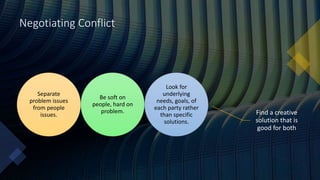
Negotiating Conflict
Separate
problem issues
from people
issues.
Be soft on
people, hard on
problem.
Look for
underlying
needs, goals, of
each party rather
than specific
solutions.
Find a creative
solution that is
good for both
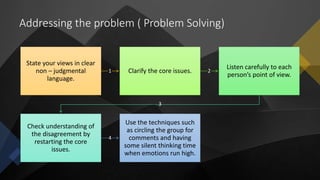
Addressing the problem ( Problem Solving)
1
State your views in clear
non – judgmental
language.
2
Clarify the core issues.
3
Listen carefully to each
person’s point of view.
4
Check understanding of
the disagreement by
restarting the core
issues.
Use the techniques such
as circling the group for
comments and having
some silent thinking time
when emotions run high.
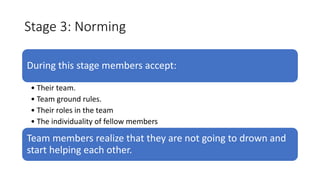
Stage 3: Norming
During this stage members accept:
• Their team.
• Team ground rules.
• Their roles in the team
• The individuality of fellow members
Team members realize that they are not going to drown and
start helping each other.
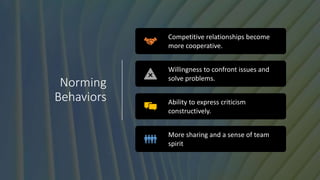
Norming
Behaviors
Competitive relationships become
more cooperative.
Willingness to confront issues and
solve problems.
Ability to express criticism
constructively.
More sharing and a sense of team
spirit
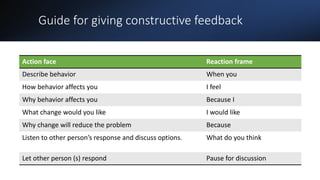
Guide for giving constructive feedback
Action face Reaction frame
Describe behavior When you
How behavior affects you I feel
Why behavior affects you Because I
What change would you like I would like
Why change will reduce the problem Because
Listen to other person’s response and discuss options. What do you think
Let other person (s) respond Pause for discussion
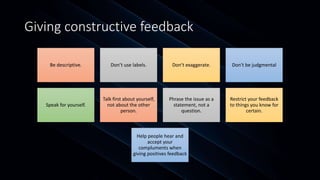
Giving constructive feedback
Be descriptive. Don’t use labels. Don’t exaggerate. Don't be judgmental
Speak for yourself.
Talk first about yourself,
not about the other
person.
Phrase the issue as a
statement, not a
question.
Restrict your feedback
to things you know for
certain.
Help people hear and
accept your
compluments when
giving positives feedback
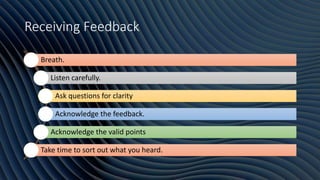
Receiving Feedback
Breath.
Listen carefully.
Ask questions for clarity
Acknowledge the feedback.
Acknowledge the valid points
Take time to sort out what you heard.
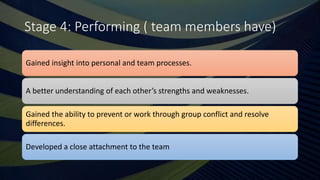
Stage 4: Performing ( team members have)
Gained insight into personal and team processes.
A better understanding of each other’s strengths and weaknesses.
Gained the ability to prevent or work through group conflict and resolve
differences.
Developed a close attachment to the team
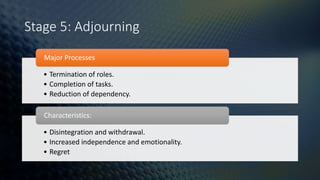
Stage 5: Adjourning
• Termination of roles.
• Completion of tasks.
• Reduction of dependency.
Major Processes
• Disintegration and withdrawal.
• Increased independence and emotionality.
• Regret
Characteristics:
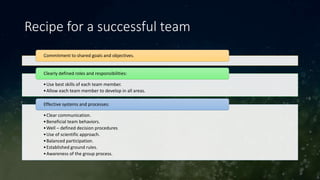
Recipe for a successful team
Commitment to shared goals and objectives.
•Use best skills of each team member.
•Allow each team member to develop in all areas.
Clearly defined roles and responsibilities:
•Clear communication.
•Beneficial team behaviors.
•Well – defined decision procedures
•Use of scientific approach.
•Balanced participation.
•Established ground rules.
•Awareness of the group process.
Effective systems and processes:
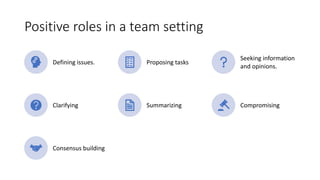
Positive roles in a team setting
Defining issues. Proposing tasks
Seeking information
and opinions.
Clarifying Summarizing Compromising
Consensus building
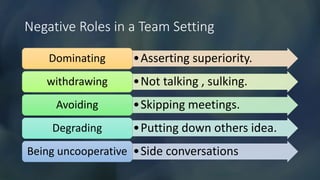
Negative Roles in a Team Setting
•Asserting superiority.
Dominating
•Not talking , sulking.
withdrawing
•Skipping meetings.
Avoiding
•Putting down others idea.
Degrading
•Side conversations
Being uncooperative
How to promote team
success
Every member must
have a common vision of
the tasks.
One way to do, this is to
develop a team
performance agreement
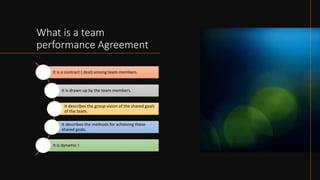
What is a team
performance Agreement
It is a contract ( deal) among team members.
It is drawn up by the team members.
It describes the group vision of the shared goals
of the team.
It describes the methods for achieving these
shared goals.
It is dynamic !
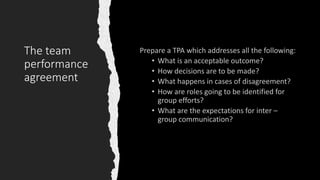
The team
performance
agreement
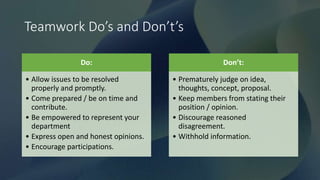
Teamwork Do’s and Don’t’s
Do:
• Allow issues to be resolved
properly and promptly.
• Come prepared / be on time and
contribute.
• Be empowered to represent your
department
• Express open and honest opinions.
• Encourage participations.
Don’t:
• Prematurely judge on idea,
thoughts, concept, proposal.
• Keep members from stating their
position / opinion.
• Discourage reasoned
disagreement.
• Withhold information.
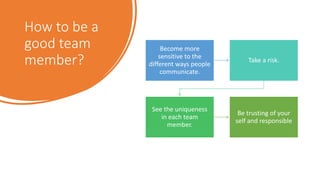
How to be a
good team
member?
Become more
sensitive to the
different ways people
communicate.
Take a risk.
See the uniqueness
in each team
member.
Be trusting of your
self and responsible
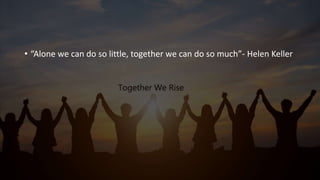
• “Alone we can do so little, together we can do so much”- Helen Keller
Benefits of teamwork
Realistic, achievable goals can be stablished for the team and individual members.
Team members commit to support each other.
Team members understand one another’s priorities.
Communication is open.
Problem solving is more effective.
Performance feedback is more meaningful.
Conflict is understood as normal
Benefits of teamwork
Balance is maintained between group productivity.
The team is recognized for outstanding results.
Members are encouraged to test their abilities and try out ideas.
Team members recognize the importance of disciplined work habits.
Learning to work effectively as a team in one unit is good preparation for working as a team with other
units.
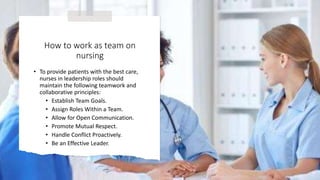
How to work as team on
nursing
• To provide patients with the best care,
nurses in leadership roles should
maintain the following teamwork and
collaborative principles:
• Establish Team Goals.
• Assign Roles Within a Team.
• Allow for Open Communication.
• Promote Mutual Respect.
• Handle Conflict Proactively.
• Be an Effective Leader.
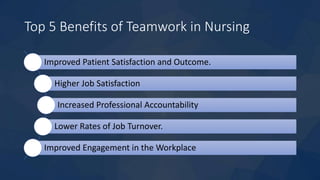
Top 5 Benefits of Teamwork in Nursing
Improved Patient Satisfaction and Outcome.
Higher Job Satisfaction
Increased Professional Accountability
Lower Rates of Job Turnover.
Improved Engagement in the Workplace
Why is teamwork in
nursing so
important?
“Healthcare is a complex entity, requiring the coordination of multiple
talented individuals to provide high-quality care,” says Susan Alexander, a
nurse practitioner at Riverside Family Health in Alabama. She explains that
high functioning teams not only provide better support for patients, but also
for each other during times of stress.
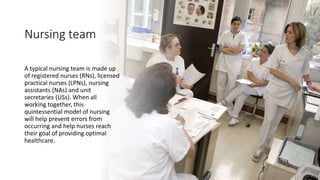
Nursing team
A typical nursing team is made up
of registered nurses (RNs), licensed
practical nurses (LPNs), nursing
assistants (NAs) and unit
secretaries (USs). When all
working together, this
quintessential model of nursing
will help prevent errors from
occurring and help nurses reach
their goal of providing optimal
healthcare.
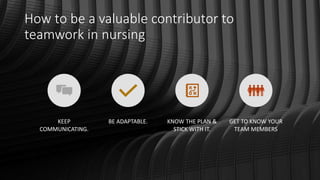
How to be a valuable contributor to
teamwork in nursing
KEEP
COMMUNICATING.
BE ADAPTABLE. KNOW THE PLAN &
STICK WITH IT.
GET TO KNOW YOUR
TEAM MEMBERS
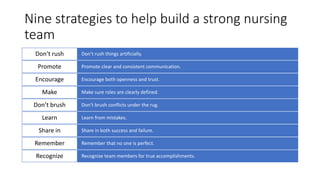
Nine strategies to help build a strong nursing
team
Don’t rush things artificially.
Don’t rush
Promote clear and consistent communication.
Promote
Encourage both openness and trust.
Encourage
Make sure roles are clearly defined.
Make
Don’t brush conflicts under the rug.
Don’t brush
Learn from mistakes.
Learn
Share in both success and failure.
Share in
Remember that no one is perfect.
Remember
Recognize team members for true accomplishments.
Recognize
Key points
Teamwork needs constant attention; annual appraisals and team away days are not enough
There needs to be a good understanding of team boundaries and the difference between the core
team and wider multidisciplinary team
Team leaders must ensure members are working to a common purpose. This shared purpose must
never be assumed, but should be revisited constantly
A good teaming strategy should make effective use of communication technology such as social media
to allow better use of face-to-face time
Individual wellbeing is linked to the wellbeing of the team; teams are most productive where there is
openness and trust and members can work to their own strengths
Review the TeamSTEPPS tool
The Agency for Healthcare Research and Quality (AHRQ) created the TeamSTEPPS framework to help
boost teamwork and increase the effectiveness of communication among nurses.
This model has five key principles for team members to uphold:
•team structure,
•communication,
•leadership,
•situation monitoring,
•mutual support.
The TeamSTEPPS framework aids in nursing team building by helping each team member understand the
requirements of teamwork. It’s important for team members to be on the same page.
Nursing team work

Nursing team work

  • 1.
  • 2.
    What is ateam? Teamwork is based on the five ‘C’ COMPLEMENTARITY COORDINATION COMMUNICATION CONFIDENCE COMMITMENT A team is a small number of people with complementary skills who are committed to a common purpose, performance goals, and approach for which they hold themselves mutually accountable.
  • 3.
    Why use teams? Mostof today’s business assignments are addressed by multidisciplinary teams. Team building is an important part of the modern workforce. Team building is an important part of your preparation for engineering practice.
  • 4.
    Advantages and challenges Advantage: • When thegroup works together, the accomplishment will surpass any results associated with one individual. • Every person can contribute in some way. Challenge: • Any team member functioning independently of other team members or competing with them will reduce the performance of the team – EVERYONE’S Outcome. • No member’s contributions should ever be automatically disregarded.
  • 5.
    Vision of theteam A common and meaningful purpose sets the tone. Specific performance goals are an integral part of the purpose. The combination is essential to the performance (measure the progress). By staying rooted in our commitment, today’s vision become tomorrow’s reality.
  • 6.
    What teammates do? TEAMMATESINCONVENIENCE THEMSELVES TO HELP EACH OTHER. TEAMMATES DEMONSTRATE PATIENCE AND CONCERN FOR EACH OTHER. TEAMMATES ENJOY EACH OTHERS' SUCCESSES AND AVOID ENVY AND JEALOUSLY. TEAMMATES SHOW COMPASSION FOR EACH OTHER, THEY CAN IDENTIFY WITH THE PAIN OF OTHERS, AND THEY ARE COMPELLED TO HELP RELIEVE IT. TEAMMATES FORGIVE EACH OTHER, THEY BELIEVE OTHERS WILL RESPOND TO FORGIVENESS WITH A DEEP SENSE OF APPRECIATION AND A DESIRE TO ACT RESPONSIBLY.
  • 7.
  • 8.
    Effective team member Takes responsibilityfor the success of the team. Delivers on comments. Contributes to discussions. Listen and ask helpful questions. Get the message across clearly. Gives and receives useful feedback
  • 9.
    Team’s succeed whenmembers have: •More likely when thy set them; recognize interdependence. Commitment to common objectives: •Good use of individual talent. •Opportunity for each to grow, learn all skills. Defined, appropriate roles and responsivities: •Open, honest communication. •Accepts conflict, manages it, resolve it well. Effective decision systems, communication and work procedures: •Mutual trust Good personal relationships.
  • 10.
  • 11.
    Stage 1: Forming • Exchangeof information. • Increased interdependency. • Task exploration. • Identification of commonalities. Major processes: • Tentative interactions. • Polite discourse. • Concern over ambiguity. • Self-discourse. Characteristics:
  • 12.
    Stage 2: Storming( during this stage) Team members realize that the task is more difficult than the they imagined. Members may be resistant to the task and fall back into their comfort zones. Communication is poor with little listening. Fluctuations in attitude about their chances of success. Among the team members there is disunity and conflict. Collaboration between members is minimal and cliques start to appear.
  • 13.
    Storming Diagnosis DO WEHAVE COMMON GOALS AND OBJECTIVES? DO WE AGREE ON ROLES AND RESPONSIBILITIES? DO OUR TASK, COMMUNICATION, AND DECISION SYSTEM WORK? DO WE HAVE ADEQUATE INTERPERSONAL SKILLS?
  • 14.
    Negotiating Conflict Separate problem issues frompeople issues. Be soft on people, hard on problem. Look for underlying needs, goals, of each party rather than specific solutions. Find a creative solution that is good for both
  • 15.
    Addressing the problem( Problem Solving) 1 State your views in clear non – judgmental language. 2 Clarify the core issues. 3 Listen carefully to each person’s point of view. 4 Check understanding of the disagreement by restarting the core issues. Use the techniques such as circling the group for comments and having some silent thinking time when emotions run high.
  • 16.
    Stage 3: Norming Duringthis stage members accept: • Their team. • Team ground rules. • Their roles in the team • The individuality of fellow members Team members realize that they are not going to drown and start helping each other.
  • 17.
    Norming Behaviors Competitive relationships become morecooperative. Willingness to confront issues and solve problems. Ability to express criticism constructively. More sharing and a sense of team spirit
  • 18.
    Guide for givingconstructive feedback Action face Reaction frame Describe behavior When you How behavior affects you I feel Why behavior affects you Because I What change would you like I would like Why change will reduce the problem Because Listen to other person’s response and discuss options. What do you think Let other person (s) respond Pause for discussion
  • 19.
    Giving constructive feedback Bedescriptive. Don’t use labels. Don’t exaggerate. Don't be judgmental Speak for yourself. Talk first about yourself, not about the other person. Phrase the issue as a statement, not a question. Restrict your feedback to things you know for certain. Help people hear and accept your compluments when giving positives feedback
  • 20.
    Receiving Feedback Breath. Listen carefully. Askquestions for clarity Acknowledge the feedback. Acknowledge the valid points Take time to sort out what you heard.
  • 21.
    Stage 4: Performing( team members have) Gained insight into personal and team processes. A better understanding of each other’s strengths and weaknesses. Gained the ability to prevent or work through group conflict and resolve differences. Developed a close attachment to the team
  • 22.
    Stage 5: Adjourning •Termination of roles. • Completion of tasks. • Reduction of dependency. Major Processes • Disintegration and withdrawal. • Increased independence and emotionality. • Regret Characteristics:
  • 23.
    Recipe for asuccessful team Commitment to shared goals and objectives. •Use best skills of each team member. •Allow each team member to develop in all areas. Clearly defined roles and responsibilities: •Clear communication. •Beneficial team behaviors. •Well – defined decision procedures •Use of scientific approach. •Balanced participation. •Established ground rules. •Awareness of the group process. Effective systems and processes:
  • 24.
    Positive roles ina team setting Defining issues. Proposing tasks Seeking information and opinions. Clarifying Summarizing Compromising Consensus building
  • 25.
    Negative Roles ina Team Setting •Asserting superiority. Dominating •Not talking , sulking. withdrawing •Skipping meetings. Avoiding •Putting down others idea. Degrading •Side conversations Being uncooperative
  • 26.
    How to promoteteam success Every member must have a common vision of the tasks. One way to do, this is to develop a team performance agreement
  • 27.
    What is ateam performance Agreement It is a contract ( deal) among team members. It is drawn up by the team members. It describes the group vision of the shared goals of the team. It describes the methods for achieving these shared goals. It is dynamic !
  • 28.
  • 29.
    Teamwork Do’s andDon’t’s Do: • Allow issues to be resolved properly and promptly. • Come prepared / be on time and contribute. • Be empowered to represent your department • Express open and honest opinions. • Encourage participations. Don’t: • Prematurely judge on idea, thoughts, concept, proposal. • Keep members from stating their position / opinion. • Discourage reasoned disagreement. • Withhold information.
  • 30.
    How to bea good team member? Become more sensitive to the different ways people communicate. Take a risk. See the uniqueness in each team member. Be trusting of your self and responsible
  • 31.
    • “Alone wecan do so little, together we can do so much”- Helen Keller
  • 32.
    Benefits of teamwork Realistic,achievable goals can be stablished for the team and individual members. Team members commit to support each other. Team members understand one another’s priorities. Communication is open. Problem solving is more effective. Performance feedback is more meaningful. Conflict is understood as normal
  • 33.
    Benefits of teamwork Balanceis maintained between group productivity. The team is recognized for outstanding results. Members are encouraged to test their abilities and try out ideas. Team members recognize the importance of disciplined work habits. Learning to work effectively as a team in one unit is good preparation for working as a team with other units.
  • 34.
    How to workas team on nursing • To provide patients with the best care, nurses in leadership roles should maintain the following teamwork and collaborative principles: • Establish Team Goals. • Assign Roles Within a Team. • Allow for Open Communication. • Promote Mutual Respect. • Handle Conflict Proactively. • Be an Effective Leader.
  • 35.
    Top 5 Benefitsof Teamwork in Nursing Improved Patient Satisfaction and Outcome. Higher Job Satisfaction Increased Professional Accountability Lower Rates of Job Turnover. Improved Engagement in the Workplace
  • 36.
    Why is teamworkin nursing so important? “Healthcare is a complex entity, requiring the coordination of multiple talented individuals to provide high-quality care,” says Susan Alexander, a nurse practitioner at Riverside Family Health in Alabama. She explains that high functioning teams not only provide better support for patients, but also for each other during times of stress.
  • 37.
    Nursing team A typicalnursing team is made up of registered nurses (RNs), licensed practical nurses (LPNs), nursing assistants (NAs) and unit secretaries (USs). When all working together, this quintessential model of nursing will help prevent errors from occurring and help nurses reach their goal of providing optimal healthcare.
  • 38.
    How to bea valuable contributor to teamwork in nursing KEEP COMMUNICATING. BE ADAPTABLE. KNOW THE PLAN & STICK WITH IT. GET TO KNOW YOUR TEAM MEMBERS
  • 39.
    Nine strategies tohelp build a strong nursing team Don’t rush things artificially. Don’t rush Promote clear and consistent communication. Promote Encourage both openness and trust. Encourage Make sure roles are clearly defined. Make Don’t brush conflicts under the rug. Don’t brush Learn from mistakes. Learn Share in both success and failure. Share in Remember that no one is perfect. Remember Recognize team members for true accomplishments. Recognize
  • 40.
    Key points Teamwork needsconstant attention; annual appraisals and team away days are not enough There needs to be a good understanding of team boundaries and the difference between the core team and wider multidisciplinary team Team leaders must ensure members are working to a common purpose. This shared purpose must never be assumed, but should be revisited constantly A good teaming strategy should make effective use of communication technology such as social media to allow better use of face-to-face time Individual wellbeing is linked to the wellbeing of the team; teams are most productive where there is openness and trust and members can work to their own strengths
  • 41.
    Review the TeamSTEPPStool The Agency for Healthcare Research and Quality (AHRQ) created the TeamSTEPPS framework to help boost teamwork and increase the effectiveness of communication among nurses. This model has five key principles for team members to uphold: •team structure, •communication, •leadership, •situation monitoring, •mutual support. The TeamSTEPPS framework aids in nursing team building by helping each team member understand the requirements of teamwork. It’s important for team members to be on the same page.