
welcome to

team formation
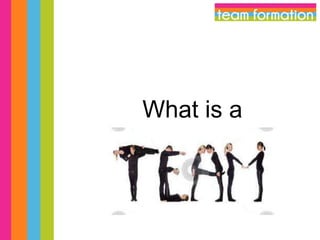
What is a
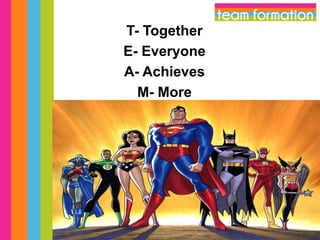
T- Together
E- Everyone
A- Achieves
M- More
What is ‘Team
Building’?
“Team building” is a philosophy of job
design in which employees are viewed as
members of interdependent teams instead
of as individual workers
What are the
stages of Team
Formation ?
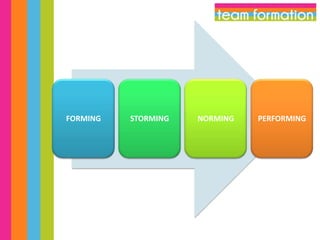
FORMING

STORMING

NORMING

PERFORMING
1. FORMING
What is Forming ?
-High dependence on leader for guidance
and direction.
-Little agreement
-Individual roles and responsibilities are
unclear.
-Lots of questions about the team's
purpose, objectives and external
relationships.
-Members test tolerance of system and
leader.
2. STORMING
What is Storming ?
-Decisions don't come easily within
group.
-Clarity of purpose increases but plenty
of uncertainties persist.
-Cliques and factions form and there may
be power struggles.

-The team needs to be focused on its
goals to avoid becoming distracted by
relationships and emotional issues.
3. NORMING
What is Norming ?
-Agreement and consensus is largely
forms among team, who respond well to
facilitation by leader.
-Roles and responsibilities are clear and
accepted.
-Big decisions are made by group
agreement. Smaller decisions may be
delegated to individuals or small teams
within group.
-Commitment and unity is
strong.
-The team discusses and
develops its processes and
working style. There is general
respect for the leader and some
of leadership is more shared by
the team.
4. PERFORMING
What is Performing ?
-The team knows clearly why it is doing
what it is doing.
-The team has a shared vision and is
able to stand on its own feet with no
interference or participation from the
leader.
-Disagreements occur but now they are
resolved within the team positively
-The team is able to work
towards achieving the goal, and
also to attend to relationship,
style and process issues along
the way. Team members look
after each other.
Team formation

Team formation

  • 1.
  • 2.
  • 3.
  • 4.
  • 5.
    “Team building” isa philosophy of job design in which employees are viewed as members of interdependent teams instead of as individual workers
  • 6.
    What are the stagesof Team Formation ?
  • 7.
  • 8.
  • 9.
    What is Forming? -High dependence on leader for guidance and direction. -Little agreement -Individual roles and responsibilities are unclear. -Lots of questions about the team's purpose, objectives and external relationships. -Members test tolerance of system and leader.
  • 10.
  • 11.
    What is Storming? -Decisions don't come easily within group. -Clarity of purpose increases but plenty of uncertainties persist. -Cliques and factions form and there may be power struggles. -The team needs to be focused on its goals to avoid becoming distracted by relationships and emotional issues.
  • 12.
  • 13.
    What is Norming? -Agreement and consensus is largely forms among team, who respond well to facilitation by leader. -Roles and responsibilities are clear and accepted. -Big decisions are made by group agreement. Smaller decisions may be delegated to individuals or small teams within group.
  • 14.
    -Commitment and unityis strong. -The team discusses and develops its processes and working style. There is general respect for the leader and some of leadership is more shared by the team.
  • 15.
  • 16.
    What is Performing? -The team knows clearly why it is doing what it is doing. -The team has a shared vision and is able to stand on its own feet with no interference or participation from the leader. -Disagreements occur but now they are resolved within the team positively
  • 17.
    -The team isable to work towards achieving the goal, and also to attend to relationship, style and process issues along the way. Team members look after each other.