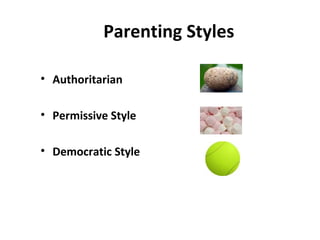
Parenting Styles Authoritarian Permissive Style Democratic Style
The Authoritarian Style Parents are like the police officer or judge. They control the problem-solving process, and tend to be loud and angry. Children obey their parents out of fear.  It is a win-lose dynamic and parents usually win. Firm, But Not Respectful
How Children Respond Anger Rebellion Submission Blaming Others Lying, Hiding Feelings Fear of Trying Something New …
Drawbacks of Authoritarian Style It does not teach children about responsibility, problems solving and respectful communication. It teaches children to be dependent on adults.
Why So Many Parents Use This Style? Most parents use it because they were raised that way themselves. It feels natural, and parents do not question its effectiveness.
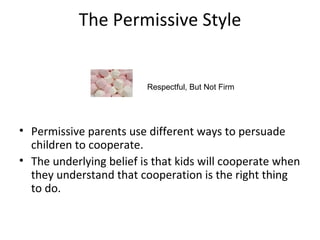
The Permissive Style Permissive parents use different ways to persuade children to cooperate. The underlying belief is that kids will cooperate when they understand that cooperation is the right thing to do. Respectful, But Not Firm
Why It Is Not Working? Permissiveness is a guidance system based on yellow lights. Stopping is optional, not required. Kids know it, but permissive parents are not aware that their signals do not really require stopping.
What Children Learn? Rules are for others, not for me. Parents serve children. Parents are responsible for solving children’s problems. Dependency, disrespect, self-centeredness.
Drawbacks of This Approach While parents protect the children from suffering from consequences of their poor choices, children lose the opportunities to learn from their mistakes.
Democratic Style The Democratic approach is a win-win method which combines firmness with respect.  It accomplishes all of our basic training goals. Firm and Respectful
Parents’ Beliefs Children are capable of solving problems on their own. Children should be given choices and allowed to learn from their choices. Encouragement is an effective way to motivate cooperation.
What Children Learn? Responsibility Cooperation Independence Respect for rules and authority Self-control
How Children Respond? More cooperation. Less limit testing. Resolve problems on their own. Regard parents’ words seriously
Reference: MacKenzie, R. J. (2001). Setting Limits with Your Strong-Willed Child. New York: Three Rivers Press.

Parenting Styles

  • 1.
    Parenting Styles AuthoritarianPermissive Style Democratic Style
  • 2.
    The Authoritarian StyleParents are like the police officer or judge. They control the problem-solving process, and tend to be loud and angry. Children obey their parents out of fear. It is a win-lose dynamic and parents usually win. Firm, But Not Respectful
  • 3.
    How Children RespondAnger Rebellion Submission Blaming Others Lying, Hiding Feelings Fear of Trying Something New …
  • 4.
    Drawbacks of AuthoritarianStyle It does not teach children about responsibility, problems solving and respectful communication. It teaches children to be dependent on adults.
  • 5.
    Why So ManyParents Use This Style? Most parents use it because they were raised that way themselves. It feels natural, and parents do not question its effectiveness.
  • 6.
    The Permissive StylePermissive parents use different ways to persuade children to cooperate. The underlying belief is that kids will cooperate when they understand that cooperation is the right thing to do. Respectful, But Not Firm
  • 7.
    Why It IsNot Working? Permissiveness is a guidance system based on yellow lights. Stopping is optional, not required. Kids know it, but permissive parents are not aware that their signals do not really require stopping.
  • 8.
    What Children Learn?Rules are for others, not for me. Parents serve children. Parents are responsible for solving children’s problems. Dependency, disrespect, self-centeredness.
  • 9.
    Drawbacks of ThisApproach While parents protect the children from suffering from consequences of their poor choices, children lose the opportunities to learn from their mistakes.
  • 10.
    Democratic Style TheDemocratic approach is a win-win method which combines firmness with respect. It accomplishes all of our basic training goals. Firm and Respectful
  • 11.
    Parents’ Beliefs Childrenare capable of solving problems on their own. Children should be given choices and allowed to learn from their choices. Encouragement is an effective way to motivate cooperation.
  • 12.
    What Children Learn?Responsibility Cooperation Independence Respect for rules and authority Self-control
  • 13.
    How Children Respond?More cooperation. Less limit testing. Resolve problems on their own. Regard parents’ words seriously
  • 14.
    Reference: MacKenzie, R.J. (2001). Setting Limits with Your Strong-Willed Child. New York: Three Rivers Press.