Team Building
Training
Our Objective
i. Teams
ii. Stages of Team Building
iii.Recipe for Team Building
iv. Meaning of the Team
v. Exercise
When several people use their skills and
knowledge together, the result should be
positive. People working together can
sustain the enthusiasm and lend support
needed to complete the task.
Why have teams?
What is a team?
A team is a group of people who are
mutually dependent on one another to
achieve a common goal.
How doTeamsWork Best
Teams succeed when members
have:
• commitment to common
objectives;
• defined roles and
responsibilities;
• effective decision systems,
communication and work
procedures,
• managing timelines; and,
• Good personal relationship
Stages ofTeam
Building
• Trust• Process
• Direction• Results
Performing Forming
StormingNorming
Stages
Stage 1
FORMING
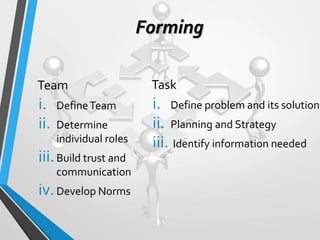
Forming
Team
i. DefineTeam
ii. Determine
individual roles
iii.Build trust and
communication
iv.Develop Norms
Task
i. Define problem and its solution
ii. Planning and Strategy
iii. Identify information needed
i. Encourage and maintain open communication.
ii. Help the team develop and fellow team norms.
iii.Help the team focus on the task.
iv.Deal constructively with conflict.
Role –Team Leader
Team Norms
i. How can we support each other?
ii. What can we do when others have problems?
iii.What are my responsibilities to the team?
Stage 2
STORMING
Storming
After a relatively polite forming stage, members grow in
confidence and an amount of power struggle is likely. The
“Team Leader” has to deal with:
i. realize that the task is more difficult than they
imagined;
ii. have fluctuations in attitude about chances of success;
iii. may be resistant to the task;
iv. have poor collaboration.
Storming Diagnosis
Ever member of the team needs to go through a self
diagnosis:
i. Do we have common goal and objectives?
ii. Do we agree on roles and responsibilities?
iii.Do our task, communication and decision
system work?
iv.Do we have adequate interpersonal skills?
Negotiating Conflict
After the Diagnosis,Team Leader needs to resolve
conflicts(if any) within the team.
i. Separate problem issues from people issues.
ii. Be soft on people and hard on the problem.
iii.Look for underlying needs, goals of each party
rather than specific solutions.
Addressing the Problem
i. State your views in clear non-judgmental
language.
ii. Clarify the core issues.
iii.Listen carefully to each person’s point of view.
iv.Check understanding by restating the core
issues.
Stage 3
NORMING
Norming
Now the group moves on to establish norms in the forms of
system and procedures, i.e. how it should work and a basis for
decision making. During this stage members accept:
i. their teams
ii. teams rules and procedures
iii. their roles in the team;
iv. The individuality of fellow members.
Team members realize that they are not going to
“crash and burn” and start helping each other.
Behavior
i. Competitive relationships become more cooperative.
ii. There is a willingness to confront issues and solve problems.
iii. Team develop the ability to express criticism constructively.
iv. There is a sense of team sprit.
Giving Constructive Feedback
i. Be descriptive
ii. Do not use labels.
iii. Do not exaggerate
iv. Do not be judgmental
v. Speak for yourself
vi. Use “I” messages
vii.Restrict your feedback to things you are sure off.
viii.Help people hear and accept your compliments when giving
positive feedback.
Receiving Constructive Feedback
i. Listen carefully
ii. Ask questions for clarity.
iii. Acknowledge the feedback.
iv. Acknowledge the valid points.
v. Take time to sort out what you heard.
Stage 4
PERFORMING
Performing
Finally, the group becomes far more of a cohesive unit and starts
to perform as a team.TheTeam members have:
i. gained insight into personal and team processes;
ii. a better understanding of each other’s strengths and
weakness;
iii. gained the ability to prevent or work through group conflict
and resolve differences;
iv. developed a close attachment to the team.
Leaders delegate and oversees!
Recipe for SuccessfulTeam
Effective system and processes
i. Clear communication
ii. Beneficial team behaviors; well defined decision procedures
and ground rules
iii. Balanced participation
iv. Awareness of the group process.
v. Good personal relationship.
Trustworthy
Excellence
Multiply
Attitude
Lets do a small test to see if we
have learnt something from this
training…
Now look at the picture and answer the following questions:
1. Which step was not properly executed during team building?
2. Give reasons why this happened?
3. How would you have done this if you were the “Team
Leader”?
“The way a team plays as a whole
determines its success.You may
have the greatest bunch of
individual stars in the world, but if
they do not play together, the
Team wont be worth a dime”
The Human Resource Department would like to thank you
for being a part of the learning culture….
We are now on facebook www.facebook.com/waterlinkpak

Team Building

  • 3.
  • 4.
    Our Objective i. Teams ii.Stages of Team Building iii.Recipe for Team Building iv. Meaning of the Team v. Exercise
  • 5.
    When several peopleuse their skills and knowledge together, the result should be positive. People working together can sustain the enthusiasm and lend support needed to complete the task. Why have teams? What is a team? A team is a group of people who are mutually dependent on one another to achieve a common goal.
  • 6.
    How doTeamsWork Best Teamssucceed when members have: • commitment to common objectives; • defined roles and responsibilities; • effective decision systems, communication and work procedures, • managing timelines; and, • Good personal relationship
  • 7.
  • 8.
    • Trust• Process •Direction• Results Performing Forming StormingNorming Stages
  • 9.
  • 10.
    Forming Team i. DefineTeam ii. Determine individualroles iii.Build trust and communication iv.Develop Norms Task i. Define problem and its solution ii. Planning and Strategy iii. Identify information needed
  • 11.
    i. Encourage andmaintain open communication. ii. Help the team develop and fellow team norms. iii.Help the team focus on the task. iv.Deal constructively with conflict. Role –Team Leader
  • 12.
    Team Norms i. Howcan we support each other? ii. What can we do when others have problems? iii.What are my responsibilities to the team?
  • 13.
  • 14.
    Storming After a relativelypolite forming stage, members grow in confidence and an amount of power struggle is likely. The “Team Leader” has to deal with: i. realize that the task is more difficult than they imagined; ii. have fluctuations in attitude about chances of success; iii. may be resistant to the task; iv. have poor collaboration.
  • 15.
    Storming Diagnosis Ever memberof the team needs to go through a self diagnosis: i. Do we have common goal and objectives? ii. Do we agree on roles and responsibilities? iii.Do our task, communication and decision system work? iv.Do we have adequate interpersonal skills?
  • 16.
    Negotiating Conflict After theDiagnosis,Team Leader needs to resolve conflicts(if any) within the team. i. Separate problem issues from people issues. ii. Be soft on people and hard on the problem. iii.Look for underlying needs, goals of each party rather than specific solutions.
  • 17.
    Addressing the Problem i.State your views in clear non-judgmental language. ii. Clarify the core issues. iii.Listen carefully to each person’s point of view. iv.Check understanding by restating the core issues.
  • 18.
  • 19.
    Norming Now the groupmoves on to establish norms in the forms of system and procedures, i.e. how it should work and a basis for decision making. During this stage members accept: i. their teams ii. teams rules and procedures iii. their roles in the team; iv. The individuality of fellow members. Team members realize that they are not going to “crash and burn” and start helping each other.
  • 20.
    Behavior i. Competitive relationshipsbecome more cooperative. ii. There is a willingness to confront issues and solve problems. iii. Team develop the ability to express criticism constructively. iv. There is a sense of team sprit.
  • 21.
    Giving Constructive Feedback i.Be descriptive ii. Do not use labels. iii. Do not exaggerate iv. Do not be judgmental v. Speak for yourself vi. Use “I” messages vii.Restrict your feedback to things you are sure off. viii.Help people hear and accept your compliments when giving positive feedback.
  • 22.
    Receiving Constructive Feedback i.Listen carefully ii. Ask questions for clarity. iii. Acknowledge the feedback. iv. Acknowledge the valid points. v. Take time to sort out what you heard.
  • 23.
  • 24.
    Performing Finally, the groupbecomes far more of a cohesive unit and starts to perform as a team.TheTeam members have: i. gained insight into personal and team processes; ii. a better understanding of each other’s strengths and weakness; iii. gained the ability to prevent or work through group conflict and resolve differences; iv. developed a close attachment to the team. Leaders delegate and oversees!
  • 25.
    Recipe for SuccessfulTeam Effectivesystem and processes i. Clear communication ii. Beneficial team behaviors; well defined decision procedures and ground rules iii. Balanced participation iv. Awareness of the group process. v. Good personal relationship.
  • 26.
  • 27.
    Lets do asmall test to see if we have learnt something from this training…
  • 28.
    Now look atthe picture and answer the following questions: 1. Which step was not properly executed during team building? 2. Give reasons why this happened? 3. How would you have done this if you were the “Team Leader”?
  • 30.
    “The way ateam plays as a whole determines its success.You may have the greatest bunch of individual stars in the world, but if they do not play together, the Team wont be worth a dime”
  • 31.
    The Human ResourceDepartment would like to thank you for being a part of the learning culture…. We are now on facebook www.facebook.com/waterlinkpak

Editor's Notes

  • #3 The way great teams solve the challenges
  • #7 Why have different to have different colors….. Every team member has different roles and abilities…
  • #13 All members need to ask these questions to themselves.
  • #32 Take a picture with the participants