Group Name:
What is a team?

A team is a number of persons associated together in
work or activity: as a group on one side (as in
football or debate).”

In other words, when one person cannot accomplish
a job alone and several individuals must cooperate
to fulfill a mission, you need a team. The better the
cooperation, communication, and coordination
among team members, the more efficient the team
Why Teams?


   Teamwork distributes the work load
   Teams develop a synergy
   Teamwork develops diverse thinking which leads
    to innovative problem solving. It also provides
    team members an opportunity to work together
    in a non-competitive environment and it builds
    their self-confidence.
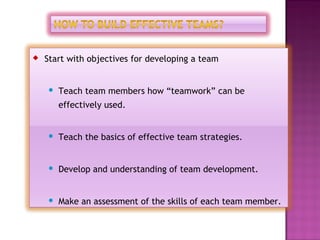
   Start with objectives for developing a team


       Teach team members how “teamwork” can be
        effectively used.


       Teach the basics of effective team strategies.


       Develop and understanding of team development.


       Make an assessment of the skills of each team member.
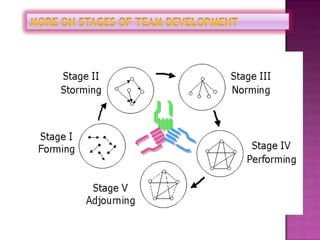
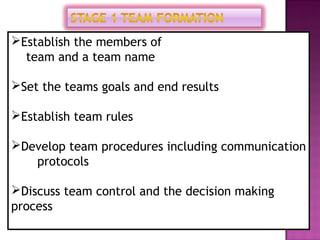
Establish the members of
  team and a team name

Set the teams goals and end results

Establish team rules

Develop team procedures including communication
   protocols

Discuss team control and the decision making
process
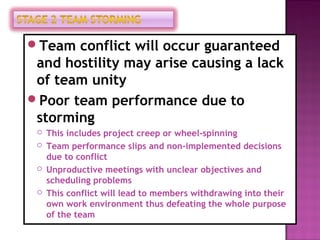
Team conflict will occur guaranteed
 and hostility may arise causing a lack
 of team unity
Poor team performance due to
 storming
    This includes project creep or wheel-spinning
    Team performance slips and non-implemented decisions
     due to conflict
    Unproductive meetings with unclear objectives and
     scheduling problems
    This conflict will lead to members withdrawing into their
     own work environment thus defeating the whole purpose
     of the team
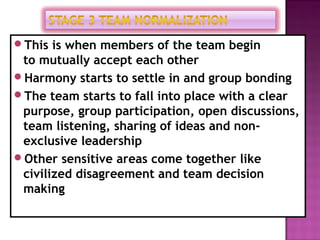
This is when members of the team begin
 to mutually accept each other
Harmony starts to settle in and group bonding
The team starts to fall into place with a clear
 purpose, group participation, open discussions,
 team listening, sharing of ideas and non-
 exclusive leadership
Other sensitive areas come together like
 civilized disagreement and team decision
 making
This is when the team becomes a      problem
 solving machine


In other words, solutions start to emerge like
 flowing water and subjectives give way to the
 objectives
Stage 5 Team Completion

This is when the project is complete and
 the team is ready to disburse. This is an
 exciting time but a sad one as well. There is a sense
 of fulfillment and a loss of team unity.

Documentation needs to be complete before the
 team can disburse. This includes:
  Lessons learned

  Reports written

  Problems and Solutions
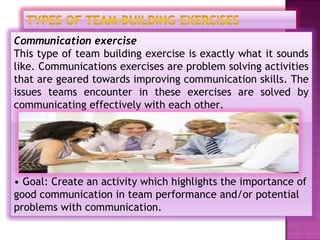
Communication exercise
This type of team building exercise is exactly what it sounds
like. Communications exercises are problem solving activities
that are geared towards improving communication skills. The
issues teams encounter in these exercises are solved by
communicating effectively with each other.


• Goal: Create an activity which highlights the importance of
good communication in team performance and/or potential
problems with communication.
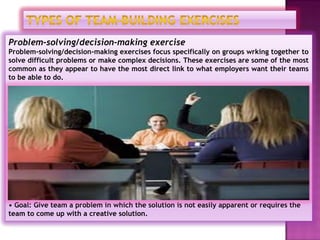
Problem-solving/decision-making exercise
Problem-solving/decision-making exercises focus specifically on groups wrking together to
solve difficult problems or make complex decisions. These exercises are some of the most
common as they appear to have the most direct link to what employers want their teams
to be able to do.


• Goal: Give team a problem in which the solution is not easily apparent or requires the
team to come up with a creative solution.
Planning/adaptability
exercise
These exercises focus on aspects of
planning and being adaptable to change.
These are important things for teams to
be able to do when they are assigned
complex tasks or decisions.

• Goal: Show the importance of planning
before implementing a solution
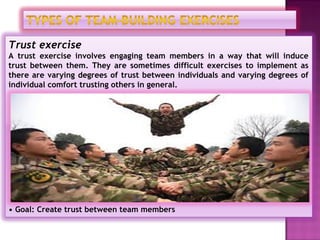
Trust exercise
A trust exercise involves engaging team members in a way that will induce
trust between them. They are sometimes difficult exercises to implement as
there are varying degrees of trust between individuals and varying degrees of
individual comfort trusting others in general.


• Goal: Create trust between team members
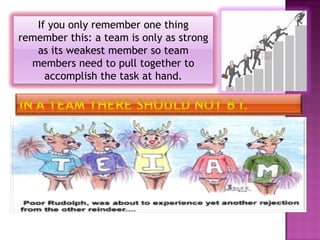
If you only remember one thing
remember this: a team is only as strong
   as its weakest member so team
  members need to pull together to
     accomplish the task at hand.
Team building presentation ppt.2003

Team building presentation ppt.2003

  • 3.
  • 7.
    What is ateam? A team is a number of persons associated together in work or activity: as a group on one side (as in football or debate).” In other words, when one person cannot accomplish a job alone and several individuals must cooperate to fulfill a mission, you need a team. The better the cooperation, communication, and coordination among team members, the more efficient the team
  • 10.
    Why Teams?  Teamwork distributes the work load  Teams develop a synergy  Teamwork develops diverse thinking which leads to innovative problem solving. It also provides team members an opportunity to work together in a non-competitive environment and it builds their self-confidence.
  • 11.
    Start with objectives for developing a team  Teach team members how “teamwork” can be effectively used.  Teach the basics of effective team strategies.  Develop and understanding of team development.  Make an assessment of the skills of each team member.
  • 14.
    Establish the membersof team and a team name Set the teams goals and end results Establish team rules Develop team procedures including communication protocols Discuss team control and the decision making process
  • 15.
    Team conflict willoccur guaranteed and hostility may arise causing a lack of team unity Poor team performance due to storming  This includes project creep or wheel-spinning  Team performance slips and non-implemented decisions due to conflict  Unproductive meetings with unclear objectives and scheduling problems  This conflict will lead to members withdrawing into their own work environment thus defeating the whole purpose of the team
  • 16.
    This is whenmembers of the team begin to mutually accept each other Harmony starts to settle in and group bonding The team starts to fall into place with a clear purpose, group participation, open discussions, team listening, sharing of ideas and non- exclusive leadership Other sensitive areas come together like civilized disagreement and team decision making
  • 17.
    This is whenthe team becomes a problem solving machine In other words, solutions start to emerge like flowing water and subjectives give way to the objectives
  • 18.
    Stage 5 TeamCompletion This is when the project is complete and the team is ready to disburse. This is an exciting time but a sad one as well. There is a sense of fulfillment and a loss of team unity. Documentation needs to be complete before the team can disburse. This includes:  Lessons learned  Reports written  Problems and Solutions
  • 24.
    Communication exercise This typeof team building exercise is exactly what it sounds like. Communications exercises are problem solving activities that are geared towards improving communication skills. The issues teams encounter in these exercises are solved by communicating effectively with each other. • Goal: Create an activity which highlights the importance of good communication in team performance and/or potential problems with communication.
  • 25.
    Problem-solving/decision-making exercise Problem-solving/decision-making exercisesfocus specifically on groups wrking together to solve difficult problems or make complex decisions. These exercises are some of the most common as they appear to have the most direct link to what employers want their teams to be able to do. • Goal: Give team a problem in which the solution is not easily apparent or requires the team to come up with a creative solution.
  • 26.
    Planning/adaptability exercise These exercises focuson aspects of planning and being adaptable to change. These are important things for teams to be able to do when they are assigned complex tasks or decisions. • Goal: Show the importance of planning before implementing a solution
  • 27.
    Trust exercise A trustexercise involves engaging team members in a way that will induce trust between them. They are sometimes difficult exercises to implement as there are varying degrees of trust between individuals and varying degrees of individual comfort trusting others in general. • Goal: Create trust between team members
  • 32.
    If you onlyremember one thing remember this: a team is only as strong as its weakest member so team members need to pull together to accomplish the task at hand.