FORMING, STORMING, 
NORMING, PERFORMING, 
AND ADJOURNING 
1 
Managers are people who do things right, while leaders are people 
who do the right thing. – Warren Bennis, Ph.D. "On Becoming a Leader" 
Glen B. Alleman, 2003
Introduction 
¨ Forming – team members are introduced to each other, 
each positioning from specialist Point of View 
¨ Storming – the team transitions from “as is” to “to be” y 
articulating shared outcome 
¨ Norming – the team reaches consensus on the “to be” 
process and the a shared outcome 
¨ Performing – the team has settled its relationships and 
expectations of each other with mutual accountability 
¨ Adjourning – the team shares the improved processes with 
others 
2
Staged Development of Teams 
¨ The Forming, Storming, Norming, Performing stages are seemingly obvious, 
but are in fact difficult. 
¤ Participants want to move to the Performing stage without passing through the 
first three stages. 
¤ The Forming stage is relatively easy. 
¤ The Storming stage is difficult and many times the cause of the team’s failure. 
¤ Performing seems easy once the storming process is complete. 
¨ The “Real” problem is how to identify when a stage is complete: 
¤ The team members agree that the stage is complete? 
¤ The team coach agrees the stage is complete? 
¤ The team simply moves on to the next stage? 
¨ The definition of the “exit criteria” between stages needs to be worked out 
prior to the team’s reaching the end of the stage. 
¤ This again, seems obvious but is also very difficult. 
3
Forming 
4 
¨ The “polite” stage in which the team starts to form. 
¨ Everyone is trying to figure out what the team 
concept is, what their role is, how they are going to 
hang on to their power base. 
¨ Initial “silent” leaders may take the reins. 
¨ The team is usually positive – for the most part – for 
the initial meetings. 
¨ No one has offended anyone at this point yet!
Forming 
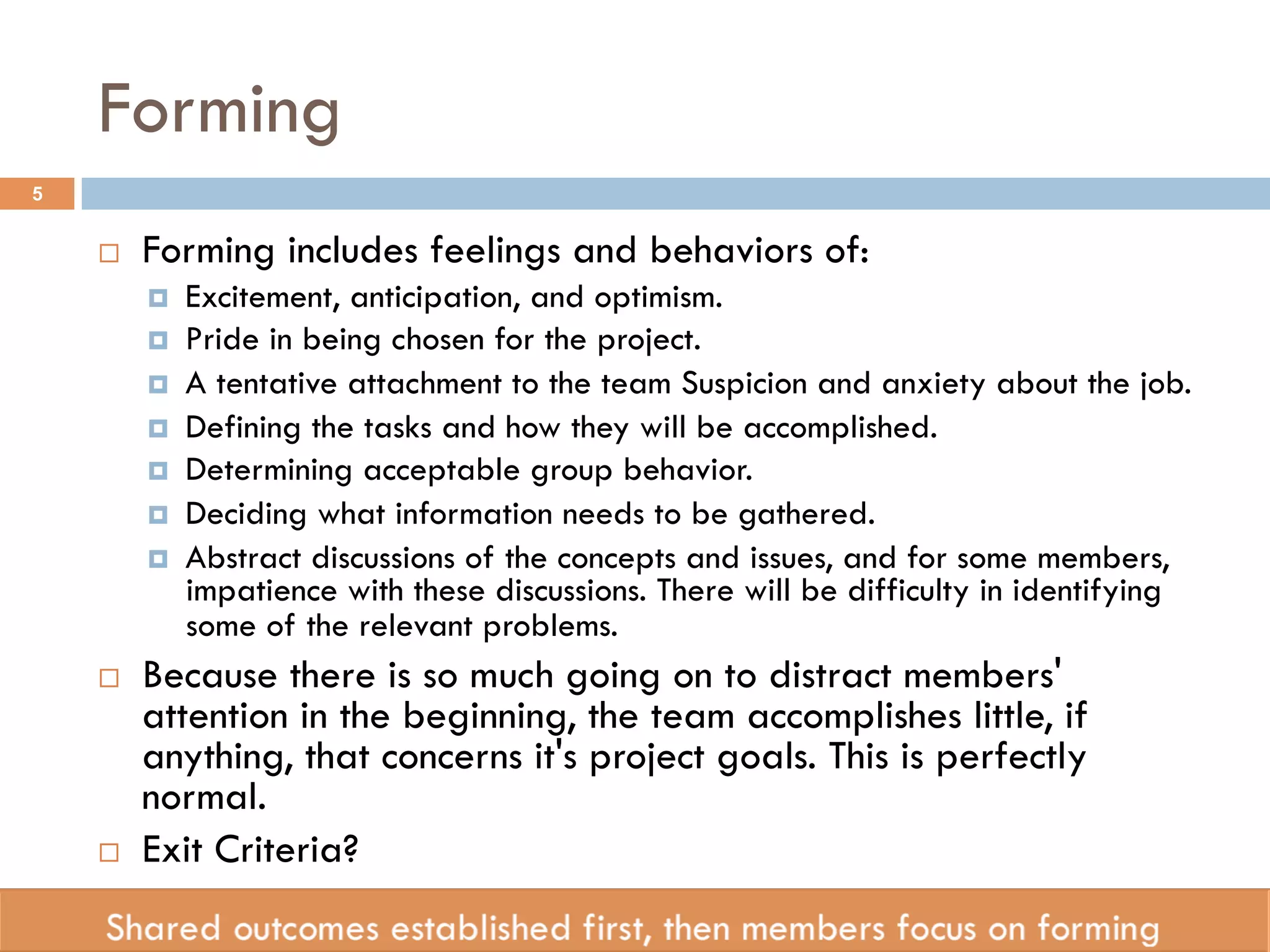
¨ Forming includes feelings and behaviors of: 
¤ Excitement, anticipation, and optimism. 
¤ Pride in being chosen for the project. 
¤ A tentative attachment to the team Suspicion and anxiety about the job. 
¤ Defining the tasks and how they will be accomplished. 
¤ Determining acceptable group behavior. 
¤ Deciding what information needs to be gathered. 
¤ Abstract discussions of the concepts and issues, and for some members, 
impatience with these discussions. There will be difficulty in identifying 
some of the relevant problems. 
¨ Because there is so much going on to distract members' 
attention in the beginning, the team accomplishes little, if 
anything, that concerns it's project goals. This is perfectly 
normal. 
¨ Exit Criteria? 
5
Storming 
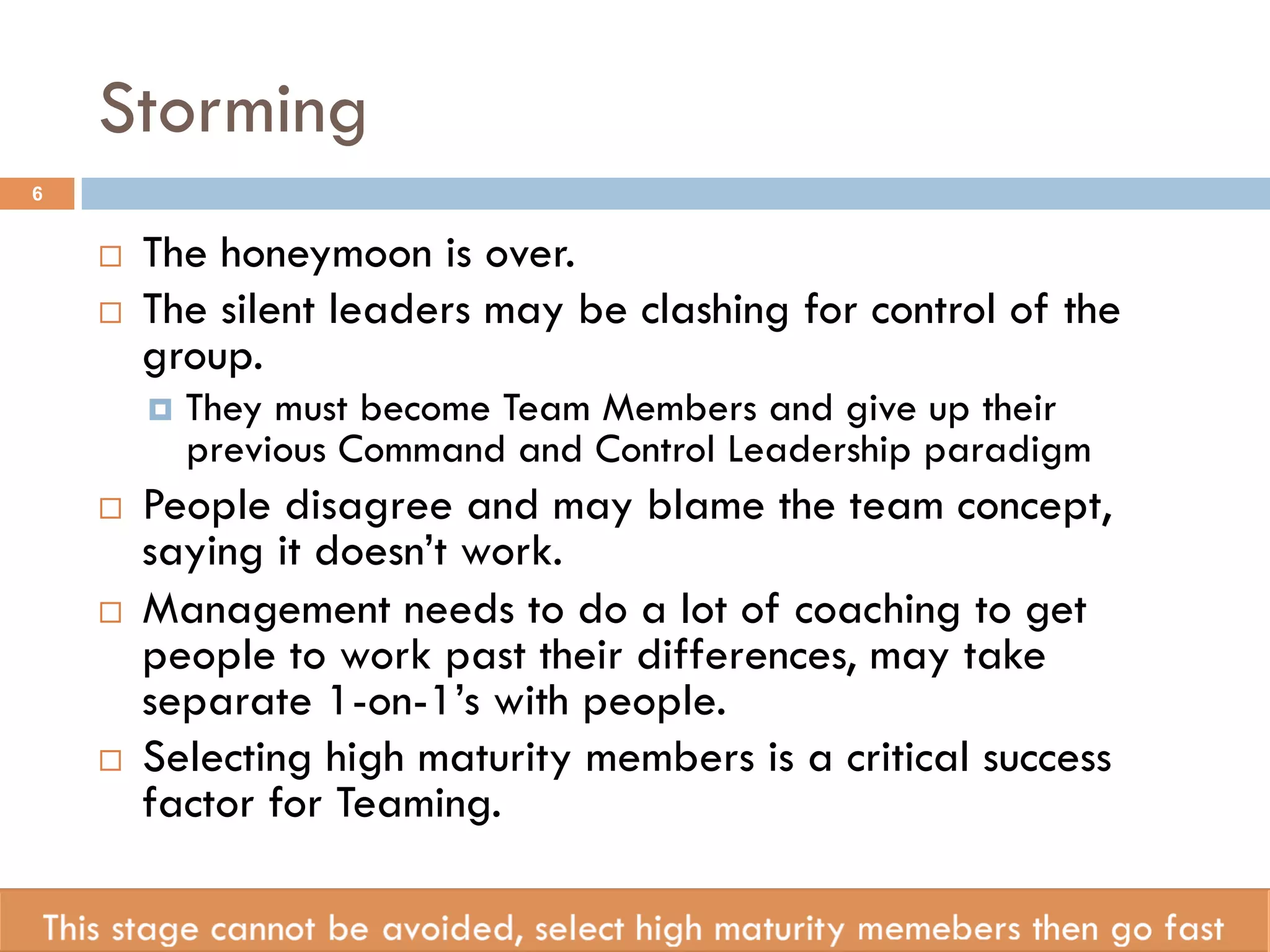
¨ The honeymoon is over. 
¨ The silent leaders may be clashing for control of the 
group. 
¤ They must become Team Members and give up their 
previous Command and Control Leadership paradigm 
¨ People disagree and may blame the team concept, 
saying it doesn’t work. 
¨ Management needs to do a lot of coaching to get 
people to work past their differences, may take 
separate 1-on-1’s with people. 
¨ Selecting high maturity members is a critical success 
factor for Teaming. 
6
Storming 
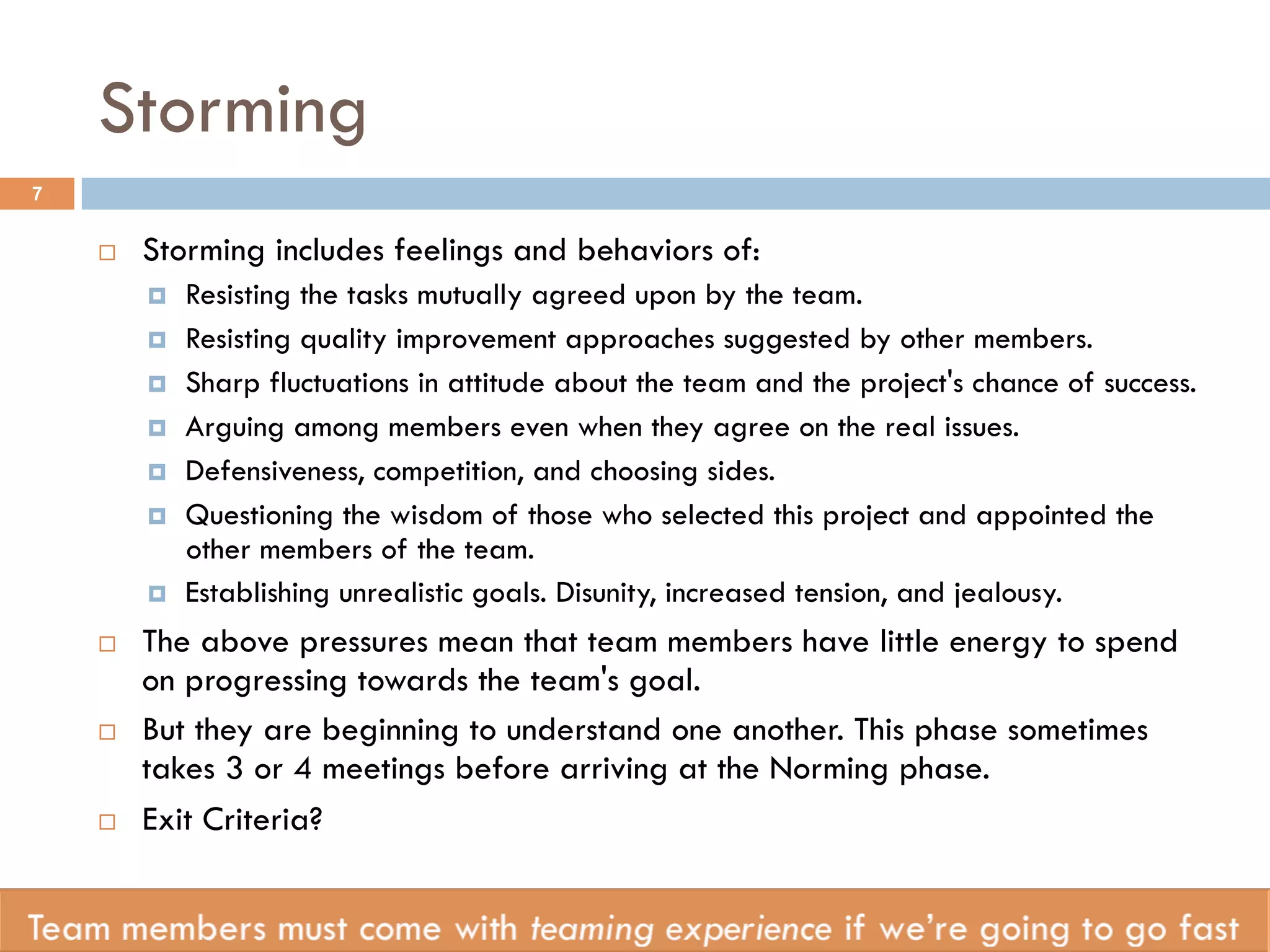
¨ Storming includes feelings and behaviors of: 
¤ Resisting the tasks mutually agreed upon by the team. 
¤ Resisting quality improvement approaches suggested by other members. 
¤ Sharp fluctuations in attitude about the team and the project's chance of success. 
¤ Arguing among members even when they agree on the real issues. 
¤ Defensiveness, competition, and choosing sides. 
¤ Questioning the wisdom of those who selected this project and appointed the 
other members of the team. 
¤ Establishing unrealistic goals. Disunity, increased tension, and jealousy. 
¨ The above pressures mean that team members have little energy to spend 
on progressing towards the team's goal. 
¨ But they are beginning to understand one another. This phase sometimes 
takes 3 or 4 meetings before arriving at the Norming phase. 
¨ Exit Criteria? 
7
Norming 
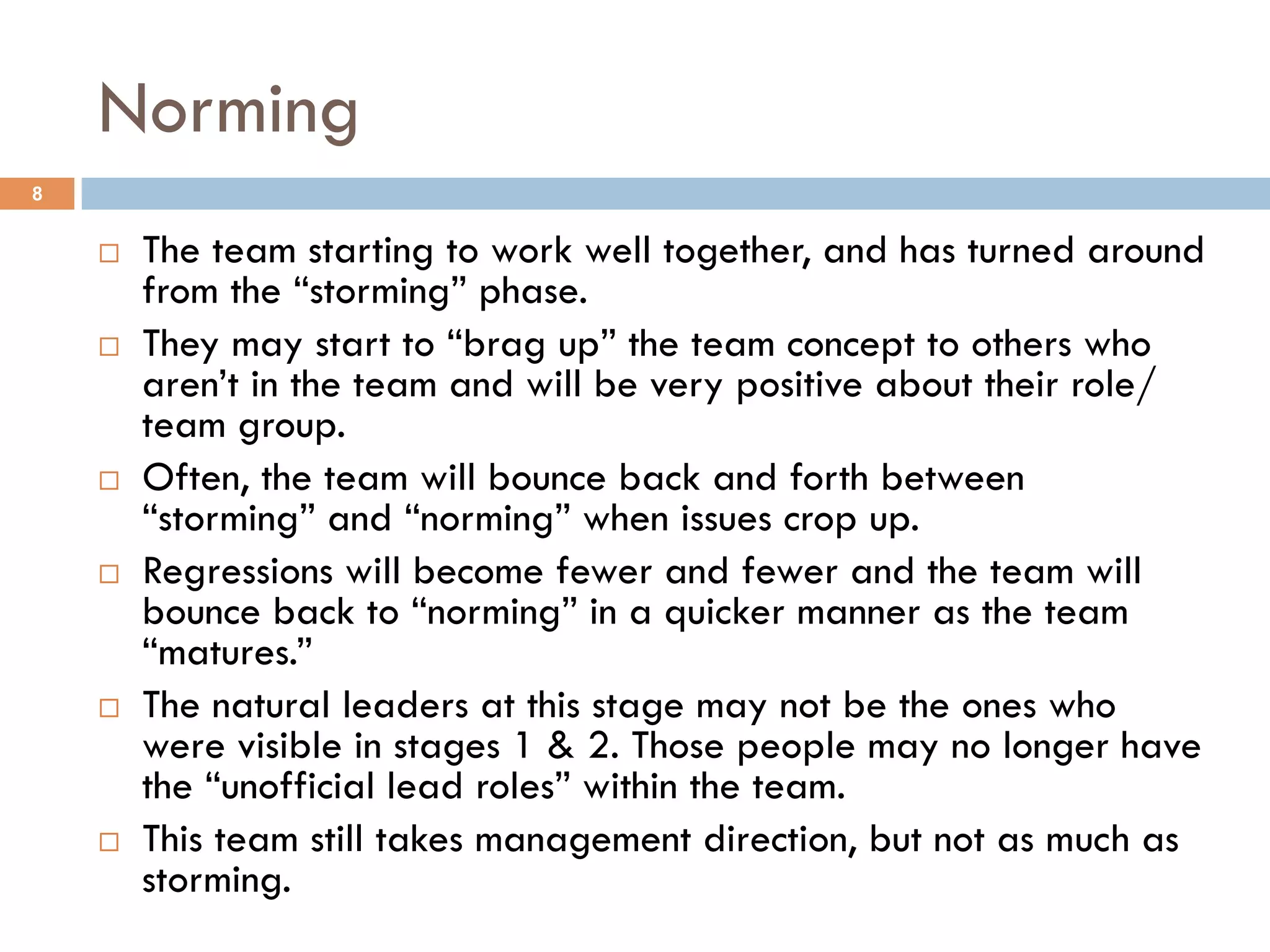
¨ The team starting to work well together, and has turned around 
from the “storming” phase. 
¨ They may start to “brag up” the team concept to others who 
aren’t in the team and will be very positive about their role/ 
team group. 
¨ Often, the team will bounce back and forth between 
“storming” and “norming” when issues crop up. 
¨ Regressions will become fewer and fewer and the team will 
bounce back to “norming” in a quicker manner as the team 
“matures.” 
¨ The natural leaders at this stage may not be the ones who 
were visible in stages 1 & 2. Those people may no longer have 
the “unofficial lead roles” within the team. 
¨ This team still takes management direction, but not as much as 
storming. 
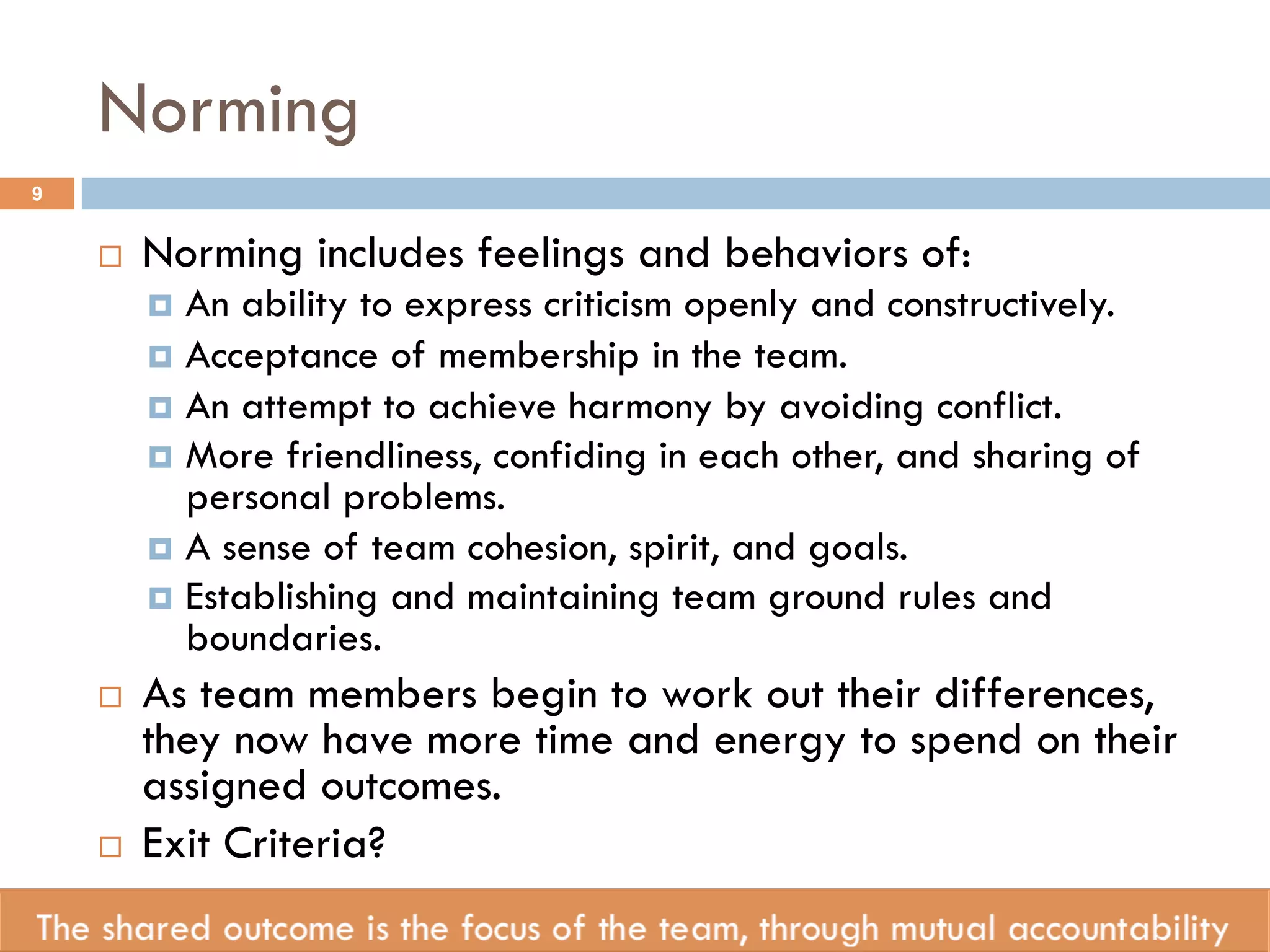
8
Norming 
¨ Norming includes feelings and behaviors of: 
¤ An ability to express criticism openly and constructively. 
¤ Acceptance of membership in the team. 
¤ An attempt to achieve harmony by avoiding conflict. 
¤ More friendliness, confiding in each other, and sharing of 
personal problems. 
¤ A sense of team cohesion, spirit, and goals. 
¤ Establishing and maintaining team ground rules and 
boundaries. 
¨ As team members begin to work out their differences, 
they now have more time and energy to spend on their 
assigned outcomes. 
¨ Exit Criteria? 
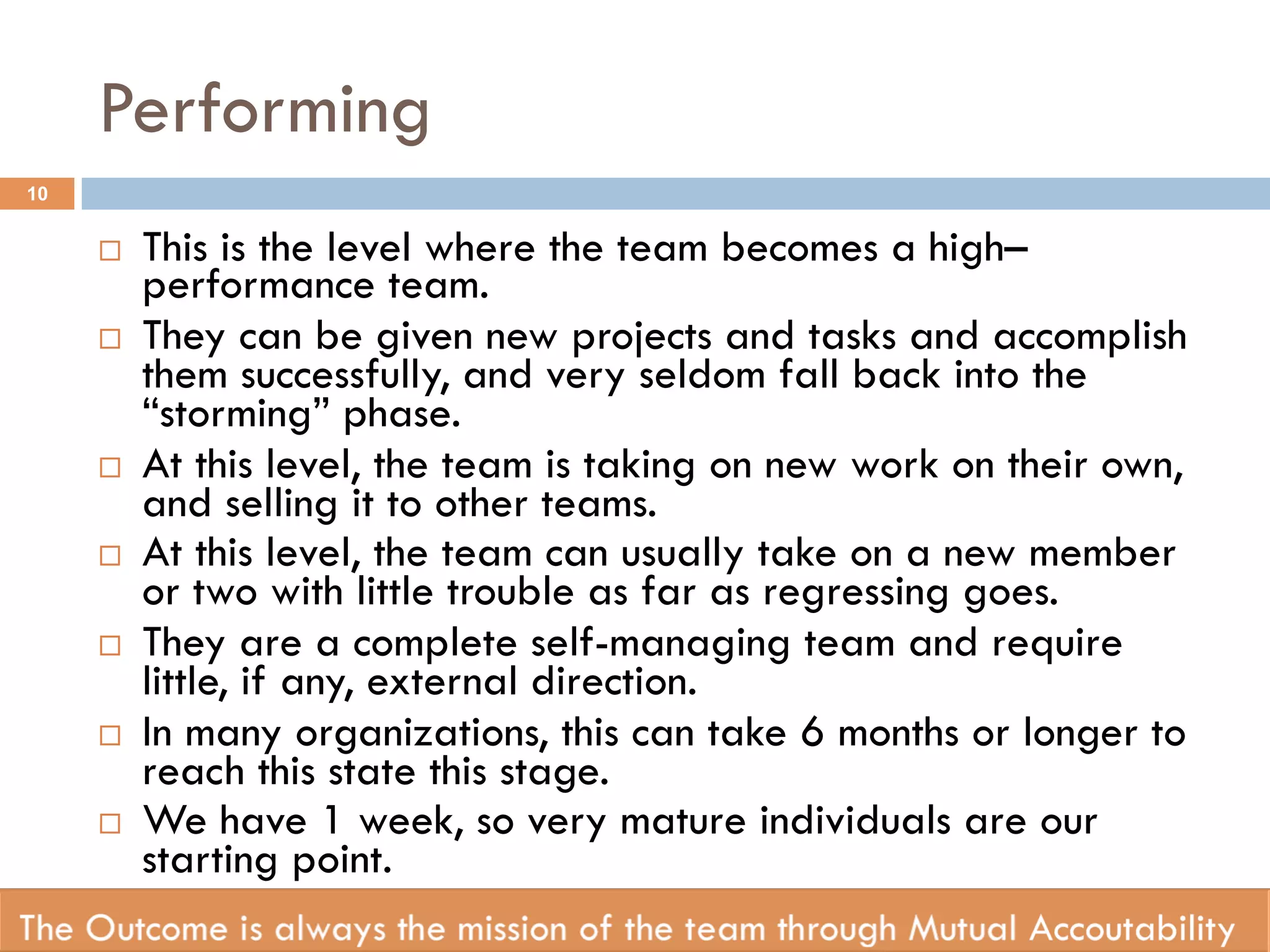
9
Performing 
¨ This is the level where the team becomes a high– 
performance team. 
¨ They can be given new projects and tasks and accomplish 
them successfully, and very seldom fall back into the 
“storming” phase. 
¨ At this level, the team is taking on new work on their own, 
and selling it to other teams. 
¨ At this level, the team can usually take on a new member 
or two with little trouble as far as regressing goes. 
¨ They are a complete self-managing team and require 
little, if any, external direction. 
¨ In many organizations, this can take 6 months or longer to 
reach this state this stage. 
¨ We have 1 week, so very mature individuals are our 
starting point. 
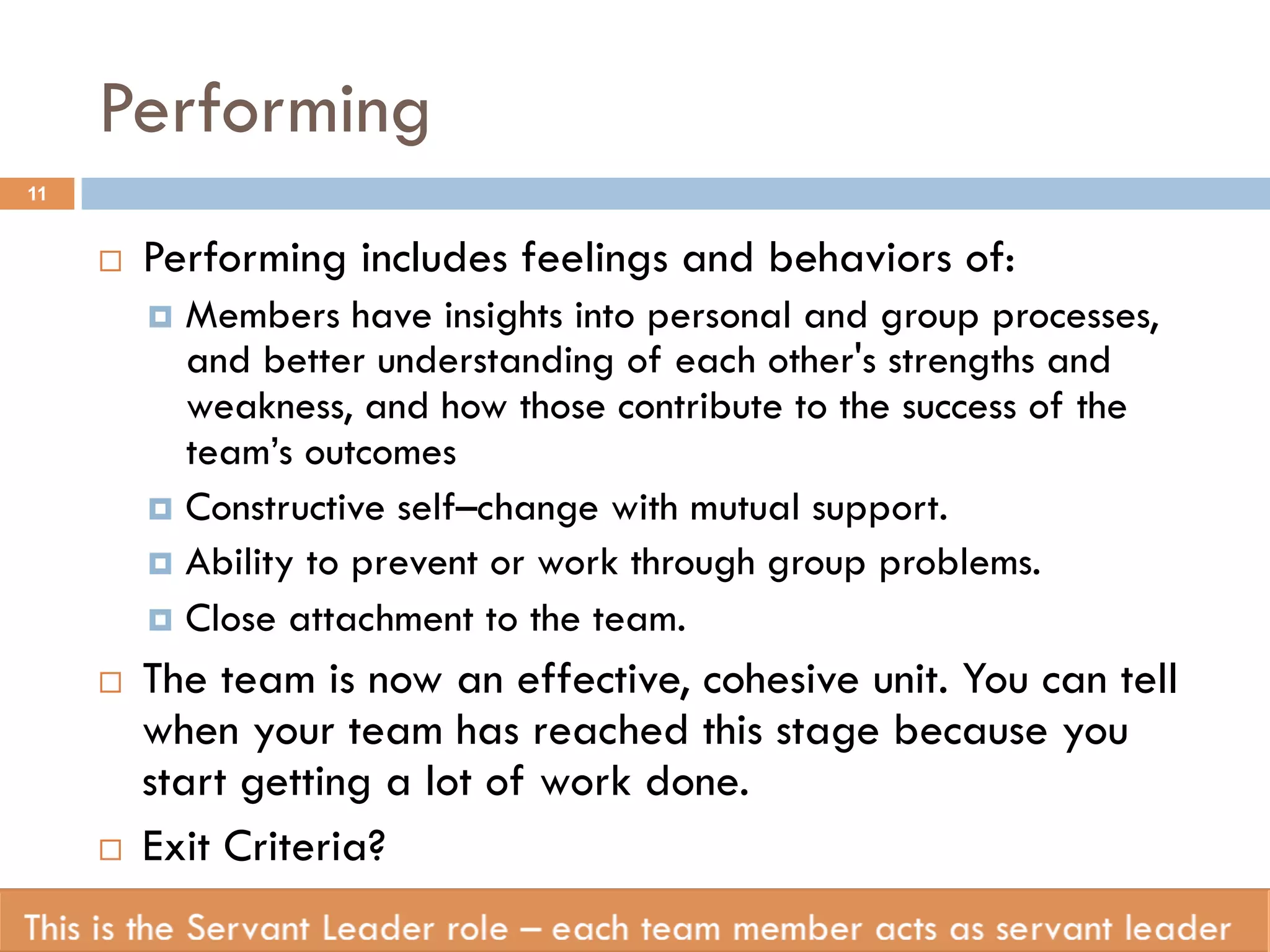
10
Performing 
¨ Performing includes feelings and behaviors of: 
¤ Members have insights into personal and group processes, 
and better understanding of each other's strengths and 
weakness, and how those contribute to the success of the 
team’s outcomes 
¤ Constructive self–change with mutual support. 
¤ Ability to prevent or work through group problems. 
¤ Close attachment to the team. 
¨ The team is now an effective, cohesive unit. You can tell 
when your team has reached this stage because you 
start getting a lot of work done. 
¨ Exit Criteria? 
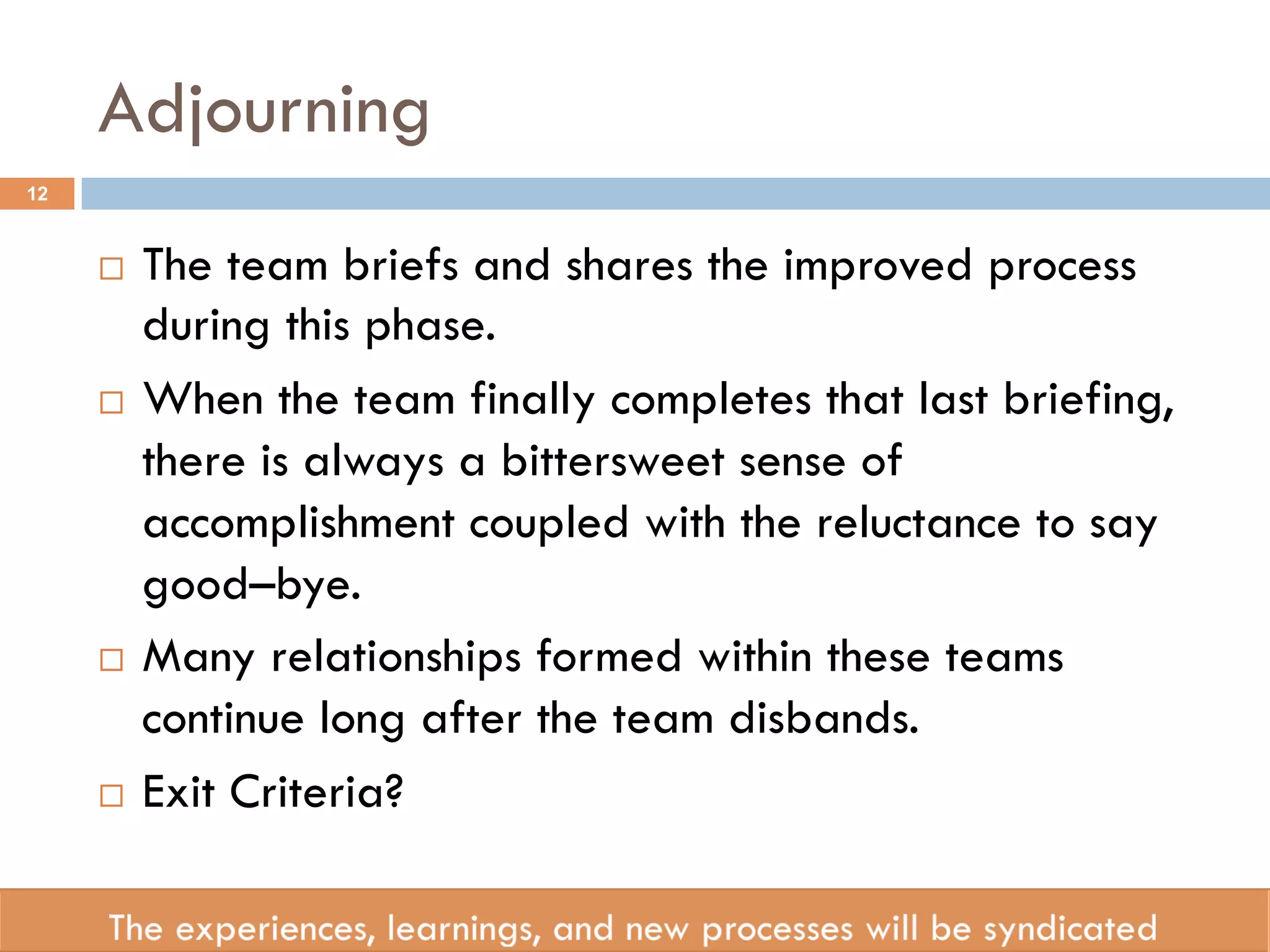
11
Adjourning 
¨ The team briefs and shares the improved process 
during this phase. 
¨ When the team finally completes that last briefing, 
there is always a bittersweet sense of 
accomplishment coupled with the reluctance to say 
good–bye. 
¨ Many relationships formed within these teams 
continue long after the team disbands. 
¨ Exit Criteria? 
12
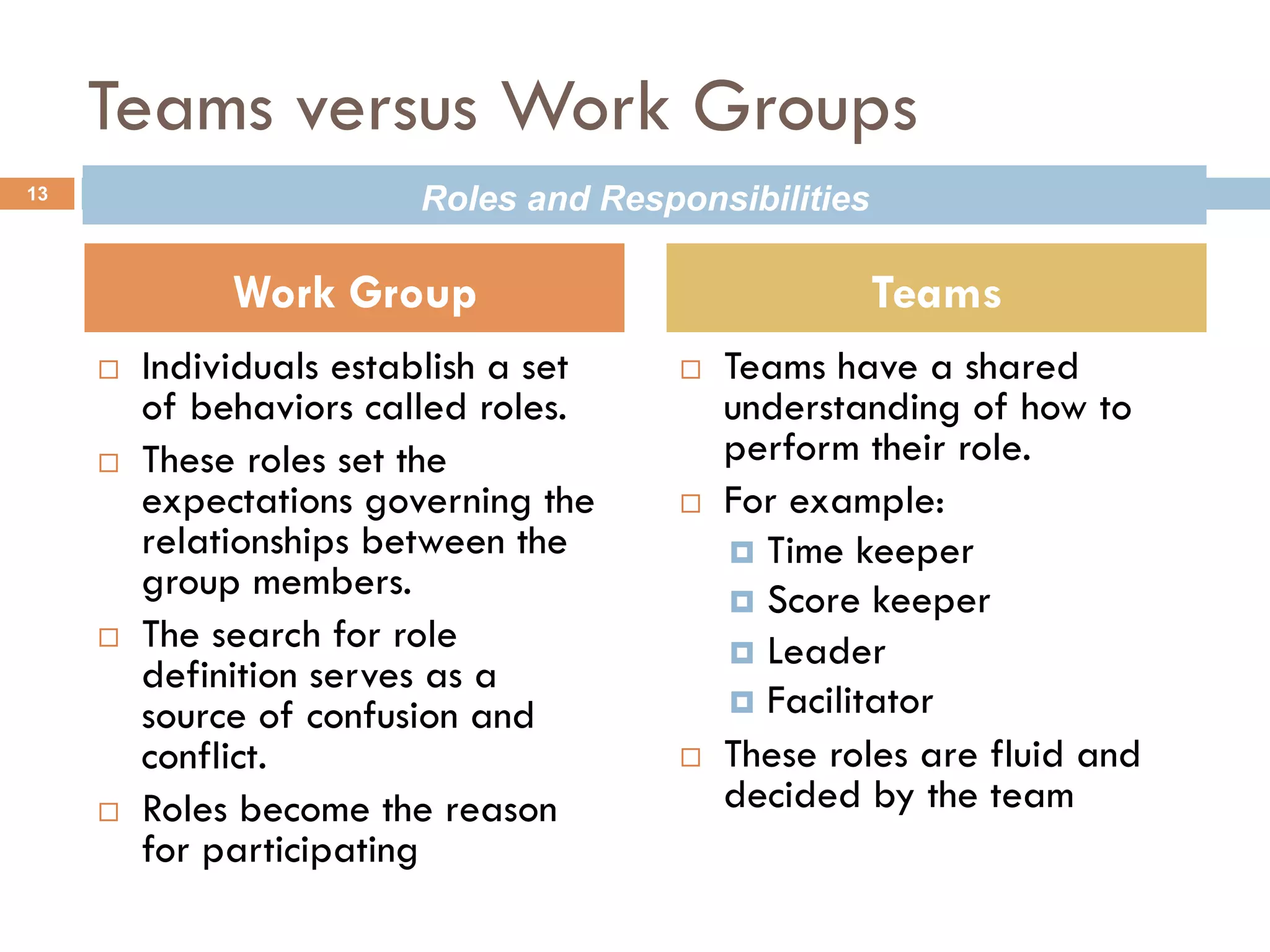
Teams versus Work Groups 
Roles and Responsibilities 
¨ Individuals establish a set 
of behaviors called roles. 
¨ These roles set the 
expectations governing the 
relationships between the 
group members. 
¨ The search for role 
definition serves as a 
source of confusion and 
conflict. 
¨ Roles become the reason 
for participating 
¨ Teams have a shared 
understanding of how to 
perform their role. 
¨ For example: 
¤ Time keeper 
¤ Score keeper 
¤ Leader 
¤ Facilitator 
¨ These roles are fluid and 
decided by the team 
13 
Work Group Teams
Teams versus Work Groups 
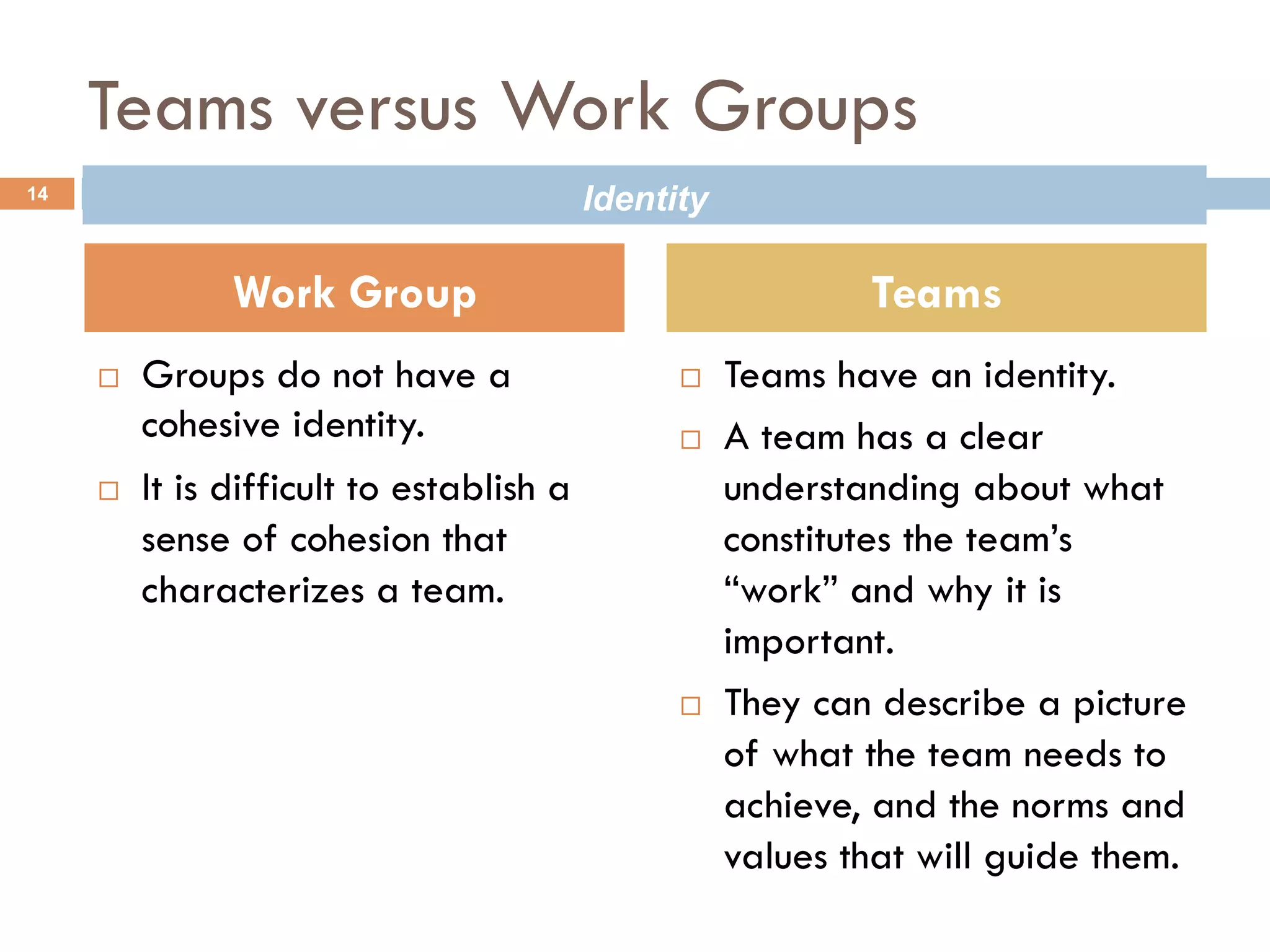
¨ Groups do not have a 
cohesive identity. 
¨ It is difficult to establish a 
sense of cohesion that 
characterizes a team. 
Identity 
¨ Teams have an identity. 
¨ A team has a clear 
understanding about what 
constitutes the team’s 
“work” and why it is 
important. 
¨ They can describe a picture 
of what the team needs to 
achieve, and the norms and 
values that will guide them. 
14 
Work Group Teams
Teams versus Work Groups 
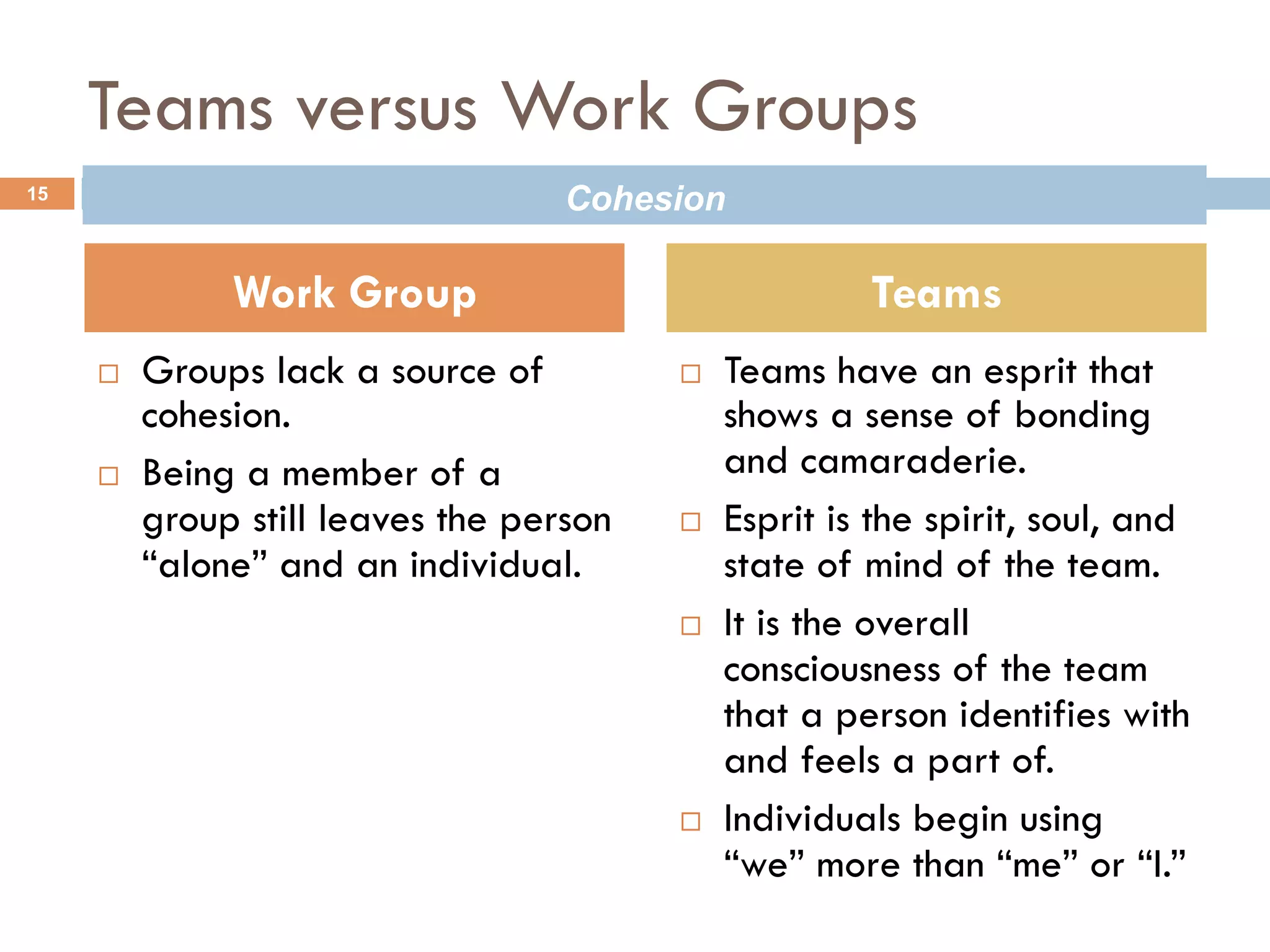
Cohesion 
¨ Groups lack a source of 
cohesion. 
¨ Being a member of a 
group still leaves the person 
“alone” and an individual. 
¨ Teams have an esprit that 
shows a sense of bonding 
and camaraderie. 
¨ Esprit is the spirit, soul, and 
state of mind of the team. 
¨ It is the overall 
consciousness of the team 
that a person identifies with 
and feels a part of. 
¨ Individuals begin using 
“we” more than “me” or “I.” 
15 
Work Group Teams
Teams versus Work Groups 
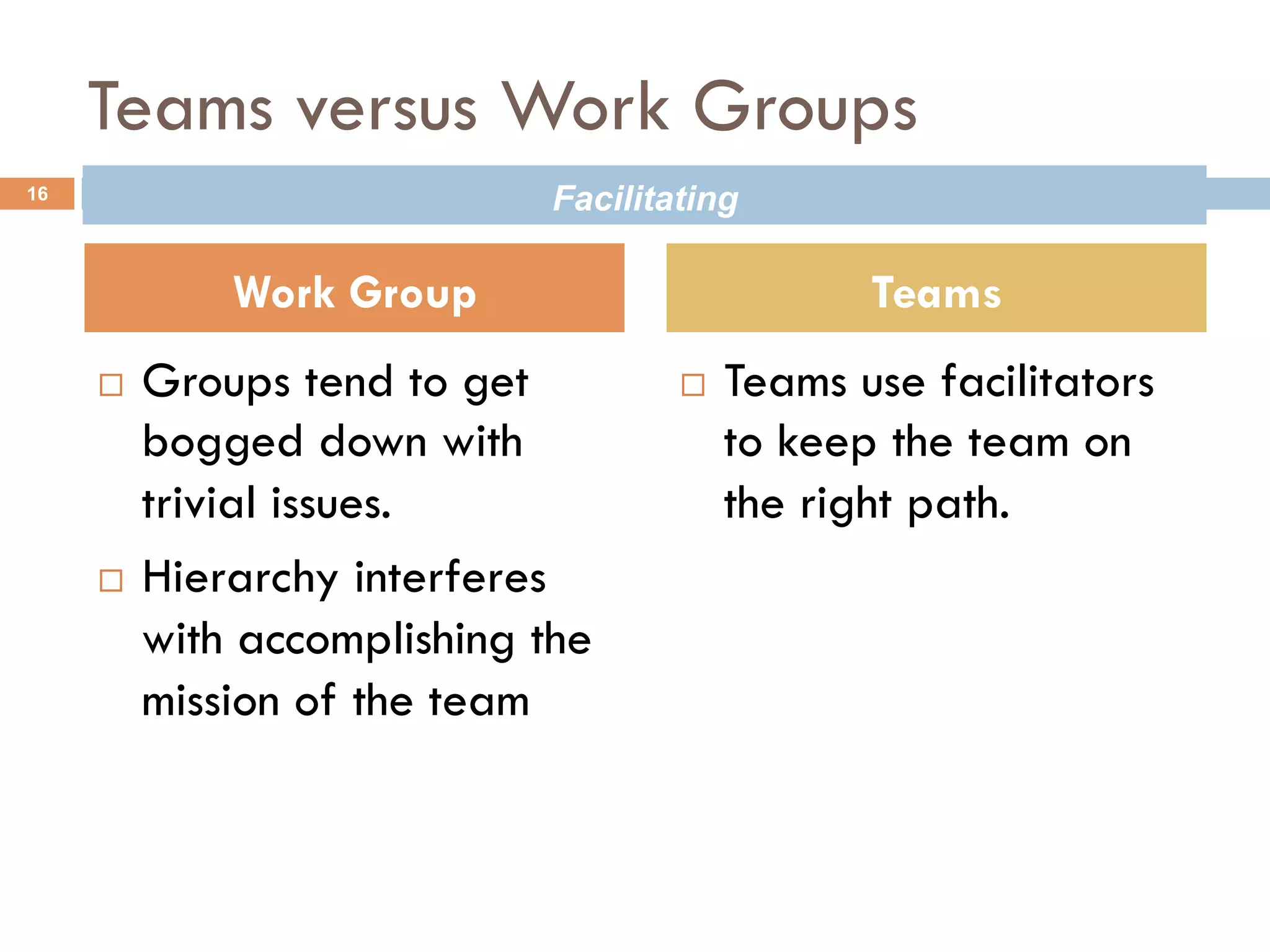
Facilitating 
¨ Groups tend to get 
bogged down with 
trivial issues. 
¨ Hierarchy interferes 
with accomplishing the 
mission of the team 
¨ Teams use facilitators 
to keep the team on 
the right path. 
16 
Work Group Teams
Teams versus Work Groups 
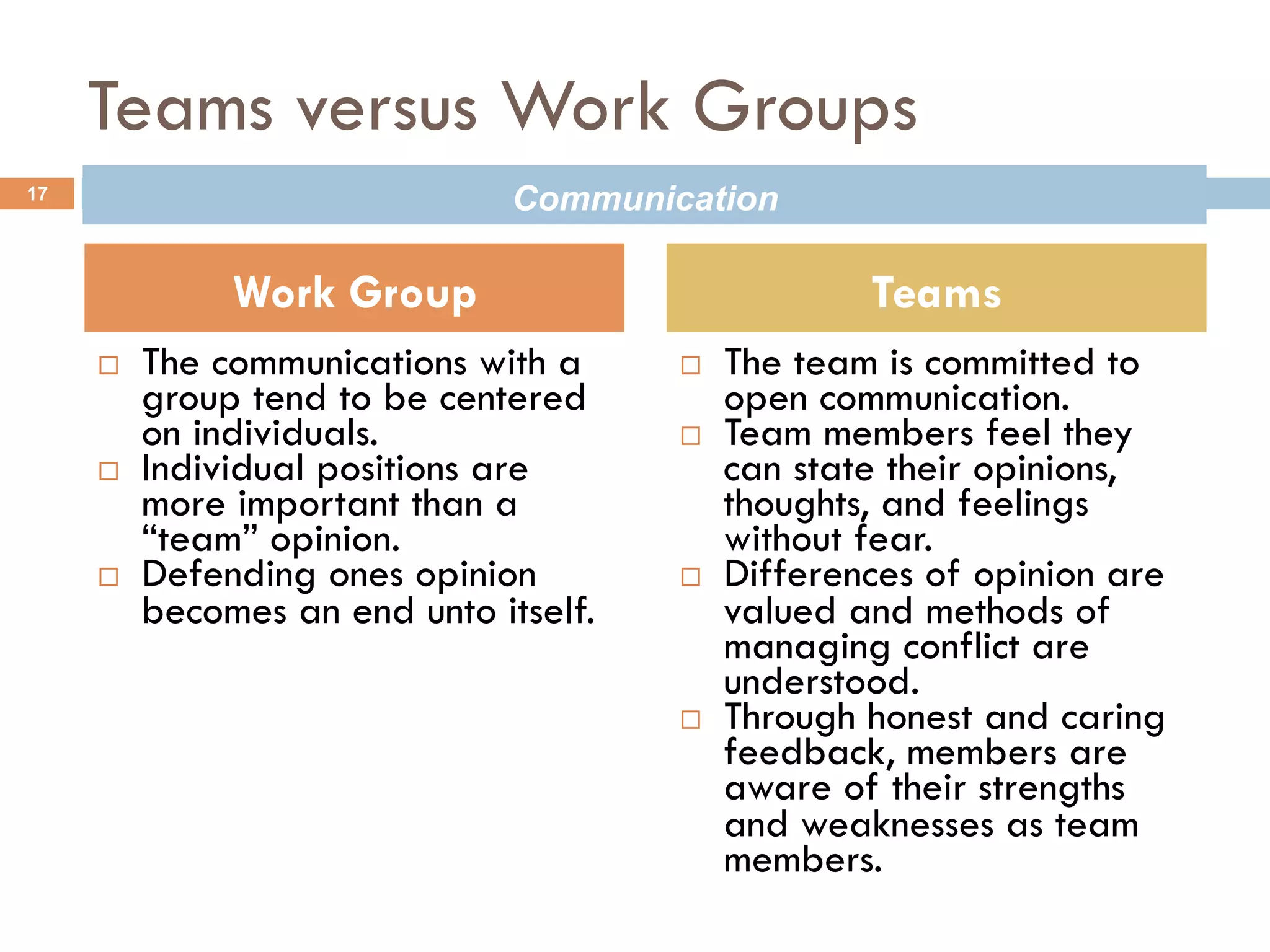
Communication Communication 
¨ The communications with a 
group tend to be centered 
on individuals. 
¨ Individual positions are 
more important than a 
“team” opinion. 
¨ Defending ones opinion 
becomes an end unto itself. 
¨ The team is committed to 
open communication. 
¨ Team members feel they 
can state their opinions, 
thoughts, and feelings 
without fear. 
¨ Differences of opinion are 
valued and methods of 
managing conflict are 
understood. 
¨ Through honest and caring 
feedback, members are 
aware of their strengths 
and weaknesses as team 
members. 
17 
Work Group Teams
Teams versus Work Groups 
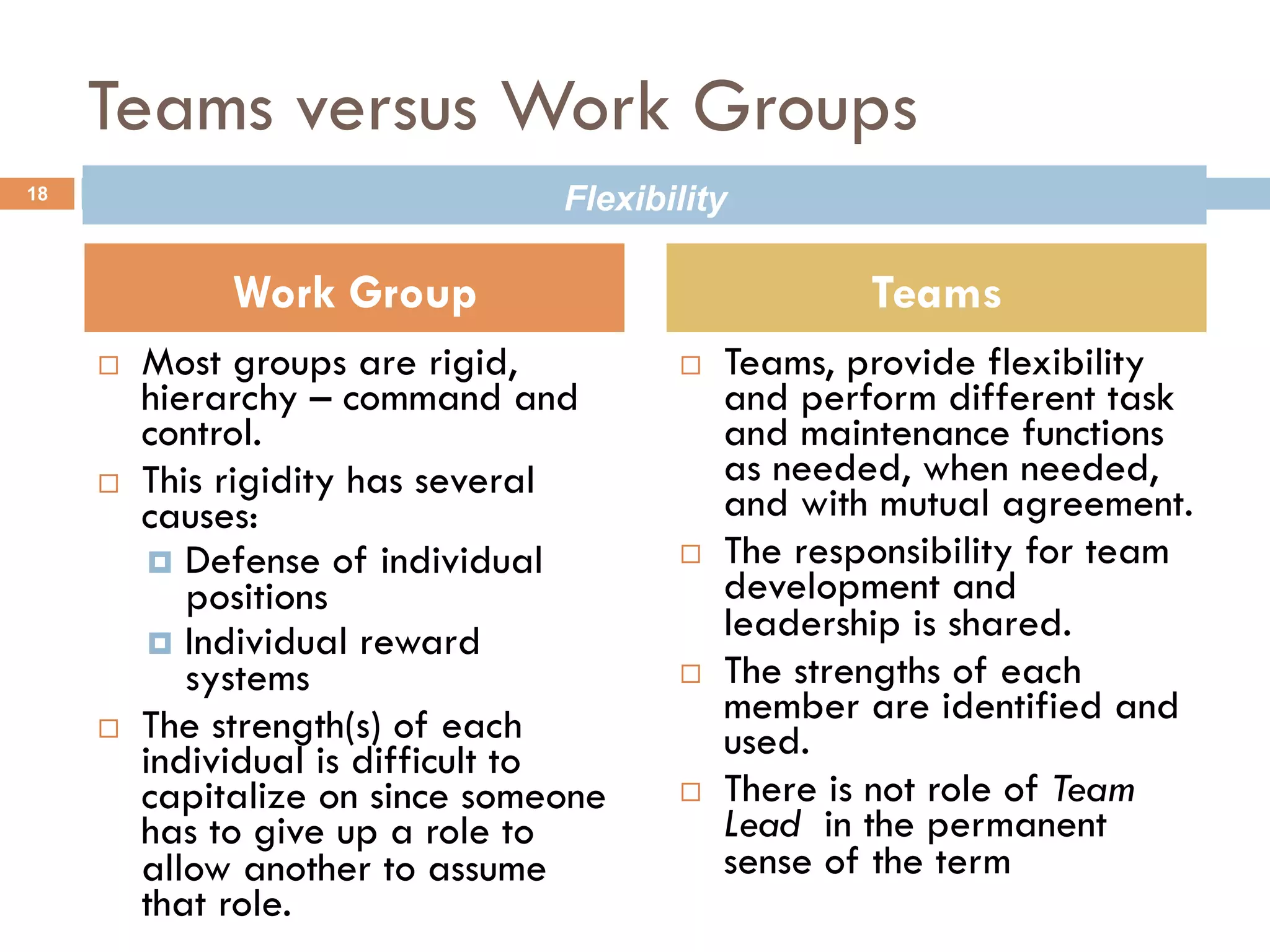
Flexibility Flexibility 
¨ Most groups are rigid, 
hierarchy – command and 
control. 
¨ This rigidity has several 
causes: 
¤ Defense of individual 
positions 
¤ Individual reward 
systems 
¨ The strength(s) of each 
individual is difficult to 
capitalize on since someone 
has to give up a role to 
allow another to assume 
that role. 
¨ Teams, provide flexibility 
and perform different task 
and maintenance functions 
as needed, when needed, 
and with mutual agreement. 
¨ The responsibility for team 
development and 
leadership is shared. 
¨ The strengths of each 
member are identified and 
used. 
¨ There is not role of Team 
Lead in the permanent 
sense of the term 
18 
Work Group Teams
Sources 
19 
¨ John Kotter, Harvard Business School is one source 
everyone should consult. 
¨ Jon Katzenbach, The Wisdom of Teams 
¨ Bruce Tuckman’s group dynamics model was first 
developed the 4 stages, then a 5th stage of the 
model used here

Forming, storming, norming, performing (v3)

  • 1.
    FORMING, STORMING, NORMING,PERFORMING, AND ADJOURNING 1 Managers are people who do things right, while leaders are people who do the right thing. – Warren Bennis, Ph.D. "On Becoming a Leader" Glen B. Alleman, 2003
  • 2.
    Introduction ¨ Forming– team members are introduced to each other, each positioning from specialist Point of View ¨ Storming – the team transitions from “as is” to “to be” y articulating shared outcome ¨ Norming – the team reaches consensus on the “to be” process and the a shared outcome ¨ Performing – the team has settled its relationships and expectations of each other with mutual accountability ¨ Adjourning – the team shares the improved processes with others 2
  • 3.
    Staged Development ofTeams ¨ The Forming, Storming, Norming, Performing stages are seemingly obvious, but are in fact difficult. ¤ Participants want to move to the Performing stage without passing through the first three stages. ¤ The Forming stage is relatively easy. ¤ The Storming stage is difficult and many times the cause of the team’s failure. ¤ Performing seems easy once the storming process is complete. ¨ The “Real” problem is how to identify when a stage is complete: ¤ The team members agree that the stage is complete? ¤ The team coach agrees the stage is complete? ¤ The team simply moves on to the next stage? ¨ The definition of the “exit criteria” between stages needs to be worked out prior to the team’s reaching the end of the stage. ¤ This again, seems obvious but is also very difficult. 3
  • 4.
    Forming 4 ¨The “polite” stage in which the team starts to form. ¨ Everyone is trying to figure out what the team concept is, what their role is, how they are going to hang on to their power base. ¨ Initial “silent” leaders may take the reins. ¨ The team is usually positive – for the most part – for the initial meetings. ¨ No one has offended anyone at this point yet!
  • 5.
    Forming ¨ Formingincludes feelings and behaviors of: ¤ Excitement, anticipation, and optimism. ¤ Pride in being chosen for the project. ¤ A tentative attachment to the team Suspicion and anxiety about the job. ¤ Defining the tasks and how they will be accomplished. ¤ Determining acceptable group behavior. ¤ Deciding what information needs to be gathered. ¤ Abstract discussions of the concepts and issues, and for some members, impatience with these discussions. There will be difficulty in identifying some of the relevant problems. ¨ Because there is so much going on to distract members' attention in the beginning, the team accomplishes little, if anything, that concerns it's project goals. This is perfectly normal. ¨ Exit Criteria? 5
  • 6.
    Storming ¨ Thehoneymoon is over. ¨ The silent leaders may be clashing for control of the group. ¤ They must become Team Members and give up their previous Command and Control Leadership paradigm ¨ People disagree and may blame the team concept, saying it doesn’t work. ¨ Management needs to do a lot of coaching to get people to work past their differences, may take separate 1-on-1’s with people. ¨ Selecting high maturity members is a critical success factor for Teaming. 6
  • 7.
    Storming ¨ Stormingincludes feelings and behaviors of: ¤ Resisting the tasks mutually agreed upon by the team. ¤ Resisting quality improvement approaches suggested by other members. ¤ Sharp fluctuations in attitude about the team and the project's chance of success. ¤ Arguing among members even when they agree on the real issues. ¤ Defensiveness, competition, and choosing sides. ¤ Questioning the wisdom of those who selected this project and appointed the other members of the team. ¤ Establishing unrealistic goals. Disunity, increased tension, and jealousy. ¨ The above pressures mean that team members have little energy to spend on progressing towards the team's goal. ¨ But they are beginning to understand one another. This phase sometimes takes 3 or 4 meetings before arriving at the Norming phase. ¨ Exit Criteria? 7
  • 8.
    Norming ¨ Theteam starting to work well together, and has turned around from the “storming” phase. ¨ They may start to “brag up” the team concept to others who aren’t in the team and will be very positive about their role/ team group. ¨ Often, the team will bounce back and forth between “storming” and “norming” when issues crop up. ¨ Regressions will become fewer and fewer and the team will bounce back to “norming” in a quicker manner as the team “matures.” ¨ The natural leaders at this stage may not be the ones who were visible in stages 1 & 2. Those people may no longer have the “unofficial lead roles” within the team. ¨ This team still takes management direction, but not as much as storming. 8
  • 9.
    Norming ¨ Normingincludes feelings and behaviors of: ¤ An ability to express criticism openly and constructively. ¤ Acceptance of membership in the team. ¤ An attempt to achieve harmony by avoiding conflict. ¤ More friendliness, confiding in each other, and sharing of personal problems. ¤ A sense of team cohesion, spirit, and goals. ¤ Establishing and maintaining team ground rules and boundaries. ¨ As team members begin to work out their differences, they now have more time and energy to spend on their assigned outcomes. ¨ Exit Criteria? 9
  • 10.
    Performing ¨ Thisis the level where the team becomes a high– performance team. ¨ They can be given new projects and tasks and accomplish them successfully, and very seldom fall back into the “storming” phase. ¨ At this level, the team is taking on new work on their own, and selling it to other teams. ¨ At this level, the team can usually take on a new member or two with little trouble as far as regressing goes. ¨ They are a complete self-managing team and require little, if any, external direction. ¨ In many organizations, this can take 6 months or longer to reach this state this stage. ¨ We have 1 week, so very mature individuals are our starting point. 10
  • 11.
    Performing ¨ Performingincludes feelings and behaviors of: ¤ Members have insights into personal and group processes, and better understanding of each other's strengths and weakness, and how those contribute to the success of the team’s outcomes ¤ Constructive self–change with mutual support. ¤ Ability to prevent or work through group problems. ¤ Close attachment to the team. ¨ The team is now an effective, cohesive unit. You can tell when your team has reached this stage because you start getting a lot of work done. ¨ Exit Criteria? 11
  • 12.
    Adjourning ¨ Theteam briefs and shares the improved process during this phase. ¨ When the team finally completes that last briefing, there is always a bittersweet sense of accomplishment coupled with the reluctance to say good–bye. ¨ Many relationships formed within these teams continue long after the team disbands. ¨ Exit Criteria? 12
  • 13.
    Teams versus WorkGroups Roles and Responsibilities ¨ Individuals establish a set of behaviors called roles. ¨ These roles set the expectations governing the relationships between the group members. ¨ The search for role definition serves as a source of confusion and conflict. ¨ Roles become the reason for participating ¨ Teams have a shared understanding of how to perform their role. ¨ For example: ¤ Time keeper ¤ Score keeper ¤ Leader ¤ Facilitator ¨ These roles are fluid and decided by the team 13 Work Group Teams
  • 14.
    Teams versus WorkGroups ¨ Groups do not have a cohesive identity. ¨ It is difficult to establish a sense of cohesion that characterizes a team. Identity ¨ Teams have an identity. ¨ A team has a clear understanding about what constitutes the team’s “work” and why it is important. ¨ They can describe a picture of what the team needs to achieve, and the norms and values that will guide them. 14 Work Group Teams
  • 15.
    Teams versus WorkGroups Cohesion ¨ Groups lack a source of cohesion. ¨ Being a member of a group still leaves the person “alone” and an individual. ¨ Teams have an esprit that shows a sense of bonding and camaraderie. ¨ Esprit is the spirit, soul, and state of mind of the team. ¨ It is the overall consciousness of the team that a person identifies with and feels a part of. ¨ Individuals begin using “we” more than “me” or “I.” 15 Work Group Teams
  • 16.
    Teams versus WorkGroups Facilitating ¨ Groups tend to get bogged down with trivial issues. ¨ Hierarchy interferes with accomplishing the mission of the team ¨ Teams use facilitators to keep the team on the right path. 16 Work Group Teams
  • 17.
    Teams versus WorkGroups Communication Communication ¨ The communications with a group tend to be centered on individuals. ¨ Individual positions are more important than a “team” opinion. ¨ Defending ones opinion becomes an end unto itself. ¨ The team is committed to open communication. ¨ Team members feel they can state their opinions, thoughts, and feelings without fear. ¨ Differences of opinion are valued and methods of managing conflict are understood. ¨ Through honest and caring feedback, members are aware of their strengths and weaknesses as team members. 17 Work Group Teams
  • 18.
    Teams versus WorkGroups Flexibility Flexibility ¨ Most groups are rigid, hierarchy – command and control. ¨ This rigidity has several causes: ¤ Defense of individual positions ¤ Individual reward systems ¨ The strength(s) of each individual is difficult to capitalize on since someone has to give up a role to allow another to assume that role. ¨ Teams, provide flexibility and perform different task and maintenance functions as needed, when needed, and with mutual agreement. ¨ The responsibility for team development and leadership is shared. ¨ The strengths of each member are identified and used. ¨ There is not role of Team Lead in the permanent sense of the term 18 Work Group Teams
  • 19.
    Sources 19 ¨John Kotter, Harvard Business School is one source everyone should consult. ¨ Jon Katzenbach, The Wisdom of Teams ¨ Bruce Tuckman’s group dynamics model was first developed the 4 stages, then a 5th stage of the model used here