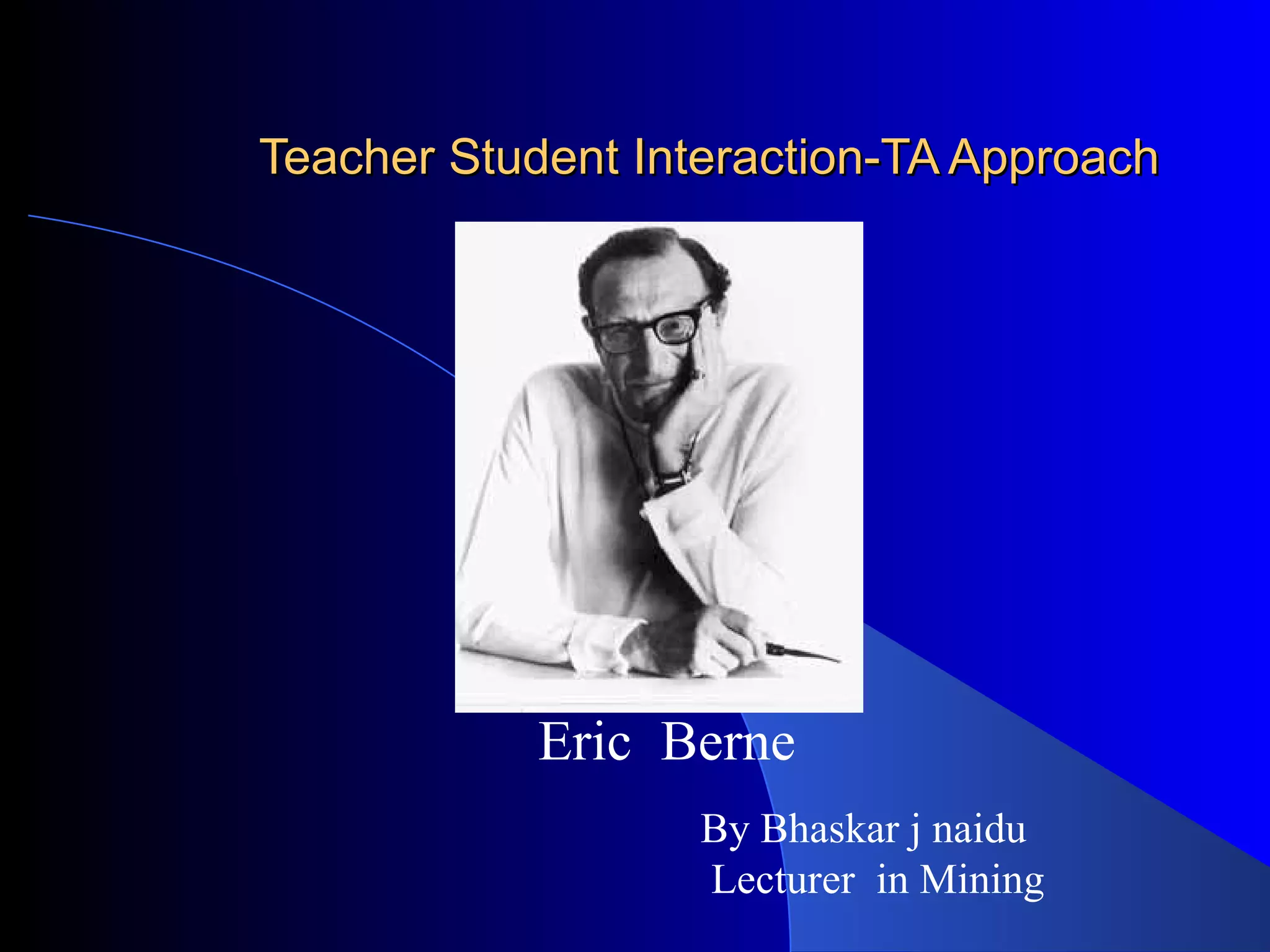
Teacher Student Interaction-TA Approach Eric  Berne By Bhaskar j naidu Lecturer  in Mining
Transactional analysis is a theory of personality and a systematic psychotherapy for personal growth and personal change.  Among psychological approaches, it is outstanding in the depth of its theory and the wide variety of its applications.
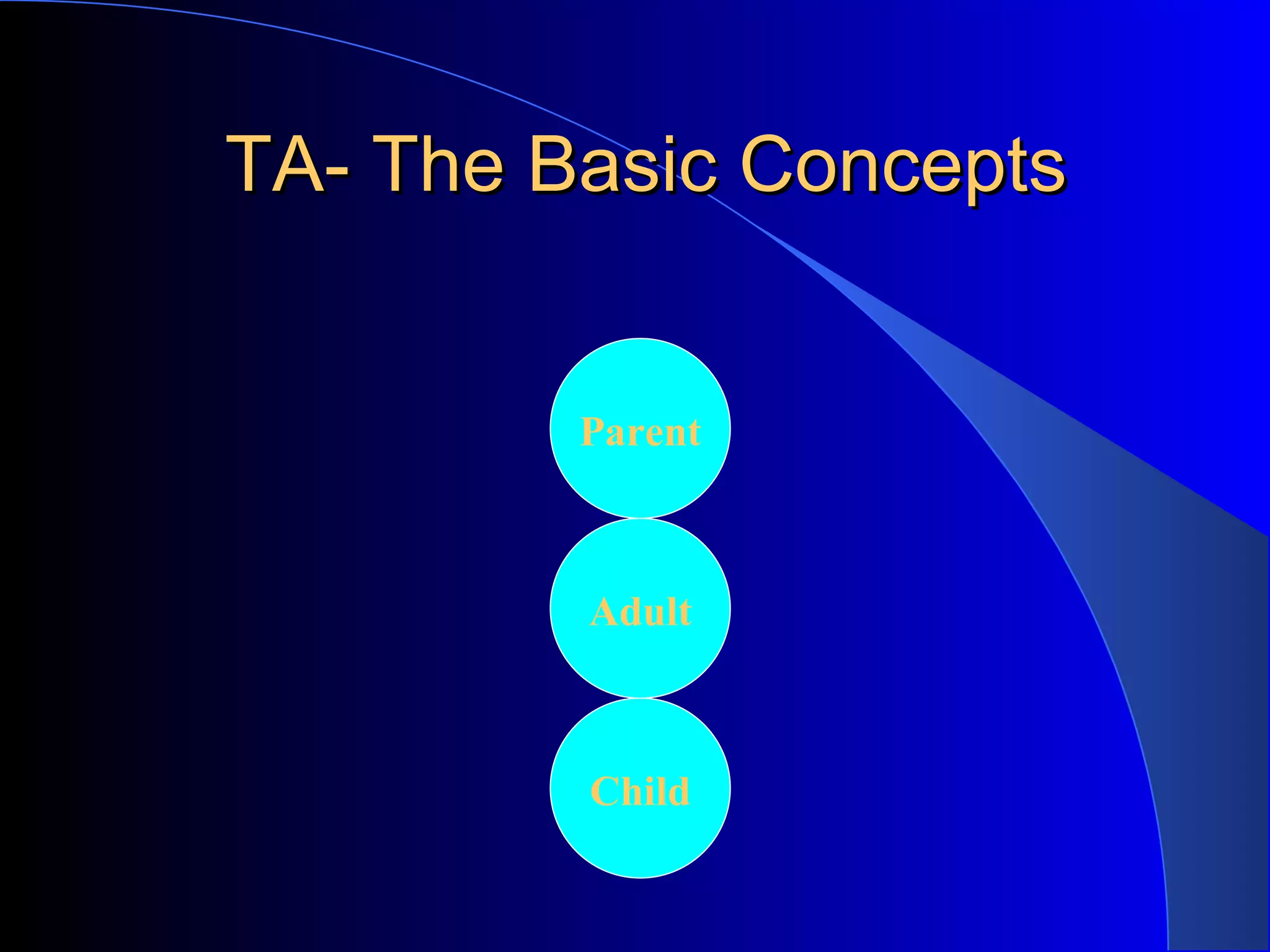
Key Ideas in Transactional Analysis 1. Ego State Model (PAC Model): An ego state is a set of related behaviors, thoughts, and feelings, a way in which we manifest a part of our personality at a given time. Transactional analysis portrays three ego states: Adult (behaving, thinking, feeling in response to what is going on around me in the here and now), Parent (behaving, thinking, feeling in ways that are a copy of one of my parents or other parent figures), and Child (behaving, thinking, feeling that I used when I was a child). When we use the ego-state model to understand personality, we are employing structural analysis.
2. Transactions, Strokes, Time Structuring:  One can address you from any of  ego states, and you can reply in turn. This exchange is a transaction. The use of the ego-state model to analyze sequences of transactions is transactional analysis proper. When you and I transact, I signal recognition of you and you return that recognition; any act of recognition is a stroke. People need strokes to maintain their psychical and psychological well-being. When people transact in groups or pairs, they use time in various specific ways which can be listed and analyzed; this is the analysis of time structuring
Communication-What constitutes it? Spoken words Gestures  Postures Attitudes Perceptions Interpretations
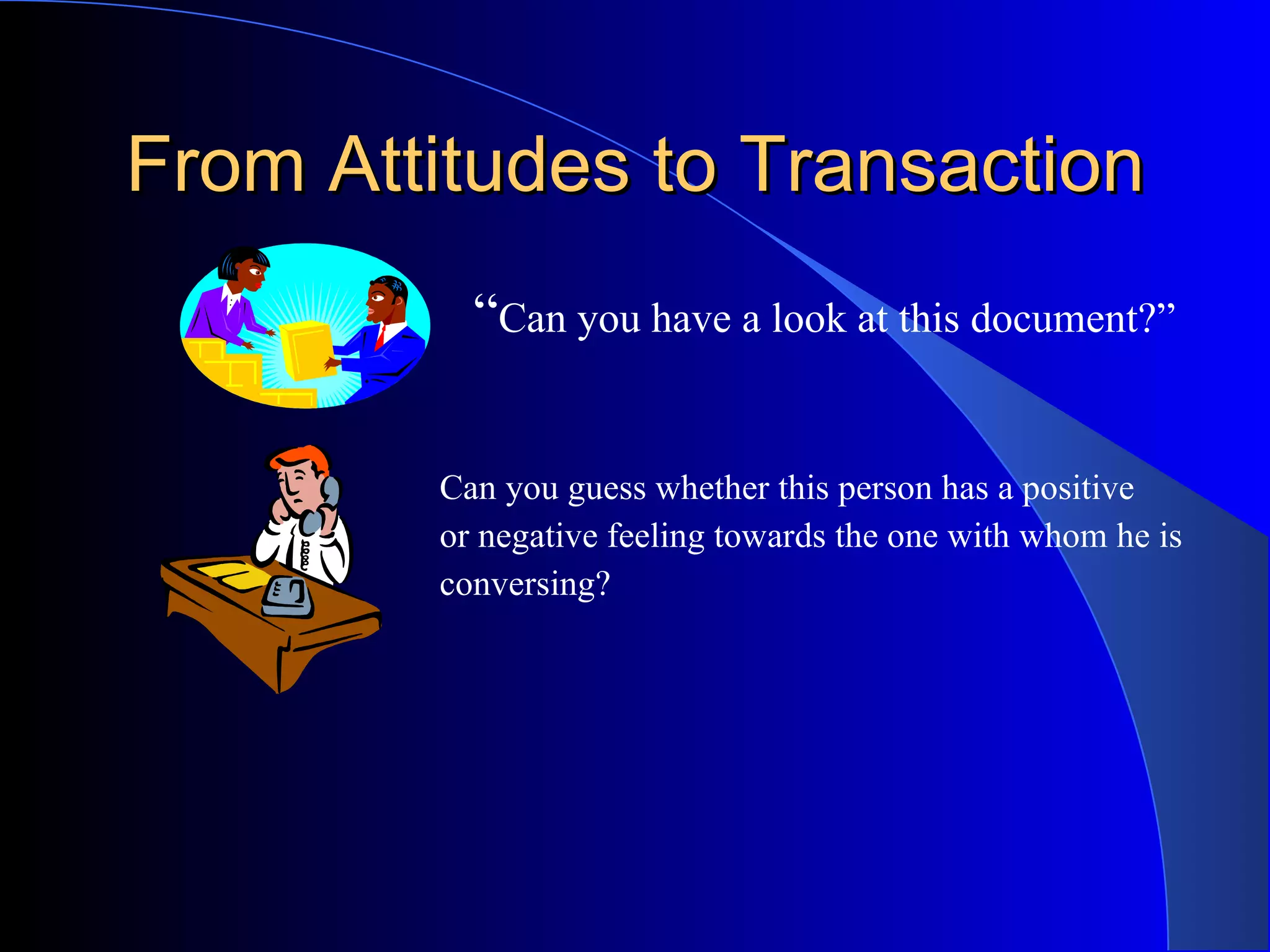
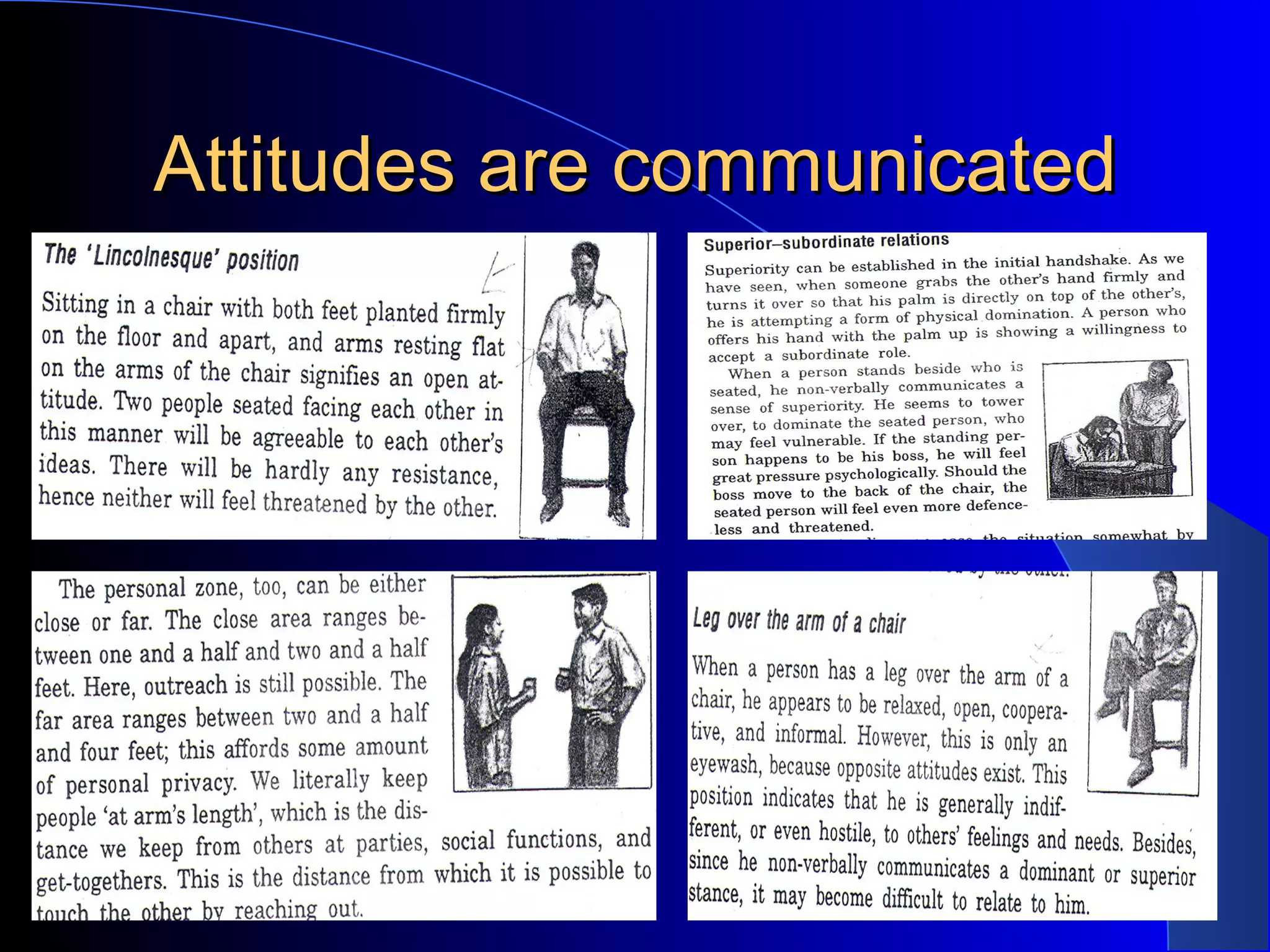
From Attitudes to Transaction “ Can you have a look at this document?”   Can you guess whether this person has a positive   or negative feeling towards the one with whom he is   conversing?
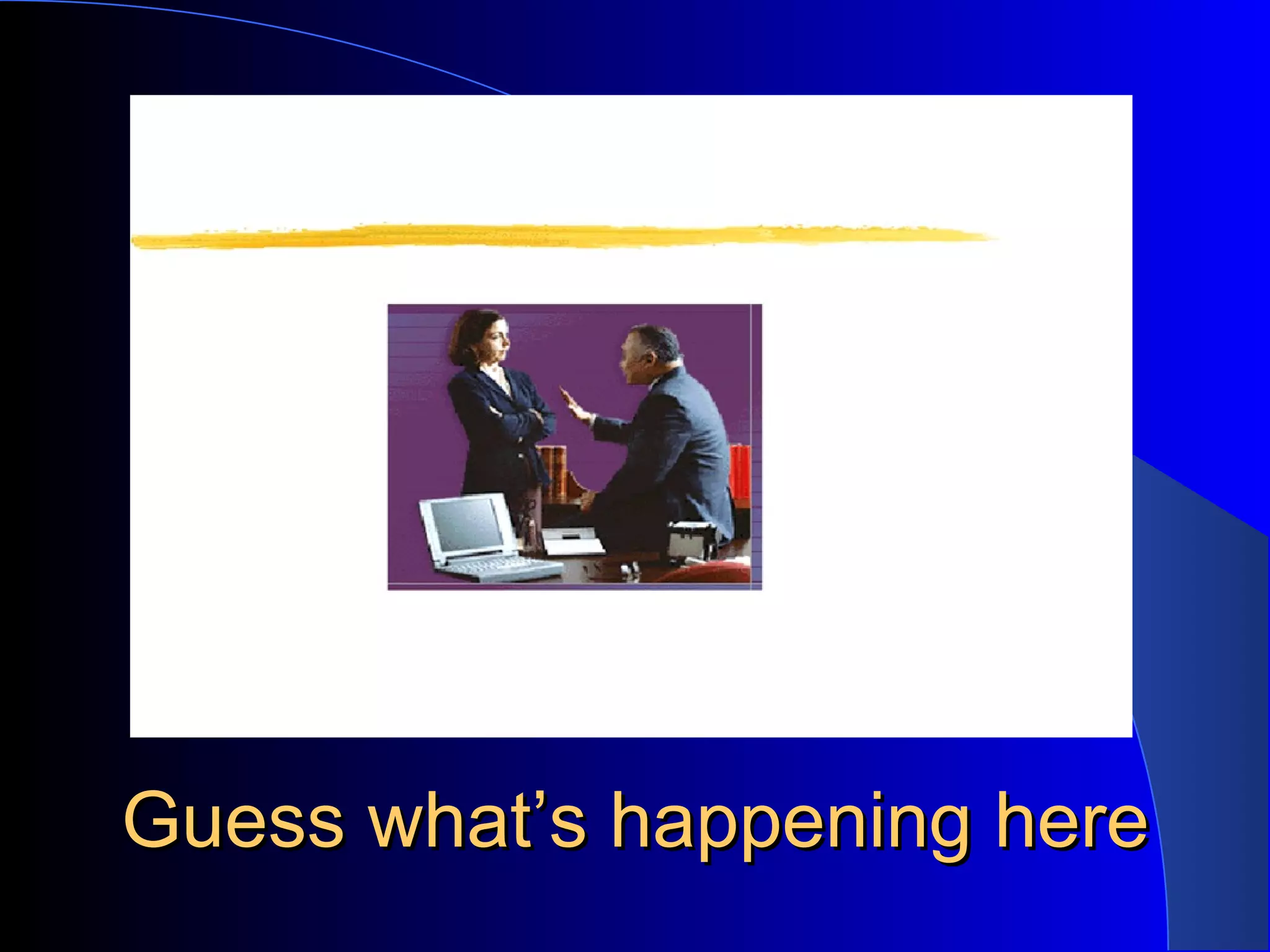
Guess what’s happening here
‘ What’ Depends on ‘How’ …. & ‘How’ goes beyond the spoken words Transaction Interaction Reaction Perception Communication Attitudes
Attitudes are communicated
TA- The Basic Concepts Parent Adult Child
 
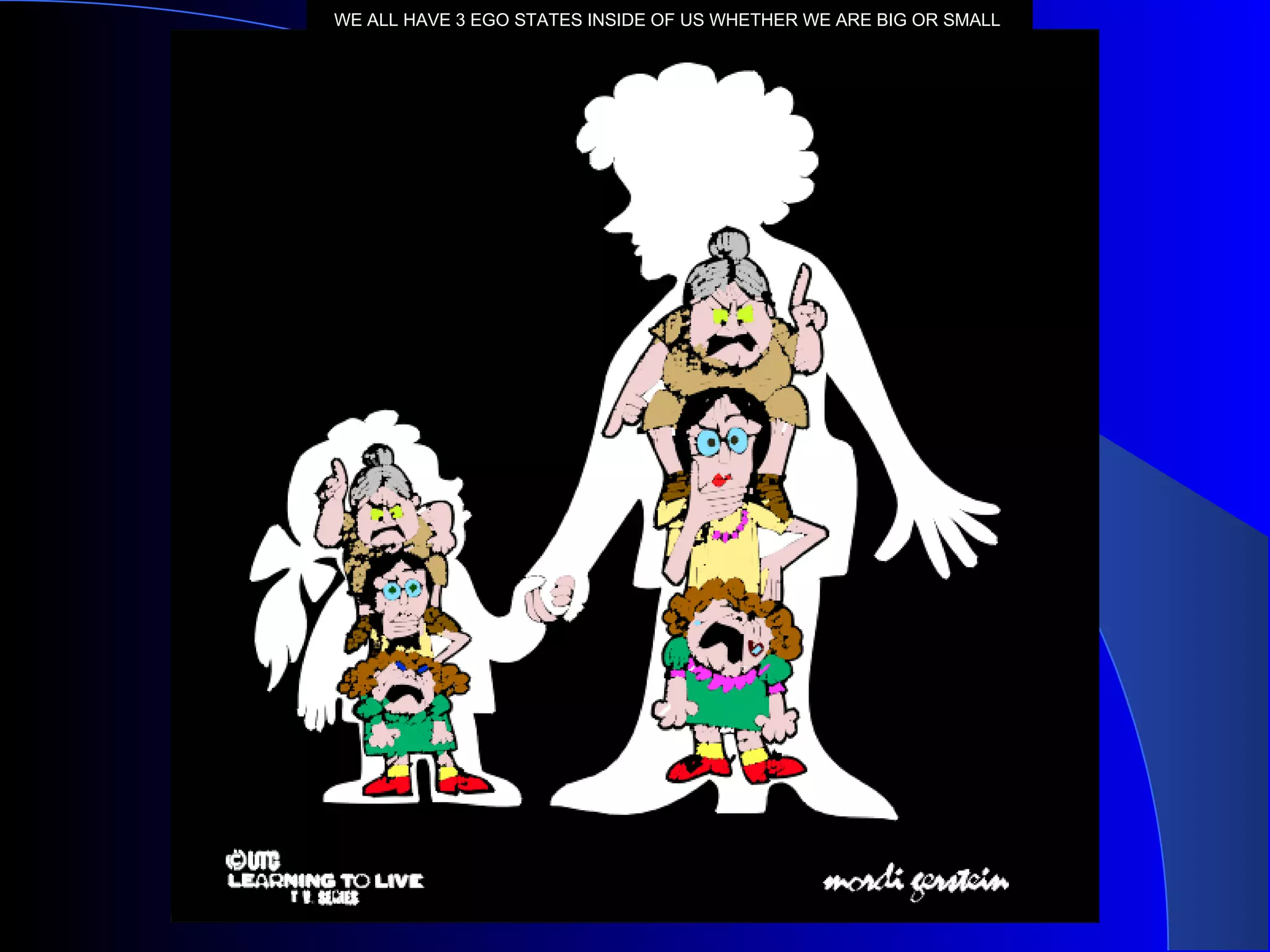
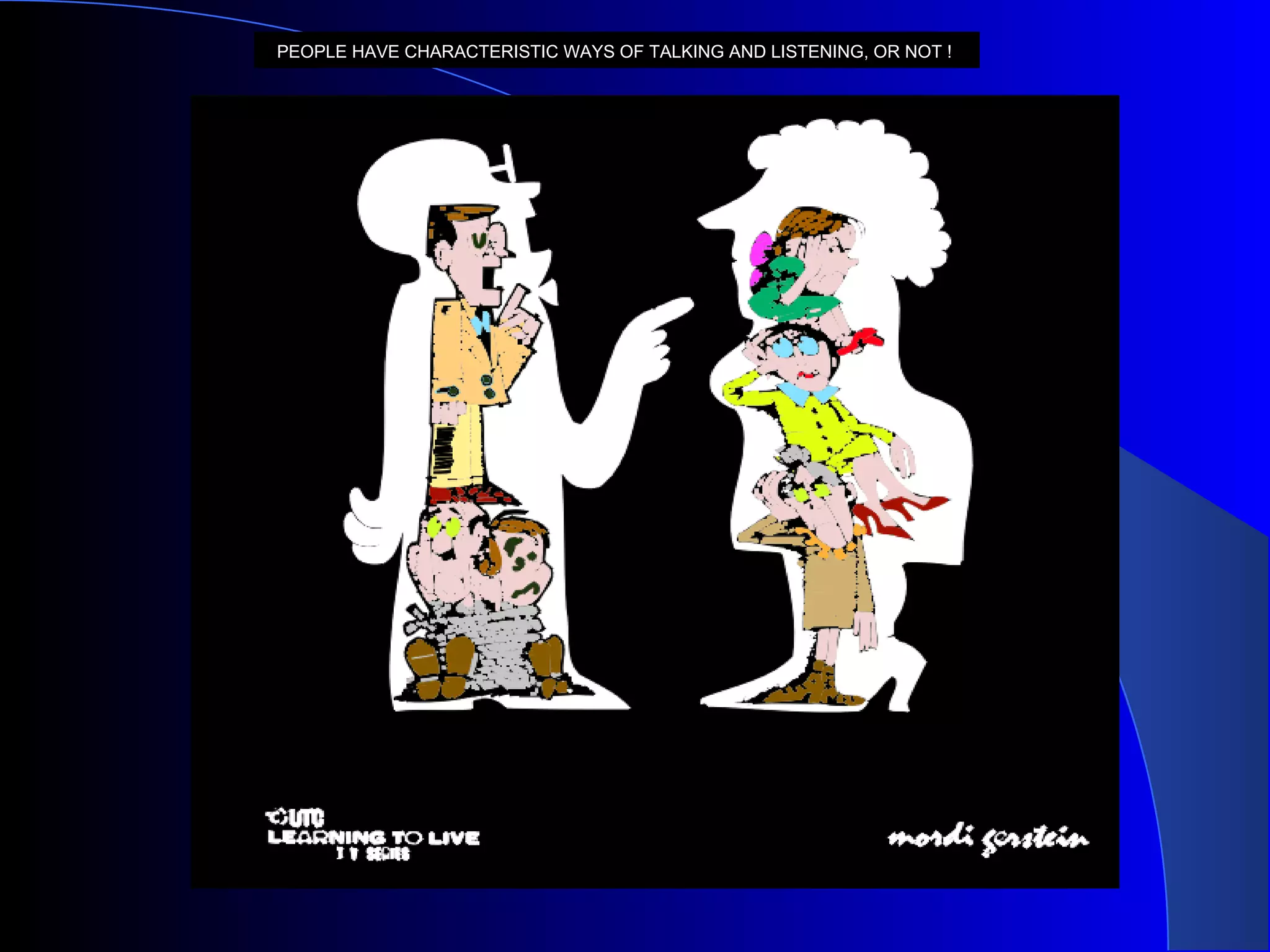
WE ALL HAVE 3 EGO STATES INSIDE OF US WHETHER WE ARE BIG OR SMALL
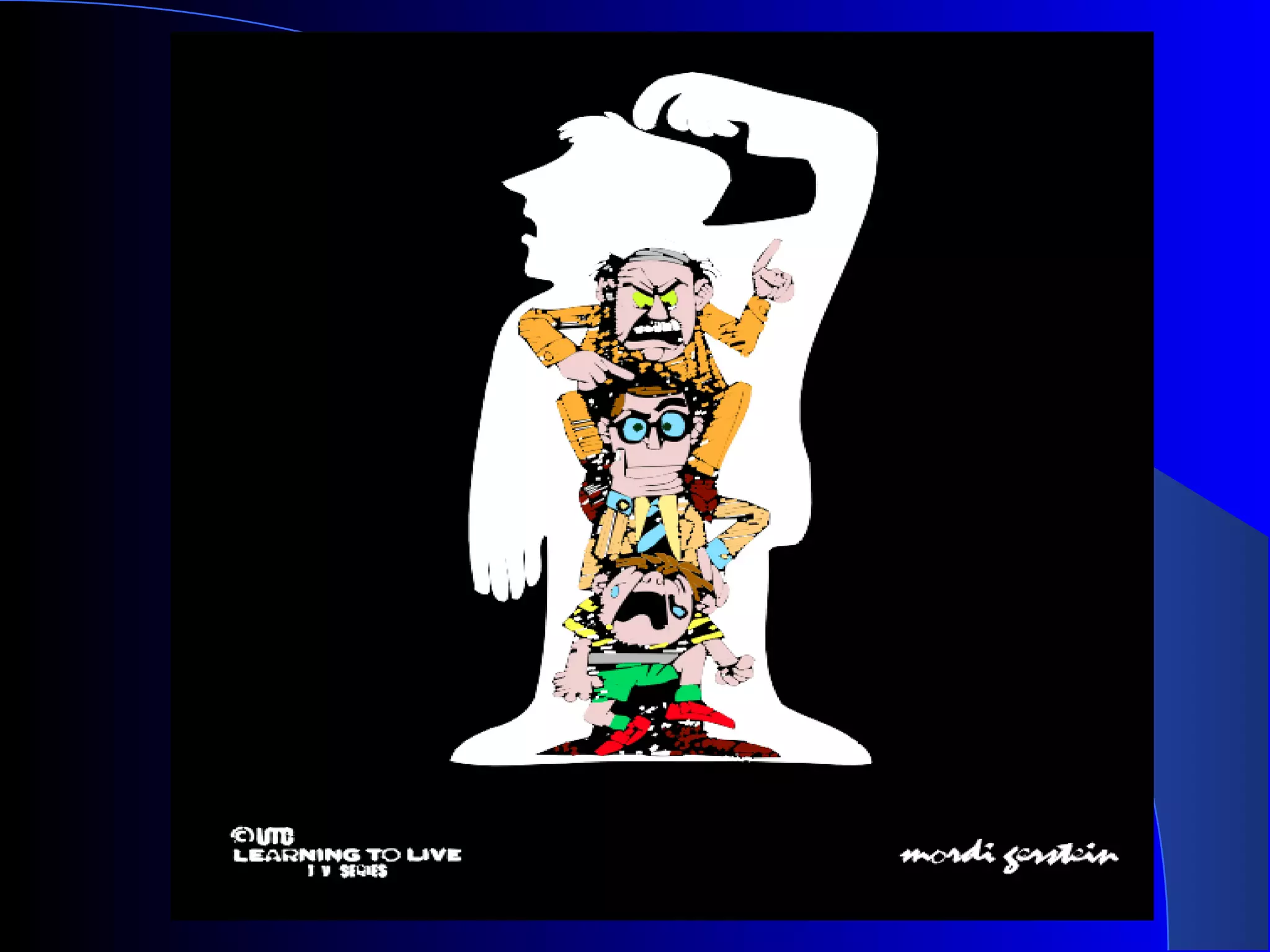
PEOPLE HAVE CHARACTERISTIC WAYS OF TALKING AND LISTENING, OR NOT !
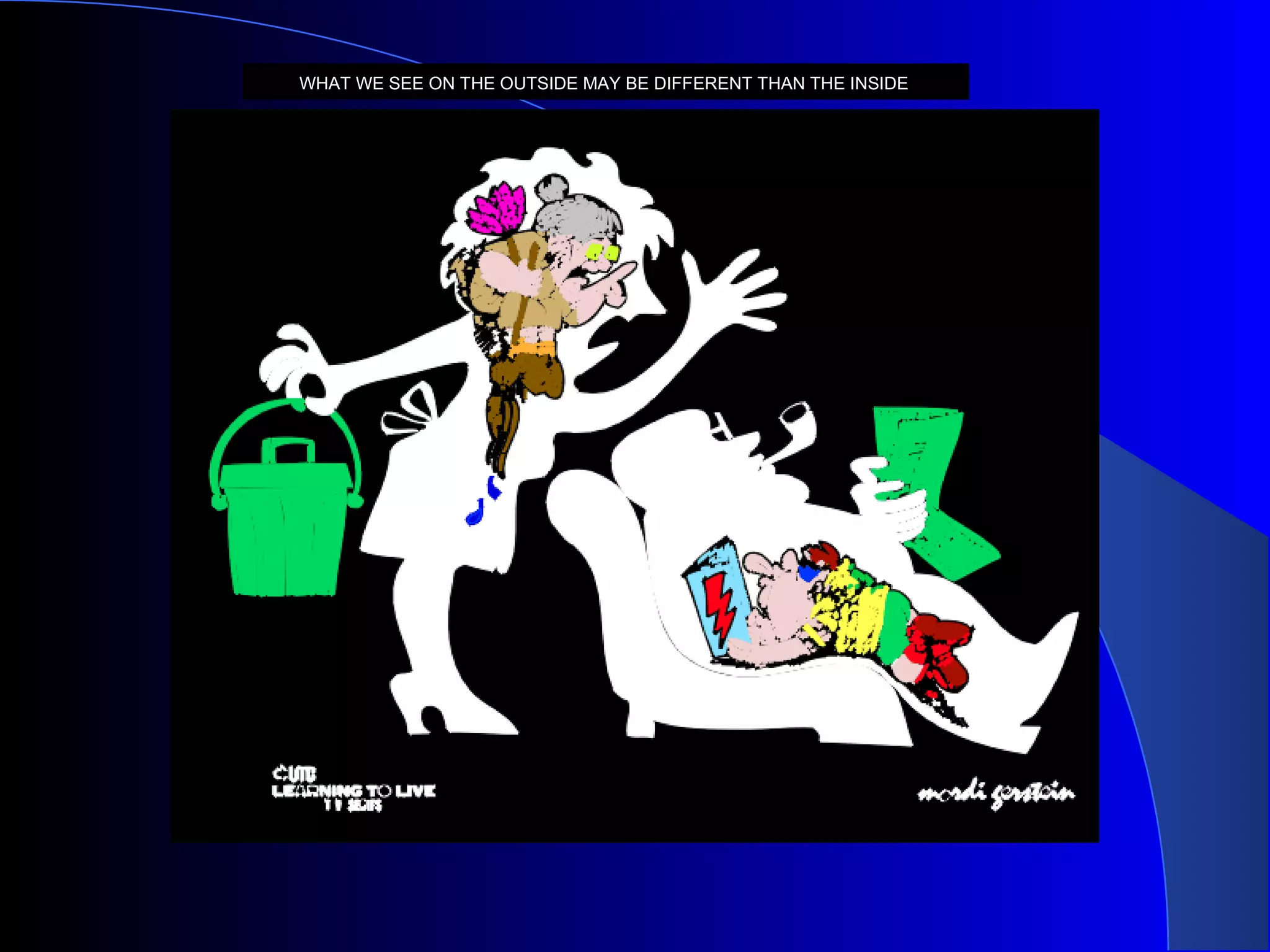
WHAT WE SEE ON THE OUTSIDE MAY BE DIFFERENT THAN THE INSIDE
Parent ("exteropsyche"):   a state in which people behave, feel, and think in response to an unconscious mimicking of how their parents (or other parental figures) acted, or how they interpreted their parent's actions. For example, a person may shout at someone out of frustration because they learned from an influential figure in childhood the lesson that this seemed to be a way of relating that worked.
Adult ("neopsyche"):  a state of the ego which is most like a computer processing information and making predictions absent of major emotions that cloud its operation. Learning to strengthen the Adult is a goal of TA. While a person is in the Adult ego state, he/she is directed towards an objective appraisal of reality.  Child ("archaeopsyche"):  a state in which people behave, feel and think similarly to how they did in childhood. For example, a person who receives a poor evaluation at work may respond by looking at the floor, and crying or pouting, as they used to when scolded as a child. Conversely, a person who receives a good evaluation may respond with a broad smile and a joyful gesture of thanks. The Child is the source of emotions, creation, recreation, spontaneity and intimcacy.
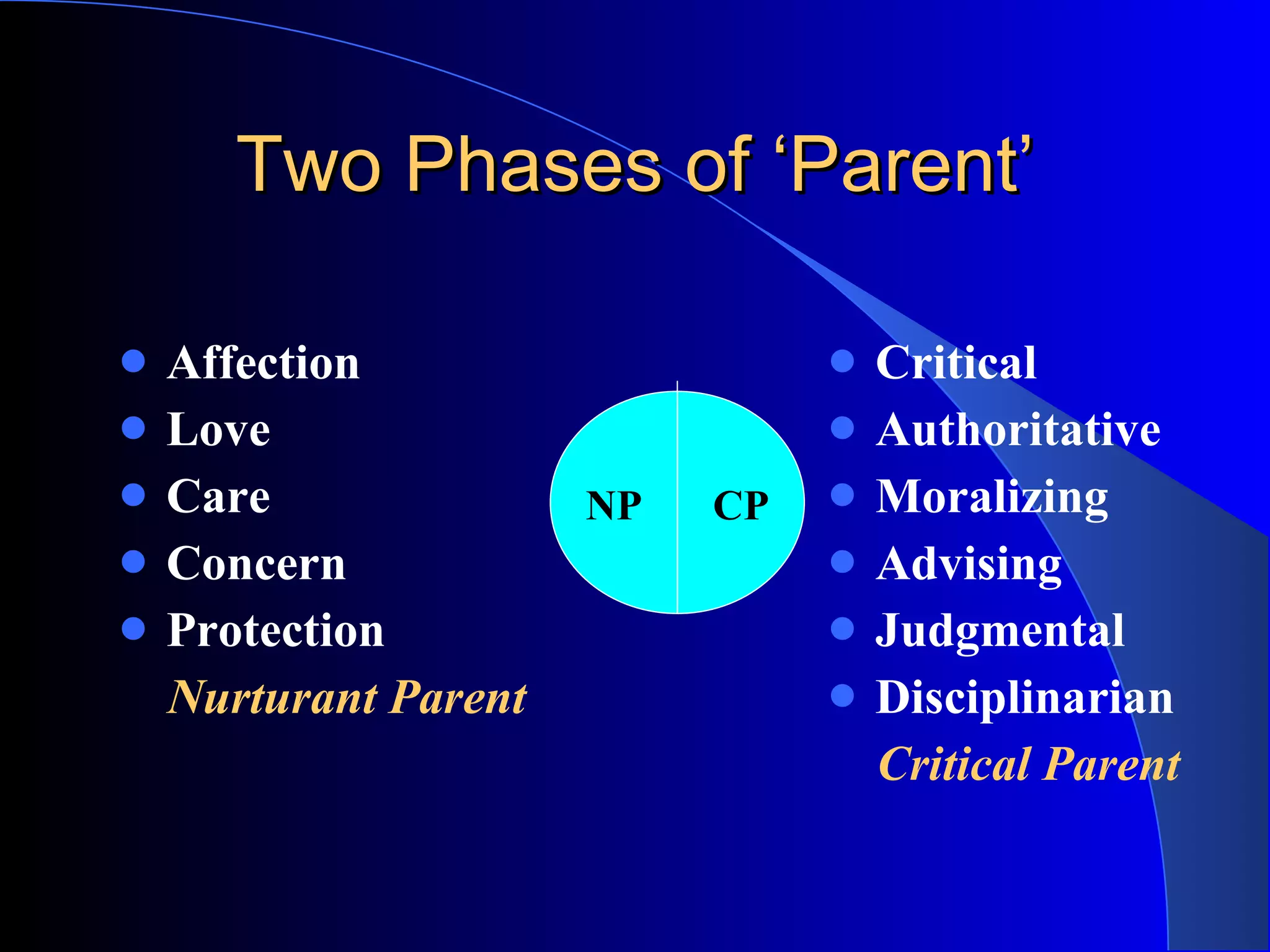
Two Phases of ‘Parent’ Affection Love Care Concern Protection Nurturant Parent Critical Authoritative Moralizing Advising Judgmental Disciplinarian Critical Parent NP CP
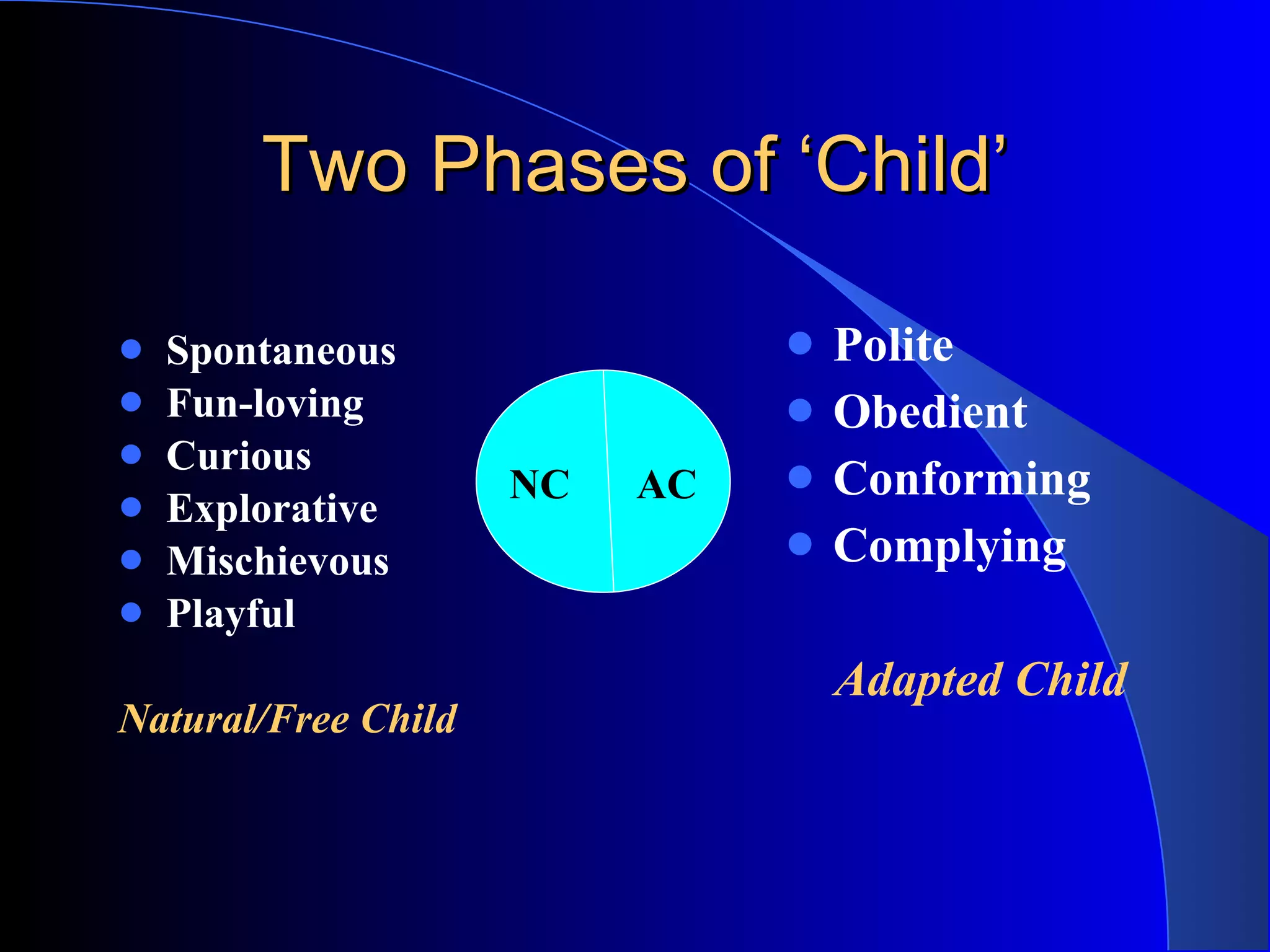
Two Phases of ‘Child’ Spontaneous Fun-loving Curious Explorative Mischievous Playful   Natural/Free Child   Polite Obedient Conforming Complying Adapted Child NC AC
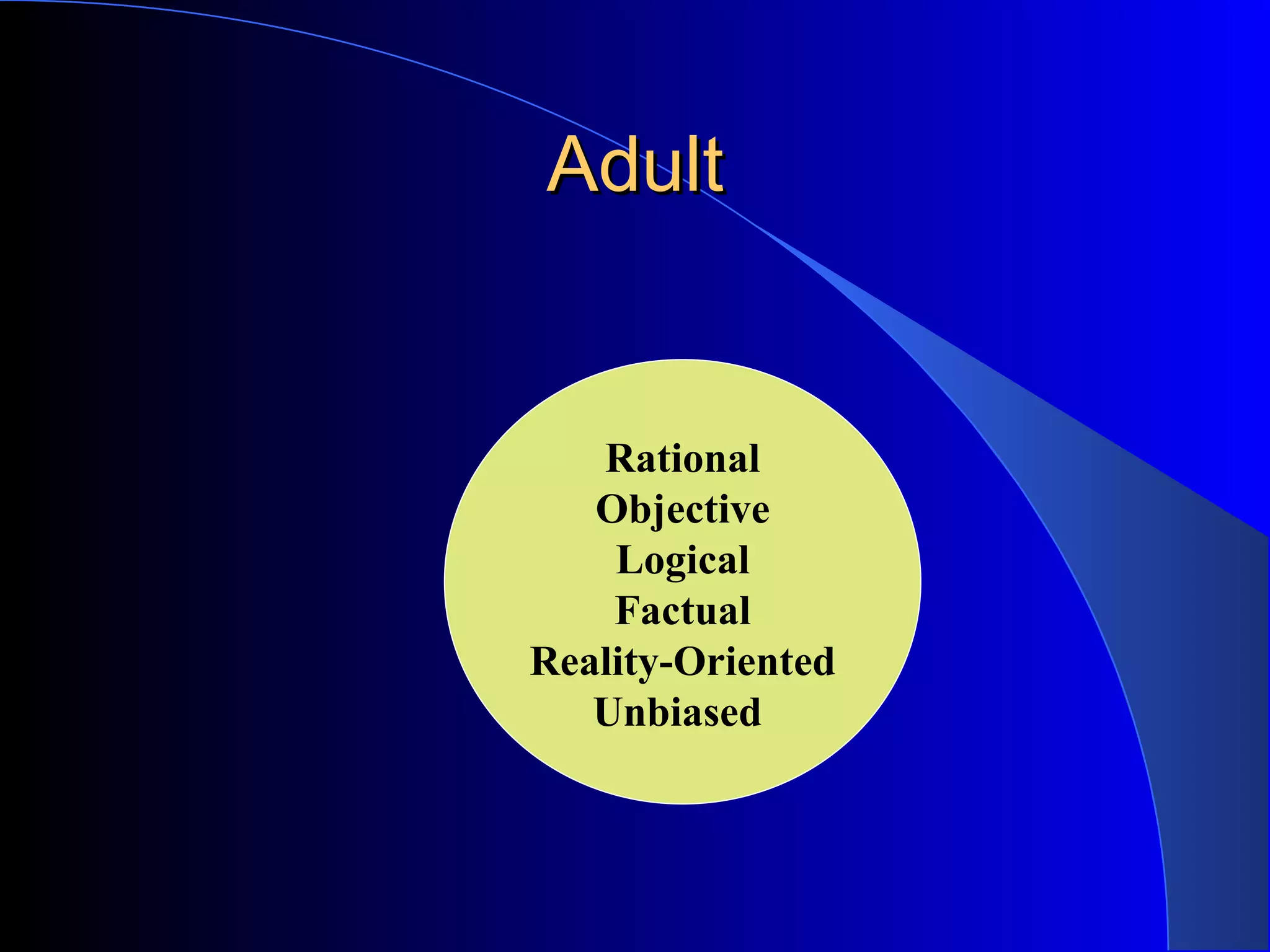
Adult Rational Objective Logical Factual Reality-Oriented Unbiased
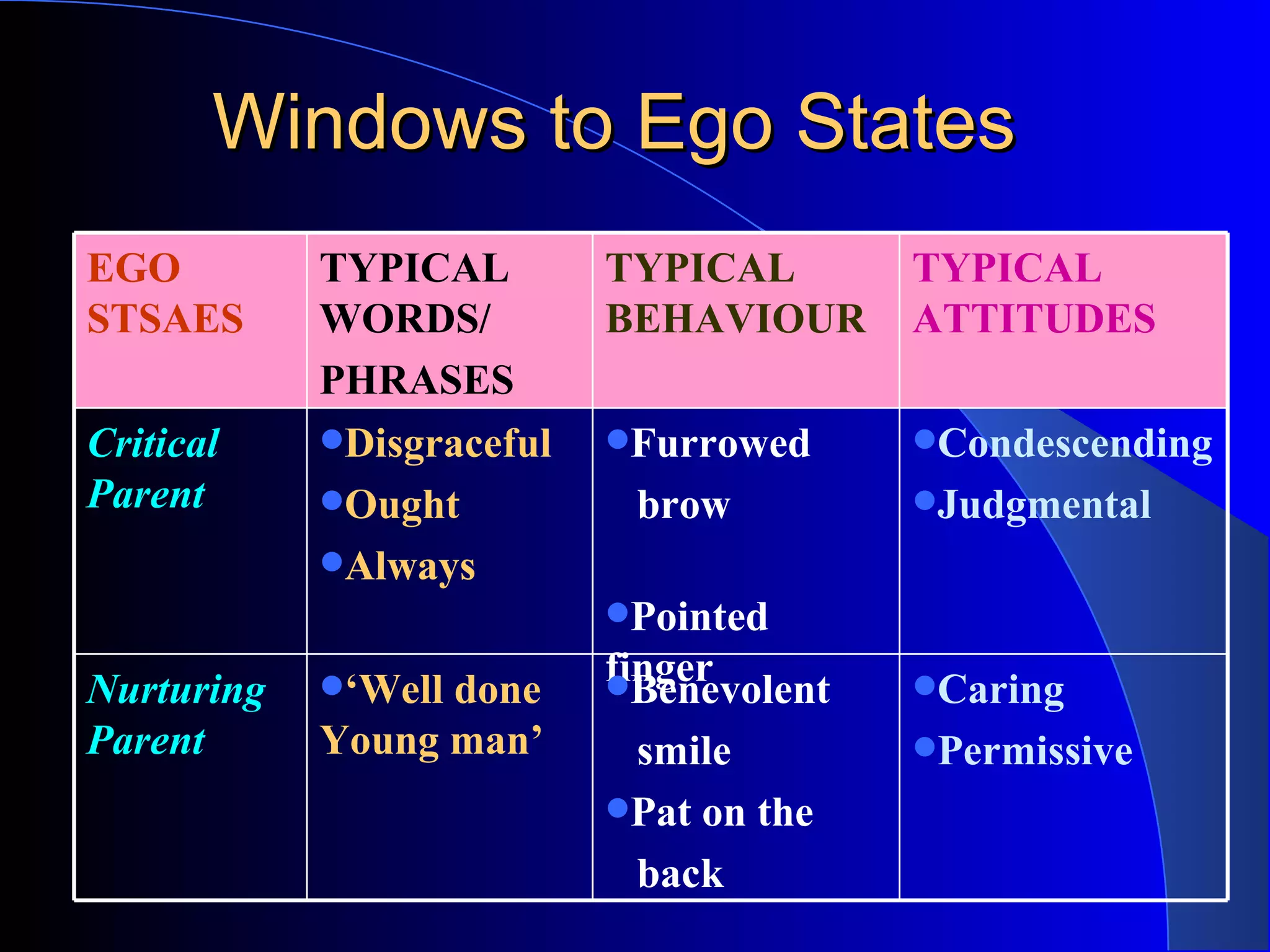
Windows to Ego States EGO STSAES TYPICAL WORDS/ PHRASES TYPICAL BEHAVIOUR TYPICAL ATTITUDES Critical Parent Disgraceful Ought Always Furrowed  brow  Pointed finger Condescending Judgmental Nurturing Parent ‘ Well done Young man’ Benevolent smile  Pat on the back Caring Permissive
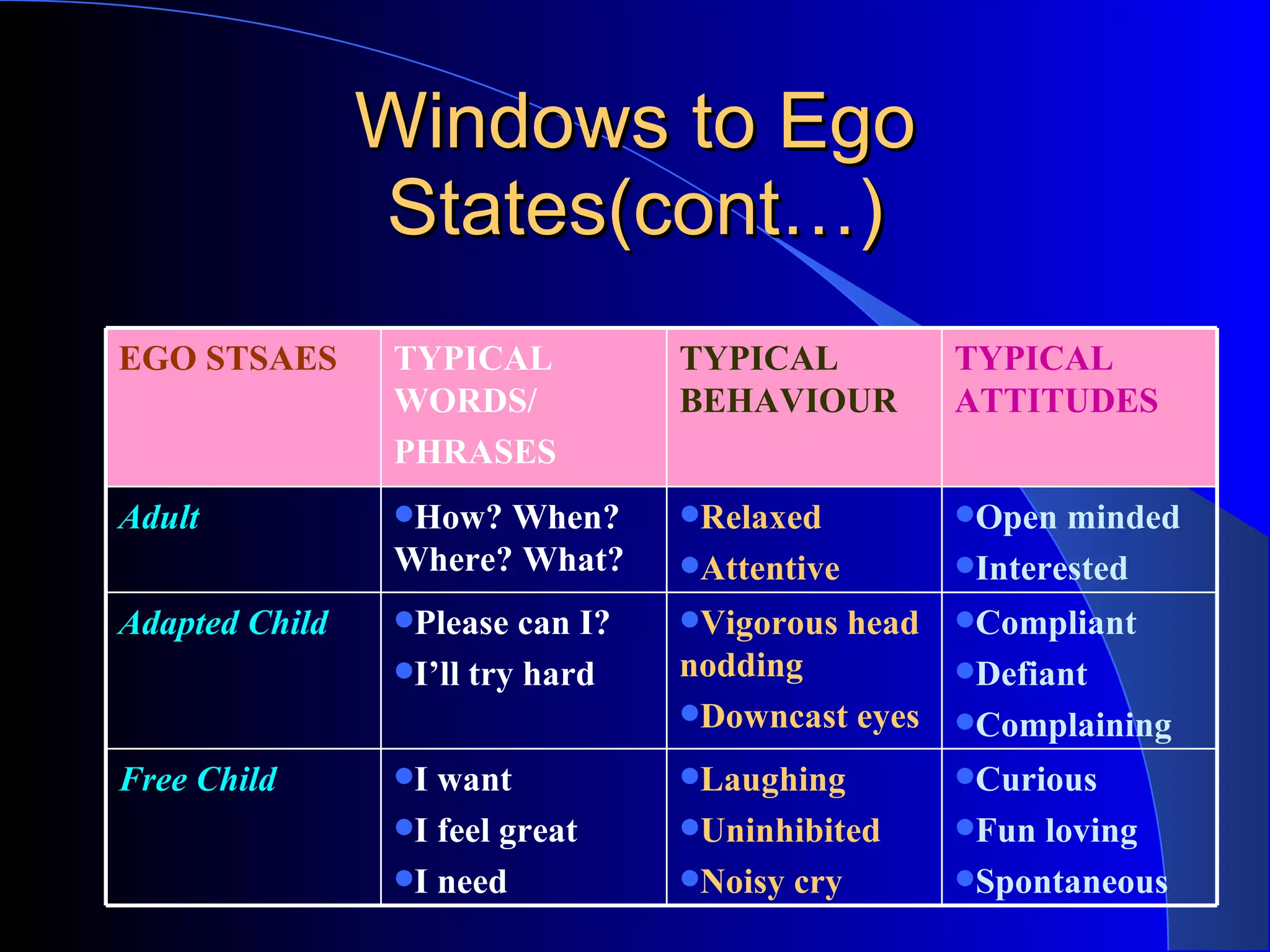
Windows to Ego States(cont…) EGO STSAES TYPICAL WORDS/ PHRASES TYPICAL BEHAVIOUR TYPICAL ATTITUDES Adult How? When? Where? What? Relaxed Attentive Open minded Interested Adapted Child Please can I? I’ll try hard Vigorous head nodding Downcast eyes Compliant Defiant Complaining Free Child I want I feel great I need Laughing  Uninhibited Noisy cry Curious Fun loving Spontaneous
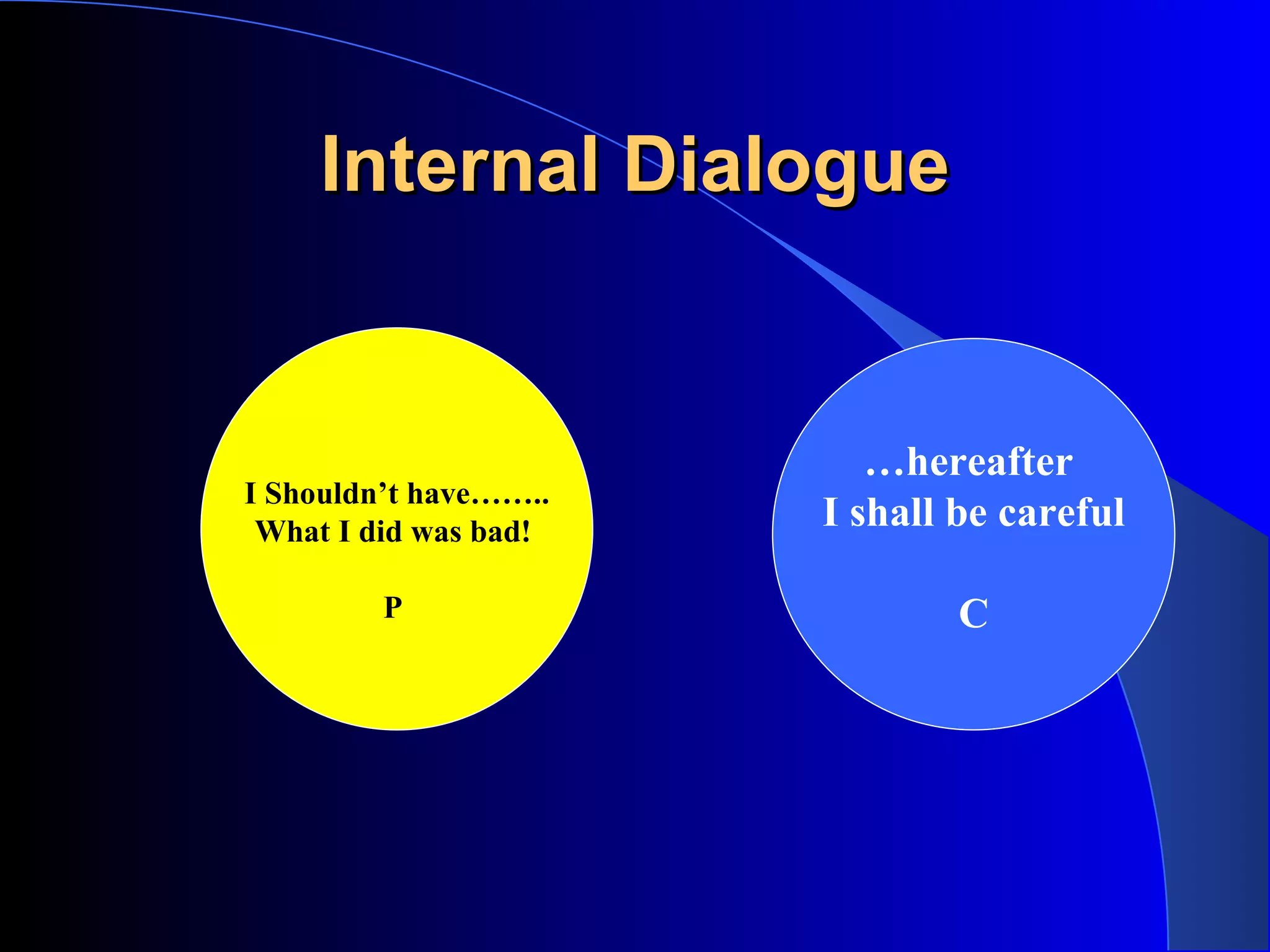
Internal Dialogue I Shouldn’t have…….. What I did was bad!   P  … hereafter  I shall be careful C
Transactions
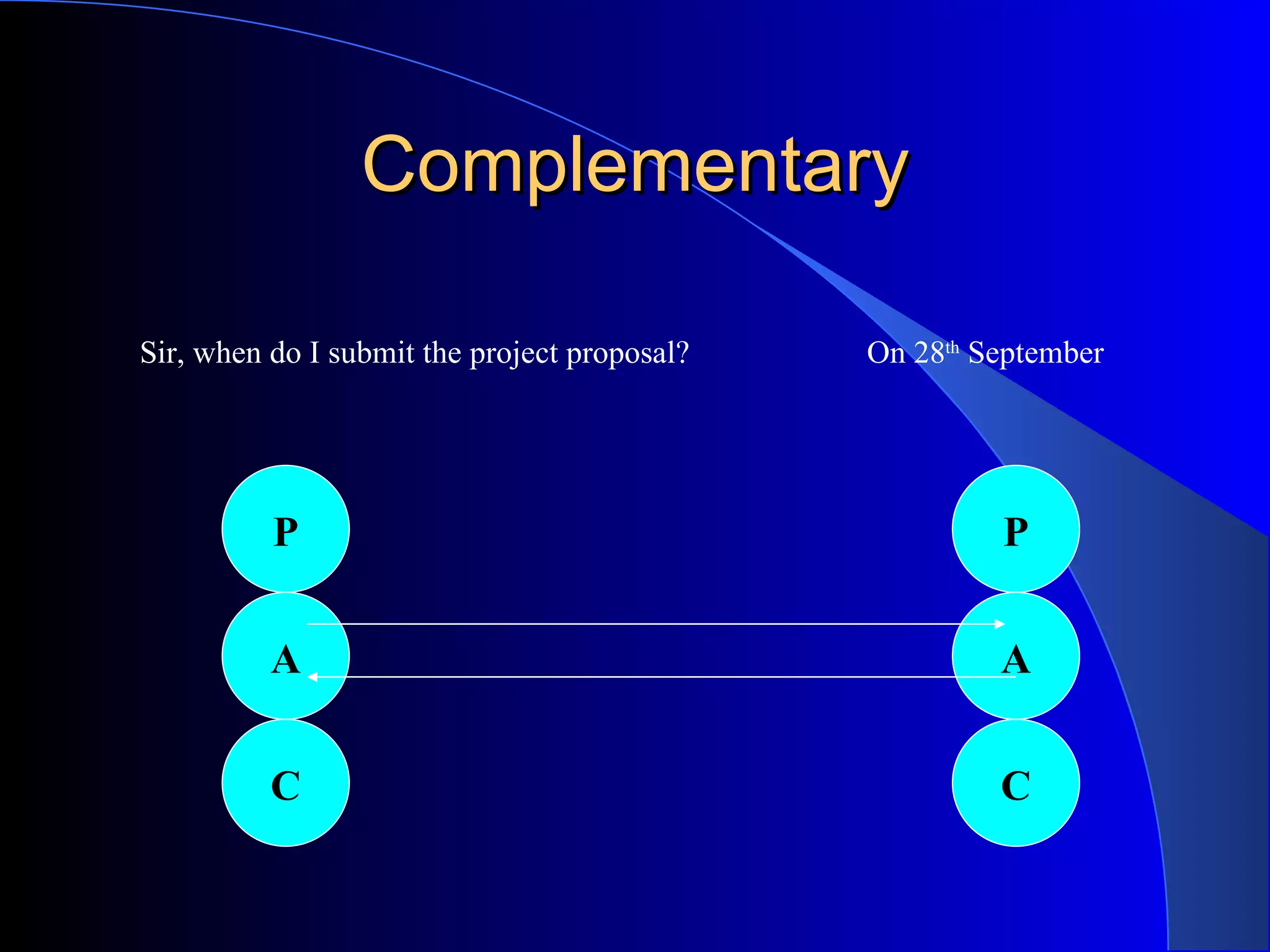
Complementary Sir, when do I submit the project proposal?  On 28 th  September P A C P A C
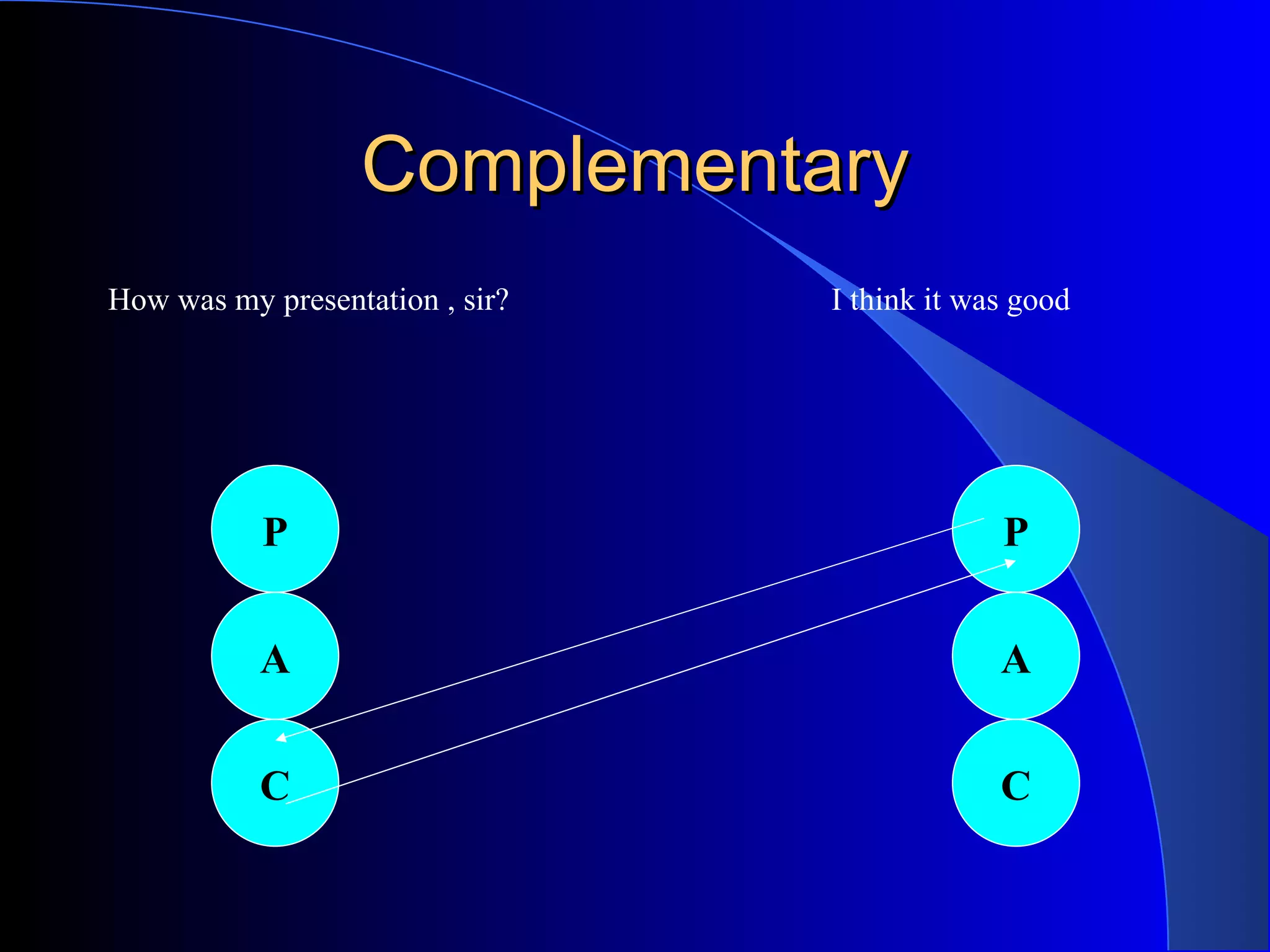
Complementary How was my presentation , sir?  I think it was good P A C P A C
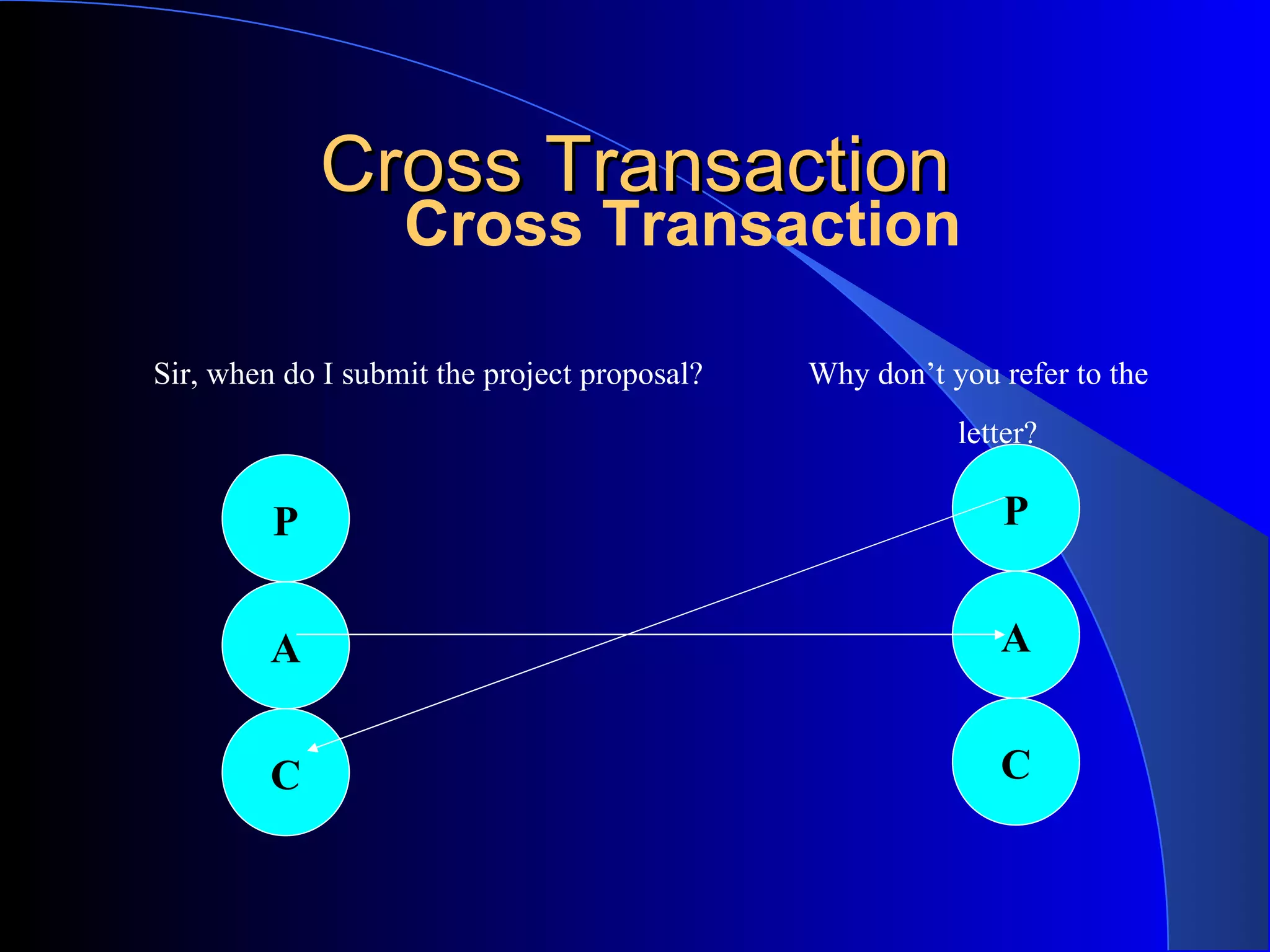
Cross Transaction Cross Transaction Sir, when do I submit the project proposal?  Why don’t you refer to the    letter?   P A C P A C
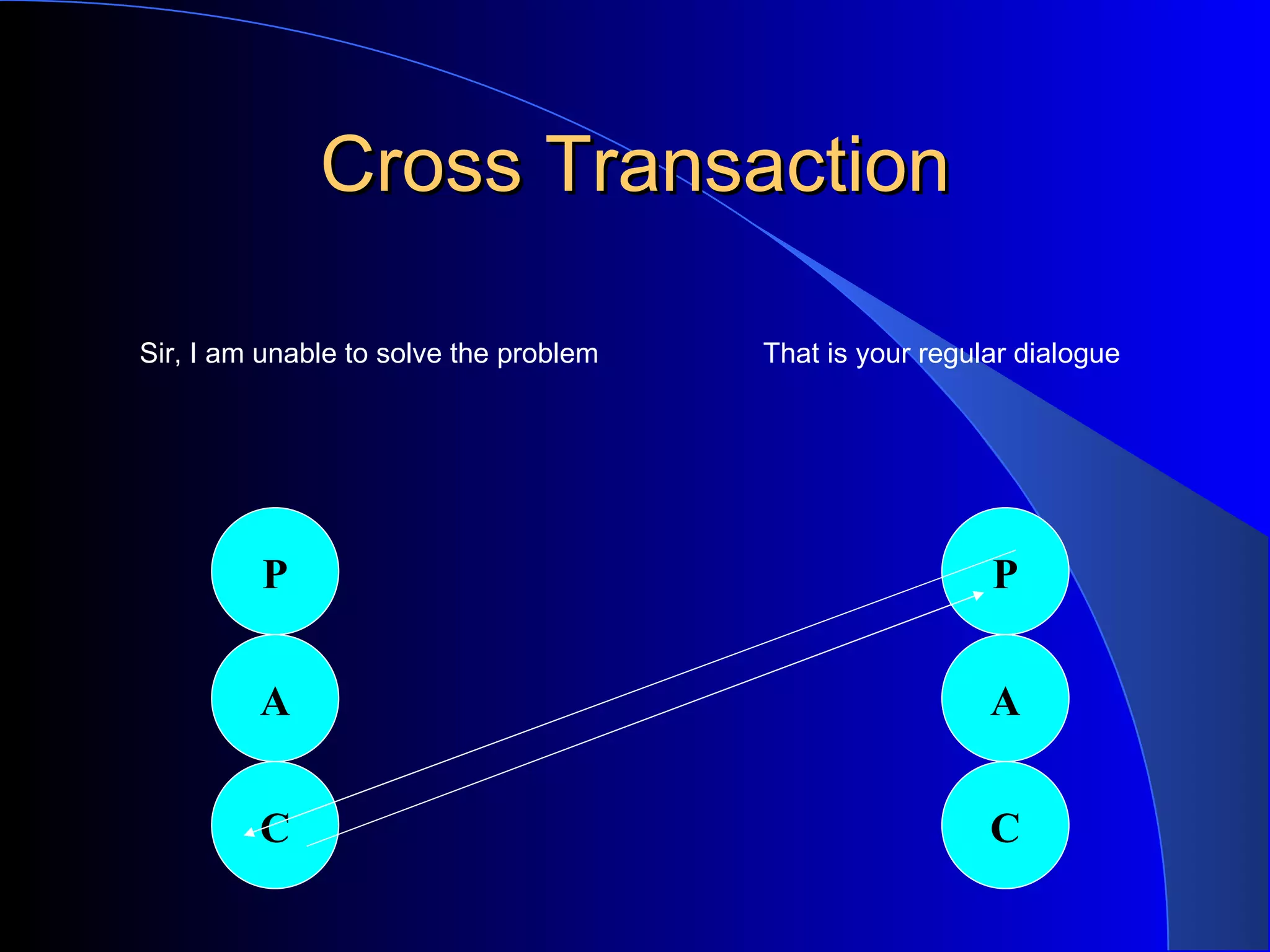
Cross Transaction Sir, I am unable to solve the problem  That is your regular dialogue P A C P A C
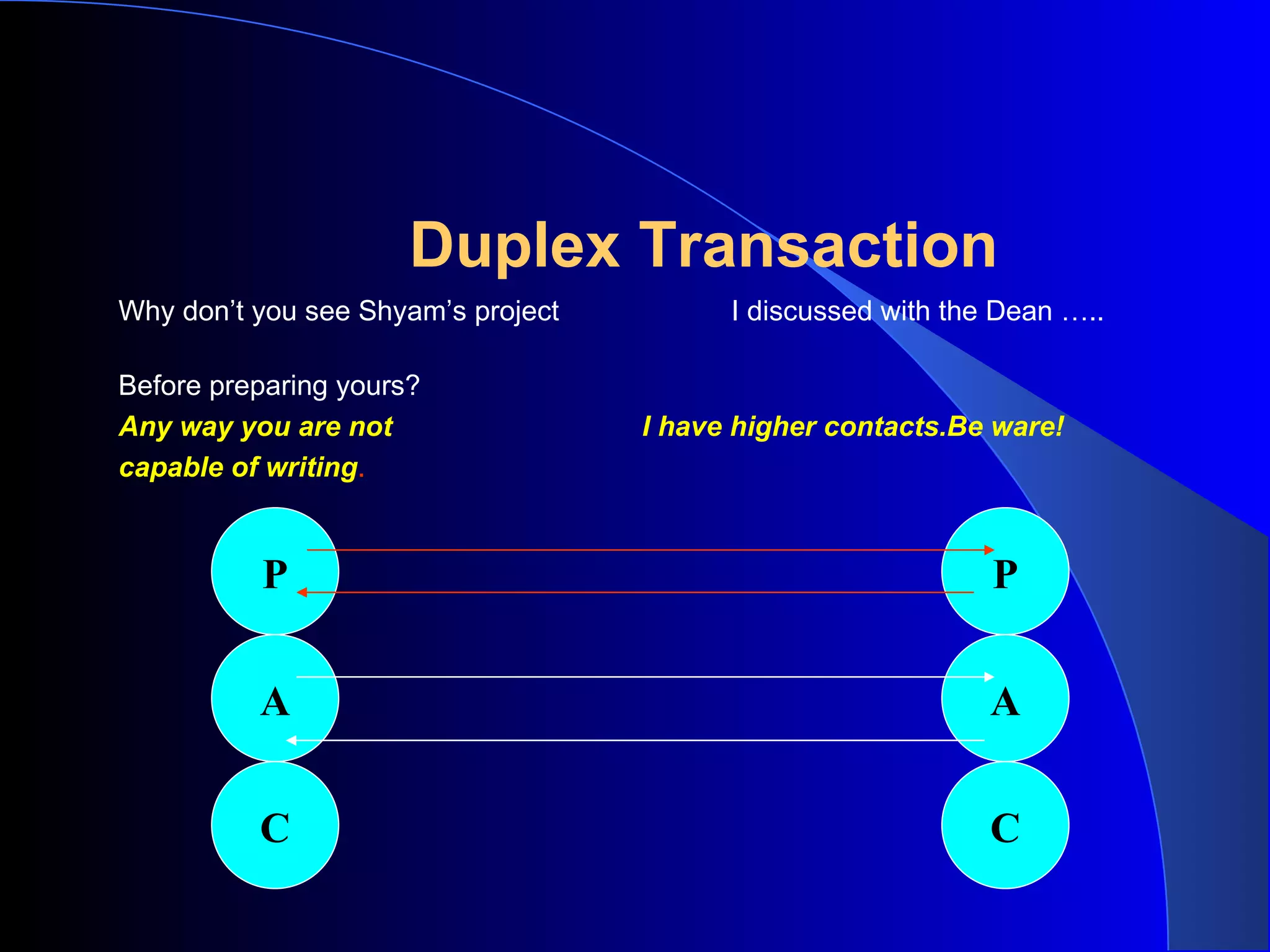
Duplex Transaction Why don’t you see Shyam’s project  I discussed with the Dean …..  Before preparing yours?  Any way you are not    I have higher contacts.Be ware! capable of writing .  P A C P A C
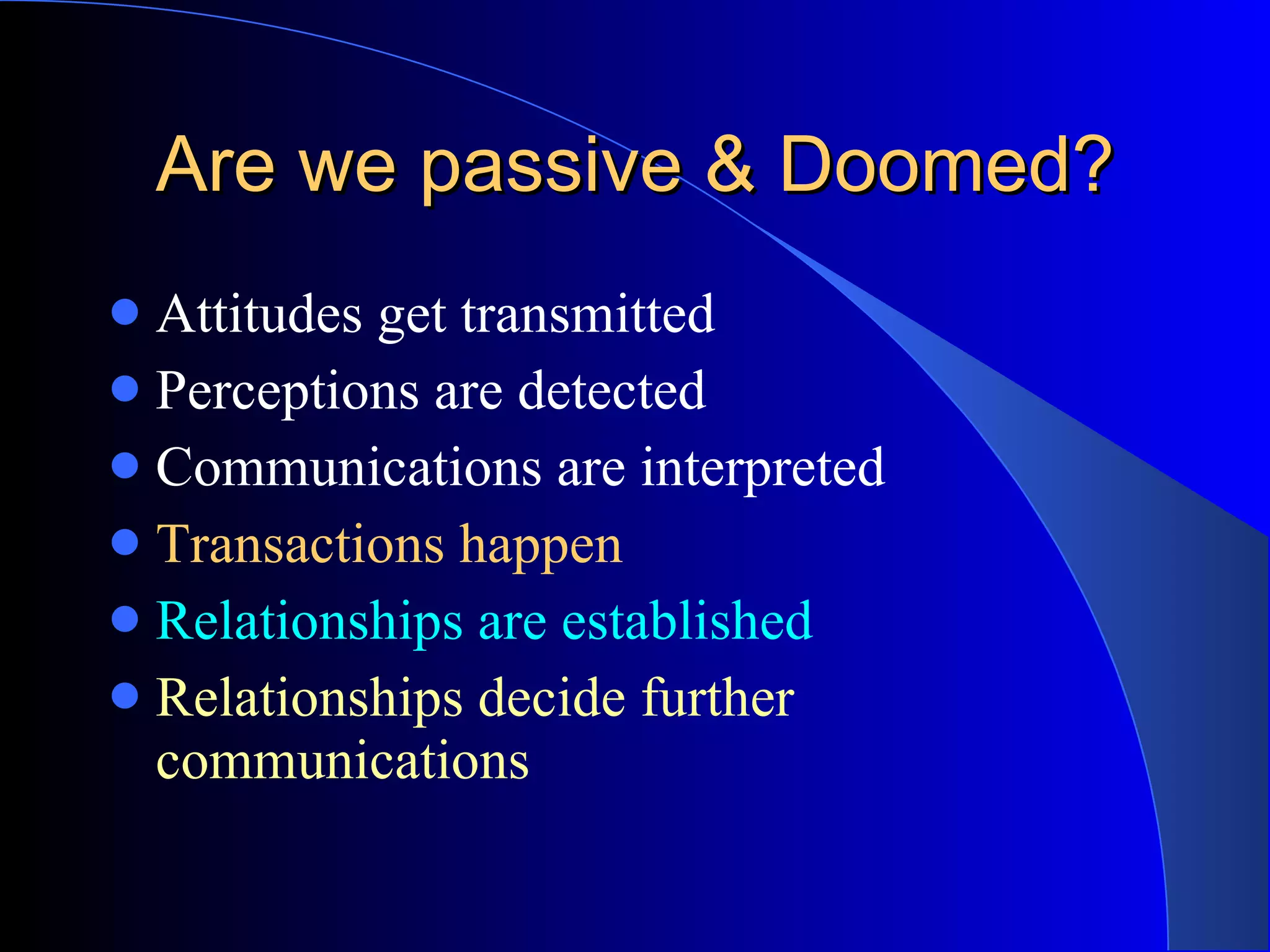
Are we passive & Doomed? Attitudes get transmitted Perceptions are detected Communications are interpreted Transactions happen Relationships are established Relationships decide further communications
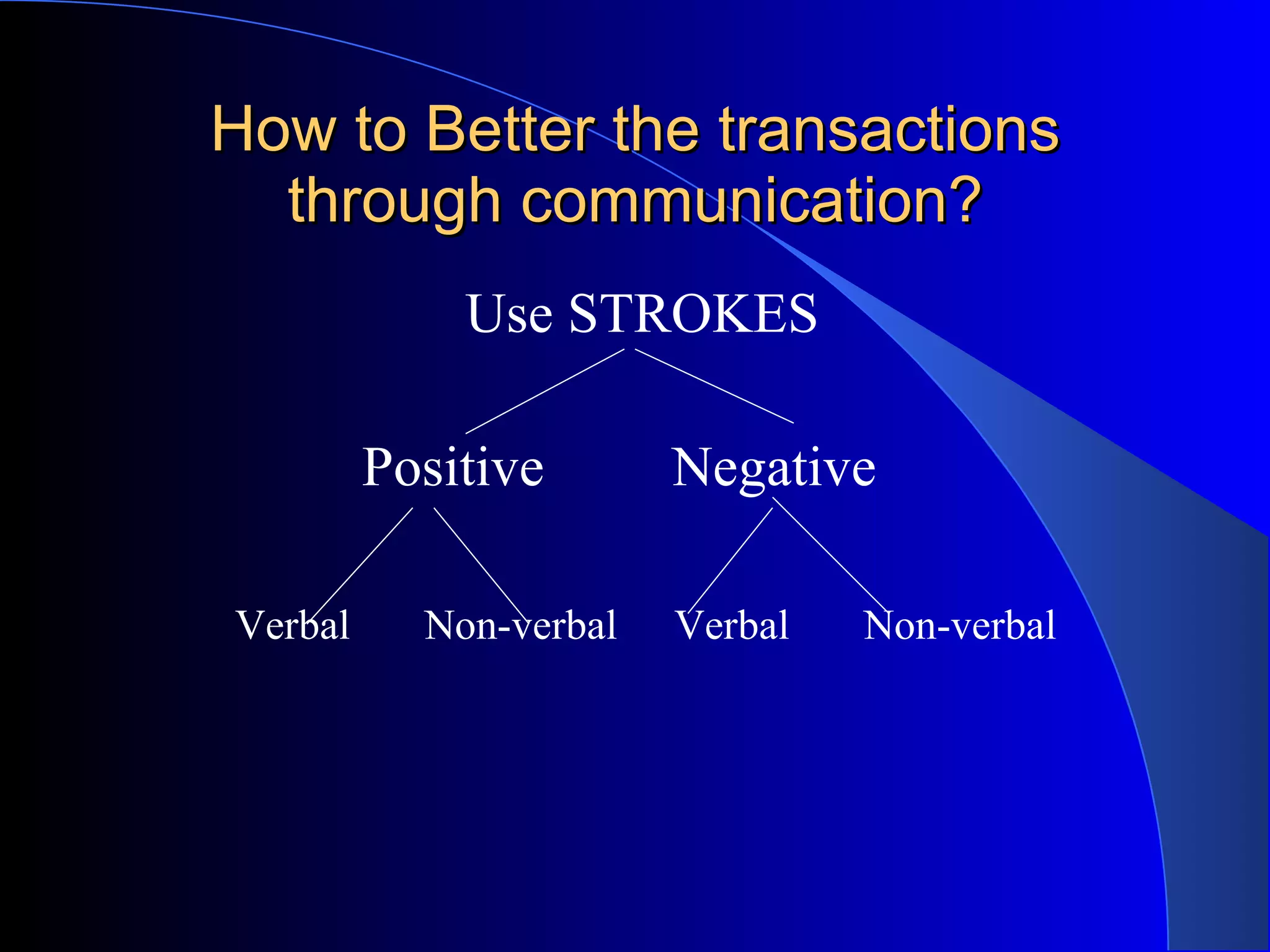
How to Better the transactions through communication? Use STROKES Positive  Negative Verbal  Non-verbal   Verbal  Non-verbal
Transactions and Strokes Transactions  are the flow of communication, and more specifically the unspoken psychological flow of communication that runs in parallel.  Transactions occur simultaneously at both explicit and psychological levels. Example: sweet caring voice with sarcastic intent. To read the real communication requires both surface and non-verbal reading.  Strokes  are the recognition, attention or responsiveness that one person gives another. Strokes can be positive or negative  A key idea is that people hunger for recognition, and that lacking positive strokes, will seek whatever kind they can, even if it is recognition of a negative kind. We test out as children what strategies and behaviors seem to get us strokes, of whatever kind we can get
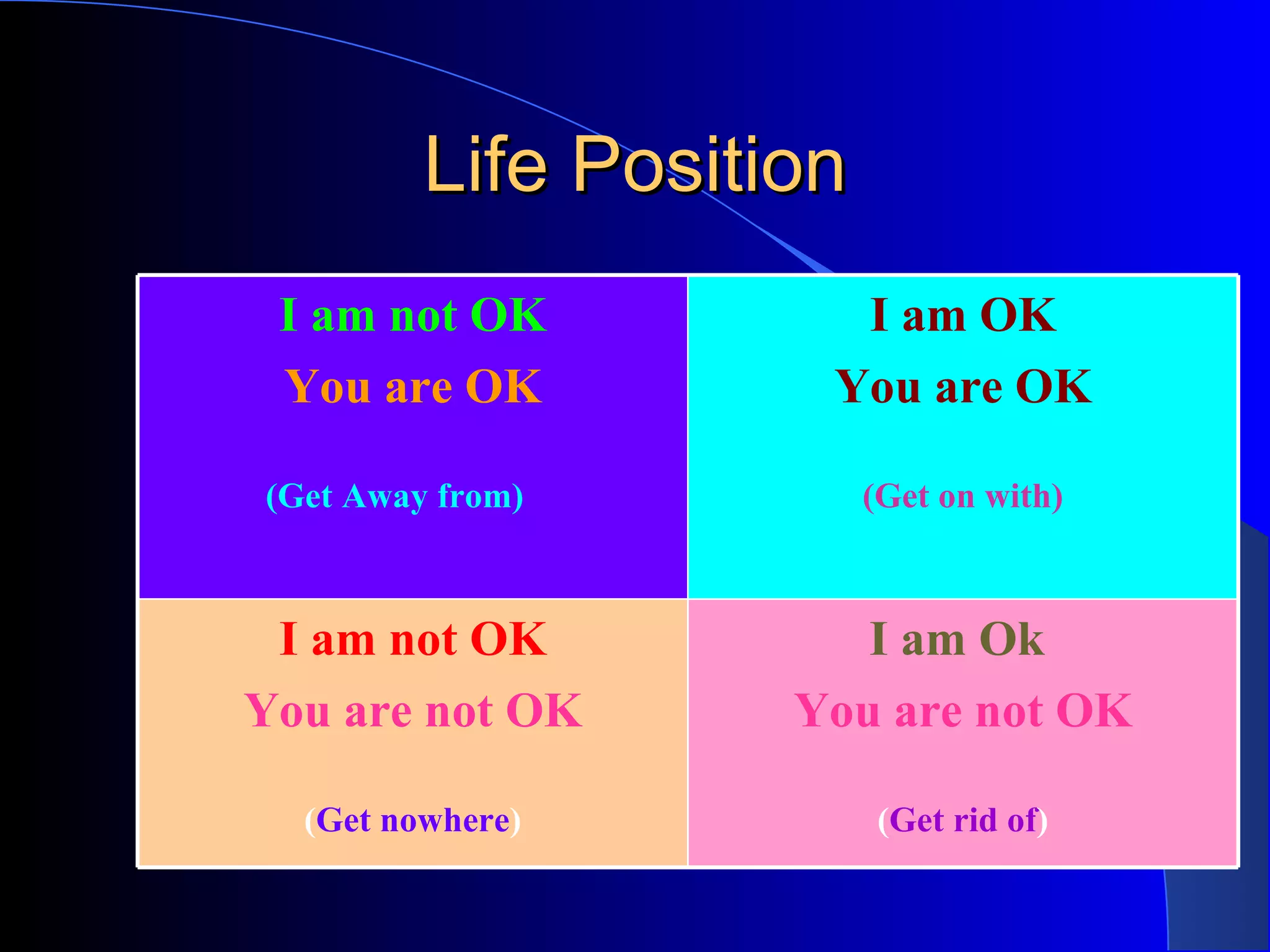
Life Position I am not OK You are OK (Get Away from) I am OK You are OK (Get on with) I am not OK You are not OK ( Get nowhere ) I am Ok   You are not OK ( Get rid of )
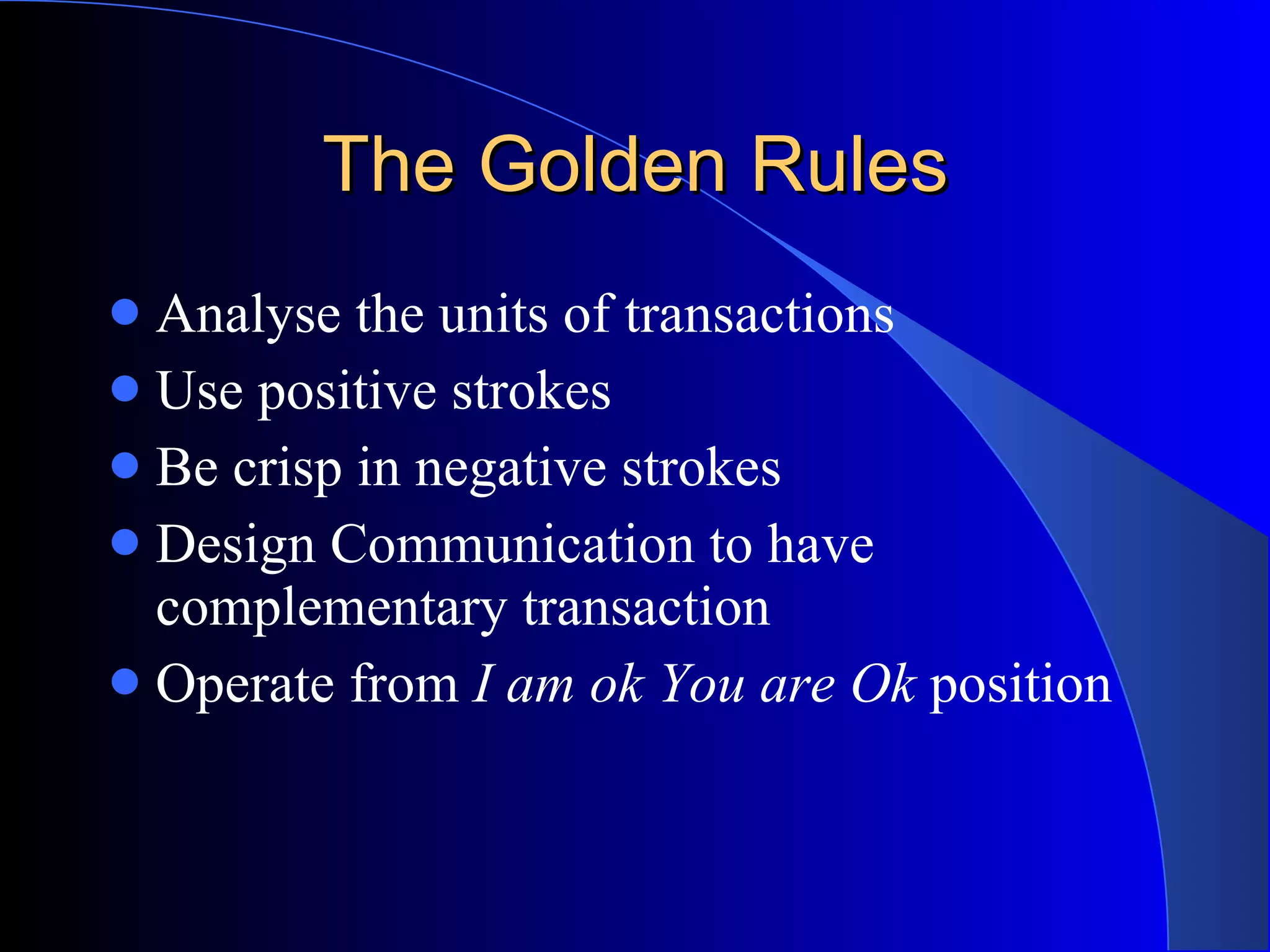
The Golden Rules Analyse the units of transactions Use positive strokes Be crisp in negative strokes Design Communication to have complementary transaction Operate from  I am ok You are Ok  position
To have a good day…. Exchange more  Golden stamps Thank you

Teacher student interaction ta approach new

  • 1.
    Teacher Student Interaction-TAApproach Eric Berne By Bhaskar j naidu Lecturer in Mining
  • 2.
    Transactional analysis isa theory of personality and a systematic psychotherapy for personal growth and personal change. Among psychological approaches, it is outstanding in the depth of its theory and the wide variety of its applications.
  • 3.
    Key Ideas inTransactional Analysis 1. Ego State Model (PAC Model): An ego state is a set of related behaviors, thoughts, and feelings, a way in which we manifest a part of our personality at a given time. Transactional analysis portrays three ego states: Adult (behaving, thinking, feeling in response to what is going on around me in the here and now), Parent (behaving, thinking, feeling in ways that are a copy of one of my parents or other parent figures), and Child (behaving, thinking, feeling that I used when I was a child). When we use the ego-state model to understand personality, we are employing structural analysis.
  • 4.
    2. Transactions, Strokes,Time Structuring: One can address you from any of ego states, and you can reply in turn. This exchange is a transaction. The use of the ego-state model to analyze sequences of transactions is transactional analysis proper. When you and I transact, I signal recognition of you and you return that recognition; any act of recognition is a stroke. People need strokes to maintain their psychical and psychological well-being. When people transact in groups or pairs, they use time in various specific ways which can be listed and analyzed; this is the analysis of time structuring
  • 5.
    Communication-What constitutes it?Spoken words Gestures Postures Attitudes Perceptions Interpretations
  • 6.
    From Attitudes toTransaction “ Can you have a look at this document?” Can you guess whether this person has a positive or negative feeling towards the one with whom he is conversing?
  • 7.
  • 8.
    ‘ What’ Dependson ‘How’ …. & ‘How’ goes beyond the spoken words Transaction Interaction Reaction Perception Communication Attitudes
  • 9.
  • 10.
    TA- The BasicConcepts Parent Adult Child
  • 11.
  • 12.
    WE ALL HAVE3 EGO STATES INSIDE OF US WHETHER WE ARE BIG OR SMALL
  • 13.
    PEOPLE HAVE CHARACTERISTICWAYS OF TALKING AND LISTENING, OR NOT !
  • 14.
    WHAT WE SEEON THE OUTSIDE MAY BE DIFFERENT THAN THE INSIDE
  • 15.
    Parent ("exteropsyche"): a state in which people behave, feel, and think in response to an unconscious mimicking of how their parents (or other parental figures) acted, or how they interpreted their parent's actions. For example, a person may shout at someone out of frustration because they learned from an influential figure in childhood the lesson that this seemed to be a way of relating that worked.
  • 16.
    Adult ("neopsyche"): a state of the ego which is most like a computer processing information and making predictions absent of major emotions that cloud its operation. Learning to strengthen the Adult is a goal of TA. While a person is in the Adult ego state, he/she is directed towards an objective appraisal of reality. Child ("archaeopsyche"): a state in which people behave, feel and think similarly to how they did in childhood. For example, a person who receives a poor evaluation at work may respond by looking at the floor, and crying or pouting, as they used to when scolded as a child. Conversely, a person who receives a good evaluation may respond with a broad smile and a joyful gesture of thanks. The Child is the source of emotions, creation, recreation, spontaneity and intimcacy.
  • 17.
    Two Phases of‘Parent’ Affection Love Care Concern Protection Nurturant Parent Critical Authoritative Moralizing Advising Judgmental Disciplinarian Critical Parent NP CP
  • 18.
    Two Phases of‘Child’ Spontaneous Fun-loving Curious Explorative Mischievous Playful Natural/Free Child Polite Obedient Conforming Complying Adapted Child NC AC
  • 19.
    Adult Rational ObjectiveLogical Factual Reality-Oriented Unbiased
  • 20.
    Windows to EgoStates EGO STSAES TYPICAL WORDS/ PHRASES TYPICAL BEHAVIOUR TYPICAL ATTITUDES Critical Parent Disgraceful Ought Always Furrowed brow Pointed finger Condescending Judgmental Nurturing Parent ‘ Well done Young man’ Benevolent smile Pat on the back Caring Permissive
  • 21.
    Windows to EgoStates(cont…) EGO STSAES TYPICAL WORDS/ PHRASES TYPICAL BEHAVIOUR TYPICAL ATTITUDES Adult How? When? Where? What? Relaxed Attentive Open minded Interested Adapted Child Please can I? I’ll try hard Vigorous head nodding Downcast eyes Compliant Defiant Complaining Free Child I want I feel great I need Laughing Uninhibited Noisy cry Curious Fun loving Spontaneous
  • 22.
    Internal Dialogue IShouldn’t have…….. What I did was bad! P … hereafter I shall be careful C
  • 23.
  • 24.
    Complementary Sir, whendo I submit the project proposal? On 28 th September P A C P A C
  • 25.
    Complementary How wasmy presentation , sir? I think it was good P A C P A C
  • 26.
    Cross Transaction CrossTransaction Sir, when do I submit the project proposal? Why don’t you refer to the letter? P A C P A C
  • 27.
    Cross Transaction Sir,I am unable to solve the problem That is your regular dialogue P A C P A C
  • 28.
    Duplex Transaction Whydon’t you see Shyam’s project I discussed with the Dean ….. Before preparing yours? Any way you are not I have higher contacts.Be ware! capable of writing . P A C P A C
  • 29.
    Are we passive& Doomed? Attitudes get transmitted Perceptions are detected Communications are interpreted Transactions happen Relationships are established Relationships decide further communications
  • 30.
    How to Betterthe transactions through communication? Use STROKES Positive Negative Verbal Non-verbal Verbal Non-verbal
  • 31.
    Transactions and StrokesTransactions are the flow of communication, and more specifically the unspoken psychological flow of communication that runs in parallel. Transactions occur simultaneously at both explicit and psychological levels. Example: sweet caring voice with sarcastic intent. To read the real communication requires both surface and non-verbal reading. Strokes are the recognition, attention or responsiveness that one person gives another. Strokes can be positive or negative A key idea is that people hunger for recognition, and that lacking positive strokes, will seek whatever kind they can, even if it is recognition of a negative kind. We test out as children what strategies and behaviors seem to get us strokes, of whatever kind we can get
  • 32.
    Life Position Iam not OK You are OK (Get Away from) I am OK You are OK (Get on with) I am not OK You are not OK ( Get nowhere ) I am Ok You are not OK ( Get rid of )
  • 33.
    The Golden RulesAnalyse the units of transactions Use positive strokes Be crisp in negative strokes Design Communication to have complementary transaction Operate from I am ok You are Ok position
  • 34.
    To have agood day…. Exchange more Golden stamps Thank you