ORGANISATIONAL BEHAVIOUR
SUBMITTED TO-
DR. TARUNA YADAV
DEPT. OF RURAL MANAGEMENT
SUBMITTED BY-
MEGHA ROY
MBA RM 2ND SEMESTER
203511
798/20
TRANSACTIONAL ANAYLSIS
DEFINTION
• The Transactional Analysis refers to the psychoanalytic process wherein
the interpersonal behaviors are studied. In other words, a social
psychological model that talks about the personal growth and personal
change, i.e., identifying the ego states of each individual to understand
their behaviors and altering them to solve the emotional problems.
WHO DEVELOPED THIS MODEL?
• This model was originally developed by Dr Eric Berne, who during his
observation found that his patients behaved in a way as if several different
people were inside them. This forced him to study the personality and
dynamics of self and its relationship with others which helped in
determining the kinds of behaviors that an individual shows in different
real time situations.
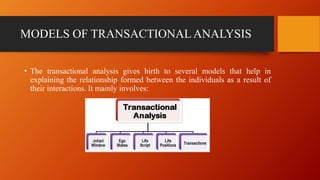
MODELS OF TRANSACTIONAL ANALYSIS
• The transactional analysis gives birth to several models that help in
explaining the relationship formed between the individuals as a result of
their interactions. It mainly involves:
1. JOHARI WINDOW
• The Johari window model is used to
enhance the individual’s perception on
others. This model is based on two ideas-
trust can be acquired by revealing
information about you to others and learning
yourselves from their feedbacks. Each
person is represented by the Johari model
through four quadrants or window pane.
Each four window panes signifies personal
information, feelings, motivation and
whether that information is known or
unknown to oneself or others in four
viewpoints.
• 1. Open/self-area or arena – Here the information about the person his attitudes,
behaviour, emotions, feelings, skills and views will be known by the person as well as by
others. This is mainly the area where all the communications occur and the larger the arena
becomes the more effectual and dynamic the relationship will be. ‘Feedback solicitation’ is
a process which occurs by understanding and listening to the feedback from another
person. Through this way the open area can be increased horizontally decreasing the blind
spot. The size of the arena can also be increased downwards and thus by reducing the
hidden and unknown areas through revealing one’s feelings to other person.
• 2. Blind self or blind spot – Information about yourselves that others know in a group but
you will be unaware of it. Others may interpret yourselves differently than you expect. The
blind spot is reduced for an efficient communication through seeking feedback from
others.
• 3. Hidden area or façade – Information that is known to you but will be kept
unknown from others. This can be any personal information which you feel reluctant
to reveal. This includes feelings, past experiences, fears, secrets etc. we keep some of
our feelings and information as private as it affects the relationships and thus the
hidden area must be reduced by moving the information to the open areas.
• 4. Unknown area – The Information which are unaware to yourselves as well as
others. This includes the information, feelings, capabilities, talents etc. This can be
due to traumatic past experiences or events which can be unknown for a lifetime. The
person will be unaware till he discovers his hidden qualities and capabilities or
through observation of others. Open communication is also an effective way to
decrease the unknown area and thus to communicate effectively.
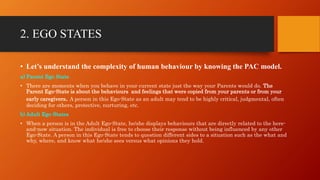
2. EGO STATES
• Let’s understand the complexity of human behaviour by knowing the PAC model.
a) Parent Ego State
• There are moments when you behave in your current state just the way your Parents would do. The
Parent Ego-State is about the behaviours and feelings that were copied from your parents or from your
early caregivers. A person in this Ego-State as an adult may tend to be highly critical, judgmental, often
deciding for others, protective, nurturing, etc.
b) Adult Ego-States
• When a person is in the Adult Ego-State, he/she displays behaviours that are directly related to the here-
and-now situation. The individual is free to choose their response without being influenced by any other
Ego-State. A person in this Ego-State tends to question different sides to a situation such as the what and
why, where, and know what he/she sees versus what opinions they hold.
c) Child Ego-State
• A person in this Ego-State displays behaviours, feelings or may think about situations
while being influenced by their thoughts as replayed in childhood.A person in this Ego-
State may display rebellion, delight, whining, sulking, panic, fear, or even a lot of
laughter.
• A person is never consciously aware of their Three Ego-States. Every person re-
experiences a part of the Parent Ego-State or the Child Ego-State to base their
communication in the present situation.
3. LIFE SCRIPT
• Transactional Analysis outlines each person has already written their life story or a script
based on many things such as the Life Positions. Berne highlights that this begins from the
day one is born. Every individual has a beginning, a middle and an end - just the script you’d
notice in a movie. Here, you are the Director and the scriptwriter and you define your ending
without your conscious knowledge.
• First developed by Eric Berne and then worked upon by Claude Steiner, a Life Script is a
plan that is influenced by the people one grows up with. A child observes and prepares this
Life Plan based on external influences as well as what happens internally. A parent gives
messages to a child such as, “The world is not safe.” A child grows up thinking, “ I shouldn’t
trust anybody.” It’s important to note how two children may interpret the same messages
through their own understanding.
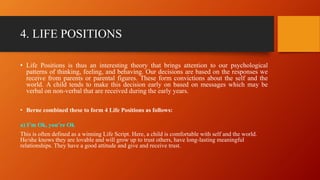
4. LIFE POSITIONS
• Life Positions is thus an interesting theory that brings attention to our psychological
patterns of thinking, feeling, and behaving. Our decisions are based on the responses we
receive from parents or parental figures. These form convictions about the self and the
world. A child tends to make this decision early on based on messages which may be
verbal on non-verbal that are received during the early years.
• Berne combined these to form 4 Life Positions as follows:
a) I’m Ok, you’re Ok
This is often defined as a winning Life Script. Here, a child is comfortable with self and the world.
He/she knows they are lovable and will grow up to trust others, have long-lasting meaningful
relationships. They have a good attitude and give and receive trust.
b) I’m not Ok, you’re Ok
A child here often considers themselves on the losing end. They firmly believe in this and create life
stories that bring more misery. An individual feels the need to please others while feeling victimized. They
often show more support to other people’s strength instead of their own.
c) I’m Ok, you’re not Ok
An infant grows up thinking he/she is above the others. Such a child becomes an adult focused on his own
‘wants’ while stepping over others. This adult may tend to project their problems on others, and play the
blame-game. A person like this always makes others feel inferior while feeling ‘okay’ about themselves.
d) I’m not OK, you’re not OK
When a child decides this Life Position, the child has an internal struggle with self and the world as well.
They end up creating a life of misery while not believing in self and taking decisions that put them in the
spot of being a victim. A person feels frustrated and hopeless. Such a person may withdraw or even injure
themselves.
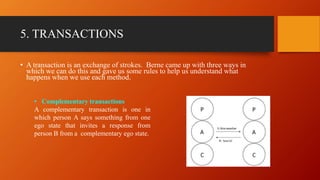
5. TRANSACTIONS
• A transaction is an exchange of strokes. Berne came up with three ways in
which we can do this and gave us some rules to help us understand what
happens when we use each method.
• Complementary transactions
A complementary transaction is one in
which person A says something from one
ego state that invites a response from
person B from a complementary ego state.
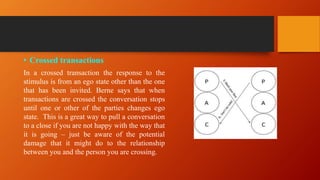
• Crossed transactions
In a crossed transaction the response to the
stimulus is from an ego state other than the one
that has been invited. Berne says that when
transactions are crossed the conversation stops
until one or other of the parties changes ego
state. This is a great way to pull a conversation
to a close if you are not happy with the way that
it is going – just be aware of the potential
damage that it might do to the relationship
between you and the person you are crossing.
• Ulterior Transactions
Berne says that we can communicate on two
levels. There is the social message – what
we say, and the psychological message –
what we mean. Sometimes the two things do
not match. Sarcasm is a great example of
this. When we are sarcastic what we say is
the opposite of what we mean. The person
who we are being sarcastic to picks up the
psychological message rather than the social
message. When this happens the transaction
is said to be ulterior.
THANK YOU

Transactional Analysis

  • 1.
    ORGANISATIONAL BEHAVIOUR SUBMITTED TO- DR.TARUNA YADAV DEPT. OF RURAL MANAGEMENT SUBMITTED BY- MEGHA ROY MBA RM 2ND SEMESTER 203511 798/20 TRANSACTIONAL ANAYLSIS
  • 2.
    DEFINTION • The TransactionalAnalysis refers to the psychoanalytic process wherein the interpersonal behaviors are studied. In other words, a social psychological model that talks about the personal growth and personal change, i.e., identifying the ego states of each individual to understand their behaviors and altering them to solve the emotional problems.
  • 3.
    WHO DEVELOPED THISMODEL? • This model was originally developed by Dr Eric Berne, who during his observation found that his patients behaved in a way as if several different people were inside them. This forced him to study the personality and dynamics of self and its relationship with others which helped in determining the kinds of behaviors that an individual shows in different real time situations.
  • 4.
    MODELS OF TRANSACTIONALANALYSIS • The transactional analysis gives birth to several models that help in explaining the relationship formed between the individuals as a result of their interactions. It mainly involves:
  • 5.
    1. JOHARI WINDOW •The Johari window model is used to enhance the individual’s perception on others. This model is based on two ideas- trust can be acquired by revealing information about you to others and learning yourselves from their feedbacks. Each person is represented by the Johari model through four quadrants or window pane. Each four window panes signifies personal information, feelings, motivation and whether that information is known or unknown to oneself or others in four viewpoints.
  • 6.
    • 1. Open/self-areaor arena – Here the information about the person his attitudes, behaviour, emotions, feelings, skills and views will be known by the person as well as by others. This is mainly the area where all the communications occur and the larger the arena becomes the more effectual and dynamic the relationship will be. ‘Feedback solicitation’ is a process which occurs by understanding and listening to the feedback from another person. Through this way the open area can be increased horizontally decreasing the blind spot. The size of the arena can also be increased downwards and thus by reducing the hidden and unknown areas through revealing one’s feelings to other person. • 2. Blind self or blind spot – Information about yourselves that others know in a group but you will be unaware of it. Others may interpret yourselves differently than you expect. The blind spot is reduced for an efficient communication through seeking feedback from others.
  • 7.
    • 3. Hiddenarea or façade – Information that is known to you but will be kept unknown from others. This can be any personal information which you feel reluctant to reveal. This includes feelings, past experiences, fears, secrets etc. we keep some of our feelings and information as private as it affects the relationships and thus the hidden area must be reduced by moving the information to the open areas. • 4. Unknown area – The Information which are unaware to yourselves as well as others. This includes the information, feelings, capabilities, talents etc. This can be due to traumatic past experiences or events which can be unknown for a lifetime. The person will be unaware till he discovers his hidden qualities and capabilities or through observation of others. Open communication is also an effective way to decrease the unknown area and thus to communicate effectively.
  • 8.
    2. EGO STATES •Let’s understand the complexity of human behaviour by knowing the PAC model. a) Parent Ego State • There are moments when you behave in your current state just the way your Parents would do. The Parent Ego-State is about the behaviours and feelings that were copied from your parents or from your early caregivers. A person in this Ego-State as an adult may tend to be highly critical, judgmental, often deciding for others, protective, nurturing, etc. b) Adult Ego-States • When a person is in the Adult Ego-State, he/she displays behaviours that are directly related to the here- and-now situation. The individual is free to choose their response without being influenced by any other Ego-State. A person in this Ego-State tends to question different sides to a situation such as the what and why, where, and know what he/she sees versus what opinions they hold.
  • 9.
    c) Child Ego-State •A person in this Ego-State displays behaviours, feelings or may think about situations while being influenced by their thoughts as replayed in childhood.A person in this Ego- State may display rebellion, delight, whining, sulking, panic, fear, or even a lot of laughter. • A person is never consciously aware of their Three Ego-States. Every person re- experiences a part of the Parent Ego-State or the Child Ego-State to base their communication in the present situation.
  • 10.
    3. LIFE SCRIPT •Transactional Analysis outlines each person has already written their life story or a script based on many things such as the Life Positions. Berne highlights that this begins from the day one is born. Every individual has a beginning, a middle and an end - just the script you’d notice in a movie. Here, you are the Director and the scriptwriter and you define your ending without your conscious knowledge. • First developed by Eric Berne and then worked upon by Claude Steiner, a Life Script is a plan that is influenced by the people one grows up with. A child observes and prepares this Life Plan based on external influences as well as what happens internally. A parent gives messages to a child such as, “The world is not safe.” A child grows up thinking, “ I shouldn’t trust anybody.” It’s important to note how two children may interpret the same messages through their own understanding.
  • 11.
    4. LIFE POSITIONS •Life Positions is thus an interesting theory that brings attention to our psychological patterns of thinking, feeling, and behaving. Our decisions are based on the responses we receive from parents or parental figures. These form convictions about the self and the world. A child tends to make this decision early on based on messages which may be verbal on non-verbal that are received during the early years. • Berne combined these to form 4 Life Positions as follows: a) I’m Ok, you’re Ok This is often defined as a winning Life Script. Here, a child is comfortable with self and the world. He/she knows they are lovable and will grow up to trust others, have long-lasting meaningful relationships. They have a good attitude and give and receive trust.
  • 12.
    b) I’m notOk, you’re Ok A child here often considers themselves on the losing end. They firmly believe in this and create life stories that bring more misery. An individual feels the need to please others while feeling victimized. They often show more support to other people’s strength instead of their own. c) I’m Ok, you’re not Ok An infant grows up thinking he/she is above the others. Such a child becomes an adult focused on his own ‘wants’ while stepping over others. This adult may tend to project their problems on others, and play the blame-game. A person like this always makes others feel inferior while feeling ‘okay’ about themselves. d) I’m not OK, you’re not OK When a child decides this Life Position, the child has an internal struggle with self and the world as well. They end up creating a life of misery while not believing in self and taking decisions that put them in the spot of being a victim. A person feels frustrated and hopeless. Such a person may withdraw or even injure themselves.
  • 13.
    5. TRANSACTIONS • Atransaction is an exchange of strokes. Berne came up with three ways in which we can do this and gave us some rules to help us understand what happens when we use each method. • Complementary transactions A complementary transaction is one in which person A says something from one ego state that invites a response from person B from a complementary ego state.
  • 14.
    • Crossed transactions Ina crossed transaction the response to the stimulus is from an ego state other than the one that has been invited. Berne says that when transactions are crossed the conversation stops until one or other of the parties changes ego state. This is a great way to pull a conversation to a close if you are not happy with the way that it is going – just be aware of the potential damage that it might do to the relationship between you and the person you are crossing.
  • 15.
    • Ulterior Transactions Bernesays that we can communicate on two levels. There is the social message – what we say, and the psychological message – what we mean. Sometimes the two things do not match. Sarcasm is a great example of this. When we are sarcastic what we say is the opposite of what we mean. The person who we are being sarcastic to picks up the psychological message rather than the social message. When this happens the transaction is said to be ulterior.
  • 16.