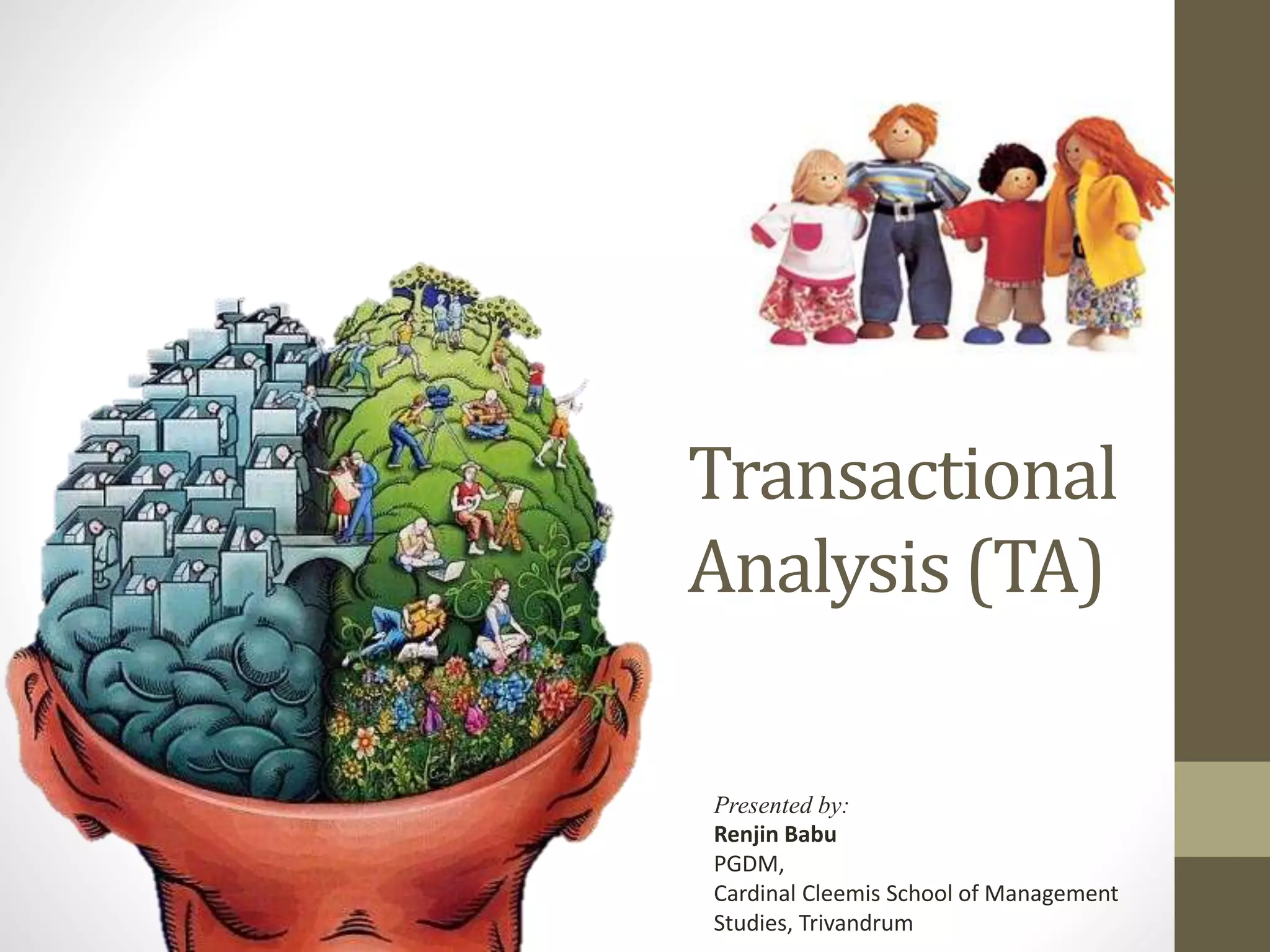
Transactional 
Analysis (TA) 
Presented by: 
Renjin Babu 
PGDM, 
Cardinal Cleemis School of Management 
Studies, Trivandrum
What is Transactional Analysis? 
Transactional Analysis is: 
An easily understandable yet sophisticated 
psychological theory about people's thinking, 
feelings and behavior and, 
A contemporary and effective system of 
psychotherapy, education, organizational and 
socio-cultural analysis and social psychiatry.
TA and its founder 
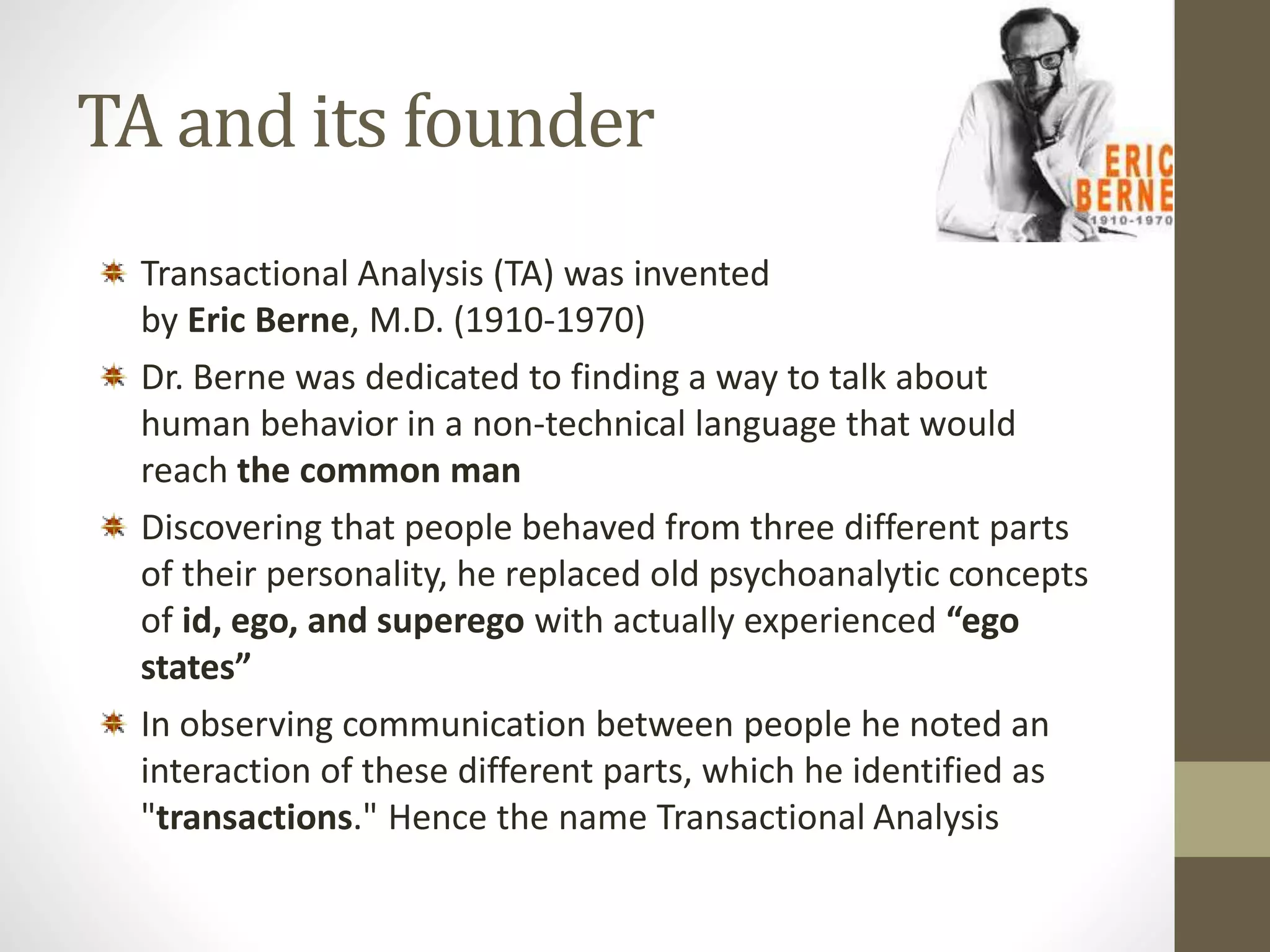
Transactional Analysis (TA) was invented 
by Eric Berne, M.D. (1910-1970) 
Dr. Berne was dedicated to finding a way to talk about 
human behavior in a non-technical language that would 
reach the common man 
Discovering that people behaved from three different parts 
of their personality, he replaced old psychoanalytic concepts 
of id, ego, and superego with actually experienced “ego 
states” 
In observing communication between people he noted an 
interaction of these different parts, which he identified as 
"transactions." Hence the name Transactional Analysis
Key Ideas in Transactional Analysis
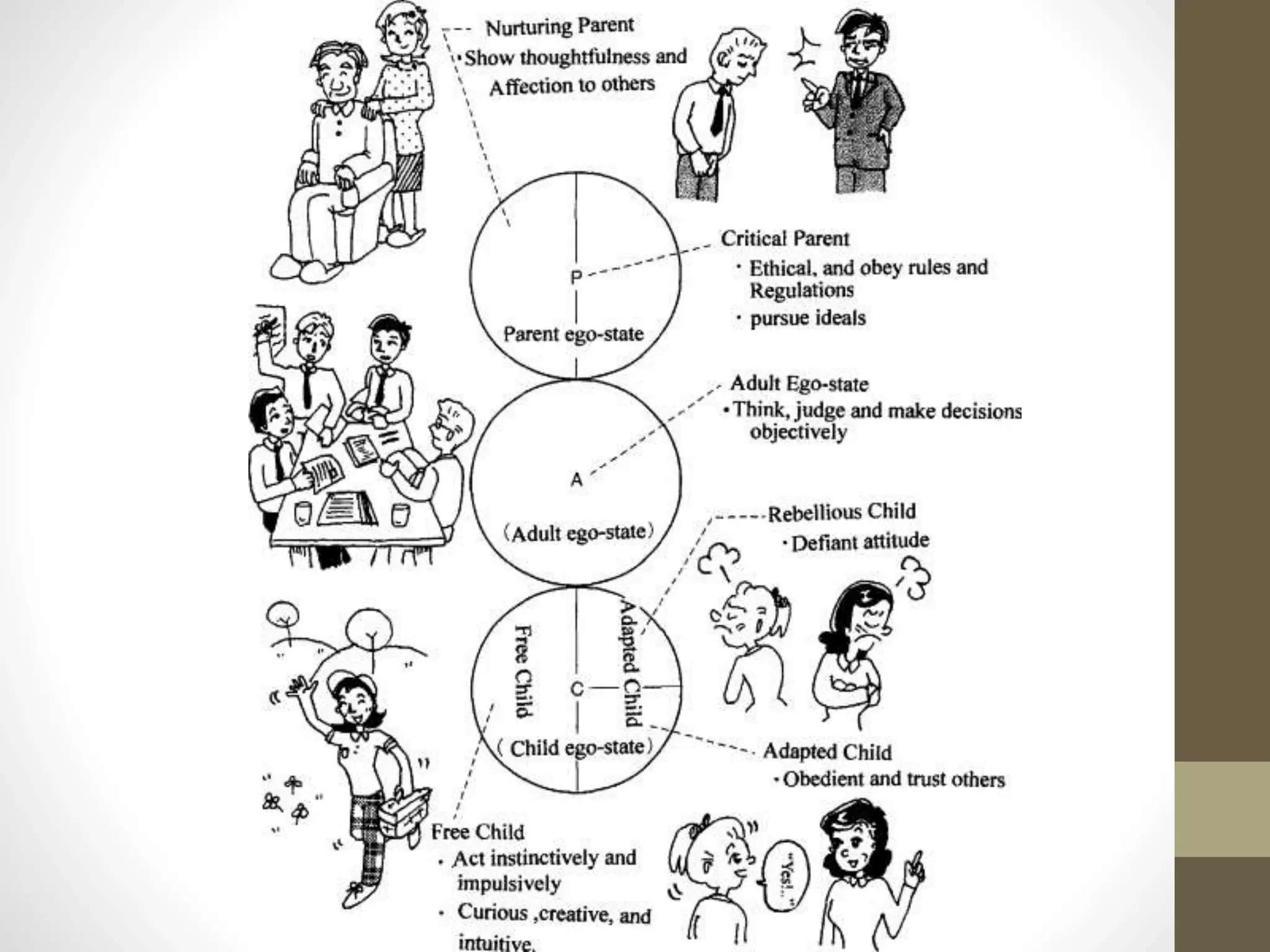
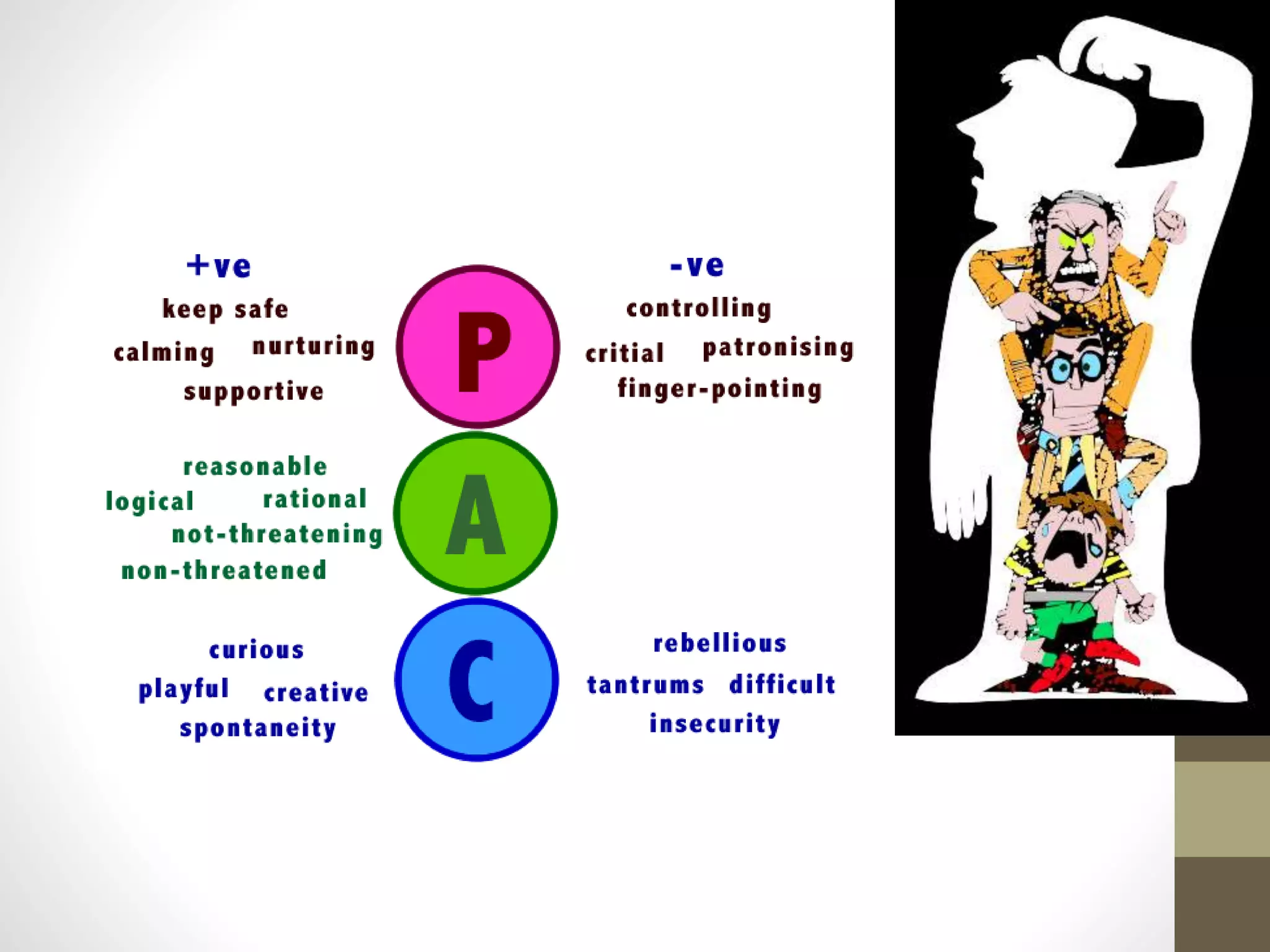
Ego State Model (PAC model) 
An ego state is a specific way of thinking, feeling and 
behaving and each ego state has its origin in specific 
regions of the brain 
People can behave from their Parent ego state, or 
from their Child ego state or from their Adult ego 
state 
At any one time our actions come from one of these 
three ego states
The Child 
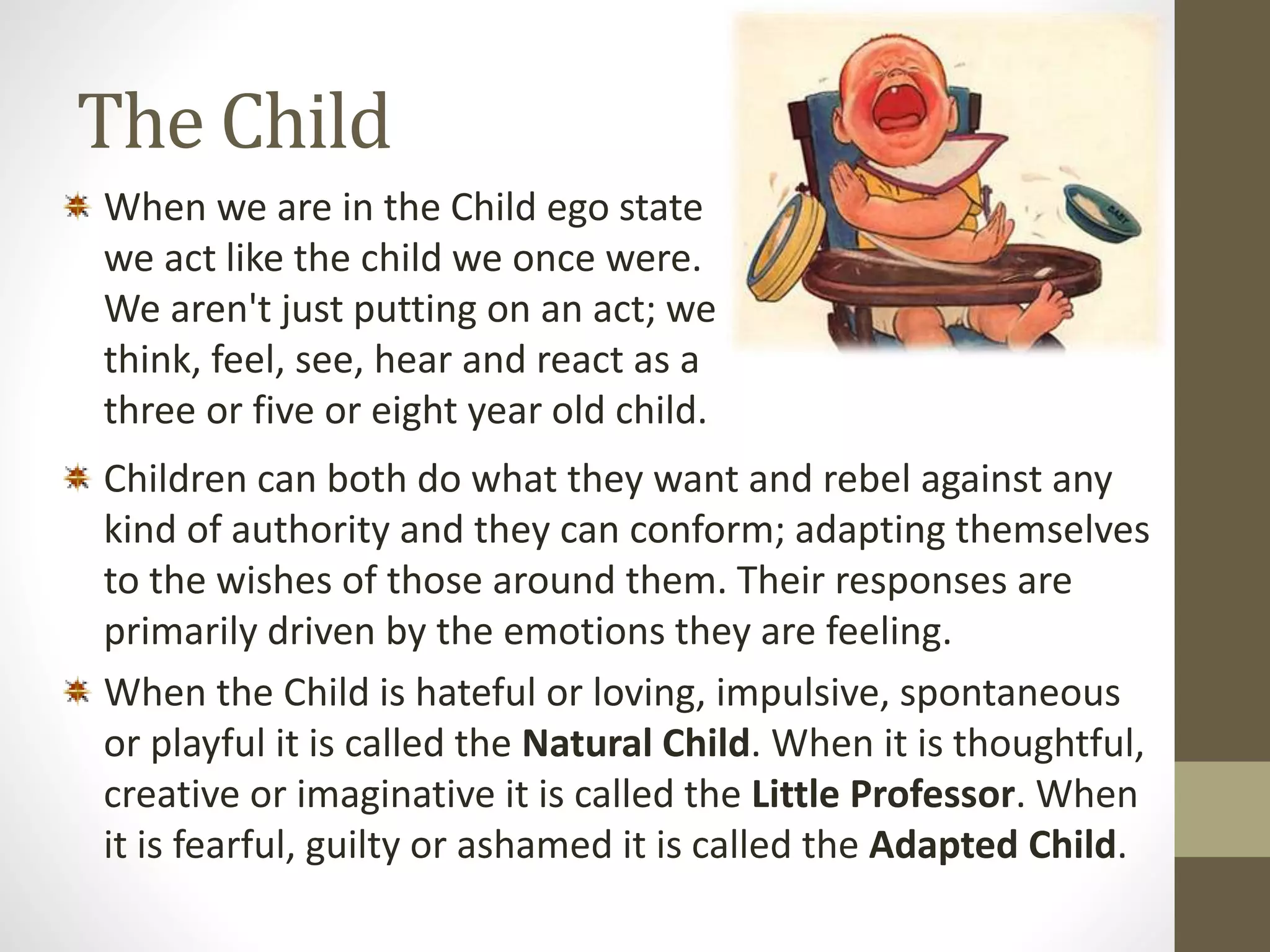
When we are in the Child ego state 
we act like the child we once were. 
We aren't just putting on an act; we 
think, feel, see, hear and react as a 
three or five or eight year old child. 
Children can both do what they want and rebel against any 
kind of authority and they can conform; adapting themselves 
to the wishes of those around them. Their responses are 
primarily driven by the emotions they are feeling. 
When the Child is hateful or loving, impulsive, spontaneous 
or playful it is called the Natural Child. When it is thoughtful, 
creative or imaginative it is called the Little Professor. When 
it is fearful, guilty or ashamed it is called the Adapted Child.
The Child 
The Child has all the feelings; fear, love, anger, joy, 
sadness, shame and so on 
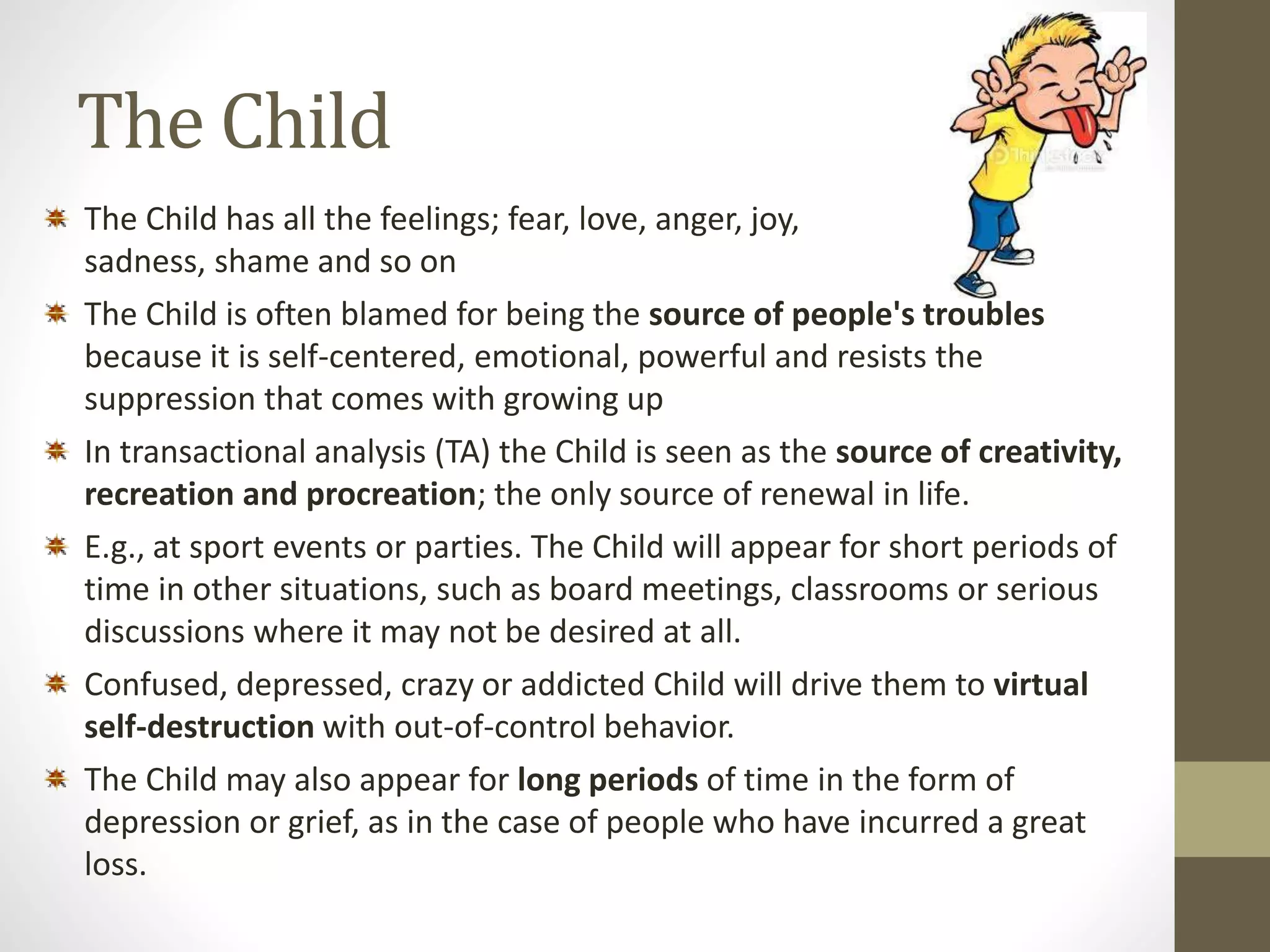
The Child is often blamed for being the source of people's troubles 
because it is self-centered, emotional, powerful and resists the 
suppression that comes with growing up 
In transactional analysis (TA) the Child is seen as the source of creativity, 
recreation and procreation; the only source of renewal in life. 
E.g., at sport events or parties. The Child will appear for short periods of 
time in other situations, such as board meetings, classrooms or serious 
discussions where it may not be desired at all. 
Confused, depressed, crazy or addicted Child will drive them to virtual 
self-destruction with out-of-control behavior. 
The Child may also appear for long periods of time in the form of 
depression or grief, as in the case of people who have incurred a great 
loss.
The Parent 
The Parent is like a tape recorder. It is a collection of pre-recorded, 
pre-judged, prejudiced codes for living. 
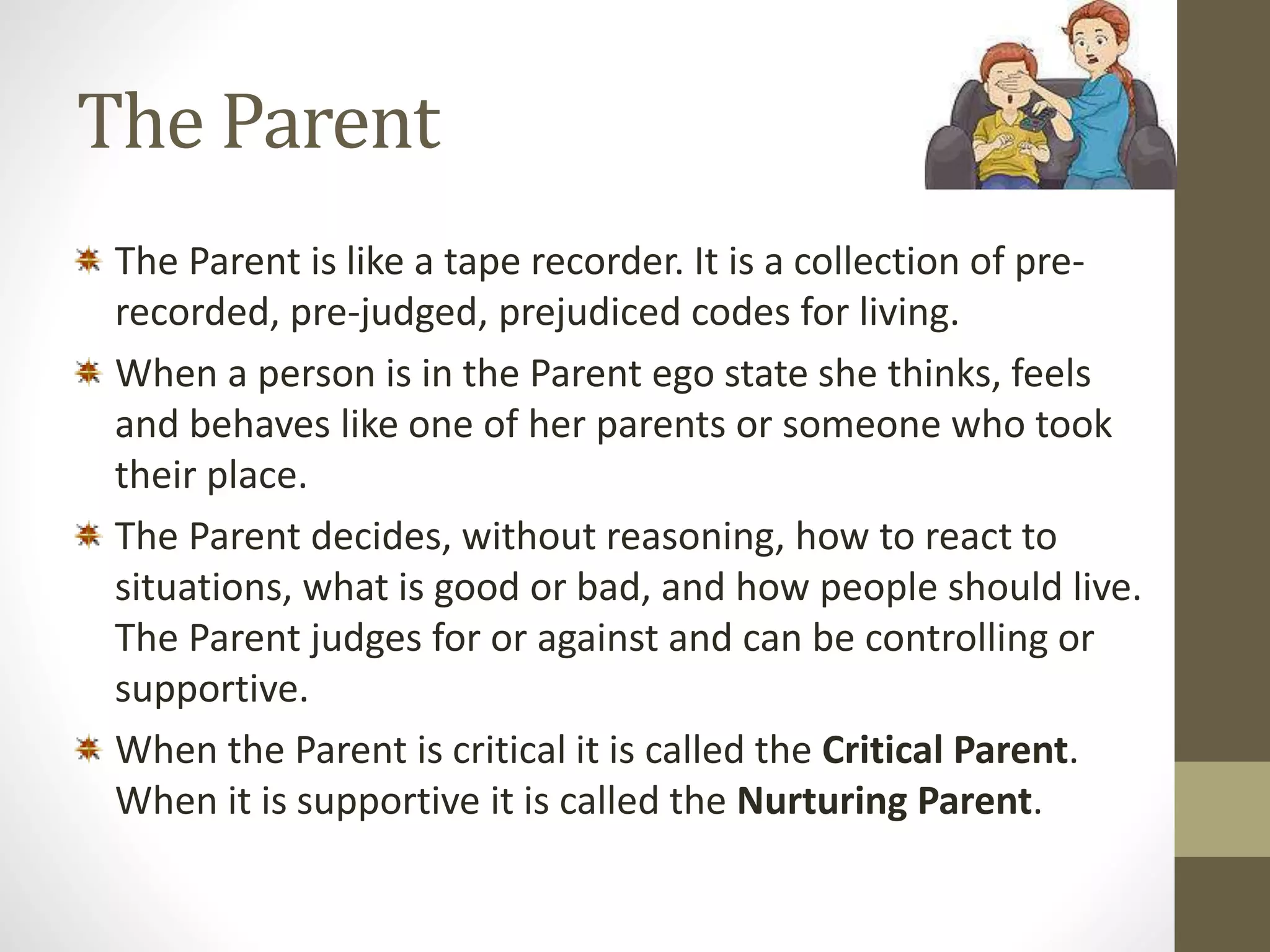
When a person is in the Parent ego state she thinks, feels 
and behaves like one of her parents or someone who took 
their place. 
The Parent decides, without reasoning, how to react to 
situations, what is good or bad, and how people should live. 
The Parent judges for or against and can be controlling or 
supportive. 
When the Parent is critical it is called the Critical Parent. 
When it is supportive it is called the Nurturing Parent.
The Parent 
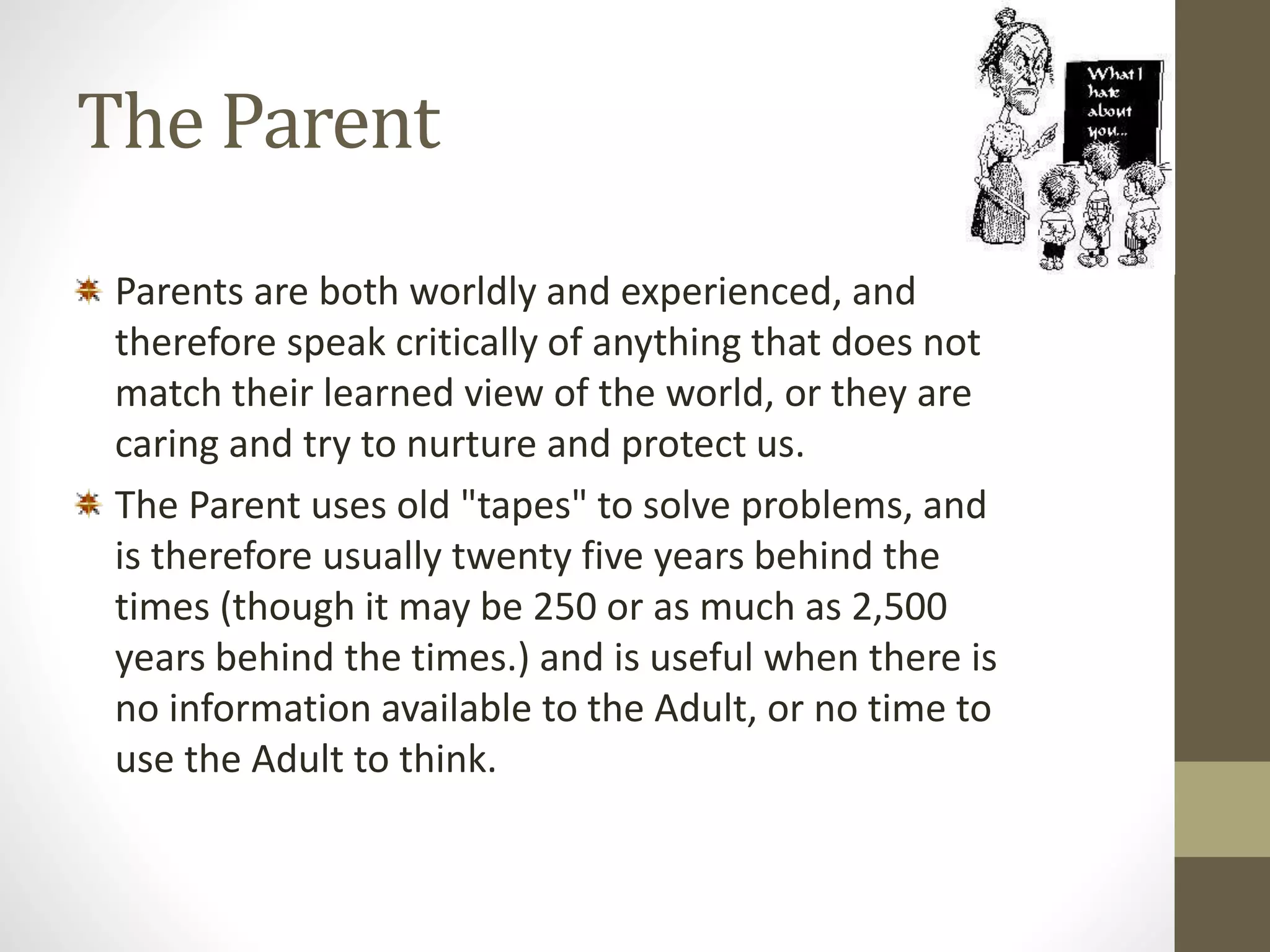
Parents are both worldly and experienced, and 
therefore speak critically of anything that does not 
match their learned view of the world, or they are 
caring and try to nurture and protect us. 
The Parent uses old "tapes" to solve problems, and 
is therefore usually twenty five years behind the 
times (though it may be 250 or as much as 2,500 
years behind the times.) and is useful when there is 
no information available to the Adult, or no time to 
use the Adult to think.
The Adult 
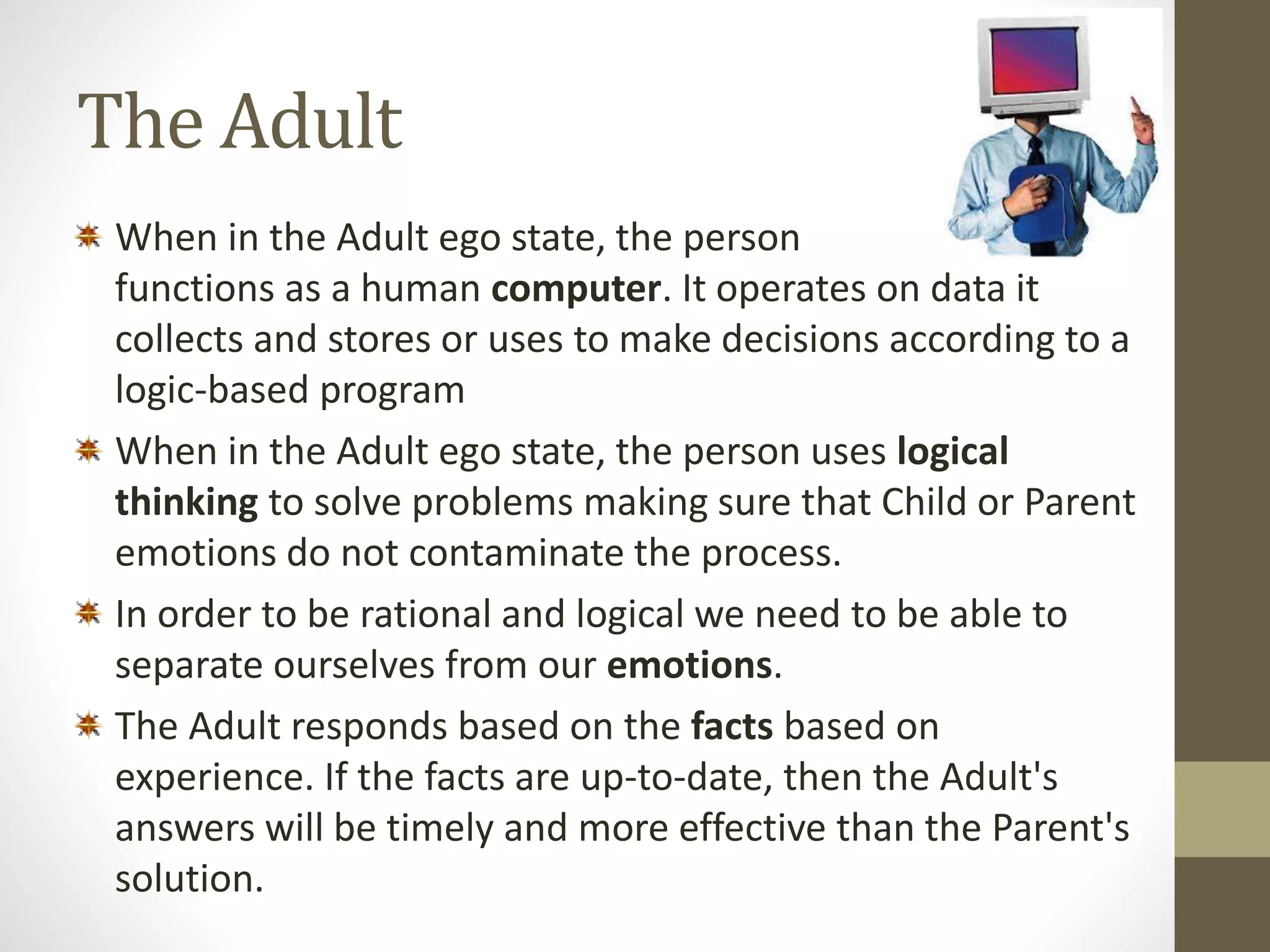
When in the Adult ego state, the person 
functions as a human computer. It operates on data it 
collects and stores or uses to make decisions according to a 
logic-based program 
When in the Adult ego state, the person uses logical 
thinking to solve problems making sure that Child or Parent 
emotions do not contaminate the process. 
In order to be rational and logical we need to be able to 
separate ourselves from our emotions. 
The Adult responds based on the facts based on 
experience. If the facts are up-to-date, then the Adult's 
answers will be timely and more effective than the Parent's 
solution.
The Adult 
Sometimes the Adult uses information which has its source 
in the Child or in the Parent and which may be incorrect. 
This is known as contamination. 
When a contamination comes from the Parent it is called a prejudice. 
For instance when someone assumes that women prefer to follow a 
man's lead instead of making their own decisions this is data which 
comes to the Adult the from the Parent, and is a contamination 
because it is accepted as a fact without checking it against reality. 
The same unchecked acceptance of information can occur with 
information fed by the Child in which case it is called delusion. A 
delusion is usually based on a Child fear or hope that is accepted as 
reality by the Adult. For instance when a person is convinced that he is 
being poisoned by the government this is probably based on his Child's 
fears which the Adult accepts, rather than on fact.
Strokes and Transactions 
The human infant is born helpless, ill equipped to attend to his/ her 
survival. 
Berne used the term “strokes" for units of care, as first registered by the 
infant on being held and caressed. 
We need both actual strokes and symbolic strokes throughout our lives, 
which is why and how we are interdependent. 
Whether it be the actual touch of a handshake or the symbolic “touch” 
of a smile, or even of a telephone call, we continue to depend on strokes 
from others for a sense of existence. In fact, this underlies all 
communication among people. 
As Berne put it, we “transact” with others by exchanging strokes, just the 
way we might exchange goods in the market place for mutual benefit. 
If you consider that each one of us operates interchangeably out of three 
different ego states, which ego state of mine is it that may transact with 
any one of yours? How can I be sure to reach the ego state in you that I 
hope to address in order to obtain the strokes I want in exchange?
Life positions 
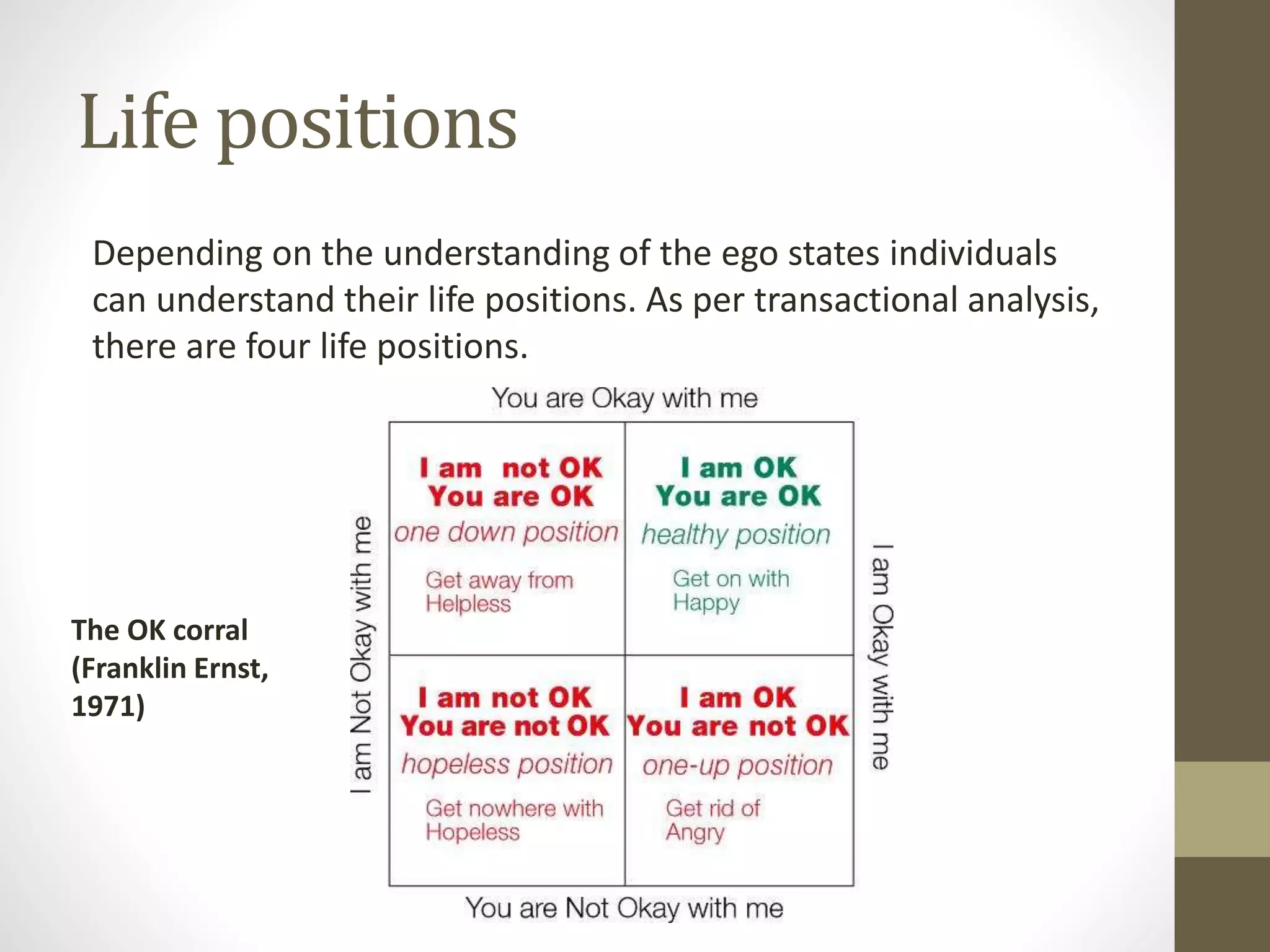
Depending on the understanding of the ego states individuals 
can understand their life positions. As per transactional analysis, 
there are four life positions. 
The OK corral 
(Franklin Ernst, 
1971)
Blame Model 
The Transactional Analysis 'Okay Corral' can be linked to 'blame', for 
which Jim Davis developed this simple and helpful model. 
Commonly when emotions are triggered people adopt one of three 
attitudes relating to blame, which each correlate to a position on the 
Okay Corral: 
 I'm to blame (You are okay and I'm not okay - 'helpless') 
 You are to blame (I'm okay and you are not okay - 'angry') 
 We are both to blame (I'm not okay and you are not okay - 
'hopeless') 
None of these is a healthy position. 
Instead the healthy position is, and the mindset should be: "It's no-one's 
fault, blame isn't the issue - what matters is how we go forward 
and sort things out." (I'm okay and you are okay - 'happy')
The Script Analysis 
The script is a life plan, made when we are growing up. It is 
like having the script of a play in front of us - we read the 
lines and decide what will happen in each act and how the 
play will end. The script is developed from our early 
decisions based upon our life experience. 
Roles 
 Legitimate roles:- these roles are realistically 
appropriate to the situation. 
 Illegitimate roles :-the roles are said to be illegitimate if 
they are used like masks and people use them for the 
purposes of manipulation
Driver Behaviour or Working Styles 
These are ways in which we defend against the injunctions. 
These are very helpful to us and when we understand them 
we can work to their strengths through choice, rather than 
because subconsciously we believe we have to do things 
this way to be okay. The names of five working styles have 
been developed, these are: 
 Be Perfect 
 Be Strong 
 Try Hard 
 Please Others 
 Hurry Up
Time Structuring 
The way in which we structure time is likely to reflect the 
different hungers. We all structure time in a variety of ways: 
 Withdrawal 
 Rituals 
 Pastiming 
 Activities 
 Games 
 Intimacy 
Obtaining balance means ensuring that we have sufficient 
time for play and intimacy and if this does not occur then it 
would be beneficial to explore what we might be avoiding.
Game analysis 
When similar situations keep happening over and over again then the term 
Transactional Analysis uses for this is a game. A game is a familiar pattern of 
behaviour with a predictable outcome. 
Games are learned patterns of behaviour, and most people play a small number 
of favourite games with a range of different people and in varying intensities. 
Games vary in the length of time that passes while they are being played. Some 
can take seconds or minutes while others take weeks months or even years. 
People play games for these reasons: 
 To structure time 
 To acquire strokes 
 To maintain the substitute feeling and the system of thinking, beliefs and 
actions that go with it 
 To confirm parental injunctions and further the life script 
 To maintain the person's life position by "proving" that self/others are not 
OK 
 To provide a high level of stroke exchange while blocking intimacy and 
maintaining distance 
 To make people predictable.
The Philosophy of Transactional 
Analysis 
The philosophical assumptions of transactional 
analysis are: 
People are OK. 
Everyone has the capacity to think. 
People decide their own destiny, and these 
decisions can be changed.
Applications of TA 
Personal change 
Educational change 
Organizational change 
Spiritual change 
Social Change
Transaction analysis

Transaction analysis

  • 1.
    Transactional Analysis (TA) Presented by: Renjin Babu PGDM, Cardinal Cleemis School of Management Studies, Trivandrum
  • 2.
    What is TransactionalAnalysis? Transactional Analysis is: An easily understandable yet sophisticated psychological theory about people's thinking, feelings and behavior and, A contemporary and effective system of psychotherapy, education, organizational and socio-cultural analysis and social psychiatry.
  • 3.
    TA and itsfounder Transactional Analysis (TA) was invented by Eric Berne, M.D. (1910-1970) Dr. Berne was dedicated to finding a way to talk about human behavior in a non-technical language that would reach the common man Discovering that people behaved from three different parts of their personality, he replaced old psychoanalytic concepts of id, ego, and superego with actually experienced “ego states” In observing communication between people he noted an interaction of these different parts, which he identified as "transactions." Hence the name Transactional Analysis
  • 4.
    Key Ideas inTransactional Analysis
  • 5.
    Ego State Model(PAC model) An ego state is a specific way of thinking, feeling and behaving and each ego state has its origin in specific regions of the brain People can behave from their Parent ego state, or from their Child ego state or from their Adult ego state At any one time our actions come from one of these three ego states
  • 6.
    The Child Whenwe are in the Child ego state we act like the child we once were. We aren't just putting on an act; we think, feel, see, hear and react as a three or five or eight year old child. Children can both do what they want and rebel against any kind of authority and they can conform; adapting themselves to the wishes of those around them. Their responses are primarily driven by the emotions they are feeling. When the Child is hateful or loving, impulsive, spontaneous or playful it is called the Natural Child. When it is thoughtful, creative or imaginative it is called the Little Professor. When it is fearful, guilty or ashamed it is called the Adapted Child.
  • 7.
    The Child TheChild has all the feelings; fear, love, anger, joy, sadness, shame and so on The Child is often blamed for being the source of people's troubles because it is self-centered, emotional, powerful and resists the suppression that comes with growing up In transactional analysis (TA) the Child is seen as the source of creativity, recreation and procreation; the only source of renewal in life. E.g., at sport events or parties. The Child will appear for short periods of time in other situations, such as board meetings, classrooms or serious discussions where it may not be desired at all. Confused, depressed, crazy or addicted Child will drive them to virtual self-destruction with out-of-control behavior. The Child may also appear for long periods of time in the form of depression or grief, as in the case of people who have incurred a great loss.
  • 8.
    The Parent TheParent is like a tape recorder. It is a collection of pre-recorded, pre-judged, prejudiced codes for living. When a person is in the Parent ego state she thinks, feels and behaves like one of her parents or someone who took their place. The Parent decides, without reasoning, how to react to situations, what is good or bad, and how people should live. The Parent judges for or against and can be controlling or supportive. When the Parent is critical it is called the Critical Parent. When it is supportive it is called the Nurturing Parent.
  • 9.
    The Parent Parentsare both worldly and experienced, and therefore speak critically of anything that does not match their learned view of the world, or they are caring and try to nurture and protect us. The Parent uses old "tapes" to solve problems, and is therefore usually twenty five years behind the times (though it may be 250 or as much as 2,500 years behind the times.) and is useful when there is no information available to the Adult, or no time to use the Adult to think.
  • 10.
    The Adult Whenin the Adult ego state, the person functions as a human computer. It operates on data it collects and stores or uses to make decisions according to a logic-based program When in the Adult ego state, the person uses logical thinking to solve problems making sure that Child or Parent emotions do not contaminate the process. In order to be rational and logical we need to be able to separate ourselves from our emotions. The Adult responds based on the facts based on experience. If the facts are up-to-date, then the Adult's answers will be timely and more effective than the Parent's solution.
  • 11.
    The Adult Sometimesthe Adult uses information which has its source in the Child or in the Parent and which may be incorrect. This is known as contamination. When a contamination comes from the Parent it is called a prejudice. For instance when someone assumes that women prefer to follow a man's lead instead of making their own decisions this is data which comes to the Adult the from the Parent, and is a contamination because it is accepted as a fact without checking it against reality. The same unchecked acceptance of information can occur with information fed by the Child in which case it is called delusion. A delusion is usually based on a Child fear or hope that is accepted as reality by the Adult. For instance when a person is convinced that he is being poisoned by the government this is probably based on his Child's fears which the Adult accepts, rather than on fact.
  • 14.
    Strokes and Transactions The human infant is born helpless, ill equipped to attend to his/ her survival. Berne used the term “strokes" for units of care, as first registered by the infant on being held and caressed. We need both actual strokes and symbolic strokes throughout our lives, which is why and how we are interdependent. Whether it be the actual touch of a handshake or the symbolic “touch” of a smile, or even of a telephone call, we continue to depend on strokes from others for a sense of existence. In fact, this underlies all communication among people. As Berne put it, we “transact” with others by exchanging strokes, just the way we might exchange goods in the market place for mutual benefit. If you consider that each one of us operates interchangeably out of three different ego states, which ego state of mine is it that may transact with any one of yours? How can I be sure to reach the ego state in you that I hope to address in order to obtain the strokes I want in exchange?
  • 15.
    Life positions Dependingon the understanding of the ego states individuals can understand their life positions. As per transactional analysis, there are four life positions. The OK corral (Franklin Ernst, 1971)
  • 16.
    Blame Model TheTransactional Analysis 'Okay Corral' can be linked to 'blame', for which Jim Davis developed this simple and helpful model. Commonly when emotions are triggered people adopt one of three attitudes relating to blame, which each correlate to a position on the Okay Corral:  I'm to blame (You are okay and I'm not okay - 'helpless')  You are to blame (I'm okay and you are not okay - 'angry')  We are both to blame (I'm not okay and you are not okay - 'hopeless') None of these is a healthy position. Instead the healthy position is, and the mindset should be: "It's no-one's fault, blame isn't the issue - what matters is how we go forward and sort things out." (I'm okay and you are okay - 'happy')
  • 17.
    The Script Analysis The script is a life plan, made when we are growing up. It is like having the script of a play in front of us - we read the lines and decide what will happen in each act and how the play will end. The script is developed from our early decisions based upon our life experience. Roles  Legitimate roles:- these roles are realistically appropriate to the situation.  Illegitimate roles :-the roles are said to be illegitimate if they are used like masks and people use them for the purposes of manipulation
  • 18.
    Driver Behaviour orWorking Styles These are ways in which we defend against the injunctions. These are very helpful to us and when we understand them we can work to their strengths through choice, rather than because subconsciously we believe we have to do things this way to be okay. The names of five working styles have been developed, these are:  Be Perfect  Be Strong  Try Hard  Please Others  Hurry Up
  • 19.
    Time Structuring Theway in which we structure time is likely to reflect the different hungers. We all structure time in a variety of ways:  Withdrawal  Rituals  Pastiming  Activities  Games  Intimacy Obtaining balance means ensuring that we have sufficient time for play and intimacy and if this does not occur then it would be beneficial to explore what we might be avoiding.
  • 20.
    Game analysis Whensimilar situations keep happening over and over again then the term Transactional Analysis uses for this is a game. A game is a familiar pattern of behaviour with a predictable outcome. Games are learned patterns of behaviour, and most people play a small number of favourite games with a range of different people and in varying intensities. Games vary in the length of time that passes while they are being played. Some can take seconds or minutes while others take weeks months or even years. People play games for these reasons:  To structure time  To acquire strokes  To maintain the substitute feeling and the system of thinking, beliefs and actions that go with it  To confirm parental injunctions and further the life script  To maintain the person's life position by "proving" that self/others are not OK  To provide a high level of stroke exchange while blocking intimacy and maintaining distance  To make people predictable.
  • 21.
    The Philosophy ofTransactional Analysis The philosophical assumptions of transactional analysis are: People are OK. Everyone has the capacity to think. People decide their own destiny, and these decisions can be changed.
  • 22.
    Applications of TA Personal change Educational change Organizational change Spiritual change Social Change