CLASSROOM INTERACTION
UNIVERSIDAD DE LAS FUERZAS ARMADAS
ENGLISH METHODOLOGY
CINTIA CUZME
DEFINITION
• Describes the form and content of behaviour or social
interaction in the classroom. In particular, research on
gender, class, and ‘race’ in education has examined the
relationship between teacher and students in the
classroom
A Dictionary of Sociology 1998, originally published by Oxford University Press 1998.
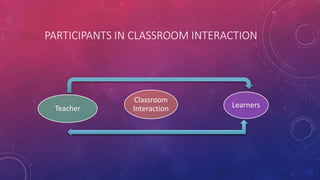
PARTICIPANTS IN CLASSROOM INTERACTION
Classroom
InteractionTeacher Learners
CLASSROOM INTERACTION, DEPENDING ON WHO
COMMUNICATES WITH WHOM:
• a) Teacher – learners
• b) Teacher – learner/a group of learners
• c) Learner – learner
• d) Learners – learners
OBJETIVES
• Help learners to identify their own learning methods.
• Guide the learners to communicate with their peers easily.
• Aim at meaningful communication among the students in their target
language
• Give to students various types of interaction face to face.
• To aim at probing into the learner’s prior learning ability and his way of
conceptualizing facts and ideas.
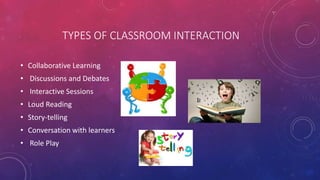
TYPES OF CLASSROOM INTERACTION
• Collaborative Learning
• Discussions and Debates
• Interactive Sessions
• Loud Reading
• Story-telling
• Conversation with learners
• Role Play
TEACHER`S ROLE
• It is the responsibility of the teacher to create a learning atmosphere inside
the classroom. It is through these interaction that the teacher can extract
responses from learners and motivate them to come out with new ideas
related to the topic.
• The teacher is a planner who plans out the best of the modules of interaction
that would be effective to invite the learners in classroom interaction.
• Through classroom interaction the learners will be able to get themselves
involved with concepts, ideas and various other devices and products for
language and culture learning
RELATIONSHIP BETWEEN TEACHER-STUDENT
• The quality of teacher-student relationship is the keystone for all aspects of classroom
management. ( Marzano & Marzano, 2003)
• “If a teacher has a good relationship with students, then students will more readily accept
the rules and procedures and the disciplinary actions that follow their violations.” The more
teachers demonstrated relationship-building responses, children’s externalizing problems
were reduced as part of a reciprocal relationship» (Helker & Ray, 2009).
• Teachers who foster an engaging positive teacher-student relationship report reduced stress
and student misbehavior. (Conley, nd.)
INTERACTION PATTERNS
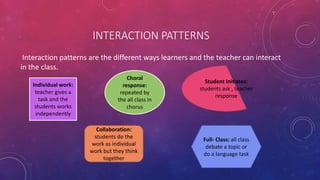
Interaction patterns are the different ways learners and the teacher can interact
in the class.
Individual work:
teacher gives a
task and the
students works
independently
Choral
response:
repeated by
the all class in
chorus
Collaboration:
students do the
work as individual
work but they think
together
Student Initiates:
students ask , teacher
response
Full- Class: all class
debate a topic or
do a language task
INTERACTION PATTERNS
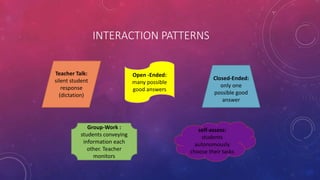
Teacher Talk:
silent student
response
(dictation)
Closed-Ended:
only one
possible good
answer
Group-Work :
students conveying
information each
other. Teacher
monitors
self-assess:
students
autonomously
choose their tasks
Open -Ended:
many possible
good answers
PERSONAL INTEREST IN STUDENTS TO IMPROVE THE
CLASSROOM INTERACTION
Teachers can :
• Talk informally with students before, during, and after class about their interests.
• Greet students outside of school—for instance, at extracurricular events or at the store.
• Single out a few students each day in the lunchroom and talk with them.
• Be aware of and comment on important events in students' lives, such as participation in sports,
drama, or other extracurricular activities.
• Meet students at the door as they come into class; greet each one by name.
ESTABLISH CLEAR EXPECTATIONS AND CONSEQUENCES FOR
A GOOD CLASSROOM INTERACTION
• Teachers can establish clear expectations for behavior in two ways: by establishing clear rules and
procedures and by providing consequences for student behavior.
• Some strategies that can be used to achieve this:
• Using a wide variety of verbal and physical reactions and cues
• Cuing the class about expected behaviors through prearranged signals • Providing tangible recognition
of appropriate behavior
• Employing group contingency policies
• Employing home contingency techniques
FEEDBACK
Another key part of classroom interaction is teacher
feedback. In order to improve, students must get feedback
and correction.
FEEDBACK
• Improving classroom interaction involves continually assessing your teaching,
students learning, and your relationship with the students
• You can give feedback orally or in writing Sometimes you may want to correct
an individual student in front of other students, while at other times it is
better to offer general suggestions and corrections for the entire group
• Make sure students understand your assignments. Ask if there is anything else
that they need to handle the assignment. Ask the students if they understand
why we are doing this assignment.
BIBLIOGRAPHY
• http://www.sdas.edus.si/Elope/PDF/ElopeVol1Dagarin.pdf
• https://fle200s12classroominteraction.files.wordpress.com/2012/05/crile50allrigh.pdf
• https://fle200s12classroominteraction.wordpress.com/pictures/
• http://pt.slideshare.net/yaowarinsriuttaman/classroom-interaction-32085345

Classroom Interaction

  • 1.
    CLASSROOM INTERACTION UNIVERSIDAD DELAS FUERZAS ARMADAS ENGLISH METHODOLOGY CINTIA CUZME
  • 2.
    DEFINITION • Describes theform and content of behaviour or social interaction in the classroom. In particular, research on gender, class, and ‘race’ in education has examined the relationship between teacher and students in the classroom A Dictionary of Sociology 1998, originally published by Oxford University Press 1998.
  • 3.
    PARTICIPANTS IN CLASSROOMINTERACTION Classroom InteractionTeacher Learners
  • 4.
    CLASSROOM INTERACTION, DEPENDINGON WHO COMMUNICATES WITH WHOM: • a) Teacher – learners • b) Teacher – learner/a group of learners • c) Learner – learner • d) Learners – learners
  • 5.
    OBJETIVES • Help learnersto identify their own learning methods. • Guide the learners to communicate with their peers easily. • Aim at meaningful communication among the students in their target language • Give to students various types of interaction face to face. • To aim at probing into the learner’s prior learning ability and his way of conceptualizing facts and ideas.
  • 6.
    TYPES OF CLASSROOMINTERACTION • Collaborative Learning • Discussions and Debates • Interactive Sessions • Loud Reading • Story-telling • Conversation with learners • Role Play
  • 7.
    TEACHER`S ROLE • Itis the responsibility of the teacher to create a learning atmosphere inside the classroom. It is through these interaction that the teacher can extract responses from learners and motivate them to come out with new ideas related to the topic. • The teacher is a planner who plans out the best of the modules of interaction that would be effective to invite the learners in classroom interaction. • Through classroom interaction the learners will be able to get themselves involved with concepts, ideas and various other devices and products for language and culture learning
  • 8.
    RELATIONSHIP BETWEEN TEACHER-STUDENT •The quality of teacher-student relationship is the keystone for all aspects of classroom management. ( Marzano & Marzano, 2003) • “If a teacher has a good relationship with students, then students will more readily accept the rules and procedures and the disciplinary actions that follow their violations.” The more teachers demonstrated relationship-building responses, children’s externalizing problems were reduced as part of a reciprocal relationship» (Helker & Ray, 2009). • Teachers who foster an engaging positive teacher-student relationship report reduced stress and student misbehavior. (Conley, nd.)
  • 9.
    INTERACTION PATTERNS Interaction patternsare the different ways learners and the teacher can interact in the class. Individual work: teacher gives a task and the students works independently Choral response: repeated by the all class in chorus Collaboration: students do the work as individual work but they think together Student Initiates: students ask , teacher response Full- Class: all class debate a topic or do a language task
  • 10.
    INTERACTION PATTERNS Teacher Talk: silentstudent response (dictation) Closed-Ended: only one possible good answer Group-Work : students conveying information each other. Teacher monitors self-assess: students autonomously choose their tasks Open -Ended: many possible good answers
  • 11.
    PERSONAL INTEREST INSTUDENTS TO IMPROVE THE CLASSROOM INTERACTION Teachers can : • Talk informally with students before, during, and after class about their interests. • Greet students outside of school—for instance, at extracurricular events or at the store. • Single out a few students each day in the lunchroom and talk with them. • Be aware of and comment on important events in students' lives, such as participation in sports, drama, or other extracurricular activities. • Meet students at the door as they come into class; greet each one by name.
  • 12.
    ESTABLISH CLEAR EXPECTATIONSAND CONSEQUENCES FOR A GOOD CLASSROOM INTERACTION • Teachers can establish clear expectations for behavior in two ways: by establishing clear rules and procedures and by providing consequences for student behavior. • Some strategies that can be used to achieve this: • Using a wide variety of verbal and physical reactions and cues • Cuing the class about expected behaviors through prearranged signals • Providing tangible recognition of appropriate behavior • Employing group contingency policies • Employing home contingency techniques
  • 13.
    FEEDBACK Another key partof classroom interaction is teacher feedback. In order to improve, students must get feedback and correction.
  • 14.
    FEEDBACK • Improving classroominteraction involves continually assessing your teaching, students learning, and your relationship with the students • You can give feedback orally or in writing Sometimes you may want to correct an individual student in front of other students, while at other times it is better to offer general suggestions and corrections for the entire group • Make sure students understand your assignments. Ask if there is anything else that they need to handle the assignment. Ask the students if they understand why we are doing this assignment.
  • 15.
    BIBLIOGRAPHY • http://www.sdas.edus.si/Elope/PDF/ElopeVol1Dagarin.pdf • https://fle200s12classroominteraction.files.wordpress.com/2012/05/crile50allrigh.pdf •https://fle200s12classroominteraction.wordpress.com/pictures/ • http://pt.slideshare.net/yaowarinsriuttaman/classroom-interaction-32085345