Acute Glomerulonephritis
• Dr. CSN Vittal
Definition
• An acute inflammation of renal glomerular parenchyma
due to deposition of immune complexes characterized by
sudden onset of
 oliguria,
 hematuria,
 hypertension and
 edema
Incidence
• 2 to 4 % of pediatric admissions in India
• 90 % of renal disease of childhood
Etiology
• Streptococcal infection
• Non streptococcal
• Bacterial : Infective endocarditis, shunt nephritis, typhoid, syphilis,
S.pneumoniae, meningococcal
• Viral : HBV, mumps, varicella, ECHO, coxsackie,
measles, infective mononucleosis
• Autoimmune
• Goodpastuer’s syndrome, HSP, SLE, IgA nephropathy
• Miscellaneous
• GBS, DPT vaccination, Irradiation to Wilms tumor
Pathology
• Gross:
- Both kidneys enlarged
- Ischemic
• Microscopy:
- Glomeruli enlarged, infiltrated by polymorphs
- Epithelial crescents
• Immunofluorescence:
- Lumpy-bumpy deposits of IgG, antigen and C3
• Electron microscopy:
- Mesangial proliferation and mesangial matrix deposition
- Lumps of immune complex depositions on the epithelial side of GBM
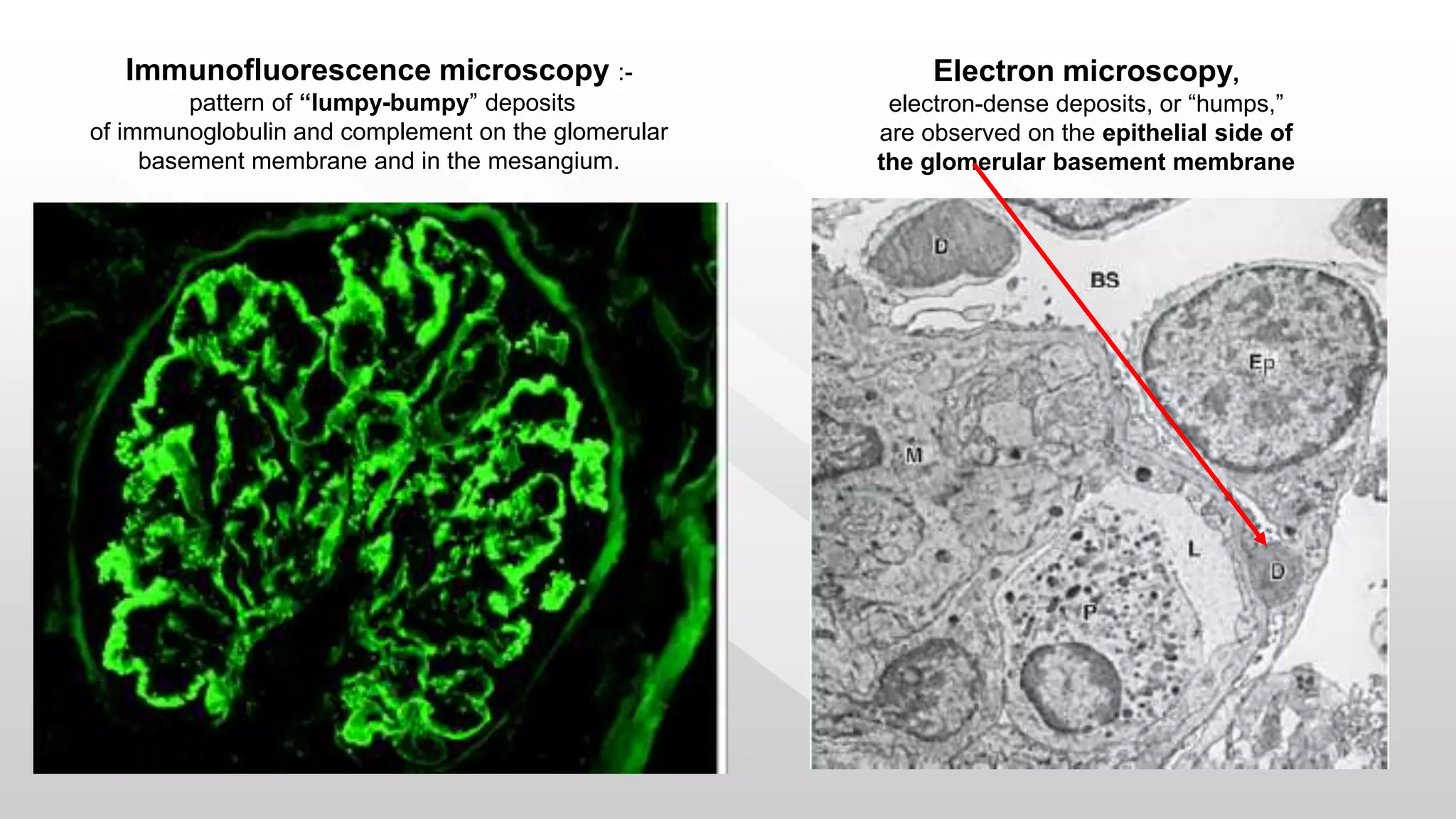
Electron microscopy,
electron-dense deposits, or “humps,”
are observed on the epithelial side of
the glomerular basement membrane
Immunofluorescence microscopy :-
pattern of “lumpy-bumpy” deposits
of immunoglobulin and complement on the glomerular
basement membrane and in the mesangium.
The Clinical Spectrum of Renal Disease
Disease
Category
(Most to Least
Severe)
Asymptomatic
(e.g. Thin basement
membrane disease)
(Least Severe)
Chronic progressive
glomerulopathy
(e.g. Diabetes
nephropathy)
Nephrotic
syndrome
(e.g. Minimal
change disease)
Nephritic
syndrome
(e.g. post-
infectious GN)
RPGN
(Most Severe)
Clinical Signs /
Symptoms
Microscopic
hematuria
Insidious
progressive loss of
renal function
Greater than
3.5 gm of
protein in 24 hr
urine
Hypertension,
RBC casts,
Hematuri,
Azotemia
Acute renal
failure +
nephritic
syndrome
AGN - Pathophysiology
Oliguria
1. Spasm of afferent arteriole (i blood flow)
2. Obliteration of lumen by mucosal edema & cellular
infiltration
3. Crescents causing obstruction
4. h absorption of Na and water from renal tubules
AGN - Pathophysiology
Hypertension
1. h absorption of Na and water from renal tubules
2. h sympathetic activity
3. h arterial spasm
4. h cardiac output
AGN - Pathophysiology
Oedema
1. Retention of Na and water from renal tubules
2. Circulation of unknown antigen causing peripheral
vasodilatation
AGN - Pathophysiology
Hematuria
Macroscopic = > 25000 RBC / ml
Microscopic =
• Presence of 5 or > RBC per mm3 fresh uncentrifuged midstream urine
• > 5 RBC per hpf in centrifuged specimen (of 10 ml, at 750 rpm for 5 min)
Post Streptococcal Glomerulonephritis
- Etiology
• Streptococcal serotypes involved
• Pharyngitis :
• Types 1, 3, 4, 12, 25, 49
• Pyoderma
• Types 2,47, 49, 55, 57, 60
• Streptococcal antigens involved in immune response :
• Zymogen precursor of exotoxin
• Glutaraldehyde phosphate dehydrogenase
Usually occurs 7-14 days after pharyngitis and 2 wks – 6 wks after skin infection
Post Streptococcal Glomerulonephritis
Age group
2 – 12 yrs (Rare before 2 yrs)
Sex
Male predominance
Socioeconomic group
Common in low socioeconomic group
Seasonal variation
During winter and rainy season serotype 12 causes
Ac. pharyngitis
During summer – serotype 49 causes skin infections
Post Streptococcal Glomerulonephritis
Pathogenesis
• Cross-reactivity of streptococcal pyogenic exotoxin (SPE)-B and other
M proteins with various components of the glomerular basement
membrane.
• Type III immunological reaction in which glomeruli are damaged due to
deposition of IgG antibody, antigen and complement C3.
• Rarely C1q and C4 may be involved
• Nephritis-Associated Plasmin Receptor (NAPlr) is involved
Post Streptococcal Glomerulonephritis
Clinical Features
• Puffiness of face – more in the mornings
• Edema feet
• Oliguria ( < 400 ml / m2)
• Hematuria (cola coloured urine)
• Breathlessness due to hypertensive heart failure
• Fever
• Hypertension
• Abdominal pain
• Atypical presentations:
• Hypertensive encephalopathy – confusion, convulsions, etc.
• Pulomonary edema – due to CHF
• Acute renal failure
Hypertension
Values Above;-
80 / 45 Preterm
90 / 60 Term Newborn
120 / 75 Up to 2 years
130 / 80 2 – 5 years
135 / 85 6 – 11 years
140 / 90 Older children
Post Streptococcal Glomerulonephritis
Diagnostic criteria of APSGN
At least 2 of the following criteria must be present
1. Positive throat or skin culture for streptococcus – Confirmatory or Carrier state
2. Streptococcal products like anti-streptokinase, anti-hyalironidase, anti-DNAse B,
ASO titre are elevated (Anti – DNAse B is the single most specific test for
Streptococcal infection)
3. Hypocomplementemia : Serum C3 reduced to 90% and CH50 decreased with in 2
weeks, but C4 is normal.
• The antistreptolysin O titre is commonly elevated after a pharyngeal infection but rarely increases after streptococcal skin
infections.
Post Streptococcal Glomerulonephritis
Investigations - For kidney injury :
Urine analysis
• Proteinuria – non selective; 1+ or 2+ protein with red cells
• Hematuria :
- Macroscopic: Plenty of RBC & RBC casts in urine
- Microscopic: > 5 RBC / HPF in 10 ml centrifuged urine
• Hypocomplementemia
Kidney function Tests
• Blood urea
• S. creatinine (h due to i GFR)
Red Cell Cast in urine
Diagnosis of Glomerulonephritis
Low C3 complement Normal C3 complement
• Systemic Diseases
• SLE
• Infective endocarditis
• Shunt nephritis
• Cryoglobulinemia
• Isolated Renal Diseases
• Postinfectious nephritis
• Membranoproliferative GN
• Systemic Diseases
• Polyarteritis nodosa
• Wageners’ granulomatosis
• Henoch-Schonlein purpura
• Goodpasture’s syndrome
• Isolated Renal Diseases
• IgA nephropathy
• RPGN
• Antineutrophil cytoplasmic
antibody (ANCA) immune
complex disease
Post Streptococcal Glomerulonephritis
Course
• Renal Failure – less than 1 % in children, slightly higher in adults
• Resolution usually quick,
• plasma Cr usually returns to previous levels by 3-4 weeks
• Hematuria resolves usually within 3-6 months,
• Proteinuria falls at a slower rate
• Some patients experience htn, recurrent proteinuria, and renal insufficiency 10-
40 yrs after
• > 20% of adults may have some degree of persistent proteinuria and or
compromise of GFR for 1 year
Post Streptococcal Glomerulonephritis
Complications
1. Hypertensive encephalopathy
Failure of autoregulatory system of the vessels of brain due to acute rise of
blood pressure
• Altered sensorium, convulsions, etc,
2. Hypertensive heart failure
3. Hypocalcemia
4. Hyperphosphatemia
5. Hyperkalemia
6. Acute renal failure
Post Streptococcal Glomerulonephritis
Management
1. Diet / fluids
2. Diuretics
3. Treatment of Hypertension
4. Infections control
5. Management of Lt ventricular failure
01
02
03
04
05
Diuretics Infections
control
Diet / fluids
Tt of
Hypertension
Management of
Complications
Post Streptococcal Glomerulonephritis
Management
Diet / Fluids
• Intake of sodium, potassium and fluids is restricted until blood
levels of creatinine reduce and urine output increases
• Overhydration may increase the risk of hypertension and
precipitate left ventricular failure.
• Monitor fluid Input and Output. Restriction of fluid intake to an
amount equal to insensible losses and 24 hr urine output.
• Daily weight monitoring
01
Diuretics: Treatment of Edema
• For milder edema: Oral frusemide at a dose of 1-3 mg/kg;
• For pulmonary edema: IV frusemide (2-4 mg/kg)
The edema disappears with the return of renal function
02
Treatment of Hypertension
• Mild cases – Managed with salt & water restriction.
• Drugs used:
• Atenelol, hydralazine, nifedipine,
Risk of hyperkalemia with ACE inhibitors and beta blocker
03
Infections control
If active pharyngitis or pyoderma is present
Drug of choice: Penicillin 4 – 8 Lakhs PPF for 10 days
• Treatment with penicillin has no effect on the course of the disease
04
Management of complications:
• Left ventricular failure
• Hypertensive encephalopathy
• Acute renal failure
• Acidosis
• Hyperkalemia
• Hyperphosphatemia
• Hypocalcemia
• Seizures
05
Management of Hypertensive Crisis / Encephalopathy
1. Intravenous Sodium Nitroprusside [Arterial & venous vasodilator]
Dose : 0.3 µg / kg / min (max 10 µg / kg / min)
2. Propranalol: [b 1 selective blocker]
Dose: 1-3 mg / kg / dose q 12 h
3. Esmolol: [b 1 selective blocker]
Dose: 130 – 300 µg / kg / min
4. Nifidepine: (Calcium channel blocker)
Dose : 0.5 mg / kg Sublingual repeated after 30 min
5. Amlodepine:(Calcium channel blocker)
Dose : 0.1 to 0.6 mg / kg / d in 2-3 doses – Oral
6. Labetelol: [Combined b -adrenergic (b1 & b2) and a-adrenergic blocker] Dose : 0.2-1.0
mg/kg can be given as an IV bolus every 10 min; Dosages of 0.25 - 3 mg / kg / hr by IV infusion..
7. Hydralazine: [Direct arterial vasodilator with no effect on venous circulation]
Dose : 0.1 - 0.2 mg / kg every 2 hrs (max 10 µg / kg / min)
Indications
for Renal
Biopsy
1
Features of systemic illness: features.
o Fever, rash, joint pain, heart disease
2 Severe renal failure requiring dialysis
3 Mixed features of glomerulonephritis & nephrotic syndrome
4 Absence of serologic evidence of streptococcal infection;
5 Normal levels of C3 in the acute stage of illness
6 Severe Hypertension
7 Unresolving Acute GN:-
 Massive proteinuria persisting > 4 wks
 Abnormal renal function (azotemia) - past 2 wks
 hematuria past 3 wks
 Urinary sedimentation abnormality persists >18 mo.
Post Streptococcal Glomerulonephritis
Prognosis
• Complete recovery in 95% cases
• Complement returns to normal within 3 wks
• Microscopic hematuria persists for 1-2 wks
• Hypertension returns to normal in 2-3 wks
• 1-5 % Mortality
• 1 – 5 % develop into Chronic GN, Chronic Renal Failure
Membranoproliferative Glomerulonephritis
(Mesangiocapillary Glomerulonephritis)
• Type-1:
• Caused by immune complex formation and deposition
• Of the classical pathway of complement consumption
• Type 2:
• Dense Deposit Disease, Mesangiocapillary GN
• Associated with the uncontrolled systemic activation of the alternative pathway (AP) of
the complement cascade
• Type 3:
• Candidate gene on Chromosome 1
• Immune complex deposits were observed under both glomerular endothelial cells and
epithelial cells
Than
Q
- Dr. C.S.N.Vittal

Acute glomerulonephritis for UGs

  • 1.
  • 2.
    Definition • An acuteinflammation of renal glomerular parenchyma due to deposition of immune complexes characterized by sudden onset of  oliguria,  hematuria,  hypertension and  edema
  • 3.
    Incidence • 2 to4 % of pediatric admissions in India • 90 % of renal disease of childhood
  • 4.
    Etiology • Streptococcal infection •Non streptococcal • Bacterial : Infective endocarditis, shunt nephritis, typhoid, syphilis, S.pneumoniae, meningococcal • Viral : HBV, mumps, varicella, ECHO, coxsackie, measles, infective mononucleosis • Autoimmune • Goodpastuer’s syndrome, HSP, SLE, IgA nephropathy • Miscellaneous • GBS, DPT vaccination, Irradiation to Wilms tumor
  • 5.
    Pathology • Gross: - Bothkidneys enlarged - Ischemic • Microscopy: - Glomeruli enlarged, infiltrated by polymorphs - Epithelial crescents • Immunofluorescence: - Lumpy-bumpy deposits of IgG, antigen and C3 • Electron microscopy: - Mesangial proliferation and mesangial matrix deposition - Lumps of immune complex depositions on the epithelial side of GBM
  • 7.
    Electron microscopy, electron-dense deposits,or “humps,” are observed on the epithelial side of the glomerular basement membrane Immunofluorescence microscopy :- pattern of “lumpy-bumpy” deposits of immunoglobulin and complement on the glomerular basement membrane and in the mesangium.
  • 8.
    The Clinical Spectrumof Renal Disease Disease Category (Most to Least Severe) Asymptomatic (e.g. Thin basement membrane disease) (Least Severe) Chronic progressive glomerulopathy (e.g. Diabetes nephropathy) Nephrotic syndrome (e.g. Minimal change disease) Nephritic syndrome (e.g. post- infectious GN) RPGN (Most Severe) Clinical Signs / Symptoms Microscopic hematuria Insidious progressive loss of renal function Greater than 3.5 gm of protein in 24 hr urine Hypertension, RBC casts, Hematuri, Azotemia Acute renal failure + nephritic syndrome
  • 9.
    AGN - Pathophysiology Oliguria 1.Spasm of afferent arteriole (i blood flow) 2. Obliteration of lumen by mucosal edema & cellular infiltration 3. Crescents causing obstruction 4. h absorption of Na and water from renal tubules
  • 10.
    AGN - Pathophysiology Hypertension 1.h absorption of Na and water from renal tubules 2. h sympathetic activity 3. h arterial spasm 4. h cardiac output
  • 11.
    AGN - Pathophysiology Oedema 1.Retention of Na and water from renal tubules 2. Circulation of unknown antigen causing peripheral vasodilatation
  • 12.
    AGN - Pathophysiology Hematuria Macroscopic= > 25000 RBC / ml Microscopic = • Presence of 5 or > RBC per mm3 fresh uncentrifuged midstream urine • > 5 RBC per hpf in centrifuged specimen (of 10 ml, at 750 rpm for 5 min)
  • 13.
    Post Streptococcal Glomerulonephritis -Etiology • Streptococcal serotypes involved • Pharyngitis : • Types 1, 3, 4, 12, 25, 49 • Pyoderma • Types 2,47, 49, 55, 57, 60 • Streptococcal antigens involved in immune response : • Zymogen precursor of exotoxin • Glutaraldehyde phosphate dehydrogenase Usually occurs 7-14 days after pharyngitis and 2 wks – 6 wks after skin infection
  • 14.
    Post Streptococcal Glomerulonephritis Agegroup 2 – 12 yrs (Rare before 2 yrs) Sex Male predominance Socioeconomic group Common in low socioeconomic group Seasonal variation During winter and rainy season serotype 12 causes Ac. pharyngitis During summer – serotype 49 causes skin infections
  • 15.
    Post Streptococcal Glomerulonephritis Pathogenesis •Cross-reactivity of streptococcal pyogenic exotoxin (SPE)-B and other M proteins with various components of the glomerular basement membrane. • Type III immunological reaction in which glomeruli are damaged due to deposition of IgG antibody, antigen and complement C3. • Rarely C1q and C4 may be involved • Nephritis-Associated Plasmin Receptor (NAPlr) is involved
  • 16.
    Post Streptococcal Glomerulonephritis ClinicalFeatures • Puffiness of face – more in the mornings • Edema feet • Oliguria ( < 400 ml / m2) • Hematuria (cola coloured urine) • Breathlessness due to hypertensive heart failure • Fever • Hypertension • Abdominal pain • Atypical presentations: • Hypertensive encephalopathy – confusion, convulsions, etc. • Pulomonary edema – due to CHF • Acute renal failure
  • 17.
    Hypertension Values Above;- 80 /45 Preterm 90 / 60 Term Newborn 120 / 75 Up to 2 years 130 / 80 2 – 5 years 135 / 85 6 – 11 years 140 / 90 Older children
  • 18.
    Post Streptococcal Glomerulonephritis Diagnosticcriteria of APSGN At least 2 of the following criteria must be present 1. Positive throat or skin culture for streptococcus – Confirmatory or Carrier state 2. Streptococcal products like anti-streptokinase, anti-hyalironidase, anti-DNAse B, ASO titre are elevated (Anti – DNAse B is the single most specific test for Streptococcal infection) 3. Hypocomplementemia : Serum C3 reduced to 90% and CH50 decreased with in 2 weeks, but C4 is normal. • The antistreptolysin O titre is commonly elevated after a pharyngeal infection but rarely increases after streptococcal skin infections.
  • 19.
    Post Streptococcal Glomerulonephritis Investigations- For kidney injury : Urine analysis • Proteinuria – non selective; 1+ or 2+ protein with red cells • Hematuria : - Macroscopic: Plenty of RBC & RBC casts in urine - Microscopic: > 5 RBC / HPF in 10 ml centrifuged urine • Hypocomplementemia Kidney function Tests • Blood urea • S. creatinine (h due to i GFR)
  • 20.
    Red Cell Castin urine
  • 21.
    Diagnosis of Glomerulonephritis LowC3 complement Normal C3 complement • Systemic Diseases • SLE • Infective endocarditis • Shunt nephritis • Cryoglobulinemia • Isolated Renal Diseases • Postinfectious nephritis • Membranoproliferative GN • Systemic Diseases • Polyarteritis nodosa • Wageners’ granulomatosis • Henoch-Schonlein purpura • Goodpasture’s syndrome • Isolated Renal Diseases • IgA nephropathy • RPGN • Antineutrophil cytoplasmic antibody (ANCA) immune complex disease
  • 22.
    Post Streptococcal Glomerulonephritis Course •Renal Failure – less than 1 % in children, slightly higher in adults • Resolution usually quick, • plasma Cr usually returns to previous levels by 3-4 weeks • Hematuria resolves usually within 3-6 months, • Proteinuria falls at a slower rate • Some patients experience htn, recurrent proteinuria, and renal insufficiency 10- 40 yrs after • > 20% of adults may have some degree of persistent proteinuria and or compromise of GFR for 1 year
  • 23.
    Post Streptococcal Glomerulonephritis Complications 1.Hypertensive encephalopathy Failure of autoregulatory system of the vessels of brain due to acute rise of blood pressure • Altered sensorium, convulsions, etc, 2. Hypertensive heart failure 3. Hypocalcemia 4. Hyperphosphatemia 5. Hyperkalemia 6. Acute renal failure
  • 24.
    Post Streptococcal Glomerulonephritis Management 1.Diet / fluids 2. Diuretics 3. Treatment of Hypertension 4. Infections control 5. Management of Lt ventricular failure
  • 25.
    01 02 03 04 05 Diuretics Infections control Diet /fluids Tt of Hypertension Management of Complications Post Streptococcal Glomerulonephritis Management
  • 26.
    Diet / Fluids •Intake of sodium, potassium and fluids is restricted until blood levels of creatinine reduce and urine output increases • Overhydration may increase the risk of hypertension and precipitate left ventricular failure. • Monitor fluid Input and Output. Restriction of fluid intake to an amount equal to insensible losses and 24 hr urine output. • Daily weight monitoring 01
  • 27.
    Diuretics: Treatment ofEdema • For milder edema: Oral frusemide at a dose of 1-3 mg/kg; • For pulmonary edema: IV frusemide (2-4 mg/kg) The edema disappears with the return of renal function 02
  • 28.
    Treatment of Hypertension •Mild cases – Managed with salt & water restriction. • Drugs used: • Atenelol, hydralazine, nifedipine, Risk of hyperkalemia with ACE inhibitors and beta blocker 03
  • 29.
    Infections control If activepharyngitis or pyoderma is present Drug of choice: Penicillin 4 – 8 Lakhs PPF for 10 days • Treatment with penicillin has no effect on the course of the disease 04
  • 30.
    Management of complications: •Left ventricular failure • Hypertensive encephalopathy • Acute renal failure • Acidosis • Hyperkalemia • Hyperphosphatemia • Hypocalcemia • Seizures 05
  • 31.
    Management of HypertensiveCrisis / Encephalopathy 1. Intravenous Sodium Nitroprusside [Arterial & venous vasodilator] Dose : 0.3 µg / kg / min (max 10 µg / kg / min) 2. Propranalol: [b 1 selective blocker] Dose: 1-3 mg / kg / dose q 12 h 3. Esmolol: [b 1 selective blocker] Dose: 130 – 300 µg / kg / min 4. Nifidepine: (Calcium channel blocker) Dose : 0.5 mg / kg Sublingual repeated after 30 min 5. Amlodepine:(Calcium channel blocker) Dose : 0.1 to 0.6 mg / kg / d in 2-3 doses – Oral 6. Labetelol: [Combined b -adrenergic (b1 & b2) and a-adrenergic blocker] Dose : 0.2-1.0 mg/kg can be given as an IV bolus every 10 min; Dosages of 0.25 - 3 mg / kg / hr by IV infusion.. 7. Hydralazine: [Direct arterial vasodilator with no effect on venous circulation] Dose : 0.1 - 0.2 mg / kg every 2 hrs (max 10 µg / kg / min)
  • 32.
    Indications for Renal Biopsy 1 Features ofsystemic illness: features. o Fever, rash, joint pain, heart disease 2 Severe renal failure requiring dialysis 3 Mixed features of glomerulonephritis & nephrotic syndrome 4 Absence of serologic evidence of streptococcal infection; 5 Normal levels of C3 in the acute stage of illness 6 Severe Hypertension 7 Unresolving Acute GN:-  Massive proteinuria persisting > 4 wks  Abnormal renal function (azotemia) - past 2 wks  hematuria past 3 wks  Urinary sedimentation abnormality persists >18 mo.
  • 33.
    Post Streptococcal Glomerulonephritis Prognosis •Complete recovery in 95% cases • Complement returns to normal within 3 wks • Microscopic hematuria persists for 1-2 wks • Hypertension returns to normal in 2-3 wks • 1-5 % Mortality • 1 – 5 % develop into Chronic GN, Chronic Renal Failure
  • 34.
    Membranoproliferative Glomerulonephritis (Mesangiocapillary Glomerulonephritis) •Type-1: • Caused by immune complex formation and deposition • Of the classical pathway of complement consumption • Type 2: • Dense Deposit Disease, Mesangiocapillary GN • Associated with the uncontrolled systemic activation of the alternative pathway (AP) of the complement cascade • Type 3: • Candidate gene on Chromosome 1 • Immune complex deposits were observed under both glomerular endothelial cells and epithelial cells
  • 35.