ANTI TUBERCULAR DRUGS
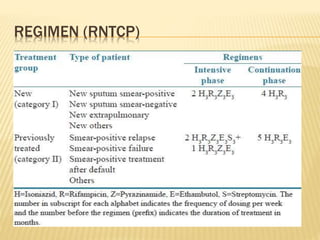
REGIMEN (RNTCP)
 Categories of tuberculosis and their treatment regimens
have been recommended by WHO.
 bone tuberculosis is classified to be a severe form of
extrapulmonary tuberculosis and hence should be given
Category I treatment (2HRZE & 4HR i.e. 2 months of
H,R,Z and E followed by 4 months of H and R).
 two phases: an initial ‘Intensive phase’, consisting of
four to five drugs to rapidly destroy the majority of the
organisms
 a ‘continuation phase’ which consists of two to three
drugs.
 Historically, the recommended duration was - 18 to 24-no scientific
basis
 Even today there is lack of consensus regarding the ideal duration of
treatment for bone TB.
 Uncertainty about the penetration of osteoarticular lesions by the
available drugs and the fear of early or late recurrence forced the
surgeons to continue chemotherapy for prolonged periods.
 Modern anti-tuberculous drugs have been shown to penetrate
osseous tissue in amounts much higher than the minimal inhibitory
concentrations.
 Wallace Fox for the first time proved that addition of R or Z to
regimens containing H made it possible to shorten the duration of
treatment
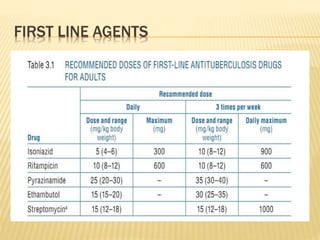
FIRST LINE AGENTS
ISONIAZID (INH)
 Isoniazid is the most active drug for the
treatment of tuberculosis caused by
susceptible strains
 structural similarity to pyridoxine.
 MOA: Isoniazid inhibits synthesis of mycolic
acids, which are essential components of
mycobacterial cell walls.
.
 orally administered, well absorbed, widely
distributed in body, including cerebrospinal
fluid.
 INH can also penetrate into macrophages.
 Most INH is metabolized in the liver.
PHARMACOLOGIC ACTIVITY
 bactericidal - actively growing tubercle bacilli.
bacteriostatic -resting tubercle bacilli.
 Isoniazid is able to penetrate into phagocytic
cells and thus is active again both extracellular
and intracellular organisms.
 DOSE: ADULTS: PO/IM 5 mg/kg/day as single
daily dose (max 300 mg/day). INFANTS &
CHILDREN: PO/IM 10 to 20 mg/kg/day in
single daily dose (max 300 mg/day).
ADVERSE EFFECTS
 Allergic Reaction: fever,skin rash
 Hepatotoxicity : Up to 20% of patients taking INH
develop elevated serum amino transferase levels.
 Severe hepatic injury occurs more frequently in
patients over the age of 35, especially in those
who are alcoholic.
 Isoniazid is discontinued if symptoms of hepatitis
develop or if the aminotransferase activity
increases to more than three times normal.
 Peripheral and CNS toxicity - toxicity results
from an increased excretion of pyridoxine
induced by isoniazid, which produces a
pyridoxine deficiency.
 Peripheral neuritis, urinary retention, insomnia,
and psychotic episodes can occur.
 Concurrent pyridoxine 25–50 mg/d
administration with INH prevents most of these
complications.
 Isoniazid as a single agent is also indicated for
treatment of latent tuberculosis. The dosage is
300 mg/d (5 mg/kg/d) or 900 mg twice weekly
for 9 months.
RIFAMPIN
 Synthetic derivates of rifamycin B produced by
Sterptomyces mediterranei
 oral administration, well absorbed, widely
distributed in body.
 most of the drug is excreted as a deacylated
metabolite in feces and in the urine.
 half-life is about 4 hours.
PHARMACOLOGY
 It is bactericidal for mycobacteria.
 It can kill organisms that are poorly accessible to
many other drugs, such as intracellular organisms
and those sequestered in abscesses.
 MOA: It binds strongly to the β-subunit of DNA-
dependent RNA polymerase and thereby inhibits
RNA synthesis.
 Drug-resistance is due to target mutations in RNA
polymerase, occurs readily.
 No cross-resistance to other classes of
antimicrobial drugs.
ADVERSE EFFECTS
 Urine, sweat, tears, and contact lenses may take
on an orange color because of rifampin
administration, this effect is harmless.
 Light-chain proteinuria and impaired antibody
response may occur.
 Rifampin induces hepatic microsomal enzymes
and therefore, affects the half-life of a number of
drugs.
 When taken erratically in large doses, a febrile
“flu-like” syndrome can occur.
DOSE
 Rifampin, usually 600 mg/d (10 mg/kg/d)
orally, must be administered with isoniazid or
other antituberculous drugs to patients with
active tuberculosis to prevent emergence of
drug-resistant mycobacteria.
ETHAMBUTOL
 bacteriostatic
 Well absorbed from the gut and widely
distributed in all body tissues and fluids.
 resistance to ethambutol emerges rapidly
when the drug is used alone.
 The most common serious adverse effect is
dose-related optic neuritis, causing loss of
visual acuity and red-green color-blindness, but
are reversible.
 Ethambutol hydrochloride, 15–25 mg/kg, is
usually given as a single daily dose
 50 mg/kg when a twice-weekly dosing
schedule
PYRAZINAMIDE
 Pyrazinamide is a pyrazine analogue of
nicotinamide.
 pH 5.5 it inhibits tubercle bacilli and some
other mycobacteria.
 Quickly absorbed after oral administration
 Widely distributed in body tissues,including
inflamed meninges.
 Excreted mainly by glomerular filtration
ADVERSE EFFECTS
 Major adverse effects of pyrazinamide include
hepatotoxicity (in 1–5% of patients)
 nausea, vomiting, drug fever, and
hyperuricemia.
 Hyperuricemia may provoke acute gouty
arthritis.
DOSE: 40–50 mg/kg is used for thrice-weekly or
twice-weekly treatment regimens
STREPTOMYCIN
 Streptomycin - first antimicrobial drug used to
treat tuberculosis.
 It is effective against most tubercle bacilli, but
its activity is weaker than that of INH and RFP.
 Streptomycin penetrates cells poorly-produce
drug resistance.
 It is always given together with other drugs to
prevent emergence of resistance.
 The typical adult dose is 1 g/d (15 mg/kg/d). If
the creatinine clearance is less than 30
mL/min or the patient is on hemodialysis, the
dose is 15 mg/kg two or three times a week
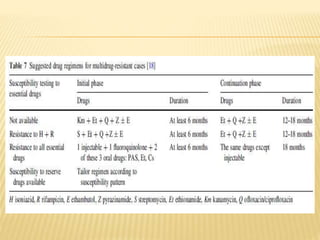
MDR TB
 Multi-drug-resistant tuberculosis (MDR-TB) is
defined as tuberculosis that is resistant to at
least isoniazid (INH) and rifampicin.
 multidrug-resistant tuberculosis can be cured
with long treatments of second-line drugs, but
these are more expensive than first-line drugs
and have more adverse effects.
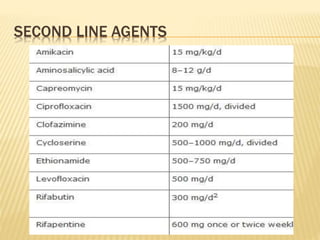
SECOND LINE AGENTS
WHEN CAN IT BE USED
 (1) in case of resistance to first-line agents;
 (2) in case of failure of clinical response to
conventional therapy;
 (3) in case of serious treatment-limiting
adverse drug reactions;
 (4) when expert guidance is available to deal
with the toxic effects
ETHIONAMIDE
 Ethionamide is chemically related to isoniazid
 blocks the synthesis of mycolic acids.
 It is poorly water-soluble and available only in
oral form.
 It is metabolized by the liver
 Ethionamide is administered at an initial dose
of 250 mg once daily, which is increased in
250-mg increments to the recommended
dosage of 1 g/d (or 15 mg/kg/d), if possible.
ADVERSE EFFECTS
 intense gastric irritation , neurologic symptoms
 Ethionamide is also hepatotoxic.
 Neurologic symptoms may be alleviated by
pyridoxine.
 Resistance to ethionamide as a single agent
develops rapidly in vitro and in vivo.
 low-level cross-resistance between isoniazid
and ethionamide.
CAPREOMYCIN
 peptide protein synthesis inhibitor, antibiotic
obtained from Streptomyces capreolus.
 Daily injection of 1 g intramuscularly
 Capreomycin (15 mg/kg/d) is an important
injectable agent for treatment of drug-resistant
tuberculosis.
 Strains of M tuberculosis resistant to
streptomycin or amikacin (eg, the multidrug-
resistant W strain) are susceptible to
capreomycin.
 Resistance to capreomycin, may be due to an rrs
mutation.
 nephrotoxic and ototoxic.
 Tinnitus, deafness, and vestibular disturbances
occur.
 The injection causes significant local pain, and
sterile abscesses may occur.
 Toxicity is reduced if 1 g is given two or three
times weekly after an initial response has been
achieved with a daily dosing schedule
CYCLOSERINE
 Cycloserine is an inhibitor of cell wall synthesis.
 Cycloserine is cleared renally, and the dose
should be reduced by half if creatinine
clearance is less than 50 mL/min.
 ADVERSE:peripheral neuropathy and central
nervous system dysfunction, depression and
psychotic reactions
 Pyridoxine 150 mg/d should be given with
cycloserine to ameliorates neurologic toxicity.
Adverse effects - most common during the first 2
weeks of therapy, occur at higher doses.
 Side effects can be minimized by monitoring peak
serum concentrations.
 The peak concentration is reached 2–4 hours
after dosing. The recommended range of peak
concentrations is 20–40 mcg/mL
 Contraindications- Epilepsy; depression; severe
anxiety or psychosis; severe renal insufficiency;
excessive concurrent use of alcohol.
 Route/Dosage
ADULTS: PO 250–500 mg q 12 hr; start with 250
mg q 12 hr for first 2 wk (maximum 1 g/day).
CHILDREN: PO 10–20 mg/kg/day administered
in 2 equally divided doses (maximum 1 g/day).
AMINOSALICYLIC ACID (PAS)
 Competitively antagonizes metabolism of para-
aminobenzoic acid, resulting in bacteriostatic
activity against Mycobacterium tuberculosis.
 Adverse:Peptic ulceration and hemorrhage may
occur. Hypersensitivity reactions may occur
after 3–8 weeks of aminosalicylic acid therapy.
 Infrequently used now since better tolerated
drugs are available
 ADULTS: PO 12 to 16 g/day in 2 to 3 divided
doses. CHILDREN: PO 275 to 420 mg/kg/day
in 3 to 4 divided doses.
 Contraindications; Severe hypersensitivity to
aminosalicylate sodium and its congeners
KANAMYCIN & AMIKACIN
 Aminoglycoside antibiotics
 Kanamycin has been used for treatment of TB
caused by streptomycin-resistant strains, but
the availability of less toxic alternatives (eg,
capreomycin and amikacin) has rendered it
obsolete
 Most MDR strains are amikacin sensitive
 Amikacin is also active against atypical
mycobacteria
 no cross-resistance between streptomycin and
amikacin, but kanamycin resistance often indicates
resistance to amikacin as well.
 Serum concentrations of 30–50 mcg/mL are achieved
30–60 minutes after a 15 mg/kg intravenous infusion.
 indication- treatment of tuberculosis suspected or
known to be caused by streptomycin-resistant or
multidrug-resistant strains.
 Amikacin must be used in combination .
 The recommended dosages are the same as that for
streptomycin.
FLUOROQUINOLONES
 ciprofloxacin, levofloxacin, gatifloxacin, and
moxifloxacin inhibit strains of M tuberculosis
 Moxifloxacin is the most active against M
tuberculosis by weight
 the drug must be used in combination with two or
more other active agents-to prevent resistance
 standard dosage of ciprofloxacin is 750 mg orally
twice a day, levofloxacin is 500–750 mg once a
day, moxifloxacin is 400 mg once a day.
LINEZOLID
 Prevents the formation of a functional 70S
initiation complex, which is essential to the
bacterial translation process.
 It achieves good intracellular concentrations.
 Linezolid has been used in combination with
other second- and third-line drugs to treat
patients with tuberculosis caused by multidrug-
resistant strains
 adverse effects; bone marrow suppression and
irreversible peripheral and optic neuropathy,
have been reported with the prolonged courses
 600-mg (adult) dose administered once a day
 it should be considered a drug of last resort for
infection caused by multidrug-resistant strains.
RIFABUTIN
 Inhibits DNA-dependent RNA polymerase in
susceptible strains of bacteria.
 Its activity is similar to that of rifampin, and
cross-resistance with rifampin is virtually
complete.
 Rifabutin is both substrate and inducer of
cytochrome P450 enzymes.
 it is a less potent inducer, rifabutin is indicated
in place of rifampin for treatment of
tuberculosis in HIV-infected patients who are
receiving concurrent antiretroviral therapy with
a protease inhibitor or NNRTI (eg, efavirenz)
 DOSE;
ADULTS: PO 300 mg once daily. INFANTS AND
CHILDREN: PO Up to 5 mg/kg/day.
RIFAPENTINE
 Rifapentine is an analog of rifampin
 it is a bacterial RNA polymerase inhibitor.
 potent inducer of CYT P450
 600 mg (10 mg/kg) once weekly is indicated for
treatment of tuberculosis caused by rifampin-
susceptible strains during the continuation phase
only .
 Rifapentine should not be used to treat HIV-
infected patients because of an unacceptably high
relapse rate with rifampin-resistant organism.
XDR TB
 XDR-TB is defined as TB that has developed
resistance to at least rifampicin and isoniazid ,
as well as to any member of
the quinolone family and at least one of the
following second-line anti-TB injectable
drugs: kanamycin, capreomycin, or amikacin
TB AND HIV CO-INFECTION
 3–5 % of patients with pulmonary TB develops
musculoskeletal lesions but the incidence of
musculoskeletal lesions increases to 60 % in
patients who are HIV positive.
 Direct observational therapy is even more
important for HIV-positive tuberculosis patients
and is known to significantly decrease mortality
in these patients
 addition of rifampicin to the drug regimens in
HIV patients significantly reduces mortality ,
 protease inhibitors and NNRTI interact with
rifampicin and therefore should not be
prescribed along with rifampicin.
 PARADOXICAL WORSENING- when antiretroviral
therapy is started in a patient being treated
with tb, there is rapid worsening of symptoms-
improvement in inflamatory response
 anti-retroviral is known to activate latent
tuberculosis in HIV-positive patients which is
supposed to be due to the immune
reconstitution syndrome

Anti tubercular drugs

  • 1.
  • 2.
  • 3.
     Categories oftuberculosis and their treatment regimens have been recommended by WHO.  bone tuberculosis is classified to be a severe form of extrapulmonary tuberculosis and hence should be given Category I treatment (2HRZE & 4HR i.e. 2 months of H,R,Z and E followed by 4 months of H and R).  two phases: an initial ‘Intensive phase’, consisting of four to five drugs to rapidly destroy the majority of the organisms  a ‘continuation phase’ which consists of two to three drugs.
  • 4.
     Historically, therecommended duration was - 18 to 24-no scientific basis  Even today there is lack of consensus regarding the ideal duration of treatment for bone TB.  Uncertainty about the penetration of osteoarticular lesions by the available drugs and the fear of early or late recurrence forced the surgeons to continue chemotherapy for prolonged periods.  Modern anti-tuberculous drugs have been shown to penetrate osseous tissue in amounts much higher than the minimal inhibitory concentrations.  Wallace Fox for the first time proved that addition of R or Z to regimens containing H made it possible to shorten the duration of treatment
  • 5.
  • 6.
    ISONIAZID (INH)  Isoniazidis the most active drug for the treatment of tuberculosis caused by susceptible strains  structural similarity to pyridoxine.  MOA: Isoniazid inhibits synthesis of mycolic acids, which are essential components of mycobacterial cell walls. .
  • 7.
     orally administered,well absorbed, widely distributed in body, including cerebrospinal fluid.  INH can also penetrate into macrophages.  Most INH is metabolized in the liver.
  • 8.
    PHARMACOLOGIC ACTIVITY  bactericidal- actively growing tubercle bacilli. bacteriostatic -resting tubercle bacilli.  Isoniazid is able to penetrate into phagocytic cells and thus is active again both extracellular and intracellular organisms.  DOSE: ADULTS: PO/IM 5 mg/kg/day as single daily dose (max 300 mg/day). INFANTS & CHILDREN: PO/IM 10 to 20 mg/kg/day in single daily dose (max 300 mg/day).
  • 9.
    ADVERSE EFFECTS  AllergicReaction: fever,skin rash  Hepatotoxicity : Up to 20% of patients taking INH develop elevated serum amino transferase levels.  Severe hepatic injury occurs more frequently in patients over the age of 35, especially in those who are alcoholic.  Isoniazid is discontinued if symptoms of hepatitis develop or if the aminotransferase activity increases to more than three times normal.
  • 10.
     Peripheral andCNS toxicity - toxicity results from an increased excretion of pyridoxine induced by isoniazid, which produces a pyridoxine deficiency.  Peripheral neuritis, urinary retention, insomnia, and psychotic episodes can occur.  Concurrent pyridoxine 25–50 mg/d administration with INH prevents most of these complications.
  • 11.
     Isoniazid asa single agent is also indicated for treatment of latent tuberculosis. The dosage is 300 mg/d (5 mg/kg/d) or 900 mg twice weekly for 9 months.
  • 12.
    RIFAMPIN  Synthetic derivatesof rifamycin B produced by Sterptomyces mediterranei  oral administration, well absorbed, widely distributed in body.  most of the drug is excreted as a deacylated metabolite in feces and in the urine.  half-life is about 4 hours.
  • 13.
    PHARMACOLOGY  It isbactericidal for mycobacteria.  It can kill organisms that are poorly accessible to many other drugs, such as intracellular organisms and those sequestered in abscesses.  MOA: It binds strongly to the β-subunit of DNA- dependent RNA polymerase and thereby inhibits RNA synthesis.  Drug-resistance is due to target mutations in RNA polymerase, occurs readily.  No cross-resistance to other classes of antimicrobial drugs.
  • 14.
    ADVERSE EFFECTS  Urine,sweat, tears, and contact lenses may take on an orange color because of rifampin administration, this effect is harmless.  Light-chain proteinuria and impaired antibody response may occur.  Rifampin induces hepatic microsomal enzymes and therefore, affects the half-life of a number of drugs.  When taken erratically in large doses, a febrile “flu-like” syndrome can occur.
  • 15.
    DOSE  Rifampin, usually600 mg/d (10 mg/kg/d) orally, must be administered with isoniazid or other antituberculous drugs to patients with active tuberculosis to prevent emergence of drug-resistant mycobacteria.
  • 16.
    ETHAMBUTOL  bacteriostatic  Wellabsorbed from the gut and widely distributed in all body tissues and fluids.  resistance to ethambutol emerges rapidly when the drug is used alone.  The most common serious adverse effect is dose-related optic neuritis, causing loss of visual acuity and red-green color-blindness, but are reversible.
  • 17.
     Ethambutol hydrochloride,15–25 mg/kg, is usually given as a single daily dose  50 mg/kg when a twice-weekly dosing schedule
  • 18.
    PYRAZINAMIDE  Pyrazinamide isa pyrazine analogue of nicotinamide.  pH 5.5 it inhibits tubercle bacilli and some other mycobacteria.  Quickly absorbed after oral administration  Widely distributed in body tissues,including inflamed meninges.  Excreted mainly by glomerular filtration
  • 19.
    ADVERSE EFFECTS  Majoradverse effects of pyrazinamide include hepatotoxicity (in 1–5% of patients)  nausea, vomiting, drug fever, and hyperuricemia.  Hyperuricemia may provoke acute gouty arthritis. DOSE: 40–50 mg/kg is used for thrice-weekly or twice-weekly treatment regimens
  • 20.
    STREPTOMYCIN  Streptomycin -first antimicrobial drug used to treat tuberculosis.  It is effective against most tubercle bacilli, but its activity is weaker than that of INH and RFP.  Streptomycin penetrates cells poorly-produce drug resistance.  It is always given together with other drugs to prevent emergence of resistance.
  • 21.
     The typicaladult dose is 1 g/d (15 mg/kg/d). If the creatinine clearance is less than 30 mL/min or the patient is on hemodialysis, the dose is 15 mg/kg two or three times a week
  • 22.
    MDR TB  Multi-drug-resistanttuberculosis (MDR-TB) is defined as tuberculosis that is resistant to at least isoniazid (INH) and rifampicin.  multidrug-resistant tuberculosis can be cured with long treatments of second-line drugs, but these are more expensive than first-line drugs and have more adverse effects.
  • 24.
  • 25.
    WHEN CAN ITBE USED  (1) in case of resistance to first-line agents;  (2) in case of failure of clinical response to conventional therapy;  (3) in case of serious treatment-limiting adverse drug reactions;  (4) when expert guidance is available to deal with the toxic effects
  • 26.
    ETHIONAMIDE  Ethionamide ischemically related to isoniazid  blocks the synthesis of mycolic acids.  It is poorly water-soluble and available only in oral form.  It is metabolized by the liver  Ethionamide is administered at an initial dose of 250 mg once daily, which is increased in 250-mg increments to the recommended dosage of 1 g/d (or 15 mg/kg/d), if possible.
  • 27.
    ADVERSE EFFECTS  intensegastric irritation , neurologic symptoms  Ethionamide is also hepatotoxic.  Neurologic symptoms may be alleviated by pyridoxine.  Resistance to ethionamide as a single agent develops rapidly in vitro and in vivo.  low-level cross-resistance between isoniazid and ethionamide.
  • 28.
    CAPREOMYCIN  peptide proteinsynthesis inhibitor, antibiotic obtained from Streptomyces capreolus.  Daily injection of 1 g intramuscularly  Capreomycin (15 mg/kg/d) is an important injectable agent for treatment of drug-resistant tuberculosis.  Strains of M tuberculosis resistant to streptomycin or amikacin (eg, the multidrug- resistant W strain) are susceptible to capreomycin.  Resistance to capreomycin, may be due to an rrs mutation.
  • 29.
     nephrotoxic andototoxic.  Tinnitus, deafness, and vestibular disturbances occur.  The injection causes significant local pain, and sterile abscesses may occur.  Toxicity is reduced if 1 g is given two or three times weekly after an initial response has been achieved with a daily dosing schedule
  • 30.
    CYCLOSERINE  Cycloserine isan inhibitor of cell wall synthesis.  Cycloserine is cleared renally, and the dose should be reduced by half if creatinine clearance is less than 50 mL/min.  ADVERSE:peripheral neuropathy and central nervous system dysfunction, depression and psychotic reactions
  • 31.
     Pyridoxine 150mg/d should be given with cycloserine to ameliorates neurologic toxicity. Adverse effects - most common during the first 2 weeks of therapy, occur at higher doses.  Side effects can be minimized by monitoring peak serum concentrations.  The peak concentration is reached 2–4 hours after dosing. The recommended range of peak concentrations is 20–40 mcg/mL
  • 32.
     Contraindications- Epilepsy;depression; severe anxiety or psychosis; severe renal insufficiency; excessive concurrent use of alcohol.  Route/Dosage ADULTS: PO 250–500 mg q 12 hr; start with 250 mg q 12 hr for first 2 wk (maximum 1 g/day). CHILDREN: PO 10–20 mg/kg/day administered in 2 equally divided doses (maximum 1 g/day).
  • 33.
    AMINOSALICYLIC ACID (PAS) Competitively antagonizes metabolism of para- aminobenzoic acid, resulting in bacteriostatic activity against Mycobacterium tuberculosis.  Adverse:Peptic ulceration and hemorrhage may occur. Hypersensitivity reactions may occur after 3–8 weeks of aminosalicylic acid therapy.
  • 34.
     Infrequently usednow since better tolerated drugs are available  ADULTS: PO 12 to 16 g/day in 2 to 3 divided doses. CHILDREN: PO 275 to 420 mg/kg/day in 3 to 4 divided doses.  Contraindications; Severe hypersensitivity to aminosalicylate sodium and its congeners
  • 35.
    KANAMYCIN & AMIKACIN Aminoglycoside antibiotics  Kanamycin has been used for treatment of TB caused by streptomycin-resistant strains, but the availability of less toxic alternatives (eg, capreomycin and amikacin) has rendered it obsolete  Most MDR strains are amikacin sensitive  Amikacin is also active against atypical mycobacteria
  • 36.
     no cross-resistancebetween streptomycin and amikacin, but kanamycin resistance often indicates resistance to amikacin as well.  Serum concentrations of 30–50 mcg/mL are achieved 30–60 minutes after a 15 mg/kg intravenous infusion.  indication- treatment of tuberculosis suspected or known to be caused by streptomycin-resistant or multidrug-resistant strains.  Amikacin must be used in combination .  The recommended dosages are the same as that for streptomycin.
  • 37.
    FLUOROQUINOLONES  ciprofloxacin, levofloxacin,gatifloxacin, and moxifloxacin inhibit strains of M tuberculosis  Moxifloxacin is the most active against M tuberculosis by weight  the drug must be used in combination with two or more other active agents-to prevent resistance  standard dosage of ciprofloxacin is 750 mg orally twice a day, levofloxacin is 500–750 mg once a day, moxifloxacin is 400 mg once a day.
  • 38.
    LINEZOLID  Prevents theformation of a functional 70S initiation complex, which is essential to the bacterial translation process.  It achieves good intracellular concentrations.  Linezolid has been used in combination with other second- and third-line drugs to treat patients with tuberculosis caused by multidrug- resistant strains
  • 39.
     adverse effects;bone marrow suppression and irreversible peripheral and optic neuropathy, have been reported with the prolonged courses  600-mg (adult) dose administered once a day  it should be considered a drug of last resort for infection caused by multidrug-resistant strains.
  • 40.
    RIFABUTIN  Inhibits DNA-dependentRNA polymerase in susceptible strains of bacteria.  Its activity is similar to that of rifampin, and cross-resistance with rifampin is virtually complete.  Rifabutin is both substrate and inducer of cytochrome P450 enzymes.
  • 41.
     it isa less potent inducer, rifabutin is indicated in place of rifampin for treatment of tuberculosis in HIV-infected patients who are receiving concurrent antiretroviral therapy with a protease inhibitor or NNRTI (eg, efavirenz)  DOSE; ADULTS: PO 300 mg once daily. INFANTS AND CHILDREN: PO Up to 5 mg/kg/day.
  • 42.
    RIFAPENTINE  Rifapentine isan analog of rifampin  it is a bacterial RNA polymerase inhibitor.  potent inducer of CYT P450  600 mg (10 mg/kg) once weekly is indicated for treatment of tuberculosis caused by rifampin- susceptible strains during the continuation phase only .  Rifapentine should not be used to treat HIV- infected patients because of an unacceptably high relapse rate with rifampin-resistant organism.
  • 43.
    XDR TB  XDR-TBis defined as TB that has developed resistance to at least rifampicin and isoniazid , as well as to any member of the quinolone family and at least one of the following second-line anti-TB injectable drugs: kanamycin, capreomycin, or amikacin
  • 44.
    TB AND HIVCO-INFECTION  3–5 % of patients with pulmonary TB develops musculoskeletal lesions but the incidence of musculoskeletal lesions increases to 60 % in patients who are HIV positive.  Direct observational therapy is even more important for HIV-positive tuberculosis patients and is known to significantly decrease mortality in these patients
  • 45.
     addition ofrifampicin to the drug regimens in HIV patients significantly reduces mortality ,  protease inhibitors and NNRTI interact with rifampicin and therefore should not be prescribed along with rifampicin.  PARADOXICAL WORSENING- when antiretroviral therapy is started in a patient being treated with tb, there is rapid worsening of symptoms- improvement in inflamatory response
  • 46.
     anti-retroviral isknown to activate latent tuberculosis in HIV-positive patients which is supposed to be due to the immune reconstitution syndrome